Research in Plant Disease pISSN 1598-2262, eISSN 2233-9191 www.online-rpd.org
The Korean Society of Plant Pathology
This is an open access article distributed under the terms of the Creative Commons Attribution Non-Commercial License (http://creativecommons.org/licenses/
by-nc/4.0/), which permits unrestricted non-commercial use, distribution, and reproduction in any medium, provided the original work is properly cited.
진딧물 전반 딸기 바이러스 발생조사 및 딸기모틀바이러스의 계통분석
Incidence of Aphid-Transmitted Strawberry Viruses in Korea and Phylogenetic Analysis of Korean Isolates of Strawberry Mottle Virus권선정* · 윤정범 · 조인숙 · 윤주연 · 권태룡 농촌진흥청 국립원예특작과학원 원예특작환경과
Sun-Jung Kwon* , Jung-Beom Yoon, In-Sook Cho, Ju-Yeon Yoon, and Tae-Ryong Kwon
Horticultural and Herbal Crop Environment Division, National Institute of Horticultural and Herbal Science, RDA, Wanju 55365, Korea
Among more than 30 viruses infecting strawberry, aphid-transmitted viruses including Strawberry mild yellow edge virus (SMYEV), Strawberry mottle virus (SMoV), Strawberry crinkle virus (SCV), and Strawberry vein banding virus (SVBV) have been considered as the most economically important viruses of straw- berry in the world. To determine the incidence of these four viruses in major Korean strawberry cultivars, field surveys were conducted in major production areas during 2018–2019. In our surveys, SMYEV and SMoV were detected with low infection rates of 0.7% and 1.3%, respectively, whereas SCV and SVBV were not detected. No obvious symptoms were observed in the strawberry plants infected by SMYEV or SMoV. Since no sequences of SMoV Korean isolates have been reported, we initially determined nucleo- tide sequence of the 3' untranslated region (UTR) of seven SMoV isolates obtained during the surveys.
The 3' UTR sequences (782 nt) of seven Korean isolates were phylogenetically compared with those of the previously reported SMoV isolates. Phylogenetic analysis revealed that most Korean isolates are closely related to Canadian isolates and only little evolutionary differentiation occurred among the Kore- ans isolates. This might be due to the low incidence of SMoV in strawberry in Korea.
Keywords: Aphid-transmitted strawberry virus, Incidence, Phylogenetic analysis, Strawberry mottle virus
딸기(Fragaria spp.)는 장미과에 속하는 다년생 식물로 전 세 계적으로 20여 종(species)과 수많은 교배종(hybrids) 및 품종 (cultivars)이 존재한다. 재배종 딸기인 Fragaria × ananassa 는 F. virginiana (북아메리카 유래)와 F. chiloensis (남아메리 카 유래)의 교배종으로 1750년대 유럽에서 유래되어 지금까 지 전 세계적으로 가장 많이 재배되고 있으며 딸기 육종의 기
본형으로 이용되고 있다(Martin과 Tzanetakis, 2006; Staudt, 1962). 국내에 딸기(F. × ananassa)가 도입된 것은 1900년대 초기로 2000년대 초반까지 주로 일본 품종이 재배되었으나 1990년 후반 이후 국내 육성 품종 개발이 활발히 이루어져 현재 국산 딸기 품종의 보급률은 93% 이상을 차지하고 있다.
딸기는 영양번식에 의해 다년생으로 재배되므로 바이러스 에 감염될 경우 바이러스가 축적되어 생육 및 수량에 영향을 받을 수 있다. 딸기에 발생한다고 보고된 바이러스는 약 30여 종이며 그 중 Strawberry mild yellow edge virus (SMYEV, ge- nus Potexvirus), Strawberry mottle virus (SMoV, family Seco-
*Corresponding author Tel: +82-63-238-6323 Fax: +82-63-238-6305 E-mail: [email protected] ORCID
https://orcid.org/0000-0002-7127-3634
Received November 2, 2019 Revised November 27, 2019 Accepted November 27, 2019
viridae, genus not assigned), Strawberry crinkle virus (SCV, genus Cytorhabdovirus), Strawberry vein banding virus (SVBV, genus Caulimovirus)가 경제적으로 가장 중요한 바 이러스로 알려져 있다(Fránová, 2001; Martin과 Tzanetakis, 2006; Mellor와 Krczal, 1987; Spiegel과 Martin, 1998). 이들 바이러스는 모두 진딧물에 의해 전반되는 바이러스로 딸기 품종 및 바이러스 계통(strain)에 따라 병원성에 차이가 있지 만 F. vesca (야생딸기)나 F. virginiana와 같은 감수성 품종의 경우 과실의 향을 떨어뜨리고 색 발현이 잘 되지 않으며 런너 (runner) 생산을 저하시킨다고 보고되고 있다(Frazier, 1974;
Freeman과 Mellor, 1962; Horn과 Carver, 1962). 한편, 재배 딸기(F. × ananassa)의 육성품종 대부분은 바이러스에 내성 (tolerant)이 있다고 알려져 있어 단일감염에서는 병징을 동반 하지 않거나 피해가 약하지만 2종 이상의 바이러스가 복합감 염이 될 경우 딸기 수량을 급격히 저하시키고 퇴화를 유도한 다(Spiegel과 Martin, 1998). 이러한 이유로 딸기 재배 시 바 이러스를 매개하는 진딧물 방제는 매우 중요하다. 딸기 바이 러스를 전반하는 대표적인 진딧물은 Chaetosiphon fragaefo- lii로 SMYEV, SCV, SVBV는 Chaetosiphon spp.에 의해서만 전 반되는 반면, SMoV의 경우 Chaetosiphon spp.와 Aphis gos- sypii (목화진딧물)에 의해 전반된다(Krczal, 1982; Martin과 Tzanetakis, 2006). 국내의 경우 2007–2008년에 딸기 바이러스 병 조사가 이루어진 바 있으나(Choi 등, 2009), 국내 육성 품종 이 널리 보급된 이후 딸기 포장에서 바이러스병 조사가 이루어 진 바 없어 본 연구에서 딸기에 가장 문제가 되는 진딧물 전반
딸기 바이러스 4종(SMYEV, SMoV, SCV, SVBV)을 대상으로 딸기 주요 재배지역(진주, 논산, 고성, 함양, 순창, 평창, 강릉)과 국내 육성 주요 재배 품종(매향, 설향, 금실, 싼타, 무하, 장하, 고하, 죽 향)을 대상으로 바이러스병 발생 여부를 조사하였다.
국내 육성 딸기 품종의 진딧물 전반 딸기 바이러스 발생조사.
4종의 진딧물 전반 딸기 바이러스를 진단하기 위해 먼저 각 바 이러스의 특이 프라이머를 제작하였다. 정확한 진단을 위해 GenBank database를 이용하여 각 바이러스의 다양한 분리주 (isolate)의 염기서열을 비교하여 가장 보존이 잘 되어있는 각 바이러스별 유전자 염기서열을 바탕으로 프라이머를 제작하였 다(Table 1). 2018년–2019년까지 딸기 재배 농가 및 원묘장에서 이상 증상을 보이는 잎 시료와 무병징 시료를 무작위로 채집하 여 총 918점(매향 322점, 설향 183점, 금실 169점, 싼타 42점, 무 하88점, 장하 51점, 기타[고하, 죽향] 63점)에 대해 기존 방법과 동일하게 핵산을 추출하고 유전자 진단을 실시하였다(Kwon 등, 2018). 진단 결과 채집 지역에 따른 유의성은 없었으며 SMYEV가 매향, 설향, 금실에서 각각 0.9%, 0.5%, 0.6%, SMoV가 매향, 설향, 금실, 싼타에서 각각 0.3%, 1.0%, 1.1%, 2.4%의 발생 률로 검출되었고 SCV와 SVBV는 어떤 품종에서도 검출되지 않 았다(Table 2). 한편, 바이러스가 검출된 시료에서 뚜렷한 바이 러스 증상은 발견되지 않았고 한 시료에서 2종이 함께 검출된 복합감염 시료는 없었다(data not shown). 국내 육성 딸기에서 SMYEV에 대한 특성 및 국내 분리주의 유전자 분석은 최근에 보고된 반면(Cho 등, 2011; Kwon 등, 2018), SMoV에 대한 국내 Table 1. List of primers used to detect four aphid-transmitted strawberry viruses
Virus Primer Sequence (5’→3’) Reference or GenBank database Gene Size (bp)
SMYEV CF ACAATCGCCCTGGTCAGTAATTCC Kwon et al. (2018) CP 729
CR TGGAGCTGGGTAGAAGAAGTGAGA
SMoV 3UF CGACAGTTCTCTATGTAGGACACC AJ311875a, AJ311876b, KU177218a, KU177219b KU200454b, KU200457b, KU200459b, KU200461b
3' UTR 782 3UR CATCTATCTAAAGTTAAGTCTACA
SCV RdF ATATCCGGATTTGAGAACA AY250986, AY331389, AY331386, AY331390, AY331385, AY331387, AY331388
RdRp 527
RdR CCTTAACATTGGTGGCAGAC
SVBV CF AGAGAAAGACTCGAACAATG HE681085, KT250632, MH894295, X97304, KR080547, KP311681, KX950836, KX787430
CP 959
CR CCATATTGTGTTTCCGGTGA
SMYEV, Strawberry mild yellow edge virus; SMoV, Strawberry mottle virus; UTR, untranslated region; SCV, Strawberry crinkle virus; RdRp, RNA- dependent RNA polymerase; SVBV, Strawberry vein banding virus; CP, coat protein.
aFor RNA1.
bFor RNA2.
분리주에 유전적 분석은 다뤄진 바 없어 증폭산물에 대한 염기 서열 분석을 추가로 진행하였다.
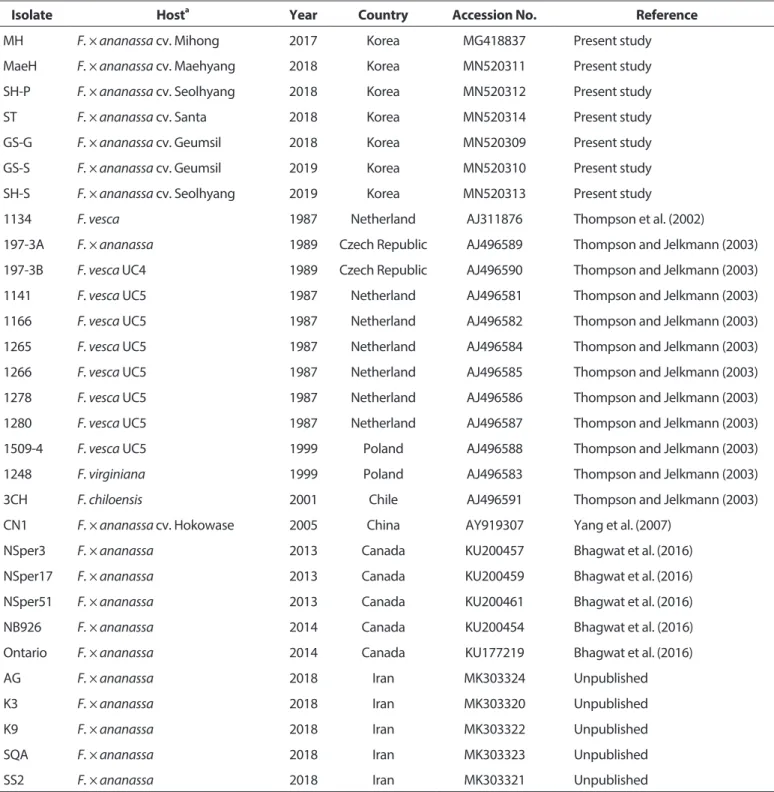
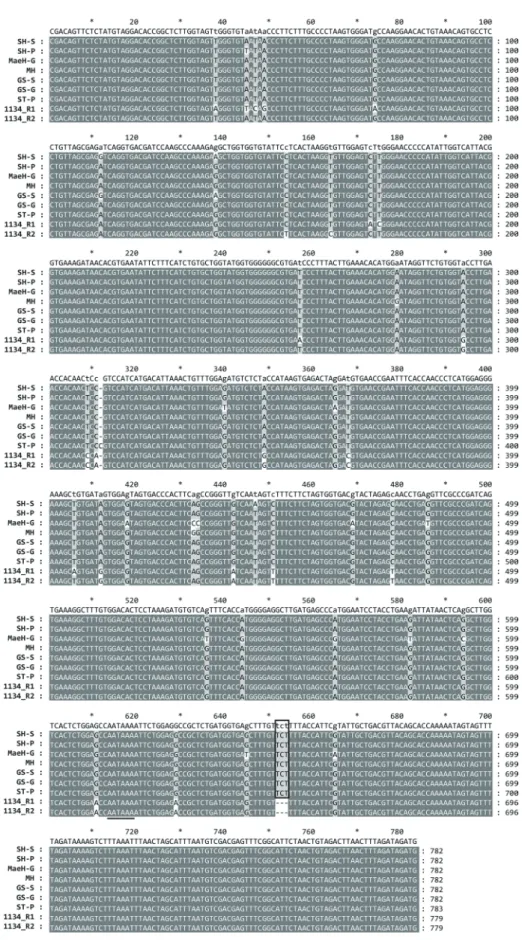
SMoV 국내 분리주의 3′ untranslated region (UTR) 염 기서열의 유전학적 특성 및 계통 분석. 매향, 설향, 금실, 싼 타에서 분리된 총 6개의 SMoV 3′ UTR 증폭산물은 Kwon 등 (2018)의 방법과 동일하게 염기서열을 분석하고 GenBank 에 등록하였다: MaeH (MN520311), SH-P (MN520312), SH-S (MN520313), GS-G (MN520309), GS-S (MN520310), ST (MN520314). 6개의 국내 분리주와 함께 SMoV 감염주로 확보 하고 있는 미홍 품종(MH)도 분석에 함께 포함시켰다(Table 3). 7개의 국내 분리주와 기존에 보고된 분리주 1134 RNA1 과 RNA2의 3′ UTR 782 nt 서열을 ClustalX 프로그램을 이용 해 비교 분석했다(Table 3). 그 결과, 7개의 국내 분리주 모두 공통적으로 분리주 1134에 비해 염기가 3개(TCT, at position 672–675) 더 많았으며 ST-P 분리주는 하나의 염기(C, at posi- tion 312)가 더 있는 것을 알 수 있었다. 분리주 1134의 RNA1 과 2의 비교에서 SMoV의 3′ UTR은 RNA1과 RNA2 간에 큰 차 이가 없는 것을 확인하였다. 한편, 3′ 말단에 poly A tail을 가 지는 바이러스의 특징인 polyadenylation signal (AATAAA motif)이 3′ 말단의 상단 174염기에 위치하는 것을 확인하였 다(Fig. 1). SMoV는 전세계적으로 딸기(Fragaria spp.)에서 다양한 분리주들이 보고되어 있는 반면(Bhagwat 등, 2016;
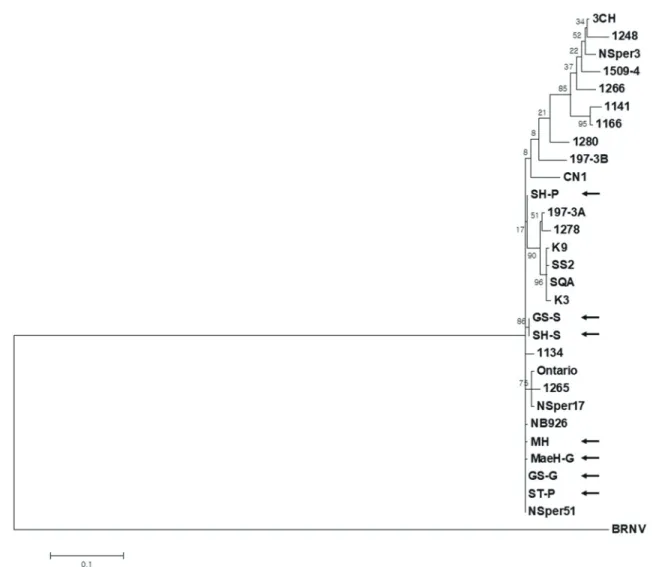
Thompson과 Jelkmann, 2003; Thompson 등, 2002; Yang 등, 2007) 국내 분리주에 대한 염기서열 등록은 본 연구를 통 해 처음 보고되었다. 국내 분리주의 분자계통학적 위치를 분 석하기 위해 GenBank에 등록된 다양한 SMoV 분리주(Table 3)의 3′ UTR 염기서열을 수집하여 maximum likelihood 분석 방식을 이용한 계통분석을 실시하였다. Phylogenetic tree 작 성 결과, 국내 분리주 대부분은 캐나다 분리주와 근연관계가
가장 가까운 반면 SH-P의 경우 유럽 및 이란 분리주와 근연관 계를 형성하는 것을 알 수 있었다. 또한 염기서열의 진화적 측 면에서 SMoV의 발생이 많은 유럽과 캐나다 분리주의 경우에 는 국내 분리주와 비교했을 때 염기서열진화의 분화가 더 많 이 진행된 것에 비해 국내 분리주는 모두 진화적으로 분화가 되지 않았음을 확인할 수 있었다(Fig. 2). 이러한 결과로 미루 어 볼 때 국내에서는 SMoV 발생이 많지 않아 바이러스의 변 이가 일어날 확률이 적고 감염된 모주로부터 영양번식에 의 해 검출되고 있는 것으로 추측된다.
국내 딸기 농가의 진딧물 발생 종 동정. 국내 딸기의 SMoV 감염과 진딧물 전염 관계를 파악하기 위해 국내 딸기 농가의 주 요 발생 진딧물 종을 동정하였다. 순창과 진주, 함양 딸기농가 에서 농가별로 20마리씩 진딧물을 채집하여 DNA barcoding 방법(Lee 등, 2011)에 따라 cytochrome c oxidase subunit I의 염기서열을 분석한 결과, 84%가 목화진딧물로 나타났고 16%
는 Aphis cf. rostella가 발생하는 것으로 조사되었다(data not shown). 주요 딸기진딧물로 알려진 Chaetosiphon spp.는 발견 되지 않았다. 딸기 재배 특성상 농가별로 정기적인 방제 처리로 인해 많은 수의 진딧물을 채집하기에는 제한이 있었다는 점을 감안하여도 국내에서 딸기 바이러스의 주요 진딧물(Chaetosi- phon spp.)은 크게 문제가 되지 않는 것으로 보여지지만 SMoV 의 경우 목화진딧물로도 전반이 되기 때문에 주의가 필요해 보 인다.
본 연구를 통해, 국내에서 재배되는 주요 딸기 품종의 진 딧물 전반 바이러스 감염률은 1% 내외(SMYEV, 0.7%; SMoV, 1.3%)로 조사되었고, 바이러스 감염에 따른 생육 저하나 뚜렷 한 병징은 관찰되지 않았다. SMoV 국내 분리주 7개에 대한 염 기서열 및 유전학적 계통분석을 통해 국내 SMoV 분리주는 진화적으로 분화가 많지 않음을 확인하였다. 진딧물 종 분석 Table 2. Incidence of four aphid-transmitted strawberry viruses in major Korean cultivars during 2018–2019
Virus Fragaria ananassa cv.
Maehyang Seolhyang Geumsil Santa Mooha Jangha Othersa
SMYEV 3/322 1/183 1/169 0/42 0/88 0/51 0/63
SMoV 1/322 2/183 2/169 1/42 0/88 0/51 0/63
SCV 0/322 0/183 0/169 0/42 0/88 0/51 0/63
SVBV 0/322 0/183 0/169 0/42 0/88 0/51 0/63
SMYEV, Strawberry mild yellow edge virus; SMoV, Strawberry mottle virus; SCV, Strawberry crinkle virus; SVBV, Strawberry vein banding virus.
aStrawberry cultivar Goha and Jukhyang.
결과 주요 딸기 진딧물(Chaetosiphon spp.)의 발생도 없는 것 으로 조사되어 진딧물 전반에 의한 감염보다는 영양번식에 의해 전반되어 발생되고 있을 확률이 높을 것으로 추측된다.
국내의 경우, 딸기 품종 육종에 있어서 바이러스 무병묘 생산 체계가 효율적으로 진행되고 있다고 여겨지며, 농가에 보급
후에도 재배관리가 잘 되고 있는 것으로 보여진다. 더 나아가 새로운 딸기 바이러스 및 매개충 종 유입에 대비하고 기존에 보고된 바이러스에 대해서는 딸기 품종별로 병원성 분석에 대한 연구가 더 진행되어야 할 것으로 생각된다.
Table 3. Information of SMoV isolates analyzed in this study
Isolate Hosta Year Country Accession No. Reference
MH F. × ananassa cv. Mihong 2017 Korea MG418837 Present study
MaeH F. × ananassa cv. Maehyang 2018 Korea MN520311 Present study
SH-P F. × ananassa cv. Seolhyang 2018 Korea MN520312 Present study
ST F. × ananassa cv. Santa 2018 Korea MN520314 Present study
GS-G F. × ananassa cv. Geumsil 2018 Korea MN520309 Present study
GS-S F. × ananassa cv. Geumsil 2019 Korea MN520310 Present study
SH-S F. × ananassa cv. Seolhyang 2019 Korea MN520313 Present study
1134 F. vesca 1987 Netherland AJ311876 Thompson et al. (2002)
197-3A F. × ananassa 1989 Czech Republic AJ496589 Thompson and Jelkmann (2003)
197-3B F. vesca UC4 1989 Czech Republic AJ496590 Thompson and Jelkmann (2003)
1141 F. vesca UC5 1987 Netherland AJ496581 Thompson and Jelkmann (2003)
1166 F. vesca UC5 1987 Netherland AJ496582 Thompson and Jelkmann (2003)
1265 F. vesca UC5 1987 Netherland AJ496584 Thompson and Jelkmann (2003)
1266 F. vesca UC5 1987 Netherland AJ496585 Thompson and Jelkmann (2003)
1278 F. vesca UC5 1987 Netherland AJ496586 Thompson and Jelkmann (2003)
1280 F. vesca UC5 1987 Netherland AJ496587 Thompson and Jelkmann (2003)
1509-4 F. vesca UC5 1999 Poland AJ496588 Thompson and Jelkmann (2003)
1248 F. virginiana 1999 Poland AJ496583 Thompson and Jelkmann (2003)
3CH F. chiloensis 2001 Chile AJ496591 Thompson and Jelkmann (2003)
CN1 F. × ananassa cv. Hokowase 2005 China AY919307 Yang et al. (2007)
NSper3 F. × ananassa 2013 Canada KU200457 Bhagwat et al. (2016)
NSper17 F. × ananassa 2013 Canada KU200459 Bhagwat et al. (2016)
NSper51 F. × ananassa 2013 Canada KU200461 Bhagwat et al. (2016)
NB926 F. × ananassa 2014 Canada KU200454 Bhagwat et al. (2016)
Ontario F. × ananassa 2014 Canada KU177219 Bhagwat et al. (2016)
AG F. × ananassa 2018 Iran MK303324 Unpublished
K3 F. × ananassa 2018 Iran MK303320 Unpublished
K9 F. × ananassa 2018 Iran MK303322 Unpublished
SQA F. × ananassa 2018 Iran MK303323 Unpublished
SS2 F. × ananassa 2018 Iran MK303321 Unpublished
aHost description: species or indicator plant (UC4, F. vesca and Fragaria virginiana bybrid; UC5, F. vesca, F. chiloensis, and F. virginiana hybrid).
Fig. 1. An alignment of nucleotide sequences of the 3′ untranslated region of 7 Korean isolates of Strawberry mottle virus and RNA1 and RNA2 of the isolate 1134. Sequences were aligned by ClustalX2. The consensus sequences are shown at the top. For each position, bases in a majority and bases in a minority are showed in the light gray background and white background, respectively. Extra bases only found in the Korean isolates are boxed. Polyadenylation signal (AATAAA motif at position 164–169), is underlined. Accession numbers of the isolates in Table 3.
요 약
딸기를 감염하는 30여 종의 바이러스 중 전 세계적으로 가 장 많이 발생하는 4종의 바이러스는 Strawberry mild yellow edge virus (SMYEV), Strawberry mottle virus (SMoV), Strawberry crinkle virus (SCV), Strawberry vein banding virus (SVBV)로 이들 은 모두 진딧물이 전반되며 경제적으로 가장 중요한 바이러스 들이다. 2018–2019년까지 국내 주요 딸기 생산지에서 국내 딸 기 품종을 대상으로 이들 4종 진딧물 전반 바이러스의 발생조 사를 실시하였다. 그 결과, 일부 국내 딸기 품종에서 SMYEV와 SMoV가 각각 0.7%와 1.3%의 낮은 감염률로 검출되었으며 SCV 와 SVBV는 전혀 검출되지 않았다. 한편, 바이러스 감염 식물에
서 병징은 관찰되지 않았다. 국내에서 SMoV에 대한 염기서열 은 보고된 바 없어 SMoV 국내분리주에 대한 3′ untranslated region의 염기서열을 결정하고 분석하였다. 기존에 보고된 SMoV 분리주들과의 분자계통학적 유연관계 분석 결과, 대부분 의 국내 분리주는 캐나다 분리주와 근연관계가 높은 것으로 나 타났으며 염기서열의 진화적 측면에서 분화가 거의 일어나지 않 은 분리주임을 확인하였다.
Conflicts of Interest
No potential conflict of interest relevant to this article was reported.
Fig. 2. Phylogenetic analysis of the 3′ untranslated region sequences of Strawberry mottle virus isolates. The tree was constructed by the maximum likelihood method using MEGA 7 program. Seven Korean isolates are marked with arrows. The numbers on the branch- es indicate bootstrap percentages based on 1,000 replications (only values >60% are shown). Description and accession numbers of the isolates are shown in Table 3. The Black raspberry necrosis virus (BRNV, GenBank accession No. NC008183) was included as an outgroup control.
Acknowledgments
This research was supported by a grant from the Agenda Program (PJ01186302) funded by Rural Development Admin- istration of Korea.
References
Bhagwat, B., Dickison, V., Su, L., Bernardy, M., Wiersma, P. A., Nie, X.
et al. 2016. Molecular characterization of divergent strawberry mild yellow edge virus isolates from Eastern Canada. J. Phyto- pathol. 164: 691-696.
Cho, J.-D., Choi, G.-S., Chung, B.-N., Kim, J.-S. and Choi, H.-S. 2011.
Strawberry mild yellow edge potexvirus from strawberry in Korea.
Plant Pathol. J. 27: 187-190.
Choi, G.-S., Lee, J.-A., Cho, J.-D., Chung, B.-N., Cho, I.-S. and Kim, J.-S.
2009. Strawberry virus diseases occurring in Korea, 2007-2008.
Res. Plant Dis. 15: 8-12. (In Korean)
Fránová, J. 2001. Occurrence of graft-transmissible virus diseases of the strawberry in the Czech Republic. Acta Virol. 45: 151-157.
Frazier, N. W. 1974. Six new strawberry indicator clones evaluated for the detection and diagnosis of twelve graft-transmissible diseases. Plant Dis. Rep. 58: 28-31.
Freeman, J. A. and Mellor, F. C. 1962. Influence of latent viruses on vigor, yield and quality of British Sovereign strawberries. Can. J.
Plant Sci. 42: 602-610.
Horn, N. L. and Carver, R. G. 1962. Effect of three viruses on plant production and yields of strawberries. Plant Dis. Rep. 46: 762- 765.
Krczal, H. 1982. Investigation on the biology of the strawberry aphid (Chaetosiphon fragaefolii), the most important vector of strawberry viruses in West Germany. Acta Hortic. 129: 63-68.
Kwon, S.-J., Cho, I.-S., Yoon, J.-Y. and Choi, G.-S. 2018. Genetic di- versity of two isolates in strawberry mild yellow edge virus from Korea. Res. Plant Dis. 24: 285-291. (In Korean)
Lee, W., Kim, H., Lim, J., Choi, H.-R., Kim, Y., Kim, Y.-S. et al. 2011. Bar- coding aphids (Hemiptera: Aphididae) of the Korean Peninsula:
updating the global data set. Mol. Ecol. Resour. 11: 32-37.
Martin, R. R. and Tzanetakis, I. E. 2006. Characterization and recent advances in detection of strawberry viruses. Plant Dis. 90: 384- 396.
Mellor, F. C. and Krczal, H. 1987. Strawberry mottle. In: Virus Disease of Small Fruits, Agricultural Handbook, No. 631, ed. by R. H.
Converse, pp. 10-16. United States Department of Agriculture, Agricultural Research Service, Washington, DC, USA.
Spiegel, S. and Martin, R. R. 1998. Virus and viruslike diseases. In:
Compendium of Strawberry Disease, ed. by J. L. Maas, pp. 62- 72. 2nd ed. American Phytopathological Society, St. Paul, MN, USA.
Staudt, G. 1962. Taxonomic studies in the genus Fragaria. Typifica- tion of Fragaria species known at the time of Linnaeus. Can. J.
Bot. 40: 869-886.
Thompson, J. R. and Jelkmann, W. 2003. The detection and varia- tion of Strawberry mottle virus. Plant Dis. 87: 385-390.
Thompson, J. R., Leone, G., Lindner, J. L., Jelkmann, W. and Schoen, C. D. 2002. Characterization and complete nucleotide sequence of Strawberry mottle virus: a tentative member of a new family of bipartite plant picorna-like viruses. J. Gen. Virol. 83: 229-239.
Yang, H., Zhang, Z., Dai, H. and Li, H. 2007. Detection of strawberry mottle virus by RT-PCR. Acta Hortic. 764: 127-136.