한국어병학회지 제23 권 제1 호(2010) J. Fish Pathol., 23(1):1 ~ 8 (2010)
1
국내 양식 무지개송어에서 분리한 IHNV glycoprotein의 유전자 분석
김형준�
국립수산물품질검사원 인천지원
Phylogenetic analysis of infectious hematopoietic necrosis virus (IHNV) isolated from cultured rainbow trout
Oncorhynchus mykiss in Korea
Hyoung Jun Kim�
Incheon Branch Office, National Fisheries Products Inspection Service, Hang-dong, Jung-gu, Incheon 400-800, Korea
Infectious hematopoietic necrosis virus (IHNV) is the causative agent of IHN, one of the most serious viral diseases of salmonid fish. In this study, glycoprotein (G) gene nucleotide sequence of isolated IHNV RtWanju09 from Jeollabuk-do province was analyzed to evaluate their genetic relatedness to worldwide isolates. As the result, it was revealed that IHNV RtWanju09 isolate belongs to JRt Shizuoka lineage with IHNV RtPy91 and RtJe00. The genetic diversity of G gene between RtWanju09 isolate and RtPy91 isolate from Gangwon-do province was 1.77% and maximum nucleotide diversity among the JRt Shizuoka lineage in Korea was 3.03% during the past 20 years, supporting that the continuous evolution has been occurred among JRt Shizuoka isolates. It was believed that IHNV RtWanju09 isolate has been introduced by the movement of contaminated eggs with IHNV from Gangwon-do to Jeollabuk-do by the reason that the eyed eggs in Jeollabuk-do province used to be obtained from Gangwon-do province. In this study, the domestic transfer of IHNV was firstly investigated by the transfer history of eggs and the phylogenetic analysis using IHNV glycoprotein gene sequence.
Key words: IHNV, Glycoprotein, Phylogenetic analysis, Rainbow trout, Korea
전염성 조혈기 괴사증 (Infectious Hematopoiet- ic necrosis; IHN)은 연어과 어류에서 나타나는 질병 중 가장 심각한 질병 중의 하나이다. 이 질 병은 어종, 어체 크기, 바이러스주, 환경 상태에 따라 양식장 내 어류에 80% 가까운 손실을 입 힌다 (Wolf, 1988; Bootland and Leong, 1999).
IHN virus (IHNV)는 Rhabdoviridae과 의
Novirhabdovirus 속에 속하며, 대략 11k
nucleotide의 negative-sense RNA genome과 5개 의 구조 단백질인 nucleocapsid protein (N), phos- phoprotein (P), matrix protein (M), glycoprotein
(G), polymerase (L) 및 non-virion protein (NV)으 로 구성되어 있다 (Kurath et al., 1985; Tordo et al., 2005). Nichol et al. (1995)은 IHNV의 G와 NV 유전자들의 계통학적 분석을 기초로 IHNV 분리주들과 지역적 기원이 상응되는 것에 대해 서 보고하였다. Garver et al. (2003)과 Kurath et al. (2003)은 북미의 북부 (upper, U), 중부 (mid- dle, M), 남부 (lower, L) 지역에서 분리한 바이러 스의 genogroup은 지역적으로 상응하는 3 그룹 이 있음을 보고하였다. 최근에는 유럽과 아시아 분리주들의 두 genogroup들이 추가로 보고되었
�Corresponding Author : Hyoung Jun Kim, Tel : 82-10-6403-1882 Fax: 82-32-881-6067, E-mail: [email protected]
1...
다 (Enzmann et al., 2005; Nishizawa et al., 2006;
Kim et al., 2007). 그래서 세계 각지의 IHNV 분 리주들은 지역에 따라 상응하는 5개 (북미의 U, M, L, 유럽, 아시아)의 genogroup으로 확인되었 다 (Nishizawa et al., 2006; Kim et al., 2007). 가장 최근에 Mochizuki et al. (2009)는 일본과 한국의 IHNV분리주 그룹(JRt)의 비교에서 JRt그룹에는 지리적으로 상응하는 2개의 계통 (Shizuoka and Nagano lineages)이 존재함을 보고하였다.
북미 북부지역의 풍토병이었던 IHN은 IHNV- 감염어 또는 오염된 난의 이동으로 유럽과 아시 아의 여러 국가에 확산되었다 (Kimura and Yoshimizu, 1991; Winton, 1991; Bootland and Leong, 1999). 아시아 국가 중에는 한국과 일본 이 발병국가인데, 일본에서는 1970년대 미국의 알래스카로부터 IHNV-오염란이 수입되었고, 그 후 일본 전역으로 IHNV가 확산되었다 (Kimura and Yoshimizu, 1991; Yoshimizu, 1996; Nishizawa et al., 2006). 확산된 바이러스는 일본의 무지개 송어 양식장 환경에서 빠르게 진화하였다 (Nishizawa et al., 2006). 한국의 경우 1990년대에 일본의 무지개송어 발안난을 수입하면서 일본 의 IHNV가 우리나라로 이동되었을 것으로 추 정하고 있다 (Kim et al., 2007). 일반적으로 IHNV의 높은 병원성은 치어기에만 치우쳐져 있었으나, 최근에 무지개송어 성어에서도 폐사 가 나타나 문제시되고 있다 (Kim et al., 2003;
Nishizawa et al., 2006). 이러한 병원성의 변화는 바이러스를 유전학적으로 분석한 결과, 바이러 스의 빠른 변이로 인해 병원성이 높아졌음이 제 기되었다 (Nishizawa et al., 2006; Mochizuki et al., 2009). 특히, 최근 Mochizuki et al. (2009)는 IHNV의 G유전자의 계통학적 분석으로 아시아 그룹인 JRt그룹 내에서 Shizuoka lineage와 Nagano lineage에서의 대표 IHNV 분리주들간의 병원성을 비교해 본 결과, Shizuoka lineage가 Nagano lineage보다 높은 병원성을 나타낸다고 보고하였다.
우리나라에서도 두 lineage에 각각 포함되어
있는 강원도 및 충청북도 분리주 (Shizuoka 계 통)와 경상북도 분리주 (Nagano 계통)가 이미 보 고된 바 (Kim et al., 2007)있으나, 이들 병원체의 국내 이동에 대해서는 전혀 보고된 바 없다. 본 연구는 전라북도에 소재한 무지개송어 양식장 에서 IHNV를 분리하였고, 분리된 IHNV의 G 단 백질 유전자를 분석하여 IHNV가 어디에서 이 동되었는지를 추정하였으며, 국내의 IHNV의 유 전자적 변이율에 대해서도 검토하였다.
재료 및 방법
바이러스
2009년 12월 전라북도에 소재한 무지개송어 양식장에서 양식하는 채란용 성어 암컷 5마리의 난 및 난액에서 바이러스 모니터링을 실시한 결 과 IHNV가 검출되었다. 분리된 바이러스는 Rtwanju09라 명명하였다. IHNV가 분리된 양식 장은 지하수를 사용한 유수식 양식장으로, 사육 한 무지개송어는 강원도의 종묘생산시설로부터 구입한 발안란으로 양식했던 것이다. 시료채취는 양식된 무지개송어 친어에서 복부를 압박하여 유출된 난을 멸균 50 mL Tube에 바로 받아 넣 고, 밀봉한 후 얼음팩을 넣은 아이스박스에 넣어 실험실로 운반하였다. 운반된 시료는 실험실의 클린 벤치 내에서 난과 난액으로 구분하여 1.5 mL micro-tube에 넣었다. 시료는 MEM으로 10배 희석하고 마쇄하였고, 6,000rpm, 4℃, 30분의 조 건으로 원심 분리하여 4℃ 냉장고에서 overnight 한 후 상층액을 세포 접종용으로 사용하였다.
세포는 epithelioma papillosum cyprinid (EPC)를 사용하였고, 10% fetal bovine serum (FBS; Gibco, USA), 100 IU/mL 페니실린 G와 100 ㎍/mL 스트 렙토마이신이 첨가된 MEM (Gibco, USA)배지와 함께 25 ㎠ T-Flask (Falcon, USA)에 15℃의 배양 기에서 배양했으며, 2주간 배양된 세포를 24 well plate (Corning, USA)에 1 ml/well씩 분주한 후, 15
℃ 배양기에서 overnight 배양하였다. 그 후, 준비 된 세포 접종액 100 ㎕를 세포에 접종하여 15℃
배양기에서 2주간 배양하면서 세포변성효과 (cytopathic effect; CPE)를 관찰하였다.
Polymerase chain reaction(PCR)과 염기서열 분석 CPE가 나타난 세포에서의 바이러스 게놈 RNA는 RNA 분리 키트 (Isogen, Nippon Gene, Japan)를 사용하여 RNA를 추출하였고, 그 추출 된 RNA는 역전사 반응 (Reverse transcription)을 위해 One Step RT-PCR Kit (Bioneer, Korea)를 사 용하여 cDNA를 합성하였다. PCR 반응은 합성 된 cDNA 2 ㎕, 1.25 U Ex Taq DNA polymerase (Takara, Japan), 0.2 mM dNTP, 1.5 mM MgCl2와 Nishizawa et al. (2006)에 의해 디자인 된 HG(- 31:-12)(5’- AGA ACG CAA CTC GCA GAG AC - 3’)와 HG (1602:1622)(5’- GTG GGG AGG AAG TGA AGA TTG - 3’)의 IHNV의 G gene open reading frame (ORF) 부분의 primer를 각각 1 μM씩 혼합하여 최종 volume이 20 ㎕가 되도 록 준비하였다. PCR조건은 thermal cycler (Bio- Rad, USA)를 사용하여 95℃에서 5분간 pre- denaturation시킨 후, 95℃ denaturation 1분, 60℃
annealing 1분, 72℃ extension 1분을 30cycle 반응 시킨 후 72℃에서 5분간 post-extension을 실시 하였다. 증폭된 산물은 1.0% agarose-TAE (40mM Tris-acetate, pH 8.0과 1mM EDTA) gel을 사용하여 전기영동하였다. 증폭된 PCR 산물은 PCR Purification Kit (Nucleogene, Korea)를 사용 하여 정제하였으며, 정제 후 T-easy vector (Promega, USA)에 클로닝하였다. 그 후 plasmid extraction kit (Bioneer, Korea)를 사용하여 plas- mid DNA를 분리하였고, 분리된 plasmid DNA는 ABI PRISM dye terminator sequencing chemistry (Applied Biosystems, USA)를 사용하여 sequenc- ing하였다. Sequencing에 사용된 primer는 T7, SP6 primer와 ID4 primer (5’-CTC TGG ACA AGC TCT CCA AGG-3’) (Miller et al., 1998)를 사용하였다.
바이러스 유전자 계통학적 분석
염기서열 data는 Bioedit program을 사용하여 결과를 분석하였고, clustal X (Thompson et al., 1994; 1997)를 사용하여 Genbank에 등록된 세계 의 IHNV G ORF full 유전자 49 분리주들과 함께 alignment하였다. 49개의 IHNV G gene sequence data의 Genbank 등록번호는 Kim et al. (2007)과 Mochizuki et al. (2009)의 논문에 기입된 것을 참 고하였다. Alignment된 유전자들은 Mega4 프로 그램 (Tamura et al., 2007)의 neighbor joining cri- teria를 사용하여 계통학적 분석을 실시하였으 며, Radial tree는 NJplot와 Unrooted (Perriere and Gouy, 1996) 소프트웨어를 사용하여 제작하였다.
결과 및 고찰
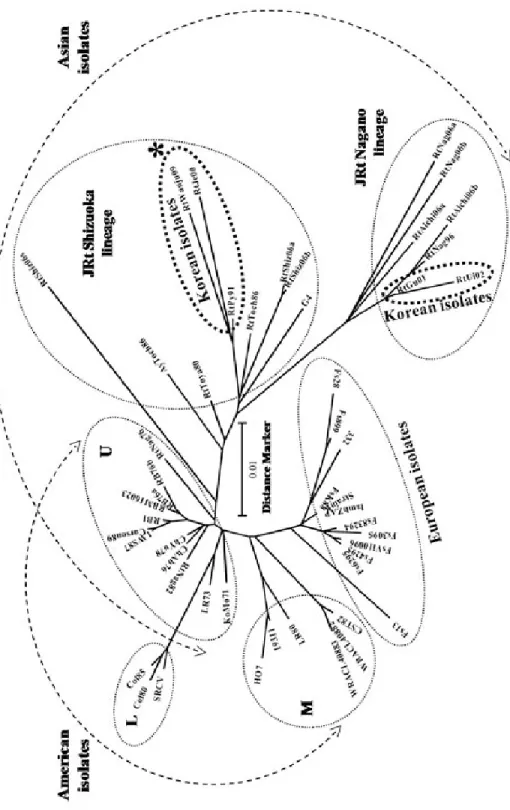
전라북도 소재의 양식장에서 양식된 무지개송 어 친어 5마리 중 1마리의 난과 난액에서 IHNV 가 분리되었다. IHNV HG primer set를 이용하여 PCR을 실시한 결과, 약 1.6kb의 PCR산물이 증 폭되었고, 증폭된 산물은 IHNV G 단백질의 508 아미노산이 코딩된 1.527 base의 단일 ORF가 포 함되어 있음이 확인되었다 (data not shown, Gen- bank accession number; HM021723). IHNV ORF Full 길이 G 유전자 염기서열을 기초로 한 방사 상의 계통학적 분석 tree는 Fig. 1에 나타냈다. 이 전의 연구자들이 보고한 바와 같이, 세계에서 분 리된 IHNV는 5개의 지역적 기원에 상응하는 genogroup들이 존재하는 것으로 확인하였고, 5 개의 genogroup들 중 3개는 북미의 U, M, L이 고, 4번째 genogroup은 genogroup M의 소스인 유럽의 분리주, 그리고 5번째 genogroup은 genogroup U의 소스로 표시된 아시아 분리주인 JRt 그룹으로 이 중 아시아 그룹인 Genogroup JRt는 1980년대 이후에서 2006년까지의 일본 IHNV들은 두 계통 JRt Shizuoka와 JRt Nagano 로 나타났다 (Garver et al., 2003; Kurath et al., 2003; Enzmann et al., 2005; Nizhizawa et al., 2006;
Fig. 1. Molecular phylogenetic tree showing the genetic relationships among 50 isolates of infectious hematopoietic necrosis virus (IHNV) based on nucleotide sequences of the glycoprotein gene open reading frame (ORF). Bootstrap values for 1000 replicates are shown at major nodes in the tree. The distance marker refers to the expected number of substitutions per site.
Kim et al., 2007; Mochizuki et al., 2009). JRt Shizuoka 계통은 일본 분리주 RtShiz06S, RtShiz06a, RtShiz06b, AyToch86, RtToch86, RtToya80, G4와 한국의 두 분리주, RtPy91과 RtJe00으로 구성된 반면, JRt Nagano 계통은 일 본의 RtNag96, RtNag06a, RtNag06b, RtAichi06a, RtAichi06b와 한국의 두 분리주 RtGu01과 RtUi02가 포함되었다. 일본 분리주의 두 계통 (JRt Shizuoka, JRt Nagano)은 지리적으로 Shizuoka와 Nagano 양식장 사이에 후지산을 경 계로 양쪽의 수계가 달라서 무지개송어의 자연 적 이동은 전혀 있을 수 없으며, 실제로 양식장 과 양식장 사이에서 무지개송어의 이동이 없었 다고 한다 (Nishizawa et al., 2006). 또한 한국에 서의 두 계통 (JRt Shizuoka, JRt Nagano)도 지리 적으로 JRt Shizuoka에 강원도 평창의 RtPy91과 충청북도 제천의 RtJe00이 속하였으며, JRt Nagano는 경상북도 구미의 RtGu01과 경상북도 의성의 RtUi02가 속하여 두 계통 사이에 소백산 맥의 경계로 인해 무지개송어의 자연적인 이동 은 전혀 있을 수 없다 (Kim et al., 2007). RtWan- ju09가 분리된 전라북도 지역도 소백산맥을 경
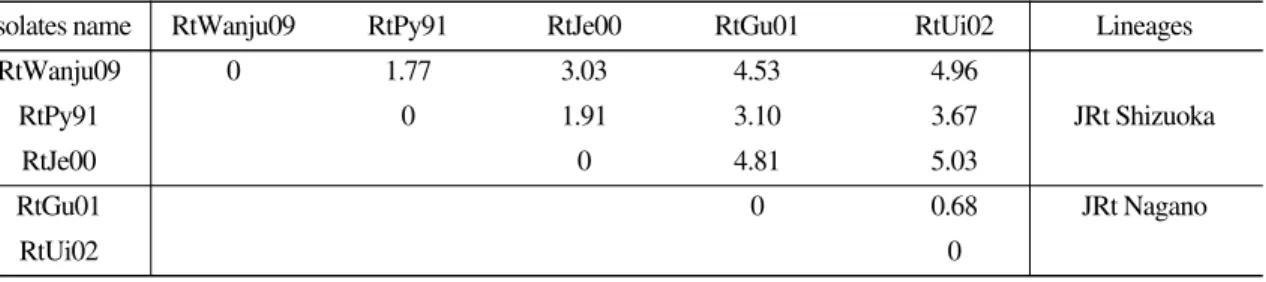
계로 보았을 때 JRt Nagano 그룹에서 이동되었 다고 볼 수 없었다 (Fig. 2). 그러나, 양식장과 양 식장 사이에 무지개송어 발안란의 이동은 빈번 했으며, 실제로 전라북도에서 양식된 무지개송 어는 강원도에서 발안란을 받아 양식된 것이었 다. 이 발안란은 어느 한 시점에 외국에서 수입 되었으며, 그 후 양식기술의 발달로 계속적인 완 전생산이 가능해 생산된 발안란 또는 무지개송 어는 양식업자 사이에서는 한국산 무지개송어 라 불리우는 것이었다. IHNV RtWanju09의 G 유전자를 분석한 결과 JRt Shizuoka에 속해 있는 것으로 확인되었으며 (Fig. 1), IHNV RtJe00과 RtPy91과 계통학적으로 유사한 JRt Shizuoka의 Korean isolates 그룹에 함께 포함되었으며, 유전 적으로 강원도의 RtPy91과의 유전적 차이는 1.77% 였다 (Table 1). 따라서, 전라북도에 위치 한 무지개송어 양식장에서의 IHNV는 발안란의 이동 이력과 IHNV의 계통학적 분석을 통해 이 바이러스는 JRt Shizuoka에 속하는 한국의 강원 도에서 전라북도 소재의 양식장으로 이동되었 을 가능성이 높다. 또한 이 바이러스는 RtPy91 이 기원으로 제천과 전라북도에 이동된 것으로 Fig. 2. Sampling location and years of isolation of IHNV in Korea. Big star indicates isolated IHNV in this study and small stars indicate four IHNV isolates reported in Korea. A thick line indicates a mountain range.
추정되며 (Fig. 1), 약 20여년이 지나는 사이에 JRt Shizuoka lineage 사이의 바이러스의 변화율 은 최대 3.03%여서 바이러스의 변이가 계속 진 행중인 것으로 사료되었다. 그러나, JRt Nagano lineage 사이의 두 바이러스의 변화율은 0.68%
에 불과하며, JRt Shizuoka lineage와 JRt Nagano lineage 사이의 바이러스 변화율은 최대 5.03%
인 것으로 나타나 lineage와 lineage 사이의 바이 러스 유전자는 큰 폭의 차이가 있음이 밝혀졌다 (Table 1).
원래 IHN은 치어기 때 주로 나타나는 질병으 로 생각해 왔으나, 최근에는 상품 크기의 성어에 서도 폐사를 일으켜 병원성의 변화가 의심되었 다 (Kim et al., 2003; Nishizawa et al., 2006). 최근, Mochizuki et al. (2009)은 IHNV G 유전자의 계통 학적 분석으로 나뉘어진 JRt Shizuoka lineage와 JRt Nagano lineage의 병원성 비교에서 JRt Shizuoka lineage에 속하는 IHNV의 병원성은 JRt Nagano lineage에 속하는 IHNV보다 높은 고 병원성을 나타낸다고 보고하였다.
본 연구에서 분리된 IHNV RtWanJu09는 고병 원성인 JRt Shizuoka lineage에 속하는 것으로 나 타나, 발안란 또는 무지개송어의 이동에 있어 소 독을 철저히 하고, 이러한 고병원성의 바이러스 가 확산되지 않도록 주의해야할 필요가 있을 것 으로 사료된다.
요 약
무지개 송어 발안란의 이동 이력과 IHNV G gene 염기서열의 계통학적 분석에 의해 IHNV의 국내 이동에 대해서 처음으로 조사되었다.
IHNV RtWanju09 분리주는 IHNV RtPy91과 RtJe00의 JRt Shizuoka lineage에 속하는 것으로 나타났으며, 강원도에서 분리된 IHNV RtPy91과 RtWanju09 사이의 G gene의 유전적 차이는 1.77%였고, 약 20년간 우리나라의 JRt Shizuoka lineage에 속하는 한국 분리주들은 최대 3.03%
의 유전적 차이를 나타내 계속적으로 바이러스 가 진화하는 것을 알 수 있었다. 또한 전라북도 지역에서 분리된 IHNV RtWanju09 분리주는 IHNV가 오염된 강원도 지역산 발안란이 전라 북도에 전파되었을 것으로 사료된다.
참 고 문 헌
Bootland, L.M. and Leong, J.C.: Infectious hematopoietic necrosis virus. In Fish dis- eases and disorders; Viral, bacterial and fun- gal infections, Vol. 3, pp.57-121, Woo, P.T.K., Bruno, D.W. (eds). CABI Publishing, NY, 1999.
Enzmann, P.J., Kurath, G., Fichtner, D. and Bergmann, S.M.: Infectious hematopoietic necrosis virus: monophyletic origin of Euro- pean isolates from North American genogroup M. Dis. Aquat. Org., 66:187-195, 2005.
Table 1. Pairwise comparisons of nucleotide sequence diversities (%) of the glycoprotein gene ORF in Korea isolates
Isolates name RtWanju09 RtPy91 RtJe00 RtGu01 RtUi02 Lineages
RtWanju09 0 1.77 3.03 4.53 4.96
RtPy91 0 1.91 3.10 3.67 JRt Shizuoka
RtJe00 0 4.81 5.03
RtGu01 0 0.68 JRt Nagano
RtUi02 0
Garver, K.A., Troyer, R.M. and Kurath, G.: Two distinct phylogenetic clades of infectious hematopoietic necrosis virus overlap within the Columbia River basin. Dis. Aquat. Org., 55:187-203, 2003.
Gilmore R.D.Jr. and Leong, J.C.: The nucleocapsid gene of infectious hematopoietic necrosis virus, a fish rhabdovirus. Virology, 167: 644- 648, 1988.
Kim, C.H., Winton, J.R. and Leong, J.C.: Neutral- ization-resistant variants of infectious hematopoietic necrosis virus have altered virulence and tissue tropism. J. Virol., 68:
8447-8453, 1994.
Kim, K.H., Kim, Y.J., Jung, S.J., Jung, T.S. and Oh, M.J.: Isolation and characterization of infec- tious hematopoietic necrosis virus causing high mortality in rainbow trout Oncorhynchus mykiss. J. Fish Pathol., 16(2):81-90, 2003.
Kim, W.S., Oh, M.J., Nishizawa, T., Park, J.W., Kurath, G. and Yoshimizu, M.: Genotyping of Korean isolates of infectious hematopoi- etic necrosis virus (IHNV) based on the gly- coprotein gene. Arch. Virol., 152: 2119- 2124, 2007.
Kimura, T. and Yoshimizu, M.: Viral diseases of fish in Japan. Annu. Rev. Fish Dis., 1:67-82, 1991.
Koener, J.F., Passavant, C.W., Kurath, G. and Leong, J.C.: Nucleotide sequence of a cDNA clone carrying the glycoprotein gene of infectious hematopoietic necrosis virus, a fish rhabdovirus. J. Virol., 61: 1342-1349, 1987.
Kurath, G., Ahern, K.G., Pearson, G.D. and Leong, J.C.: Molecular cloning of the six mRNA species of infectious hematopoietic necrosis virus, a fish rhabdovirus, and gene order
determination by R-loop mapping. J. Virol., 53: 469-476, 1985.
Kurath, G., Garver, K.A., Troyer, R.M., Emmeneg- ger, E.J., Einer-Jensen, K. and Anderson, E.D.: Phylogeography of infectious hematopoietic necrosis virus in North Amer- ica. J. Gen. Virol., 84: 803-814, 2003.
Miller, T.A., Rapp, J., Wastlhuber, U., Hoffmann, R.W. and Enzmann, P.J.: Rapid and sensitive reverse transcriptase-polymerase chain reac- tion based detection and differential diagno- sis of fish pathogenic rhabdoviruses in organ samples and culture cells. Dis. Aquat. Org., 34:13-20, 1998.
Mochizuki, M., Kim, H.J., Kasai, H., Nishizawa, T.
and Yoshimizu, M.: Virulence change of infectious hematopoietic necrosis against rainbow trout Oncorhynchus mykiss with viral molecular evolution. Fish Pathol., 44(4):159-165, 2009.
Morzunov, S.P., Winton, J.R. and Nichol, S.T.: The complete genome structure and phylogenetic relationship of infectious hematopoietic necrosis virus. Virus Res., 38:175-192, 1995.
Nichol, S.T., Rowe, J.E. and Winton, J.R.: Molecu- lar epizootiology and evolution of the glyco- protein and non-virion protein genes of infec- tious hematopoietic necrosis virus, a fish rhabdovirus. Virus Res., 38:159-173, 1995.
Nishizawa, T., Kinoshita, S., Kim, W.S., Higashi, S. and Yoshimizu, M.: Nucleotide diversity of Japanese isolates of infectious hematopoietic necrosis virus (IHNV) based on the glycoprotein gene. Dis. Aquat. Org., 71: 267-272, 2006.
Perrière, G. and Gouy, M.: WWW-Query: an on- line retrieval system for biological sequence banks. Biochimie., 78:364-369, 1996.
Schutze, H., Enzmann, P.J., Kuchling, R., Mundt, E.,
Niemann, H. and Mettenleiter, T.C.: Com- plete genomic sequence of the fish rhab- dovirus infectious haematopoietic necrosis virus. J. Gen. Virol., 76:2519-2527, 1995.
Tamura, K., Dudley, J., Nei, M. and Kumar, S.:
MEGA4: Molecular Evolutionary Genetics Analysis (MEGA) software version 4.0.
Mol. Biol. Evol., 24:1596-1599, 2007.
Thompson, J.D., Higgins, D.G. and Gibson, T.J.:
Clustal W: improving the sensitivity of pro- gressive multiple sequence alignment through sequence weighting, position-spe- cific gap penalties and weight matrix choice.
Nucleic Acids Res., 22:4673-4680, 1994.
Thompson, J.D., Gibson, T.J., Plewniak, F., Jean- mougin, F. and Higgins, D.G.: The Clustal X windows interface: flexible strategies for multiple sequence alignment aided by quali- ty analysis tools. Nucleic Acids Res., 25:4876-4882, 1997.
Tordo, N., Benmansour, A., Calisher, C., Dietzgen,
R.G., Fang, R.X., Jackson, A.O., Kurath, G., Nadin-Davis, S., Tesh, R.B. and Walker, P.J.:
Family Rhabdoviridae. In Virus taxonomy, VIIIth report of the ICTV, pp.623-644, Fau- quet, C.M., Mayo, M.A., Maniloff, J., Des- selberger , U. and Ball, L.A., Elsevier, Acad- emic Press, 2005.
Winton, J.R.: Recent advances in detection and con- trol of infectious hematopoietic necrosis virus in aquaculture. Annu. Rev. Fish Dis., 1:83-93, 1991.
Wolf, K.: Infectious hematopoietic necrosis. In Fish viruses and fish viral diseases, pp.83-114, Wolf, K., Cornell University Press, Ithaca, 1988.
Yoshimizu, M.: Disease problems of salmonid fish in Japan caused by international trade. Rev.
Sci. Tech., 15:533-549, 1996.
Manuscript Received : February 24, 2010 Revised : April 20, 2010 Accepted : April 26, 2010