Veterinary Science
DOI: 10.4142/jvs.2009.10.3.219
*Corresponding author
Tel: +66-2-218-9412; Fax: +66-2-255-3910
E-mail: [email protected]
Detection and molecular characterization of infectious bronchitis virus isolated from recent outbreaks in broiler flocks in Thailand
Tawatchai Pohuang, Niwat Chansiripornchai*, Achara Tawatsin, Jiroj Sasipreeyajan
Department of Veterinary Medicine, Faculty of Veterinary Science, Chulalongkorn University, Bangkok 10330, Thailand
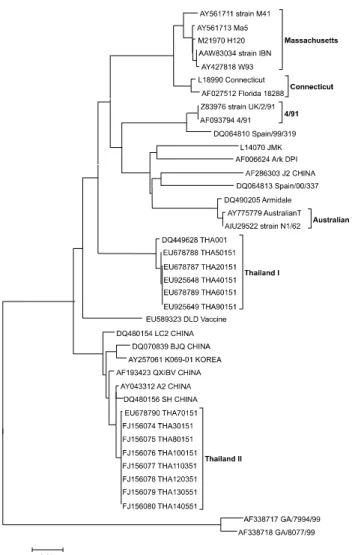
Thirteen field isolates of infectious bronchitis virus (IBV) were isolated from broiler flocks in Thailand between January and June 2008. The 878-bp of the S1 gene covering a hypervariable region was amplified and sequenced. Phylogenetic analysis based on that region revealed that these viruses were separated into two groups (I and II). IBV isolates in group I were not related to other IBV strains published in the GenBank database. Group 1 nucleotide sequence identities were less than 85% and amino acid sequence identities less than 84% in common with IBVs published in the GenBank database. This group likely represents the strains indigenous to Thailand. The isolates in group II showed a close relationship with Chinese IBVs. They had nucleotide sequence identities of 97-98% and amino acid sequence identities 96-98% in common with Chinese IBVs (strain A2, SH and QXIBV).
This finding indicated that the recent Thai IBVs evolved separately and at least two groups of viruses are circulating in Thailand.
Keywords: infectious bronchitis virus, phylogenetic analysis, S1 gene, sequencing, Thailand
Introduction
Infectious bronchitis (IB), caused by the IB virus (IBV), is a highly contagious disease and results in a significant economic loss to the commercial chicken industry. The disease frequently causes respiratory signs including gasping, coughing, sneezing, tracheal rales, and nasal discharge. In layer fowls, respiratory distress and a decrease in egg production have been reported [10]. In addition, some strains have been associated with kidney lesions [18,19,22].
IBV, the causative agent of IB, belongs to the genus
Coronavirus in the family Coronaviridae [6]. It is an enveloped virus and has a positive-sense, single-stranded, RNA genome, approximately 27 kb in length. The virion has three major structural proteins namely the nucleocapsid (N) protein, the membrane (M) protein, and the spike (S) glycoprotein. The S glycoprotein is post-translationally cleaved into the S1 and S2 subunits [6]. The S1 subunit, located on the outside of the virion, is responsible for the fusion between the virus envelope and the host cell membrane. Moreover, it is responsible for neutralizing serotype-specific antibodies in chickens [4]. The S1 subunit demonstrates more sequence variability than S2 [14]. Neutralizing and serotype-specific epitopes are associated with the defined hypervariable region (HVR) in the S1 subunit; therefore, the molecular characterization of IBV is based on analysis of the S1 gene [12].
During 1953-1954, the first IBV outbreak was reported in Thailand [7]. Although many IB vaccine strains such as Connecticut, H120, Ma5, M41 and Armidale A3, have been used in Thailand for many years, IBV outbreaks have been ongoing [1]. Moreover, the relationships between recent Thai IBV isolates and foreign IBV isolates are not known.
The objective of this study was to characterize IBV field isolates in the recent outbreak of the disease in Thailand by analyzing the S1 gene and compared them with those that have been published previously.
Materials and Methods Viruses
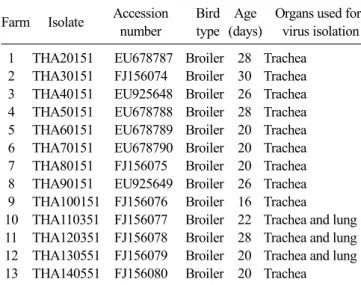
Between January and June, 2008, thirteen poultry farms in the eastern part of Thailand had an outbreak of a mild-to-moderate respiratory disease (Table 1). All flocks had been vaccinated against IB with commercial live attenuated H120. Chickens showed respiratory symptoms including gasping, coughing, sneezing, and tracheal rales.
Sick chickens were selected and sent to the Department of
Veterinary Medicine, Faculty of Veterinary Science,
Chulalongkorn University. Necropsy was performed and