An Analysis on the Effect of Patient-controlled Analgesia Performed by Orthopaedic Department or Postoperative Pain Control after Shoulder and Elbow Surgery
Jae-Kwang Yum, Jin-Hyok Kim, Kyung-Hwan Boo , Soo-Hyung Ahn
Department of Orthopedic Surgery, Sanggye Paik Hospital, Inje University College of Medicine, Seoul, Korea
Background: We investigated the effectiveness of pain management and the adverse events of intravenous (IV) patient-controlled anal- gesia (PCA) after orthopedic surgery.
Methods: From September 2014 and August 2015, we performed a retrospective analysis of 77 patients who underwent orthopedic surgery of the shoulder or the elbow in our hospital. The composition of the intravenous PCA administered to the patients was as fol- lows: 250 mg of dexketoprofen trametamol, 70 mg of oxycodone, and 0.6 mg of ramosetron, which were made up to 79 ml of normal saline. We evaluated and statistically analyzed the difference in the visual analogue scale (VAS) scores for pain at immediate postopera- tion, at 24 hours of PCA, at 72 hours of PCA, and after discontinuation of PCA and in the incidence of adverse events.
Results: We found that VAS score decreased for 3 postoperative days and that with discontinuation of IV PCA a meaningful change in VAS score was no longer seen. Of the 77 patients, 22 presented with adverse events (28.6%). We terminated IV PCA temporarily in the 21 patients who presented with adverse events; we terminated analgesia permanently in one patient (1.2%). Consequently, 76 of 77 pa- tients carried out IV PCA till the designated period.
Conclusions: Intravenous PCA after orthopedic surgery of the shoulder or the elbow may be accompanied with adverse events. Careful assessment of the patient and treatment of the adverse outcomes are key to a successful maintenance of PCA and to a successful man- agement of postoperative pain.
(Clin Shoulder Elbow 2015;18(4):237-241)
Key Words: Patient-controlled analgesia; Non-steroidal anti-inflammatory agents; Oxycodone; Ramosetron; Pain measurement Clinics in Shoulder and Elbow Vol. 18, No. 4, December, 2015
http://dx.doi.org/10.5397/cise.2015.18.4.237
Received September 7, 2015. Revised November 28, 2015. Accepted December 4, 2015.
Correspondence to: Kyung-Hwan Boo
Department of Orthopedic Surgery, Inje University Sanggye Paik Hospital, 1342 Dongil-ro, Nowon-gu, Seoul 01757, Korea Tel: +82-2-950-1114, Fax: +82-2-950-1429, E-mail: [email protected]
Financial support: None. Conflict of interests: None.
Introduction
Intravenous patient-controlled analgesia (IV PCA) is known to be one of the most effective and widespread method for man- agement of postoperative pain after an orthopedic surgery.1) The use of IV PCA and the occurrence of adverse events associated with its use have not been described previously in an orthopedic setting. Although IV PCA is an effective method for pain control, adverse events such as nausea and vomiting often lead to pre- mature termination of PCA. To investigate the appropriate forms of analgesia and of postoperative care for postoperative pain, we analyzed the effectiveness of PCA after orthopedic surgery for
pain control and the adverse events that present in patients who underwent PCA.
Methods
Between September 2014 and August 2015, we carried out orthopedic surgery of the shoulder and of the elbow in 77 patients aged between 14 and 87 years (a mean age of 52.1
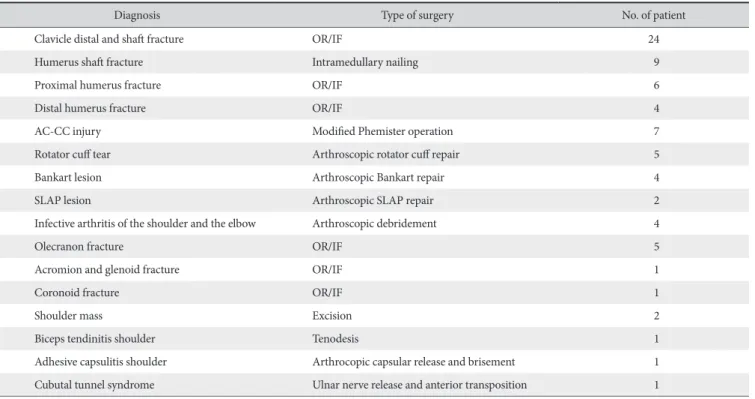
± 17.9 years). The patient sample comprised 51 men and 26 women who were asked to partake in a questionnaire and in a retrospective study (Table 1). The contents of this study were approved by the Institutional Review Board based in Inje Uni-
versity Sanggye Paik Hospital. We excluded patients with factors that could potentially interfere with drug metabolism such as a medical history of liver or renal disease or abnormal findings of blood tests. Other than the preoperative administration of Fen- tanyl, we did not use any other form of analgesic pre- or intra- operatively. For the PCA, we mixed 250 mg of dexketoprofen trometamol, 70 mg of oxycodone, and 0.6 mg of ramosetron in 79 ml of saline and administered the formulation to the pa- tient intravenously using a PCA infusion pump (PP-9800B1®; AMPALL Corporation, Seoul, Korea) for 3 days (a basal rate of 1
ml/h, a bolus of 0.5 ml, and a lock out of 15 minutes). We made a statistical analysis of the visual analogue scale (VAS) score and adverse events recorded at the immediate postoperation, at 24 hours of PCA, at 72 hours of PCA, and at post-PCA (PASW ver.
18.0; IBM Co., Armonk, NY, USA).
Results
We found that the VAS score, comparing to its preopera- tive value, decreased by 24 hours of PCA and by 72 hours of PCA (Repeated measures ANOVA, p<0.05). The VAS score did not decrease any more when PCA was terminated after 3 days (p=1.000) (Fig. 1). We found that 22 patients (28.6%) presented with postoperative adverse effects (Table 2), for whom the PCA were terminated temporarily and the adverse events, such as nausea, vomiting, dizziness, were treated using 10 mg of IV Table 1. Demographic Data according to the Type of Surgery
Diagnosis Type of surgery No. of patient
Clavicle distal and shaft fracture OR/IF 24
Humerus shaft fracture Intramedullary nailing 9
Proximal humerus fracture OR/IF 6
Distal humerus fracture OR/IF 4
AC-CC injury Modified Phemister operation 7
Rotator cuff tear Arthroscopic rotator cuff repair 5
Bankart lesion Arthroscopic Bankart repair 4
SLAP lesion Arthroscopic SLAP repair 2
Infective arthritis of the shoulder and the elbow Arthroscopic debridement 4
Olecranon fracture OR/IF 5
Acromion and glenoid fracture OR/IF 1
Coronoid fracture OR/IF 1
Shoulder mass Excision 2
Biceps tendinitis shoulder Tenodesis 1
Adhesive capsulitis shoulder Arthrocopic capsular release and brisement 1
Cubutal tunnel syndrome Ulnar nerve release and anterior transposition 1
OR/IF: open reduction and internal fixation, AC-CC: acromioclavicular-coracoclavicular, SLAP: superior labral anterior posterior.
VASscore
Immediate postoperative 7
6
5
4
3
2
Time 24 hours
of PCA
72 hours of PCA
After discontinuation
of PCA
Fig. 1. Postoperative mean visual analogue scale (VAS) scores (0 to 10) through repeated measures ANOVA. PCA: patient-controlled analgesia.
Table 2. Adverse Events Associated with Intravenous Patient-controlled Analgesia
Adverse event No. of case
Nausea 8
Vomiting 9
Dizziness 3
Hypotension 1
Headache 1
Total 22
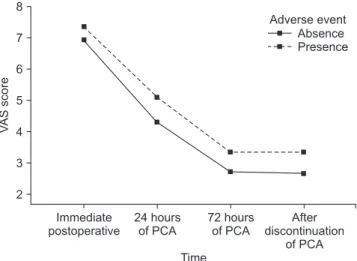
metoclopramide. The PCA was continued under patient consent when the adverse events had disappeared. We terminated PCA permanently in one patient who had presented with hypoten- sion; the patient’s adverse event improved after premature ter- mination of analgesia. A total of 76 patients carried out PCA to completion despite occurrence of adverse events. Compared to those with adverse events, those without generally had a higher VAS score, yet a time-matched significant difference was not seen between the two groups (p>0.05) (Fig. 2). A satisfaction survey was carried out to assess the patients’ subjective rating of pain management through PCA, and the results were categorized into ‘satisfied’, ‘normal’, or ‘unsatisfied’. We found that 66.2% of patients were satisfied with their clinical outcome (Table 3).
We did not see age-, sex-, disease-, or fracture-dependent difference in VAS scores. Nor did we see a statistically significant difference between patients who received bone surgery con- comitant to soft tissue procedure and those who did not. We found that the postoperative VAS score higher when the dura- tion of the operation had exceeded 60 minutes than when it had not, but the change in VAS score during the postoperative 24 hours did not show a statistically significant difference be- tween those whose operation exceeded 60 minutes and those whose did not (Table 4).
Discussion
We found a statistically significant decrease in VAS score for pain with 3 days of postoperative IV PCA, indicating IV PCA as an effective analgesic tool. Compared to those who presented with adverse events and those who did not, the VAS score did not show a statistically significant difference. But because 28.6%
of patients who received IV PCA present with complications,
the occurrence of adverse effects cannot be overlooked. An- algesic drugs are classified according to their mode of action;
recent studies have shown that a multimodal analgesia protocol enhances postoperative control of pain.2-7) Other studies have found that the prophylactic use of antiemetics with the opioids reduces postoperative nausea and vomiting (PONV).8) These two findings were taken into consideration when formulating our PCA medication.
One of the analgesics used in this study was oxycodone, a strong opioid that acts on mu- and kappa-opioid receptors. Its pharmacological actions are known to be similar to those of morphine but with a larger analgesic effect; oxycodone can relieve neuropathic and somatic pain, even of malignant origin with a swift time-to-effect and with a drug effect that lasts up to 12 hours.9) A comparative analysis by Silvasti et al.10) found that in patients who received spinal fusion surgery or breast reduc- tion and had undergone IV PCA oxycodone and morphine showed similar analgesic efficacies when oxycodone was ad- ministered as bolus doses of 30 µg/kg (3 mg/ml) without basal infusion; of those who were administered oxycodone, 18 of 24 patients presented with PONV. Taking the results of these studies into consideration, we lowered the basal rate of oxycodone to 0.7 mg/ml per hour and administered the opioid as boluses of 0.35 mg in order that complications associated with oxycodone are minimized.
The second analgesic drug, with a different mode of action to oxycodone, used in this study was dexketoprofen, which is an S-isomer of the racemic drug ketoprofen. Beltrán et al.,11)
VASscore
Immediate postoperative 8
7 6 5 4 3 2
Time 24 hours
of PCA
72 hours of PCA
After discontinuation
of PCA Adverse event
Absence Presence
Fig. 2. Comparative analysis of visual analogue scale (VAS) scores between the non-adverse event group and the adverse event group. PCA: patient-controlled analgesia.
Table 3. The Level of Satisfaction of Intravenous Patient-controlled Analgesia
Classification No. of patient
Satisfactory 51
Normal 20
Unsatisfactory 6
Table 4. Statistical Evaluation of VAS Scores according to Demographic and Clinical Factors
Factor p-value
Age (over/under 60 yr) 0.334
Sex (men/women) 0.555
Disease/fracture 0.356
Bone procedure/soft tissue procedure 0.922 Operation time (over/under 60 min)
- Immediate postoperative VAS score 0.044*
Operation time (over/under 60 min)
- Postoperative 24 hours VAS score changes 0.918 VAS: visual analogue scale.
*Statistically significant on the Mann-Whitney U-test.
in a multicentre double-blind randomized trial, showed that the analgesic effect of dexketoprofen is swift, quickly resolving symptoms of pain in patients with degenerative arthritis of the knee. Sweetman12) reported that dexketoprofen trometamol has high analgesic potency for not only patients with musculoskeletal diseases, such as degenerative arthritis and lower back pain, but also those with postoperative, dental, or menstrual pain. Further, trometamine salt has been shown to contribute to enhanced drug absorption into body and a reduced time of action. Zippel and Wagenitz13) reported that analgesic efficacy of dexketopro- fen after an orthopedic surgery is larger than that of ketoprofen and that the former is associated with less complications; still, the prevalence of adverse events was far from being insignificant as 16% to 21% of patients presented with them. Further, additional analgesia had to be employed in more than 80% of patients in both groups. Of note, the authors stated the choice of the dual drug should be selected from across drug class.
Koh et al.14) have reported that the prophylactic administra- tion of ramosetron in patients who were treated for total knee arthroplasty was not effective against PONV although at the first postoperative 24 hour they did show that PONV were more reduced with analgesia than without. In a prospective random- ized double-blind study by Choi et al.,15) ramosetron was shown to have a greater analgesic effect and to be associated with a third less PONV than ondansetron; both drugs are Hydroxy- tryptamine receptor 3 antagonists, but ramosetron has a higher binding affinity to the receptor than Ondansetron. Lee et al.8) re- ported that an oral administration of ramosetron give 30 minutes before the operation reduces PONV more than when it is given after general anesthesia.
The use of postoperative analgesics has been associated with adverse events. To reduce the rate of complications studies have attempted to assess the effect of lowered volumes of analgesics or of multimodal analgesia.2-7,16,17) For instance, Sinatra et al.18) found that by using a Cox 2 inhibitor the volume of analgesics used could be decreased. In this study, we used multimodal analgesia by combining oxycodone and ketoprofen; we used oxcodone for its strong analgesic efficacy and Ketoprofen for its use in reducing overall drug volume. A multimodal analgesic approach to treatment can lead to an additive or a synergistic ef- fect.
Limitations of this study include the fact that according to sur- gery type and to the mode of anesthesia the basal pain elicited may differ between patients and the need to also adjust volume with age and with bodyweight was overlooked. We attempted to use lower volumes and concentrations of the medication con- stituents than those used in other studies in an effort to minimize the incidence of adverse events; still, we found that around 28.6% of patients presented with adverse effects. In the future, a greater number of studies are required to investigate ways to reduce the rate of adverse events or, if possible, to block the
incidence of the events at all. Until then, we must find ways to improve the immediate postoperative response to such adverse events at the patient ward.
Conclusion
Management of pain after orthopedic surgery of the shoulder and elbow can be achieved through IV PCA with a satisfactory level of control. But 28.6% of patients who are administered IV PCA present with adverse events. To gain a better understanding of the occurrence of adverse events, more studies that assess the effect of changing the constituents of analgesia and their vol- umes on pain management are required. We found that when adverse events do occur the key to a successful IV PCA and, ultimately, to postoperative pain control is to treat the adverse complications appropriately and promptly.
References
1. Albert TJ, Cohn JC, Rothman JS, Springstead J, Rothman RH, Booth RE Jr. Patient-controlled analgesia in a postoperative to- tal joint arthroplasty population. J Arthroplasty. 1991;6 Suppl:
S23-8.
2. White PF. Multimodal analgesia: its role in preventing postop- erative pain. Curr Opin Investig Drugs. 2008;9(1):76-82.
3. Vendittoli PA, Makinen P, Drolet P, et al. A multimodal anal- gesia protocol for total knee arthroplasty. A randomized, con- trolled study. J Bone Joint Surg Am. 2006;88(2):282-9.
4. Tang R, Evans H, Chaput A, Kim C. Multimodal analgesia for hip arthroplasty. Orthop Clin North Am. 2009;40(3):377-87.
5. Skinner HB. Multimodal acute pain management. Am J Or- thop (Belle Mead NJ). 2004;33(5 Suppl):5-9.
6. Hartrick CT. Multimodal postoperative pain management. Am J Health Syst Pharm. 2004;61 Suppl 1:S4-10.
7. Dorr LD, Raya J, Long WT, Boutary M, Sirianni LE. Multimodal analgesia without parenteral narcotics for total knee arthro- plasty. J Arthroplasty. 2008;23(4):502-8.
8. Lee HJ, Shin CS, Choi BS, Yoon JY, Kwon JY, Kim HK. Effect of oral ramosetron for postoperative nausea and vomiting in surgical patients using patientcontrolled analgesia. Korean J Anesthesiol. 2008;54(1):63-8.
9. Riley J, Eisenberg E, Müller-Schwefe G, Drewes AM, Arendt- Nielsen L. Oxycodone: a review of its use in the management of pain. Curr Med Res Opin. 2008;24(1):175-92.
10. Silvasti M, Rosenberg P, Seppälä T, Svartling N, Pitkänen M.
Comparison of analgesic efficacy of oxycodone and morphine in postoperative intravenous patient-controlled analgesia. Acta Anaesthesiol Scand. 1998;42(5):576-80.
11. Beltrán J, Martín-Mola E, Figueroa M, et al. Comparison of dexketoprofen trometamol and ketoprofen in the treatment of osteoarthritis of the knee. J Clin Pharmacol. 1998;38(12 Suppl):
74S-80S.
12. Sweetman BJ. Development and use of the quick acting chiral NSAID dexketoprofen trometamol (keral). Acute Pain.
2003;4(3-4):109-15.
13. Zippel H, Wagenitz A. Comparison of the efficacy and safety of intravenously administered dexketoprofen trometamol and ketoprofen in the management of pain after orthopaedic sur- gery: a multicentre, double-blind, randomised, parallel-group clinical trial. Clin Drug Investig. 2006;26(9):517-28.
14. Koh IJ, Chang CB, Jeon YT, Ryu JH, Kim TK. Does ramosetron reduce postoperative emesis and pain after TKA? Clin Orthop Relat Res. 2012;470(6):1718-27.
15. Choi YS, Shim JK, Yoon DH, Jeon DH, Lee JY, Kwak YL. Effect of
ramosetron on patient-controlled analgesia related nausea and vomiting after spine surgery in highly susceptible patients: com- parison with ondansetron. Spine (Phila Pa 1976). 2008;33(17):
E602-6.
16. Kehlet H, Dahl JB. The value of “multimodal” or “balanced analgesia” in postoperative pain treatment. Anesth Analg.
1993;77(5):1048-56.
17. Viscusi ER. Emerging techniques in the treatment of postopera- tive pain. Am J Health Syst Pharm. 2004;61 Suppl 1:S11-4.
18. Sinatra RS, Torres J, Bustos AM. Pain management after major orthopaedic surgery: current strategies and new concepts. J Am Acad Orthop Surg. 2002;10(2):117-29.