Efficacy and Safety of Combined Subacromial and Intravenous Patient-controlled Analgesia after Arthroscopic Rotator Cuff Repair
Joong-Bae Seo , Jae-Sung Yoo, Jee-Won Ryu, Yong-Eun Shin
Department of Orthopedic Surgery, Dankook University Medical College, Cheonan, Korea
Background: This study investigated the efficacy and safety of combined subacromial and intravenous patient-controlled analgesia for control of postoperative pain after arthroscopic rotator cuff repair.
Methods: Between May 2012 and August 2014, 60 patients who underwent arthroscopic rotator cuff repair with acromioplasty and received patient-controlled analgesia were studied prospectively. Cases were divided into 2 groups: combined subacromial and intrave- nous infusion group (group A, 30 cases) and solitary intravenous infusion group (group B, 30 cases). The visual analogue scale was used to record the patient’s level of pain every 12 hours during postoperative 72 hours and the following 48 hours after the suspension of patient-controlled analgesia.
Results: The mean preoperative visual analogue scale score was 7.8 in group A and 7.6 in group B, and the immediate postoperative visual analogue scale score was 7.9 and 8.1 for each group. At postoperative time (From 12 hours to 72 hours after operation), the scores of combined subacromial and intravenous infusion were significantly lower than those of solitary intravenous infusion. Significant differ- ence in the frequency of supplemental analgesic injections was observed between group A and group B (p=0.008). However, no signifi- cant difference in complication rate was observed between the two groups (p=0.562).
Conclusions: Combined subacromial and intravenous patient-controlled analgesia after arthroscopic rotator cuff repair is more effec- tive than solitary intravenous infusion without significantly increasing complications. Therefore, combined subacromial and intravenous patient-controlled analgesia could be a effective pain control method.
(Clin Shoulder Elbow 2016;19(4):192-196)
Key Words: Rotator cuff tear; Rotator cuff repair; Patient-controlled analgesia; Postoperative pain control Clinics in Shoulder and Elbow Vol. 19, No. 4, December, 2016
https://doi.org/10.5397/cise.2016.19.4.192
Received January 2, 2016. Revised January 31, 2016. Accepted February 10, 2016.
Correspondence to: Joong-Bae Seo
Department of Orthopedic Surgery, Dankook University Medical College, Kinesiologic Medical Science, Dankook University Graduate School, 119 Dandae-ro, Dongnam-gu, Cheonan 31116, Korea
Tel: +82-41-550-3060, Fax: +82-41-556-0551, E-mail: [email protected] IRB approval (No. DKUH 2016-07-034).
Financial support: None. Conflict of interests: None.
Introduction
Acute postoperative pain after arthroscopic shoulder surgery varies from moderate to severe, and intensive postoperative rehabilitation could be interrupted by postoperative pain. Thus, many pain control methods were used in an effort to reduce acute postoperative pain.
Postoperative pain control methods include continuous interscalene infusion of levobupivacaine,1) intra-articular injec- tion of morphine and bupivacaine,2) peripheral nerve block,3) patient-controlled analgesia (PCA) using intravenous injection4)
and continuous-flow cold therapy.5) Intravenous PCA provided better pain relief, less morphine consumption, and reduced the incidence of complication compared with intermittent injection of pain medication as needed.4,6) Therefore PCA after shoulder surgery, particularly patient-controlled intravenous injection after open surgery7) and patient-controlled subacromial infusion after arthroscopic surgery has become more common.8,9)
Although intravenous PCA has been regarded as a useful pain control device, it would not provide optimal analgesia, so that additional pain therapy might be needed.10) However, subacro- mial and intravenous PCA require caution because of complica-
tions including temporary hypotension, nausea, and vomiting.
Few studies of subacromial PCA with intravenous PCA have been reported.
The purpose of our study was to compare the effective- ness, patient satisfaction, and complications between patient- controlled subacromial infusion of bupivacaine combined with patient-controlled intravenous analgesia and solitary patient- controlled intravenous analgesia after arthroscopic rotator cuff repair. The patients were divided into two groups: combined patient-controlled subacromial and intravenous analgesia group and only patient-controlled intravenous analgesia group.
Methods
Following Institutional Review Board of Dankook University Medical College approval, 60 consecutive patients who under- went arthroscopic rotator cuff repair under general anesthesia for full-thickness rotator cuff tears and PCA were studied prospec- tively. There were 33 males and 27 female patients, with a mean
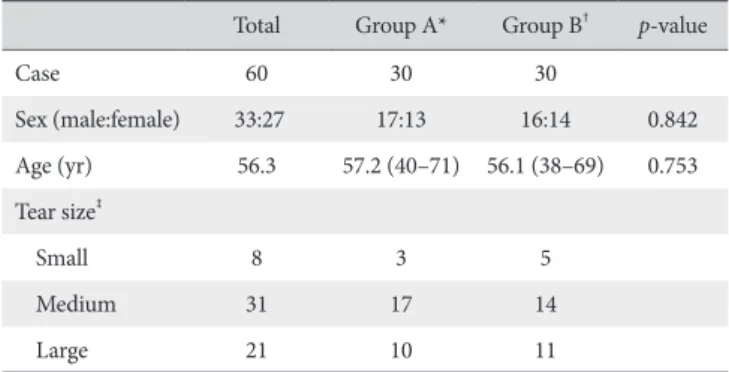
age of 56.3 years (range, 38–71 years). The size of cuff tear was defined as the length of the greatest diameter measured using a probe during surgery. The tear sizes were categorized as small (<1 cm), medium (1 to 3 cm), large (3 to 5 cm), and massive (>5 cm), according to the classification of DeOrio and Cofield (Table 1).11)
Those who underwent repair under local anesthesia or had partial or massive tears larger than 5 cm, acromioclavicular ar- thritis requiring distal clavicle resection, advanced glenohumeral arthritis, anterior instability, stiffness, or nerve damage or those requiring tenotomy or tenodesis of the long head of the biceps were excluded. Also, on preoperative radiographs, a flat-type acromion or no acromial spur cases not requiring acromioplasty were excluded.
Before undergoing operation after being diagnosed with rotator cuff tear, the patients were divided into two groups in random order. On operation day, one of the two PCA methods was selected and the other was used the next time. As such, 30 cases were collected for each group, a combined intravenous injection with fentanyl and ketorolac tromethamine and sub- acromial infusion with 0.5% bupivacaine (group A) and an only intravenous infusion group (group B). Any case that fell under the exclusion criteria was excluded from the beginning. Only those who received explanations on the study and agreed to it were enrolled. All repairs were performed by the senior author with the arthroscopic technique using suture anchors (double row suture bridge technique) for a full coverage according to tear configuration. Acromioplasty was performed in all cases. All shoulders were immobilized in a brace and pendulum exercises were started one day after the operation.
In the 30 patients in group A, the epidural catheter was in- serted through the anterior portal and located in the subacromial space (Fig. 1). The catheter was then connected to the Accufus- er-Plus Kit® (Wooyoung Medical, Seoul, Korea), a silicon-balloon infuser, for continuous flow of 100 ml of 0.5% bupivacaine into the subacromial space at a speed of 1.0 ml/h. Patients with se-
Fig. 1. Epidural catheter placed in subacro- mial space under arthroscopic visualization.
Table 1. Demographic Data
Total Group A* Group B† p-value
Case 60 30 30
Sex (male:female) 33:27 17:13 16:14 0.842
Age (yr) 56.3 57.2 (40–71) 56.1 (38–69) 0.753 Tear size‡
Small 8 3 5
Medium 31 17 14
Large 21 10 11
Values are presented as number only or median (range).
*Combined subacromial and intravenous infusion. †Solitary intravenous infu- sion. ‡The tear sizes were categorized as small (<1 cm), medium (1 to 3 cm), large (3 to 5 cm), and massive (>5 cm), according to the classification of DeO- rio and Cofield.11)
vere pain were able to control the amount of bupivacaine by self-infusing an additional 0.5 ml of bupivacaine, but they were not allowed to repeat the infusion within 15 minutes.
In all patients in group A and group B, 500 to 1,000 μg of fentanyl and 100 ml of ketorolac tromethamine were injected intravenously at a speed of 1 ml/hr. The patients were able to self-infuse an additional 1 ml but had to wait 15 minutes for the next infusion. In both groups, when PCA failed to alleviate pain, uniform supplemental analgesic injections (Tramadol 50 mg/ml, intravenous injection) were administered at the patient’s request, and the frequency of injections was recorded for each patient.
Preoperative and immediate postoperative pain at rest was measured using the visual analogue scale (VAS). After PCA be- gan, pain was assessed every 12 hours during postoperative 72 hours. When PCA was stopped after postoperative 72 hours, pain was measured every 12 hours for the next 48 hours. The results according to the frequency of supplemental analgesic in- jections and complications were analyzed for each group.
The paired Student t-test was used for statistical analysis. The chi-square test was used for the comparison based on the sex and age of patients between the two groups. Statistics were per- formed using IBM SPSS software ver. 19.0 (IBM Co., Armonk, NY, USA) and the p<0.05 were considered significant.
Results
In group A, there were 17 male and 13 female patients, with a mean age of 57.2 years. In group B, there were 16 male and
14 female patients, with a mean age of 56.1 years. The sex ratio and age were not statistically different between the two groups (p=0.584 and 0.732, respectively). According to the classifica- tion of DeOrio and Cofield,11) arthroscopic findings of group A included 3 cases of small-sized tear, 17 cases of medium-sized tear, and 10 cases of large-sized tear. Group B included 5 cases of small-sized tear, 14 cases of medium-sized tear, and 11 cases of large-sized tear.
The mean preoperative VAS score of group A was 7.8, 7.6 for group B (p=0.865). Immediately after operation, group A scored 7.9 and group B 8.1 (p=0.643). No significant difference was found between groups A and B at preoperative and immediately postoperative time. From postoperative 12 hours to 72 hours, most VAS scores of combined subacromial and intravenous infu- sion were lower with statistical significance than those of solitary intravenous infusion (p<0.05). After PCA was stopped, the VAS score of group A increased from 3.6 to 4.1. However, the VAS score of group B decreased from 4.9 to 4.4. After 72 hours, pain was alleviated over time, with group A scoring 2.6 on postopera- tive day 5 and group B scoring 2.8. No significant difference was found between the two groups (Table 2, Fig. 2).
The frequency of supplemental analgesic injections for pain control during PCA was 0.4 times in group A and 2.2 times in group B until postoperative day 5. Significant difference in the frequency of supplemental analgesic injections was observed between group A and group B (p=0.008) (Table 3).
Among the 30 patients in group A, 7 reported transient nau- sea, vomiting, and dizziness. Three of them gave up PCA at postoperative 12 hours and the remaining four patients at post- operative 72 hours. Four patients in group B had mild nausea, vomiting, and headache at postoperative 12 hours but did not Table 2. Visual Analogue Scale Pain Scores from Preoperative Day to 5th
Postoperative Day
Time Group A* Group B† p-value
Preoperative 7.8 ± 2.0 7.6 ± 2.1 0.865
Immediately 7.9 ± 1.6 8.1 ± 1.4 0.643
Postoperative (hr)
12 6.3 ± 1.9 7.3 ± 3.1 0.041
24 5.1 ± 1.7 6.2 ± 3.4 0.016
36 3.7 ± 1.3 5.5 ± 2.4 <0.001
48 3.7 ± 1.4 5.3 ± 2.7 <0.001
60 3.2 ± 2.1 5.3 ± 3.1 <0.001
72 3.6 ± 1.8 4.9 ± 2.4 0.046
84 4.1 ± 1.3 4.4 ± 2.1 0.556
96 3.8 ± 2.4 4.6 ± 2.8 0.074
108 3.4 ± 2.1 3.9 ± 1.7 0.336
120 2.6 ± 1.2 2.8 ± 1.9 0.439
Values are presented as mean ± standard deviation.
*Combined subacromial and intravenous infusion. †Solitary intravenous infu- sion.
VAS
9 8 7 6 5 4 3 2 1
Preoperative time Immediatel
y 12 24 36 48 60 72 84 96 108 120
Time (hr) 0
Combined subacromial and intravenous infusion Solitary intravenous infusion
Postoperative time
Fig. 2. The mean visual analogue scale (VAS) pain score was lower for patients using the combined subacromal and intravenous infusion than those receiv- ing the intravenous infusion.
stop PCA. The complication rate of group A was slightly higher than that of group B, but no statistically significant difference was observed between the two groups (p=0.562) (Table 3). In all pa- tients, there were no cases of infection in the operation site.
Discussion
The introduction of arthroscopic surgery of the shoulder joint has enabled rapid rehabilitation and recovery to activities of dai- ly living and increased interest in postoperative pain control.8,9,12) Arthroscopic rotator cuff repair, in particular, results in severe pain during the immediate postoperative period. Thus, many studies have focused on direct analgesic injection or infusion into the repaired site instead of intravenous injection for pain control.
The continuous infusion of a subacromial pain pump after arthroscopic subacromial decompression has been shown to minimize use of parenteral opiate analgesia, decrease pain in multiple testing parameters, and in a prospective, randomized, double-blinded controlled study, to decrease pain for the first 2 days after operation and decrease analgesic use.13-15) A study of patient-controlled subacromial pain pumps showed a 34% re- duction on the VAS, but no change in the amount of oral opioid use.16) In another study, use of the subacromial infusion pump resulted in shorter recovery room stays but made no difference in pain, narcotic use, or postoperative range of motion of the shoulder joint.17) Therefore authors suggested that patients with continuous infusion of a subacromial pain pump require less ad- ditional analgesia for more effective pain alleviation.
Fentanyl and ketorolac tromethamine move to the central nervous system through blood and interact with the receptor in the system to reduce postoperative pain. PCA with fentanyl and ketorolac tromethamine has been widely accepted not only in orthopaedic surgery but also in other operations and has proven its efficacy.18-20) Results for gender related difference in intrave- nous PCA for postoperative pain control after rotator cuff repair were also reported.21) However, no study on results of combined subacromial infusion with intravenous analgesia have been re- ported, and reports analyzing complications of combined anal- gesia are even harder to find.
In our series, preoperative and immediate postoperative pain was not significantly different between group A and group B. At postoperative 12 hours, the group with combined subacromial and intravenous infusion showed better results in pain allevia- tion compared with the group with solitary intravenous infusion.
From postoperative 12 hours to 72 hours, significant differences were found between group A and group B (p<0.05). Therefore, we reached the conclusion that combined subacromial and intravenous infusion might be more effective in pain alleviation than solitary intravenous infusion in the initial stage after the op- eration. After PCA was stopped, pain increased slightly in group A and gradually reduced over time. The frequency of supple- mental analgesic injections was significantly lower in group A than in group B (p=0.008) without increasing complication rate, implying that the effects of combined subacromial and intrave- nous PCA were better than those of solitary intravenous PCA.
Our study has the following limitations: first, subjects were limited to those with rotator cuff tears, making it difficult to ap- ply the results to other patients with different shoulder disorders;
second, long-term outcome was not evaluated for detection of complication and male and female patients were not compared;
third, we only investigated VAS at rest but did not evaluate VAS during motion of the shoulder and physiotherapy performances;
fourth, the patients were not evaluated for chondrotoxicity of bupivacaine. Bupivacaine is known to have a chondrotoxicity.22) However a study by Busfield et al.23) using subacromial bupiva- caine found no evidence of chondrotoxicity in the early period.
We supposed that subacromial infusion would not or would show minimized leakage to the glenohumeral joint followed by coverage of the tendon tear. These limitations could represent areas of future research.
Conclusion
Combined subacromial and intravenous PCA after ar- throscopic rotator cuff repair is more effective than solitary in- travenous infusion without significantly increasing complications in the short term postoperative period. Therefore, combined subacromial and intravenous PCA could be an effective pain control method. However it is important to use caution regard- Table 3. PCA-related Adverse Effects and Frequency of Supplemental Analgesic Injections
Variable PCA-related adverse effect (n) Mean frequency of supplemental
analgesic injection (times)
Nausea Vomiting Dizziness Headache Total
Group A* 4 2 1 0 7 0.4
Group B† 2 1 0 1 4 2.2
Total 6 3 1 1 11
p-value 0.562 0.008
PCA: patient-controlled analgesia.
*Combined subacromial and intravenous infusion. †Solitary intravenous infusion.
ing adverse effects of this pain control method.
References
1. Koltka K, Doğruel B, Sentürk M, Atalar AC, Küçükay S, Pem- beci K. Postoperative analgesia for arthroscopic rotator cuff surgery: a comparison between subacromial and interscalene levobupivacaine. Agri. 2011;23(1):7-12.
2. Boden BP, Fassler S, Cooper S, Marchetto PA, Moyer RA.
Analgesic effect of intraarticular morphine, bupivacaine, and morphine/bupivacaine after arthroscopic knee surgery. Ar- throscopy. 1994;10(1):104-7.
3. Edkin BS, Spindler KP, Flanagan JF. Femoral nerve block as an alternative to parenteral narcotics for pain control after ante- rior cruciate ligament reconstruction. Arthroscopy. 1995;11(4):
404-9.
4. Matheny JM, Hanks GA, Rung GW, Blanda JB, Kalenak A. A comparison of patient-controlled analgesia and continuous lumbar plexus block after anterior cruciate ligament recon- struction. Arthroscopy. 1993;9(1):87-90.
5. Barber FA, McGuire DA, Click S. Continuous-flow cold ther- apy for outpatient anterior cruciate ligament reconstruction.
Arthroscopy. 1998;14(2):130-5.
6. Ferrante FM, Orav EJ, Rocco AG, Gallo J. A statistical model for pain in patient-controlled analgesia and conventional intra- muscular opioid regimens. Anesth Analg. 1988;67(5):457-61.
7. Singelyn FJ, Seguy S, Gouverneur JM. Interscalene bra- chial plexus analgesia after open shoulder surgery: con- tinuous versus patient-controlled infusion. Anesth Analg.
1999;89(5):1216-20.
8. Muittari PA, Nelimarkka O, Seppälä T, Kanto JH, Kirvelä OA. Comparison of the analgesic effects of intrabursal oxy- codone and bupivacaine after acromioplasty. J Clin Anesth.
1999;11(1):11-6.
9. Tetzlaff JE, Brems J, Dilger J. Intraarticular morphine and bu- pivacaine reduces postoperative pain after rotator cuff repair.
Reg Anesth Pain Med. 2000;25(6):611-4.
10. Rhee YG, Ha JH, Cho NS, Jeong BO. Patient-controlled anal- gesia using accufuser-plus kit® after arthroscopic rotator cuff repair: subacromial catheter vs intravenous injection. J Korean Orthop Assoc. 2006;41:52-7.
11. DeOrio JK, Cofield RH. Results of a second attempt at surgi- cal repair of a failed initial rotator-cuff repair. J Bone Joint Surg
Am. 1984;66(4):563-7.
12. Joshi GP, McCarroll SM. Intra-articular morphine for the man- agement of frozen shoulder. Anaesthesia. 1992;47(7):627.
13. Bishop JY, Sprague M, Gelber J, et al. Interscalene regional an- esthesia for arthroscopic shoulder surgery: a safe and effective technique. J Shoulder Elbow Surg. 2006;15(5):567-70.
14. Faryniarz D, Morelli C, Coleman S, et al. Interscalene block anesthesia at an ambulatory surgery center performing pre- dominantly regional anesthesia: a prospective study of one hundred thirty-three patients undergoing shoulder surgery. J Shoulder Elbow Surg. 2006;15(6):686-90.
15. Park JY, Lee GW, Kim Y, Yoo MJ. The efficacy of continuous intrabursal infusion with morphine and bupivacaine for post- operative analgesia after subacromial arthroscopy. Reg Anesth Pain Med. 2002;27(2):145-9.
16. Harvey GP, Chelly JE, AlSamsam T, Coupe K. Patient-controlled ropivacaine analgesia after arthroscopic subacromial decom- pression. Arthroscopy. 2004;20(5):451-5.
17. Quick DC, Guanche CA. Evaluation of an anesthetic pump for postoperative care after shoulder surgery. J Shoulder Elbow Surg. 2003;12(6):618-21.
18. Egbert AM, Parks LH, Short LM, Burnett ML. Randomized trial of postoperative patient-controlled analgesia vs intramuscular narcotics in frail elderly men. Arch Intern Med. 1990;150(9):
1897-903.
19. Harrison DM, Sinatra R, Morgese L, Chung JH. Epidural nar- cotic and patient-controlled analgesia for post-cesarean sec- tion pain relief. Anesthesiology. 1988;68(3):454-7.
20. Jackson D. A study of pain management: patient controlled analgesia versus intramuscular analgesia. J Intraven Nurs.
1989;12(1):42-51.
21. Cho CH. Gender-related difference in intravenous patient- controlled analgesia for postoperative pain control in rotator cuff repair. J Korean Orthop Assoc. 2010;45(1):31-6.
22. Breu A, Rosenmeier K, Kujat R, Angele P, Zink W. The cytotox- icity of bupivacaine, ropivacaine, and mepivacaine on human chondrocytes and cartilage. Anesth Analg. 2013;117(2):514- 22.
23. Busfield BT, Lee GH, Carrillo M, Ortega R, Kharrazi FD. Sub- acromial pain pump use with arthroscopic shoulder surgery: a short-term prospective study of complications in 583 patients.
J Shoulder Elbow Surg. 2008;17(6):860-2.