Recent Updates Regarding Outcomes and Complications of Reverse Total Shoulder Arthroplasty
Seok Won Chung
Department of Orthopedic Surgery, Konkuk University School of Medicine, Seoul, Korea
Indications of reverse total shoulder arthroplasty (RTSA) have been consistently extended by technical advancements in reverse arthro- plasty prosthesis, continuous development of the implants, accumulated experiences and its successful treatment outcomes; accordingly, its use has rapidly increased. RTSA has been performed for a variety of indications, with variable outcomes depending on the initial di- agnosis. However, controversial opinions still exist regarding the design of reverse arthroplasty prosthesis (medialized or lateralized design and the neck-shaft angle of the humeral prosthesis), suture of the subscapularis tendon, use of cement during placement of the humeral prosthesis, and surgical procedures; therefore, these should be investigated so that they can be better understood.
(Clin Shoulder Elbow 2017;20(3):172-179)
Key Words: Reverse total shoulder arthroplasty; Initial diagnosis; Outcomes; Recent update Clinics in Shoulder and Elbow Vol. 20, No. 3, September, 2017
https://doi.org/10.5397/cise.2017.20.3.172
Received June 13, 2017. Revised July 5, 2017. Accepted July 8, 2017.
Correspondence to: Seok Won Chung
Department of Orthopedic Surgery, Konkuk University Medical Center, Konkuk University School of Medicine, 120-1 Neungdong-ro, Gwangjin- gu, Seoul 05030, Korea
Tel: +82-2-2030-7604, Fax: +82-2-2030-7748, E-mail: [email protected] Review article does not need an IRB approval.
Financial support: This research was supported by a grant of the Korea Health Technology R&D Project through the Korea Health Industry Development Institute (KHIDI), funded by the Ministry of Health & Welfare, Republic of Korea (grant number: HI15C1856).
Conflict of interests: None.
Introduction
The primary indications of reverse total shoulder arthroplasty (RTSA) include cuff tear arthropathy and irreparable massive ro- tator cuff tear. With recent improvements in reverse shoulder ar- throplasty implant and technical advancements, there have been improvements in surgical outcomes of the RTSA.1,2) Accordingly, its recent indications have been extended to cases such as acute proximal humerus fracture, non-union or malunion after proxi- mal humerus fracture (proximal humerus fracture sequelae), pri- mary osteoarthritis with or without cuff tears, rheumatoid arthri- tis with or without cuff tears, failed open reduction and internal fixation of proximal humerus fracture, failed shoulder arthroplas- ty, severe shoulder joint instability, chronic anterior dislocation, tumors and severe osteoporosis. Overall, surgical outcomes of the RTSA are satisfactory. Indeed, the 10-year survival rate prior to revision surgery has been reported to be approximately
92%.3) In addition, surgical outcomes are reportedly comparable to those of anatomic total shoulder arthroplasty.4) Moreover, patients undergoing RTSA have been shown to have equivalent or better quality of life on the 36-Item Short Form Survey instru- ment when compared with their age- and sex-matched normal controls.5) However, indications of the RTSA are very diverse, resulting in variations in surgical outcomes depending. Thus, research regarding the recent update on the surgical outcomes of RTSA according to the indications of the RTSA is necessary to provide accurate prognoses of RTSA.
Therefore, this study reviewed recent updates on surgical outcomes of RTSA depending on its indications. In addition, key issues or controversial opinions about RTSA were addressed. Fi- nally, relevant factors that may affect its surgical outcomes were analyzed.
Surgical Outcomes of the Reverse Total Shoulder Arthroplasty for Cuff Tear Arthropathy and Massive Rotator Cuff Tears
Both cuff tear arthropathy (CTA) and massive rotator cuff tears are the most traditional indications of RTSA. Of various indica- tions of RTSA, the 10-year survival rate has been reported to be the most excellent in the CTA and massive rotator cuff tears.6) Various authors have reported excellent results after RTSA in patients with CTA or massive rotator cuff tears.7-10) Al-Hadithy et al.7) reported that the mean age-adjusted Constant and Oxford scores improved from 34.2 to 71.0 points and 15 to 33 points, respectively, and the mean abduction and forward flexion im- proved from 64° to 100° and 55° to 110°, respectively. More- over, Samuelsen et al.8) reported that the active abduction was improved from 57.5° to 132.4° at a mean follow-up of 3 years, while the active external rotation improved from 20.1° to 39.4°.
Additionally, revision-free survival was 99% and 91% upon 2- and 5-year follow-up, while reoperation-free survival was 97%
and 90%, respectively. Recently, Petrillo et al.11) conducted a systematic review of recently published studies regarding surgical outcomes of the RTSA for its traditional indications. These au- thors analyzed a total of 408 shoulder joints of 396 patients (mean age: 71.9 years and the mean follow-up period: 35.3 months).
The reverse shoulder arthroplasty implants included Delta III (DePuy Orthopaedics, Warsaw, IN, USA) (206 cases; 50.5%), Arrow (FhOrthopaedics, Mulhouse, France) (76 cases; 18.6%), RSP (DJO Surgical, Austin, TX, USA) (60 cases; 14.7%), the Zim- mer Trabecular Metal Shoulder System (Zimmer, Warsaw, IN, USA) (27 cases; 6.6%) and Aequalis (Tornier SAS, Montbonnot, France) (3 cases; 0.7%). Surgical outcomes showed American Shoulder and Elbow Surgeons (ASES) scores of 72.2 points, Con- stant scores of 60.3 points, University of California Los Angeles scores of 26.9 points, Simple Shoulder Test (SST) scores of 7.5 points and pain visual analogue scale scores of 1.8 points. The upper extremity elevation had an angle of 124.4°, while external rotation with the arm at side produced an angle of 27.7° and that with the arm at 90° generated an angle of approximately 47°. Among postoperative complications, acromial fracture and heterotopic ossification occurred frequently, with an overall incidence of approximately 17.4% (71 cases). Moreover, the number of cases requiring revision surgery was 7.4% (30 cases).
Factors causing poor surgical outcomes included younger age, preoperative high functional class, neurological deficits, poor deltoid muscle tension and poor teres minor, each of these de- serves special attention.11)
Outcomes of Reverse Total Shoulder Arthroplasty for Acute Proximal
Humerus Fracture
In cases of acute proximal humerus fracture, indications of RTSA include severe osteoporosis in the elderly, 3- or 4-part fracture, head split fracture, pathological fracture, an inability to achieve a union of the fracture site using hemiarthroplasty and the concurrent presence of pre-existing irreparable rotator cuff tear. In these cases, there has been a rapid increase in the use of RTSA. There has also been a change in the trend in that the frequency at which RTSA is used has become similar to or greater than that of bipolar shoulder arthroplasty.12,13) Longo et al.14) conducted a meta-analysis of 13 recently published studies investigating application of RTSA in 256 cases of acute proximal humerus fracture. They found that the mean age of patients was 75.5 years and the mean follow-up period was 27.8 months.
Thus, these authors reported mean ASES scores of 70.3 points and Constant scores of 56.7 points. They also reported that the upper extremity elevation had an angle of 113.4°, while external rotation with the arm at side produced an angle of 11.8°, that with the arm at 90° of abduction generated an angle of approxi- mately 35.5° and internal rotation produced an angle of approx- imately 38°. There were also a total of 36 cases (13.9%) of post- operative complications including seven cases of infection and five cases of dislocation. Moreover, 82 cases (31.7%) of scapular notching and 28 cases (10.8%) of heterotopic ossification were observed, as well as 55 cases (21.2%) of malunion or non-union of the fracture site. Finally, there were nine cases (2.9%) of revi- sion surgery.
In most cases of the acute proximal humerus fracture, hemi- arthroplasty and reverse total arthroplasty were performed. Ac- cordingly, many studies have been conducted to compare surgi- cal outcomes between the two modalities. Several systematic reviews of these comparative studies were performed. Accord- ing to studies conducted before 2015,15-17) there was an overall good recovery of forward flexion patients undergoing RTSA. In addition, patients undergoing hemiarthroplasty achieved a good recovery of external rotation that was an advantageous modality in that it caused less complications. There were also no signifi- cant differences in functional outcomes between the two mo- dalities. Accordingly, both modalities have their own advantages and disadvantages, with outcomes that have been reported to be similar.15-17) However, a recent systematic review conducted in 2016 and 2017 indicated that surgical outcomes of RTSA have been shown to be better than those of hemiarthroplasty in terms of functional outcomes, complications and revision surgery. In addition, the RTSA have shown that the angle of ex- ternal rotation is comparable to hemiarthroplasty.13,18,19) We be- lieve that this improvement of external rotation of RTSA mainly arises from the development and increased use of implants with
lateralized design. Even though the results of RTSA are reliable in that tuberosity healing is not essential for the action of RTSA, we should not neglect the tuberosity because tuberosity healing is still important to achieving active external rotation strength after RTSA.20,21)
Outcomes of Reverse Total Shoulder Arthroplasty for Proximal Humerus
Fracture Sequelae
There are four types of proximal humerus fracture sequelae.
Type 1 refers to the collapse or necrosis of the humeral head.
Type 2 refers to non-reducible dislocation or fracture-dislocation.
Type 3 refers to non-union of the surgical neck. Type 4 refers to severe malunion of the fracture site.22) Of these, Types 3 and 4 are mainly managed by the RTSA. Holton et al.23) conducted a systematic review of recently published studies of RTSA in cases of proximal humerus fracture sequelae. Thus, these au- thors analyzed a total of 234 cases from nine studies, where the mean age was 69.7 years and the mean follow-up period was 39 months. The results indicated that the ASES scores were 50.1 to 63.0 points, the Constant scores were 46.6 to 65.5 points and the SST scores were 3.2 to 6.0 points. These authors also reported that the upper extremity elevation had an angle of 90.0° to 120.5°, the external rotation of the arm at side had an angle of 6° to 30° and internal rotation at the 3rd to 4th lumbar level. The overall incidence of complications was reported to be approximately 9.5% (Raiss et al.24): 1 humeral shaft fracture, 1 infection, 1 dislocation, and 1 aseptic loosening) to 41% (Kılıç et al.25): 1 acromial fracture, 5 infections, 4 hematomas needing surgery, 1 neuropraxia, 3 subluxations, and 2 disconnections of components). Overall, surgical outcomes of the RTSA in cases of proximal humerus fracture sequelae were poorer relative to CTA, massive rotator cuff tears or arthritis. Of these, surgi- cal outcomes were poorest in cases of Type 3. However, when compared with hemiarthroplasty in cases of proximal humerus fracture sequelae, RTSA has better surgical outcomes in terms of functions and complications.
Outcomes of Reverse Total Shoulder Arthroplasty for Glenohumeral
Osteoarthritis
Osteoarthritis of the glenohumeral joint can commonly be classified according to the Walch classification system.26) In cases of advanced osteoarthritis, defects of the posterior region of the glenoid are prevalent, as shown in those of Walch B2 type or C type. This deserves special attention. In these cases, reaming, bone graft or cementing can be used during pre-treatment of the glenoid prior to placement of baseplate in the prosthesis, otherwise pre-treatment can be performed using a wedge-
shaped baseplate. McFarland et al.27) recently reported surgical outcomes of RTSA for a total of 42 patients with primary os- teoarthritis accompanied by severe bone defects of the glenoid without rotator cuff tear (mean age, 71 years old; minimum follow-up period, 2 years). There were 18 cases of Walch A2 type, five cases of B2 type and 18 cases of C type. Moreover, surgery consisted of reaming without bone graft through me- dialization of the baseplate. The results revealed considerable recovery of pain, range of motion (ROM) of the joint and func- tional outcomes. There was only one case of baseplate failure, for which revision surgery was performed. Although indications of the RTSA have been extended to osteoarthritis of the gleno- humeral joint in the elderly with severe osteoporosis, anatomic total shoulder arthroplasty has commonly been conducted as a treatment modality in cases of osteoarthritis of the glenohumeral joint without rotator cuff tear. Steen et al.28) recently conducted a case-control analysis of surgical outcomes between the two modalities (24 RTSAs vs. 96 matched anatomic arthroplasties).
After a minimum follow-up period of 2 years, there were no significant differences in ASES and SST scores (79.9 vs. 80.4 points and 7.9 vs. 7.8 points, respectively) in the forward flexion and external rotation (153.3° vs. 159.1° and 47.1° vs. 61.2°, respectively), and in postoperative complications between the two modalities. The results of RTSA appear to be comparable or even better in patients with osteoarthritis compared with CTA.
Somerson et al.6) reported that the increase of postoperative scores compared with preoperative scores were higher in CTA than osteoarthritis in their meta-analysis.
Outcomes of Reverse Total Shoulder Arthroplasty for Rheumatoid Arthritis
Patients with rheumatoid arthritis commonly have poor bone quality, a progression of joint destruction and a poor quality of rotator cuff tendon and muscle. Therefore, these patients would be vulnerable to acceleration of arthritis if they receive bipolar shoulder arthroplasty. Anatomic arthroplasty may cause complications such as progressive loosening of the prosthesis, bone erosion, progressive rotator cuff tear and arthropathy. Re- verse arthroplasty has been used as an alternative method to resolve these problems, particularly fragile rotator cuff tendons and muscles and other complications. Postacchini et al.29) con- ducted a systematic review of five recently published studies of RTSA to treat 100 cases of rheumatoid arthritis. The results revealed that patients had a mean age of 60.2 years and a mean follow-up period of 46.4 months. Furthermore, all patients had a concurrent presence of the rotator cuff tear, most of which had a larger tear accompanied by joint destruction. The Delta III (DePuy), Aequalis (Tornier), and DJO (DJO Surgical) reverse prostheses were used, all of which employed a cemented stem.
Furthermore, there were three cases of severe bone defects, for
which bone graft was performed. The results revealed that up- per extremity elevation and external rotation had an angle of 115° to 138° and 5.8° to 46°, respectively. Moreover, most stud- ies showed that the degree of subjective satisfaction was greater than 90%. There were also a total of 31 cases of complications (31%), including three cases of glenoid fracture and two cases of fracture of the scapular spine. In addition, there were eight cases of revision surgery.
Outcomes of Reverse Total Shoulder Arthroplasty for Failed Fixation
of Proximal Humerus Fracture
In cases of proximal humerus fracture, complications and re- vision surgery after surgical fixation of the fracture are commonly seen, with incidences of up to 35%.30) In these cases, poor surgi- cal outcomes of hemiarthroplasty or anatomic total arthroplasty have been reported to be prevalent because of joint destruction, concurrent presence of rotator cuff tear and malunion or non- union of the fracture site. RTSA has been applied to resolve these issues in the elderly.31) Recently, Grubhofer et al.32) analyzed 54 cases of RTSA that failed in patients treated for proximal humer- us fracture. A mean period of 20 months had elapsed between RTSA and the initial surgery, and all surgical operations were performed using the Zimmer Trabecular Metal Shoulder System (Zimmer). After a minimum follow-up period of more than 2 years, the Constant scores were 55 points, the upper extremity elevation had an angle of 104° and the external rotation had an angle of 17°. In addition, there was one case of periprosthetic fracture, two cases of infection and one case of revision surgery due to hematoma. Surgical outcomes of the RTSA as a revi- sion surgery varied depending on the types of initial treatment modalities for proximal humerus fracture. Dezfuli et al.33) ana- lyzed differences in surgical outcomes of 13 cases of RTSA for the proximal humerus fracture, 13 cases of RTSA for nonunion or mal-union following conservative management of the initial proximal humerus fracture, 12 cases of RTSA for complications of hemiarthroplasty for the initial proximal humerus fracture and 11 cases of RTSA for complications of the open reduction and internal fixation of the initial proximal humerus fracture. The mean age was 71 years, the minimum follow-up period was 2 years, and surgery was performed using the Equinoxe Platform System (Exactech, Gainesville, FL, USA). that the results revealed that functional scores were significantly lower in patients who underwent RTSA as a revision surgery because of postoperative complications of initial hemiarthroplasty or initial fixation surgery relative to those who did not. In patients undergoing RTSA fol- lowing failed fixation of the proximal humerus fracture, there was one case of infection and two cases of periprosthetic fracture.
The overall incidence of postoperative complications showed no significant differences from other groups.
Outcomes of Reverse Total Shoulder Arthroplasty as a Revision Surgery
for Failed Shoulder Arthroplasty
The incidence of postoperative complications of the RTSA and anatomic arthroplasty is considerably high. Of the total cases of both surgeries, a substantial number of cases required revision surgery. Day et al.34) reported that patients undergoing anatomic shoulder arthroplasty had an overall incidence of complications of 22.6% and a frequency of revision surgery of 11.2%. This high incidence of complications might arise from infections or loosening or instability of prosthesis. Above all, rotator cuff tears and defects occurring as delayed complications after anatomic arthroplasty are the most responsible factors. In addition, the incidence of these complications was relatively higher in cases of severe osteoporosis and great initial comminution of the fracture site. In these cases, the RTSA should be considered a first line of treatment during revision surgery. Randelli et al.35) conducted a systematic review of nine recent studies (226 cases) investigating surgical outcomes of the RTSA in patients accompanied by rota- tor cuff tear who failed in shoulder arthroplasty and found ASES scores of approximately 52.1 to 67.7 points, an upper extremity elevation with an angle of 76° to 120° and an external rota- tion with an angle of 1.0° to 17.6°. These authors also reported that approximately 10% to 42% of the total patients required a revision surgery. Poor surgical outcomes can be predicted to some extent based on bone loss arising from removal of the humeral prosthesis, and appropriate measures against it, as well as prolonged operation time during revision surgery for failed shoulder arthroplasty. However, these problems are expected to improve to some extent with the recent development of arthro- plasty using a stemless humeral implant. In association with this, Holschen et al.36) analyzed 44 cases of failed shoulder revision arthroplasty and found that the stemless implant group had bet- ter surgical outcomes than the stemmed implant group in terms of the upper extremity elevation (138.6° vs. 108.2°), external rotation (8.5° vs. 4.9°) and external rotation muscle strength (4.1 vs. 2.8). The reasons for the initial use of arthroplasty may also affect its surgical outcomes. Recently, Holschen et al.37) analyzed 44 cases of RTSA as a revision surgery for failed arthroplasty to compare 23 cases of osteoarthritis and 21 cases of proximal hu- merus fracture. They found that osteoarthritis as an initial indica- tion was associated with better surgical outcomes (ASES scores:
71.3 vs. 58.9 points, Constant scores: 60.6 vs. 54.7 points, up- per extremity elevation: 126.4° vs. 114.7°, and overall incidence of complications: 8.7% vs. 23.8%). Younger individuals use the shoulder joint more and therefore have a higher expectation of shoulder use than older individuals. It is also presumed that younger individuals might sustain a greater severity of shoulder joint injury. Therefore, it is generally believed that surgical out- comes might be poorer in younger than older individuals. How-
ever, according to Black et al.,38) there were no significant differ- ences between 32 cases of RTSA as a revision surgery for failed arthroplasty and their age-matched controls (33 cases of primary RTSA).
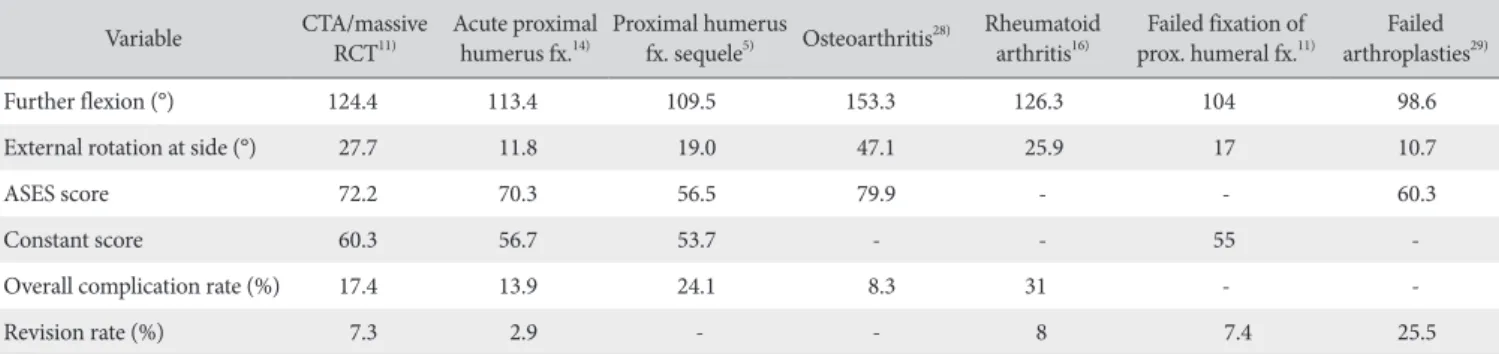
The outcomes of RTSAs according to each etiology are sum- marized in Table 1. Generally, surgical outcomes of RTSA in cas- es of glenohumeral osteoarthritis, CTA, massive rotator cuff tear and rheumatoid arthritis were quite satisfactory. However, the degree of satisfaction with surgical outcomes was relatively lower in patients undergoing RTSA as a revision surgery for repair of proximal humerus fracture and shoulder arthroplasty.
Differences in Outcomes Depending on Several Issues Reverse Total Shoulder
Arthroplasty
There is still debate regarding the factors that may affect surgical outcomes of the RTSA, which include medialization or lateralization of the center of rotation, the degree of humeral retroversion and neck-shaft angle, the suture of the subcapular tendon and differences between the cemeted stem and the un- cemented stem.
The basic concept of RTSA based on the Grammont design focuses on recovery of the upper extremity elevation by medially displacing the center of rotation and thereby improving stability.
However, this remains problematic in that there is an increase in scapular notching and a decrease in the rotational force because of the medialized center of rotation. Therefore, joint prostheses with a more lateralized center of rotation have developed and become commercially available. Lawrence et al.39) conducted a systematic review of 13 recently published studies of RTSA and found that medialzed products (Aequalis [Tornier] and Delta III [DePuy]) had slightly better upper extremity elevation and lower incidence of postoperative complications than lateralized ones (DJO [DJO surgical]). These authors also found that the lateral- ized products had considerably better levels of external rotation than medialized products.
Theoretically, there would be improvements in internal
rotation and decreases in overall impingement if there was a decrease in humeral retroversion. Conversely, there would be improvements in functional ROM as well as external rotation. If there was a increase in the humeral retroversion. Differences in surgical outcomes of RTSA depending on the degree of humeral retroversion have been studied. For example, Rhee et al.40) ana- lyzed differences between a 20° retroversion group and a 0° ret- roversion group using the Aequalis product and found no signifi- cant differences in functional outcomes or ROM. However, the 0°
retroversion group showed better outcomes in association with motions with internal rotation (e.g., back washing or brassiere wearing). Similarly, de Boer et al.41) compared surgical outcomes of the Aequalis product between the 20° retroversion group and the 0° retroversion group and found no significant inter-group differences in ROM, functional outcomes or muscle strength upon final follow-up. In addition, Kontaxis et al.42) compared surgical outcomes of the Zimmer Trabecular Metal Shoulder Sys- tem (Zimmer) between the 0° to 10° retroversion group and the 20° to 30° retroversion group, demonstrating that there were no significant differences in the ROM and functional outcomes on final follow-up. These authors also added that there were no sig- nificant differences in activities of daily living in association with the internal rotation. Overall, it can be inferred that there were no significant differences in the humeral retroversion in a clinical setting, which is not in agreement with the theoretical assump- tions.
Reverse arthroplasty prostheses are commercially available with neck-shaft angles varying from 135° to 155°, and surgical outcomes vary depending on the neck-shaft angle. Erickson et al.43) analyzed 2,222 cases from 38 published studies of RTSA and then compared outcomes among individuals receiving a neck-shaft angle of 135° vs. 155°. They found that the 155°
neck-shaft angle group had a significantly smaller angle of ex- ternal rotation and a significantly higher incidence of scapular notching than the135° neck-shaft angle group (32.9° vs. 23° and 2.83% vs. 16.80%, respectively).
In cases with intact subscapularis tendon or reparable sub- scapularis tears, controversial opinions exist regarding the neces-
Table 1. Outcomes of Reverse Shoulder Arthroplasties according to Etiology (Focusing on Recent Systematic Reviews) Variable CTA/massive
RCT11) Acute proximal
humerus fx.14) Proximal humerus
fx. sequele5) Osteoarthritis28) Rheumatoid
arthritis16) Failed fixation of
prox. humeral fx.11) Failed arthroplasties29)
Further flexion (°) 124.4 113.4 109.5 153.3 126.3 104 98.6
External rotation at side (°) 27.7 11.8 19.0 47.1 25.9 17 10.7
ASES score 72.2 70.3 56.5 79.9 - - 60.3
Constant score 60.3 56.7 53.7 - - 55 -
Overall complication rate (%) 17.4 13.9 24.1 8.3 31 - -
Revision rate (%) 7.3 2.9 - - 8 7.4 25.5
CTA: cuff tear arthropathy, RCT: rorarer cuff tear, fx.: fracture, prox.: proximal, ASES: American Shoulder and Elbow Surgeons.
sity to suture the subscapularis tendon. Some advocate for the suture44,45) because they feel it plays an important role in improv- ing anteror stability and raising the force of internal rotation.
However, others do not advocate for the suture.46,47) These au- thors argue that repair of the subscapularis may further decrease the force of the external rotation and act as an adductor rather than an internal rotator. Thus, these authors maintain that repair of the subscapularis would prevent the deltoid muscle from elevating the arm. The need to suture the subscapularis tendon has been studied by several authors, all of whom agreed that the subscapularis tendon did not affect the ROM, functional out- comes, muscle strength or incidence of postoperative complica- tions in patients undergoing RTSA.40,48-50) This leads to the specu- lation that it would not be mandatory to suture the subscapularis tendon during RTSA.
The use of cement during the placement of humeral prosthe- ses for the RTSA raises the initial stability, but is disadvantageous in that it prolongs the operation time and makes it difficult to remove the prosthesis for a revision surgery. Therefore, there has been an increase in the use of cementless stems. In association with this, Phadnis et al.51) conducted a systematic review of 41 studies of RTSA (1,784 cases) and found that the use of cement was not associated with the ROM and functional outcomes, although the cementless stem group had a significantly lower incidence of complications. Based on these reports, it can be in- ferred that the use of cemetless stem would be more beneficial in reducing the operation time and the difficulty of revision sur- gery. They recommended the use of cementless stem in RTSA, unless the cemented stem is inevitable, such as revision surgery or fracture surgery.
Conclusions
Indications of RTSA have been persistently extended with technical advancements in reverse arthroplasty prosthesis, ac- cumulated experiences and its successful treatment outcomes.
Accordingly, its use has rapidly increased. This increase in use has been accompanied by continuous improvements in reverse arthroplasty prosthesis. In this situation, recent update in out- comes after RTSA deserve special attention. The RTSA has been performed for a variety of indications, their outcomes should be evaluated depending on the initial diagnosis. Moreover, its surgi- cal outcomes also vary depending on the initial diagnosis. The surgical outcomes of RTSA in cases of glenohumeral osteoarthri- tis, CTA, massive rotator cuff tear and rheumatoid arthritis were quite satisfactory. However, the degree of satisfaction with surgi- cal outcomes was relatively lower in patients undergoing RTSA as a revision surgery to repair proximal humerus fracture and shoulder arthroplasty. Moreover, controversial opinions still exist regarding the internal or external location of the center of rota- tion, the neck-shaft angle of the humeral prosthesis, suture of the
subscapularis tendon, use of cement during placement of the humeral prosthesis, the design of reverse arthroplasty prosthesis and surgical procedures. Accordingly, additional studies should be conducted to better understand these aspects of RTSA.
References
1. Villacis D, Sivasundaram L, Pannell WC, Heckmann N, Omid R, Hatch GF 3rd. Complication rate and implant survival for reverse shoulder arthroplasty versus total shoulder arthroplasty:
results during the initial 2 years. J Shoulder Elbow Surg. 2016;
25(6):927-35.
2. Zhou HS, Chung JS, Yi PH, Li X, Price MD. Management of complications after reverse shoulder arthroplasty. Curr Rev Musculoskelet Med. 2015;8(1):92-7.
3. Favard G, Walch G. Long term survival rate of the reverse shoulder arthroplasty. Paris Shoulder Course. 2013.
4. Triplet JJ, Everding NG, Levy JC, et al. Anatomic and reverse total shoulder arthroplasty in patients older than 80 years. Or- thopedics. 2015;38(10):e904-10.
5. Castricini R, Gasparini G, Di Luggo F, De Benedetto M, De Gori M, Galasso O. Health-related quality of life and function- ality after reverse shoulder arthroplasty. J Shoulder Elbow Surg.
2013;22(12):1639-49.
6. Somerson JS, Neradilek MB, Hsu JE, Service BC, Gee AO, Matsen FA 3rd. Is there evidence that the outcomes of primary anatomic and reverse shoulder arthroplasty are getting better?
Int Orthop. 2017;41(6):1235-44.
7. Al-Hadithy N, Domos P, Sewell MD, Pandit R. Reverse shoul- der arthroplasty in 41 patients with cuff tear arthropathy with a mean follow-up period of 5 years. J Shoulder Elbow Surg.
2014;23(11):1662-8.
8. Samuelsen BT, Wagner ER, Houdek MT, et al. Primary reverse shoulder arthroplasty in patients aged 65 years or younger. J Shoulder Elbow Surg. 2017;26(1):e13-7.
9. Makhni EC, Swart E, Steinhaus ME, et al. Cost-effectiveness of reverse total shoulder arthroplasty versus arthroscopic rotator cuff repair for symptomatic large and massive rotator cuff tears.
Arthroscopy. 2016;32(9):1771-80.
10. Morris BJ, Haigler RE, O’Connor DP, Elkousy HA, Gartsman GM, Edwards TB. Outcomes of staged bilateral reverse shoul- der arthroplasties for rotator cuff tear arthropathy. J Shoulder Elbow Surg. 2015;24(3):474-81.
11. Petrillo S, Longo UG, Papalia R, Denaro V. Reverse shoulder arthroplasty for massive irreparable rotator cuff tears and cuff tear arthropathy: a systematic review. Musculoskelet Surg.
2017;101(2):105-12.
12. Hasty EK, Jernigan EW 3rd, Soo A, Varkey DT, Kamath GV.
Trends in surgical management and costs for operative treat- ment of proximal humerus fractures in the elderly. Orthope- dics. 2017;40(4):e641-7.
13. van der Merwe M, Boyle MJ, Frampton CMA, Ball CM. Re- verse shoulder arthroplasty compared with hemiarthroplasty in the treatment of acute proximal humeral fractures. J Shoulder Elbow Surg. 2017;26(9):1539-45.
14. Longo UG, Petrillo S, Berton A, Denaro V. Reverse total shoulder arthroplasty for the management of fractures of the proximal humerus: a systematic review. Musculoskelet Surg.
2016;100(2):83-91.
15. Mata-Fink A, Meinke M, Jones C, Kim B, Bell JE. Reverse shoulder arthroplasty for treatment of proximal humeral frac- tures in older adults: a systematic review. J Shoulder Elbow Surg. 2013;22(12):1737-48.
16. Ferrel JR, Trinh TQ, Fischer RA. Reverse total shoulder arthro- plasty versus hemiarthroplasty for proximal humeral fractures:
a systematic review. J Orthop Trauma. 2015;29(1):60-8.
17. Namdari S, Horneff JG, Baldwin K. Comparison of hemiar- throplasty and reverse arthroplasty for treatment of proximal humeral fractures: a systematic review. J Bone Joint Surg Am.
2013;95(18):1701-8.
18. Chen L, Xing F, Xiang Z. Effectiveness and safety of interven- tions for treating adults with displaced proximal humeral fracture: a network meta-analysis and systematic review. PLoS One. 2016;11(11):e0166801.
19. Shukla DR, McAnany S, Kim J, Overley S, Parsons BO. Hemi- arthroplasty versus reverse shoulder arthroplasty for treatment of proximal humeral fractures: a meta-analysis. J Shoulder El- bow Surg. 2016;25(2):330-40.
20. Formaini NT, Everding NG, Levy JC, Rosas S. Tuberosity heal- ing after reverse shoulder arthroplasty for acute proximal humerus fractures: the “black and tan” technique. J Shoulder Elbow Surg. 2015;24(11):e299-306.
21. Levy JC, Badman B. Reverse shoulder prosthesis for acute four-part fracture: tuberosity fixation using a horseshoe graft. J Orthop Trauma. 2011;25(5):318-24.
22. Boileau P, Chuinard C, Le Huec JC, Walch G, Trojani C.
Proximal humerus fracture sequelae: impact of a new radio- graphic classification on arthroplasty. Clin Orthop Relat Res.
2006;442:121-30.
23. Holton J, Yousri T, Arealis G, Levy O. The role of reverse shoul- der arthroplasty in management of proximal humerus fractures with fracture sequelae: a systematic review of the literature.
Orthop Rev (Pavia). 2017;9(1):6977.
24. Raiss P, Edwards TB, Collin P, et al. Reverse shoulder arthroplas- ty for malunions of the proximal part of the humerus (Type-4 Fracture Sequelae). J Bone Joint Surg Am. 2016;98(11):893-9.
25. Kılıç M, Berth A, Blatter G, et al. Anatomic and reverse shoul- der prostheses in fracture sequelae of the humeral head. Acta Orthop Traumatol Turc. 2010;44(6):417-25.
26. Walch G, Badet R, Boulahia A, Khoury A. Morphologic study of the glenoid in primary glenohumeral osteoarthritis. J Arthro- plasty. 1999;14(6):756-60.
27. McFarland EG, Huri G, Hyun YS, Petersen SA, Srikumaran U.
Reverse total shoulder arthroplasty without bone-grafting for severe glenoid bone loss in patients with osteoarthritis and in- tact rotator cuff. J Bone Joint Surg Am. 2016;98(21):1801-7.
28. Steen BM, Cabezas AF, Santoni BG, et al. Outcome and value of reverse shoulder arthroplasty for treatment of glenohumeral osteoarthritis: a matched cohort. J Shoulder Elbow Surg. 2015;
24(9):1433-41.
29. Postacchini R, Carbone S, Canero G, Ripani M, Postacchini F.
Reverse shoulder prosthesis in patients with rheumatoid arthri- tis: a systematic review. Int Orthop. 2016;40(5):965-73.
30. Konrad G, Bayer J, Hepp P, et al. Open reduction and internal fixation of proximal humeral fractures with use of the locking proximal humerus plate. Surgical technique. J Bone Joint Surg Am. 2010;92 Suppl 1 Pt 1:85-95.
31. Garofalo R, Flanagin B, Castagna A, Lo EY, Krishnan SG. Re- verse shoulder arthroplasty for proximal humerus fracture using a dedicated stem: radiological outcomes at a minimum 2 years of follow-up-case series. J Orthop Surg Res. 2015;
10:129.
32. Grubhofer F, Wieser K, Meyer DC, Catanzaro S, Schürholz K, Gerber C. Reverse total shoulder arthroplasty for failed open reduction and internal fixation of fractures of the proximal hu- merus. J Shoulder Elbow Surg. 2017;26(1):92-100.
33. Dezfuli B, King JJ, Farmer KW, Struk AM, Wright TW. Out- comes of reverse total shoulder arthroplasty as primary versus revision procedure for proximal humerus fractures. J Shoulder Elbow Surg. 2016;25(7):1133-7.
34. Day JS, Lau E, Ong KL, Williams GR, Ramsey ML, Kurtz SM.
Prevalence and projections of total shoulder and elbow arthro- plasty in the United States to 2015. J Shoulder Elbow Surg.
2010;19(8):1115-20.
35. Randelli P, Randelli F, Compagnoni R, et al. Revision reverse shoulder arthroplasty in failed shoulder arthroplasties for rota- tor cuff deficiency. Joints. 2015;3(1):31-7.
36. Holschen M, Franetzki B, Witt KA, Liem D, Steinbeck J. Is reverse total shoulder arthroplasty a feasible treatment option for failed shoulder arthroplasty? A retrospective study of 44 cases with special regards to stemless and stemmed primary implants. Musculoskelet Surg. 2017;101(2):173-80.
37. Holschen M, Franetzki B, Witt KA, Liem D, Steinbeck J. Con- versions from anatomic shoulder replacements to reverse total shoulder arthroplasty: do the indications for initial surgery influence the clinical outcome after revision surgery? Arch Or- thop Trauma Surg. 2017;137(2):167-72.
38. Black EM, Roberts SM, Siegel E, Yannopoulos P, Higgins LD, Warner JJ. Reverse shoulder arthroplasty as salvage for failed prior arthroplasty in patients 65 years of age or younger. J Shoulder Elbow Surg. 2014;23(7):1036-42.
39. Lawrence C, Williams GR, Namdari S. Influence of gle- nosphere design on outcomes and complications of re-
verse arthroplasty: a systematic review. Clin Orthop Surg.
2016;8(3):288-97.
40. Rhee YG, Cho NS, Moon SC. Effects of humeral component retroversion on functional outcomes in reverse total shoulder arthroplasty for cuff tear arthropathy. J Shoulder Elbow Surg.
2015;24(10):1574-81.
41. de Boer FA, van Kampen PM, Huijsmans PE. Is there any influ- ence of humeral component retroversion on range of motion and clinical outcome in reverse shoulder arthroplasty? A clini- cal study. Musculoskelet Surg. 2017;101(1):85-9.
42. Kontaxis A, Chen X, Berhouet J, et al. Humeral version in re- verse shoulder arthroplasty affects impingement in activities of daily living. J Shoulder Elbow Surg. 2017;26(6):1073-82.
43. Erickson BJ, Frank RM, Harris JD, Mall N, Romeo AA. The influence of humeral head inclination in reverse total shoul- der arthroplasty: a systematic review. J Shoulder Elbow Surg.
2015;24(6):988-93.
44. Chalmers PN, Rahman Z, Romeo AA, Nicholson GP. Early dislocation after reverse total shoulder arthroplasty. J Shoulder Elbow Surg. 2014;23(5):737-44.
45. Edwards TB, Williams MD, Labriola JE, Elkousy HA, Gartsman GM, O’Connor DP. Subscapularis insufficiency and the risk of shoulder dislocation after reverse shoulder arthroplasty. J
Shoulder Elbow Surg. 2009;18(6):892-6.
46. Clark JC, Ritchie J, Song FS, et al. Complication rates, disloca- tion, pain, and postoperative range of motion after reverse shoulder arthroplasty in patients with and without repair of the subscapularis. J Shoulder Elbow Surg. 2012;21(1):36-41.
47. Routman HD. The role of subscapularis repair in reverse total shoulder arthroplasty. Bull Hosp Jt Dis (2013). 2013;71 Suppl 2:
108-12.
48. Vourazeris JD, Wright TW, Struk AM, King JJ, Farmer KW. Pri- mary reverse total shoulder arthroplasty outcomes in patients with subscapularis repair versus tenotomy. J Shoulder Elbow Surg. 2017;26(3):450-7.
49. de Boer FA, van Kampen PM, Huijsmans PE. The influence of subscapularis tendon reattachment on range of motion in reversed shoulder arthroplasty: a clinical study. Musculoskelet Surg. 2016;100(2):121-6.
50. Grassi FA, Zorzolo I. Reverse shoulder arthroplasty without subscapularis repair for the treatment of proximal humeral fractures in the elderly. Musculoskelet Surg. 2014;98 Suppl 1:
5-13.
51. Phadnis J, Huang T, Watts A, Krishnan J, Bain GI. Cemented or cementless humeral fixation in reverse total shoulder arthro- plasty? A systematic review. Bone Joint J. 2016;98(1):65-74.