• 검색 결과가 없습니다.

Spore Associated Bacteria (SAB) of Arbuscular Mycorrhizal Fungi (AMF) and Plant Growth Promoting Rhizobacteria (PGPR) Increase Nutrient Uptake and Plant Growth Under Stress Conditions

N/A
N/A
Protected

Academic year: 2021

Share "Spore Associated Bacteria (SAB) of Arbuscular Mycorrhizal Fungi (AMF) and Plant Growth Promoting Rhizobacteria (PGPR) Increase Nutrient Uptake and Plant Growth Under Stress Conditions"

Copied!
11
0
0

로드 중.... (전체 텍스트 보기)

전체 글

(1)

Spore Associated Bacteria (SAB) of Arbuscular Mycorrhizal Fungi (AMF) and Plant Growth Promoting Rhizobacteria (PGPR) Increase Nutrient Uptake and

Plant Growth Under Stress Conditions

Selvakumar Gopal, Murugesan Chandrasekaran, Charlotte Shagol, Kiyoon Kim, and Tongmin Sa*

Department of Agricultural Chemistry, Chungbuk National University, Cheongju, Chungbuk 361-763, Republic of Korea

Microorganisms present in the rhizosphere soil plays a vital role in improving the plant growth and soil fertility. Many kinds of fertilizers including chemical and organic has been approached to improve the productivity. Though some of them showed significant improvement in yield, they failed to maintain the soil properties. Rather they negatively affected soil eventually, the land became unsuitable for agricultural. To overcome these problems, microorganisms have been used as effective alternative. For past few decades, plant growth promoting rhizobacteria (PGPR) and arbuscular mycorrhizal fungi (AMF) have been used as effective inoculants to enhance the plant growth and productivity. PGPR improves the plant growth and helps the plant to withstand biotic and abiotic stresses. AM fungi are known to colonize roots of plants and they increase the plant nutrient uptake. Spore associated bacteria (SAB) are attached to spore wall or hyphae and known to increase the AMF germination and root colonization but their mechanism of interaction is poorly known.

Better understanding the interactions among AMF, SAB and PGPR are necessary to enhance the quality of inoculants as a biofertilizers. In this paper, current knowledge about the interactions between fungi and bacteria are reviewed and discussed about AMF spore associated bacteria.

Key words: Arbuscular mycorrhizal fungi, Spore associated bacteria, PGPR, Co-inoculation, Stress tolerance

Received : 2012. 7. 18 Accepted : 2012. 8. 13

*Corresponding author : Phone: +82432612561 E-mail: [email protected]

Introduction

Human population is ever increasing and it will require minimum 3 to 4% of increased agricultural production every year (Cantrell and Linderman, 2001). But the availability of arable land seems unchanged, in which certain percentage of land faces different kind of stresses like salt, drought, and metal due to climate change, organic fertilizer, and continuous irrigation. Among 1.5 billion hectares of cultivable land present in the world, 77 million hectares (5%) are not favorable for good yield because of high salt content (Abdel Latef and Chaoxing, 2011) and 20% of the irrigated agricultural land is adversely affected by salinity (Wu et al., 2010). Salt-affected soils are increasing steadily in all continents, in particular arid and semi-arid areas and they cover more than 7% of the total land surface in earth (Evelin et al., 2009; Tian et al., 2004), it represents that salt stress is a major limiting

factor in crop production. Soil salinity increases the osmotic stress in plants and hence the crop yield decreases, high concentration of Na

+

and Cl

-

present in the saline soil results nutrient imbalance, reduce nutrient uptake including P, and ion toxicity of plants (Daei et al., 2009). The significance of soil salinity for agricultural yield is enormous and various salt concentrations can be elevated. Continuous irrigation can increase the concent- ration of calcium and magnesium carbonates, lands with geological marine history or prolonged deposition of wind-borne marine salts, where not enough rainfall to leach the salts, soils can be tested positively for salinity stress (Tester and Davenport, 2003).

High concentration of salt in soil can affect the plants in

four ways, 1. Induce drought stress: decreased water

content and nutrient availability due to increased osmotic

pressure of the soil solution, this causes nutrient deficiency,

growth reduction, and wilting (Colla et al., 2008). 2. Ion

toxicity: excessive uptake of Na

+

and Cl

-

affects cell

membrane functioning (Daei et al., 2009) and cell

metabolism by reducing enzyme activities this leads to

growth inhibition and injury of the foliage. 3. Ion

(2)

Table 1. Plant inoculated with arbuscular mycorrhizal fungi and its response under stress conditions.

AMF spores Crop Plant responses References

Glomus mosseae,

G. intraradices Pepper Increased the growth and plants had higher P

and chlorophyll content. Cekic et al., (2012)

G. mosseae

Tomato (Lycopersicon esculentum cv Zhongzha105)

Improved dry matter, leaf area, fruit fresh weight and fruit yield. Chlorophyll content and P, Na, K concentrations were high.

Abdel Latef and Chaoxing, (2011)

Glomus mosseae Peanut The salt-tolerance capacity of AM plant was

increased, water content was increased. Al-Khaliel, (2010) G. mosseae,

G.versiforme Trifoliate orange

Improved salt stress. Notably elevated the soluble protein, ASC and GSH contents of the seedlings.

Wu et al., (2010)

Glomus etunicatum, G. mosseae, G. intraradices

Tabasi (Mutated) Higher concentrations of P, K, Zn and grain

yield of Tabasi. More translocation of C. Daei et al., (2009)

G. intraradices Zucchini squash (Cucurbita pepo L.)

Improved growth, yield, water status, higher K

and lower Na concentration in leaf tissue. Colla et al., (2008) imbalance: ion competition reduces the nutrient uptake,

transport and internal distribution such as K, Mg, Ca, P, and N. 4. Soil compaction: high concentrations of Na

+

increases soil pH and destructs soil structure with impaired drainage and root growth (Weissenhorn, 2002).

To alleviate salt stress and reduce the crop loss, scientists have searched for new salt-tolerant crop plants (Gallagher, 1985; Evelin et al., 2009) and they found improved salt-tolerant plant through breeding techniques (Cuartero and Fernandez-Munoz, 1999; Colla et al., 2008). To overcome the detrimental effects of salt stress, scientists are also engineering the genetically modified genes to improve the plant stress tolerant (Zhang and Blumwald, 2001). Though these technologies are most successful, implementing the techniques require much investment and it stays beyond the economic means of developing nations (Evelin et al., 2009).

Multiple biochemical methods has been conducted on plants to determine their ability to tolerate the stress conditions that facilitated to uptake more water, minimizes the chloroplast damage, and maintains ion homeostasis (Parida and Das, 2005). In recent years, the biological method is most wildly used to alleviate the soil stresses including salinity and it has received a greater attention (Daei et al., 2009; Miransari, 2009; Cekic et al., 2012). In natural environment, plants are capable to be colonized by both internal and external microorganisms. Some microorganisms, particularly halotolerant bacteria and fungi can improve plant performance under saline stress and, consequently, enhance yield (Siddikee et al., 2010).

AMF and stress

Arbuscular mycorrhizal fungi (AMF) are obligate biotrophs that forms symbiotic or mutualistic association with roots of about 80% of plant species (Rai, 2001;

Bianciotto et al., 2000; Hildebrandt et al., 2002; Cekic et al., 2012). The interaction between AMF and host plants under different conditions has received greater attention because of their mutual association (Miransari, 2009) especially when they are subjected to stresses. AMF widely exist in salt-affected soils (Abdel Latef and Chaoxing, 2011). Aliasgharzadeh et al. (2001) observed that the number of spores did not significantly decrease with increasing soil salinity (mean of 100 per 10 g soil).

The higher fungal spore density in saline soils represent that the sporulation is stimulated under salt stress (Tresner and Hayes, 1971) it concludes that AMF may produce spores at low root-colonization levels in severe saline conditions (Aliasgharzadeh et al., 2001). Though many reports (Al-Khaliel, 2010; Tian et al., 2004;

Sannazzaro et al., 2006; Giri and Mukerji, 2004) reveals

that AMF spores are sustainable under salinity stress, few

states that high saline content present in the soil (150 mM

NaCl) may inhibit the AMF spore germination, hyphae

growth, and hyphal spreading after initial infection

(McMillen et al., 1998). Tian et al. (2004) reported that

though increasing NaCl level reduced the mycorrhizal

colonization, mycorrhizal fungi dependency of cotton

plants was increased. Recent works carried on plants

inoculated with AMF under stress conditions and plant

responses to stresses are listed in Table 1.

(3)

Table 1. Plant inoculated with arbuscular mycorrhizal fungi and its response under stress conditions. (Countined)

AMF spores Crop Plant responses References

G. intraradices L. glaber Improved salt tolerance, had higher protein,

chlorophyll level, water and K

+

/Na

+

ratio. Sannazzaro et al., (2006)

G. clarum Mungbean

(V. radiata var.

significantly increased the dry weight, height, chlorophyll, sugar protein content, – and P-use efficiencies, nitrogenase, acid and alkaline phosphatase activities,

Rabie, (2005)

G. macrocarpum S. aegyptiaca S. grandiflora

Improved growth rate and salt-tolerance and suppress the adverse effect of salinity stress.

Number of nodules was higher. High concentration of P.

Giri and Mukerji, (2004)

G. mosseae Cotton With increasing NaCl, increased mycorrhizal

dependency. Increased P uptake. Tian et al., (2004)

Glomus mosseae Maize (Zeamays L.)

Plants colonized by G.mosseae can alleviate the deleterious effects of NaCl stress.

Significantly increased P, chlorophyll content and soluble sugar concentration.

Feng et al., (2002)

Glomus intraradices, G. aggregatum Glomus sp.

Onion (Alliumcepa L) Lettuce (Lactucasativa L.)

Greater fresh and dry shoot mass. Greater concentrations of P, Zn, Cu, Na, and Fe.

Cantrell and Linderman, (2001)

G. mosseae Alfalfa, Medicagosativa L. cv. Aragon

Incresed growth and nutrition. Nodule formation was greater.

Azcon and El-Atrash, (1997)

G. intraradices Guayule, var. LA-1 Two – fivefold increased growth. Decreased

concentrations of Cu and Zn. Pfeiffer and Bloss, (1988)

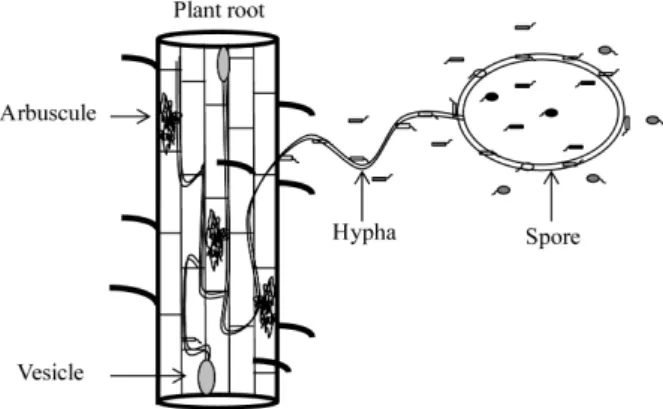
Fig. 1. Arbuscular mycorrhizal colonization. Plant root is colonized by newly germinated spore (S) hyphae and previously colonized root hyphae (arrow) (Peterson et al., 2004).

Interaction between AMF and plant root

An Arbuscular mycorrhizal fungus germinates when the conditions are favor and they colonize the roots and rhizosphere soil by forming hyphae. In most plants, AMF colonizes the root cortex cells by penetrating through epidermal cells. AMF can positively interact with roots without causing any damage to host plant. AMF hyphae infect the roots intercellularly and intracellularly, arbuscules formation is the main future of AM symbiosis (Bago et al., 1998). Intercellular hypha penetrates the plant roots and forms arbuscules inside cortical cells without disturbing cell protoplast (Alexander et al., 1988) whereas the extraradical hypha penetrates in soil and serves as nutrient absorber. Arbuscular mycorrhizal fungi also forms vesicle, a nutrient storage place in between the cells of roots. Roots can be colonized by hyphae germinated either from the new spore or from the previously colonized roots; Fig. 1 illustrates both existing and newly germinated hyphae colonization.

AMF associations in different species formed two distinctive morphology types by the method of colonization and it has been named as Arum-type and Paris-type (Brundrett, 2004). In linear (Arum-type) association hyphae grows

longitudinally and proliferates in the cortex of host cells.

This occurs because hyphae grow through longitudinal

intercellular air spaces. In coiling (Paris-type) association

there are no continuous longitudinal air spaces so hyphae

spread by forming coils within the cells.

(4)

Table 2. Isolated and identified associated bacteria of AMF and its origin.

AMF spore Associated Bacteria Bacteria isolated from Reference

G. margarita Bacillus sp.,

B. thuringiensis. Liquid present inside the spore Cruz and Ishii, (2011) G. intraradices,

G. mosseae

Pseudomonas sp., Arthrobacter sp., Paenibacillus sp.

Spore surface and inside. Bharadwaj et al., (2008)

Glomus dussii Bacillus cereus Hyphae (attached to) González-Chávez et al., (2008) G. margarita Janthinobacterium sp. Inside the spores Cruz et al., (2007)

G. margarita Bacillus asahii,

Methylobacterium sp. Around the spore and hyphae. Horii and Ishii, (2006)

Glomus constrictum, Glomus geosporum

Cytophaga-Flexibacter-Bacteroides group,

Fibrobacteres Acidobacteriagroup, Betaproteobacteria,

Gammaproteobacteria, Deltaproteobacteria.

Laminated layer or embedded in the sloughing hyaline layer and holes within the outer layer of the spores.

Roesti et al., (2005)

G. clarum

Alcaligenes, Bacillus sp., Burkholderia, Flavobacterium, Pseudomonas sp.

Surface of the spores after decon- tamination for 0 min, 30 min, 45 min and 60 min.

Xavier and Germida, (2003) Fig. 2. Occurrence of microorganisms in mycorrhizospher.

- Spore associated bacteria; - Endosymbiotic bacteria; - Rhizosphere bacteria.

Spore Associated Bacteria (SAB)

It is well established that the composition of bacterial communities associated in the mycorrhizosphere may influenced by arbuscular mycorrhizal fungi. The place where rhizosphere bacterial communities and fungi interact is commonly referred as mycorrhizosphere. Various mechanisms has been proposed by this interaction, including spore germination (Bharadwaj et al., 2011), biocontrol (Li et al., 2007), metal tolerance (González-Chávez et al., 2008). Xavier and Germida (2003) reported that the spore associated bacteria of Glomus clarum may specifi-

cally stimulate spore germination. Although the fungi and its close proximity of bacteria interaction seem logical, little is known about the extent that which bacteria associate with which AMF and their specificity for interaction (Toljander et al., 2005). Scientists have identified and isolated spore associated bacteria from spore surface, inside spore, and around hyphae. Fig. 2 demonstrates the occurrence of microorganism presents in and around the spore. Members of bacterial genus Bacillus, Pseudomonas, Paenibacillus, Burkholderia, and Arthrobacter are found to be associated with AMF (Horii and Ishii, 2006;

Bharadwaj et al., 2008; Mansfeld-Giese et al., 2002; Levy et al., 2009; González-Chávez et al., 2008). Levy et al.

(2003) demonstrated that Burkholderia sp. including B.

vietnamiensis, B. cepacia, and B. pseudomallei grown on germinating AMF spore Gigaspora decipiens were capable of entering into spores. He also stated among these, B. vietnamiensis invaded 12% of spores, and B.

pseudomallei invaded 7% of spores. Some isolated spore associated bacteria and its origin are listed in Table 2.

SAB role in mycorrhizosphere

Bacteria have been observed to live in close association

with AMF. Plant in association with AMF and its

associated bacteria can sustain stressful environments

(5)

like metal stress (González-Chávez et al., 2008), antioxidant enzymes activity (Abdel Latef and Chaoxing, 2011).

Depends upon the environment, spores can associate with different species of rhizosphere bacteria. Certain arbuscular mycorrhizal fungi hyphae produce hydrolytic enzymes which hydrolyses the biopolymers such as protein, chitin and cellulose that will help the AMF to degrade the plant cell walls and infect them. Bharadwaj et al. (2008) reported that the early colonization of potato roots by G.

mosseae was stimulated by its spore associated bacteria of Pseudomonas sp. Bacteria B. pabuli isolated from spore G. clarum increased the shoot dry weight of pea plant (Xavier and Germida, 2003). In addition to the application of plant growth, SAB also plays an important role in biocontrol by inhibiting the plant pathogens. Li et al. (2007) has reported that AMF associated bacteria Paenibacillus had the ability to prevent pre-emergence damping-off caused by P. aphanidermatum in cucumber seedling. Soil serves as central storage system for all plant nutrients including carbon. AMF hypha in soil produces glomalin a glycoprotein (Wright and Upadhyaya, 1998) which has a carbon and nitrogen storing properties.

Glomalin protein helps formation of ‘sticky’ string-bag of hyphae (Jastrow et al., 1998) which helps in formation of soil aggregates and improves water stability and decreases the soil erosion.

PGPR

In the last few decades, microorganisms have been used in agriculture with the aim of improving nutrients availability for plants. The bacteria present in the rhizosphere soil have been isolated and tested for their efficiency in plant growth promotion. The use of plant growth promoting rhizobacteria (PGPR) for sustainable agriculture has been wildly used and reported signifi- cantly increased plant growth and yield in economically important crops (Madhaiyan et al., 2010; Siddikee et al., 2011; Chabot et al., 1996). Various species of bacteria like Pseudomonas, Azospirillum, Azotobacter, Enterobacter, Alcaligenes, Arthrobacter, Burkholderia, Bacillus, Methylo- bacterium and Serratia have been reported to enhance the plant growth (Joseph et al., 2007; Kloepper et al., 1989;

Poonguzhali et al., 2008) by either direct or indirect mechanisms. Some of the mechanisms had close attention because of their importance in plant growth which includes 1. mineral nutrient solubilization (Madhaiyan et al., 2010; Zahran, 1999) 2. antagonistic activity (Kumar

et al., 2012) 3. alleviation of plant stress tolerance to salinity, drought, and metal toxicity (Siddikee et al., 2011; Sandhya et al., 2010) 4. phytohormones production (Merzaeva and Shirokikh, 2010). Ethylene is a plant hormone and it is required for seed germination by many plant species. Low level ethylene appears to enhance the root initiation but high level ethylene produced by fast growing roots can inhibit the root elongation (Ma et al., 1998). 1-Aminocyclopropane-1-carboxylic acid (ACC) is the immediate precursor of ethylene, ACC deaminase containing microorganisms hydrolyses ACC into ammonia and α-ketobutyrate (Glick et al., 1998). Lowering the endogenous ethylene level eliminates the inhibitory effects of higher ethylene concentration (Zahir et al., 2011).

Combined inoculation of AMF, SAB and PGPR

Plants can interact with several soil microorganisms, including plant growth–promoting rhizobacteria (PGPR) and arbuscular mycorrhizal fungi (AMF), most of the studies has been conducted separately either with PGPR or AMF to test their ability to promote the plant growth.

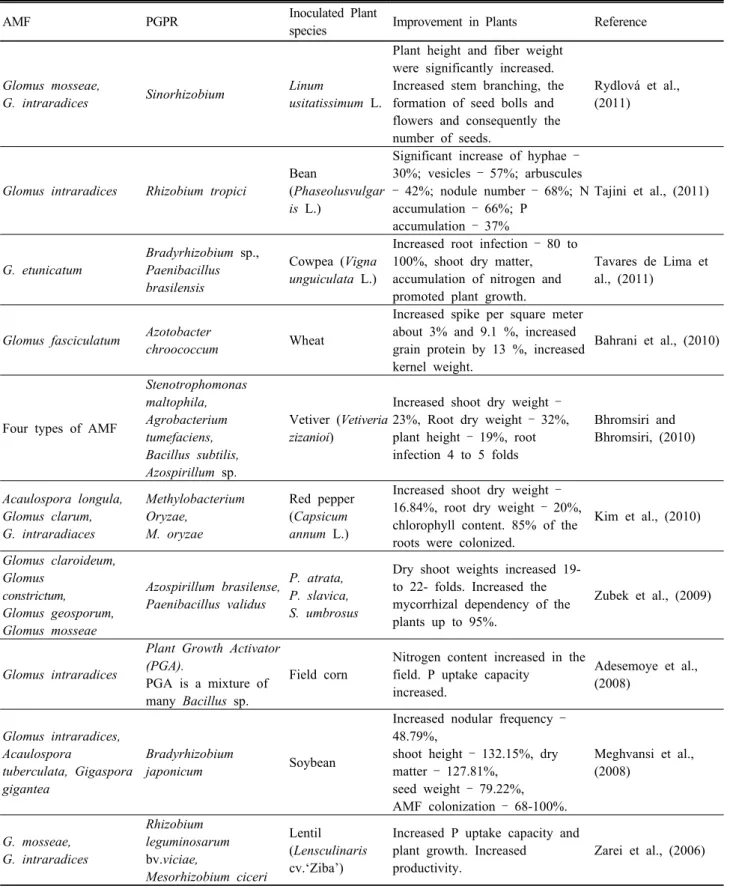
Spore associated bacteria are closely attached to fugal spore surface or hyphae. In soil ecosystems, a better understanding of interaction between AMF and rhizosphere bacteria, particularly PGPRs are essential to ensure the beneficial release of agronomically useful inoculants (Bianciotto et al., 1996). It is reported that SAB can also act as PGPR and it is naturally bound to AMF spores (Bharadwaj et al., 2008). In recent findings, the synergistic effects of AMF and PGPR combined inoculation have been demonstrating beneficial impact on plants. There are many reports (Adesemoye et al., 2008; Zarei et al., 2006;

Kim et al., 2010; Tajini et al., 2011) proposed that the

co-inoculation of fungi and bacteria improves the nutrient

uptake and plant growth (Table 3), still there is only little

information known about the mechanism of controlling

bacteria and AMF in plant roots in mycorrhizosphere

(Artursson et al., 2006). Though exact mechanism is not

well known, Bharadwaj et al. (2011) claims that the

spore’s secreted compound makes the environment

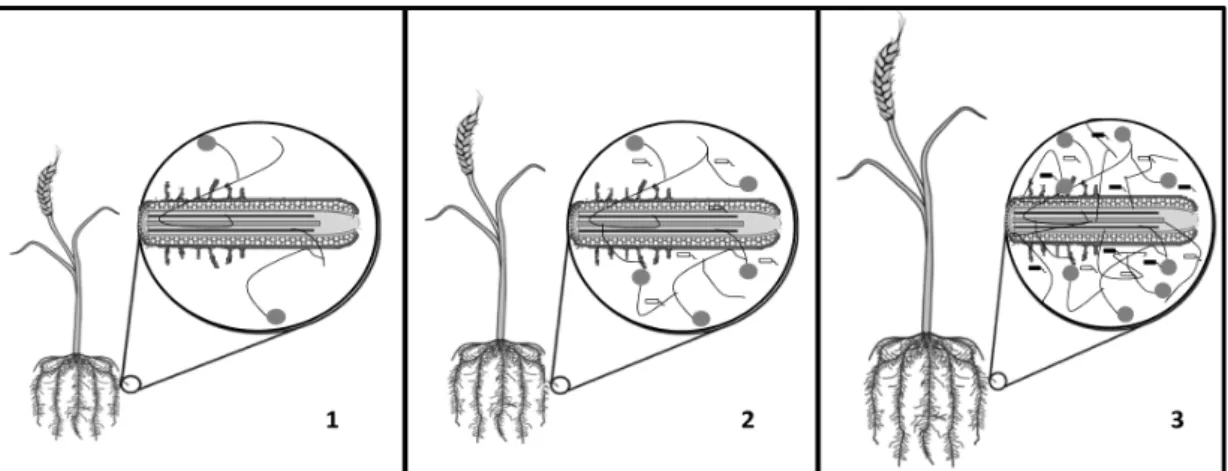
favourable for supporting the growth of bacteria. Based

on the results published for co-inoculation effects of

SAB, AMF and PGPR, Fig. 3 represents the assumption

of plant response for this combined inoculation.

(6)

Table 3. AMF and PGPR co-inoculation effect in different plant species.

AMF PGPR Inoculated Plant

species Improvement in Plants Reference

Glomus mosseae,

G. intraradices Sinorhizobium Linum

usitatissimum L.

Plant height and fiber weight were significantly increased.

Increased stem branching, the formation of seed bolls and flowers and consequently the number of seeds.

Rydlová et al., (2011)

Glomus intraradices Rhizobium tropici

Bean

(Phaseolusvulgar is L.)

Significant increase of hyphae – 30%; vesicles – 57%; arbuscules – 42%; nodule number – 68%; N accumulation – 66%; P

accumulation – 37%

Tajini et al., (2011)

G. etunicatum

Bradyrhizobium sp., Paenibacillus brasilensis

Cowpea (Vigna unguiculata L.)

Increased root infection – 80 to 100%, shoot dry matter, accumulation of nitrogen and promoted plant growth.

Tavares de Lima et al., (2011)

Glomus fasciculatum Azotobacter

chroococcum Wheat

Increased spike per square meter about 3% and 9.1 %, increased grain protein by 13 %, increased kernel weight.

Bahrani et al., (2010)

Four types of AMF

Stenotrophomonas maltophila, Agrobacterium tumefaciens, Bacillus subtilis, Azospirillum sp.

Vetiver (Vetiveria zizanioi)

Increased shoot dry weight – 23%, Root dry weight – 32%, plant height – 19%, root infection 4 to 5 folds

Bhromsiri and Bhromsiri, (2010)

Acaulospora longula, Glomus clarum, G. intraradiaces

Methylobacterium Oryzae,

M. oryzae

Red pepper (Capsicum annum L.)

Increased shoot dry weight – 16.84%, root dry weight – 20%, chlorophyll content. 85% of the roots were colonized.

Kim et al., (2010)

Glomus claroideum, Glomus

constrictum, Glomus geosporum, Glomus mosseae

Azospirillum brasilense, Paenibacillus validus

P. atrata, P. slavica, S. umbrosus

Dry shoot weights increased 19- to 22- folds. Increased the mycorrhizal dependency of the plants up to 95%.

Zubek et al., (2009)

Glomus intraradices

Plant Growth Activator (PGA).

PGA is a mixture of many Bacillus sp.

Field corn

Nitrogen content increased in the field. P uptake capacity

increased.

Adesemoye et al., (2008)

Glomus intraradices, Acaulospora

tuberculata, Gigaspora gigantea

Bradyrhizobium

japonicum Soybean

Increased nodular frequency – 48.79%,

shoot height – 132.15%, dry matter – 127.81%,

seed weight – 79.22%, AMF colonization – 68-100%.

Meghvansi et al., (2008)

G. mosseae, G. intraradices

Rhizobium leguminosarum bv.viciae,

Mesorhizobium ciceri

Lentil (Lensculinaris cv.‘Ziba’)

Increased P uptake capacity and plant growth. Increased

productivity.

Zarei et al., (2006)

Nutrient uptake Phosphorus, nitrogen, zinc, and copper are the most commonly reported elements for plant; these elements uptake can be enhanced by AMF.

Most of the elements including phosphorus, nitrogen remains insoluble form in soil. After fertilizer application,

a large portion of inorganic phosphate rapidly immobilizes

and becomes unavailable to plants (Nautiyal, 1999). In

salt-stressed soil, mineral nutrients especially phosphate

ions precipitate with Ca

2+

ions and become unavailable to

plant thus it significantly reduces the plant nutrient

(7)

Fig. 3. Plant response to microbial inoculation. 1. Plant inoculated with AMF alone. 2. Plant inoculated with AMF and spore associated bacteria. 3. Plant inoculated with AMF, SAB and PGPR.

absorption (Giri and Mukerji, 2004). Soil or seed inoculated with P solubilizing bacteria may increase the nutrient availability in soil; Anandham et al. (2007) reported that Burkholderia sp. strain CBPB-HOD exhibited the higher P solubilization efficiency. Sastry et al. (2000) reported that inoculation of three AMF spores Acaulospora scrobiculata, Gigaspora albida, and Glomus intraradices with pseudomonad strain PRS9 improved the nutrient uptake in Eucalyptus hybrid.

Pseudomonas fluorescens-GRPr and Rhizobium legumino- sarum DSP

2

strains inoculated with AMF spore increased nitrogen and phosphorus content of shoot and root in early growth of D. sisso (Bisht et al., 2009). Gryndler et al. (2002) reported that co-inoculation of AMF spores Glomus fasciculatum and Glomus etunicatum with nine bacterial strains including Bacillus subtilis, Agrobacterium radiobacter, and Pseudomonas putida increased the hyphal growth which mediates the nutrient uptake and it increased the growth of strawberry. Significant P content was increased when G. clarum inoculated with diazotrophs on the growth of sweet potato (Paula et al., 1992).

Antagonistic activity Lack of effective chemical control and agrochemical consequences of change in soil properties has stimulated continued interest in biocontrol for soil-borne disease (Edwards et al., 1998). The use of microorganisms as biocontrol has dual impact on plants;

it reduces the deleterious effects of soil-borne pathogens and also improves the plant growth significantly (Jaizme- Vega et al., 2006). Akkopru and Demir (2005) reported that AMF spore G. intraradices and some gram negative bacteria P. fluorescens, P. putida, and E. cloaceae co-inoculation have positively inhibited wilting disease

in tomato caused by Fusarium oxysporum f. sp. lycopersici (FOL). Behn (2008) reported that co-inoculation of AMF G. mossea and P. fluorescens RA56 inhibited the Gaeumannomyces graminis pathogen activity and promoted the plant growth. Nematode penetration of roots, nematode reproduction, and nematode-incited disease were decreased when AMF spore G. mosseae and PGPR Bacillus sp. co-inoculated on growth of tomato (Liu et al., 2012).

Salt stress Soil salinity stress triggers a wide range of responses in plants including diminishment in water potential and leaf size, alteration of cellular metabolism, and increased ethylene production with the primary effect of growth inhibition. Heavily irrigated agricultural lands may contain high salinity. Most of the economically important plant species are highly sensitive to salinity stress, these salt sensitive plants also known as glycophytes (Mahajan and Tuteja, 2005).

Giri and Mukerji (2004) reported that Sesbania aegyptiaca and Sesbania grandiflora plants inoculated with G. macrocarpum showed increased AM fungal sporulation, colonization and had a high P concentration under salt-stress. Author further reports that the Na uptake in root and shoot tissues were notably reduced over control. Siddikee et al. (2011) reported that ethylene concentration increased along with increasing salinity level, ACC deaminase producing halotolerant bacteria inoculation reduced the ethylene production. Soil ions also affected by salinity such as Na and Cl, decreasing water potential, and distributing ion balance concentration;

this will negatively impact on nutrient uptake and

transportation. Dual inoculation of AMF and B. substilis

(8)

showed greater plant height, number of branches, fresh and dry weight, essential oil % and yield as well as N, P, K % and lower Na % over control (Abdel Rahman et al., 2011). In addition to that B. substilis increased the stability of the cell membrane, improved the root vigour of plant and photosynthesis under salt stress by increasing the net photosynthetic rate and the stomatic conductance.

Metal stress In ecosystem, heavy metal contamination has been and still being increased due to natural and human activities. Health hazardous chemicals present in the soil prompted efforts to develop phytoremediation strategies (Khan et al., 2000). One of the best and efficient ways to improve the plant resistance to metal contamination in soil is use of microorganisms. Chen et al. (2007) reported that four plants species P. vittata, C.

drummondii, T repens, and L. perenne inoculated with AMF spore G. mosseae enhanced metal tolerance and maintained soil quality. Wu et al. (2006) reported that plant inoculated with B. juncea did not greatly alter the metal concentration but effectively promoted the plant growth from growth inhibition, author also documented that the Pb and Zn concentrations in plant tissues and Cu and Cd concentrations in shoots were increased. Plant Trifolium repens L inoculated with AMF and Brevibacillus brevis under nickel supplemented soil showed significant growth improvement, mycorrhizal colonization increased essential nutrients in plants and plants had a decreased amount on Ni absorption (Vivas et al., 2006a). In Zn polluted soil, mycorrhizal colonization improved superior nodule formation, nodulation by Rhizobium become sensitive to Zn contamination than AM symbiosis. Evidence suggests that these microorganisms can be efficiently resistant to increasing Zn concentrations (Vivas et al., 2006b).

Drought stress Water stress may occur either because of excess water or water deficit. Flooding is the example for excess of water; water deficit is a most common stress which is otherwise known as drought stress. Drought stress causes the dehydration of cells and osmotic imbalance (Mahajan and Tuteja, 2005).

Vivas et al. (2003) reported that G. mosseae, G.

intraradices and bacteria Bacillus sp. co-inoculation enhanced the fungal development and metabolism, the author also emphasizes that stressed plants increased drought resistance by maintaining high levels of proline, photosynthetic activity, and water use efficiency.

Relative water uptake of plants colonized by G.

intraradices was 106.4% over the control whereas plant colonized by autochthonous G. intraradices was 113.9% over the control (Marulanda et al., 2006).

Conclusion

The use of microorganisms for sustainable agricultural has been wildly implemented and proven as a successive method. Though some organisms are pathogenic to plant, many beneficiary plant growth promoting rhizobacteria and fungi are well documented. AM fungi are known to form mutualistic symbiosis with roots of more than 80%

of plant species. Some spore associated bacteria are known to help AMF to germinate and to colonize the roots. But the mechanism of AMF and SAB association in soil is not well-known. To improve the effective use of microorganism in agriculture, the understanding of interactions between microorganisms in rhizosphere is necessary. AMF and PGPR have been used separately as a biofertilizer for last few decades. The recent approaches combined PGPR and AMF together to increase their performance towards improved productivity. Further investigation about SAB and their role in rhizosphere may bring more detailed knowledge of interaction between fungi and bacteria which will help to improve quality of inoculants in biofertilizers.

Acknowledgement

This research was supported by Basic Science Research Program through the National Research Foundation of Korea (NRF) funded by the Ministry of Education, Science and Technology (2012R1A2A1A01005294).

References

Abdel Latef, A.A.H., and H. Chaoxing. 2011. Effect of arbuscular mycorrhizal fungi on growth, mineral nutrition, antioxidant enzymes activity and fruit yield of tomato grown under salinity stress. Sci. Hortic. 127:228-233.

Abdel Rahman, S.S.A., A.A.S. Abdel-Kader, and S.E. Khalil.

2011. Response of three sweet basil cultivars to inoculation with Bacillus subtilis and arbuscular mycorrhizal fungi under salt stress conditions. Nature and Science 9(6):93-111.

Adesemoye, A.O., H.A. Torbert, and J.W. Kloepper. 2008.

Enhanced plant nutrient use efficiency with PGPR and AMF in an integrated nutrient management system. Can. J. Microbiol.

54:876-886.

Akkopru, A. and S. Demir. 2005. Biological control of Fusarium

(9)

wilt in tomato caused by Fusarium oxysporum f. sp. lycopersici by AMF Glomus intraradices and some rhizobacteria. J.

Phytopathol. 153:544-550.

Alexander, T., R. Meier, R. Toth, and HC. Weber. 1988.

Dynamics of arbuscule development and degeneration in mycorrhizas of Triticum aestivum L. and Avena sativa L. with reference to Zea mays L. New Phytol. 110:363-370.

Aliasgharzadeh, N., N. Saleh Rastin, H. Towfighi, and A.

Alizadeh. 2001. Occurrence of arbuscular mycorrhizal fungi in saline soils of the Tabriz Plain of Iran in relation to some physical and chemical properties of soil. Mycorrhiza 11:119-122.

Al-Khaliel, A.S. 2010. Effect of salinity stress on mycorrhizal association and growth response of peanut infected by Glomus mosseae. Plant Soil Environ. 56:318-324.

Anandham, R., K.H. Choi, P. Indira Gandhi, W.J. Yim, S.J.

Park, K.A. Kim, M. Madhaiyan, and T.M. Sa. 2007. Evaluation of shelf life and rock phosphate solubilization of Burkholderia sp. in nutrient-amended clay, rice bran and rock phosphate- based granular formulation. World J. Microbiol. Biotechnol.

23:1121-1129.

Artursson, V., R.D. Finlay, and J.K. Jansson. 2006. Interactions between arbuscular mycorrhizal fungi and bacteria and their potential for stimulating plant growth. Environ. Microbiol.

8(1):1-10.

Azcon, R. and E. EI-Atrash. 1997. Influence of arbuscular mycorrhizae and phosphorus fertilization on growth, nodulation and N

2

fixation (

15

N) in Medicago sativa at four salinity levels. Biol. Fertil. Soils 24:81-86.

Bago, B., C. Azco N-Aguilar, A. Goulet, and Y. Piche. 1998.

Branched absorbing structures (BAS): a feature of the extraradical mycelium of symbiotic arbuscular mycorrhizal fungi. New Phytol. 139:375-388.

Bahrani, A., J. Pourreza, and M. Hagh Joo. 2010. Response of winter wheat to co-inoculation with Azotobacter and arbescular mycorrhizal fungi (AMF) under different sources of nitrogen fertilizer. Am-Euras. J. Agric. and Environ. Sci. 8 (1):95-103.

Behn, O. 2008. Influence of Pseudomonas fluorescens and arbuscular mycorrhiza on the growth, yield, quality and resistance of wheat infected with Gaeumannomyces graminis.

J. Plant Dis. Prot. 115(1):4-8.

Bharadwaj, D.P., P. Lundquist, and S. Alstrom. 2008. Arbuscular mycorrhizal fungal spore-associated bacteria affect mycorrhizal colonization, plant growth and potato pathogens. Soil Biol.

Biochem. 40:2494-2501.

Bharadwaj, D.P., S. Alström, and P.O. Lundquist. 2011.

Interactions among Glomus irregulare, arbuscular mycorrhizal spore-associated bacteria, and plant pathogens under in vitro conditions. Mycorrhiza 22:437-447.

Bhromsiri, C. and A. Bhromsiri. 2010. The effects of plant growth-promoting rhizobacteria and arbuscular mycorrhizal fungi on the growth, development and nutrient uptake of different vetiver ecotypes. Thai Journal of Agricultural Science 43(4):239-249.

Bianciotto, V., D. Minerdi, S. Perotto, and P. Bonfante. 1996.

Cellular interactions between arbuscular mycorrhizal fungi and rhizosphere bacteria. Protoplasma 193:123-131.

Bianciotto, V., E. Lumini, L. Lanfranco, D. Minerdi, P. Bonfante, and S. Perotto. 2000. Detection and identification of bacterial endosymbionts in arbuscular mycorrhizal fungi belonging to the family Gigasporaceae. Appl. Environ. Microbiol. 66:4503- 4509.

Bisht, R., S. Chaturvedi, R. Srivastava, A.K. Sharma, and B.N.

Johri. 2009. Effect of arbuscular mycorrhizal fungi, Pseudomonas fluorescens and Rhizobium leguminosarum on the growth and nutrient status of Dalbergia sissoo Roxb. Trop. Ecol.

50(2):231-242.

Brundrett, M. 2004. Diversity and classification of mycorrhizal associations. Biol. Rev. 79:473-495.

Cantrell, I.C. and R.G. Linderman. 2001. Preinoculation of lettuce and onion with VA mycorrhizal fungi reduces deleterious effects of soil salinity. Plant and Soil 233:269-281.

Cekic, F.O., S. Unyayar, and I. Ortas. 2012. Effects of arbuscular mycorrhizal inoculation on biochemical parameters in Capsicum annuum grown under long term salt stress. Turk.

J. Bot. 36:63-72.

Chabot, R., H. Antoun, and M.P. Cescas. 1996. Growth promotion of maize and lettuce by phosphate-solubilizing Rhizobium leguminosarum biovar, phaseoli. Plant and Soil 184:311-321.

Chen, B. C., Y.G. Zhu, J. Duan, X.Y. Xiao, and S.E. Smith.

2007. Effects of the arbuscular mycorrhizal fungus Glomus mosseae on growth and metal uptake by four plant species in copper mine tailings. Environ. Pollut. 147:374-380.

Colla, G., Y. Rouphael, M. Cardarelli, M. Tullio, C.M. Rivera, and E. Rea. 2008. Alleviation of salt stress by arbuscular mycorrhizal in zucchini plants grown at low and high phosphorus concentration. Biol. Fertil. Soils 44:501-509.

Cruz, A.F. and T. Ishii. 2011. Arbuscular mycorrhizal fungal spores host bacteria that affect nutrient biodynamics and biocontrol of soilborne plant pathogens. Biology Open 1:52-57.

Cruz, A.F., S. Horii, S. Ochiai, A. Yasuda, and T. Ishii. 2007.

Isolation and analysis of bacteria associated with spores of Gigaspora margarita. J. Appl. Microbiol. 104:1711-1717.

Cuartero, J. and R. Fernaandez-Munaoz. 1999. Tomato and salinity. Sci. Hortic. 78:83-125.

Daei, G., M.R. Ardekani, F. Rejali, S. Teimuri, and M.

Miransari. 2009. Alleviation of salinity stress on wheat yield, yield components, and nutrient uptake using arbuscular mycorrhizal fungi under field conditions. J. Plant Physiol.

166:617-625.

Edwards, S.G., J.P.W. Young, and A.H. Fitter. 1998. Interactions between Pseudomonas fluorescens biocontrol agents and Glomus mosseae, an arbuscular mycorrhizal fungus within the rhizosphere. FEMS Microbiol. Lett. 166:297-303.

Evelin, H., R. Kapoor, and B. Giri. 2009. Arbuscular mycorrhizal fungi in alleviation of salt stress: a review. Ann. Bot.

104:1263-1280.

Feng, G., F. S. Zhang, X.L. Li, C.Y. Tian, C. Tang, and Z.

Rengel. 2002. Improved tolerance of maize plants to salt stress by arbuscular mycorrhiza is related to higher accumulation of soluble sugars in roots. Mycorrhiza 12:185-190.

Gallagher, J.L. 1985. Halophytic crops for cultivation at

seawater salinity. Plant Soil 89:323-336.

(10)

Giri, B. and K.G. Mukerji. 2004. Mycorrhizal inoculant alleviates salt stress in Sesbania aegyptiaca and Sesbania grandiflora under field conditions: evidence for reduced sodium and improved magnesium uptake. Mycorrhiza 14:307-312.

Glick, B.R., D.M. Penrose, and J. Li. 1998. A model for the lowering of plant ethylene concentrations by plant growth-promoting bacteria. J. theor. Biol. 190:63-68.

González-Chávez, M.C.A., R. Newsam, R. Linderman, J. Dodd, and J.M. Valdez-Carrasco. 2008. Bacteria associated with the extraradical mycelium of an arbuscular mycorrhizal fungus in an As/Cu polluted soil. Publicado como ARTÍCULO en Agrociencia 42:1-10.

Gryndler, M., M. Vosatka, H. Hrselova, V. Catska, I.

Chvatalova, and J. Jansa. 2002. Effect of dual inoculation with arbuscular mycorrhizal fungi and bacteria on growth and mineral nutrition of strawberry. J. Plant Nutr. 25(6):1341-1358.

Hildebrandt, U., K. Janetta, and H. Bothe. 2002. Towards growth of arbuscular mycorrhizal fungi independent of a plant host. Appl. Environ. Microbiol. 68:1919-1924.

Horii, S. and T. Ishii. 2006. Identification and function of Gigaspora margarita growth-promoting microorganisms.

Symbiosis 41:135-141.

Jaizme-Vega, M.C., A.S. Rodríguez-Romero, and L.A. Barroso Núñez. 2006. Effect of the combined inoculation of arbuscular mycorrhizal fungi and plant- growth promoting rhizobacteria on papaya (Carica papaya L.) infected with the root-knot nematode Meloidogyne incognita. Fruits 61:1-7.

Jastrow, J.D., R.M. Miller, and J. Lussenhop. 1998. Contri- butions of interacting biological mechanisms to soil aggregate stabilization in restored prairie. Soil Biol. Biochem. 30(7):905- 916.

Joseph, B., R.R. Patra, and R. Lawrence. 2007. Characterization of plant growth promoting rhizobacteria associated with chickpea (Cicer arietinum L.). Int. J. Plant Prod. 2:141-152.

Khan, A.G., C. Kuek, T.M. Chaudhry, C.S. Khoo, and W.J.

Hayes. 2000. Role of plants, mycorrhizae and phytochelators in heavy metal contaminated land remediation. Chemosphere 41:197-207.

Kim, K., W. Yim, P. Trivedi, M. Madhaiyan, H.P. Deka Boruah, Md. Rashedul Islam, G. Lee, and T.M. Sa. 2010. Synergistic effects of inoculating arbuscular mycorrhizal fungi and Methylobacterium oryzae strains on growth and nutrient uptake of red pepper (Capsicum annuum L.). Plant Soil.

327:429-440.

Kloepper, J.W., R. Lifshitz, and R.M. Zablotowicz. 1989.

Free-living bacterial inocula for enhancing crop productivity.

Trends Biotechnol. 7:39-43.

Kumar, P., R.C. Dubey, and D.K. Maheshwari. 2012. Bacillus strains isolated from rhizosphere showed plant growth promoting and antagonistic activity against phytopathogens.

Microbiol. Res. 167:493-499.

Levy, A., A.J. Merritt, M.J. Maya, B.J. Chang, L.K. Abbott, and T.J.J. Inglis. 2009. Association between Burkholderia species and arbuscular mycorrhizal fungus spores in soils. Soil Biol.

Biochem. 41:1757-1759.

Levy, A., J. Chang, L.K. Abbott, J. Kuo, G. Harnett, and T.J.J.

Inglis. 2003. Invasion of spores of the arbuscular mycorrhizal

fungus Gigaspora decipiens by Burkholderia spp. Appl.

Environ. Microbiol. 69:6250-6256.

Li, B., S. Ravnskov, G. Xie, and J. Larsen. 2007. Biocontrol of Pythium damping-off in cucumber by arbuscular mycorrhiza- associated bacteria from the genus Paenibacillus. Biocontrol 52:863-875.

Liu, R., M. Dai, X. Wu, M. Li, and X. Liu. 2012. Suppression of the root-knot nematode [Meloidogyne incognita (Kofoid &

White) Chitwood] on tomato by dual inoculation with arbuscular mycorrhizal fungi and plant growth-promoting rhizobacteria.

Mycorrhiza 22:289-296.

Ma, J.H., J.L. Yao, D. Cohen, and B. Morris. 1998. Ethylene inhibitors enhance in vitro root formation from apple shoot cultures. Plant Cell Reports 17:211-214.

Madhaiyan, M., S. Poonguzhali, B.G. Kang, Y.J. Lee, J.B.

Chung, and T.M. Sa. 2010. Effect of co-inoculation of methylotrophic Methylobacterium oryzae with Azospirillum brasilense and Burkholderia pyrrocinia on the growth and nutrient uptake of tomato, red pepper and rice. Plant soil 328:71-82.

Mahajan, S. and N. Tuteja. 2005. Cold, salinity and drought stresses: An overview. Arch. Biochem. Biophys. 444:139-158.

Mansfeld-Giese, K., J. Larsen, and L. Bodker. 2002. Bacterial populations associated with mycelium of the arbuscular mycorrhizal fungus Glomus intraradices. FEMS Microbiol.

Ecol. 41:133-140.

Marulanda, A., J.M. Barea, and R. Azcon. 2006. An indigenous drought-tolerant strain of Glomus intraradices associated with a native bacterium improves water transport and root development in Retama sphaerocarpa. Microb. Ecol. 52:670-678.

McMillen, B.G., S. Juniper, and L.K. Abbott. 1998. Inhibition of hyphal growth of a vesicular arbuscular mycorrhizal fungus in soil containing sodium chloride limits the spread of infection from spores. Soil Biol. Biochem. 30(13):1639-1646.

Meghvansi, M.K., K. Prasad, D. Harwani, and S.K. Mahna.

2008. Response of soybean cultivars toward inoculation with three arbuscular mycorrhizal fungi and Bradyrhizobium japonicum in the alluvial soil. Eur. J. Soil Biol. 44:316-323.

Merzaeva, O.V. and I. G. Shirokikh. 2010. The Production of auxins by the endophytic bacteria of winter rye. Appl.

Biochem. Microbiol. 46:44-50.

Miransari, M. 2009. Contribution of arbuscular mycorrhizal symbiosis to plant growth under different types of soil stress.

Plant Biol. 12:563-569.

Nautiyal, C.S. 1999. An efficient microbiological growth medium for screening phosphate solubilizing microorganisms.

FEMS Microbiol. Lett. 170: 265-270.

Parida, A.K. and A. B. Das. 2005. Salt tolerance and salinity effects on plants: a review. Ecotox. Environ. Safe. 60:324-349.

Paula, M.A., S. Urquiaga, J.O. Siqueira, and J. Dobereiner.

1992. Synergistic effects of vesicular-arbuscular mycorrhizal fungi and diazotrophic bacteria on nutrition and growth of sweet potato (Ipomoea batatas). Biol. Fertil. Soils 14:61-66.

Peterson, R.L., H.B. Massicotte, and L.H. Melville. 2004.

Mycorrhizas: Anatomy and Cell Biology. National Research Council of Canada.

Pfeiffer, C.M. and H.E. Bloss. 1988. Growth and nutrition of

(11)

guayule (Parthenium argentatum) in a saline soil as influenced by vesicular-arbuscular mycorrhiza and phosphorus fertilization.

New phytol. 108:315-321.

Poonguzhali, S., M. Madhaiyan, and T.M. Sa. 2008. Isolation and identification of phosphate solubilizing bacteria from Chinese cabbage and their effect on growth and phosphorus utilization of plants. J. Microbiol. Biotechnol. 18: 773-777.

Rabie, G.H. 2005. Influence of arbuscular mycorrhizal fungi and kinetin on the response of mungbean plants to irrigation with seawater. Mycorrhiza 15:225-230.

Rai, M.K. 2001. Current advances in mycorrhization in micropropagation. In vitro Cell. Dev. Biol. 37:158-167.

Roesti, D., K. Ineichen, O. Braissant, D. Redecker, A. Wiemken, and M. Aragno. 2005. Bacteria associated with spores of the arbuscular mycorrhizal fungi Glomus geosporum and Glomus constrictum. Appl. Environ. Microbiol. 71:6673-6679.

Rydlová, J., D. Püschel, R. Sudová, M. Gryndle, O. Mikanová, and M. Vosátka. 2011. Interaction of arbuscular mycorrhizal fungi and rhizobia: Effects on flax yield in spoil-bank clay. J.

Plant Nutr. Soil Sci.174:128-134.

Sandhya, V., Sk. Z. Ali, M. Grover, G. Reddy, and B. Venkateswarlu.

2010. Effect of plant growth promoting Pseudomonas spp. on compatible solutes, antioxidant status and plant growth of maize under drought stress. Plant Growth Regul. 62:21-30.

Sannazzaro, A.I., O.A. Ruiz, E.O. Alberto, and A.B. Menendez.

2006. Alleviation of salt stress in Lotus glaber by Glomus intraradices. Plant Soil 285:279-287.

Sastry, M. S. R., A.K. Sharma, and B.N. Johri. 2000. Effect of an AM fungal consortium and Pseudomonas on the growth and nutrient uptake of Eucalyptus hybrid. Mycorrhiza 10:55-61.

Siddikee, M.A., B.R. Glick, P.S. Chauhan, W.Y. Yim, and T.M.

Sa. 2011. Enhancement of growth and salt tolerance of red pepper seedlings (Capsicum annuum L.) by regulating stress ethylene synthesis with halotolerant bacteria containing 1-aminocyclopropane-1-carboxylic acid deaminase activity.

Plant Physiol. Biochem. 49:427-434.

Siddikee, M.A., P.S. Chauhan, R. Anandham, Gwang-Hyun Han, and T.M. Sa. 2010. Isolation, characterization, and use for plant growth promotion under salt stress, of ACC deaminase-producing halotolerant bacteria derived from coastal soil. J. Microbiol. Biotechnol. 20(11):1577-1584.

Tajini, F., M. Trabelsi, and J.J. Drevon. 2011. Co-inoculation with Glomus intraradices and Rhizobium tropici CIAT899 increases P use efficiency for N

2

fixation in the common bean (Phaseolus vulgaris L.) under P deficiency in hydroaeroponic culture. Symbiosis. 53:123-129.

Tavares de Lima, A.S., T.F. Xavier, C.E. Pereira de Lima, J.P.

Oliveira, A.C.E. Santo Mergulhão, and M.V. Barreto Figueiredo. 2011. Triple inoculation with Bradyrhizobium, Glomus and Paenibacillus on cowpea (vigna unguiculata [L.]

Walp.) development. Braz. J. Microbiol. 42:919-926.

Tester, M. and R. Davenport. 2003. Na

+

tolerance and Na

+

transport in higher plants. Ann. Bot. 91:503-527.

Tian, C.Y., G. Feng, X.L. Li, and F.S. Zhang. 2004. Different effects of arbuscular mycorrhizal fungal isolates from saline or non-saline soil on salinity tolerance of plants. Appl. Soil

Ecol. 26:143-148.

Toljander, J.F., V. Artursson, L.R. Paul, J.K. Jansson, and R.D.

Finlay. 2005. Attachment of different soil bacteria to arbuscular mycorrhizal fungal extraradical hyphae is determined by hyphal vitality and fungal species. FEMS Microbiol. Lett. 254:34-40.

Tresner, H.D. and J.A. Hayes. 1971. Sodium chloride tolerance of terrestrial fungi. 22:210-213.

Vivas, A., A. Marulanda, J.M. Ruiz-Lozano, J.M. Barea, and R.

Azcon. 2003. Influence of a Bacillus sp. on physiological activities of two arbuscular mycorrhizal fungi and on plant responses to PEG-induced drought stress. Mycorrhiza 13:249-256.

Vivas, A., B. Biro, T. Nemeth, J.M. Barea, and R. Azcon. 2006a.

Nickel-tolerant Brevibacillus brevis and arbuscular mycorrhizal fungus can reduce metal acquisition and nickel toxicity effects in plant growing in nickel supplemented soil. Soil Biol. Biochem. 38:2694-2704.

Vivas, A., B. Biro, J.M. Ruız-Lozano, J.M. Barea, and R. Azcon.

2006b. Two bacterial strains isolated from a Zn-polluted soil enhance plant growth and mycorrhizal efficiency under Zn-toxicity. Chemosphere 62:1523-1533.

Weissenhorn, I. 2002. Mycorrhiza and salt tolerance of trees.

Final report of partner 9.

Wright, S. F. and A. Upadhyaya. 1998. A survey of soils for aggregate stability and glomalin, a glycoprotein produced by hyphae of arbuscular mycorrhizal fungi. Plant and Soil 198:97-107.

Wu, Q.S., Y.N. Zou, W. Liu, X.F. Ye, H.F. Zai, and L.J. Zhao.

2010. Alleviation of salt stress in citrus seedlings inoculated with mycorrhiza: changes in leaf antioxidant defense systems.

Plant Soil Environ. 56(10):470-475.

Wu, S. C., K.C. Cheung, Y.M. Luo, and M.H. Wong. 2006.

Effects of inoculation of plant growth-promoting rhizobacteria on metal uptake by Brassica juncea. Environ. Pollut.

140:124-135.

Xavier, L.J.C. and J.J. Germida. 2003. Bacteria associated with Glomus clarum spores influence mycorrhizal activity. Soil Biol. Biochem. 35:471-478.

Zahir, Z.A., M. Zafar-ul-Hye, S. Sajjad, and M. Naveed. 2011.

Comparative effectiveness of Pseudomonas and Serratia sp.

containing ACC-deaminase for coinoculation with Rhizobium leguminosarum to improve growth, nodulation, and yield of lentil. Biol. Fertil. Soils 47:457-465.

Zahran, H.H. 1999. Rhizobium-legume symbiosis and nitrogen fixation under sever conditions and in an arid climate.

Microbiol. Mol. Biol. Rev. 63(4):968-989.

Zarei, M., N. Saleh-Rastin, H. Ali Alikhani, and N. Aliasgharzadeh.

2006. Responses of lentil to co-inoculation with phosphate- solubilizing rhizobial strains and arbuscular mycorrhizal fungi. J. Plant Nutr. 29:1509-1522.

Zhang, H.X. and E. Blumwald. 2001. Transgenic salt-tolerant tomato plants accumulate salt in foliage but not in fruit.

Nature 19:765-768.

Zubek, S., K. Turnau, M. Tsimilli-Michael, and R.J. Strasser.

2009. Response of endangered plant species to inoculation

with arbuscular mycorrhizal fungi and soil bacteria. Mycorrhiza

19:113-123.

수치

Table 1. Plant inoculated with arbuscular mycorrhizal fungi and its response under stress conditions
Table 2. Isolated and identified associated bacteria of AMF and its origin.
Table 3. AMF and PGPR co-inoculation effect in different plant species.
+2

참조

관련 문서

Characterization of Heavy Metal Tolerant and Plant Growth-Promoting Rhizobacteria Isolated from Soil Contaminated with Heavy Metal and Diesel.. Soo Yeon Lee, Yun-Yeong

The objective of this study was to determine the effect of electrical conductivity (EC) of nutrient solution on the growth, nutrient uptake of potted kalanchoe

ABSTRACT The aim of our study was to investigate the interactive effects of container size and nutrient supply on plant growth, chlorophyll synthesis, transpiration, CO

Canola Plant Growth Promotion by a Selected Plant Growth Promoting- Rhizobacteria, Burkholderia pyrrocinia Strain 13-1 in the Cold Condition.. Jae Eun Lee, Sang Min Cho, Young

Isolation and Characterization of Plant Growth Promoting Rhizobacteria From Button Mushroom Compost.. Korean Journal of