Kor. J. Hort. Sci. Technol. 28(6):973-979, 2010
Ebb and flow 저면관수 시스템에서 칼랑코에( Kalanchoe blossfeldiana
‘New Alter’) 생육단계별 배양액 농도에 따른 생육, 양분흡수 및 배지 양분 집적
노은희1,2ㆍ손정익1,2*
1서울대학교 식물생산과학부, 2서울대학교 농업생명과학연구원
Plant Growth and Nutrient Uptake of Kalanchoe Plants (Kalanchoe blossfeldiana
‘New Alter’) and Nutrient Accumulation of Growing Media with Growth Stage at Different Nutrient Strengths in Ebb and Flow Subirrigation Systems
Eun Hee Noh1,2 and Jung Eek Son1,2*
1Department of Plant Science, Seoul National University, Seoul 151-921, Korea
2Research Institute for Agriculture and Life Sciences, Seoul National University, Seoul 151-921, Korea
Abstract. The objective of this study was to determine the effect of electrical conductivity (EC) of nutrient solution on the growth, nutrient uptake of potted kalanchoe plants (Kalanchoe blossfeldiana ‘New Alter’) and the nutrient accumulation at the growing media with growth stage in ebb and flow subirrigation systems.
Significant differences in leaf area, plant height, and dry weight of the plants were found among the different ECs of nutrient solution of 0.8, 1.6, 2.4, and 3.2 dS・m-1. Particularly the difference in plant growth became significantly greater from 5 weeks after treatment. The overall growth was the highest at EC 1.6 dS・m-1. Leaf area, plant height, and dry weight were maintained higher when EC increased to 2.4 dS・m-1, but rapidly decreased after EC 3.2 dS・m-1. The uptake of NO3-N was the greatest while that of Mg2+ was the lowest at EC 1.6 dS・m-1, even though small differences were found among macro elements. The EC at the top layer of the growing media was 1 to 3 times higher than that at the bottom layer. Nutrient accumulation was accelerated in both the top and bottom layers with growth stage. At EC 3.2 dS・m-1, the growth of the plants was suppressed due to higher nutrient accumulation at the growing media. From the results, the strength and composition of nutrient solution should be determined by considering nutrient accumulation at the growing media in addition to EC of nutrient solution in ebb and flow subirrigation systems.
Additional key words: electrical conductivity, macronutrient build-up, nutrient uptake rate, potted plant, substrate
*Corresponding author: [email protected]
※ Received 6 October 2010; Accepted 27 October 2010. 이 논문은 농림수산식품부 농림기술개발사업의 지원으로 수행되었음.
서 언
칼랑코에는 화색이 다양하고 소화수가 많으며 개화기간 이 길어 한국, 일본, 네덜란드 등 많은 나라에서 소비가 증가 되고 있고(Dole과 Wilkins, 1999; Kim 등, 2007; Lu와 Son, 2005; Son 등, 2006) 수출용 분화 작물 등 부가가치가 높은 작목으로 유망 시 되고 있다. 고품질의 분화 칼랑코에를 대 량 생산하기 위해서 다양한 재배방법이 도입되고 있는데, ebb and flow(EBB) 방식의 저면 관수시스템은 분화작물을
효율적으로 생산하는 관수시스템 중의 하나로 알려져 있다.
관수시스템에 따라서 양분공급 방식이 상이하기 때문에 효 율적으로 칼랑코에를 재배하기 위해서는 EBB 방식에서의 양분 흡수 특성에 관한 연구가 필요하다.
실제로 EBB 저면관수시스템에서 Cui(2002)은 도리테높 시스, Jeon(2003)은 제라니움, James(2001)은 페튜니아와 베 고니아에 대해 적정 배양액 농도를 구명하였다. 또한 EBB 저면관수시스템에서 페튜니아를 재배할 경우 배지 추출물 의 EC를 기준으로 배양액 농도를 관리하는 것이 배양액EC
를 기준으로 배양액 농도를 관리하는 것 보다 효과적이라 하였다(Kang과 van Iersel, 2009). 그러나 이러한 연구는 적 정EC를 구명하는데 그쳐 각 이온의 농도를 결정하기 위한 보다 세부적인 접근이 필요하다. 또 다른 관점에서는 EBB 저면관수 시스템은 배양액을 재순환하므로 폐액 배출을 방 지할 수 있으며, 저면에서 균일한 수분을 공급할 수 있고, 자동화를 통한 노동력 절감 효과를 낼 수 있는 장점이 있지 만(Rouphael 등, 2004; Uva 등, 1998; van Os, 1999), 생산 성 증대를 위하여 증발 정도와 배양액 농도에 따라서 배지 내 양분 집적을 고려할 필요가 있다(Kang과 van Iersel, 2009;
Rouphael과 Colla, 2009).
최근, EBB 저면관수시스템을 사용한 분화 생산을 더욱 효율적으로 사용하기 위해 적정 관수와 적정 배양액 농도 구명에 관한 연구에 관심이 증대되고 있다. 특히 EBB저면 관수시스템에서 배지에 유입된 양분은 용탈이 일어나지 않 기에 배지에 많은 양분이 집적된다(Cox, 2001; Rouphael 등, 2006, 2008; van Iersel, 1999). 본 연구에서는 EBB 저면관 수 시스템에서 배양액 농도 처리에 따른 분화 칼랑코에 생 육단계별 생육 및 양분흡수 특성을 조사하고 배지 양분집적 을 분석함으로써, 최적생육에 적합한 배양액의 EC범위와 양수분흡수율(n/w)을 구하며 배양액의 조성과 농도를 결정 하기 위한 기초 자료를 수집하기 위해 수행되었다.
재료 및 방법
작물 및 재배조건
실험은 2005년 9월부터 12월까지 서울대학교 농업생명 과학대학 부속농장의 벤로형 유리온실에서 수행하였다. 칼 랑코에(Kalanchoe blossfeldiana ‘New Alter’) 품종을 사용 하였다. 삽수는 실험 장소에서 재배된 모주에서 균일한 것 을 채취하여 사용하였다. 직경 9cm 화분을 0.5 × 0.3m 크기 의 ebb and flow(EBB) 저면관수시스템 10개에 각각 12개씩 배치하였고, 각각의 EBB 저면관수시스템에 16L의 양액탱 크를 사용하였다. 관수는 각각의 양액탱크에 수중펌프를 장 치하여 매일 동일한 시간에 배양액을 10분간씩 1회 관수하 였다. 실험기간 중 평균 기온은 22℃(최고 32℃, 최저 16℃) 로 관리하였고 평균 일사량은 7.7(5.95-14.2)mol・m-2・day-1 이었으며 평균습도는 65%를 유지하였다.
배양액 농도 처리
배양액은 네덜란드 온실 작물연구소(PBG)의 분화용 표준 배양액을 1S(기본농도)로 하여 1/2S, 1S, 2S로 농도를 처리 하였고, 표준 배양액은 다량 원소 NO3-N 10.6, NH4-N 1.1,
H2PO4- 4.5, K+ 5.5, Ca2+ 3.0, Mg2+ 0.75mmol・L-1, 미량원소 의 농도는 Fe 20, Mn 10, Zn 3, B 20, Cu 0.5, Mo 0.5μmol・L-1 로 조성하였다. 이때1/2S, 1S, 3/2S, 2S 배양액의 전기전도도 (electrical conductivity, EC)는 각각 0.8, 1.6, 2.4, 3.2dS・m-1 였고 pH는 NaOH와 H2SO4를 이용하여 5.5-6.5로 조절하여 관리하였다. 그 외 배양액을 사용하지 않고 수돗물을 이용 한 처리구(EC 0.1dS・m-1)를 두었다.
조사 및 분석 방법
생육을 조사하기 위하여 실험 처리 후 제 1, 3, 5, 8, 11째 주에 각각의 EBB저면관수시스템에서 2개의 식물체를 취하 여 초장, 엽면적, 분지수를 조사하였고 건물중을 조사하기 위하여 식물체를 70℃건조기에 넣고 72시간 건조시킨 후 측정하였다. 엽면적은 엽면적 측정기 LI-3100(Li-Cor Inc., USA)로 측정하였다. 양수분 흡수율은 일정기간 식물이 흡수 한 배양액 양과 그 중 함유되어 있는 각 원소를 측정하여 실 험기간에 흡수한 비료를 n이라 하고, 동시에 흡수된 물량은 w라고 하였으며 그 비율인 n/w를 계산하여 산출하였다. 이온 분석은 처리 별 일정간격으로 채취한 배양액을 여과지(No.
2)로 거른 후 NO3-N은 Kjeldahl steam distillte(Eastin, 1978) 방법으로 측정하였고, P, K, Ca, Mg는 ICP(ISPS-1000IV, Shimadzu, Japan)로 측정하였다. 삽수를 취하여 9cm 화분 에 피트모스와 펄라이트 7:3(v/v)로 혼합하여 충진 한 후에 삽수를 정식하였다.
배지 내 위치 별 EC 측정을 위하여 처리 후, 1, 3, 5, 8, 11주 후에 개체를 샘플링 하였다. 화분의 배지는 전체 높이 가 7cm이며, 상층부 2cm와 하층부 5cm를 분리하여 채취하 였다. 채취한 배지는 풍건 후, 1:2(v/v) 희석 방법에 의해 10mL 배지에 20mL의 증류수를 섞어서 30분간 교반하고, 15분간 안정시킨 후 No. 2 여과지로 여과한 후 EC 미터로 EC를 측정하였다. 처리 11주 후에 처리 별 샘플 한 배지는 추출법에 의해 배지로부터 각 무기이온을 추출하여 NO3-N 은 Kjeldahl steam distiller(Eastin, 1978) 방법으로 측정하였 고 P, K, Ca, Mg는 ICP(ISPS-1000IV, Shimadzu, Japan)로 측정하였다.
실험설계 및 통계분석
완전임의배치 방법을 사용하였고 각 처리당 EBB저면관 수시스템 2개씩을 사용하였으며, 각 시스템에 칼랑코에 12 개체씩 배치하였다. 따라서 양분흡수율을 조사하기 위한 자 료는 매회 2반복 측정하였고 생육조사와 배지 분석을 위하 여 매회 1개 시스템 당 2개체씩 샘플링 하여 4반복 측정하였 다. 모든 통계분석은 SAS 8.2(Statistical Analysis Software,
Leaf area (cm 2 )
0 100 200 300 400 500 600
700 week 1
week 3 week 5 week 8 week 11
Electrical conductivity of nutrient solution (dSm-1)
0.1 0.8 1.6 2.4 3.2
Plant height (cm)
2 4 6 8 10 12 14 16 18 20 22 24
Dry weight (g)
0 1 2 3 4 5 6
0.1 0.8 1.6 2.4 3.2
Number of pedicels
0 2 4 6 8 10 12 14
(d・Sm-1)
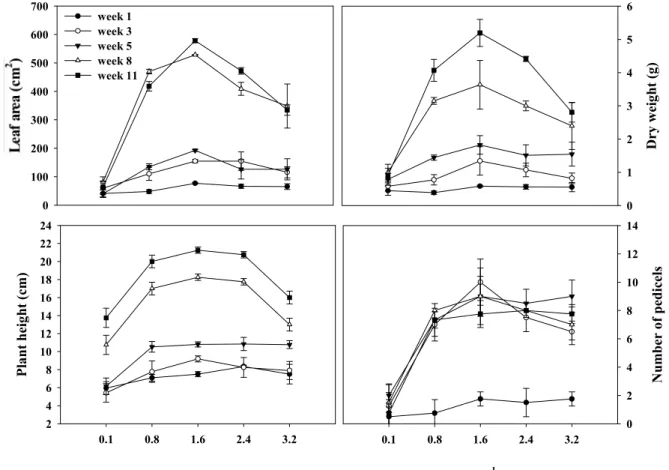
Fig. 1. Leaf areas, dry weights, plant heights, and number of pedicels of kalanchoe plants grown in ebb and flow subirrigation systems under different nutrient strengths of nutrient solution at each growth stage. Vertical bars represent SE of the means (n = 4).
USA)를 이용하였고, P≤0.05 수준에서 검정하였다.
결과 및 고찰
작물생육 특성
칼랑코에 각 생육단계에서 배양액 농도에 따른 생육은 통 계적(P≤0.05)으로 유의한 차이를 나타냈다(Fig. 1). 초장은 정식 후 3주까지는 배양액 농도 별 차이가 없었다. 정식 후 5주에 초장은 6-9cm로 배양액 농도 처리 사이에는 유의성 은 없었지만 EC 1.6dS・m-1에서 전체적으로 균일하게 컸다.
수돗물로 재배하였을 경우(EC 0.1dS・m-1)는 초장이 초기 단계와 같이 자라지 않았다. 정식 8주에 초장은 EC 0.8-2.4 dS・m-1 처리에서 16-18cm로 유사하였고 EC 3.2dS・m-1 처 리와 EC 0.1dS・m-1 처리에서는 초장이 11-12cm였다. 정식 후 11주째에서도 초장은 8주째와 같은 경향이었다.
엽면적도 처리 5주 후까지는 배양액 농도 별 큰 차이를 보이지 않았지만 처리 8주 후에는 배양액 농도에 따른 차이 가 매우 현저하였다. 엽면적이 가장 크게 나타난 처리구는 EC 1.6dS・m-1이었다. 처리 8주 후에 EC 1.6dS・m-1 처리구
에서 엽면적은 525cm2로 EC 0.8dS・m-1의 469cm2보다 60cm2 많았고 EC 2.4dS・m-1의 408cm2보다 110cm2 많았으며 EC 3.2dS・m-1의 348cm2보다는 180cm2나 많아 그 차이가 매우 컸다. 11주째에서도 역시 8주째와 같은 경향이었다. 건물중 은 엽면적과 비슷한 경향을 보였다. 엽면적, 건물중이 가장 크게 나타난 것은 배양액 농도 처리 8주와 11주 모두 EC 1.6dS・m-1 처리구에서 나타났다. 분지수는 수돗물 재배인 EC 0.1dS・m-1에서는 거의 분지가 발생하지 않았다. 분지는 정 식 3주 후에 대부분 발생하였고 각 배양액 농도 처리에 따라 유의한 차이는 나타나지 않았다.
칼랑코에 각 생육 단계별로 EC 1.6dS・m-1에서 가장 양호 하였으며, 생육전체를 보면 EC 0.8-2.4dS・m-1 범위에서 대 체적으로 생장이 양호하였으나EC 3.2dS・m-1가 되면 생육 이 매우 저조하였다(Fig. 2). 이 결과는 장기간 높은 농도의 배양액으로 재배함으로써 배지에 많은 염류가 집적되어 생 리장해가 발생한 결과로 판단되며, 이러한 현상은 칼랑코에 뿐만 아니라 기타 분화 재배에서도 유사하게 나타났다. 저 면관수시스템을 이용한 셀비아, 베고니아, 페튜니아 양액재 배시 고농도 배양액에서 생장이 억제되었다고 하였다(Kang
EC: 0.1 dS・m-1 0.8 dS・m-1 1.6 dS・m-1 2.4 dS・m-1 3.2 dS・m-1 Fig. 2. Apparent growth of kalanchoe plants grown in ebb and
flow subirrigation systems under different nutrient strengths of nutrient solution.
Weeks after treatment
0 2 4 6 8 10 12
Nutrient uptake rate (mmol
. L-1)
0 2 4 6 8 10 12
14 NO3-N H2PO4- K+
Ca 2+
Mg2+
Water uptake (mL.day-1/plant)
0 10 20 30 40 50 water
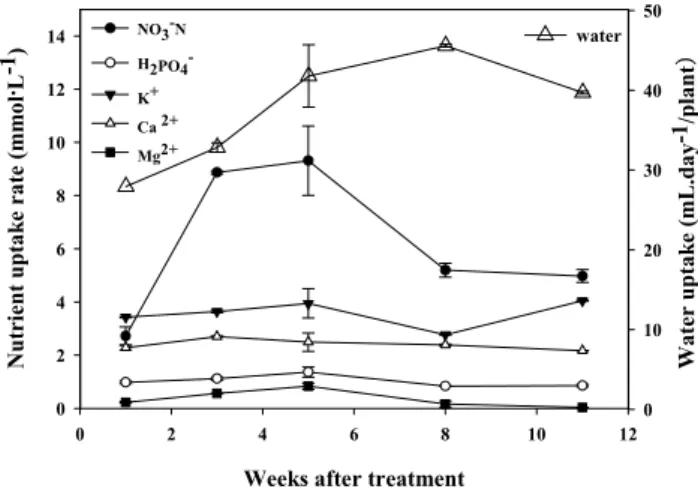
Fig. 3. Nutrient uptake rates of kalanchoe plants grown in ebb and flow subirrigation systems at an electrical conductivity of EC 1.6 dS・m-1 during the experimental period. Vertical bars represent SE of the means (n = 2).
과 van Iersel, 2004, 2009; Nemali와 van Iersel, 2004). 이 결과들은 대부분 본 실험의 결과에서와 같이 최적 생육을 위한 EC의 범위는 비교적 넓게 나타났다.
양분 흡수 특성
칼랑코에 생육이 가장 좋았던 EC 1.6dS・m-1처리구에서 양 분흡수율을 조사한 결과는 Fig. 3과 같다. 그 결과 NO3-N의 흡수율은 처리 1주까지는 2.7mmol・L-1의 낮은 흡수율을 보이 다가 3주부터는 급격히 상승하여 5주까지는 8.9-9.4mmol・L-1 의 높은 흡수율을 나타내었다. 8주 후 11주까지는 다시 5.2 mmol・L-1로 감소하는 경향을 보였다. H2PO4-는 1.0-1.4mmol・L-1 사이에서 일정한 수준을 유지하였고 K+는 2.8-4.1mmol・L-1 로 변화가 크지 않았으며 Ca2+도 2.2-2.7mmol・L-1로 크게 변화되지 않는 경향을 보였다. Mg2+는 생육이 왕성한 생육 초기에 0.6-0.8mmol・L-1의 비교적 높은 수준으로 증가하였 다가 생육후기에는 다시 0.2mmol・L-1로 떨어지는 경향을 보였다. 실제로 수분흡수량이 생육단계에 따라서 증가하기 때문에 절대 양분흡수량은 생육단계에 따라서 증가하였다 고 볼 수 있다.
생육단계에 따라 적정 EC의 범위는 비슷하였지만 무기이 온 별로 양수분 흡수율의 차이가 크게 나타난 결과로부터, 배양액 관리 시 EC뿐만 아니라 무기이온의 흡수율을 각각 조절할 필요가 있음을 확인하였다. 실제로 Hwang 등(2003) 의 의하면 생육단계별로 배양액 농도를 다르게 하는 것이 효율적이었다. 특히 현재 순환식 수경 시스템에서는 EC 기 준으로 관리하기 때문에 배양액 내 특정한 함량이 저하되거 나 높아져서 성분의 변화가 심하게 나타나고, 이것은 곧 작 물의 생육 장해를 일으킬 수 있는 원인이 된다. 따라서 이러 한 문제를 해결하기 위해서는 생육단계에 따라 배양액 내의 부족 이온의 보충과 과잉이온의 배제 등과 같은 양액 조성 의 적절한 관리가 필요하다.
배지의 염류 집적
배양액 농도 처리 후 생육단계별로 배지 내의 EC를 상, 하층으로 나누어 조사한 결과 배양액의 농도가 증가함에 따 라 배지의 상, 하층의 EC가 증가하였고 포트 내 배지의 위 치에 따라 배지의 EC가 다르게 나타났다(Fig. 4). 수돗물만 으로 관리한 처리구에서 배지 상층부분의 EC는 생육초기 0.37dS・m-1에서 생육이 진행됨에 따라 EC 0.97dS・m-1까지 상승하였고 이는 하층 0.05-0.17dS・m-1보다 높았다. 1/2S(EC 0.8dS・m-1)에서 배지 상부의 EC는 생육초기 0.47dS・m-1에 서 생장 후기 2.17dS・m-1로 증가하였고 이는 하층부의 EC 가 0.08dS・m-1에서 0.51dS・m-1로 증가된 것보다 항상 4-5배 정도 높게 나타났다. 1S처리에서는 생장 초기 상층부의 EC 가 0.55dS・m-1에서 생장 후기 2.89dS・m-1까지 증가하였고 이는 하층부의 EC가 0.35dS・m-1에서 1.25dS・m-1로 증가된 것보다 항상 1-2배정도 높게 나타났다.
3/2S처리에서 배지 상층의 EC는 0.96dS・m-1에서 3.39 dS・m-1로 증가되었고, 하층부는 생장 초기 0.45dS・m-1에서 1.61dS・m-1로 증가되어 생장 기간 동안 1-2배 높게 나타났 다. 2S 처리에서 배지 상층의 EC는 생장 초기 1.63dS・m-1에 서 3.89dS・m-1로 증가하였고 하층의 EC는 0.56dS・m-1에서 생장 후기의 2.82dS・m-1로 증가하여 상층부는 하층에 비해 1배 높게 집적되었다. van Iersel(1999)도 생육단계가 진전 됨에 따라 배지의 EC가 증가하였다는 결과를 제시한 바 있 다. 생육이 진전됨에 따라 포트 상부의 EC가 높아진 것은 저면 관수에 의해 비료염의 용탈이 이루어지지 않았기 때문 으로 생각된다. 식물에 의해 흡수되지 않고 남아 있던 무기 양분의 일부가 물과 함께 배지 상층부로 이동하며 물이 증 발할 때 상층부에 잔류하게 된다. 양액을 공급할 때마다 이
Electrical conductivity of nutrient solution (dS. m-1)
0.1 0.8 1.6 2.4 3.2
Electrical conductivity in growing medium (dS
. m
-1)
0 1 2 3 4 5
week 1 week 3 week 5 week 8 week 11
0 1 2 3 4 5
Top layer
Bottom layer
Fig. 4. Electrical conductivity (EC) at the top and bottom layers of growing media under different strengths of nutrient solution in ebb and flow subirrigation systems with growth stage of kalanchoe plants. Vertical bars represent SE of the means (n = 4).
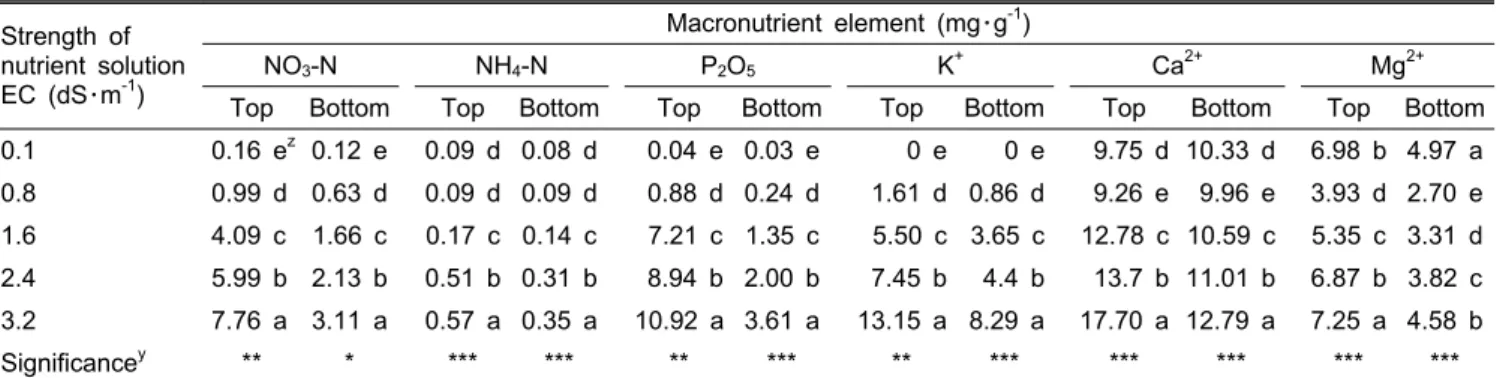
Table 1. Effect of electrical conductivity of nutrient solution on macronutrient build-up (mg・g-1) at the top and bottom layers of the growing media in ebb and flow subirrigation systems for kalanchoe plants. Sampling was conducted at 11weeks after treatments.
Strength of nutrient solution EC (dS・m-1)
Macronutrient element (mg・g-1)
NO3-N NH4-N P2O5 K+ Ca2+ Mg2+
Top Bottom Top Bottom Top Bottom Top Bottom Top Bottom Top Bottom
0.1 0.16 ez 0.12 e 0.09 d 0.08 d 0.04 e 0.03 e 0 e 0 e 9.75 d 10.33 d 6.98 b 4.97 a 0.8 0.99 d 0.63 d 0.09 d 0.09 d 0.88 d 0.24 d 1.61 d 0.86 d 9.26 e 9.96 e 3.93 d 2.70 e 1.6 4.09 c 1.66 c 0.17 c 0.14 c 7.21 c 1.35 c 5.50 c 3.65 c 12.78 c 10.59 c 5.35 c 3.31 d 2.4 5.99 b 2.13 b 0.51 b 0.31 b 8.94 b 2.00 b 7.45 b 4.4 b 13.7 b 11.01 b 6.87 b 3.82 c 3.2 7.76 a 3.11 a 0.57 a 0.35 a 10.92 a 3.61 a 13.15 a 8.29 a 17.70 a 12.79 a 7.25 a 4.58 b
Significancey ** * *** *** ** *** ** *** *** *** *** ***
zMean separation within columns by Duncan’s multiple range test at 5% level (n = 4).
ySignificance at *p ≤ 0.05, **p ≤ 0.01 and ***p ≤ 0.001.
런 작용은 반복되고 양액 농도가 높을 수록 배지 상단부의 염류 집적 정도가 증가하게 된다.
모든 원예작물은 배지의 EC가 1.25-2.25dS・m-1에서 생장 이 적합하다고 보고된 바 있다(Dole과 Wilkins, 1999). 본 실험에서도 마찬가지로 생육이 좋았던 1/2S, 1S와 3/2S에서
는 뿌리가 모여있는 근권의 EC가 이 범위 내에 속해있음을 확인하였다. 베고니아와 페튜니아의 EBB 저면관수시스템 재배에서 배양액 농도가 배지 내 양분집적에 미치는 영향은 매우 컸다(Nemali, 2004). 제라니움을 EBB저면관수시스템 에 재배하였을 때 배양액 농도가 증가함에 따라 배지의 상 층부분의 EC는 증가되었으나, 근권부의 중-하층부 EC는 배 양액 농도에 따라 큰 차이를 보이지 않아서(Jeon 등, 2003), 본 연구와 다소 차이를 보였다.
배양액 농도 처리 11주 후 배지의 무기물 함량을 분석한 결과는 Table 1과 같다. 배양액 농도가 EC 0.1, 0.8, 1.6, 2.4, 3.2dS・m-1로 증가함에 따라 배지에 집적되는 무기물의 함량 은 유의하게 증가하였다(p≤0.05). 특히 배양액 농도 증가에 따른 이온의 집적의 증가 폭은 뿌리가 없는 배지의 상층에서 뿌리가 많은 하층보다 높게 나타났다. 이는 배지의 전체 무 기물 농도를 나타내는 배지 추출물의 EC(Fig. 3)의 결과와 같은 경향을 보였다. 생육이 가장 우수하였던 EC 1.6dS・m-1 에서 NO3-N은 상층부에 4.09(mg・g-1)로 집적되어 하층의 1.66(mg・g-1)보다 1배 이상 높았고 NH4-N은 상층부에 0.17 (mg・g-1)로 집적되어 하층의 0.14(mg・g-1)보다 조금 높았다.
P2O5의 경우 상층에 7.21(mg・g-1)의 농도로 집적되어 하층 의 1.35(mg・g-1)보다 4배 이상 높았다. K, Ca, Mg에서도 마 찬가지 경향이었다. EC 0.1dS・m-1처리구에서 Ca과 Mg이 비교적 높은 농도로 집적됨은 식물체에 의해 흡수가 이루어 지지 않고 또한 배지 표면으로 증발이 많이 일어나 많은 양 의 양분이 유입된 결과로 분석된다. 생육이 저조하였던 EC 3.2dS・m-1에서는 배지의 EC분석에서 나타난 결과와 마찬 가지로 무기물 함량이 높아서 생육에 지장을 준 것으로 분 석된다. 이와 같은 결과는 Cui 등(2002)이 발표한 연구결과 와 일치한 경향을 보였다. 특히 고농도 처리구에서 Ca의 집 적이 증가하였으며 배지 내에 염류들이 많이 집적됨을 알 수 있었고 식물체 생장억제 요인중의 하나임을 확인하였다.
결론적으로 칼랑코에 생육에 적합한 EC범위는 0.8-2.4 dS・m-1로 생육단계별로 큰 차이를 보이지 않았지만, 무기이 온의 흡수율은 생육단계에 따라 많은 차이를 보였고, 포트 내 배지 염류 집적은 생육단계에 따라 그 차이가 컸다. 따라 서 생육단계별 적정 배양액 농도를 결정할 시 단순히 전체 EC를 기준으로 하기 보다는 배지 집적을 분석한 양분흡수 율을 계산하여 각 무기물의 농도를 확정하는 과정을 걸쳐야 할 것으로 판단된다.
초 록
Ebb and flow저면관수 시스템에서 배양액 농도에 따른 칼랑코에(Kalanchoe blossfeldiana ‘New Alter’)의 생육단계 별 생육특성, 양분흡수율 및 배지의 양분집적 상태를 조사 하였다. 생육단계별 배양액 농도 처리(EC 0.8, 1.6, 2.4, 3.2 dS・m-1)에 따른 작물 생육은 유의한 차이가 있었다. 1, 3, 5, 8, 11주 처리 후에 작물 생육을 조사한 결과, 5주 후부터 처리 별 차이가 매우 컸고, 각 생육단계에서 생장이 가장 양 호하였던 처리구는 EC 1.6dS・m-1이었으며, 엽면적, 초장, 건물중은 EC 2.4dS・m-1을 지나 EC 3.2dS・m-1에서 급격히 감소하는 현상을 보였다. 칼랑코에 각 생육단계에서 생장이 가장 양호하였던 EC 1.6dS・m-1처리구에 대해 양분흡수 특 성을 조사한 결과 무기이온의 흡수율은 생육단계별 다소 차 이가 있었으나 NO3-N가 가장 크고 Mg2+가 가장 낮게 나타 났다. 배양액 농도 처리구에서 배지 위치 별 EC를 조사한 결과 배지 상층부의 EC는 하층부 EC보다 1-3배 높았고 또 한 생육이 진행됨에 따라 배지 상층부 및 하층부에서 집적 되는 무기양분의 누적량이 증가되었으며 집적량이 많은 EC 3.2dS・m-1처리구에서는 작물의 생장을 억제시키는 효과가 나타난 것으로 분석되었다. 따라서 EBB저면관수 시스템에 서는 배양액의 EC에만 의존할 것이 아니라 배지 내 양분 집적을 고려하여 배양액 공급 시 조성 및 농도를 결정할 필 요가 있다.
추가 주요어 : 전기전도도, 다량원소집적, 양분흡수율, 분화, 배지
인용문헌
Argo, W.R. and J.A. Biernbaum. 1994. A method for quantifying plant available water holding capacity and water absorption potential in container media under production conditions.
HortScience 29:501.
Cox, D.A. 2001. Growth, nutrient content, and growth medium
electrical conductivity of poinsettia irrigated by subirrigation or from overhead. J. Plant Nutr. 24:523-533.
Cui, Y.Y., E.J. Hahn, X.C. Piao, Y.B. Lee, and K.Y. Paek. 2002.
Effect of nutrient solution strength on growth of doritaenopsis
‘Tinny Tender’ in an ebb and flow system. J. Kor. Soc. Hort.
Sci. 43:86-90.
Dole, J.M. and H.F. Wilkins. 1999. Floriculture. Prentice Hall, New Jersey, U.S.A. p. 403-408.
Eastin, E.F. 1978. Total nitrogen determination for plant material containing nitrate. Annal. Biochem. 85:591-594.
Hwang, I.T., K.C. Cho, K.S. Kim, S.J. Chung, and K.B. Ahn.
2003. Growth responses as affected by different ion strengths of nutrient solution with growth stage of hydroponically grown Dendranthema grandiflorum cv. Chungwoon. J. Kor. Soc.
Hort. Sci. 44:233-237.
James, E.C. and M.W. van Iersel. 2001. Fertilizer concentration affects growth and flowering of subirrigated petunias and begonias. HortScience 36:40-44.
Jeon, M.W., E.J. Hahn, and K.Y. Paek. 2003. Effect of nutrient solution strength on growth of potted pelargonium hortorum
‘Pinto White’ and ‘Pinto Pink’ cultured in an ebb and flood irrigation system. J. Kor. Soc. Hort. Sci. 44:518-522.
Kang, J.G. and M.W. van Iersel. 2001. Interactions between temperature and fertilizer concentration affect growth of subirrigated petunias. J. Plant Nutr. 24:753-765.
Kang, J.G. and M.W. van Iersel. 2004. Nutrient solution con- centration affects shoot : root ratio, leaf area ratio, and growth of subirrigated salvia (Salvia splendens). HortScience 39:49-54.
Kang, J.G. and M.W. van Iersel. 2009. Managing fertilization of bedding plants: a comparison of constant fertilizer con- centrations versus constant leachate electrical conductivity.
HortScience 44:151-156.
Kent, M.W. and D.W. Reed. 1996. Nitrogen nutrition of new guinea impatiens ‘barbados’ and Spathiphyllum ‘petite’ in a subirrigation system. J. Amer. Soc. Hort. Sci. 121:816-819.
Kim, S.H., W. Oh, and K.S. Kim. 2007. Effects of nitrogen con- centration and NO3-:NH4+ ratio of nutrient solution on stock plant growth, cutting yield, and quality in Kalanchoe bloss- feldiana. Hort. Environ. Biotechnol. 48:52-59.
Lee, J.H., J.S. Moon, K.B. Park, M.R. Huh, and J.C. Park. 1999.
Growth effect of levels of nutrient solution using the ebb and flow system in 6 herbs. J. Kor. Soc. Hort. Sci. 40:399-402.
Lu, Y.J. and J.E. Son. 2005. Effects of nutrient strength and light intensity on nutrient uptake and growth of young kalanchoe plants (Kalanchoe blossfeldiana ‘Marlene’) at seedling stage.
J. Bio-Environ. Control 14:149-154.
Mortensen, L.M. 2000. Effects of air humidity on growth, flowering, keeping quality and water relations of four short-day greenhouse species. Sci. Hort. 86:299-310.
Nemali, K.S. and M.W. van Iersel. 2004. Light intensity and fertilizer concentration: II. Optimal fertilizer solution concent- ration for species differing in light requirement and growth rate. HortScience 39:1293-1297.
Rouphael, Y., G. Colla, A. Battistelli, S. Moscatello, S. Proietti, and E. Rea. 2004. Yield, water requirement, nutrient uptake and fruit quality of zucchini squasha grown in soil and closed soilless culture. J. Hort. Sci. Biotechnol. 79:423-430.
Rouphael, Y. and G. Colla. 2005. Growth, yield, fruit quality and nutrient uptake of hydroponically cultivated zucchini squash as affected by irrigation systems and growing seasons. Sci.
Hort. 105:177-195.
Rouphael, Y., M. Cardarelli, E. Rea, A. Battistelli, and G. Colla.
2006. Comparison of the subirrigation and drip-irrigation systems for greenhouse zucchini squash production using saline and non-saline nutrient solutions. Agricultural Water Management 82:99-117.
Rouphael, Y., M. Cardarelli, E. Rea, and G. Colla. 2008. The influence of irrigation system and nutrient solution concent- ration on potted geranium production under various conditions of radiation and temperature. Sci. Hort. 118:328-337.
Rouphael, Y. and G. Colla. 2009. The influence of drip irrigation or subirrigation on zucchini squash grown in closed-loop
substrate culture with high and low nutrient solution concent- rations. HortScience 44:306-311.
Son, J.E., M.M. Oh, Y.J. Lu, K.S. Kim, and G.A. Giacomelli.
2006. Nutrient-flow wick culture system for potted plant pro- duction: System characteristics and plant growth. Sci. Hort.
107:392-398.
Uva, W.L., T.C. Weiler, and R.A. Milligan. 1998. A survey on the planning and adoption of zero runoff subirrigation systems in greenhouse operations. HortScience 33:193-196.
van Iersel, M.W. 1999. Fertilizer concentration affects growth and nutrient composition of subirrigated pansies. HortScience 34:660-663.
van Os, E.A., 1999. Closed soilless growing systems: a sustainable solution for Dutch greenhouse horticulture. Water Sci. Technol.
39:105-112.