†
Corresponding author: (Phone) +82-62-228-0508
(E-mail) [email protected] < Received June 3, 2010>
268
Combined Effects of Container Volume and Fertilizer Level on Plant Growth, Physiological Characteristics, and Nutrient Uptake of Vinca Plant
( Catharanthus roseus )
Jong-Goo Kang*, and Sang-Uk Chon**
†*Department of Horticulture, Sunchon National University, Maegok-Dong 315, Jeonnam 540-742, South Korea
**EFARINET Co. Ltd., BI Center, Chonsun University, Seosuk-Dong 375, Gwangju 501-759, South Korea
ABSTRACT The aim of our study was to investigate the interactive effects of container size and nutrient supply on plant growth, chlorophyll synthesis, transpiration, CO
2assimilation, water use efficiency (WUE), and nutrient uptake of vinca plant (Catharanthus roseus). A complete experiment utilizing four concentrations of fertilizer and three volumes of containers was conducted. As the container size was increased, the plant height, leaf area, and dry weight of vinca significantly in- creased regardless of fertilizer level. The leaf area and dry weight of vinca were highly sensitive to the container size.
However, the chlorophyll contents of vinca 20 days after the transplant significantly increased with decreasing container sizes and increasing fertilizer concentrations. Significant differ- ences in transpiration and CO
2assimilation occurred with the use of differentfertilizer solutions, but the highest values for transpiration and CO
2assimilation were in plants grown in the 15 cm-diameter containers. The highest water use efficiency was observed in the plants grown in 10 cm-containers with 4 dS/m of fertilizer, and there were no significant differences in WUE values among container sizes with fertilizer concen- trations of 0, 1, or 2 dS/m. No significant difference in nutrient uptake was observed among the fertilizer levels or among the container sizes. However, at a fertilizer concentration of 4 dS/m, the uptake of several nutrients, including N, P, K, Ca, Mg, B and Fe, was higher in small containers than in larger ones.
Keywords : container volume, fertilizer level, plant growth, Vinca
Catharanthus roseus (L.) G. Don. is one of the most important medicinal plants, and an ornamental bedding plant belonging to the family Apocynaceae. Two varieties of C.
roseus can be distinguished based on the flower color,
namely, the pink-flowered rosea and the white-flowered alba [Jaleel and Panneerselvam, 2007]. C. roseus plant is commer- cially important due to the presence of medicinal alkaloids and its ornamental value [Jaleel et al., 2006]. It is a perennial tropical plant that produces more than 100 monoterpenoid indole alkaloids (MIAs), including two commercially impor- tant cytotoxic dimeric alkaloids used in cancer chemotherapy [Jaleel et al., 2007c].
C. roseus derives its economic importance from the highly valued leaf anticancer alkaloids, vincristine and vinblastine, and the antihypertensive alkaloid ajmalicine found in its root [Srivastava and Srivastava. 2007; Karthikeyan et al., 2007 Jaleel et al., 2006]. The entire plant is rich in alkaloids, but the maximum concentrations of alkaloids are found in the root bark particularly during flowering. An infusion of leaves is used to treat menorrhagia, and the juice of the leaves is applied externally to relieve wasp stings. All parts of the plant have with hypoglycemic properties that are used to treat diabetes [Jaleel et al., 2007a; Jaleel et al., 2007d]. Several studies have already been carried out regarding medicinal importance [Jaleel et al., 2006; Jaleel et al., 2007e] and the growth regulatory effects of this plant [Jaleel et al., 2007f;
Jaleel et al., 2007b].
Restrictions on the nutrient supply and container volumes
affect plant vigor and size. A small root volume is commonly
observed in intensive agriculture with drip irrigation. Pot
culture without soil in intensive horticulture severely limits
the growth and development of the plant root system(Bar
Tal et al., 1994a). A suitable restriction of root growth was
suggested as a practical method for inducing early flowering
to shorten the growing period of some field and vegetable
crops and for their potential economic success of high density
planting of crops, such as cotton (Carmi, 1986; Ben Porath
and Baker, 1990), tomato (Ruff et al., 1987), and sweet pepper (NeSmith et al., 1992).
Reducing the soil volume often leads to dwarf plants (Carmi and Heuer, 1981 Flocker et al, 1959 Richards and Rowe, 1977, Tschaplinski and Blake, 1985.), but there is also altered distribution of relative dry weight in inhibited plants, to indicate a reduction in total plant growth(Carmi, 1986 Krizek et al., 1985, Richards and Rowe, 1977), however, root growth is more impaired in a restricted volumeas compared to aerial part, creating a relative decrease in root dry weight (Carmi and Shalhevet, 1983). Plants grown in small containers characteristically develop a shorter, more densely branched root system than those grown in large containers; this, in turn, may affect the total plant growth because the roots are an important source of growth substances for the plant (Richards and Rowe, 1977).
No studies on the influence of the nutritional supply status on flowering and fruit set of crops have been reported.
Moreover, the plant response to pot size is closely related to the nutritional supply. The restriction imposed by small container resulted in more short lateral roots and change in the root metabolism that affects the uptake rate of the nutrients and water both per unit of root area and for the entire plant (Peterson et al., 1991a; Peterson et al., 1991b).
Plants with small root volumes need frequent irrigation. The aeration and hydraulic coefficients of the soil or growth medium decreased as the root density increases. Technically, if the root volume is smaller than the lowest theoretical size for sufficient nutrient absorption, it becomes impossible for the roots to supply enough nutrients for the plant (Bar Tal et al., 1994a; Bar Tal et al.,1994b).
Similarly, the influence of the nutritional supply status on the flower and fruit set of sweet pepper have also been reported. Sweet pepper growing in minimal media experienced a delay in flowering (50%) of 4-6 days and a delay in the initial fruit set by seven days, compared with sweet pepper grown in the field (Shrivastava, 1996). Nitrogen fertilization did not influence the fruiting time, mean fruit weight, or mid-harvest time of sweet pepper (Vos and Frinking, 1997).
The objective of this study was to evaluate the interactive effects of container volume and nutritional supply levels that are commonly adopted in greenhouse production on the growth and physiological characteristics of vinca plant.
MATERIALS AND METHODS
Plant material
Plug seedlings of Vinca ‘Pacifica Punch’ were obtained from Park Wholesale Inc. (Greenwood, SC) and transplanted into plastic pots on April 13, 2007. The pots were filled with peat-based growing medium (Fafard 2P, Fafard, Inc., Anderson, SC). The medium was composed of peat and perlite. Initial pH and electrical conductivity (EC) of nutrition solution were pH 5.98 and 0.61 dS/m, respectively. The pH was measured using a Model IQ150 Handheld pH / mV / Temperature meter (IQ Scientific Instruments, Inc., San Diego CA). The EC was measured using a Sigma Probe (Delta-T Devices Ltd, Burwell, Cambridge, UK). After transplantation, all the plants were placed on ebb and flow benches in a greenhouse. The temperatures of the greenhouse during day and night time were set to 24℃ and 20℃ respectively.
Cultural conditions
To determine the effects of pot size on plant growth, plants were transplanted into round pots with a 5, 10 or 15 cm diameter, having same height (20 cm). The plants were sub- irrigated daily with a fertilizer solution with an EC of 0.5, 1, 2 or 4 dS/m. The fertilizer solutions were made using a water-soluble N-P-K fertilizer (15-5-15, Peat-Lite Special, The Scotts Co.), and the pH of each fertilizer solution was not controlled. Water was pumped onto the benches using submersed water pumps (Nokorode-2; Little Giant, Oklahoma City, Okla.). About 3 min were required for the pumps to fill the trays with approximately 3 cm of fertilizer solution, and 6 min for the water to drain back into the holding tanks. The fertilizer solution was stored in 210 L plastic barrels and was replenished as needed. The EC of the fertilizer was adjusted every refilling time.
Measurement for physiological parameters
The EC and water content in the substrate was measured at
regular intervals through out the growing period using a
Sigma Probe EC meter (Delta-T Devices Ltd., Burwell,
Cambridge, UK) and a Theta Probe soil moisture sensor
(Delta-T Devices Ltd., Burwell, Cambridge, UK). Plant
height, leaf area, dry weight and flower width of the vinca
plant were measured at the end of experiment.
Pl an t hei ght (cm)
0 5 10 15 20 2530 5 cm
10 cm 15 cm NS a
b NS
b
NS
Fertilizer solution (EC)
0 1 2 4
Le af a rea ( cm
2)
0 50 100 150 200 250 300
350 5 cm10 cm
15 cm a
a
a b
a b
b b
c a
c c
A
B
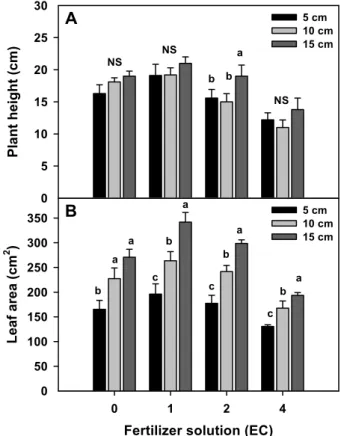
Fig. 1. Combined effects of container size and fertilizer solution on plant height (A) and leaf area (B) of vinca plant. Within each fertilizer solution, means followed by the sameletter are not significantly different at p<0.05. Each bar represents standard error of the mean.
The chlorophyll content of the leaves was measured at regular intervals through out the growing period usinga SPAD-502 chlorophyll meter (Minolta, Ramsey, NJ), which measures chlorophyll content in arbitrary units (here referred to as SPAD units).
The transpiration and CO
2assimilation of individual pairs of vinca leaves were measured on the 15
thday post transplantation. Leaf gas exchange parameters including the specific transpiration (E: evaporation) and CO
2assimilation (PN) were measured with a portable photosynthesis system (CIRAS-1, PP Systems, Haverhill, Mass.). The water use efficiency (WUE) was calculated by the following equation:
WUE = PN [μmol CO
2m
-2s
-1] / E [mmol H
2O m
-2s
-1].
The remaining shoots were dried in a forced-air drying oven at 80℃for a minimum of 3 days before the dry mass was measured. The nutrient content of the shoot samples was analyzed. The tissue N was determined with a CNS 2000 analyzer (LECO Corp., St. Joseph, Mich.) (Mills and Jones, 1996), while P, K, Ca, Mg, S, Al, B, Cu, Fe, Mn, Na, and Zn were determined by dry ashing and by inductively coupled plasma (ICP) spectrometry (Jones and Case, 1990).
Statistics
The experimental design was a randomized complete block with three replicates. The data were analyzed by regression analysis and least significant differences (LSD) test using the Statistical Analysis Software (SAS Institute, Cary, NC).
RESULTS AND DISCUSSION
Plant growth
The restriction imposed by the container volume combined with restrictions in fertilization significantly affected all aspects of the vegetative growth including plant height and, especially leaf area (Fig. 1). With increasing container size, plant height and leaf area of vinca significantly increased at all fertilizer concentrations. Plant height (19.1 to 21.0 cm) and leaf area (196.2 to 341.9 cm
2) in particular showed the highest values at a fertilizer concentration (as an EC value of) of 1.0 dS/m regardless of the container size and showed a stimulatory effect at lower concentration. However, at the highest concentration of 4.0 dS/m, all growth characteristics analyzed were lower in value compared with plants grown in
the other lower fertilizer concentrations and compared with the untreated control. Small container volumes often produce smaller plants than do larger containers. In addition, plants in smaller containers tend to produce lower yields than com- parable plantings established from larger container volumes (Marsh and Paul, 1988; Weston and Zandstra, 1986).
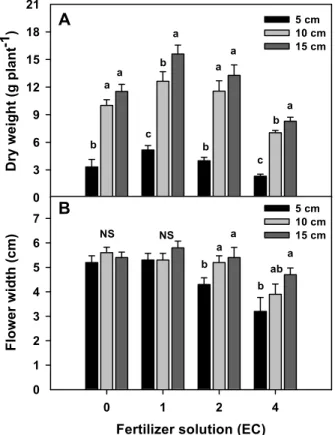
The dry weight was one of the most sensitive parameters affected by the container size. At all concentrations of fertilizer, the dry weight in small containers was significantly reduced. In particular, the dry weight was the highest (5.2 to15.6g plant
-1) at a fertilizer concentration of 1.0 dS / m, regardless of container size, and the lowest (2.3 to 8.3g plant
-1) at 4.0 dS/m, which demonstrates the stimulatory effect of lower concentrations (Fig. 2A). On the other hand, the flower width of vinca grown in smaller containers was significantly reduced with increase in fertilizer concentration.
Furthermore, flower width of vinca grown in larger containers
Dr y weig ht (g plant -1 )
0 3 6 9 12 15 18 215 cm 10 cm 15 cm
a
a a
a b
b
b b
c c
a a
Fertilizer solution (EC)
0 1 2 4
Fl ower wid th (cm)
0 1 2 3 4 5 6
7 5 cm10 cm
15 cm a
a
a NS
b
b ab
NS
A
B
Fig. 2. Combined effects of container size and fertilizer solution on dry weight (A)and flower width (B) of vinca plant. Within each fertilizer solution, means followed by the same letter are not significantly different at p<0.05. Each bar represents standard error of the mean.
Fertilizer solution (EC)
0 1 2 4
chlorophy ll content (U NIT)
0 10 20 30 40 50
60 5 cm
10 cm 15 cm
a
NS
b b
NS NS
Fig. 3. Combined effects of container size and fertilizer solution on chlorophyll content of vinca plant. Within each fertilizer solution, means followed by the same letter are not significantly different at p<0.05. Each bar represents standard error of the mean.
showed the less reduction with increasing fertilizer concent- ration (Fig. 2B).
In general, as the container size increased, the plant leaf area, shoot biomass, and root biomass increased (Cantliffe, 1993). Root and shoot growth, biomass accumulation and partitioning, photosynthesis, leaf chlorophyll content, plant water relations, nutrient uptake, respiration, flowering, and yield are all affected by the root restriction due to container size.
Chlorophyll synthesis
The chlorophyll contents of vinca 20 days post transplan- tation significantly increased with decreasing container size and increasing fertilizer concentration (Fig. 3). With the highest fertilizer concentration of 4 dS/m, the chlorophyll content of vinca was higher with a 5 cm-diameter container (50.56 mgg
-1F.W.) than with 10 cm-diameter (43.56 mgg
-1F.W.) and 15 cm-diameter containers (42.22mgg
-1F.W.).
However, there is no difference in chlorophyll content among container sizes with lower fertilizer concentration (Fig. 3).
The restriction of container volume caused an increase in chlorophyll content in vinca leaves.
NeSmith et al. (1992) reported that the decline in the leaf photosynthetic rate of bell peppers in response to a decreased root volume was coupled with a reduction in leaf chlorophyll content.
Transpiration, CO
2assimilation and WUE
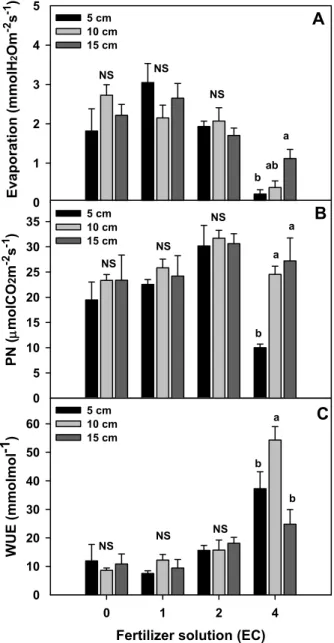
There were significant differences in transpiration and CO
2assimilation among the various fertilizer concentrations.
Similarly, there were differences among container sizes but
only the highest fertilizer concentration. The highest values
occurred with 15 cm-diameter containers. Similarly, there was
a significant difference in transpiration among fertilizer
solutions. Especially, the highest transpiration value was
found at a fertilizer concentration of 1 dS/m (2.15 to 3.05
mmol H
2O m
-2s
-1) and the lowest at 4 dS/m (0.21 to 1.12
mmol H
2O m
-2s
-1). The change in transpiration in plants
grown in different container sizes showed significant
differences with a fertilizer level of 4 dS/m only, andthe
highest values were obtained when plants were grown in a 15
cm-container (Fig. 4A). The CO
2assimilation (PN) meas-
ured on the 15
thday post transplantation was the highest at a
Ev apor ati o n (mmol H
2Om
-2s
-1)
0 1 2 3 45 5 cm
10 cm 15 cm
a
ab NS
b NS
NS
PN ( μmolC O
2m
-2s
-1)
0 5 10 15 20 25 3035 5 cm10 cm 15 cm
a
a
b NS
NS
NS
Fertilizer solution (EC)
0 1 2 4
WUE (mmolmol -1 )
0 10 20 30 40 50 605 cm 10 cm 15 cm
a
NS
b b
NS NS