255
Biodiversity and Distribution of Arbuscular Mycorrhizal Fungi in Korea
Ju-Kyeong Eo
1,2, Sang-Hee Park
1, Eun-Hwa Lee
1and Ahn-Heum Eom
1*
1Department of Biology Education, Korea National University of Education, Cheongju, 363-791, Korea
2Bureau of Basic Ecological Research, National Institute of Ecology, Seocheon, 325-813, Korea
ABSTRACT : In this study, we summarized previous studies on diversity and distribution of arbuscular mycorrhizal fungi (AMF) for last 30 years in Korea. According to a review of the literature concerning AMF in Korea, 14 genera and 89 species have been recorded. Host plants for AMF are very diverse and include crop species and woody plants in natural forests. Based on the achievements of the last 30 years of study on AMF, we anticipate that relatively more intensive studies of the functional and genetic diversity of AMF will be conducted.
KEYWORDS : Arbuscular mycorrhiza, Distribution, Diversity, Glomeromycota, Korea
Introduction
Arbuscular mycorrhizal fungi (AMF), which maintain symbiotic relationships with most terrestrial plants, appe- ared on land more than 460 million years ago, and they helped plants adapt to the terrestrial environment [1].
AMF evolved specialized organs such as arbuscules, vesi- cles, etc., to interact with roots of plants and they provide resistance to environmental stresses (e.g., draught and sa- linity), help defend against disease, and absorb minerals, all of which benefit the host plants. The number of spe- cies of vascular plants worldwide is estimated at approxi- mately 270,000 [2], while that of AMF is around 240 [3];
this asymmetric symbiotic relationship has generated tremendous academic interest. It is generally accepted that AMF exhibit relatively high genetic and functional diversity to overcome their limited species diversity [4].
In Korea, the history of AMF-related study is relatively
short (ca. 30 years). Vascular plants distributed in the Korean peninsula have been reported to contain 3,000 to 5,000 taxa [5,6]; however, precise estimates of AMF spe- cies in Korea are currently lacking. Here, we review the state of AMF research in Korea in an attempt to deter- mine the diversity of AMF species and their host plants in order to provide a basis for future AMF studies. Pub- lished papers were examined to ascertain the results of AMF-related research carried out in Korea, and a taxo- nomical treatment was conducted according to Schüßler and Walker [3].
AMF species diversity
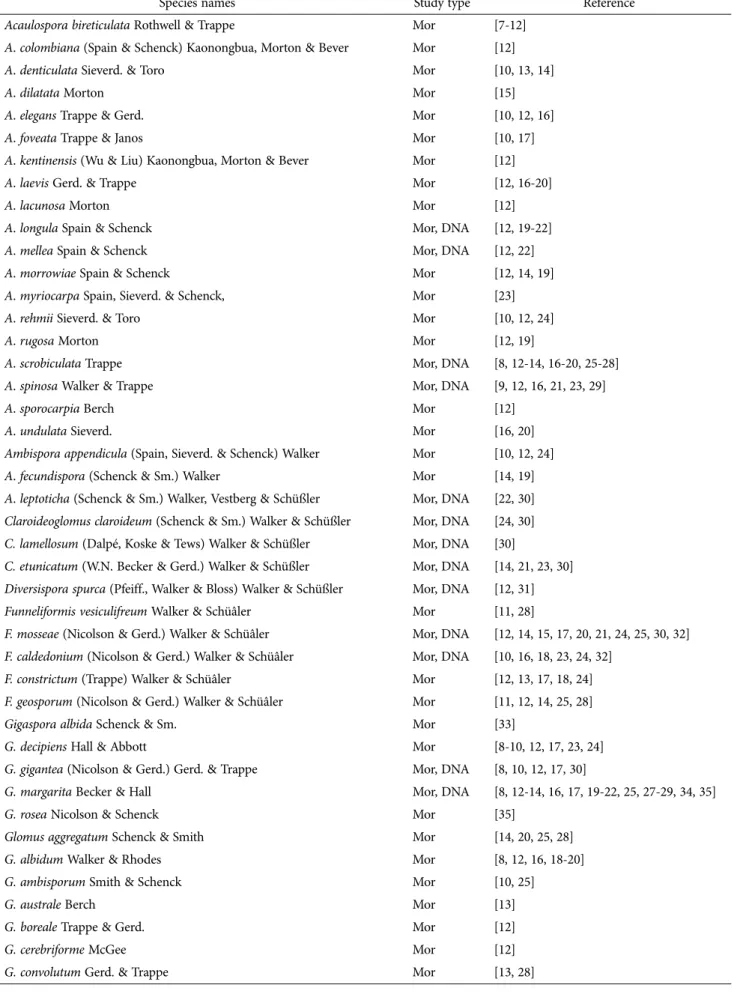
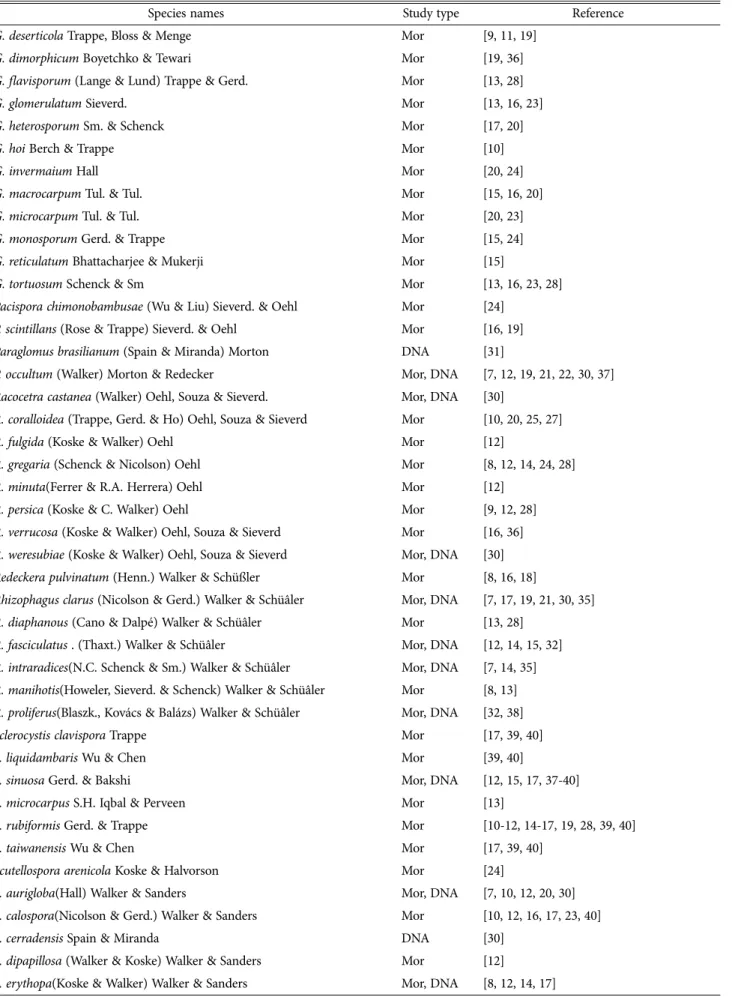
A total of 89 species of AMF have been reported in Korea; however, new species have not been discovered (Table 1). Among them, species in the genera Acaulospora and Glomus have the most abundant (19 species), fol- lowed by Scutellospora (15 species), Pascispora and Para- glomus (two species each), and Diversispora and Redeckera (one species each). Gigaspora margarita was the most frequently appeared species in the literatures. Also, Aca- ulospora scrobiculata, Funneliformis mosseae and Sclerocy- stis rubiformis were also frequently appeared in the lite- ratures.
In most of studies, AMF were identified using mor- phological characteristics of spores extracted from field- collected soils. Of the 89 AMF species, approximately 25% was identified by using both morphological and molecular data, but the remainder by using only mor- phological characteristics (Table 1). AMF, compared with
*Corresponding author E-mail: [email protected] Received December 17, 2014 Revised December 17, 2014 Accepted December 18, 2014
This is an Open Access article distributed under the terms of the Creative Commons Attribution Non-Commercial License (http://
creativecommons.org/licenses/by-nc/3.0/) which permits unrestricted non-commercial use, distribution, and reproduction in any medium, provided the original work is properly cited.
Kor. J. Mycol. 2014 December, 42(4): 255-261 http://dx.doi.org/10.4489/KJM.2014.42.4.255 pISSN 0253-651X • eISSN 2383-5249
© The Korean Society of Mycology
Table 1. List of Glomeromycota studied on different sites in Korea
Species names Study type Reference
Acaulospora bireticulata Rothwell & Trappe Mor [7-12]
A. colombiana (Spain & Schenck) Kaonongbua, Morton & Bever Mor [12]
A. denticulata Sieverd. & Toro Mor [10, 13, 14]
A. dilatata Morton Mor [15]
A. elegans Trappe & Gerd. Mor [10, 12, 16]
A. foveata Trappe & Janos Mor [10, 17]
A. kentinensis (Wu & Liu) Kaonongbua, Morton & Bever Mor [12]
A. laevis Gerd. & Trappe Mor [12, 16-20]
A. lacunosa Morton Mor [12]
A. longula Spain & Schenck Mor, DNA [12, 19-22]
A. mellea Spain & Schenck Mor, DNA [12, 22]
A. morrowiae Spain & Schenck Mor [12, 14, 19]
A. myriocarpa Spain, Sieverd. & Schenck, Mor [23]
A. rehmii Sieverd. & Toro Mor [10, 12, 24]
A. rugosa Morton Mor [12, 19]
A. scrobiculata Trappe Mor, DNA [8, 12-14, 16-20, 25-28]
A. spinosa Walker & Trappe Mor, DNA [9, 12, 16, 21, 23, 29]
A. sporocarpia Berch Mor [12]
A. undulata Sieverd. Mor [16, 20]
Ambispora appendicula (Spain, Sieverd. & Schenck) Walker Mor [10, 12, 24]
A. fecundispora (Schenck & Sm.) Walker Mor [14, 19]
A. leptoticha (Schenck & Sm.) Walker, Vestberg & Schüßler Mor, DNA [22, 30]
Claroideoglomus claroideum (Schenck & Sm.) Walker & Schüßler Mor, DNA [24, 30]
C. lamellosum (Dalpé, Koske & Tews) Walker & Schüßler Mor, DNA [30]
C. etunicatum (W.N. Becker & Gerd.) Walker & Schüßler Mor, DNA [14, 21, 23, 30]
Diversispora spurca (Pfeiff., Walker & Bloss) Walker & Schüßler Mor, DNA [12, 31]
Funneliformis vesiculifreum Walker & Schüâler Mor [11, 28]
F. mosseae (Nicolson & Gerd.) Walker & Schüâler Mor, DNA [12, 14, 15, 17, 20, 21, 24, 25, 30, 32]
F. caldedonium (Nicolson & Gerd.) Walker & Schüâler Mor, DNA [10, 16, 18, 23, 24, 32]
F. constrictum (Trappe) Walker & Schüâler Mor [12, 13, 17, 18, 24]
F. geosporum (Nicolson & Gerd.) Walker & Schüâler Mor [11, 12, 14, 25, 28]
Gigaspora albida Schenck & Sm. Mor [33]
G. decipiens Hall & Abbott Mor [8-10, 12, 17, 23, 24]
G. gigantea (Nicolson & Gerd.) Gerd. & Trappe Mor, DNA [8, 10, 12, 17, 30]
G. margarita Becker & Hall Mor, DNA [8, 12-14, 16, 17, 19-22, 25, 27-29, 34, 35]
G. rosea Nicolson & Schenck Mor [35]
Glomus aggregatum Schenck & Smith Mor [14, 20, 25, 28]
G. albidum Walker & Rhodes Mor [8, 12, 16, 18-20]
G. ambisporum Smith & Schenck Mor [10, 25]
G. australe Berch Mor [13]
G. boreale Trappe & Gerd. Mor [12]
G. cerebriforme McGee Mor [12]
G. convolutum Gerd. & Trappe Mor [13, 28]
Table 1. List of Glomeromycota studied on different sites in Korea (continued)
Species names Study type Reference
G. deserticola Trappe, Bloss & Menge Mor [9, 11, 19]
G. dimorphicum Boyetchko & Tewari Mor [19, 36]
G. flavisporum (Lange & Lund) Trappe & Gerd. Mor [13, 28]
G. glomerulatum Sieverd. Mor [13, 16, 23]
G. heterosporum Sm. & Schenck Mor [17, 20]
G. hoi Berch & Trappe Mor [10]
G. invermaium Hall Mor [20, 24]
G. macrocarpum Tul. & Tul. Mor [15, 16, 20]
G. microcarpum Tul. & Tul. Mor [20, 23]
G. monosporum Gerd. & Trappe Mor [15, 24]
G. reticulatum Bhattacharjee & Mukerji Mor [15]
G. tortuosum Schenck & Sm Mor [13, 16, 23, 28]
Pacispora chimonobambusae (Wu & Liu) Sieverd. & Oehl Mor [24]
P. scintillans (Rose & Trappe) Sieverd. & Oehl Mor [16, 19]
Paraglomus brasilianum (Spain & Miranda) Morton DNA [31]
P. occultum (Walker) Morton & Redecker Mor, DNA [7, 12, 19, 21, 22, 30, 37]
Racocetra castanea (Walker) Oehl, Souza & Sieverd. Mor, DNA [30]
R. coralloidea (Trappe, Gerd. & Ho) Oehl, Souza & Sieverd Mor [10, 20, 25, 27]
R. fulgida (Koske & Walker) Oehl Mor [12]
R. gregaria (Schenck & Nicolson) Oehl Mor [8, 12, 14, 24, 28]
R. minuta(Ferrer & R.A. Herrera) Oehl Mor [12]
R. persica (Koske & C. Walker) Oehl Mor [9, 12, 28]
R. verrucosa (Koske & Walker) Oehl, Souza & Sieverd Mor [16, 36]
R. weresubiae (Koske & Walker) Oehl, Souza & Sieverd Mor, DNA [30]
Redeckera pulvinatum (Henn.) Walker & Schüßler Mor [8, 16, 18]
Rhizophagus clarus (Nicolson & Gerd.) Walker & Schüâler Mor, DNA [7, 17, 19, 21, 30, 35]
R. diaphanous (Cano & Dalpé) Walker & Schüâler Mor [13, 28]
R. fasciculatus . (Thaxt.) Walker & Schüâler Mor, DNA [12, 14, 15, 32]
R. intraradices(N.C. Schenck & Sm.) Walker & Schüâler Mor, DNA [7, 14, 35]
R. manihotis(Howeler, Sieverd. & Schenck) Walker & Schüâler Mor [8, 13]
R. proliferus(Blaszk., Kovács & Balázs) Walker & Schüâler Mor, DNA [32, 38]
Sclerocystis clavispora Trappe Mor [17, 39, 40]
S. liquidambaris Wu & Chen Mor [39, 40]
S. sinuosa Gerd. & Bakshi Mor, DNA [12, 15, 17, 37-40]
S. microcarpus S.H. Iqbal & Perveen Mor [13]
S. rubiformis Gerd. & Trappe Mor [10-12, 14-17, 19, 28, 39, 40]
S. taiwanensis Wu & Chen Mor [17, 39, 40]
Scutellospora arenicola Koske & Halvorson Mor [24]
S. aurigloba(Hall) Walker & Sanders Mor, DNA [7, 10, 12, 20, 30]
S. calospora(Nicolson & Gerd.) Walker & Sanders Mor [10, 12, 16, 17, 23, 40]
S. cerradensis Spain & Miranda DNA [30]
S. dipapillosa (Walker & Koske) Walker & Sanders Mor [12]
S. erythopa(Koske & Walker) Walker & Sanders Mor, DNA [8, 12, 14, 17]
vascular plants and animals, have few key morphological characteristics and the morphology of spores extracted from field soil has been affected by various environmen- tal factors, leading to misidentification; thus, sound mo- lecular data are needed for accurate AMF identification.
Host plant diversity
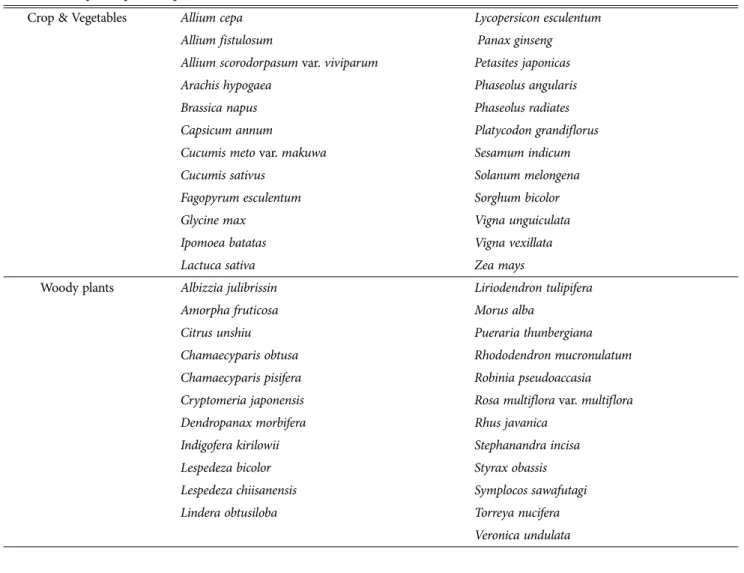
Host plants for AMF are divided into three categories, herbaceous, woody, and crop species, and, in total, AMF were found from about 100 host plants (Table 2). Among them, about 25% are crop species, 24% woody plants, and
51% herbaceous plants. Most crop species are also herba- ceous plants; thus, it would be reasonable to focus on woody plants for investigating AMF biodiversity. The literature shows that most host plants are common spe- cies; thus, rare species such as alpine or endangered spe- cies that are sensitive to climatic change or human devel- opment also need to be investigated.
Regional diversity
The distribution of sampling sites for AMF in Korea to date is illustrated in Fig. 1. The region of greatest focus Table 1. List of Glomeromycota studied on different sites in Korea (continued)
Species names Study type Reference
S. gilmorei(Trappe & Gerd.) Walker & Sanders Mor [7, 12, 17, 20]
S. heterogama(Nicolson & Gerd.) Walker & Sanders Mor [16, 25, 27, 34]
S. nigra (Redhead) Walker & Sanders Mor [12]
S. pellucida (Nicolson & Schenck) Walker & Sanders Mor [17, 19, 24, 36]
S. savannicola(Herrera & Ferrer) Walker & Sanders Mor [17]
Table 2. Host plant species reported to be studied AMF in Korea
Herbaceous plants Agropyron yesoense Lespedeza cunneata
Amphicarpaea edgeworthii Lotus corniculatus var. japonicus
Artemisia annua Miscanthus sinensis
Artemisia iwayomogi Orostachys japonica
Artemisia princeps var. orientalis Persicaria blumei
Artemisia scoparia Persicaria thunbergii
Aster tripolum Phragmites communis
Botrychium ternatum Polygonatum odoratum var. pluriflorum
Calamagrostis epigeios Sedum oryzifolium
Cassia mimosoidea var. nomame Setaria viridis
Chenopodium ficifolium Sedum sarmentosum
Commelina communis Sonchus brachyotus
Chrysanthemum morifolium Sonchus oieraceus
Desmodium oxyphyllum Sophora flavescens
Digitaria sanguinalis Stellaria aquatic
Disporum smilacinum Tephroseris kirilowii
Erigeron bonariensis Themeda triandra var. japonica
Glycine soga Trifolium respens
Impatiens balsamina Veronica undulate
Imperata cylindrica Vicia amoena
Isachne globosa Vicia unijuga
Ixeris dentata Viola mandshurica
Kummerowia striata Zoysia japonica
Table 2. Host plant species reported to be studied AMF in Korea (continued)
Crop & Vegetables Allium cepa Lycopersicon esculentum
Allium fistulosum Panax ginseng
Allium scorodorpasum var. viviparum Petasites japonicas
Arachis hypogaea Phaseolus angularis
Brassica napus Phaseolus radiates
Capsicum annum Platycodon grandiflorus
Cucumis meto var. makuwa Sesamum indicum
Cucumis sativus Solanum melongena
Fagopyrum esculentum Sorghum bicolor
Glycine max Vigna unguiculata
Ipomoea batatas Vigna vexillata
Lactuca sativa Zea mays
Woody plants Albizzia julibrissin Liriodendron tulipifera
Amorpha fruticosa Morus alba
Citrus unshiu Pueraria thunbergiana
Chamaecyparis obtusa Rhododendron mucronulatum
Chamaecyparis pisifera Robinia pseudoaccasia
Cryptomeria japonensis Rosa multiflora var. multiflora
Dendropanax morbifera Rhus javanica
Indigofera kirilowii Stephanandra incisa
Lespedeza bicolor Styrax obassis
Lespedeza chiisanensis Symplocos sawafutagi
Lindera obtusiloba Torreya nucifera
Veronica undulata
Fig. 1. AMF sampling sites in Korea.
is the center of South Korea (e.g., Chungbuk province and the regions in its vicinity). Therefore, these would be appropriate reference sites for selecting new sampling sites for future studies of AMF. The northern and the southern part of South Korea have not been evaluated extensively in AMF studies. The vegetation in the sou- thern Korea is different from that in the rest of Korea, and similar to that in other countries such as southern China and Kyushu in Japan. Moreover, these countries share some plant species; thus, comparative analysis of AMF between plants or between regions of these coun- tries would be possible. In the case of the north western Korea, there are many alpine regions; hence, its diversity with respect to alpine plants and geological features would likely affect AMF species diversity and distribution.
Conclusion
From the perspective of this review, AMF-related rese- arch in Korea is relatively narrow in scope compared with that in other countries with respect to AMF diversity. In particular, the number of investigated host plants is merely 1/300 to 1/500 of the entire Korean plant taxa, and regionally and geologically, only Chungbuk province has been investigated relatively intensively. Thus, investiga- tions that are more comprehensive are needed to establish a more complete understanding of AMF diversity in Korea. With respect to biodiversity, basing future AMF study of undiscovered areas and host plants on the re- sults of this review will be a good strategy for improving Korean biodiversity, including that of AMF.
REFERENCES
1. Redecker D, Kodner R, Graham LE. Glomalean fungi from the Ordovician. Science 2000;289:1920.
2. Guerrant EO, Havens K, Maunder M. Ex situ plant conser- vation: Supporting species survival in the wild: Island Press;
2004.
3. Schüßler A, Walker C. The Glomeromycota. A species list with new families and new genera. Createspace Independent Publishing Platform; 2010.
4. Kuhn G, Hijri M, Sanders IR. Evidence for the evolution of multiple genomes in arbuscular mycorrhizal fungi. Nature 2001;414:745-8.
5. Lee TB. Illustrated Flora of Korea. Seoul: Hyangmunsa; 1985.
6. Lee YN. Flora of Korea. Seoul: Kyo-Hak Publishing Com- pany; 2004.
7. Eom AH, Lee SS. Endomycorrhizal fungi identified on the soils in forest and coast areas. Kor J Mycol 1989;17:14-20.
8. Eom AH, Lee SS. Endomycorrhizal fungi found from the
soils of the communities of Persicaria thunbergii H. Gross.
Kor J Mycol 1990;18:26-41.
9. Mun HT, Kim CK, Choe DM. Effect of Vesicular - arbuscular mycorrhizae on the growth of bell pepper and corn seedlings.
Kor J Mycol 1990;13:1-8.
10. Sohn BK, Kim KS. Studies on the indigenous vesicular- arbuscular mycorrhizal fungi (VAMF) in horticultural crops grown under greenhouse: 2. Identification of the indigenous VAMF distributed in greenhouse soil. Kor J Soil Sci Fertil 1991;24:293-301.
11. Lee YS, Chung JB, Moon DK. Identification of mycorrhizal fungi identified on Citrus orchard soils in the island of Cheju.
Kor J Mycol 1998;26:97-102.
12. Lee KJ, Lee KH, Castillo ET, Budi SW. Biodiversity, spore density and root colonization of arbuscular mycorrhizal fungi at expressway cut-slopes in Korea. J Kor For Soc 2009;98:539- 47.
13. Kim JT, Kim CK. Vesicular - arbuscular mycorrhizal fungi found in the soils around the roots of the leguminous plants.
Kor J Mycol 1992;20:171-82.
14. Eom AH, Tae MS, Lee JK. Diversity of arbuscular mycorrhi- zal fungi in arable and natural soils in Korea. J Ecol Environ 2004;27:179-84.
15. Koh SD, Kim DJ, Ji SH. Morphological studies on arbuscular mycorrhizal spores in relation to coal - waste vegetations.
Bull Sci Educ 2000;16:57-64.
16. Ahn TK, Lee MW, Lee SS. Ecological study on arbuscular mycorrhizal fungi in the soils around leguminous plant in Korea. Kor J Mycol 1992;20:204-15.
17. Gu CD. Species divrsity of arbuscular mycorrhizal fungi community edpending on environmental conditions of forest soils. J Kor Soc Environ Restor Technol 2000;3:70-9.
18. Koh SD, Lee HH. Studies of species and distribution of vesicular - arbuscular mycorrhizal fungi in relation to salt - marsh plants. Kor J Mycol 1984;12:175-82.
19. Lee SS, Eom AH, Lee OH, Kim MK, Kim SI. Descriptions of some arbuscular mycorrhizal fungi produced under artificial conditions and collected in Korea. Kor J Mycol 1993;21:85- 93.
20. Choi KD, Ka KH, Lee YS, Shim JO, Lee SS. Diversity of arbuscular mycorrhizal fungi in Paekryung and Daecheong Islands. Microbiology 2000;28:133-41.
21. Lee JE, Eom AH. Effect of organic farming on spore diversity of arbuscular mycorrhizal fungi and glomalin in soil. Myco- biology 2009;37:272-6.
22. Park SH, Eo JK, Ka KH, Eom AH. Diversity of arbuscular mycorrhizal fungi of woody plants in Mt. Munan. Kor J Mycol 2011;39:1-6.
23. Lee SS, Ka KH, Lee SK, Peak KY. Vesicular - arbuscular mycorrhizal fungi found at the horticultural and cultivated plants. Kor J Mycol 1991;19:186-202.
24. Koh SD, Park JY. Study to Species composition and distribu- tion of arbuscular mycorrhizal fungi(AMF) at Shinduri sand- dune in Boryung district, Chungnam province. Bull Sci Educ 2003;19:189-203.
25. Ka KH, Lee SS, Lee MW. Vesicular-arbuscular mycorrhizal fungi found from the soils of plant communities. Kor J Mycol 1990;18:191-7.
26. Ka KH, Lee SS, Lee MW. New description of Acaulospora
scrobiculata collected in Korea. Kor J Mycol 1990;18:178-80.
27. Lee SS, Ryu CN. Symbiosis of arbuscular mycorrhizae on the plant roots. Kor J Mycol 1992;20:126-33.
28. Kim JT, Lee KH, Jung BC, Kim CK. Symbiotic properties of arbuscular mycorrhizal fungi and sand dune plants. Kor J Mycol 1993;21:235-45.
29. Park HM, Nam MH, Kang HW, Lee JS, Ko JY, Kang UG, Park KB. Density of arbuscular mycorrhizal spore of plastic film house soil in Yeongnam area and characteristics of AMF in vitro. Kor J Mycol 1999;32:203-9.
30. Lee JK, Park SH, Eom AH. Molecular identification of arbu- scular mycorrhizal fungal spores collected in Korea. Myco- biology 2006;34:7-13.
31. Eom AH, Eo JK, Kim DH, Jeong HS. Identification of arbu- scular mycorrhizal fungi colonizing Panax ginseng Using 18S rDNA sequence. J Kor Sci Appl Biol Chem 2004;47:182-6.
32. Lee SW, Lee EH, Eom AH. Effects of organic farming on communities of arbuscular mycorrhizal fungi. Mycobiology 2008;36:19-23.
33. An TJ, Shin YS, Lee SE, Ahn YS, Kim YG, Park CB, Yu SH.
Antifungal activity of Impatiens balsamina against ginseng pa- thogen Alternaria panax. Kor J Med Crop Sci 2009;17:464-9.
34. Koo CD. Arbuscular mycorrhizal fungus inoculation effect on Korean ash tree seedlings differs depending upon fungal species and soil conditions. J Kor For Soc 1997;86:466-75.
35. Sohn BK, Kim HL, Kim YJ. Density of arbuscular mycorrhizal fungi and chemical properties of soils in seasoning crop cultivation. Kor J Soil Sci Fertil 2003;36:145-53.
36. Ka KH, Ryu CN, Lee SS. Identification of Several Endomy- corrhizal Fungi from the Communities of Cassia mimosoides var. nomame Makino. Plant Pathol J 1990;6:1-7.
37. Eo JK, Eom AH. The Effect of benomyl treatments on gin- senosides and arbuscular mycorrhizal symbiosis in roots of Panax ginseng. J Ginseng Res 2009;33:256-9.
38. Lee JK, Eom AH, Lee SS. Identification of arbuscular my- corrhizal fungi from Botrychium ternatum native in Korea.
Mycobiology 2004;32:179-85.
39. Koo CD, Kim TH, Yi CK, Lee WK, Kang CH, Lee BC, Lee SK. Sporocarp - forming, arbscular mycorrhizal fungi, Glo- mus spp. in forest soils of Korea. Kor J Mycol 1992;20:29-36.
40. Lee SK, Eom AH, Lee SS. Population changes of arbuscular mycorrhizalsproes in the different soil environments. Kor J Mycol 1992;20:134-43.