• 검색 결과가 없습니다.

Current Perspectives on the Effects of Plant Growth-promoting Rhizobacteria

N/A
N/A
Protected

Academic year: 2021

Share "Current Perspectives on the Effects of Plant Growth-promoting Rhizobacteria"

Copied!
13
0
0

로드 중.... (전체 텍스트 보기)

전체 글

(1)

Current Perspectives on the Effects of Plant Growth-promoting Rhizobacteria

Thien Tu Huynh Le

1†

, Sang Eun Jun

2†

and Gyung-Tae Kim

1,2

*

1

Department of Applied Bioscience, Graduate School of Natural Science, Dong-A University, Busan 49315, Korea

2

Department of Molecular Genetics, College of Natural Resources and Life Science, Dong-A University, Busan 49315, Korea

Received November 6, 2019 /Revised November 19, 2019 /Accepted November 21, 2019

The rhizosphere is the active zone where plant roots communicate with the soil microbiome, each re- sponding to the other’s signals. The soil microbiome within the rhizosphere that is beneficial to plant growth and productivity is known as plant growth-promoting rhizobacteria (PGPR). PGPR take part in many pivotal plant processes, including plant growth, development, immunity, and productivity, by influencing acquisition and utilization of nutrient molecules, regulation of phytohormone biosyn- thesis, signaling, and response, and resistance to biotic- and abiotic-stresses. PGPR also produce secon- dary compounds and volatile organic compounds (VOCs) that elicit plant growth. Moreover, plant roots exude attractants that cause PGPR to aggregate in the rhizosphere zone for colonization, improv- ing soil properties and protecting plants against pathogenic factors. The interactions between PGPR and plant roots in rhizosphere are essential and interdependent. Many studies have reported that PGPR function in multiple ways under the same or diverse conditions, directly and indirectly. This review focuses on the roles and strategies of PGPR in enhancing nutrient acquisition by nutrient fix- ation/solubilization/mineralization, inducing plant growth regulators/phytohormones, and promoting growth and development of root and shoot by affecting cell division, elongation, and differentiation.

We also summarize the current knowledge of the effects of PGPR and the soil microbiota on plants.

Key words : Nutrient, PGPR, phytohormone, plant growth and development, rhizosphere

Authors contributed equally.

*Corresponding author

*Tel : +82-51-200-7519 Fax : +82-51-200-7524

*E-mail : [email protected]

This is an Open-Access article distributed under the terms of the Creative Commons Attribution Non-Commercial License (http://creativecommons.org/licenses/by-nc/3.0) which permits unrestricted non-commercial use, distribution, and reproduction in any medium, provided the original work is properly cited.

Journal of Life Science 2019 Vol. 29. No. 11. 1281~1293 DOI : https://doi.org/10.5352/JLS.2019.29.11.1281

Introduction

Plant–microbe interactions occur in the rhizosphere and endosphere (Fig. 1). Endophytic bacteria are those that colo- nize the internal tissues of plants without having negative effects on their host [99]. Endophytes often promote plant growth and development [29]. The rhizosphere is the active microbial region surrounding the root system and is influ- enced by root exudates (Fig. 1) [47, 112]. The rhizosphere bacterial population is estimated to be 10 to 100 times higher than the bulk soil population [17]. Root exudates contain abundant ions, oxygen, water, and carbon-containing com- pounds [72, 112]. Root exudates can serve as attractants or repellents that accumulate favorable microbes or protect plants from pathogens, according to the physiological con- dition of the plant [5]. The various plant–microbiome inter-

actions in the rhizosphere affect plant growth and develop- ment, influencing crop yields [18, 102]. Beneficial bacteria in the rhizosphere, termed plant growth-promoting rhizo- bacteria (PGPR), enhance plant health, growth, and yield [64, 107, 109].

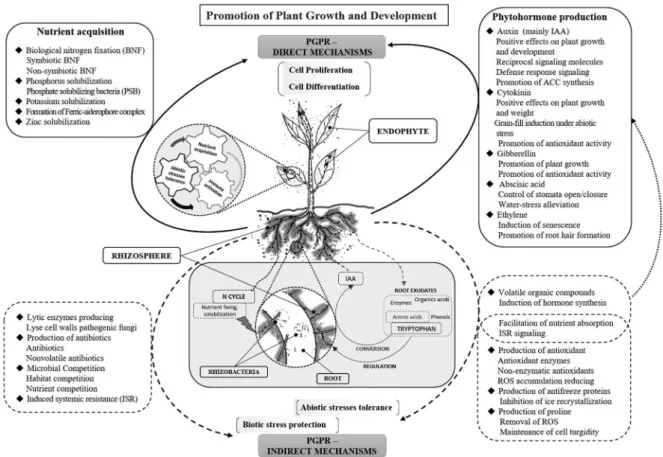
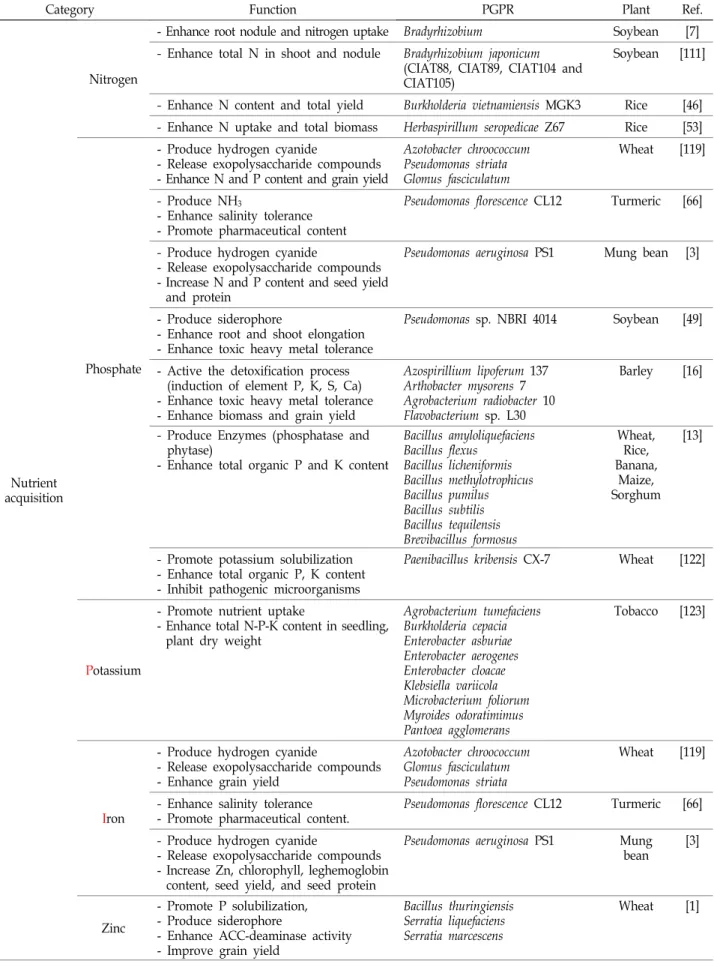
PGPR affect plant growth and development via direct and indirect mechanisms (Fig. 1) [43, 48]. PGPR directly/in- directly affect plant developmental and metabolic processes, not only by the bacteria themselves but also by the pro- duction and secretion of various compounds, including phy- tohormones, anti-oxidants, proline, antifreeze proteins, vola- tile organic compounds (VOCs), antibiotics, and lytic enzymes. In direct mechanisms, the PGPR and their prod- ucts improve the mobility and availability of nutrients for easy uptake by plants [76], regulating plant growth and development. Indirectly, PGPR products induce abiotic stress tolerance, change the properties of the soil environ- ment by attracting a beneficial microbiome or repelling phy- topathogens, and modify soil structure by solubilizing or se- questering heavy metal elements [2, 76]. Table 1 lists recent studies of PGPR. In this review, we update the information on the important effects of PGPR for enhancing plant growth directly by facilitating resource acquisition and stimulating phytohormones.

- Review -

(2)

Fig. 1. Direct and indirect mechanisms of the effects of PGPR on plants. PGPR inhabit the rhizosphere or are endophytes and affect cell growth, including cell proliferation, expansion, and differentiation, thereby modifying plant growth and fitness.

Direct mechanisms increase the availability of essential nutrients and the production or release of phytohormones. The indirect mechanisms improve plant tolerance of abiotic or biotic stresses. VOCs can also promote PGPR hormone production directly.

The solid arrows and boxes indicate direct mechanisms; the dashed arrows and boxes indicate indirect mechanisms of PGPR on host plants; and the dotted arrow shows the effect of VOCs on hormone-producing PGPR. A middle gray box at the bottom shows an example of the direct signals between rhizobacteria and plant roots.

PGPR and nutrient acquisition

Numerous factors affect plant growth, including external and internal cues. Nutrients are important factors that in- duce plant growth and productivity and increase plant biomass. PGPR improve the mobility of nutrients in the soil and rhizosphere, which facilitates plant uptake. The follow- ing paragraphs outline the mechanisms by which PGPR in- crease the bioavailability of soil-borne nutrients.

Biological nitrogen fixation

Nitrogen (N) is an essential constituent of proteins and nucleic acids [104] and is the most important plant nutrient.

More than 78% of all N is present in gaseous form. PGPR can reduce N

2

in the atmosphere to ammonia (NH

3

), a usable organic form, through biological nitrogen fixation (BNF) via nitrogenase [63]. At mild temperatures, PGPR induce BNF

[96]. There are two main groups of BNF bacteria: symbiotic (endophytic) (Rhizobium, Bradyrhizobium, Sinorhizobium, Mesorhizobium, and Frankia) [117], and non-symbiotic (free-living) (Azoarcus, Azotobacter, Acetobacter, Azospirillum, Burkholderia, Cyanobacteria, Enterobacter, Gluconacetobacter, and Pseudomonas) BNF bacteria [19]. The symbiotic BNF bac- teria are responsible for more than 80% of global BNF, and the remaining 20% is supplied by non-symbiotic free-living BNF bacteria [32].

Bio-available phosphorous for plant uptake

Phosphorus (P) plays a key role in energy transfer, photo-

synthesis, macromolecule biosynthesis, and vital metabolic

processes in plant growth [9, 51]. P is present in both organic

and inorganic forms [61]. However, the mobility of P is af-

fected by the soil structure and soil quality, and the amount

of usable P in soil is low. PGPR can solubilize and activate

(3)

the P from soil. Phosphate-solubilizing bacteria (PSB) can convert phosphate from many unavailable forms, such as rock phosphate and mono-calcium or di-calcium phosphate, into available forms by producing enzymes and acids [25, 88]. PGPR involved in the solubilization and mineralization of P including Arthrobacter, Bacillus, Burkholderia, Enterobacter, Erwinia, Flavobacterium, Microbacterium, Pseudomonas, and Rhizobium (Table 1). Recent studies have shown that the per- formance of PSB is affected by external factors, particularly stress conditions [4, 65].

Potassium solubilization

Potassium (K) is important for photosynthesis, enzyme activation, and protein synthesis. K deficiency causes poor root structure, represses growth, and lowers productivity.

Soluble K is present in soil in low concentrations and more than 90% of K is in inactive forms such as silicate minerals and rocks [39, 90]. Bacillus mucilaginosus, Bacillus edaphicus, Burkholderia sp., Acidithiobacillus ferrooxidans, Pseudomonas sp., and Paenibacillus sp. are PGPR that release soluble K from K-bearing soil (Table 1) [69]. The application of PGPR as K bio-fertilizer to reduce the use of chemical fertilizers and support eco-sustainable agriculture has been reported [100].

Iron chelate produced by siderophores

Iron (Fe) is an essential protein co-factor involved in vital metabolic processes such as photosynthesis and respiration [30, 89]. Fe is mainly present as ferric ions (Fe

3+

), which liv- ing organisms cannot absorb [8]. Fortunately, some rhizo- sphere bacteria increase the solubility of iron by producing siderophores, a ferric-iron-specific chelating agent [41, 114].

Representative PGPR that produce siderophores include Pseudomonas, Azotobacter, Bacillus, Enterobacter, Serratia, Azo- spirillum, and Rhizobium. The siderophore complex reduces ferric ions (Fe

3+

) into ferrous ions (Fe

2+

), which easily enter cells (Table 1) [95]. These siderophores also form complexes with other metals such as molybdenum, manganese, cobalt, and nickel, increasing their availability to plants and other microorganisms.

Zinc solubilization

In plants, zinc (Zn) deficiency affects membrane integrity, protection against abiotic stress, and the synthesis of chlor- ophyll, carbohydrates, auxins, and nucleotides [56, 106]. The majority of Zn in soil is in insoluble sphalerite form (ZnS) or in various mineral ores; a minority is in soluble form,

and plants can acquire divalent zinc. Communication among PGPR is involved in the solubilization and activation of Zn through soil acidification, proton and siderophore pro- duction, and oxidoreductive systems, which increase the ability of plants to absorb Zn [44]. Zn-solubilizing PGPR in- clude Pseudomonas aeruginosa, Bacillus aryabhattai, Gluconace- tobacter diazotrophicus, Pseudomonas striata, Pseudomonas fluo- rescence, Burkholderia cenocepacia, Serratia liquefaciens, Serratia marcescens, and Bacillus thuringiensis (Table 1). Inoculation with these Zn-solubilizing bacteria increased the Zn content of straw and grains, promoting growth and increasing yield in soybean, rice, maize, and wheat (Table 1) [1].

PGPR produce phytohormones

Plants synthesize phytohormones to regulate their devel- opmental and physiological processes and to recognize in- ternal and external environmental changes as signals and ligands. There are 11 classes of phytohormones: auxins, ab- scisic acid (ABA), cytokinins (CKs), gibberellins (GAs), ethyl- ene, brassinosteroids, jasmonates (JA), nitric oxides, poly- amines, salicylic acids, and strigolactones [12, 20]. Many studies of genetic mutants of Arabidopsis have recognized the interactions between plants and particular phytohormones.

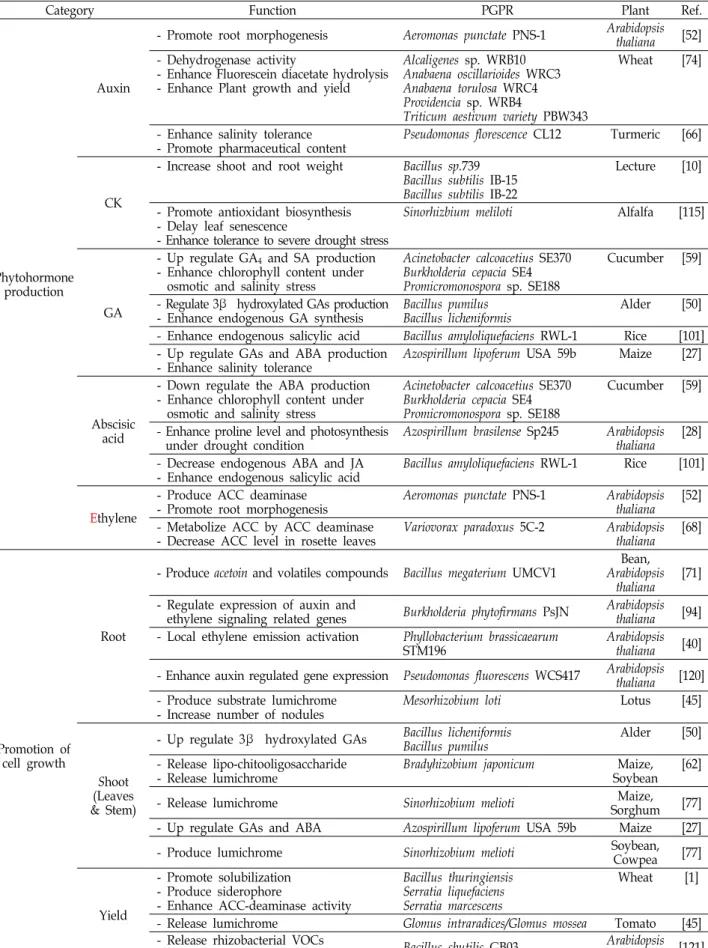
The beneficial microbiota stimulates the biosynthesis of phy- tohormones, which promotes plant growth and nutrient acquisition. The interactions of plants with symbiotic or non-symbiotic bacteria influence plant growth, develop- ment, health, and yield by producing and secreting various metabolically active compounds [11, 38]. Not surprisingly, microbial regulators, which are very similar to phyto- hormones, affect plants. These microbial phytohormones have similar effects on the supply of exogenous phyto- hormones. The PGPR genera Arthrobacter, Bradyrhizobium, Mesorhizobium, Bacillus, Rhizobium, Rhanella, Pantoea, Pseudo- monas, Herbaspirillum, Enterobacter, Brevundimonas, and Bur- kholderia can produce phytohormones (Table 1), which af- fects cell division and differentiation and the root structure, ultimately altering plant growth and development (Fig. 1) [11, 38].

Auxin

Auxins are important hormones that contribute to the

overall architecture of the plant from the cellular to the in-

dividual plant level. Auxins participate in polar signaling

in the elongation of sub-apical meristem cells, organ for-

(4)

Table 1. Recent studies on the interaction of plant-PGPR and plant-growth promoting effects

Category Function PGPR Plant Ref.

Nutrient acquisition

Nitrogen

- Enhance root nodule and nitrogen uptake Bradyrhizobium Soybean [7]

- Enhance total N in shoot and nodule Bradyrhizobium japonicum (CIAT88, CIAT89, CIAT104 and CIAT105)

Soybean [111]

- Enhance N content and total yield Burkholderia vietnamiensis MGK3 Rice [46]

- Enhance N uptake and total biomass Herbaspirillum seropedicae Z67 Rice [53]

Phosphate

- Produce hydrogen cyanide

- Release exopolysaccharide compounds - Enhance N and P content and grain yield

Azotobacter chroococcum Pseudomonas striata Glomus fasciculatum

Wheat [119]

- Produce NH

3

- Enhance salinity tolerance - Promote pharmaceutical content

Pseudomonas florescence CL12 Turmeric [66]

- Produce hydrogen cyanide

- Release exopolysaccharide compounds - Increase N and P content and seed yield

and protein

Pseudomonas aeruginosa PS1 Mung bean [3]

- Produce siderophore

- Enhance root and shoot elongation - Enhance toxic heavy metal tolerance

Pseudomonas sp. NBRI 4014 Soybean [49]

- Active the detoxification process (induction of element P, K, S, Ca) - Enhance toxic heavy metal tolerance - Enhance biomass and grain yield

Azospirillium lipoferum 137 Arthobacter mysorens 7 Agrobacterium radiobacter 10 Flavobacterium sp. L30

Barley [16]

- Produce Enzymes (phosphatase and phytase)

- Enhance total organic P and K content

Bacillus amyloliquefaciens Bacillus flexus

Bacillus licheniformis Bacillus methylotrophicus Bacillus pumilus Bacillus subtilis Bacillus tequilensis Brevibacillus formosus

Wheat, Rice, Banana,

Maize, Sorghum

[13]

- Promote potassium solubilization - Enhance total organic P, K content - Inhibit pathogenic microorganisms

Paenibacillus kribensis CX-7 Wheat [122]

Potassium

- Promote nutrient uptake

- Enhance total N-P-K content in seedling, plant dry weight

Agrobacterium tumefaciens Burkholderia cepacia Enterobacter asburiae Enterobacter aerogenes Enterobacter cloacae Klebsiella variicola Microbacterium foliorum Myroides odoratimimus Pantoea agglomerans

Tobacco [123]

Iron

- Produce hydrogen cyanide

- Release exopolysaccharide compounds - Enhance grain yield

Azotobacter chroococcum Glomus fasciculatum Pseudomonas striata

Wheat [119]

- Enhance salinity tolerance - Promote pharmaceutical content.

Pseudomonas florescence CL12 Turmeric [66]

- Produce hydrogen cyanide

- Release exopolysaccharide compounds - Increase Zn, chlorophyll, leghemoglobin

content, seed yield, and seed protein

Pseudomonas aeruginosa PS1 Mung bean

[3]

Zinc

- Promote P solubilization, - Produce siderophore

- Enhance ACC-deaminase activity - Improve grain yield

Bacillus thuringiensis Serratia liquefaciens Serratia marcescens

Wheat [1]

(5)

Table 1. Continued

Category Function PGPR Plant Ref.

Phytohormone production

Auxin

- Promote root morphogenesis Aeromonas punctate PNS-1 Arabidopsis thaliana [52]

- Dehydrogenase activity

- Enhance Fluorescein diacetate hydrolysis - Enhance Plant growth and yield

Alcaligenes sp. WRB10 Anabaena oscillarioides WRC3 Anabaena torulosa WRC4 Providencia sp. WRB4

Triticum aestivum variety PBW343

Wheat [74]

- Enhance salinity tolerance

- Promote pharmaceutical content Pseudomonas florescence CL12 Turmeric [66]

CK

- Increase shoot and root weight Bacillus sp.739 Bacillus subtilis IB-15 Bacillus subtilis IB-22

Lecture [10]

- Promote antioxidant biosynthesis - Delay leaf senescence

- Enhance tolerance to severe drought stress

Sinorhizbium meliloti Alfalfa [115]

GA

- Up regulate GA

4

and SA production - Enhance chlorophyll content under

osmotic and salinity stress

Acinetobacter calcoacetius SE370 Burkholderia cepacia SE4 Promicromonospora sp. SE188

Cucumber [59]

- Regulate 3β‐hydroxylated GAs production

- Enhance endogenous GA synthesis Bacillus pumilus

Bacillus licheniformis Alder [50]

- Enhance endogenous salicylic acid Bacillus amyloliquefaciens RWL-1 Rice [101]

- Up regulate GAs and ABA production

- Enhance salinity tolerance Azospirillum lipoferum USA 59b Maize [27]

Abscisic acid

- Down regulate the ABA production - Enhance chlorophyll content under

osmotic and salinity stress

Acinetobacter calcoacetius SE370 Burkholderia cepacia SE4 Promicromonospora sp. SE188

Cucumber [59]

- Enhance proline level and photosynthesis

under drought condition Azospirillum brasilense Sp245 Arabidopsis thaliana [28]

- Decrease endogenous ABA and JA

- Enhance endogenous salicylic acid Bacillus amyloliquefaciens RWL-1 Rice [101]

Ethylene

- Produce ACC deaminase

- Promote root morphogenesis Aeromonas punctate PNS-1 Arabidopsis thaliana [52]

- Metabolize ACC by ACC deaminase

- Decrease ACC level in rosette leaves Variovorax paradoxus 5C-2 Arabidopsis thaliana [68]

Promotion of cell growth

Root

- Produce acetoin and volatiles compounds Bacillus megaterium UMCV1 Bean, Arabidopsis

thaliana [71]

- Regulate expression of auxin and

ethylene signaling related genes Burkholderia phytofirmans PsJN Arabidopsis thaliana [94]

- Local ethylene emission activation Phyllobacterium brassicaearum

STM196 Arabidopsis

thaliana [40]

- Enhance auxin regulated gene expression Pseudomonas fluorescens WCS417 Arabidopsis thaliana [120]

- Produce substrate lumichrome

- Increase number of nodules Mesorhizobium loti Lotus [45]

Shoot (Leaves

& Stem)

- Up regulate 3β‐hydroxylated GAs Bacillus licheniformis

Bacillus pumilus Alder [50]

- Release lipo-chitooligosaccharide - Release lumichrome

Bradyhizobium japonicum Maize,

Soybean [62]

- Release lumichrome Sinorhizobium melioti Maize,

Sorghum [77]

- Up regulate GAs and ABA Azospirillum lipoferum USA 59b Maize [27]

- Produce lumichrome Sinorhizobium melioti Soybean,

Cowpea [77]

Yield

- Promote solubilization - Produce siderophore

- Enhance ACC-deaminase activity

Bacillus thuringiensis Serratia liquefaciens Serratia marcescens

Wheat [1]

- Release lumichrome Glomus intraradices/Glomus mossea Tomato [45]

- Release rhizobacterial VOCs

- Regulate auxin homeostasis Bacillus sbutilis GB03 Arabidopsis

thaliana [121]

(6)

mation, shoot elongation, and root development via photo- tropism and gravitropism. Auxin signaling and plant bio- synthesis are tightly regulated [33, 37]. The most essential auxin is indole-3-acetic acid (IAA), which has major effects in intact plants and is the most potent native auxin [67, 105, 110]. IAA is biosynthesized by both PGPR and pathogenic bacteria [37, 54, 91]. IAA-producing bacteria have the poten- tial to interfere with plant auxin homeostasis. Whether bacte- rial IAA promotes or inhibits plant growth depends on the plant endogenous IAA level and amount of bacterial IAA produced [75, 91]. Some reports describe the negative effects of bacterial IAA, such as reduced root motility, debilitation of the plant defense system by loosening the plant cell wall and altering the hypersensitive response, and promoting pathogen colonization [83, 91]. However, most research has found that auxin-producing bacteria positively affect im- portant steps in plant growth and development. Rhizobac- teria producing IAA promote plant growth when bacterial IAA is within an ideal concentration range. IAA-producing bacteria, such as Agrobacterium, Bradyrhizobium, Enterobacter, Klebsiella, Pseudomonas, and Rhizobium, promote root elonga- tion and lateral root formation in canola, Medicago, and wheat in host specific- and dose-dependent manners as PGPR (Table 1) [91, 104]. PGPR producing IAA also promote root hair formation, resulting in root system development, improved water and nutrient acquisition, and root anchoring in the soil as well as increased plant biomass. Some research shows that auxin-producing PGPR can directly stabilize the auxin level of host plants by supplying auxin in root nodules [41]. Most auxin-producing rhizobial knock-out mutants are still involved in plant growth and development, suggesting the existence of other mechanisms that act in combination with IAA biosynthesis, such as 1-aminocyclopropane-1-car- boxylate (ACC) deaminase, phosphate solubilization, or di- nitrogen fixation, on biomass [35]. ACC deaminase pro- duction by PGPR represses the inhibition of root growth by converting ACC into ammonia and alpha-ketobutyrate [35].

Bacterial IAA induces the activation of key enzymes in the tricarboxylic acid cycle, which enhances nitrogen fixation in plant nodules and increases plant biomass [124]. IAA is also a reciprocal signaling molecule that sustains symbiotic rela- tionships that have co-evolved between plants and bacteria.

Despite the characterization of IAA synthesis pathways from isolated IAA-producing bacteria, the details of the inter- actions between plants and PGPR are still unclear. Neverthe- less, the co-cultivation of plants and IAA-producing bacteria

should improve biofertilization, phytostimulation, and bio- control to reduce the use of chemical fertilizers and herbicides.

Cytokinin

Cytokinin (CK) is also an important hormone that is in- volved in developmental processes throughout plant life, in- cluding meristematic cell division and differentiation, organ formation, root hair induction, and leaf expansion and sen- escence delay in plants [24, 33]. CK is also involved in chlor- oplast and xylem differentiation, apical dominance, bloom- ing and fruiting, nutrient signals, and plant–pathogenic bacteria interactions [98]. CK produced by Bacillus subtilis accumulates in plants, resulting in increased plant growth and weight (Table 1) [10]. Several CK-producing bacteria have been shown to improve the drought tolerance of alfalfa and enhance rhizobacterial colonization in the rhizosphere [115]. The increased CK concentration under abiotic stress is linked to a stay-green phenotype and improved grain fill- ing and antioxidant production (Table 1) [22, 80, 108].

Gibberellin

Gibberellins (GA), which are synthesized from diterpe- noid acids via the terpenoid pathway, stimulate stem elonga- tion [36, 118] and promote chlorophyll biogenesis and the photosynthetic rate of plants [60, 116]. GA production has been detected in both fungi and bacteria [23]. The fungus Gibberella fujikuroi GA pathway is distinct from the host plant pathway [21]. GA have been also detected in Achromobacter xylosoxidans, Acinetobacter calcoaceticus, Azotobacter spp., Azo- spirillum spp., Bacillus spp., Gluconobacter diazotrophicus, Her- baspirillum seropedicae, and Bradyrhizobium and Rhizobium strains (Table 1) [34]. Some nitrogen-fixing bacteria, includ- ing a soybean symbiont (Bradyrhizobium japonicum) and a broad-host-nodulating species (Sinorhizobium fredii), contain a putative GA biosynthetic operon/gene cluster necessary to produce GA

9

[85], suggesting that a GA biosynthetic path- way evolved independently in bacteria (Table 1). Under abiotic stress, especially osmotic stress in plants, the pres- ence of GA can promote antioxidant enzyme production by reducing the level of reactive oxygen species, thereby im- proving the plant host fitness [73].

Abscisic acid

Abscisic acid (ABA) is biosynthesized in plants by an in-

direct pathway in which ABA is converted from the car-

(7)

otenoid lycopene enzymatically [82]. ABA plays roles in abiotic stress protection (salinity, drought, and metal tox- icity), bud dormancy, fruit ripening, stomata opening and closing, suppression of seed germination, and inhibition of root elongation [33, 103]. Based on many in vitro studies, it was proposed that PGPR produce ABA [26], including Azospirillum brasilense and Bradyrhizobium japonicum. Azospir- illum brasilense grown on defined media produced ABA. In vitro, the ABA concentration doubled in plant tissues when Arabidopsis seedlings were treated with Azospirillum brasi- lense suspension, indicating that PGPR promote plant ABA levels (Table 1) [26]. A similar result was reported when aseptic maize seedlings were inoculated with Azospirillum lipoferum USA59b, which may help to alleviate water stress in plants [27].

Ethylene

Ethylene or ripening hormone plays an important role in physiological processes, including stimulation of fruit ripen- ing, cell expansion, seed germination, and senescence [33].

Ethylene represses primary root elongation and lateral root formation [84, 92]. Recent research focused on the effect of rhizobacteria on plant ethylene levels via ACC deaminase [42, 78, 81], which is found in 34 bacterial genera, and Azospirillum brasilense Sp245 was one of the best-known PGPR [15]. This enzyme is a key factor in PGPR activity to stimulate root elongation via a reduction in endogenous ethylene.

PGPR affect plant growth and development

Through direct (such as the production of phytohormones and facilitation of soil nutrient acquisition) and indirect (such as competition with pathogens and improvement of soil properties) mechanisms, PGPR affect host plant growth and development, from the molecular level to crop yield.

Because PGPR inhabit the rhizosphere, many studies have focused on the effects of PGPR on root systems. Of the vari- ous hormones produced by PGPR, auxins influence root ar- chitecture [113] and development [55] by altering cell divi- sion and differentiation. Auxin-producing PGPR evoked transcriptional changes in root elongation induction and cell wall-related genes and increased root biomass and stomata size, while reducing stomata density [70].

PGPR affect both cell division at the root meristem and the sites of lateral root formation in cell division and differ-

entiation. Inoculating Arabidopsis seedlings with PGPR, such as Bacillus megaterium UMCV1 or Pseudomonas simiae WCS417, altered maintenance of the root stem cell niche and the transition from cell proliferation to cell differentiation (Table 1) [71, 120]. Pseudomonas simiae increases cell division in the root meristematic zone [120], whereas Bacillus mega- terium decreases cell division [71]. However, inoculation with these bacteria caused a decrease in primary root length, due to decreased cell elongation in the elongation zone by 40% and 50%, respectively [71, 120]. PGPR also affect the formation of root hairs, which emerge closer to the root tip.

The changes in root development caused by PGPR result from modification of the plant hormone response. Pseudomo- nas simiae WCS417 induced increased meristematic cell divi- sion and lateral root numbers, suggesting increased aux- in-responsive gene expression. By contrast, Bacillus mega- terium UMCV1 induced decreased meristematic cell division (Table 1) [71, 120]. The cellular and genetic effects of PGPR on the root system accompany changes in the endogenous phytohormone response. Inoculating plants with IAA-pro- ducing rhizobacteria strains induced growth in root length and leaves under saline conditions [6]. Bacillus subtilis GB03, which produces IAA, initiated growth by modifying auxin homeostasis and cell-wall-loosening enzymes [97, 121].

Bacteria, including PGPR, produce and secret quorum- sensing molecules, which are involved in cell-to-cell commu- nication to monitor cell density and the composition of the microbial community in the extracellular environment by adjusting their gene expression and physiological processes [113]. Quorum sensing negatively regulates IAA production in bacteria. A few strains of Azospirillum lipoferum produce quorum-sensing N-acyl-homoserine lactone (AHL) mole- cules that reduce IAA production via AHL inactivation [113].

AHL alters root development in Arabidopsis by inhibiting primary root growth, altering lateral root formation, and causing the proliferation of root hairs, thereby increasing the absorptive surface [86, 87]. Depending on the concentration and length of AHLs, AHL-producing rhizobacteria induce distinct changes in root systems. For example, high AHL concentrations promote lateral root development and inhibit primary root growth, perhaps by altering cytokinin signaling rather than the auxin response [86]. Conversely, at low con- centrations, short-chain AHLs promote primary root elonga- tion by inducing increased numbers of meristematic cells and increasing cell size in the elongation zone [124].

Similarly, VOCs produced by PGPR affected the growth of

(8)

Arabidopsis thaliana [121] and Lactuca sativa [79] by up-regu- lating the expression of auxin synthesis genes, modifying the cell well by promoting the expression of expansion genes (EXP1, EXP6, and EXPA5), and regulating auxin homeo- stasis (Table 1). PGPR are also reported to affect other plant parts, such as leaves and stems. Tomato plants inoculated with the PGPR Promicromonospora sp. SE188 had longer shoots and greater biomass, exhibiting GA-production and phosphate-solubilization activities [57]. GA-deficient mutant soybean plants had increased total weight, plant height, and chlorophyll content when inoculated with GA-producing Pseudomonas putida H-2-3 [58]. The PGPR Burkholderia phyto- firmans PsJN enhanced primary root growth, root hair devel- opment and growth, and aerial growth, including increasing the size of leaf epidermal cells [93]. The secondary metabo- lites and VOCs produced by PGPR can improve plant growth and development. PGPR-produced VOCs accelerate increased shoot length and biomass [14], shorten leaf emer- gence, or increase leaf size via lumichrome and riboflavin [31]. Many studies have reported that PGPR exudates, VOCs, secondary metabolites, and phytohormones influence root permeation and the transport of nutrients to the shoot, and promote cell division and expansion, ultimately resulting in increased plant growth. Although further studies of the physiological, molecular, and genetic interactions between plants and PGPR are required, the appropriate coordination of crop species and PGPR should provide renewable meth- ods to enhance crop yield.

Conclusion

Plants have evolved reciprocally beneficial interactions in the rhizosphere with various rhizobacteria and have used them to recognize and adapt to changes in the external environment. This review summarized the effects of PGPR in promoting various characteristics of plant growth via di- rect mechanisms. PGPR help to increase the availability of essential nutrients by mobilizing, solubilizing, or producing siderophore compounds, thereby promoting plant growth.

Phytohormones produced or released by PGPR play dual roles: modifying the physiological processes of the host and protecting plant processes under biotic or abiotic stresses.

Rhizobacteria-produced exudates, including secondary me- tabolites, VOCs, and quorum-sensing molecules, can modify the physical, chemical, and biological properties of the rhizo- sphere environment. These modifications directly or in-

directly stimulate cell division and expansion, facilitate nu- trient acquisition, and activate defenses against abiotic and biotic stresses. However, the details of the mechanisms of the effects of PGPR on plants at the cellular, genetic, and molecular levels remain poorly understood. It is important to investigate these effects of PGPR under controlled con- ditions to reveal the precise mechanisms by which PGPR promote plant growth and increase crop yields. Ultimately, PGPR are a promising approach to replace chemical fertil- izers, synthesized hormones, and chemical pesticides in agriculture.

Acknowledgement

This work was supported by the Dong-A University re- search fund.

References

1. Abaid-Ullah, M., Hassan, M. N., Jamil, M., Brader, G., Shah, M. K., Sessitsch, A. and Hafeez, F. Y. 2015. Plant growth promoting rhizobacteria: an alternate way to improve yield and quality of wheat (Triticum aestivum). Int. J. Agric. Biol.

17, 51-60.

2. Ahemad, M. 2012. Implications of bacterial resistance against heavy metals in bioremediation: a review. J. Inst.

Integr. Omics Appl. Biotechnol. 3, 39-46.

3. Ahemad, M. and Khan, M. S. 2010d. Phosphate-solubilizing and plant growth promoting Pseudomonas aeruginosa PS1 im- proves greengram performance in quizalafop-p-ethyl and clodinafop amended soil. Arch. Environ. Contam. Toxicol. 58, 361-372.

4. Ahemad, M. and Khan, M. S. 2012a. Effect of fungicides on plant growth promoting activities of phosphate solubiliz- ing Pseudomonas putida isolated from mustard (Brassica com- pestris) rhizosphere. Chemosphere 86, 945-950.

5. Ahemad, M. and Kibret, M. 2014. Mechanisms and applica- tions of plant growth promoting rhizobacteria: Current perspective. J. King Saud Univ. Sci. 26, 1-20.

6. Albacete, A., Ghanem, M. E., Martínez-Andújar, C., Acosta, M., Sánchez-Bravo, J., Martínez, V., Lutts, S., Dodd, I. C.

and Pérez-Alfocea, F. 2008. Hormonal changes in relation to biomass partitioning and shoot growth impairment in salinized tomato (Solanum lycopersicum L.) plants. J. Exp. Bot.

59, 4119-4131.

7. Alves, B. J. R., Boddey, R. M. and Urquiaga, S. 2004. The success of Biological Nitrogen Fixation (BNF) in soybean in Brazil. Plant Soil. 252, 1-9.

8. Ammari, T. and Mengel, K. 2006. Total soluble Fe in soil solutions of chemically different soils. Geoderma 136, 876- 885.

9. Anand, K., Kumari, B. and Mallick, M. A. 2016. Phosphate

(9)

solubilizing microbes: An effective and alternative approach as biofertilizers. Int. J. Pharm. Pharm. Sci. 8, 37-40.

10. Arkhipova, T., Veselov, S., Melentiev, A., Martynenko, E.

and Kudoyarova, G. 2005. Ability of bacterium Bacillus sub- tilis to produce cytokinins and to influence the growth and endogenous hormone content of lettuce plants. Plant Soil.

272, 201-209.

11. Arora, N. K., Tewari, S. and Singh, R. 2013. Multifaceted plant-associated microbes and their mechanisms diminish the concept of direct and indirect PGPRs, pp. 411-449. In:

Arora, N. K. (ed) Plant microbe symbiosis: fundamentals and advances. Springer, New Delhi, India.

12. Arshad, M. and Frankenberger, W. T. 1998. Plant growth- regulating substances in the rhizosphere: Microbial pro- duction and functions. Adv. Agron. 62, 46-151.

13. Bahadur, I., Maurya, B. R., Meena, V. S., Saha, M., Kumar, A. and Aeron, A. 2017. Mineral release dynamics of trical- cium phosphate and waste muscovite by mineral-solubiliz- ing rhizobacteria (MSR) isolated from Indo-Gangetic Plain (IGP) of India. Geomicrobiol. J. 34, 454-466.

14. Bailly, A. and Weisskopf, L. 2012. The modulating effect of bacterial volatiles on plant growth: current knowledge and future challenges. Plant Signal. Behav. 7, 79-85.

15. Belimov, A. A., Dodd, I. C., Hontzeas, N., Theobald, J. C., Safronova, V. I. and Davies, W. J. 2009. Rhizosphere bacteria containing ACC deaminase increase yield of plants grown in drying soil via both local and systemic hormone signaling.

New Phytol. 181, 413-423.

16. Belimov, A. A., Kunakova, A. M., Safronova, V. I., Stepanok, V. V., Iudkin, L. Iu., Alekseev, Iu. V. and Kozhemiakov, A. P. 2004. Employment of rhizobacteria for the inoculation of barley plants cultivated in soil contaminated with lead and cadmium. Microbiologia 73, 99-106.

17. Berendsen, R. L., Pieterse, C. M. and Bakker, P. A. 2012.

The rhizosphere microbiome and plant health. Trends Plant Sci. 17, 478-486.

18. Berg, G. and Smalla, K. 2009. Plant species and soil type cooperatively shape the structure and function of microbial communities in the rhizosphere. FEMS Microbiol. Ecol. 68, 1-13.

19. Bhattacharyya, P. N. and Jha, D. K. 2012. Plant growth-pro- moting rhizobacteria (PGPR): emergence in agriculture.

World J. Microbiol. Biotechnol. 28, 1327-1350.

20. Bishopp, A., Mahonen, A. P. and Helariutta, Y. 2006. Signs of change: Hormone receptors that regulate plant develop- ment. Development 133, 1857-1869.

21. Bömke, C. and Tudzynski, B. 2009. Diversity, regulation and evolution of the gibberellin biosynthetic pathway in fungi compared to plants and bacteria. Phytochemistry 70, 1876- 1893.

22. Borrell, A. K., Hammer, G. L. and Henzell, R. G. 2000. Does maintaining green leaf area in sorghum improve yield un- der drought? II. Dry matter production and yield. Crop Sci.

40, 1037-1048.

23. Bottini, R., Cassán, F. and Piccoli, P. 2004. Gibberellin pro- duction by bacteria and its involvement in plant growth

promotion and yield increase. Appl. Microbiol. Biotechnol. 65, 497-503.

24. Cassán, F., Vanderleyden, J. and Spaepen, S. 2014. Physio- logical and agronomical aspects of phytohormone pro- duction by model plant-growth-promoting rhizobacteria (PGPR) belonging to the genus Azospirillum. J. Plant Growth Regul. 33, 440-459.

25. Chen, Y. P., Rekha, P. D., Arun, A. B., Shen, F. T., Lai, W.

A. and Young, C. C. 2006. Phosphate solubilizing bacteria from subtropical soil and their tricalcium phosphate solubi- lizing abilities. Appl. Soil Ecol. 34, 33-41.

26. Cohen, A. C., Bottini, R. and Piccoli, P. N. 2008. Azospirillum brasilense Sp245 produces ABA in chemically-defined cul- ture medium and increases ABA content in Arabidopsis plants. Plant Growth Regul. 54, 97-103.

27. Cohen, A. C., Travaglia, C. N., Bottini, R. and Piccoli, P.

N. 2009. Participation of abscisic acid and gibberellins pro- duced by endophytic Azospirillum in the alleviation of drought effects in maize. Botany 87, 455-462.

28. Cohen, A. C., Bottini, R., Pontin, M., Berli, F. J., Moreno, D., Boccanlandro, H., Travaglia, C. N. and Piccoli, P. N.

2015. Azospirillum brasilense ameliorates the response of Arabidopsis thaliana to drought mainly via enhancement of ABA levels. Physiol. Plant. 153, 79-90.

29. Conrath, U., Beckers, G. J. M., Flors, V., García-Agustín, P., Jakab, G. and Mauch, F. 2006. Priming: getting ready for battle. Mol. Plant Microbe. Interact. 19, 1062-1071.

30. Crowley, D. E. 2006 Microbial Siderophores in the Plant Rhizosphere, pp 169-198. In: Barton L.L. and Abadia J. (eds), Iron Nutrition in Plants and Rhizospheric Microorganisms.

Springer Publisher: Dordrecht, The Netherland.

31. Dakora, F., Matiru, V. and Kanu, A. 2015. Rhizosphere ecol- ogy of lumichrome and riboflavin, two bacterial signal mol- ecules eliciting developmental changes in plants. Front. Plant Sci. 6, 700.

32. Das, A. J., Kumar, M. and Kumar, R. 2013. Plant growth promoting rhizobacteria (PGPR): An alternative of chemical fertilizer for sustainable, environment friendly agriculture.

Res. J. Agric. For. Sci. 1, 21-23.

33. Davies, P. J. 2010. Introduction, pp. 1-35. In: Davies, P. J.

(ed.), Plant hormones: Biosynthesis, signal transduction, action!

revised 3rd edition. Springer Publisher: Dordrecht, The Nether- land.

34. Deka, H., Deka, S. and Baruah, C. 2015. Plant growth pro- moting rhizobacteria for value addition: mechanism of ac- tion, pp 305-321. In: Egamberdieva, D., Shrivastava, S., Varma, A. (Eds.), Plant-Growth-Promoting Rhizobacteria (PGPR) and Medicinal Plants. Springer International Publishing, Cham, New York, U. S. A.

35. Dobbelaere, S., Vanderleyden, J. and Okon, Y. 2003. Plant growth promoting effects of diazotrophs in the rhizosphere.

Crit. Rev. Plant Sci. 22, 107-149.

36. Dodd, I. C., Zinovkina, N. Y., Safronova, V. I. and Belimov, A. A. 2010. Rhizobacterial mediation of plant hormone status. Ann. Appl. Biol. 157, 361-379.

37. Duca, D., Lorv, J., Patten, C. L., Rose, D. and Glick, B. R.

(10)

2014. Indole-3-acetic acid in plant–microbe interactions.

Antonie van Leeuwenhoek 106, 85-125.

38. Egamberdieva, D. and Lugtenberg, B. 2014. Use of Plant Growth-Promoting Rhizobacteria to Alleviate Salinity Stress in Plants, pp 73-96. In: Miransari, M. (ed) Use of Microbes for the Alleviation of Soil Stresses, Volume 1. Springer Publisher:

New York, U. S. A.

39. Etesami, H., Emami, S. and Alikhani, H. A. 2017. Potassium solubilizing bacteria (KSB): Mechanisms, promotion of plant growth, and future prospects ­ A review. J. Soil Sci. Plant Nutr. 17, 897-911.

40. Galland, M., Gamet, L., Varoquaux, F., Touraine, B., Tour- aine, B. and Desbrosses, G. 2012. The ethylene pathway con- tributes to root hair elongation induced by the beneficial bacteria Phyllobacterium brassicacearum STM196. Plant Sci.

190, 74-81.

41. Ghosh, S. and Basu, P. S. 2006. Production and metabolism of indole acetic acid in roots and root nodules of Phaseolus mungo. Microbiol. Res. 161, 362-366.

42. Glick, B. R., Penrose, D. M. and Li, J. P. 1998. A model for the lowering of plant ethylene concentrations by plant growth-promoting bacteria. J. Theor. Biol. 190, 63-68.

43. Glick, B. R. 2012. Plant Growth-Promoting Bacteria: Me- chanisms and Applications. Scientifica (Cairo) 2012, 963401.

44. Gontia-Mishra, I., Sapre, S., Sharma, A. and Tiwari, S. 2016.

Alleviation of mercury toxicity in wheat by the interaction of mercury-tolerant plant growth-promoting rhizobacteria.

J. Plant Growth Regul. 35, 1000-1012.

45. Gouws, L. M., Botes, E., Wiese, A. J., Trenkamp, S., Torres- Jerez, I., Tang, Y., Hills, P. N., Usadel, B., Lloyd, J. R., Fernie, A. R., Kossmann, J. and van der Merwe, M. J. 2012. The plant growth-promoting substance, lumichrome, mimics starch, and ethylene-associated symbiotic responses in lotus and tomato roots. Front. Plant Sci. 3, 120.

46. Govindarajan, M., Balandreau, J., Kwon, S. W., Weon, H.

Y. and Lakshminarasimhan, C. 2008. Effects of the in- oculation of Burkholderia vietnamensis and related endophytic diazotrophic bacteria on grain yield of rice. Microb. Ecol. 55, 21-37.

47. Gray, E. J. and Smith, D. L. 2005. Intracellular and ex- tracellular PGPR: commonalities and distinctions in the plant bacterium signaling processes. Soil Biol. Biochem. 37, 395-412.

48. Gupta, G., Parihar, S. S., Ahirwar, N. K., Snehi, S. K. and Singh, V. 2015. Plant growth promoting rhizobacteria (PGPR):

current and future prospects for development of sustainable agriculture. Microb. Biochem. Technol. 7, 96-102.

49. Gupta, A., Meyer, J. M. and Goel, R. 2002. Development of heavy metal-resistant mutants of phosphate solubilizing Pseudomonas sp. NBRI 4014 and their characterization. Curr.

Microbiol. 45, 323-327.

50. Gutierrez-Manero, F. J., Ramos-Solano, B., Probanza, A., Mehouachi, J., Tadeo, F. R. and Talon, M. 2001. The plant- growth-promoting rhizobacteria Bacillus pumilus and Bacillus licheniformis produce high amounts of physiologically active gibberellins. Physiol. Plant. 111, 206-211.

51. Ham, B. K., Chen, J., Yan, Y. and Lucas, W. J. 2018. Insights into plant phosphate sensing and signaling. Curr. Opin.

Biotechnol. 49, 1-9.

52. Iqbal, A. and Hasnain, S. 2013. Aeromonas punctata PNS-1:

a promising candidate to change the root morphogenesis of Arabidopsis thaliana in MS and sand system. Acta Physiol.

Plant. 35, 657-665.

53. James, E. K., Gyaneshwar, P., Mathan, N., Barraquio, W.

L., Reddy, P. M., Iannetta, P. P. M., Olivares, F. L. and Ladha, J. K. 2002. Infection and colonization of rice seedlings by the plant growth promoting bacterium Herbaspirillum se- ropedicae Z67. Mol. Plant Microbe. Interact. 15, 894-906.

54. Jameson, P. 2000. Cytokinins and auxins in plant-pathogens interactions―an overview. Plant Growth Regul. 32, 369-380.

55. Jha, C. K. and Saraf, M. 2015. Plant growth promoting rhizo- bacteria (PGPR): a review. E3 J. Agric. Res. Dev. 5, 108-119.

56. Kamran, S., Shahid, I., Baig, D. N., Rizwan, M., Malik, K.

A. and Mehnaz, S. 2017. Contribution of zinc solubilizing bacteria in growth promotion and zinc content of wheat.

Front. Microbiol. 8, 2593.

57. Kang, S. M., Khan, A. L., Hamayun, M., Hussain, J., Joo, G. J., You, Y. H., Kim, J. G. and Lee, I. J. 2012. Gibberellin- producing Promicromonospora sp. SE188 improves Solanum lycopersicum plant growth and influences endogenous plant hormones. J. Microbiol. 50, 902-909.

58. Kang, S. M., Radhakrishnan, R., Khan, A. L., Kim, M. J., Park, J. M., Kim, B. R., Shin, D. H. and Lee, I. J. 2014.

Gibberellin secreting rhizobacterium, Pseudomonas putida H-2-3 modulates the hormonal and stress physiology of soy- bean to improve the plant growth under saline and drought conditions. Plant Physiol. Biochem. 84, 115-124.

59. Kang, S. M., Khan, A. L., Waqas, M., You, Y. H., Kim, J.

H., Kim, J. G., Hamayun, M. and Lee, I. J. 2014. Plant growth-promoting rhizobacteria reduce adverse effects of salinity and osmotic stress by regulating phytohormones and antioxidants in Cucumis sativus. J. Plant Interact. 9, 673- 682.

60. Khan, A. L., Waqas, M., Hussain, J., Al-Harrasi, A., Hamayun, M. and Lee, I. J. 2015. Phytohormones enabled endophytic fungal symbiosis improve aluminum phyto ex- traction in tolerant Solanum lycopersicum: an example of Penicillium janthinellum LK5 and comparison with exoge- nous GA

3

. J. Hazard Mater. 295, 70-78.

61. Khan, M. S., Zaidi, A., Wani, P. A. and Oves, M. 2009. Role of plant growth promoting rhizobacteria in the remediation of metal contaminated soils. Environ. Chem. Lett. 7, 1-19.

62. Khan, W., Prithiviraj, B. and Smith, D. L. 2008. Nod factor [Nod Bj V (C18:1, MeFuc)] and lumichrome enhance photo- synthesis and growth of corn and soybean. J. Plant Physiol.

165, 1342-1351.

63. Kim, J. and Rees, D. C. 1994. Nitrogenase and biological nitrogen fixation. Biochemistry 33, 389-397.

64. Kloepper, J. W., Schroth, M. N. and Miller, T. D. 1980.

Effects of rhizosphere colonization by plant growth promot- ing rhizobacteria on potato plant development and yield.

Phytopathology 70, 1078-1082.

(11)

65. Kumar, A., Kumar, A. and Pratush, A. 2014. Molecular di- versity and functional variability of environmental isolates of Bacillus species. Springerplus 3, 312.

66. Kumar, A., Singh, V., Singh, M., Singh, P. P., Singh, S. K., Singh, P. K. and Pandey, K. D. 2016b. Isolation of plant growth promoting rhizobacteria and their impact on growth and curcumin content in Curcuma longa L. Biocatal. Agric.

Biotechnol. 8, 1-7.

67. Li, M., Guo, R., Yu, F., Chen, X., Zhao, H., Li, H. and Wu, J. 2018. Indole-3-acetic Acid biosynthesis pathways in the plant-beneficial bacterium Arthrobacter pascens ZZ21. Int. J.

Mol. Sci. 19, 443.

68. Chen, L., Dodd, I. C., Theobald, J. C., Belimov, A. A. and Davies, W. J. 2013. The rhizobacterium Variovorax paradoxus 5C-2, containing ACC deaminase, promotes growth and de- velopment of Arabidopsis thaliana via an ethylene-dependent pathway. J. Exp. Bot. 64, 1565-1573.

69. Liu, D., Lian, B. and Dong, H. 2012. Isolation of Paenibacillus sp. and assessment of its potential for enhancing mineral weathering. Geomicrobiol. J. 29, 413-421.

70. Llorente, B. E., Alasia, M. A. and Larraburu, E. E. 2016.

Biofertilization with Azospirillum brasilense improves in vitro culture of Handroanthus ochraceus, a forestry, ornamental and medicinal plant. N. Biotechnol. 33, 32-40.

71. López-Bucio, J., Campos-Cuevas, J. C., Hernández-Calderón, E., Velásquez-Becerra, C., Farías-Rodríguez, R., Macías- Rodríguez, L. I. and Valencia-Cantero, E. 2007. Bacillus mega- terium rhizobacteria promote growth and alter root-system architecture through an auxin- and ethylene-independent signaling mechanism in Arabidopsis thaliana. Mol. Plant Microbe Interact. 20, 207-217.

72. Lynch, J. and Whipps, J. 1990. Substrate flow in the rhizo- sphere. Plant Soil 129, 1-10.

73. Manjili, F. A., Sedghi, M. and Pessarakli, M. 2012. Effects of phytohormones on proline content and antioxidant en- zymes of various wheat cultivars under salinity stress. J.

Plant Nutr. 35, 1098-1111.

74. Manjunath, M., Prasanna, R., Sharma, P., Nain, L. and Singh, R. 2011. Developing PGPR consortia using novel gen- era Providencia and Alcaligenes along with cyanobacteria for wheat. Arch. Agron. Soil Sci. 57, 873-887.

75. Manulis, S., Haviv-Chesner, A., Brandl, M. T., Lindow, S.

E. and Barash, I. 1998. Differential involvement of in- dole-3-acetic acid biosynthetic pathways in pathogenicity and epiphytic fitness of Erwinia herbicola pv. gypsophilae. Mol.

Plant Microbe Interact. 11, 634-642.

76. Martínez-Viveros, O., Jorquera, M. A., Crowley, D. E., Gajar- do, G. M. L. M. and Mora, M. L. 2010. Mechanisms and practical considerations involved in plant growth promotion by rhizobacteria. J. Soil Sci. Plant Nutr. 10, 293-319.

77. Matiru, V. N. and Dakora, F. D. 2005a. The rhizosphere sig- nal molecule lumichrome alters seedling development in both legumes and cereals. New Phytol. 166, 439-444.

78. Mayak, S., Tirosh, T. and Glick, B. R. 2004. Plant growth-promoting bacteria that confer resistance to water stress in tomatoes and peppers. Plant Sci. 166, 525-530.

79. Minerdi, D., Bossi, S., Maffei, M. E., Gullino, M. L. and Garibaldi, A. 2011. Fusarium oxysporum and its bacterial con- sortium promote lettuce growth and expansion A5 gene ex- pression through microbial volatile organic compound (MVOC) emission. FEMS Microbiol. Ecol. 76, 342-351.

80. Mohapatra, P. K., Panigrahi, R. and Turner, N. C. 2011.

Chapter five - Physiology of spikelet development on the rice panicle: is manipulation of apical dominance crucial for grain yield improvement? Adv. Agron. 110, 333-360.

81. Morgan, P. W. and Drew, M. C. 1997. Ethylene and plant responses to stress. Physiol. Plant. 100, 620-630.

82. Nambara, E. and Marion-Poll, A. 2005. Abscisic acid biosyn- thesis and catabolism. Annu. Rev. Plant Biol. 56, 165-185.

83. Navarro, L., Dunoyer, P., Jay, F., Arnold, B., Dharmasiri, N., Estelle, M., Voinnet, O. and Jones, J. D. G. 2006. A plant miRNA contributes to antibacterial resistance by repressing auxin signaling. Science 312, 436-443.

84. Negi, S., Sukumar, P., Liu, X., Cohen, J. D. and Muday, C.

K. 2010. Genetic dissection of the role of ethylene in regulat- ing auxin-dependent lateral and adventitious root formation in tomato. Plant J. 61, 3-15.

85. Nett, R. S., Montanares, M., Marcassa, A., Lu, X., Nagel, R., Charles, T. C., Hedden, P., Rojas, M. C. and Peters, R.

J. 2017. Elucidation of gibberellin biosynthesis in bacteria reveals convergent evolution. Nat. Chem. Biol. 13, 69-74.

86. Ortíz-Castro, R., Martínez-Trujillo, M. and López-Bucio, J.

2008. N-Acyl-L-homoserine lactones: a class of bacterial quorum-sensing signals alter post-embryonic root develop- ment in Arabidopsis thaliana. Plant Cell Environ. 31, 1497-1509.

87. Ortiz-Castro, R., Díaz-Pérez, C., Martínez-Trujillo, M., del Río, R. E., Campos-García, J. and López-Bucio, J. 2011. Tran- skingdom signaling based on bacterial cyclodipeptides with auxin activity in plants. Proc. Natl. Acad. Sci. USA. 108, 7253- 7258.

88. Oteino, N., Lally, R. D., Kiwanuka, S., Lloyd, A., Ryan, D., Germaine, K. J. and Dowling, D. N. 2015. Plant growth pro- motion induced by phosphate solubilizing endophytic Pseu- domonas isolates. Front. Microbiol. 6, 745.

89. Pahari, A. and Mishra, B. B. 2017. Antibiosis of siderophore producing bacterial isolates against phytopathogens and their effect on growth of okra. Int. J. Curr. Microbiol. App.

Sci. 6, 1925-1929.

90. Parmar, P. and Sindhu, S. S. 2013. Potassium solubilization by rhizosphere bacteria: influence of nutritional and envi- ronmental conditions. J. Microbiol. Res. 3, 25-31.

91. Patten, C. J., Blakney, A. J. C. and Coulson, T. J. D. 2013.

Activity, distribution and function of indole-3-acetic acid bi- osynthetic pathways in bacteria. Crit. Rev. Microbiol. 39, 395- 415.

92. Pierik, R., Tholde D., Poorter H., Visser E. J. W. and Voese- nek, L. A. C. J. 2006. The Janus face of ethylene: growth inhibition and stimulation. Trends Plant Sci. 11, 176-183.

93. Poupin, M. J., Timmermann, T., Vega, A., Zuñiga, A. and

González, B. 2013. Effects of the plant growth-promoting

Bacterium Burkholderia phytofirmans PsJN throughout the life

cycle of Arabidopsis thaliana. PLoS One 8, e69435.

(12)

94. Poupin, M. J., Greve, M., Carmona, V. and Pinedo, I. 2016.

A complex molecular interplay of auxin and ethylene sig- naling pathways is involved in Arabidopsis growth promo- tion by Burkholderia phytofirmans PsJN. Front. Plant Sci. 7, 492.

95. Rajkumar, M., Ae, N., Prasad, M. N. V. and Freitas, H.

2010. Potential of siderophore-producing bacteria for im- proving heavy metal phytoextraction. Trends Biotechnol.

28, 142-149.

96. Raymond, J., Siefert, J. L., Staples, C. R. and Blankenship, R. E. 2004. The natural history of nitrogen fixation. Mol.

Biol. Evol. 21, 541- 554.

97. Ryu, C. M., Farag, M. A., Hu, C. H., Reddy, M. S., Wei, H. X., Paré, P. W. and Kloepper, J. W. 2003. Bacterial vola- tiles promote growth in Arabidopsis. Proc. Natl. Acad. Sci.

USA. 100, 4927-4932.

98. Sakakibara, H. 2006. Cytokinins: activity, biosynthesis, and translocation. Annu. Rev. Plant Biol. 57, 431-449.

99. Schulz, B. and Boyle, C. 2006. What are Endophytes?, pp.

1-13. In: Schulz B. J. E., Boyle C. J. C. and Sieber T. N.

(eds), Microbial Root Endophytes. Soil Biology, vol 9. Springer, Berlin, Heidelberg.

100. Setiawati, T. C. and Mutmainnah, L. 2016. Solubilization of Potassium containing mineral by microorganisms from sugarcane rhizosphere. Agri. Sci. Procedia 9, 108-117.

101. Shahzad, R., Waqas, M., Khan, A. L., Asaf, S., Khan, M.

A., Kang, S. M., Yun, B. W. and Lee, I. J. 2016. Seed-borne endophytic Bacillus amyloliquefaciens RWL-1 produces gib- berellins and regulates endogenous phytohormones of Oryza sativa. Plant Physiol. Biochem. 106, 236-243.

102. Shaikh, S., Wani, S. and Sayyed, R. 2018. Impact of Interac- tions between Rhizosphere and Rhizobacteria: A Review.

J. Bacteriol. Mycol. 5, 1058.

103. Sharp, R. E. and Le Noble, M. E. 2002. ABA, ethylene and the control of shoot and root growth under water stress.

J. Exp. Bot. 53, 33-37.

104. Shilev, S. 2013. Soil rhizobacteria regulating the uptake of nutrients and undesirable elements by plants, pp 147-150.

In: Arora, N. K. (ed), Plant microbe symbiosis: fundamentals and advances. Springer, New Delhi, India.

105. Simon, L., Bousquet, J., Lévesque, R. C. and Lalonde, M.

1993. Origin and diversification of endomycorrhizal fungi and coincidence with vascular land plants. Nature 363, 67-69.

106. Singh, B., Natesan, S. K. A., Singh, B. K. and Usha, K. 2005.

Improving zinc efficiency of cereals under zinc deficiency.

Curr. Sci. 88, 36-44.

107. Singh, M., Kumar, A., Singh, R. and Pandey, K. D. 2017a.

Endophytic bacteria: a new source of bioactive compounds.

3 Biotech. 7, 315.

108. Singh, S. and Prasad, S. M. 2014. Growth, photosynthesis and oxidative responses of Solanum melongena L. seedlings to cadmium stress: mechanism of toxicity amelioration by kinetin. Sci. Hortic. 176, 1-10.

109. Singh, V. K., Singh, A. K. and Kumar, A. 2017b. Disease management of tomato through PGPB: current trends and

future perspective. 3 Biotech. 7, 255.

110. Spaepen, S., Vanderleyden, J. and Remans, R. 2007. Indole- 3-acetic acid in microbial and microorganism plant signal- ing. FEMS Microbiol. Rev. 31, 425-448.

111. Torres, A. R., Kaschuk, G., Saridakis, G. P. and Hungria, M. 2012. Genetic variability in Bradyrhizobium japonicum strains nodulating soybean Glycine max (L.) Merrill. World J. Microbiol. Biotechnol. 28, 1831-1835.

112. Uren, N. C. 2000. Types, amounts, and possible functions of compounds released into the rhizosphere by soil-grown plants, pp. 1-21. In: Pinton, R., Varanini, Z. and Nannipieri, P. (eds.), The Rhizosphere: Biochemistry and Organic Substan- ces at the Soil-Plant Interface, second edition. CRC Press: Boca Raton, FL, U. S. A.

113. Vacheron, J., Desbrosses, G., Bouffaud, M. L., Touraine, B., Moenne-Loccoz, Y., Muller, D., Legendre, L., Wisniewski- Dyé, F. and Prigent-Combaret, C. 2013. Plant growth-pro- moting rhizobacteria and root system functioning. Front.

Plant Sci. 4, 356.

114. Whipps, J. M. 2001. Microbial interactions and biocontrol in the rhizosphere. J. Exp. Bot. 52, 487-511.

115. Xu, J., Li, X. L. and Luo, L. 2012. Effects of engineered Sinorhizobium meliloti on cytokinin synthesis and tolerance of alfalfa to extreme drought stress. Appl. Environ. Microbiol.

78, 8056-8061.

116. You, Y. H., Yoon, H., Kang, S. M., Shin, J. H., Choo, Y.

S, Lee, I. J., Lee, J. M. and Kim, J. G. 2012. Fungal diversity and plant growth promotion of endophytic fungi from six halophytes in Suncheon Bay. J. Microbiol. Biotechnol. 22, 1549-1556.

117. Zahran, H. H. 2001. Rhizobia from wild legumes: diversity, taxonomy, ecology, nitrogen fixation and biotechnology. J.

Biotechnol. 91, 143-153.

118. Zaidi, A., Ahmad, E., Khan, M. S., Saif, S. and Rizvi, A.

2015. Role of plant growth promoting rhizobacteria in sus- tainable production of vegetables: current perspective. Sci.

Hortic. 193, 231-239.

119. Zaidi, A. and Khan, M. S. 2005. Interactive effect of rhizo- spheric microorganisms on growth, yield and nutrient up- take of wheat. J. Plant Nutr. 28, 2079-2092.

120. Zamioudis, C., Mastranesti, P., Dhonukshe, P., Blilou, I.

and Pieterse, C. M. J. 2013. Unraveling root developmental programs initiated by beneficial Pseudomonas spp. bacteria.

Plant Physiol. 162, 304-318.

121. Zhang, H., Kim, M. S., Krishnamachari, V., Payton, P., Sun, Y., Grimson, M., Farag, M. A., Ryu, C. M., Allen, R., Melo, I. S. and Paré, P. W. 2007. Rhizobacterial volatile emissions regulate auxin homeostasis and cell expansion in Arabid- opsis. Planta 226, 839-851.

122. Zhang, A., Zhao, G., Gao, T., Wang, W., Li, J., Zhang, S.

and Zhu, B. 2013. Solubilization of insoluble potassium and phosphate by Paenibacillus kribensis CX-7: a soil micro- organism with biological control potential. Afri. J. Microbiol.

Res. 7, 41-47.

123. Zhang, C. and Kong, F. 2014. Isolation and identification

of potassium-solubilizing bacteria from tobacco rhizo-

(13)

초록:식물생장촉진 근권미생물의 영향에 대한 연구 현황 및 전망

후인르티엔투

1†

․전상은

2†

․김경태

1,2

*

(

1

동아대학교 대학원 응용생명과학과,

2

동아대학교 분자유전공학과)

근권은 식물 뿌리와 토양 미생물이 서로의 신호를 주고 받으며 끊임없이 상호반응하는 역동적인 장소이다. 근 권 주위에서 식물의 생장과 생산성에 유익한 토양 미생물을 식물생장촉진근권미생물(Plant Growth Promoting Rhizobacteria, PGPR)이라 칭하며, 이 PGPR은 식물 전 생장기간동안 생물학적 및 비생물학적 스트레스에 대한 저항성, 식물 호르몬 조절, 영양분의 흡수와 이용 등에 영향을 끼침으로써 식물의 생장과 발달, 면역, 생산력 등중 요한 생명 과정에 관여한다. 그리고, PGPR은 식물 생장을 유도하는 2차 대사산물이나 휘발성 유기 화합물을 생산 하고, 식물의 뿌리 역시 식물 유해한 인자 혹은 병원성 인자에 대항하여 자신을 보호하거나 토양 성질 개선을 위해, PGPR을 유인하고 정착시키기 위한 물질을 생산, 분비한다. 그러므로, 식물과 PGPR 사이의 상호작용은 필 수적이면서도 상호의존적이다. 현재까지, PGPR에 대한 많은 연구는 직간접적 개념에 대하여 공통적 또는 다양한 조건들에서 여러 방식으로 PGPR의 기능을 밝히는 방향으로 전개되어 왔다. 본 총설에서는 세포분열과 팽창, 분화 에 의한 식물의 생장과 발달의 촉진, 식물생장조절인자와 호르몬의 유도, 영양물질의 고정, 용해, 무기화를 촉진하 기 위한 PGPR의 역할과 전략을 소개하였다. 또한 PGPR와 토양 미생물군의 효과에 대한 현재까지의 연구 정보를 요약하였다.

spheric soil and their effect on tobacco plants. Appl. Soil.

Ecol. 82, 18-25.

124. Zhao, Q., Zhang, C., Jia, Z., Huang, Y., Li, H. and Song,

S. 2015. Involvement of calmodulin in regulation of primary

root elongation by N-3-oxo-hexanoyl homoserine lactone

in Arabidopsis thaliana. Front. Plant Sci. 5, 1-11.

수치

Fig.  1.  Direct  and  indirect  mechanisms  of  the  effects  of  PGPR  on  plants.  PGPR  inhabit  the  rhizosphere  or  are  endophytes  and  affect  cell  growth,  including  cell  proliferation,  expansion,  and  differentiation,  thereby  modifying
Table  1.  Recent  studies  on  the  interaction  of  plant-PGPR  and  plant-growth  promoting  effects
Table  1.  Continued

참조

관련 문서