ABSTRACT
Background and Objectives: Conflicting data exist regarding the prognostic implication of ventricular conduction disturbance pattern in patients with heart failure (HF). This study investigated the prognostic impact of ventricular conduction pattern in hospitalized patients with acute HF.
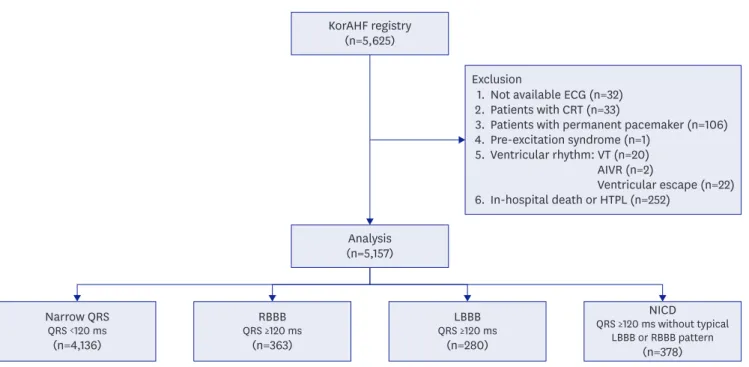
Methods: Data from the Korean Acute Heart Failure registry were used. Patients were categorized into four groups: narrow QRS (<120 ms), right bundle branch block (RBBB), left bundle branch block (LBBB), and nonspecific intraventricular conduction delay (NICD). The NICD was defined as prolonged QRS (≥120 ms) without typical features of LBBB or RBBB.
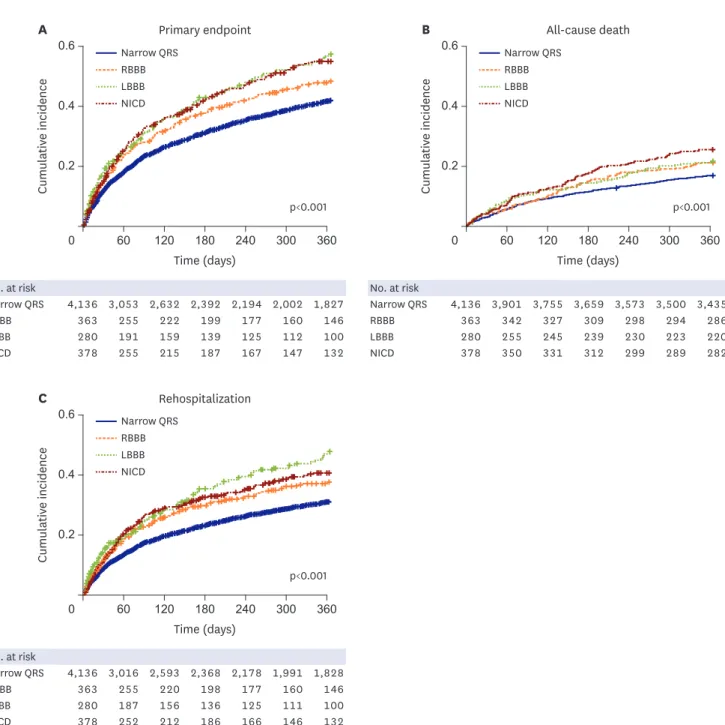
The primary endpoint was the composite of all-cause mortality or rehospitalization for HF aggravation within 1 year after discharge.
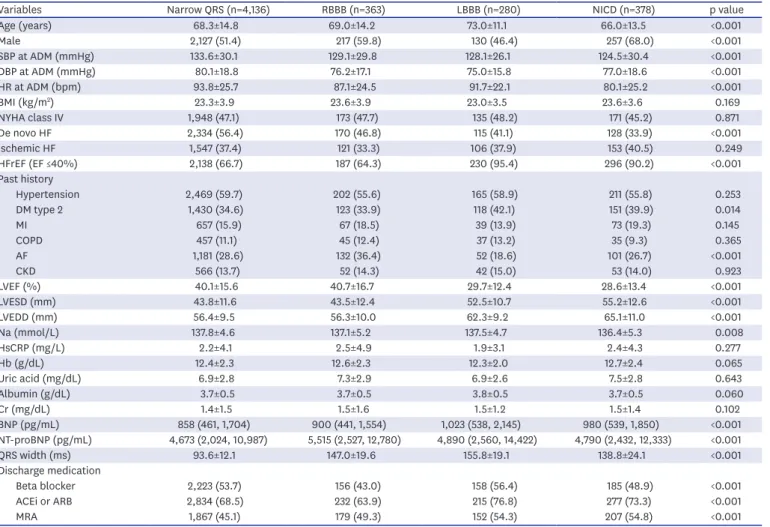
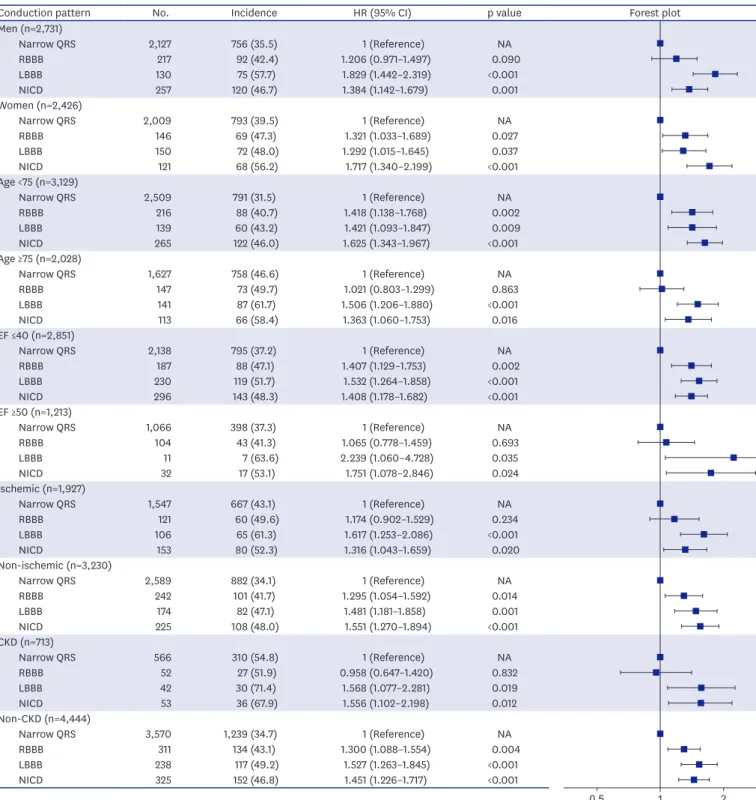
Results: This study included 5,157 patients. The primary endpoint occurred in 39.7% of study population. The LBBB group showed the highest incidence of primary endpoint followed by NICD, RBBB, and narrow QRS groups (52.5% vs. 49.7% vs. 44.4% vs. 37.5%, p<0.001). In a multivariable Cox-proportional hazards regression analysis, LBBB and NICD were associated with 39% and 28% increased risk for primary endpoint (LBBB hazard ratio [HR], 1.392; 95%
confidence interval [CI], 1.152–1.681; NICD HR, 1.278; 95% CI, 1.074–1.520) compared with narrow QRS group. The HR of RBBB for the primary endpoint was 1.103 (95% CI, 0.915–1.329).
Conclusions: LBBB and NICD were independently associated with an increased risk of 1-year adverse event in hospitalized patients with HF, whereas the prognostic impacts of RBBB were limited.
Trial Registration: ClinicalTrials.gov Identifier: NCT01389843
Keywords: Cardiac conduction system disease; Bundle branch block; Prognosis; Heart failure
Original Article
Received: Aug 27, 2018 Revised: Dec 3, 2018 Accepted: Jan 23, 2019 Correspondence to Dong-Ju Choi, MD, PhD
Department of Cardiology, Cardiovascular Center, Seoul National University Bundang Hospital, 82, Gumi-ro 173beon-gil, Seongnam 13620, Korea.
E-mail: [email protected]
Copyright © 2019. The Korean Society of Cardiology
This is an Open Access article distributed under the terms of the Creative Commons Attribution Non-Commercial License (https://
creativecommons.org/licenses/by-nc/4.0) which permits unrestricted noncommercial use, distribution, and reproduction in any medium, provided the original work is properly cited.
ORCID iDs Ji Hyun Lee
https://orcid.org/0000-0002-7162-1248 Jin Joo Park
https://orcid.org/0000-0001-9611-1490 Youngjin Cho
https://orcid.org/0000-0001-8106-3713
Ji Hyun Lee , MD 1 , Jin Joo Park , MD 2 , Youngjin Cho , MD 2 , Il-Young Oh , MD 2 , Byung-Su Yoo , MD 1 , Jae-Joong Kim , MD 3 , Kye Hun Kim , MD 4 ,
Seok-Min Kang , MD 5 , Sang Hong Baek , MD 6 , Eun-Seok Jeon , MD 7 ,
Myeong-Chan Cho , MD 8 , Shung Chull Chae , MD 9 , Byung-Hee Oh , MD 10 , and Dong-Ju Choi , MD, PhD 2
1
Department of Internal Medicine, Yonsei University Wonju College of Medicine, Wonju, Korea
2
Department of Cardiology, Cardiovascular Center, Seoul National University Bundang Hospital, Seongnam, Korea
3
Division of Cardiology, Heart Institute, Asan Medical Center, University of Ulsan, Seoul, Korea
4
Department of Internal Medicine, Heart Research Center of Chonnam National University, Gwangju, Korea
5
Department of Internal Medicine, Yonsei University College of Medicine, Seoul, Korea
6
Department of Internal Medicine, College of Medicine, The Catholic University of Korea, Seoul, Korea
7
Department of Internal Medicine, Sungkyunkwan University College of Medicine, Seoul, Korea
8
Department of Internal Medicine, Chungbuk National University College of Medicine, Cheongju, Korea
9
Department of Internal Medicine, Kyungpook National University College of Medicine, Daegu, Korea
10