INTRODUCTION
Obesity is generally recognized as an increasingly impor- tant cause of childhood and adolescent morbidity world- wide and is a contributor to chronic diseases such as type 2 diabetes and cardiovascular disease (CVD) (1). The metabolic syndrome (MetS), a clustering of obesity, impaired glucose metabolism, hypertension, and dyslipidemia, has been shown to be predictive for the development of diabetes and CVD in this young population, particularly in the overweight or obese (2). MetS has appeared with increasing frequency in children and adolescents, driven by the growing pediatric obesity epidemic (1).
Behavioral factors such as poor dietary habits, a sedentary lifestyle, and a social environment which encourages unhealthy behaviors are closely correlated with the prevalence of obesi- ty and MetS in adolescents (3). During adolescence develop- mental physiologic changes in body composition, lipid pro-
file, blood pressure, insulin secretion and number of body fat cells occur as a result of higher levels of sex and growth hor- mones. This results in increased insulin resistance that is asso- ciated with MetS. Therefore, the convergence of hormonal changes associated with adolescence and unhealthy lifestyle behaviors can predispose this group to MetS and obesity and a risk of adverse CVD events later in life (3).
Although obesity in children and adolescents has been widely studied, MetS has not because a consensus on pedi- atric MetS criteria did not exist until recently (4). In order to fill this gap, the International Diabetes Federation (IDF) published the first international definition of the pediatric MetS in 2007 (4), facilitating comparisons between pediatric populations (5). The IDF advocates waist circumference (WC) as a key diagnostic component of pediatric MetS (4) as in the adult definition. Comparisons for adolescents of different coun- tries, ethnicities, and genders should be published to evalu- ate international criteria for MetS like the 2007 IDF defini-
75
Jinkyung Park1, David C. Hilmers2, Jason A. Mendoza1,2, Janice E. Stuff1, Yan Liu1and Theresa A. Nicklas1
Children’s Nutrition Research Center1, Section of Academic General Pediatrics2, Department of Pediatrics, Baylor College of Medicine, Houston, TX, USA
Address for correspondence Theresa A. Nicklas, DrPH
USDA/ARS Children’s Nutrition Research Center, Department of Pediatrics, Baylor College of Medicine, 1100 Bates Avenue, Houston, TX 77030-2600 USA Tel : +713-798-7087, Fax : +713-798-7130 E-mail : [email protected]
This work (The project No: KRF-2007-357-C00122) was supported by the Korea Research Foundation Grant funded by the Korean Government (MOEHRD). This work is a publication of the United States Department of Agriculture (USDA/ARS) Children’s Nutrition Research Center, Department of Pediatrics, Baylor College of Medicine in Houston, Texas and was also funded in part with federal funds from the USDA/Agricultural Research Service under Cooperative Agreement No.
58-6250-6-003.nnnnproducts, or organizations imply endorsement from the US government. Special thanks to Pamelia Harris for help in preparing the manuscript.
Prevalence of Metabolic Syndrome and Obesity in Adolescents Aged 12 to 19 Years: Comparison between the United States and Korea
This study compared the prevalence of metabolic syndrome (MetS), its risk factors, and obesity in adolescents in the United States (US) and Korea. Data were obtained from 2003-2004 US National Health and Nutrition Examination Survey (NHANES) and 2005 Korea NHANES for adolescents aged 12-19 yr in the US (n=734) and in Korea (n=664). The 2007 International Diabetes Federation (IDF) pediatric defini- tion for diagnosis of MetS and the 2000 US Growth Charts and 2007 Korea Growth Charts for assessment of obesity were utilized. The prevalence of metabolic syn- drome in US and Koreans was 5.5% and 2.5%, respectively. The prevalence of obesity was 18.1% in US compared to 9.0% in Koreans. The prevalence of abdom- inal obesity, hyperglycemia, and hypertriglyceridemia were higher in the US, where- as that of low HDL-C levels was higher in Korea. Despite the doubled prevalence for the single entities of MetS and obesity in the US, the prevalence of MetS in obese US and Koreans did not differ (20.8% and 24.3%, respectively). In conclusion, there are differences in the prevalence of MetS, obesity, and the individual MetS risk factors between the US and Korean adolescents; however, the risk of MetS among obese adolescents is similar in both countries.
Key Words : Adolescents; Obesity; Metabolic Syndrome; National Health and Nutrition Examination Survey;
United States; Korea; International Diabetes Federation; Growth Charts
ⓒ 2010 The Korean Academy of Medical Sciences.
This is an Open Access article distributed under the terms of the Creative Commons Attribution Non-Commercial License (http://creativecommons.org/licenses/by-nc/3.0) which permits unrestricted non-commercial use, distribution, and reproduction in any medium, provided the original work is properly cited.
Received : 22 August 2008 Accepted : 25 February 2009
tion. Using the IDF definition as a starting point, modifica- tions can be made on the basis of new information (4).
Most studies in adolescents have been limited to Western countries and infrequently included Asians (6, 7). Asians, on average, have a lower body mass than Western populations and their traditional diets and lifestyle are not commonly asso- ciated with obesity or CVD risk. However, the incidence of obese children and adolescents has been increasing in Korea, as has urbanization and economic development. Accompany- ing these changes is the adoption of a westernized diet and a trend toward decreased physical activity (8). As young Asian individuals continue to adopt Western lifestyles, it is impor- tant to predict the types of population-based health conse- quences that might follow. Our study had three main hypo- theses: 1) US adolescents have a higher prevalence of obesity and MetS than Korean adolescents; 2) individual abnormal- ities of MetS differ between US and Korean adolescents; and 3) Korean adolescents have an equal or greater prevalence of MetS when compared to US adolescents of the same BMI cat- egory, since Asians have a higher risk of type 2 diabetes and CVD at lower BMI’s than European populations (9). By com- paring the differences in the prevalence of MetS and obesity in US and Korean adolescents using the latest national data- sets, we set out to provide guidance both to countries whose population is starting to embrace Western lifestyles and to Western societies who wish to reduce the high burden of com- plications from these conditions.
MATERIALS AND METHODS Data source and subjects
This study was based on data from the 2003-2004 US National Health and Nutrition Examination Surveys (NH- ANES) (10) and the 2005 Korean NHANES (KNHANES) (11). Both were cross-sectional nationally representative sur- veys of the US and Korean civilian non-institutionalized pop- ulations, and used standardized protocols within each survey for all interviews and medical examinations (10, 11). Sub- jects selected from the US NHANES were Mexican-Ameri- cans, non-Hispanic Whites, and non-Hispanic Blacks and from the KNHANES were Koreans. The subjects from both data sets were limited to young men and non-pregnant women aged 12 to 19 yr who participated in the medical examina- tion of NHANES and KNHANES and who had fasted at least 8 hr prior to the blood collection. Only subjects who had all five indicators of MetS measured according to IDF criteria were included in the study. Samples of 734 (414 male) and 664 (359 male) subjects from the US and Korean NH- ANES, respectively, were used in the analyses, and the esti- mated US and Korean population represented by each sam- ple was 25.5 million and 4.4 million, respectively. The pro- portion of ethnicities that comprised the entire US sample
population in this study was Mexican-Americans 12.2± 3.5%, non-Hispanic Whites 72.5±4.6%, and non-Hispan- ic Blacks 15.2±2.5%, respectively.
US NHANES and Korean NHANES methodologies have been described in detail elsewhere (10, 11). Socio-demograph- ic data were collected by personal interview.
Anthropometric indices such as height, weight, and waist circumference were also extracted from each database, and body mass index (BMI) was calculated from height and weight. The data was obtained in a similar manner in each study. Height was measured in an upright position with a stadiometer, and weight was measured at a standing position on a self-zero- ing scale. Waist circumference was measured at the midpoint between the bottom of the rib cage and above the top of the iliac crest during minimal respiration. Laboratory indices and blood pressure were also collected by a standard protocol, and the mean of the 2nd and 3rd systolic and diastolic blood pres- sure (SBP and DBP) readings were used for this study.Pulse pressure was defined as the difference between SBP and DBP.
For both surveys, fasting blood glucose (FBG) was measured indirectly by spectrophotometry after an enzymatic reaction, and triglycerides (TG) were indirectly determined by spec- trophotometry after hydrolyzation to glycerol and two-stage enzymatic reactions. High density lipoprotein cholesterol (HDL-C) was indirectly measured by spectrophotometry after precipitation with sulfated alpha-cyclodextrin and a two-stage enzymatic reaction. Low density lipoprotein cholesterol (LDL- C) was calculated using the Friedewald equation (serum total cholesterol (TC)-(HDL-C)-TG/5) after eliminating those who had TG greater than 400 mg/dL (12).
Definition of MetS and obesity
Because of the profound physiological and developmental changes during puberty, the 2007 pediatric IDF definition of MetS (4) divided children and adolescents into the follow- ing age groups: 6 to <10, 10 to <16, and ≥16 yr. Accord- ing to this definition, the adult IDF guidelines for the MetS were applied to adolescents 16 years or older, and the KSSO, a Korean-specific criterion (13), was used for Korean waist circumference (WC). In individuals aged 10-15 yr, MetS is present if he or she has central adiposity (≥90th WC per- centile or adult threshold if lower) plus at least two of the following criteria: 1) TG ≥150 mg/dL, 2) HDL-C <40 mg/
dL, 3) SBP ≥130 mmHg or DBP ≥85 mmHg, 4) FBG
≥100 mg/dL or previously diagnosed type 2 diabetes. For US males aged 12-15 yr, we used adult WC thresholds of 90 cm for Mexican Americans and 94 cm for Whites and African Americans since these were smaller than the corresponding 90th percentiles for age. For US females of all ages, we used the adult threshold of 80 cm because it was smaller than their 90th percentile for age. For Korean males and females aged 12-15 yr, we used the WC thresholds (sex- and age-specific 90th percentiles) derived from the reference WC in the 2007
Korea Growth Charts instead of the recommended adult IDF threshold criteria which was larger than their 90th percentiles for age.
To evaluate the prevalence of obesity and MetS by BMI levels, subjects were classified into three BMI categories (nor- mal weight, overweight, and obese) using the 2000 US Grow- th Charts (14) and the 2007 Korea Growth Charts (15). The analyses by this classification were applied only to individu- als aged 12-18 yr because the Korean Growth Charts do not go beyond 18 yr. Obesity was defined as a BMI ≥95th per- centile for age and gender; adolescents with a BMI ≥85th but <95th percentile were defined as ‘‘overweight;’’ and par- ticipants defined as ‘‘normal weight’’ had a BMI from the 5th to the 85th percentile (14, 15).
Statistical methods
Statistical analyses were performed using SAS (version 9.1.3, SAS Institute, Inc., Cary NC, USA) and SAS-callable SUDAAN (version 9.0.3, Research Triangle Institute, Research Triangle Park, NC, USA). In order to make a statistical com- parison between the two countries, selected variables from the 2003-4 US and 2005 Korean datasets were merged and the combined data was used in all analyses. Data in all statis- tical analyses for our study were weighted to account for the complex sampling design of both NHANES which were mul- tistage, stratified, unequally weighted, or clustered. Appro- priate statistical sampling weights from each national dataset were selected as specified by the respective survey. Estimat-
ed frequencies of categorical variables and mean and standard error of continuous variables between the two countries were compared by the chi-square and t-test procedures of SUD- AAN. Each national sample weight was applied after data from the two countries were merged into a single file by cre- ating a new variable. These statistics were presented as mean
±standard error (SE) for continuous variables and frequency percentage (SE) for all categorical measures. A P value <0.05 was considered statistically significant.
RESULTS
Table 1 shows anthropometric and clinical measurements for US and Korean adolescents. Overall, height, weight, and BMI in the US were significantly higher than in Korean ado- lescents (all, P<0.001). The US adolescents had significantly higher FBG and TC than Korean adolescents (both, P<0.001).
However, LDL-C:HDL-C and TC:HDL-C ratios were signif- icantly higher in Korean adolescents than in the US (both, P<0.001) resulting from lower HDL-C (P<0.001) and higher LDL-C (P<0.05) of Koreans. SBP was higher in the US (P<
0.01), while DBP was higher in Korean adolescents (P<0.001);
however, pulse pressure was significantly higher in the US by about 10 mmHg (P<0.001). Concentrations of TG did not differ between the two countries.
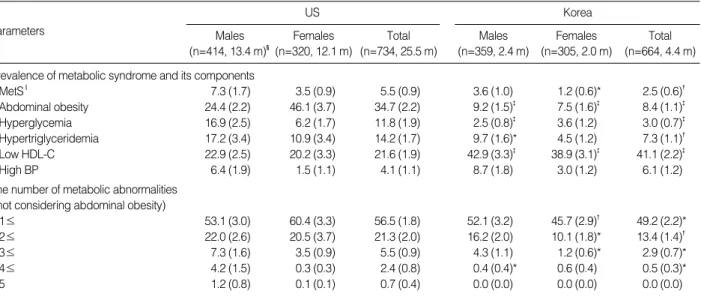
The prevalence of MetS and its components in US and Korean adolescents according to the 2007 IDF definition is presented in Table 2. The prevalence of MetS in US adoles-
Data are mean±SE. *P<0.05; �P<0.01; �P<0.001 show significant differences between the US and Korea; �n, sample size (estimated population rep- resented in millions).
US Males
(n=414, 13.4 m)�
Parameters Females
(n=320, 12.1 m)
Total (n=734, 25.5 m)
Korea Males
(n=359, 2.4 m)
Females (n=305, 2.0 m)
Total (n=664, 4.4 m) Anthropometric
Height (cm) 172.9±0.8 162.3±0.7 167.8±0.6 168.0±0.5� 159.5±0.4� 164.1±0.4�
Weight (kg) 71.9±1.1 62.7±1.6 67.5±1.0 61.1±0.8� 53.6±0.6� 57.7±0.5�
Body Mass Index (kg/m2) 23.8±0.3 23.8±0.6 23.8±0.3 21.5±0.2� 21.0±0.2� 21.3±0.2� Waist circumference (cm) 83.4±0.9 81.5±1.3 82.5±0.8 73.6±0.6� 68.4±0.5� 71.2±0.5� Biochemical
Fasting blood glucose (mg/dL) 93.9±1.2 88.4±0.8 91.3±0.8 88.1±0.4� 85.8±0.4� 87.0±0.3� Triglycerides (mg/dL) 97.8±4.1 90.1±5.8 94.2±3.5 90.9±2.9 85.7±2.3 88.5±2.1 HDL-cholesterol, HDL-C (mg/dL) 48.5±0.8 56.2±0.9 52.2±0.4 41.7±0.5� 46.6±0.6� 43.9±0.4� LDL-cholesterol, LDL-C (mg/dL) 88.8±1.5 90.2±1.5 89.4±1.2 90.2±1.4 96.3±1.2� 93.0±0.9*
Total cholesterol, TC (mg/dL) 156.6±2.1 164.9±2.4 160.5±1.7 150.1±1.7* 159.8±1.5� 154.5±1.1� LDL-C:HDL-C 1.94±0.04 1.71±0.05 1.83±0.04 2.22±0.03� 2.13±0.03� 2.18±0.02�
TC:HDL-C 3.39±0.05 3.08±0.07 3.24±0.05 3.69±0.04� 3.53±0.04� 3.62±0.03�
Blood pressure
Systolic blood pressure, SBP (mmHg) 112.7±0.6 105.7±0.7 109.4±0.6 110.1±0.8� 103.7±0.6* 107.2±0.6� Diastolic blood pressure, DBP (mmHg) 59.5±1.1 62.4±0.7 60.9±0.8 70.2±0.7� 67.4±0.6� 68.9±0.5� Pulse pressure, SBP-DBP 53.3±1.1 43.3±0.7 48.5±0.8 39.8±0.7� 36.4±0.5� 38.3±0.5� Table 1. Weighted average values of the anthropometric, biochemical indicators, and blood pressure in adolescents: The US NHANES 2003-04, Korea NHANES 2005
cents was 5.5±0.9% (males 7.3±1.7%, females 3.5±0.9
%), which is more than twice the prevalence for Korean ado- lescents, 2.5±0.6% (males 3.6±1.0%, females 1.2±0.6%, P<0.01). Based on population-weighted estimates, it can be calculated that -1.4 million US and 0.1 million Korean ado- lescents aged 12-19 yr have MetS according to the 2007 IDF pediatric criteria.
The prevalence of abdominal obesity (P<0.001), hyper- glycemia (P<0.001), and hypertriglyceridemia (P<0.01) in the US were significantly higher than in Korean adolescents, while the prevalence of a low HDL-C level was significantly higher in Korean adolescents (P<0.001). There was a strik- ing difference in the prevalence of abdominal obesity by gen- der; the prevalence in American males was more than double the prevalence in Korean males (US 24.4±2.2% vs. Korea 9.2±1.5%). American females had more than six times the prevalence found in Korean females (US 46.1±3.7% vs. Korea 7.5±1.6%). US males had nearly seven times the prevalence of hyperglycemia (US 16.9±2.5% vs. Korea 2.5±0.8%) and twice the prevalence of hypertriglyceridemia (US 17.2
±3.4% vs. Korea 9.7±1.6%). The prevalence of elevated
blood pressure did not show a clear difference overall between the two countries. The number of metabolic abnormalities in the US was higher than in Koreans even when abdominal obesity was not considered. The percentage of adolescents who had at least one of five MetS risk factors was 56.5±1.8%
in the US and 49.2±2.2% in Korea.
As shown in Table 3, the prevalence of obesity as assessed by BMI in US adolescents was approximately twice that of Korean adolescents, 18.1±3.2% (males 22.0±2.6%, females 13.9±4.9%) and 9.0±1.5% (males 9.3±2.1%, females 8.5±2.0%), respectively. Based on population-weighted estimates, it can be calculated that 4.6 million US and 0.4 million Korean adolescents aged 12-19 yr are obese, using the respective national criterion for obesity. Since the com- bined frequency of overweight and obesity was 39.2% in the US and 21.0% in Korea, the US had more adolescents who were overweight and obese (P<0.001) while a greater percent- age of Korean adolescents were normal weight.
Since there were significant differences in mean BMI levels between the two countries, we compared the frequency of the individual MetS risk factors in each of three weight cat-
Data are % (SE). *P<0.05; �P<0.01; �P<0.001 show significant differences between the US and Korea; �n, sample size (estimated population repre- sented in millions); ‖MetS, Metabolic Syndrome: IDF definition is described in ‘MATERIALS AND METHODS’.
US Males
(n=414, 13.4 m)�
Females (n=320, 12.1 m)
Total (n=734, 25.5 m)
Korea Males
(n=359, 2.4 m)
Females (n=305, 2.0 m)
Total (n=664, 4.4 m) Prevalence of metabolic syndrome and its components
MetS‖ 7.3 (1.7) 3.5 (0.9) 5.5 (0.9) 3.6 (1.0) 1.2 (0.6)* 2.5 (0.6)�
Abdominal obesity 24.4 (2.2) 46.1 (3.7) 34.7 (2.2) 9.2 (1.5)� 7.5 (1.6)� 8.4 (1.1)�
Hyperglycemia 16.9 (2.5) 6.2 (1.7) 11.8 (1.9) 2.5 (0.8)� 3.6 (1.2) 3.0 (0.7)�
Hypertriglyceridemia 17.2 (3.4) 10.9 (3.4) 14.2 (1.7) 9.7 (1.6)* 4.5 (1.2) 7.3 (1.1)�
Low HDL-C 22.9 (2.5) 20.2 (3.3) 21.6 (1.9) 42.9 (3.3)� 38.9 (3.1)� 41.1 (2.2)�
High BP 6.4 (1.9) 1.5 (1.1) 4.1 (1.1) 8.7 (1.8) 3.0 (1.2) 6.1 (1.2)
The number of metabolic abnormalities (not considering abdominal obesity)
1≤ 53.1 (3.0) 60.4 (3.3) 56.5 (1.8) 52.1 (3.2) 45.7 (2.9)� 49.2 (2.2)*
2≤ 22.0 (2.6) 20.5 (3.7) 21.3 (2.0) 16.2 (2.0) 10.1 (1.8)* 13.4 (1.4)�
3≤ 7.3 (1.6) 3.5 (0.9) 5.5 (0.9) 4.3 (1.1) 1.2 (0.6)* 2.9 (0.7)*
4≤ 4.2 (1.5) 0.3 (0.3) 2.4 (0.8) 0.4 (0.4)* 0.6 (0.4) 0.5 (0.3)*
5 1.2 (0.8) 0.1 (0.1) 0.7 (0.4) 0.0 (0.0) 0.0 (0.0) 0.0 (0.0)
Table 2. Estimated prevalence of metabolic syndrome, individual components, and distribution according to the number of metabol- ic abnormalities by IDF (2007) criteria: the US NHANES 2003-04, Korea NHANES 2005
Parameters
US Males
(n=414, 13.4 m)�
Females (n=320, 12.1 m)
Total (n=734, 25.5 m)
Korea Males
(n=359, 2.4 m)
Females (n=305, 2.0 m)
Total (n=664, 4.4 m) 5th≤ <85th (normal weight) 60.8 (4.2) 60.7 (4.7) 60.8 (3.2) 78.4 (2.8)* 79.9 (2.8)* 79.1 (2.0)*
85th≤ <95th (overweight) 17.2 (4.3) 25.4 (3.0) 21.1 (2.5) 12.3 (2.0)* 11.6 (2.3)* 12.0 (1.5)*
95th≤ (obese) 22.0 (2.6) 13.9 (4.9) 18.1 (3.2) 9.3 (2.1)* 8.5 (2.0)* 9.0 (1.5)*
Table 3. Estimated prevalence of obesity by 2000 US Growth Charts and 2007 Korea Growth Charts: the US NHANES 2003-04, Korea NHANES 2005
Data are % (SE). *P<0.001 show significant differences between the US and Korea; �n, sample size (estimated population represented in millions).
egories, normal, overweight, and obese (Table 4). There was no significant difference between the two countries in the frequency in which a specific number of abnormalities ap- peared at a given weight category. Importantly, the frequen- cies of MetS in US and Korean obese adolescents were 20.8
±6.2% and 24.3±6.4%, respectively. The prevalence of MetS in the obese groups was more than 20 times that of the normal weight groups, and about four times higher than the overweight groups in both countries. The frequency of abdominal obesity in the US was significantly higher than in Korea in all three weight categories (overall P<0.05). The frequencies of hyperglycemia and a low HDL-C level did not show a difference overall between the two countries, but there was more than twice the prevalence of hyperglycemia (both, P<0.05) in the US and low HDL-C level (both, P<0.001) in Korea in the normal and overweight groups. Thirty-seven percent of normal weight Korean adolescents had low HDL- C levels compared to 14.0% in normal weight US adoles- cents. The frequency of high blood pressure was significant- ly higher in normal weight Korean adolescents than in US normal weight adolescents (P<0.05). The frequency of hyper- triglyceridemia did not differ between the two countries in all weight categories.
DISCUSSION
To our knowledge, this is the first study to apply the new IDF pediatric definitions of MetS to Korean adolescents. In this study, the prevalences of MetS and obesity in US adoles- cents were 5.5% and 18.1%, respectively, which were appro- ximately double the corresponding prevalences (2.5% and 9.0%) in Korean adolescents, confirming our first hypothe- sis. Despite lifestyle changes such as an increase in energy
intake and a decrease in physical activity due to rapid eco- nomic development and the introduction of western culture in Korea, the MetS and obesity in US adolescents is still a greater problem than in Korean adolescents. Our study can- not assert that race itself confers an additional risk beyond cultural and environmental factors; therefore, a comprehen- sive comparison investigating the relative contribution of genetic, cultural, and environmental factors is needed.
The overall prevalence of abdominal obesity in US adoles- cents in our study was over four times higher (34.7%) than that of Koreans (8.4%); however, the abdominal obesity preva- lence in US and Korean obese adolescents was much closer (87.7% vs. 64.9%, respectively). In both countries, the abdom- inal obesity prevalence was also found to be the most com- mon of the MetS criteria in adolescents in the highest BMI category. Therefore, obese adolescents with abdominal obe- sity should be an important target for intervention in both countries.
The difference between the prevalence of abdominal obesi- ty in US and Korean females was much greater than in males.
Although the differences were not as marked, the opposite trend was seen when assessing obesity by BMI criterion as a larger difference existed between US and Korean males than females. This dichotomy is not easy to explain. Although fat and muscle mass distribution vary according to pubertal sta- tus and gender, neither the US NHANES nor KNHANES assessed pubertal status. Possible explanations are a gender- variable genetic predisposition to the accumulation of viscer- al fat which contributes to abdominal obesity or to the use of inappropriate cutoff values for abdominal and overall obe- sity by BMI. The visceral fat contribution to total body fat as well as pubertal status would be informative additions to future national surveys, in order that that more detailed hy- potheses can be made. Current Korean growth charts include
Data are % (SE). *P<0.05; �P<0.01; �P<0.001 show significant differences between the US and Korea; �MetS, Metabolic Syndrome.
n, sample size (estimated population represented in millions).
US 5th≤ <85th
(normal weight)
85th≤ <95th (overweight)
95th≤
(obese)
Korea 5th≤ <85th
(normal weight)
85th≤ <95th (overweight)
95th≤
(obese) Prevalence of metabolic syndrome and its components
MetS� 0.7 (0.6) 4.9 (2.5) 20.8 (6.2) 0.0 (0.0) 5.8 (2.9) 24.3 (6.4)
Abdominal obesity 7.9 (1.7) 61.3 (9.3) 87.7 (3.0) 0.2 (0.2)� 26.4 (5.6)� 64.9 (8.5)*
Hyperglycemia 11.9 (3.2) 9.0 (4.1) 14.4 (3.8) 3.4 (0.9)* 0.0 (0.0)* 5.8 (3.3)
Hypertriglyceridemia 8.5 (2.0) 16.3 (5.5) 22.8 (4.9) 4.8 (1.1) 11.6 (3.8) 24.3 (6.7)
Low HDL-C 13.5 (1.9) 27.3 (6.3) 40.5 (7.0) 36.8 (2.6)� 63.7 (6.3)� 59.8 (8.6)
High BP 1.6 (0.8) 3.1 (1.9) 12.3 (5.3) 5.3 (1.4)* 7.1 (3.1) 16.2 (5.4)
Number of metabolic abnormalities
1≤ (not considering abdominal obesity) 35.3 (4.1) 78.4 (5.9) 94.8 (2.3) 43.6 (2.7) 72.3 (5.1) 79.4 (8.8)
2≤ 7.5 (1.7) 29.9 (6.7) 49.8 (8.5) 6.6 (1.3) 30.7 (6.0) 59.7 (8.2)
3≤ 0.7 (0.6) 4.9 (2.5) 21.1 (6.2) 0.2 (0.2) 5.8 (2.9) 25.6 (6.4)
4≤ 0.0 (0.0) 1.9 (1.8) 9.9 (4.5) 0.0 (0.0) 0.0 (0.0) 6.2 (3.7)
5 0.0 (0.0) 1.9 (1.8) 2.1 (1.9) 0.0 (0.0) 0.0 (0.0) 0.0 (0.0)
Table 4. Distribution of MetS and its components by BMI levels: the US NHANES 2003-04, Korea NHANES 2005
Parameters
WC while US growth charts do not. Increased awareness of the dangers of abdominal obesity could be facilitated by add- ing WC to the other growth charts used in the US.
The prevalence of hyperglycemia in US adolescents (11.8%) was nearly four times higher than in Koreans (3.0%), but in both countries the prevalence was the lowest for any of the components of MetS. The higher prevalence of hyperglycemia in US adolescents may be associated with their higher preva- lence of obesity. It is known that Asian children have a much greater risk for type 2 diabetes at a relatively low BMI owing to their greater abdominal fat distribution compared with Caucasian children (16). However, our study showed a lower prevalence of hyperglycemia in Korea than in the US in obese adolescents. Importantly, neither NHANES nor KNHANES distinguished between type 1 and type 2 diabetes. Typically, a significant percentage of all pediatric diabetics are type 1 (17).
Hypertriglyceridemia and low HDL-C levels are often found together (18). Our study showed a higher prevalence of hyper- triglyceridemia in the US but a higher prevalence of low HDL-C in Korea. Various risk factors for hypertriglyceride- mia such as diabetes, obesity, alcohol intake, and a high car- bohydrate diet have been reported (19). Increasing preva- lences of hypertriglyceridemia and obesity in the US popu- lation during the period from 1971-2000 may be a result of a shift in consumption from a high fat to a high carbohydrate diet (20). Although little information exists to explain the low HDL-C status in Korean adolescents, we assume adult factors such as obesity, low levels of physical activity, high intakes of carbohydrate and fat, snacks, and processed foods, as well as genetics are implicated (21). Obesity is related to many types of lipid disorders (8, 22), which can help explain the higher prevalence of hypertriglyceridemia in the US over- all as well as similar prevalences in the two countries among obese adolescents. Decreased levels of HDL-C in adolescents have been associated with puberty, particularly in males who experience a surge of testosterone (23). Since Tanner staging was not done in either NHANES, it is difficult to determine whether the HDL-C levels were affected by differences in pubertal development in the two countries. Higher LDL- C:HDL-C and TC:HDL-C ratios in Korean adolescents result- ing from lower HDL-C and higher LDL-C of Koreans sug- gest that they have a more unfavorable lipid profile than their US counterparts. These results may indicate an elevated risk for CVD among this cohort of Korean adolescents. Further study is needed to understand the differences in patterns of dyslipidemia between the two countries and long-term con- sequences.
In our study, the overall prevalence of high blood pressure did not differ significantly between the two countries; how- ever, US adolescents had higher pulse pressures than Korean adolescents. Elevated pulse pressure is positively associated with obesity (24); thus, higher pulse pressures in US adoles- cents may be related to their higher BMI relative to Korean adolescents. Anticipating a rise in the prevalences of CVD in
young adults, Healthy People 2010 emphasized the need to monitor and manage high blood pressure in adolescents (25).
Some authors have suggested that high blood pressure in childhood and adolescence correlates with insulin level and insulin resistance (26) although inclusion of blood pressure as a component of pediatric MetS is still controversial. If a measurement of insulin levels is added to the KNHANES, the relationship between insulin levels and blood pressure in the two countries can be assessed.
Consensus adolescent MetS criteria have been unavailable until recently, and thus MetS prevalence estimates vary con- siderably. In US adolescents aged 12-19 yr, the prevalence of MetS varied from 2.0-9.6% in recent NHANES studies (16, 20). Some studies showed that the overall prevalence of MetS in US adolescents was increasing over time (6, 27). On the contrary, Ford et al. (5) reported that the prevalence of MetS in adolescents aged 12-17 was relatively stable across a 6-yr period with 4.5% for 1999-2000, 4.4-4.5% for 2001- 2002, and 3.7-3.9% for 2003-4 NHANES using the 2007 IDF definition. The prevalence of the MetS in the US was higher in our study (5.5%) than in Ford et al. (5) report pos- sibly due to differences in the age range studied. In Korea, there were two studies reporting that the overall prevalence of MetS increased from 6.8% in the 1998 KNHANES to 9.2% in the 2001 KNHANES using the criteria used by Cook et al. (7). The prevalence of MetS in males increased from 5.7% in the 1998 KNHANES to 9.0% in the 2001 KNHANES while there was no increase in females (5.1%
in 1998 and 4.9% in 2001) in the age range 10-19 yr using the NCEP-ATP III-derived definition (28). These differences should be taken into account when making comparisons with these previous studies. Likewise, caution should be used when comparing the prevalence of obesity in our study with previ- ous reports due to the utilization of different age ranges or obesity criteria. A US report showed that the prevalence of obesity among adolescents aged 12-19 yr increased from 14.8%
in 1999-2000 NHANES to 16.7% in 2001-2 NHANES and to 17.4% in 2003-4 NHANES using 2000 US Growth Charts (29). A Korean report indicates that the prevalence of obesity in the10-18 yr old population increased signifi- cantly from 5.4% in the 1998 KNHANES to 11.3% in the 2001 KNHANES using 2000 US Growth Charts (8). The Korea Centers for Disease Control and Prevention (CDC) reported that the prevalence of obesity in adolescents nearly doubled from 8.7% in 1998 to 16.0% in 2005 (30) based on 1998 Korean Growth Charts. Previous studies demon- strated the increasing prevalences of obesity in US (29) and Korean (8, 30) adolescents, and it is expected that the preva- lence of obesity in both countries will continue to be high despite public health interventions. The trend in the preva- lence of adolescent MetS remains controversial (5, 7, 27, 28).
We expect that if the prevalence of obesity decreases in both countries, prevalences of MetS will decrease as well. However, the risk factors for MetS and obesity are not identical, and
the mechanisms underlying the development of MetS are not fully understood. The frequencies of adolescents having at least one component of MetS in the obese, overweight, and normal weight categories were 94.8%, 78.4%, and 35.3%, respectively in the US, and 79.4%, 72.3%, and 43.6%, res- pectively in Korea. These findings imply that even adoles- cents with normal weight should not be excluded from screen- ing for MetS.
As predicted by our second hypothesis, the most prevalent abnormality in each country was also different: abdominal obesity in the US and low HDL-C levels in Korea. Prevalences of abdominal obesity, hyperglycemia, and hypertriglyceride- mia were higher in the US while the prevalence of low HDL- C was higher in Korea. Unlike obesity, systematic public health programs to combat pediatric MetS in each country have not been emphasized. Further research to gain a better understanding of the genetic and environmental factors res- ponsible for these differences is needed, and nation-specific strategies such as school-based health examinations and lipid screening should be established.
One notable finding is that despite the higher prevalence of MetS and obesity in the US, the prevalence of MetS in obese US and Korean adolescents did not significantly differ (20.8% and 24.3%, respectively). The number of metabolic abnormalities by BMI percentiles also showed no difference between the two countries. A number of studies have report- ed high prevalences of MetS among obese adolescents in the US (12.4-44.2%) (2, 7, 27) and Korea (33.3-64.3%) (8). In agreement with our findings, these studies also reported that the prevalence of MetS in obese adolescents did not largely differ between the two countries although Koreans had a lower BMI and obesity prevalence overall. These results imply that obese adolescents have a similar risk of MetS regardless of nationality and that the ethnic specific cut-points used in this study for the MetS criteria appropriately identified the risk of MetS across multiple ethnicities.
Our study had some limitations. First, we cannot identify the extent by which country-specific cut-off points for obe- sity and abdominal obesity affect the prevalence of MetS in each country. Second, while both surveys used similar anthro- pometric and laboratory methods, each survey used its own reference laboratories to analyze the samples and instruments, which may contribute to differences in results between coun- tries. Third, only subjects who had fasted at least 8 hr prior to the blood collection were included in the study. Fourth, participants were excluded if any of the five components of MetS were not measured, which limited our sample size. Final- ly, Tanner staging was not available which could confound the results, particularly in younger adolescents.
In summary, our study compared MetS and its components in US and Korean adolescents using the 2007 IDF definition, the first international pediatric criteria. As we hypothesized, US adolescents had nearly twice the prevalence of both MetS and obesity. There were also differences in the prevalence of
individual abnormalities and the most prevalent abnormali- ty in each country. The prevalence of MetS in both countries was similar among obese adolescents, a finding that suggests that obese adolescents, regardless of ethnicity, have a similar risk for MetS and that ethnic-specific criteria for defining MetS, such as the IDF definition, may be most appropriate. Early- screening and focused interventions for MetS and obesity should be priorities in public health planning in both coun- tries. Concomitantly, further research should be undertaken to investigate the various genetic, cultural, and environmen- tal factors underlying the differences between the two coun- tries.
REFERENCES
1. Nathan BM, Moran A. Metabolic complications of obesity in child- hood and adolescence: more than just diabetes. Curr Opin Endoc- rinol Diabetes Obes 2008; 15: 21-9.
2. Weiss R, Dziura J, Burgert TS, Tamborlane WV, Taksali SE, Yeckel CW, Allen K, Lopes M, Savoye M, Morrison J, Sherwin RS, Caprio S. Obesity and the metabolic syndrome in children and adolescents.
N Engl J Med 2004; 350: 2362-74.
3. Huang TT, Ball GD, Franks PW. Metabolic syndrome in youth: cur- rent issues and challenges. Appl Physiol Nutr Metab 2007; 32: 13-22.
4. Zimmet P, Alberti KG, Kaufman F, Tajima N, Silink M, Arslanian S, Wong G, Bennett P, Shaw J, Caprio S. The metabolic syndrome in children and adolescents-an IDF consensus report. Pediatr Dia- betes 2007; 8: 299-306.
5. Ford ES, Li C, Zhao G, Pearson WS, Mokdad AH. Prevalence of the metabolic syndrome among U.S. adolescents using the definition from the International Diabetes Federation. Diabetes Care 2008;
31: 587-9.
6. Jolliffe CJ, Janssen I. Development of age-specific adolescent meta- bolic syndrome criteria that are linked to the Adult Treatment Panel III and International Diabetes Federation criteria. J Am Coll Car- diol 2007; 49: 891-8.
7. Cook S, Weitzman M, Auinger P, Nguyen M, Dietz WH. Prevalence of a metabolic syndrome phenotype in adolescents: findings from the third National Health and Nutrition Examination Survey, 1988- 1994. Arch Pediatr Adolesc Med 2003; 157: 821-7.
8. Kim HM, Park J, Kim HS, Kim DH, Park SH. Obesity and cardio- vascular risk factors in Korean children and adolescents aged 10- 18 years from the Korean National Health and Nutrition Examina- tion Survey, 1998 and 2001. Am J Epidemiol 2006; 164: 787-93.
9. WHO Expert Consultation. Appropriate body-mass index for Asian populations and its implications for policy and intervention strate- gies. Lancet 2004; 363: 157-63.
10. Centers for Disease Control and Prevention: NHANES 2003-2004.
Available at http://www.cdc.gov/nchs/about/major/nhanes/nhanes03 -04.htm.
11. Korea Centers for Disease Control and Prevention. 2005 Korea Nation- al Health and Nutrition Examination Survey: the report of progres- sion of health examination. 2005.
12. Wang TY, Haddad M, Wang TS. Low triglyceride levels affect cal- culation of low-density lipoprotein cholesterol values. Arch Pathol Lab Med 2001; 125: 404-5.
13. Lee SY, Park HS, Kim DJ, Han JH, Kim SM, Cho GJ, Kim DY, Kwon HS, Kim SR, Lee CB, Oh SJ, Park CY, Yoo HJ. Appropriate waist circumference cutoff points for central obesity in Korean adults.
Diabetes Res Clin Pract 2007; 75: 72-80.
14. 2000 United States CDC Growth Charts, March 07, 2008. Available at http://www.cdc.gov/nchs/about/major/nhanes/growthcharts/clini- cal_charts.htm.
15. Korea Centers for Disease Control and Prevention and Korean Pedi- atrics Society. 2007 Korea Growth Charts. 2007.
16. McCarthy HD. Body fat measurements in children as predictors for the metabolic syndrome: focus on waist circumference. Proc Nutr Soc 2006; 65: 385-92.
17. Duncan GE. Prevalence of diabetes and impaired fasting glucose lev- els among US adolescents: National Health and Nutrition Examina- tion Survey, 1999-2002. Arch Pediatr Adolesc Med 2006; 160: 523-8.
18. Sokolov EI, Metel’skaia VA, Perova NV, Shchukina GN. Hormon- al regulation of lipoprotein metabolism: the role in pathogenesis of coronary heart disease. Kardiologiia 2006; 46: 4-9.
19. Pejic RN, Lee DT. Hypertriglyceridemia. J Am Board Fam Med 2006;
19: 310-6.
20. US Centers for Disease Control and Prevention: Trends in Intake of Energy and Macronutrients --- United States, 1971--2000, February 5, 2004. Available at http://www.cdc.gov/MMWR/preview/mmw- rhtml/mm5304a3.htm.
21. Kim SM, Han JH, Park HS. Prevalence of low HDL-cholesterol lev- els and associated factors among Koreans. Circ J 2006; 70: 820-6.
22. Thompson DR, Obarzanek E, Franko DL, Barton BA, Morrison J, Biro FM, Daniels SR, Striegel-Moore RH. Childhood overweight
and cardiovascular disease risk factors: the National Heart, Lung, and Blood Institute Growth and Health Study. J Pediatr 2007; 150:
18-25.
23. Morrison JA, Sprecher DL, Biro FM, Apperson-Hansen C, Dipaola LM. Serum testosterone associates with lower high-density lipoprotein cholesterol in black and white males, 10 to 15 years of age, through lowered apolipoprotein AI and AII concentrations. Metabolism 2002;
51: 432-7.
24. Stabouli S, Kotsis V, Papamichael C, Constantopoulos A, Zakopou- los N. Adolescent obesity is associated with high ambulatory blood pressure and increased carotid intimal-medial thickness. J Pediatr 2005; 147: 651-6.
25. US Centers for Disease Control and Prevention: Heart Disease and Stroke, April 30, 2008. Available at http://www.healthypeople.gov/
Document/HTML/Volume1/12Heart.htm.
26. Srinivasan SR, Myers L, Berenson GS. Changes in metabolic syn- drome variables since childhood in prehypertensive and hypertensive subjects: the Bogalusa Heart Study. Hypertension 2006; 48: 33-9.
27. Duncan GE, Li SM, Zhou XH. Prevalence and trends of a metabolic syndrome phenotype among U.S. Adolescents, 1999-2000. Diabetes Care 2004; 27: 2438-43.
28. Lim S, Jang HC, Park KS, Lee HK, Chung HR, Joung HJ, Cho SI.
Changes in metabolic syndrome of Korean children and adolescents in the period 1998 to 2001. J Endocrinol Invest 2008; 31: 327-33.
29. Ogden CL, Carroll MD, Curtin LR, McDowell MA, Tabak CJ, Fle- gal KM. Prevalence of overweight and obesity in the United States, 1999-2004. JAMA 2006; 295: 1549-55.
30. Korea Centers for Disease Control and Prevention. Symposium: In- vestment for National Health and Management of Chronic Diseases.
Seoul, April 3-4, 2007.