Original Article
pISSN 2233-9019 · eISSN 2233-9116
Korean J Fam Pract. 2015;5(3, suppl. 2):273-276
KJFP
Korean Journal of Family PracticeOriginal Article
pISSN 2233-9019 · eISSN 2233-9116 Korean J Fam Pract. 2015;5(3, suppl. 2):PB-1
KJFP
Korean Journal of Family Practicewww.kafm.or.kr
273 PB
www.kafm.or.kr서 론
인슐린 저항성은 대사증후군을 일으키는 주요 병인으로 평가 되고 있다. 최근 연구에서 대사증후군의 병인으로 유전적인 요 인이 제기되었다.1) 또한 인슐린 저항성과 대사증후군의 발병 의 위험요인과 연관이 있다는 연구결과가 있었다.2) 본 연구는 인 슐린 저항성 수치인
homeostasis model assessment for insulin resistance
(HOMA
-IR
) 를 이용하여 대사증후군의 발병 위험도를 예측하고 비교하기 위해4
년동안 추적연구를 진행하였다. 3-5)방 법
1. 연구 대상 및 기간
2010
년1
월1
일 부터2010
월12
월31
일 까지 경기도의 일개 종합 병원의 건강검진센터 를 방문한30
세 이상65
세 이하의 남녀를 대상 으로 하여2014
년12
월31
일까지2
년마다 검진을 받은 수검자를 대 상으로 하였다. 최종 연구대상자는 총69
명이었다. 검사 당시 검사 자의 기저질환 중에서 당뇨병, 고혈압, 이상지질혈증, 고요산혈증, 간 질환, 관상동맥 질환 및 뇌허혈성 질환이 있는 경우는 제외하였다 (n
=9
). 또한 이미 대사증후군으로 치료를 받은 경우, 검사 당시 공복 혈당수치가140mg
/dL
이상으로 높은 수검자도 제외하였다(n
=2
).대사증후군의 발생 위험도 예측에 있어 인슐린 연관 생화학적 표지자의 유용성
김보선, 이경식
*, 조은배, 곽태응, 김정은, 김진욱
분당제생병원 가정의학과
Usefulness of Insulin related biomarkers to Predict the Risk of Metabolic Syndrome
Bo-Seon Kim, Kyong-Shik Lee*, Eun-Bae Jo, Tae-Eung Kwack, Jeong-Eun Kim, Jin-Wook Kim Department of Family medicine, Bundang Jesaeng Hospital, Seongnam-si, Korea
Background: The predictive abilityuse of insulin resistance or insulin sensitivity as risk factors for metabolic syndrome, in combination with traditional cardiovascular risk factors for
metabolic syndrome, has not yet been clearly evaluated in healthy Korean subjects.Methods: A total of 69 subjects of Korean adult subjectss who were not diagnosed with metabolic syndrome at the baseline and who have visited the health promotion center from
January 1, 2010 to December 31, 2014., free from metabolic syndrome at the baseline were monitoredstudied. The homeostasis model assessment for insulin resistance (HOMA-IR) was selected as an insulin-related marker. Questionnaire surveyA questionnaire was used to obtain information from the subjects.Results: The incidence rates of metabolic syndrome after 2 years and, 4 years were 13% and, 8.7%, respectively (P<0.001). A logistic Logistic regression analysis identified HOMA-IR (≥ 1.51)
as a non-significant risk factors for the development of metabolic syndrome, with odds ratios of for 2012 (95% confidence intervals) and odds ratios of 2014 (95% confidence intervals) of 2.47 (0.36 – 16.91), and 6.22(0.53~ 73.37), respectively.Conclusion: The mathematical meaning of the two insulin-related biomarkers examined was the same;, and thus, HOMA-IR cannot be a usefulis not useful as a marker to predict the risk
of metabolic syndrome after adjustments for other independent variables.Keywords: Insulin resistance, metabolic syndrome
Received February 26, 2015 Revised September 2, 2015 Accepted September 3, 2015 Corresponding Author Kyung-Shik Lee
Tel: +82-2-3411-6741, Fax: +82-31-779-0169 E-mail: [email protected]
Copyright © 2015 The Korean Academy of Family Medicine
This is an open-access article distributed under the terms of the Creative Commons Attribution Non-Commercial License (http://creativecommons.org/licenses/by-nc/3.0) which permits unrestricted noncommercial use, distribution, and reproduction in any medium, provided the original work is properly cited.
Bo-Seon Kim, et al. Usefulness of Insulin related biomarkers to Predict the Risk of Metabolic Syndrome
Korean Journal of Family Practice
KJFP
274
www.kafm.or.kr Korean J Fam Pract. 2015;5(3, suppl. 2):273-2762. 연구 방법
약물 복용력, 수술력, 기저질환, 생활습관 등은 문진표를 참고하 였으며, 수검자의 공복혈당수치(
Fasting plasma glucose
,FPG
)를 참고하여 인슐린 저항성 수치(homeostasis model assessment for insulin resistance
,HOMA
-IR
)와 인슐린 감수성 지수(quantitative insulin sensitivity check index
,QUICKI
)를 산출하였으며 공식은 다음과 같다:HOMA
-IR
= (FPG
×insulin
(iu
/mL
))/405
;QUICKI
=1
/ (common logarithms
(FPG
×insulin
))초기 연구 대상자는 총
80
명 이었으며 기존 질환자(n
=11
)를 제 외하고69
명이 최종 연구 대상이었다.HOMA
-IR
의 기준치를 수 검자의HOMA
-IR
의4
분위 (75
%ile
)값인1
.51
으로 하였다. 이 값 이1
.51
이상인 경우 상대적으로 인슐린 저항성이 있는 것으로 간주 하였다. 흡연에 대해서 현재 흡연자와 비흡연자로, 음주 습관에 대 해서 주당3
병 이상 음주하는 자와 가끔 마시거나 금주인 자로, 운 동습관은 매일1
시간 이상 운동하는 자와 매일 운동하지 않는 자로 이분화하였다. 본 연구는National Cholesterol Education Program Adult Treatment Panel
의 제3
차 보고서(NCEP ATP III
,2004
)에 서 제시한 대사증후군의 기준을 수용하였다. 다음의5
가지 항목 중3
가지 이상을 만족하는 경우를 대사 증후군으로 정의하였다.6-7)1
) 허리둘레 >=90cm
(남자), >=85cm
(여자)2
) 혈압 >=130
/85 mmHg
인자3
) 공복혈당 >=100mg
/dL
인자4
) 중성지방 >=150mg
/dL
인자5
)HDL
콜레스테롤<40mg
/dL
(남자),50mg
/dL
(여자)3. 통계 분석
통계분석은
SPSS version 18
.0
(IBM Corp
.,Armonk
,NY
,USA
)을 이용하였다.HOMA
-IR
,QUICKI
, 공복 인슐린, 공복 혈 당 간의 상호적인 상관관계를 분석하기 위하여Spearman
의 상관분 석을 이용하였다. 성별, 연령, 혈청 요산수치, 혈청AST
수치 등의 독립변수를 보정한 뒤 초기 검진을 기준으로2
년 후,4
년 후의 대 사증후군의 발병률과 인슐린 관련 표지자의 관계를 보기 위해서 로 지스틱 회귀분석(Logistic regression
)을 이용하였다. 수집된 자료의 통계적인 유의수준을 검정하기 위하여 유의 수준은P value
<0
.05
로 하였다.결 과
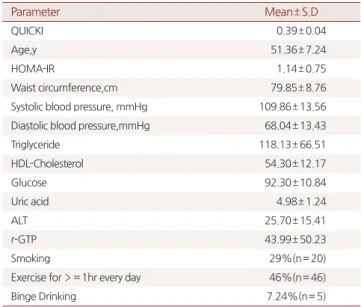
1. 연구 대상자의 일반적 특성
대상군은
69
명으로 남자는39
명, 여자는30
명이며, 평균 나이는
51
.36
±7
.24
세, 평균HOMA
-IR
은1
.14
±0
.75
,QUICKI
는0
.39
±0
.04
이었다(Table 1
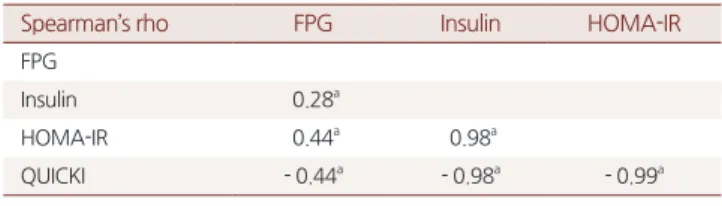
).2. 인슐린 연관 인자 및 인슐린, 공복혈당 간의 상관관계
각 인자들의 상관관계를 살펴보면,
HOMA
-IR
과QUICKI
는 공 복혈당 수치와 동일한 상관계수를 가지는 것을 알 수 있으며 인슐린 과HOMA
-IR
, 인슐린과QUICKI
값과 강한 상관관계가 있음을 알 수 있었다(Table 2
).2
년 후 대사증후군 발생은9
명(13
%)이었으며 남자가7
명, 여자가2
명으로 남성에서 우세하게 높은 것을 알 수 있다.4
년 후 대사증후 군 발생은 총6
명(8
.7
%)이었으며, 남자가4
명, 여자가2
명이었다.3. HOMA-IR과 대사증후군과의 관계
연령, 성별, 요산수치,
ALT
,r
-GTP
, 흡연유무, 운동유무, 음주 유무를 보정한 후HOMA
-IR
과 대사증후군과의 관계를 살펴보았 을 때 통계적으로 유의하지는 않으나HOMA
-IR
이1
.51
이상의 군 에서1
.51
미만인 군보다2
년 후, 그리고4
년 후에 대사증후군이 더 높게 발생하는 경향을 보였다(OR 2
.47
,95
%CI
;0
.36
~16
.91
), (OR 6
.22
,95
%CI
;0
.53
~73
.37
).불규칙적인 운동, 연령, 혈청 요산수치, 혈청
AST
수치가 통계적 으로 유의하지는 않지만 대사증후군의 위험도를 높이는 경향을 보 였다(Table 3
).Table 1. Baseline characteristics (n=69)
Parameter Mean± S.D
QUICKI 0.39± 0.04
Age,y 51.36± 7.24
HOMA-IR 1.14± 0.75
Waist circumference,cm 79.85± 8.76
Systolic blood pressure, mmHg 109.86± 13.56
Diastolic blood pressure,mmHg 68.04± 13.43
Triglyceride 118.13± 66.51
HDL-Cholesterol 54.30± 12.17
Glucose 92.30± 10.84
Uric acid 4.98± 1.24
ALT 25.70± 15.41
r-GTP 43.99± 50.23
Smoking 29%(n= 20)
Exercise for >= 1hr every day 46%(n= 46)
Binge Drinking 7.24%(n= 5)
Abbreviations: HOMA-IR; The homeostasis model assessment for insulin resistance, QUICKI;quantitative insulin sensitivity check index, HDL;high-density lipoprotein, ALT;alanine aminotransferase, r-GTP;gamma-glutamyl transferase
김보선 외. 대사증후군의 발생 위험도 예측에 있어 인슐린 연관 생화학적 표지자의 유용성 Korean Journal of Family Practice
KJFP
www.kafm.or.kr
275
Korean J Fam Pract. 2015;5(3, suppl. 2):273-276
고 찰
2
년후 대사증후군9
명,4
년 후 대사증후군7
명에 대해 각각의 다 중 로지스틱 회귀분석을 이용한 통계량을 제시하였고, 인슐린 저항 성 수치 및 기타 생화학적 지표, 생활습관 변수가 통계적으로 유의 하지 않은 결과를 보인다.Tomoyuki Kawada
의 연구는 총2642
명 의 건강한 남성을 대상으로HOMA
-IR
가 높은 군에서1
년뒤 대사 증후군의 위험도가2
.3
배 증가하는 결과를 도출하였다.8) 또한 대사 증후군은30
세 이상의 검진 환자를 기준으로 하였을 때 여성보다 남성에서 발병위험이 높은 것으로 알려져 있다.9) 이에 비해 본 연구 는 총59
명의 남성 및 여성을 대상으로 하였고,2
년,4
년에 걸쳐 대 사증후군 발병률을 추적 조사 하였다. 따라서 본 연구의 결과가 유 의한 값을 얻지 못한 원인으로 모집단 선정으로 인한 선택편의 및4
년에 걸친 추적기간 동안 다양한 요인에 의해 수검자의 건강상태가 변화할 가능성이 높다는 점을 들 수 있다.본 연구의 제한점으로는 일개 종합병원 건강증진센터 를 방문 한 수진자를 대상으로 하여 일반 인구집단을 대표하기 어려우며, 자기기입식 문진표을 통한 정보 수집이 포함되어있어 그 정확도가 떨어질 수 있다는 점,
4
년에 걸친 추적연구로 남성, 여성을 대상으 로 총69
명이 등록되었으므로 대상자 수의 한계로 인한 제한이 있 으며,4
년동안 외래 경과 관찰을 하지 않았으므로 환자의 전신 상태 변화에 대한 정보가 누락된 점을 들 수 있다.
하지만 본 연구는 내분비 질환 및 약물 복용력이 없는 건강한 성 인에 있어서 인슐린 저항성이 높은 경우 수년 뒤 대사증후군이 발병 할 위험도를 추적한 최초의 연구라는 점에 의의가 있다. 따라서 대 규모의 모집단을 선정하고 대상군을 남성과 여성으로 나누어 대사 증후군의 발병위험도를 구한다면 보다 의미 있는 결과를 얻을 수 있 을 것이다.
결 론
결과가 통계적으로 의미가 없으므로 인슐린 저항성 수치 및 기타 생화학적 지표는 건강한 성인에서 장기간의 대사증후군의 위험도 를 예측하는데 유용성이 없는 것을 알 수 있다.
요 약
연구배경: 본 연구는 인슐린 저항성 수치와 기타 생화학적 수치를 통해서 한국의 건강한 성인의
2
년 후와4
년 후의 대사증후군의 위 험도를 예측해 보고자 하였다.방법: 최종 연구 대상은 총
69
명이었으며,HOMA
-IR
의 기준치는4
분위 (75
%ile
) 값을 기준으로 하였다.결과: 연구 대상자의 평균 나이는
51
.36
세, 인슐린 저항성 지수 기 준치는1
.51
였다.2
년 후 대사증후군 발생은9
명(13
%)이었다. 다중 회귀분석(p
<0
.001
)에서 인슐린 저항성 수치인HOMA
-IR
과 대사 증후군의 위험도는 통계적으로 유의한 양의 상관관계를 보이지 못 했다.결론: 본 연구는 내분비 질환이 없는 건강한 성인에서 인슐린 저항 성 수치 및 인슐린 감수성 수치가 장기적으로 대사증후군의 발병 위
Table 3. Odds Ratios and 95% Confidence Intervals of Several Factors to predict Metabolic syndrome by Logistic Regression Analysis
Variables Positive Category 2012 OR (95%CI) 2012 95% CI 2014 OR (95%CI) 2014 95% CI
HOMA-IR >= 1.51 2.47 0.36-16.91 6.22 0.53~73.37
Sex Men 1.57 0.17-14.69 0.81 0.05~14.16
Age 45yrs old or higher 2.48 0.31-20.15 0.21 0.03~1.80
Uricacid 7mg/dL or higher 13.46 0.56-325.66 3.74 0.11~132.17
ALT 45IU/L or higher 3.80 0.39-37.55 0.80 0.03~18.89
r-GTP 50IU/L or higher 1.99 0.19-21.04 2.09 0.10~43.59
Smoking No smoking or ex-smoking 0.29 0.03-3.44 0.74 0.05~10.70
Exercise ≥ 1 hour everyday 0.43 0.06-3.00 1.84 0.20~17.13
Drinking Not overdrinking 0.00 0.00-0.00 0 0.00~0.00
Abbreviations: ALT; alanine aminotransferase, r-GTP; gamma-glutamyl transferase, HOMA-IR; the homeostasis model assessment for insulin resistance Table 2. Correlation Matrix of variables relating to Glucose Metabolism
at Baseling study
Spearman’s rho FPG Insulin HOMA-IR
FPG
Insulin 0.28a
HOMA-IR 0.44a 0.98a
QUICKI - 0.44a - 0.98a - 0.99a
a There were significant associations among four variables with significance level of 0.01(P value<0.05).
Abbreviations: FPG; fasting plasma glucose, HOMA-IR; the homeostasis model assessment for insulin resistance, QUICKI: the quantitiative insulin sensitivity check index
Bo-Seon Kim, et al. Usefulness of Insulin related biomarkers to Predict the Risk of Metabolic Syndrome
Korean Journal of Family Practice
KJFP
276
www.kafm.or.kr Korean J Fam Pract. 2015;5(3, suppl. 2):273-276험도를 예측하는데 있어 유용성이 떨어지는 것을 알 수 있다.
중심단어: 인슐린 저항성, 인슐린 감수성, 인슐린 연관 생화학 표지 자, 대사증후군
REFERENCES
1. Norris JM, Rich SS. Genetics of glucose homeostasis: implications for insulin resistance and metabolic syndrome. Arterioscler Thromb Vasc Biol. 2012;32(9):2091-6.
2. Romeo GR, Lee J, Shoelson SE. Metabolic syndrome, insulin resistance, and roles of inflammation-mechanisms and therapeutic targets. Arterioscler Thromb Vasc Biol. 2012;32(8):1771-6.
3. Matthews DR, Hosker JP, Rudenski AS, Naylor BA, Treacher DF, Turner RC. Homeostasis model assessment: insulin resistance and beta-cell function from fasting plasma glucose and insulin concentrations in man. Diabetologia. 1985;28(7):412-9.
4. Wallace TM, Matthews DR. The assessment of insulin resistance in
man. Diabetic Medicine. 2002;19(7):527-534.
5. Yokoyama H, Emoto M, Fujiwara S, Motoyama K, Morioka T, Komatsu M, et al. Quantitative insulin sensitivity check index and the reciprocal index of homeostasis model assessment are useful indexes of insulin resistance in type 2 diabetic patients with wide range of fasting plasma glucose. J Clin Endocrinol Metab.
2004;89(3):1481-4.
6. Matsuzawa Y, Funahashi T, Nakamura T. The concept of metabolic syndrome: contribution of visceral fat accumulation and its molecular mechanism. J Atheroscler Thromb. 2011;18(8):629- 39.
7. Alberti KGeorge MM, Zimmet Paul, Shaw Jonathan. The metabolic syndrome—a new worldwide definition. The Lancet.
2005;366(9491):1059-1062.
8. Tomoyuki Kawada, Insulin-related biomarkers to predict the risk of metabolic syndrome. International J of Endocrinol and Metab.
2013;11(4):e10418.
9. 2010년 건강 검진 통계 연보: 일반 건강검진 및 생애전환기 건강검 진 자료와 그 수검자의 진료자료. 보건복지부.