• 검색 결과가 없습니다.

Comparison of Thermal Stress Induced Heat Shock Factor 1 (HSF1) in Goldfish and Mouse Hepatocyte Cultures

N/A
N/A
Protected

Academic year: 2021

Share "Comparison of Thermal Stress Induced Heat Shock Factor 1 (HSF1) in Goldfish and Mouse Hepatocyte Cultures"

Copied!
7
0
0

로드 중.... (전체 텍스트 보기)

전체 글

(1)

Comparison of Thermal Stress Induced Heat Shock Factor 1 (HSF1) in Goldfish and Mouse Hepatocyte Cultures

So-Sun Kim

1

, Jae-Hyeong So

1

and Jang-Su Park

1,2

*

1

Department of Chemistry, Pusan National University, Busan 609-735, Korea

2

Graduate School of Social Enterprise, Pusan National University, Busan 609-735, Korea Received August 2, 2016 /Revised September 1, 2016 /Accepted September 1, 2016

Heat shock proteins (HSPs) are induced in response to various physiological or environmental stressors. However, the transcriptional activation of HSPs is regulated by a family of heat shock fac- tors (HSFs). Fish models provide an ideal system for examining the biochemical and molecular mecha- nisms of adaptation to various temperatures and water environments. In this study, we examined the pattern differentials of heat shock factor 1 (HSF1) and expression of heat shock protein 70 (HSP70) in response to thermal stress in goldfish and mouse hepatocyte cultures by immune-blot analysis.

Goldfish HSF1 (gfHSF1) changed from a monomer to a trimer at 33°C and showed slightly at 37°C, whereas mouse HSF1 (mHSF1) did so at 42°C. This experiment showed similar results to a previous study, indicating that gfHSF1 and mHSF1 play different temperature in the stress response. We also examined the activation conditions of the purified recombinant proteins in human HSF1 (hmHSF1) and gfHSF1 using CD spectroscopy and immune-blot analysis. The purified recombinant HSF1s were treated from 25°C to 42°C. Structural changes were observed in hmHSF1 and gfHSF1 according to the heat-treatment conditions. These results revealed that both mammal HSF1 (human and mouse HSF1) and fish HSF1 exhibited temperature-dependent changes; however, their optimal activation temperatures differed.

Key words : Goldfish, heat shock factor1, heat shock protein70, hepatocyte, trimerization

*Corresponding author

*Tel : +82-51-510-2294, Fax : +82-51-516-7421

*E-mail : [email protected]

This is an Open-Access article distributed under the terms of the Creative Commons Attribution Non-Commercial License (http://creativecommons.org/licenses/by-nc/3.0) which permits unrestricted non-commercial use, distribution, and reproduction in any medium, provided the original work is properly cited.

Journal of Life Science 2016 Vol. 26. No. 12. 1360~1366 DOI : http://dx.doi.org/10.5352/JLS.2016.26.12.1360

Introduction

Heat shock proteins (HSPs) are induced immediately when cells respond to stresses, such as high or low temper- atures, heavy metals, oxidative stress, toxins, and bacterial infections [20]. The expression of heat shock proteins (HSPs) is regulated at both the transcriptional and post-transcrip- tional levels. The transcriptional regulation of the HSP genes is mediated by the heat shock transcription factor (HSF), which is present as an inactive form in unstressed cells and is activated by stress stimuli [21]. This is a cellular defense against the deleterious effects of physiological and environ- mental stresses that are mediated by the heat shock tran- scription factors (HSFs) through a mechanism called the heat shock response. In vertebrates, four members of the HSF family have been identified. Of these, HSF1 and HSF2 are

expressed ubiquitously and conserved [22, 23, 25, 28, 29].

HSF1 and HSF2 are expressed as inert monomers and dim- ers, respectively, in unstressed cells. HSF1 is activated by classical stresses, such as heat shock and heavy metals, and responds to elevated temperatures in vitro [2, 3]. The activa- tion of HSF1 in response to cellular stress is related to its trimerization, phosphorylation and binding to DNA in the promoter regions containing the heat shock elements (HSEs), which are present mainly in the heat shock genes [17, 24, 33]. HSF1 is also involved in development and plays critical roles in longevity and cancer [6, 10, 19, 35]. Previous studies have indicated that mammalian HSF1 trimer formation de- pends on intermolecular hydrophobic noncovalent inter- actions in its trimerization domain [7, 26, 37]. EGS [ethylene glycol bis(succinimidyl succinate)], a unique sulfhydryl (SH) group cross-linker, was added during the majority of HSF1 trimerization experiments, which recommends that inter- molecular disulfide bonds [SS bond(s)] participate in trimeri- zation [5, 30].

The pollution of fresh water ecosystems by heavy metals

is one of the main environmental issues [11]. Fish models

provide an ideal system for investigating the biochemical

and molecular mechanisms of adaptation to various temper-

(2)

atures and contaminated water environments, including the regulation of thermally sensitive genes [8]. In Korea, goldfish (Carassius auratus) are distributed widely in both polluted and unpolluted water. This species has been used as a model to evaluate environmental contamination [13]. This study was designed to show the trimerization of HSF1s (mHSF and gfHSF1) exposed to thermal stress. The HSF1s were in- vestigated to analyze their protein synthesis pattern in re- sponse to thermal stress from hepatocyte cultures. Also, we showed the heat-induced expression of HSP70s from hep- atocyte cultures, because HSP70 expression is regulated by HSFs, which are the best characterized stress-responsive genes with enhanced expression [1, 34]. In addition, the structural changes of the purified HSF1s (hmHSF1 and gfHSF1) were similar to the temperature dependent protein synthesis patterns observed in hepatocyte cultures.

Materials and Methods

Animals and materials

Goldfish (Carassius auratus), approximately 10-15 cm in length and 20 g in weight, were purchased from a local mar- ket and maintained in dechlorinated freshwater tanks. The fish were killed by a sharp blow to the head followed by severance of the spinal cord, and were dissected on ice. The animal protocol used in this study was reviewed and ap- proved by the Pusan National University-Institutional Animal Care and use Committee (PNU-IACUC) according to their ethical procedures and scientific care (approval num- ber: ED-PNU2015-0267). The mouse hepatocyte cells (AML12) were purchased from ATCC and grown in a 1:1 mixture of Dulbecco's modified Eagle's medium and Ham's F12 me- dium with 0.005 mg/ml insulin, 0.005 mg/ml transferrin, 5 ng/ml selenium, and 40 ng/ml dexamethasone, 90%; fetal bovine serum, 10%; pH 7.4, at 37°C in T-75 tissue culture flasks (Sarstedt).

Isolation of liver from goldfish and primary culture of hepatocytes

The isolation and primary culture of the hepatocytes were performed using the methods reported elsewhere [4]. The fish were killed by an anesthetic overdose with MS-222 (Sigma), and their liver tissue was isolated carefully and per- fused with a hepatocyte buffer (HB, 136.9 mM NaCl, 5.4 mM KCl, 0.81 mM MgSO

4

, 0.44 mM KH

2

PO

4

, 0.33 mM Na

2

HPO

4

, 5.0 mM NaHCO

3

, pH 7.6) for 10 min at room temperature.

The liver tissue was digested with HB buffer containing col- lagenase (0.3 mg/ml) (Sigma, St. Louis, MO). The softened tissue was minced and sieved through a nylon mesh (50 μm).

The resulting cell suspension was washed three times with HB containing 1.5 mM CaCl

2

. After isolation, the cells were seeded in a Microtest

TM

tissue culture plate and cultured in Leibovitz-15 medium (L-15, Sigma, St. Louis, MO) at a den- sity of 1x10

6

cell/well. The media was changed every 24 hr and kept at 25°C.

Exposure of hepatocytes and Western blot analysis Approximately 48 hr after initiating the culture, the AML 12 cells were exposed to a temperature of 42°C and 25°C for 24 hr and, then, the hepatocytes of the goldfish were exposed to a temperature of 33°C and 37°C for 24 hr. After exposure, the harvested cells were extracted using RIPA buf- fer (Sigma) for western blot analysis. The Bio-Rad Mini Trans-Blot Electrophoretic Transfer Cell electroblotted SDS- PAGE samples, including the 42°C and 25°C treated cell pel- let, 33°C and 37°C treated cell pellet and control cell pellets in transfer buffer (15.6 mM Tris-HCl, 120 mM glycine, pH 8.3) to the nitrocellulose membrane, were examined. After being blocked with 3% bovine serum albumin (BSA) in Tris-Buffered saline (TBS), the polyclonal antibodies of anti- goldfish HSP70, HSF1 and β-actin, which were prepared in this laboratory [4, 12], a rat monoclonal antibody HSF1 Ab-1, anti-HSP70 and β-actin were purchased from Thermo scien- tific and used for specific binding. After treating primary antibodies, secondary antibodies (anti-mouse IgG antibody conjugated with alkaline phosphatase) were diluted at 1:5000. The bands were developed using the phosphatase substrate solutions.

Characterization by circular dichroism (CD) and in vitro cross-linking experiments

The purified gfHSF1 and hmHSF1 were obtained in pre- vious studies by our laboratory [12, 14] and diluted with Tris-HCl buffer (pH 7.8) to a final concentration of 0.45 mg/

ml. The CD spectra were used to examine the changes in

the conformation of the proteins. The CD scans were per-

formed on a Jasco J-715 spectropolarimeter in the far-UV

range at 25°C, 33°C and 37°C in the case of gfHSF1 and

at 25°C, 37°C and 42°C in the case of hmHSF1. A cell with

a 0.1 cm optical path was used to obtain the spectra at a

scan speed of 25 nm/min. The spectra were averaged from

five individual scans and the results are presented as the

(3)

A B

C D

Fig. 1. Western blotting gfHSF1 (A) and β-actin (C) protein in the hepatocytes of goldfish and mHSF1 (C) and β-actin (D) in the mouse hepatocyte cells (AML12). Polyclonal-antibody of anti-goldfish HSF1 and β-actin were produced and monoclonal antibody of mHSF1 (HSF1 Ab-1) and mouse β-actin (AC-15) were purchased from Thermo Scientific. All antibodies were performed to detect the HSF1 and β-actin in hepatocyte cultures.

mean molar ellipticity. The trimerization activities of the HSF1s were measured in cross-linking experiments. The pu- rified HSF1 proteins were incubated with 1 mM ethylene glycol bis[succinimidyl succinate] (EGS). The gfHSF1 was left untreated (25°C) or heat-activated for 30 min at different temperatures (33°C and 37°C). The hmHSF1 was treated at 25°C, 37 °C or 42°C, resolved by electrophoresis and ana- lyzed by immunoblotting using the polyclonal antibodies of anti-goldfish HSF1 and a rat monoclonal antibody HSF1 Ab-1.

Statistical analysis

All values are expressed as mean ± SE of 3 replicates in one representative experiment. Statistical analysis was per- formed using the SPSS (version11.0) program.

Results

This study showed that gfHSF1 and mHSF1 exhibit re- sponses in response to heat stress. In the hepatocyte cultures of goldfish and mouse, the expression of inducible HSF1 were measured during the heat stress. As shown in Fig. 1, gfHSF1 and mHSF1 protein were both detected in mono- meric bands at 25°C by Western blot analysis. Although gfHSF1 was monomeric at the control temperature (25°C), it formed a trimer upon heat shock. Trimers of gfHSF1 was observed at 33°C stronger than at 37°C(Fig. 1A). In contrast,

mHSF1 formed a trimer at 42°C, it was observed a mono- meric at 25°C and 37°C (Fig. 1B). The β-actin expression was monitored in all hepatocyte cultures as control (Fig. 1C and Fig. 1D). To observe the induction of the HSP70 protein in hepatocyte culture, an inducible HSP70 of goldfish was ex- pressed recombinantly in E. coli and purified for the pro- duction of polyclonal antibodies. The levels of HSP70 in the cultured hepatocytes were detected by western blot using the polyclonal antibody of goldfish and the monoclonal anti- body of mouse. These results refer to the previous studies of this laboratory [13]. The HSP70 expression at 25°C was used as a control to normalize the expression of other temperatures. The levels of HSP70 induced expression in goldfish hepatocyte culture were significantly increased at 33°C than at 25°C, it was slightly increased at 37°C (Fig.

2A and Fig. 2C). In case of mouse hepatocyte culture, it was

significantly increased at 42°C as compared to other temper-

atures (Fig. 2B and Fig. 2D). This study confirmed that fish

and mouse have different activated temperature by thermal

stress. Circular dichroism (CD) can screen the changes in

the conformation of biopolymers and has previously been

used to analyze the effects of heat stress on hmHSF1 and

gfHSF1 [12]. In humans, HSF1 undergoes heat-inducible

monomer-to-trimer conversion and binds to its cognate reg-

ulatory site, the heat shock element (HSE) [27]. The purified

recombinant HSF1s were incubated at temperatures ranging

from 25°C to 42°C for 30min. As a result, structural changes

(4)

A B

C D

Fig. 2. Expression of HSP70 in the culture of hepatocytes (A-D). HSP70 synthesis in primary culture of hepatocytes exposed to different temperatures of goldfish (A and C) and mouse (B and D). Western blotting HSP70 protein in the hepatocytes of goldfish (A) and the mouse hepatocyte cells (B). The relative level of gfHSP70 and mHSP70 were showed at C and D. The values are reported as the mean ± standard error of three experiments. The increase in HSP70 protein during heat exposure compared to the control at 25°C.

B

C D

A

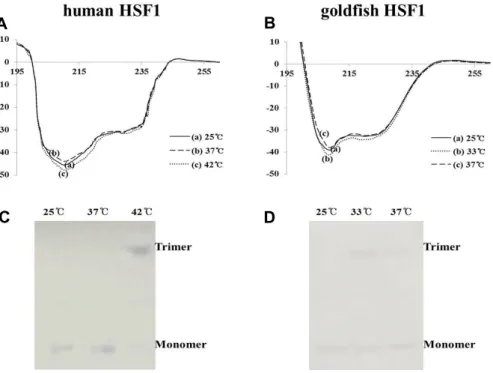
Fig. 3. Characterizations of recombinant hmHSF1 and gfHSF1 (A and B). A, Circular dichroism analysis of heat stressed hmHSF1.

Bacterial recombinant hmHSF1 were treated three point temperature, 25°C, 37°C and 42°C. The CD spectra were recorded in the far UV region (200-270 nm). The spectra were presented as the mean residue ellipticity, which is expressed as deg·cm

2

/dmol. Each spectrum is the average of three separate scans. B, Circular dichroism analysis of heat stressed gfHSF1.

HmHSF1 and gfHSF1 confer heat inducible trimerization in vitro (C and D). Purified hmHSF1 and gfHSF1 was incubated at each other temperature for 30 min after EGS cross-linking and detection by Western blotting using their specific antibodies.

in hmHSF1 were observed under heat conditions. The CD analysis of hmHSF1 at 42°C revealed an increase in the in- tensity near 208 nm compared to the control hmHSF1 at 37°C, indicating a conformation change in the secondary

structures (Fig. 3A). On the other hand, at lower temper-

atures (similar patterns in the CD spectra were observed at

25°C) the CD analysis of HSF1 showed a decrease in in-

tensity, which was caused by thermal denaturation (Fig. 3A).

(5)

In contrast, the CD analysis of gfHSF1 showed an increase in intensity at 33°C compared to the control held at 25°C and a decrease at 37°C (Fig. 3B). The purified gfHSF1 and hmHSF1 proteins from E. coli were analyzed in vitro by im- mune blotting after EGS cross-linking to identify their oligo- merization states at each temperature (hmHSF1 was exam- ined at 25°C, 37°C and 42°C, whereas gfHSF1 was examined at 25°C, 33°C and 37°C). As shown in Fig. 3C, hmHSF1 was mostly monomeric at the control temperature (37°C) and room temperature. On the other hand, at 42°C, the formation of band at higher molecular weights was observed, which are consistent with the predicted sizes of the trimer. In con- trast, gfHSF1 was detected as a trimer at temperatures lower than the corresponding temperatures for hmHSF1 (Fig. 3D).

Discussion

The temperature range to which a fish species can adapt is dependent on its adaptive cellular functions and stress responses. In a previous study, the adaptable temperatures ranged from 20°C to 32°C for the experimental laboratory fish, platyfish (Xiphophorus maculatus) and zebrafish (Danio rerio) and the cultured cells of these species can also be main- tained in a similar temperature range [36]. The cells re- sponded to unexpected adverse environmental changes by processes referred to as thermal or heavy metal responses, which were accompanied by a rapid increase in the synthesis of stress proteins [9]. This study aimed to understand the changes and roles of HSF1 in hepatocytes. Upon stress, HSF1 is the key transcriptional activator of chaperones, cochaper- ones and ubiquitin, and coordinates the expression of many transcriptional and translational regulators, signaling mole- cules and mitotic determinants [18, 31, 32]. The biochemical characterization of HSF1 and the mechanism of HSF1-medi- ated transcription have been extensively studied and are well understood [16, 27]. The results of the present study revealed the different optimal temperature activation of two HSF1s (mHSF1 and gfHSF1) under heat stress conditions in cultured hepatocytes. GfHSF1 was activated at 33°C, where- as mHSF1 was activated at 42°C. The levels of HSP70 in- duced expression in hepatocyte cultures showed similar pat- tern like trimers of HSF1. Here, we suggest that fish and mouse differ in an activation temperature by thermal stress.

In previous studies, CD spectroscopy indicated that the un- folded structure of the carboxyl-terminal domain of human HSF1 changes to a more compact structure under stress [15].

In the present study, the CD spectra showed the activation of the purified hmHSF1 and gfHSF1 in a temperature de- pendent manner. HmHSF1 showed the optimal conforma- tional change at 42°C, whereas for gfHSF1 the change was observed at lower temperatures. In these experiments, im- mune-blotting analysis revealed similar results to CD spec- troscopy in that the HSF1s changed from a monomer to trim- er upon exposure to heat stress. This difference in the con- formational change between humans and fish has not pre- viously been reported. The in vivo results were also the same as the in-vitro ones. These results suggest that fish and mam- mals (mouse and human) differ in optimal temperature in response to heat shock responses. This may be due to their structure or the differences in the amino acid sequences in each domain; mammal HSF1 and fish HSF1 did not corre- spond to important sequences forming trimers. It would seem important to study the different structural changes of fish HSF1and mammal HSF1. These functional differences will need to be examined in a future study to determine the reasons for them.

In conclusion, the heat shock factor1s (gfHSF1 and mHSF1) from hepatocyte cultures showed similar patterns in vitro, in that there was a difference in their activation temperatures. This study confirmed that their optimal tem- peratures forming trimer were different by immunoblot analysis and circular dichroism analysis.

Acknowledgment

This study was supported by a Pusan National Research University Grant (2015-2016) for two years.

References

1. Abravaya, K., Phillips, B. and Morimoto, R. I. 1991. Attenua- tion of the heat shock response in HeLa cells is mediated by the release of bound heat shock transcription factor and is modulated by changes in growth and in heat shock temperatures. Genes Dev. 5, 2117-2127.

2. Ahn, S. G., Liu, P. C., Klyachko, K., Morimoto, R. I. and Thiele, D. J. 2001. The loop domain of heat shock tran- scription factor 1 dictates DNA-binding specificity and re- sponses to heat stress. Genes Dev. 15, 2134-2145.

3. Anckar, J. and Sistonen, L. 2007. Heat shock factor 1 as a coordinator of stress and developmental pathways. Adv.

Exp. Med. Biol. 594, 78-88.

4. Chang, Z., Lu, M., Kim, S. S. and Park, J. S. 2014. Potential

role of HSP90 in mediating the interactions between estro-

gen receptor (ER) and aryl hydrocarbon receptor (AhR) sig-

(6)

naling pathways. Toxicol. Lett. 226, 6-13.

5. Dietz, K. J. and Scheibe, R. 2004. Redox regulation, an introduction. Physiol. Plant. 120, 1-3.

6. Dai, C., Whitesell, L., Rogers, A. B. and Lindquist, S. 2007.

Heat shock factor 1 is a powerful multifaceted modifier of carcinogenesis. Cell 130, 1005-1018.

7. Farkas, T., Kutskova, Y. A. and Zimarino, V. 1998 Intramo- lecular repression of mouse heat shock factor 1. Mol. Cell.

Biol. 18, 906-918.

8. George, K., Iwama, Philip, T., Thomas, Robert, B., Forsyth, Mathilakath, M. and Vijayan. 1998. Heat shock protein ex- pression in fish. Reviews in Fish Biology and Fisheries 8, 35-56.

9. Hahn, J. S., Hu, Z., Thiele, D. J. and Iyer, V. R. 2004.

Genome-wide analysis of the biology of stress responses through heat shock transcription factor. Mol. Cell. Biol. 24, 5249-5256.

10. Hsu, A. L., Murphy, C. T. and Kenyon, C. 2003. Regulation of aging and age-related disease by DAF-16 and heat-shock factor. Science 300, 1142-1145

11. Iavicoli, I., Fontana, L. and Bergamaschi, A. 2009. The effects of metals as endocrine disruptors J. Toxicol. Environ. Health B Crit. Rev. 12, 206-223.

12. Kim, S. S., Chang, Z. and Park, J. S. 2015. Identification, tissue distribution and characterization of two heat shock factors (HSFs) in goldfish (Carassius auratus). Fish Shellfish Immunol. 43, 375-386.

13. Li, C .R., Lee, S. H., Kim, S. S., Kim, A., Lee, K. W., Lu, M., Kim, H. E., Kwak, I. J., Lee, Y. J., Lim, D. K. Lee, J.

S., Kang, S. W., Huh, M. D., Chung, K. H. and Park, J. S.

2009. Environmental estrogenic effects and gonadal devel- opment in wild goldfish (Carassius auratus). Environ. Monit.

Assess. 150, 397-404.

14. Lu, M., Kim, H. E., Li, C. R., Kim, S., Kwak, I. J., Lee, Y.

J., Kim, S. S. and Park, J. S. 2008. Two distinct disulfide bonds formed in human heat shock transcription factor 1Act in opposition to regulate its DNA binding activity.

Biochemistry 47, 6007-6015.

15. Lu, M., Lee, Y. J., Park, S. M., Kang, H. S., Kang, S. W., Kim, S. and Park, J. S. 2009. Aromatic-participant inter- actions are essential for disulfide-bond-based trimerization in human heat shock transcription factor 1. Biochemistry 48, 3795-3797.

16. Mathew, A., Mathur, S. K., Jolly, C., Fox, S. G., Kim, S. and Morimoto, R. I. 2001. Stress-specific activation and re- pression of heat shock factors 1 and 2. Mol. Cell. Biol. 21, 7163-7171.

17. McMillan, D. R., Xiao, X., Shao, L., Graves, K. and Benjamin, I. J. 1998. Targeted disruption of heat shock transcription factor 1 abolishes thermotolerance and protection against heat-inducible apoptosis. J. Biol. Chem. 273, 7523-7528 18. Mendillo, M. L., Santagata, S., Koeva, M., Bell, G. W., Hu,

R., Tamimi, R. M., Fraenkel, E., Ince, T. A., Whitesell, L.

and Lindquist, S. 2012. HSF1 drives a transcriptional pro- gram distinct from heat shock to support highly malignant human cancers. Cell 150, 549-562.

19. Morley, J. F. and Morimoto, R. I. 2004. Regulation of lon-

gevity in Caenorhabditis elegans by heat shock factor and mo- lecular chaperones. Mol. Biol. Cell 15, 657-664.

20. Morimoto, R. I., Tissieres, A. and Georgopoulos, C. 1994.

The Biology of Heat Shock Proteins and Molecular Chaper- ones. Cold Spring Harbor Laboratory Press. NY, USA.

21. Morimoto, R. I. 1998. Regulation of the heat shock transcrip- tional response: cross talk between a family of heat shock factors, molecular chaperones, and negative regulators.

Genes Dev. 12, 3788-3796.

22. Nakai, A. and Morimoto, R. I. 1993. Characterization of a novel chicken heat shock transcription factor, heat shock fac- tor 3, suggests a new regulatory pathway. Mol. Cell. Biol.

13, 1983-1997.

23. Nakai, A., Tanabe, M., Kawazoe, Y., Inazawa, J., Morimoto, R. I. and Nagata, K. 1997. HSF4, a new member of the hu- man heat shock factor family which lacks properties of a transcriptional activator. Mol. Cell. Biol. 17, 469.

24. Pirkkala, L., Alastalo, T. P., Zuo, X., Benjamin, I. J. and Sistonen, L. 2000. Disruption of heat shock factor 1 reveals an essential role in the ubiquitin proteolytic pathway. Mol.

Cell. Biol. 20, 2670-2675.

25. Rabindran, S. K., Giorgi, G., Clos, J. and Wu, C. 1991.

Molecular cloning and expression of a human heat shock factor, HSF1. Proc. Natl. Acad. Sci. USA 88, 6906-6910.

26. Rabindran, S. K., Haroun, R. I., Clos, J., Wisniewski, J. and Wu, C. 1993. Regulation of heat shock factor trimer for- mation: Role of a conserved leucine zipper. Science 259, 230- 234.

27. Sarge, K. D., Murphy, S. P. and Morimoto, R. I. 1993.

Activation of heat shock gene transcription by heat shock factor 1 involves oligomerization, acquisition of DNA-bind- ing activity, and nuclear localization and can occur in the absence of stress. Mol. Cell. Biol. 3, 1392-1407.

28. Sarge, K. D., Zimarino, V., Holm, K., Wu, C. and Morimoto, R. I. 1991. Cloning and characterization of two mouse heat shock factors with distinct inducible and constitutive DNA-binding ability. Genes Dev. 5, 1902-1911.

29. Schuetz, T. J., Gallo, G. J., Sheldon, L., Tempst, P. and Kingston, R. E. 1991. Isolation of a cDNA for HSF2: evidence for two heat shock factor genes in humans. Proc. Natl. Acad.

Sci. USA 88, 6911-6915.

30. Sun, Y. and Oberley, L. W. 1996. Redox regulation of tran- scriptional activators. Free Radic. Biol. Med. 21, 335-348.

31. Trinklein, N. D., Murray, J. I., Hartman, S. J., Botstein, D.

and Myers, R. M. 2004. The role of heat shock transcription factor 1 in the genome-wide regulation of the mammalian heat shock response. Mol. Biol. Cell. 15, 1254-1261.

32. Vihervaara, A., Sergelius, C., Vasara, J., Blom, M. A. H., Elsing, A. N., Roos-Mattjus, P. and Sistonen, L. 2013. Tran- scriptional response to stress in the dynamic chromatin en- vironment of cycling and mitotic cells. Proc. Natl. Acad. Sci.

USA 110, 3388-3397.

33. Voellmy, R. 2004. On mechanisms that control heat shock transcription factor activity in metazoan cells. Cell Stress Chaperones 9, 122-133.

34. Wu, B. J., Kingston, R. E. and Morimoto, R. I. 1986. Human

(7)

초록:붕어와 마우스의 간세포 배양에서 열 스트레스에 의해 유도되는 heat shock factor1 (HSF1) 의 비교

김소선

1

․소재형

1

․박장수

1,2

*

(

1

부산대학교 화학과,

2

사회적기업 겸임교수)

Heat shock proteins (HSPs)은 다양한 생리학적인 또는 환경적 스트레스에 응답하여 유도된다. 그러나 HSPs의 전사 활성은 heat shock factors (HSFs)에 의해 조절 된다. 현재 연구에서는 붕어와 마우스의 간세포 배양에서 열 스트레스에 의한 heat shock factor 1 (HSF1)의 패턴 차이와 heat shock protein 70 (HSP70)의 발현을 면역분석법 을 이용하여 조사하였다. 붕어의 간세포는 33°C에서 trimer를 이루지만 마우스의 간세포는 42°C에서 trimer를 이 루었다. 이 연구는 붕어와 마우스의 HSF1은 열 스트레스로부터 다른 온도에서 반응을 한다는 것을 보여준다. 또 한 재조합 단백질을 이용하여 붕어와 인간의 HSF1의 온도에 따른 활성 조건을 CD spectroscopy와 면역분석을 이용하여 조사하였다. 이러한 결과들은 인간과 마우스 HSF1과 붕어의 HSF1은 온도에 의한 활성 변화를 보이지만 그들의 최적 활성 온도는 다르다는 것을 알 수 있다.

HSP70 promoter contains at least two distinct regulatory domains. Proc. Natl. Acad. Sci. USA 83, 629-633.

35. Xiao, X., Zuo, X., Davis, A. A., McMillan, D. R., Curry, B.

B., Richardson, J. A. and Benjamin, I. J. 1999. HSF1 is re- quired for extra-embryonic development, postnatal growth and protection during inflammatory responses in mice.

EMBO J. 18, 5943-5952

36. Yamashita, M., Hirayoshi, K. and Nagata, K. 2004. Characte

rization of multiple members of the HSP70 family in platy- fish culture cells: molecular evolution of stress protein

HSP70 in vertebrates. Gene 336, 207-218.

37. Zuo, J., Baler, R., Dahl, G. and Voellmy, R. 1994. Activation

of the DNA-binding ability of human heat shock tran-

scription factor 1 may involve the transition from an intra-

molecular to an intermolecular triple-stranded coiled-coil

structure. Mol. Cell. Biol. 14, 7557-7568.

수치

Fig.  1.  Western  blotting  gfHSF1  (A)  and  β-actin  (C)  protein  in  the  hepatocytes  of  goldfish  and  mHSF1  (C)  and  β-actin  (D)  in  the  mouse  hepatocyte  cells  (AML12)
Fig.  3.  Characterizations  of  recombinant  hmHSF1  and  gfHSF1  (A  and  B).  A,  Circular  dichroism  analysis  of  heat  stressed  hmHSF1

참조

관련 문서

연병장에서의 입소행사가 끝나고 나를 위해 훈련소까지 와 준 친구들과 헤어지는 순간 내 자신이 스스로 군복무를 이행하기 위해 모든 것을 뒤로 하고

Sharing about the 'Hyundai Motor India Foundation ( HMIF)' , he said HMIF was formed in the year 2006 with the purpose of 'giving back' to society and to

제9조(수당의 지급) ① 식약처장은 해외정보리포터의 보고서에 대해 제8조제1항의 평가를 거쳐 각 보고서에 대한 수당을 별표 7의 수당 지급 기준에 따라 분기별로

○ 해외 시장에서의 높은 신뢰도와 인지도를 바탕으로 한국 경제의 성장 동력으로 자리잡아가는 국내 유명 화장품 제조업체를 보호하고 , 국내 뿐만

Recognizing that a S&T Co–operation Fund of 10 million USD, contributed for the period 2011–15, has been utilized to implement joint research.. projects in the

- CERAGEM center owners, staffs and customers from Bihar state participated by donation to support daily necessities & living expenses

Rule 6(1)에 따라 원칙적으로 매입 재료 또는 서비스가 면세 재화의 제조 또는 면세 서비스의 공급에 사용될 경우 Cenvat Credit를 이용할 수 없다. 따라서

In addition, to investigate whether the difference in differentiation patterns between wild-type and Dab1 −/− cells was due to a loss of Reelin- Dab1 signaling, we