• 검색 결과가 없습니다.

Clinical evaluation of implants survival rate: Eight-year retrospective study

N/A
N/A
Protected

Academic year: 2021

Share "Clinical evaluation of implants survival rate: Eight-year retrospective study"

Copied!
7
0
0

로드 중.... (전체 텍스트 보기)

전체 글

(1)

Introduction

Since endosseous implants have been used in the treatment of various types of tooth loss, they are considered currently one of the first therapeutic options [1,2]. Moreover, dental implants have been maintained showing long-term stability for rehabilitation of full or partial edentulous patients [3,4].

Implant survival is simply defined as any implant that remains in place at the time of evaluation, regardless of any untoward signs, symptoms, or history of problems. Implant

success, on the other hand, is defined not only by the remains of the implant but also by criteria evaluating the condition and function of the implant at the time of evaluation [5].

Criteria for implant success, regarding marginal bone loss and other parameters, were first suggested by Albrektsson [6] in 1988. Since then, many studies attempt to establish the success criteria of implants. Recently, International Congress of Oral Implantologists Pisa Consensus demonstrated five criteria of implant failure [7].

Many studies regarding implant survival rates have been published. Sato et al. [8] presented that survival rate of 1-piece implants placed in immediate function was 100%, also Kim et al. [9] showed that success rate was 92%, and the survival rate was 96.0% in tapered body implant with sinus bone graft.

Moreover, Suh et al. [10] showed survival rate of ITI TE

®

implants was 100% in 3-year clinical study.

Clinical evaluation of implants survival rate: Eight-year retrospective study

Su-Yong Jeon

1

, Woo-Hyuk Yun

1

, Ha-Na Hyun

1

, Hee-Yung Chang

1

, Hyung-Keun You

1,2

, Sung-Hee Pi

1,2,

*

1

Department of Periodontology,

2

Wonkwang Dental Research Institute, Wonkwang University School of Dentistry, Iksan, Korea

ABSTRACT

Purpose: Since endosseous implants are used for the treatment of various types of tooth loss, they are considered a primary therapeutic options. Many studies regarding implant survival rates have been published. However, there have been few long-term studies on implant survival rate in Koreans. Therefore, the aim of this study was to examine implant survival rate for 8 years as well as identify potential risk factors for failure.

Materials and Methods: The present study included 535 implants in 332 patients at the Department of Periodontology of Wonkwang Dental Hospital. By means of a chart review, 1) implant site, 2) age and sex of patients, 3) diameter and length of placed implant, 4) advanced technique at recipient site, 5) periodontal treatments before implant therapy, and 6) systemic diseases such as diabetes mellitus, hypertension, or osteoporosis were recorded. The effects of evaluated variables on implant failure were analyzed using chi-square test. Statistical significance was accepted at p<0.05.

Results: The present study showed an implant survival rate of 97.76%. Overall, 12 of 535 (2.24%) implants were explanted. Two explanted implants were in the maxillary anterior area, five were in the maxillary posterior area, and five were in the mandibular posterior area. The average time from placement to explantation was 11.92±15.30 months. None of the investigated factors was significantly associated with implant failure (p>0.05).

Conclusion: Survival rate in this study was 97.76%. Despite the lack of significant association between implant failure and associated factors, there are potential risk factors. Cautious diagnosis and treatment planning are needed.

Key Words: External hex, Implant, Survival rate

Received Feb 6, 2015; Revised version received Feb 24, 2015 Accepted Feb 26, 2015

Corresponding author: Sung-Hee Pi

Department of Periodontology, Wonkwang University School of Dentistry, 460 Iksan-daero, Iksan 570-749, Korea

Tel: 82-63-859-2964, Fax: +82-63-857-6364

E-mail: [email protected]

(2)

However, there have been few long-term studies on implant survival rate in Koreans.

The identification of patients most at risk for dental implant failure is essential to the informed consent process and for treatment planning. Empirical information has associated a variety of risk factors ranging from implant design to coexisting systemic disease, with adverse outcomes [11].

The aim of this study was to examine implant survival rate for 8 years, and identify potential risk factors for failure.

Materials and Methods

Subjects

The present study included 535 implants of 332 patients who came to Department of Periodontology of Wonkwang Dental Hospital. By means of a chart review, 1) implant site, 2) age and sex of patients, 3) diameter and length of placed implant, 4) additional surgical technique on recipient site, 5) being provided periodontal treatments before implant therapy, and 6) systemic diseases such as diabetes mellitus, hypertension or osteoporosis were recorded. This study was approved by Institutional Review Board of Wonkwang Dental Hospital registered number by WKDIRB201306-01.

Implants

3i implants of Biomet (Warsaw, IN, USA) featuring external hexagon and self-tapping were placed from September 2005 to December 2012. In patients with insufficient bone volume, a hard tissue augmentation procedure including guided bone regeneration (GBR) or bone graft was performed. The sinus lift procedure was used to correct lack of distance from maxillary sinus floor to crest for implant placement. In patients with sufficient bone volume, implants were placed with a standard surgical protocol.

Implant failure criteria of the International Congress of Oral Implantologists Pisa Consensus were applied to assess failure.

1) Pain on function 2) Mobility

3) Radiographic bone loss >1/2 length of implant 4) Uncontrolled exudate

5) No longer in mouth Statistical analysis

IBM SPSS software ver. 19.0 (IBM Co., Armonk, NY, USA) was used for all statistical calculation. The influence of evaluated variables on implants failure was analyzed using chi- square test. The statistical significance was accepted at p<0.05.

Results

Sites and distribution of placed implants

A total of 280 implants were placed in the maxilla and 255 in the mandible. Seventy-three implants (13.6%) were placed in the maxillary anterior area, 15 (2.8%) in the mandibular anterior area, 207 (38.6%) in the maxillary posterior area, and 240 (44.8%) in the mandibular posterior area. There was no significant association between the site of implant placement and survival (p>0.05) (Table 1).

Age and sex

The mean age was 53.4 years (range: 17 to 78 years). Among the 332 patients, the most common age group was 50 to 59 years (134 patients; 40.4%), followed by 40 to 49 years (82 patients; 24.7%). The sex distribution was almost even (169 males and 163 females).

Diameter and length of placed implants

Diameter

Implants of six diameters were placed in this study. There were 296 (55.3%) implants of 4.0-mm diameter, 157 (44.5%) of 5.0-mm diameter, 43 (8.0%) of 3.25-mm diameter, 38 (7.1%) of 3.75-mm diameter, 1 (0.36%) of 5.5-mm diameter, and 1

Table 1. Distribution of Implant Site

Variable Incisor Canine Premolar Molar Total

Maxilla Mandible Total

57 (10.7) 9 (1.7) 66 (12.4)

16 (3.0) 6 (1.1) 22 (4.1)

52 (9.7) 43 (8.0) 95 (17.7)

155 (29.0) 197 (36.8) 352 (65.8)

280 (52.4)

255 (47.6)

535 (100.0)

Values are presented as number (%).

(3)

(0.36%) of 6-mm diameter. Implant diameter had no effect on implant survival rate (p=0.897) (Fig. 1).

Length

Implants of six lengths were placed in the present study.

The most common (47%) were implants 11.5 mm in length, followed by those 10 mm in length. Implant length had no effect on implant survival rate (p=0.542) (Fig. 2).

Distribution of additional surgical procedure for insufficient bone volume

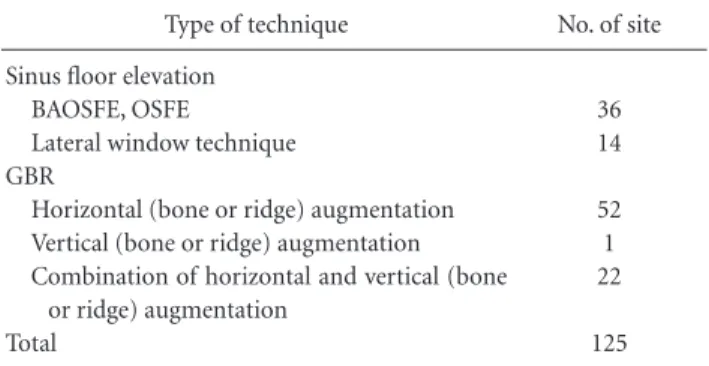
Fifty implants of 280 implants placed on the maxilla needed a sinus lifting procedure. In 14 sites, lateral window technique was used, and 36 sites were prepared with osteotome sinus floor elevation (OSFE) or bone added osteotome sinus floor technique (BAOSFE).

Also, in 75 sites with insufficient bone volume, the GBR technique was used (Table 2).

Provided periodontal treatments before implant therapy Twenty-nine patients had no record of periodontal treatment being provided. The rest of patients had proper treatment according to the severity of periodontal diseases. Patients with no periodontal treatment before implant therapy did not show a significantly lower implant survival rate (p=0.326).

Two hundred and three patients have had a periodic checkup after implant placement. This checkup included radiographic and clinical examination.

Systemic condition

Hypertension was the most prevalent disease (19.52%), followed by diabetes mellitus (7.51%). Four patients were taking medication for osteoporosis, and three patients suffered from cerebral infarction. None of these systemic conditions influenced the implant survival rate (p>0.05) (Table 3).

Survival rate of placed implant

The present study showed a 97.76% implant survival rate.

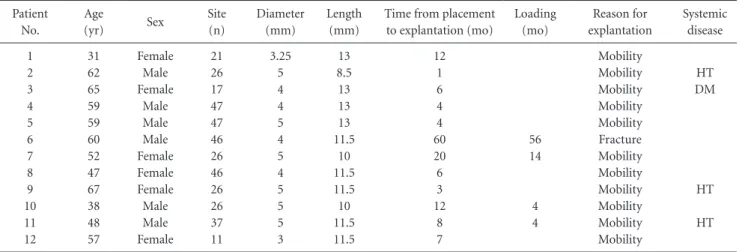
Overall, 12 of 535 (2.24%) implants were explanted, for several reasons. Two of the explanted implants were in the maxillary

3.25 3.75 4 5 5.5 6

350 300 250 200 150 100 50

Number

Diameter of implant (mm) 0

43 38

296

157

1 1

7 8.5 10 11.5 13 15

300 250 200 150 100 50

Number

Length of implant (mm) 0

24

171 256

76

1 7

Fig. 1. Distribution of diameter.

Fig. 2. Distribution of length.

Table 2. Distribution of Additional Surgical Procedure

Type of technique No. of site

Sinus floor elevation BAOSFE, OSFE

Lateral window technique GBR

Horizontal (bone or ridge) augmentation Vertical (bone or ridge) augmentation Combination of horizontal and vertical (bone

or ridge) augmentation Total

36 14 52 1 22 125 BAOSFE: bone added osteotome sinus floor technique, OSFE: osteo- tome sinus floor technique, GBR: guided bone regeneration.

Table 3. Distribution of Systemic Diseases

Systemic disease Patient (%)

Hypertension Diabetes mellitus Osteoporosis

19.52

7.51

1.20

(4)

anterior area, five were in the maxillary posterior area, and five were in the mandibular posterior area. The mean time from placement to explantation was 11.92±15.30 months.

Only one implant was explanted for fracture. Eight implants were explanted before loading of the prosthesis due to lack of primary stability (Table 4).

Discussion

The present study aimed to examine implant survival rate and the factors that influence implant survival. The survival rate of placed implants was 97.76%. Implant site, diameter and length of the placed implant, additional surgical procedures on the recipient site, supportive periodontal therapy, being provided periodontal treatments before implant therapy, and systemic diseases such as diabetes mellitus, hypertension, and osteoporosis did not significantly influence implant survival.

Moy et al. [11] demonstrated that implants placed within the maxilla experienced almost twice the failure rate of those placed in the mandible. Babbush and Shimura [12] reported success rates of 92% in the maxilla and 99% in the mandible.

The present study showed similar outcomes; the implant survival rate in the maxilla (97.51%) was lower than that in the mandible (98.04%). Although the difference was not statistically significant, the survival rate of implants placed in the maxilla tended to be low.

Many studies have reported that shorter implants have a higher failure rate [13-17]. Several related factors been sugge- sted: the implant’s primary stability, the practitioner’s learning

curve, the implant surface, and the quality of the bone [18].

However, the present study showed no significant association between the length of implants and implant survival. This result was similar to that of a previous study by Lemmerman and Lemmerman [19]. In the present study, only 1 of 12 failed implants was a short-length (8.5 mm) implant. Short implants require the use of an appropriate surgical protocol to obtain adequate primary stability. Recent studies indicated that the preparation of the surgical site should be altered to ensure greater primary stability in sites with poor bone density, such as not using a countersink for implant placement and using an adapted surgical protocol to enhance initial implant stability [20,21].

The diameter of implants did not affect the implant failure rate in the present study. Many studies have evaluated the correlation between implant diameter and survival rate, and reported controversial results. Renouard and Nisand [22]

demonstrated that narrow-diameter implants showed low failure rates. This could be explained by proper and atraumatic preparation procedure and careful patient selection in terms of biomechanical conditions and bone density. Therefore, narrow- diameter implants might be considered in clinical situations with insufficient bone volume.

All but 29 patients were provided proper periodontal treatment in the present study. Karoussis et al. [23] concluded that patients with a history of treated chronic periodontitis exhibited significantly greater long-term probing pocket depth and marginal bone loss and a higher incidence of peri- implantitis compared with periodontally healthy subjects.

Table 4. Distribution of Failed Implants Patient

No.

Age

(yr) Sex Site

(n)

Diameter (mm)

Length (mm)

Time from placement to explantation (mo)

Loading (mo)

Reason for explantation

Systemic disease 1

2 3 4 5 6 7 8 9 10 11 12

31 62 65 59 59 60 52 47 67 38 48 57

Female Male Female

Male Male Male Female Female Female Male Male Female

21 26 17 47 47 46 26 46 26 26 37 11

3.25 5 4 4 5 4 5 4 5 5 5 3

13 8.5 13 13 13 11.5

10 11.5 11.5 10 11.5 11.5

12 1 6 4 4 60 20 6 3 12

8 7

56 14

4 4

Mobility Mobility Mobility Mobility Mobility Fracture Mobility Mobility Mobility Mobility Mobility Mobility

HT DM

HT

HT

HT: hypertension, DM: diabetes mellitus.

(5)

However, there was no statistically significant relationship between implant survival in patients with a history of chronic periodontitis vs. those without. The present study showed similar results. In this study, most patients underwent periodontal treatment, and showed improvement in their periodontal condition. Although provision of periodontal treatment did not have a statistically significant effect, it might contribute to a low rate of implant failure. Further studies are needed to evaluate this possibility.

Many authors have described diabetes and hypertension as risk factors for periodontal disease. Soskolne [24] concluded that diabetic patients had a threefold higher risk of periodontal disease compared with non-diabetic patients after controlling for age, sex, and other factors. Diabetes has also been considered a relative, but not absolute, contraindication to implant therapy [25]. The present study showed no association between diabetes and implant failure. Although patients with controlled diabetes may not be at greater risk, the wound healing procedure may be impaired. Hypertension, which had the highest prevalence, did not appear to contribute to implant failure in the present study, similar to previous reports [26]. Osteoporosis has been defined as a decrease in bone mass and bone density. Few studies on the association between osteoporosis and implant failure have been conducted, and reported low correlations. The present study also showed no significant relationship between osteoporosis and implant failure. Nevertheless, some reports now tend to focus on the medication used in osteoporotic patients, with oral bisphosphonates considered a risk factor for implant survival rate on their own. However, few studies on the interrelation between bisphosphonate therapy and implant survival have been performed. The level of evidence indicative of absolute and relative contraindications for implant therapy due to systemic diseases is low.

Sinus pneumatization and alveolar bone loss limit the bone available for implant support in the posterior maxilla. In the present study, although not statistically significant, four of failed five implants in the posterior maxilla were placed with the sinus lifting procedure. McDermott et al. [27] demonstrated that the sinus elevation procedure was not an independent risk factor for implant failure. However, smoking, implants replacing molars rather than premolars, and one-stage implants were associated with an increased risk of implant failure. Also, Del Fabbro et al. [28] reported that rough-surfaced implants and grafts using

bone-substitute materials are effective in sinus lifting. It was considered that appropriate patient selection, careful evaluation of presurgical technique, and proper postoperative care would be essential.

In the present study, most failed implants were explanted before loading. Implant loss or failure is generally considered relative to the time of placement or restoration. Early implant failures occur before implant restoration. Late implant failures occur after the implant has been restored. When an implant fails before restoration, it probably did not achieve osseointegration, or the integration was weak or jeopardized by infection, movement, or impaired wound healing. Late implant failures occur after prosthesis installation for a variety of reasons. In a review of the literature to evaluate biologic causes for implant failure, Esposito et al. [29] found that infections, impaired healing, and overload were the most important contributing factors.

For successful osseointegration of implants, primary stability is essential. Also, microdesign and macrodesign of the implant surface affect primary stability. Many studies have demonstrated that differences in microdesign including surface energy, chemical composition, and surface topography, as well as macrodesign influenced clinical outcomes. Various implant systems are available. The present study showed a relatively high survival rate. The placed implants for this study, 3i implants of Biomet, feature external hexagon and a tapered screw-shape.

Essential features of the screw-shape implant aid in achieving homogeneous stress distribution [30]. Also, tapered implants improve bone density by internal condensation.

In the present study, the period of evaluation was 8 years;

however, not all implants were evaluated for 8 years. Use of a longer evaluation period would yield more accurate results.

Although implant therapy shows high predictability for replacement of single and multiple missing teeth, there are several potential risk factors. Cautious diagnosis and treatment planning can eliminate these factors.

Acknowledgments

This paper was supported in part by SoongSan Fellow Ship in

WonKwnag University in 2011.

(6)

References

1. Adell R, Eriksson B, Lekholm U, Brånemark PI, Jemt T: Long- term follow-up study of osseointegrated implants in the treatment of totally edentulous jaws. Int J Oral Maxillofac Implants 5:347-359, 1990.

2. Bornstein MM, Halbritter S, Harnisch H, Weber HP, Buser D: A retrospective analysis of patients referred for implant placement to a specialty clinic: indications, surgical procedures, and early failures. Int J Oral Maxillofac Implants 23:1109-1116, 2008.

3. Lekholm U, Gunne J, Henry P, Higuchi K, Lindén U, Bergström C, van Steenberghe D: Survival of the Brånemark implant in partially edentulous jaws: a 10-year prospective multicenter study. Int J Oral Maxillofac Implants 14:639-645, 1999.

4. Buser D, Mericske-Stern R, Bernard JP, Behneke A, Behneke N, Hirt HP, Belser UC, Lang NP: Long-term evaluation of non- submerged ITI implants. Part 1: 8-year life table analysis of a prospective multi-center study with 2359 implants. Clin Oral Implants Res 8:161-172, 1997.

5. Froum SJ, Klokkevold PR, Cho SC, Froum SH: Implant-related complications and failures. In: Carranza FA, Forrest JL, Barrie Kenney E, Klokkevolde PR, Newman MG, John Novak M, Preshaw P, Takei HH, Karimbux NY, eds. Carranza’s clinical periodontology. 11th ed. St. Louis, Saunders Elsevier, 2012.

p.732.

6. Albrektsson T: A multicenter report on osseointegrated oral implants. J Prosthet Dent 60:75-84, 1988.

7. Misch CE, Perel ML, Wang HL, Sammartino G, Galindo- Moreno P, Trisi P, Steigmann M, Rebaudi A, Palti A, Pikos MA, Schwartz-Arad D, Choukroun J, Gutierrez-Perez JL, Marenzi G, Valavanis DK: Implant success, survival, and failure: the International Congress of Oral Implantologists (ICOI) Pisa Consensus Conference. Implant Dent 17:5-15, 2008.

8. Sato J, Watanabe G, Ando M, Shimoo Y, Shizukuda K, Kimura T, Kobayashi M: A prospective multicenter study of immediate function of 1-piece implants: a 3-year follow-up report. J Prosthet Dent 112:784-791, 2014.

9. Kim JH, Kim YK, Bae JH: Retrospective clinical study on sinus bone graft and tapered-body implant placement. J Korean Assoc Oral Maxillofac Surg 39:77-84, 2013.

10. Suh HK, Chae GJ, Jung UW, Kim CS, Choi SH, Cho KS, Chai JK, Kim CK: A retrospective clinical study o f survival rate of the ITI TE(R) impl ant. J Korean Acad Periodontol 36:673-682, 2006.

11. Moy PK, Medina D, Shetty V, Aghaloo TL: Dental implant failure rates and associated risk factors. Int J Oral Maxillofac Implants 20:569-577, 2005.

12. Babbush CA, Shimura M: Five-year statistical and clinical observations with the IMZ two-stage osteointegrated implant system. Int J Oral Maxillofac Implants 8:245-253, 1993.

13. Bahat O: Brånemark system implants in the posterior maxilla:

clinical study of 660 implants followed for 5 to 12 years. Int J

Oral Maxillofac Implants 15:646-653, 2000.

14. Winkler S, Morris HF, Ochi S: Implant survival to 36 months as related to length and diameter. Ann Periodontol 5:22-31, 2000.

15. Naert I, Koutsikakis G, Quirynen M, Duyck J, van Steenberghe D, Jacobs R: Biologic outcome of implant-supported restora- tions in the treatment of partial edentulism. Part 2: a longitu- dinal radiographic study. Clin Oral Implants Res 13:390-395, 2002.

16. Weng D, Jacobson Z, Tarnow D, Hürzeler MB, Faehn O, Sanavi F, Barkvoll P, Stach RM: A prospective multicenter clinical trial of 3i machined-surface implants: results after 6 years of follow- up. Int J Oral Maxillofac Implants 18:417-423, 2003.

17. Herrmann I, Lekholm U, Holm S, Kultje C: Evaluation of patient and implant characteristics as potential prognostic factors for oral implant failures. Int J Oral Maxillofac Implants 20:220-230, 2005.

18. Renouard F, Nisand D: Impact of implant length and diameter on survival rates. Clin Oral Implants Res 17 Suppl 2:35-51, 2006.

19. Lemmerman KJ, Lemmerman NE: Osseointegrated dental implants in private practice: a long-term case series study. J Periodontol 76:310-319, 2005.

20. Tawil G, Younan R: Clinical evaluation of short, machined- surface implants followed for 12 to 92 months. Int J Oral Maxillofac Implants 18:894-901, 2003.

21. Fugazzotto PA, Beagle JR, Ganeles J, Jaffin R, Vlassis J, Kumar A: Success and failure rates of 9 mm or shorter implants in the replacement of missing maxillary molars when restored with individual crowns: preliminary results 0 to 84 months in function. A retrospective study. J Periodontol 75:327-332, 2004.

22. Renouard F, Nisand D: Short implants in the severely resorbed maxilla: a 2-year retrospective clinical study. Clin Implant Dent Relat Res 7 Suppl 1:S104-S110, 2005.

23. Karoussis IK, Kotsovilis S, Fourmousis I: A comprehensive and critical review of dental implant prognosis in periodontally compromised partially edentulous patients. Clin Oral Implants Res 18:669-679, 2007.

24. Soskolne WA: Epidemiological and clinical aspects of perio- don tal diseases in diabetics. Ann Periodontol 3:3-12, 1998.

25. Oikarinen K, Raustia AM, Hartikainen M: General and local contraindications for endosseal implants--an epidemiological pano ramic radiograph study in 65-year-old subjects.

Community Dent Oral Epidemiol 23:114-118, 1995.

26. Bornstein MM, Cionca N, Mombelli A: Systemic conditions and treatments as risks for implant therapy. Int J Oral Maxillofac Implants 24 Suppl:12-27, 2009.

27. McDermott NE, Chuang SK, Woo VV, Dodson TB: Maxillary sinus augmentation as a risk factor for implant failure. Int J Oral Maxillofac Implants 21:366-374, 2006.

28. Del Fabbro M, Testori T, Francetti L, Weinstein R: Systematic

review of survival rates for implants placed in the grafted

maxillary sinus. Int J Periodontics Restorative Dent 24:565-

(7)

577, 2004.

29. Esposito M, Hirsch J, Lekholm U, Thomsen P: Differential diagnosis and treatment strategies for biologic complications and failing oral implants: a review of the literature. Int J Oral

Maxillofac Implants 14:473-490, 1999.

30. Siegele D, Soltesz U: Numerical investigations of the influence

of implant shape on stress distribution in the jaw bone. Int J

Oral Maxillofac Implants 4:333-430, 1989.

수치

Table 1. Distribution of Implant Site
Fig. 2. Distribution of length.
Table 4. Distribution of Failed Implants Patient

참조

관련 문서

The retrospective study of survival rate of implants with maxillary sinus floor elevation.. Beom Jin Kim,

[14] observed lit- tle difference in ISQ between 3.8- and 4.6-mm diameter implants, both of which were inserted into cancellous bone, and some researchers reported that

11-17 Thus, the present study examined the effect of early prosthetic loading on implant survival, periimplant bone loss, and periodontal parameters of anodic oxidized implants

This retrospective study estimated how patient age, gender, implant type and surface, length, diameter, location, bone quality and restoration type could influence

A total of two hundred forty-nine Implantium Implants System (Dentium, Seoul, Korea) placed in ninety-five patients from 2004 to 2009 were investigated with several identified

Rough-surfaced implants have a higher survival rate than machined-surfaced implants when placed in grafted sinuses (p &lt; 0.05).. lografts, xenografts and alloplastic graft

The retrospective study of survival rate of implants with maxillary sinus floor elevation.. Beom Jin Kim, Jae

임플랜트 생존율에 영향을 미치는 변수를 찾기 위 한 Cox regression analysis에서는 95% 유의수준에 서 임플랜트 길이가 임플랜트 생존율과 상관 관계가 있는 것으로