Differential Diagnosis of Benign and
Malignant Intraductal Papillary Mucinous Tumors of the Pancreas: MR Cholangio- pancreatography and MR Angiography
Objective: To compare the usefulness of magnetic resonance cholangiopan- creatography (MRCP) and MR angiography (MRA) in differentiating malignant from benign intraductal papillary mucinous tumors of the pancreas (IPMTs), and to determine the findings which suggest malignancy.
Materials and Methods: During a 6-year period, 46 patients with IPMT under- went MRCP. Morphologically, tumor type was classified as main duct, branch duct, or combined. The diameter of the main pancreatic duct (MPD), the extent of the dilated MPD, and the location and size of the cystic lesion, septum, and com- municating channel were assessed. For all types of IPMTs, enhanced mural nod- ules and portal vein narrowing were evaluated at MRA.
Results: Combined-type IPMTs were more frequently malignant (78%) than benign (42%) (p < 0.05). Compared with benign lesions, malignant lesions were larger, and the caliber of the communicating channel was also larger (p < 0.05).
Their dilated MPD was more extensive and of greater diameter (p < 0.05), and the presence of mural nodules was more frequent (p < 0.001).
Conclusion: Combined MRCP and MRA might be useful for the differential diagnosis of malignant and benign IPMTs of the pancreas.
ntraductal papillary mucinous tumor (IPMT) of the pancreas is a recently recognized pancreatic cystic neoplasm, characterized by diffuse dilatation of the main pancreatic duct (MPD) or branch ducts and the oozing of a variable amount of mucin from the ampulla of Vater (1, 2). IPMTs have been classified as adenoma, borderline, and carcinoma, the last-mentioned category including both in- situ and invasive varieties (3).
Because of the potential of IPMTs for malignant growth, radical surgical resection is mandatory. It has also been reported, however, that these tumors progress slowly and have a good prognosis after resection; thus, some investigators have claimed that com- pared with malignant IPMTs, those that are benign do not require immediate surgery or very aggressive surgical procedures (4 6). In addition, the surgical strategy em- ployed may be affected by the grade of malignancy (7). In view of the above, if a course of treatment is to be planned, differentiation between malignant and benign IPMTs is essential.
Several recent reports have described the superiority of magnetic resonance cholan- giopancreatography (MRCP) to endoscopic retrograde cholangiopancreatography (ER- CP) and CT in the evaluation of IPMTs (8 11). However, only one article has as- sessed the usefulness of MRCP in differentiating malignant from benign IPMT (12).
We have found from experience that careful analysis of the source images obtained at contrast-enhanced MR angiography (MRA) can help differentiate malignant from be- Byung Se Choi, MD1
Tae Kyoung Kim, MD1 Ah Young Kim, MD1 Kyoung Won Kim, MD1 Sung Won Park, MD1 Pyo Nyun Kim, MD1 Hyun Kwon Ha, MD1 Moon-Gyu Lee, MD1 Song Cheol Kim, MD2
Index terms : Pancreas, neoplasms Pancreas, MR Pancreatic ducts, MR
Korean J Radiol 2003;4:157-162 Received January 14, 2003; accepted after revision, July 25, 2003.
Departments of 1Radiology and 2Surgery, Asan Medical Center, University of Ulsan College of Medicine
Address reprint requests to:
Tae Kyoung Kim, MD, Department of Radiology, Asan Medical Center, University of Ulsan College of Medicine, 388-1 Poongnap-dong, Songpa-ku, Seoul 138-736, Korea.
Telephone: (822) 3010-4400 Fax: (822) 476-4719 e-mail: [email protected]
I
nign IPMTs, But further assessment of this modality is re- quired.
The aim of this study, then, was to compare the useful- ness of MRCP and MRA in differentiating malignant from benign intraductal papillary mucinous tumors of the pan- creas, and to determine the findings which suggest malig- nancy.
MATERIALS AND METHODS
Patients
Between June 1996 and June 2002, IPMT of the pan- creas was diagnosed in 64 of our patients on the basis of pathologic examination of surgical specimens. Of these 64, 46 [M:F = 32:14; mean age, 61 (range, 40 77) years] who underwent MRCP and MRA during the month preceding surgery were included in this study. At our hospital, surgi- cal planning requires that most patients in whom IPMT of the pancreas is suspected undergo MRCP and MRA rather than dynamic MR imaging for evaluation of the extent of the disease and the relationship between affected parts and surrounding vessels and organs. These procedures showed that in our 46 patients, the pathologic diagnoses were be- nign IPMT in 19 patients, borderline IPMT in eight, and malignant IPMT in 19. A borderline lesion was defined as a tumor that was not overtly malignant but had some foci of severe cellular atypia, indicating that it should be treated as malignant. Thus, an IPMT considered at imaging to be
‘borderline’ was regarded as malignant.
Imaging Techniques
For MRCP examinations, a 1.5-T MR system (Magnetom Vision; Siemens, Erlangen, Germany) was used. Two MR- CP techniques were applied: single-slab rapid acquisition with relaxation enhancement (RARE) and multislice half- Fourier acquisition single-shot turbo spin-echo (HASTE).
The number of thick-slab acquisitions per patient ranged from three to ten (mean, six). Multislice HASTE images were then obtained in the coronal and oblique planes.
Typically, in order to simulate a right anterior oblique pro- jection on direct cholangiography, the oblique plane was at an angle of 20 35 to the coronal plane. The imaging pa- rameters for the single-shot RARE and multislice HASTE sequences have been described in detail elsewhere (13).
For MRA, peak arterial enhancement time was calculat- ed using a test bolus method and 1 mL of gadopentetate dimeglumine (Gd-DTPA). Three-dimensional (3 D) MRA was performed in the coronal plane using two different se- quences involving fast imaging with steady precession, the details of which are identical to those previously reported at our hospital (14). Thirty mL (0.2 mmol/kg) of Gd-DTPA
were administrated with an automatic power injector (MRS-50; Nemoto, Tokyo, Japan, or Spectris; Medrad, Pittsburgh, Penn., U.S.A.) at a rate of 4 mL/sec, followed by 10 mL of saline flush. The arterial phase was automati- cally subtracted from precontrast images. In order to fit the portal venous and hepatic venous phases, these were set with a post-arterial phase inter-scan delay of 20 seconds.
Analysis
The MRCP and MRA images obtained were reviewed retrospectively by two radiologists (K.W.K, S.W.P.) who were aware that the patients had IPMT of the pancreas but had no information regarding the histologic type. All MR- CP and MRA sequences in each patient were reviewed, but no attempt was made to evaluate separately the accu- racy of individual acquisitions. In cases of interobserver disagreement, final decisions were reached by consensus.
Firstly, tumors were classified as main duct type, branch duct type, or combined type (7). The first of these was di- agnosed when dilation of the main pancreatic duct (MPD) had increased its diameter to more than 5 mm. The pres- ence of one or multiple cystic lesions in the pancreas, with- out dilatation of the MPD, indicated that a branch duct- type tumor was present, and the combined type was diag- nosed when the pancreas contained one or more cystic le- sions and the diameter of the dilated MPD was more than 5 mm.
Secondly, the reviewers were asked to record the maxi- mum diameter of the MPD and the extent of MPD dilata- tion; the latter was classified as ‘< 25%’, ‘25 50%’, or ‘>
50%’. In addition, branch duct-type and combined-type le- sions were evaluated in terms of their structure (multilocu- lar or unilocular) and location (whether uncinate process and/or head, or body and/or tail), and the maximal diame- ter of the entire cystic lesion and the diameter of the largest locule were also determined. Furthermore, deci- sions were made (subjectively, with regard to the first point) as to whether the lesion had an irregular thick or smooth thin septum, whether there was communication between the lesion and the MPD, and if so, the caliber of the connecting channel.
Lastly, for all types of IPMTs, source and MIP images ob- tained at MRA were used to determine the presence and largest dimension of enhanced mural nodules, and whether narrowing of the portal vein had occurred.
For each MR finding, we determined the statistical differ- ence between benign and malignant IPMTs by using the chi-square test for qualitative variables and the unpaired Student’s t test for numeric values. A p value of less than 0.05 indicated statistical significance.
RESULTS
The MRCP findings for intraductal papillary mucinous tumors are summarized in Table 1. Among the 19 patients with benign IPMT, the main duct type occurred in two (11%) (Fig. 1), the branch duct type in nine (47%) (Fig. 2),
and the combined type in eight (42%) (Fig. 3). For the 27 patients with malignant IPMT, the corresponding figures were three (11%), three (11%) (Fig. 4), and 21 (78%) (Fig.
5). The combind type was noticeably more common among malignant tumors (p < 0.05).
Dilatation affected more than 50% of the whole MPD in 59% of malignant IPMTs (16/27) and 26% of benign
Table 1. Relationship Between MRCP Findings and Histologic Diagnosis of IPMTs of the Pancreas
MRCP Findings Benign (n = 19) Malignant (n = 27) p
Morphologic type < 0.05
Main duct 02 03
Branch duct 09 03
Combined 08 21
Extent of MPD dilatation < 0.05
< 50% 14 11
> 50% 05 16
Caliber of MPD 6.8 4.2 mm 13.3 9.0 mm0 < 0.05
Location of cystic lesion 0.55
Uncinate process / Head 12 19
Body / Tail 05 05
Size of cystic lesion 38.4 17.7 mm 55.1 27.2 mm < 0.05
Size of largest locule 19.1 9.0 mm0 21.2 10.5 mm 0.41
Shape of cystic lesion 0.08
Unilocular 02 01
Multilocular 15 23
Communication with MPD 16 23 0.08
Caliber of communication 3.2 1.3 mm 6.8 4.4 mm < 0.05
Mural nodules 04 23 < 0.001
Size of mural nodules 6 2 mm 16 11 mm < 0.001
Thick irregular septum 01 13 < 0.001
Portal vein narrowing 01 05 1.6
Fig. 2. A 44-year-old man with benign branch duct-type IPMT of the pancreas. Single-slab MRCP image (TR/TE, infinite/1200) de- picts a multilocular cystic lesion (arrowheads) in the pancreatic uncinate process and a narrow channel (arrow) which communi- cates with the pancreatic duct.
Fig. 1. A 60-year-old man with benign main duct-type IPMT of the pancreas. Single-slab MRCP image (TR/TE, infinite/1200) shows diffuse dilatation of the main pancreatic duct (arrows).
IPMTs (5/19). The caliber of the MPD ranged from 2 to 14 (6.8 4.2) mm in benign IPMTs, and 4 to 43 (13.3 9.0) mm in malignant IPMTs. The extent of MPD dilatation and the caliber of the MPD were significantly greater in malig- nant tumors than benign (p < 0.05).
Among branch duct-type and combined-type benign IPMTs, 12 branch duct lesions (71%)were in the uncinate process and/or head, and five were in the body and/or tail.
Among these types of malignant IPMTs, 19 lesions (79%) were found in the uncinate process and/or head, and five in the body and/or tail. There were no statistically signifi- cant differences in lesion location between benign and ma-
lignant IPMTs (p = 0.55).
For branch duct-type and combined-type tumors, the size of the entire cystic lesion was 38.4 17.7 mm if be- nign, and 55.1 27.2 mm if malignant. The difference was statistically significant (p < 0.05). The average size of the largest locule, for benign and malignant nodules, respec- tively, was 19.1 9.0 mm and 21.2 10.5 mm. Between benign and malignant IPMTs, there was no statistically sig- nificant difference in the size of the largest locule, the structure of the cystic lesions (unilocular or multilocular) (p
= 0.08), or the presence or absence of communication be- tween the cystic lesion and the MPD (p = 0.08). In malig-
Fig. 4. A 64-year-old woman with malignant branch duct-type IPMT of the pancreas. Single-slab MRCP image (TR/TE, infi- nite/1200) demonstrates a grapelike cluster of cysts (arrow- heads). The main pancreatic duct is not dilated. Another small cystic lesion (arrow), not resected at surgery, is seen in the pan- creatic tail.
Fig. 3. A 67-year-old man with benign combined duct-type IPMT of the pancreas. Single-slab MRCP image (TR/TE, infinite/1200) reveals a multilocular cystic lesion (arrowheads) in the pancreatic body and diffuse mild dilation of the main pancreatic duct (arrow).
Fig. 5. A 71-year-old man with malignant combined duct-type IPMT of the pancreas. Single-slab MRCP image (TR/TE, infi- nite/1200) depicts a grapelike cluster of cysts (arrowheads) in the pancreatic head. Marked diffuse dilation of the main pancreatic duct is observed (arrows).
Fig. 6. A 44-year-old man with malignant combined duct-type IPMT of the pancreas. The MRA source image (TR/TE, 4.6/1.8) shows an enhancing mural nodule (arrow) and a thick irregular septum in the multilocular cystic lesion (arrowheads) of the pan- creatic head.
nant IPMTs, however, the caliber of the communicating tract was significantly larger than in benign IPMTs (p <
0.05).
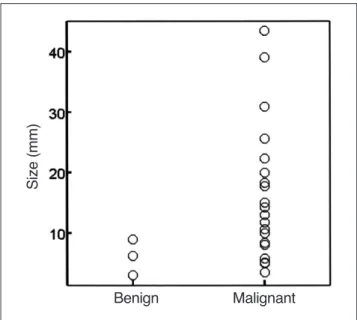
Mural nodules were observed in 85% (23/27) of malig- nant IPMTs (Fig. 6), but in only 21% (4/19) of benign IPMTs (p < 0.001). With regard to the presence or absence of portal vein narrowing, however, the difference was not statistically significant (p = 1.6). Only one of 15 benign multilocular branch duct-type lesions had a thick irregular septum, but this was present in 13 of 23 malignant multi- locular lesions (57%) (p < 0.001). The mean diameter of mural nodules was 16 11 mm in malignant IPMTs and 6 2 mm in benign IPMTs, representing a statistically signif- icant difference (p < 0.001) (Fig. 7).
DISCUSSION
Only one published report has described the use of MR- CP in the differential diagnosis of IPMT: Irie et al. (12) stat- ed that the size and type of an IPMT, the diameter of a di- lated main pancreatic duct, and the presence and size of mural nodules were related to malignancy. Sugiyama and Atomi (4) reported that compared with branch duct-type tumors, main duct and combined-type tumors were more frequently invasive carcinomas, and in our study, com- bined-type tumors were more often malignant than benign.
For main duct types, however, the frequencies with which malignant and benign IPMTs occurred were not significant- ly different, a finding which can probably be attributed to the small number of main duct-type tumors included in our
study group.
Diffuse main pancreatic duct dilatation of greater than 15 mm accompanying main duct-type tumors, or main pancre- atic duct dilatation accompanying branch duct-type tu- mors, is strongly associated with malignancy (12).
Communication between branch duct-type IPMT and the MPD was visualized in most benign and malignant IPMTs, but the diameter of the communicating channel was greater in malignant IPMTs than benign IPMTs.
In our study, there was a statistically significant differ- ence between benign and malignant IPMTs as regards both the presence and size of mural nodules. Four benign tu- mors, however, contained mural nodules, and the presence of such nodules is, therefore, a strongly suggestive but non- specific sign of malignancy. Yamaguchi et al. (5) reported that a mural nodule larger than 10 mm strongly suggests malignancy, and in our study, the size of mural nodules in all four benign IPMTs was less than 10 mm. However, 30% of malignant IPMTs (7/23) also had mural nodules less than 10 mm in size. Kobayashi et al. (15) noted that ductal wall or thickened septum-like structures were irreg- ular in adenocarcinoma and adenoma, but not in hyperpla- sia. In our study, a thick irregular septum was almost al- ways present in the multilocular cystic lesions arising in branch duct-type malignant IPMTs.
Irie et al. (12) reported that a cystic diameter of 30 mm or more may suggest malignancy, with considerable over- lap between benign and malignant IPMTs. In addition, Yanagisawa et al. (16) noted that the greatest diameter of a lesion was larger in malignant IPMTs (50 mm) than benign IPMTs (30 mm), and proposed a criterion of ‘larger than 30 mm’ as a finding suggestive of malignancy. In our study, too, the average greatest diameter of malignant IPMTs was more than that of benign IPMTs, but because of consider- able overlapping, the criterion of ‘larger than 30 mm’
seemed difficult to apply.
In evaluating mural nodules, we analyzed 3-D MRA source images rather than conventional dynamic MR im- ages; our reason for this was that because of the thin-slice imaging technique employed, the former offer much better image resolution and more physiologic interpretation for evaluation of the entire pancreas and pancreatic duct. In our study, the presence or absence of portal vein narrow- ing, determined by means of 3-D MRA, was not a statisti- cally significant determinant of benignancy or malignancy.
This result was due, we believe, to the low degree of ma- lignancy in our IPMT patients. We consider, though, that in surgical planning for curative resection, the presence or ab- sence of this narrowing is a crucial factor.
In summary, IPMTs are more commonly the combined type. In these and main duct-type tumors, mural nodules
Fig. 7. Scatterplot showing the size of mural nodules in benign and malignant IPMTs of the pancreas. Some overlap is apparent, but in benign IPMTs the mural nodule is less than 10 mm in diam- eter.
Size (mm)
Benign Malignant
larger than 10 mm and a diffuse and markedly dilated MPD suggest malignancy. In branch-duct type IPMTs, this is suggested by a larger cystic lesion, a thick and irregular septum, and a larger-diameter connective tract leading to the MPD. For the differential diagnosis of benign and ma- lignant IPMTs of the pancreas, the combined use of MRCP and MRA might be useful.
References
1. Yamada M, Kozuka S, Yamao K, Nakazawa S, Naitoh Y, Tsukamoto Y. Mucin-producing tumor of the pancreas. Cancer 1991;68:573-580
2. Doi R, Fujimoto K, Wada M, Imamura M. Surgical management of intraductal papillary mucinous tumor of the pancreas.
Surgery 2002;132:80-85
3. Kimura W, Sasahira N, Yoshikawa T, Muto T, Makuuchi M.
Duct-ectatic type of mucin producing tumor of the pancreas—
new concept of pancreatic neoplasia. Hepatogastroenterology 1996;43:692-709
4. Sugiyama M, Atomi Y. Intraductal papillary mucinous tumors of the pancreas: imaging studies and treatment strategies. Ann Surg 1998;228:658-691
5. Yamaguchi K, Ogawa Y, Chijiiwa K, Tanaka M. Mucin-hyper- secreting tumors of the pancreas: assessing the grade of malig- nancy preoperatively. Am J Surg 1996;171:427-431
6. Uehara H, Nakaizumi A, Iishi H, et al. Cytologic examination of pancreatic juice for differential diagnosis of benign and malig- nant mucin-producing tumors of the pancreas. Cancer 1994;74:
826-33
7. Sugiyama M, Atomi Y, Kuroda A. Two types of mucin-produc- ing cystic tumors of the pancreas: diagnosis and treatment.
Surgery 1997;122:617-625
8. Sugiyama M, Atomi Y, Hachiya J. Intraductal papillary tumors
of the pancreas: evaluation with magnetic resonance cholan- giopancreatography. Am J Gastroenterol 1998;93:156-159 9. Koito K, Namieno T, Ichimura T, et al. Mucin-producing pancre-
atic tumors: comparison of MR cholangiopancreatography with endoscopic retrograde cholangiopancreatography. Radiology 1998;208:231-237
10. Onaya H, Itai Y, Niitsu M, Chiba T, Michishita N, Saida Y.
Ductectatic mucinous cystic neoplasm of the pancreas: evalua- tion with MR cholangiopancreatography. AJNR Am J Neuroradiol 1998;171:171-177
11. Fukukura Y, Fujiyoshi F, Sasaki M, et al. HASTE MR cholan- giopancreatography in the evaluation of intraductal papillary- mucinous tumors of the pancreas. J Comput Assist Tomogr 1999;23:301-305
12. Irie H, Honda H, Aibe H, et al. MR cholangiopancreatographic differentiation of benign and malignant intraductal mucin-pro- ducing tumors of the pancreas. AJNR Am J Neuroradiol 2000;
174:1403-1408
13. Kim TK, Kim BS, Kim JH, et al. Diagnosis of intrahepatic stones: superiority of MR cholangiopancreatography over endo- scopic retrograde cholangiopancreatography. AJNR Am J Neuroradiol 2002;179:429-434
14. Kim JH, Kim TK, Eun HW, et al. Preoperative evaluation of gallbladder carcinoma: efficacy of combined use of MR imaging, MR cholangiography, and contrast-enhanced dual-phase three- dimensional MR angiography. J Magn Reson Imaging 2002;16:
676-684
15. Kobayashi G, Fujita N, Lee S, Kimura K, Watanabe H, Mochizuki F. Correlation between ultrasonographic findings and pathological diagnosis of mucin-producing tumor of the pan- creas. Nippon Shokakibyo Gakkai Zasshi 1990;87:235-242 16. Yanagisawa A, Ohashi K, Hori M, et al. Ductectatic-type muci-
nous cystadenoma and cystadenocarcinoma of the human pan- creas: a novel clinicopathological entity. Jpn J Cancer Res 1993;84:474-479