Duodenum-preserving pancreatic head resection in benign and
low-grade malignant pancreatic tumors
Juhan Lee1, Jin Hong Lim2, Sung Hoon Kim3, Hyun Ki Kim4, Seung Woo Park5, Jae Bock Chung5, and Kyung Sik Kim1 1
Department of Surgery, Severance Hospital, Yonsei University College of Medicine, Seoul, 2Department of Surgery, Yongin Severance Hospital, Yonsei University College of Medicine, Yongin, 3Department of Surgery,
Wonju Severance Christian Hospital, Yonsei University Wonju College of Medicine, Wonju, Departments of 4
Pathology, 5Internal Medicine, Severance Hospital, Yonsei University College of Medicine, Seoul, Korea
Backgrounds/Aims: With development of imaging techniques, pancreatic tumors are being diagnosed more frequently. Applying the standard surgical procedures for pancreatic head tumors, such as pancreaticoduodenectomy and pylo-rus-preserving pancreaticoduodenectomy may seem too extensive for benign or low-grade malignant pancreas head tumors. Duodenum-preserving pancreatic head resection (DPPHR) has been safely performed in patients with chronic pancreatitis. Recently, DPPHR has been used as a limited surgical procedure to remove benign or low-grade malignant pancreatic head lesions. This study is aimed to evaluate the results of DPPHR in benign or low-grade malignant tumors.
Methods: Between 2004 and 2012, six patients underwent DPPHR due to benign or low-grade malignant pancreas tumor. We performed this retrospective analysis based on the medical records. Results: Five of six patients were diag-nosed as intraductal papillary mucinous neoplasms. Remaining one patient was diagdiag-nosed as solid pseudopapillary neoplasm. The median age of patients was 60.3 (27-75) years, and the median follow-up period was 24 months. The operation time, blood loss and length of stay were 442.5 minutes, 680 ml and 19.2 days, respectively. There was no mortality. Five patients experienced complications including 1 delayed gastric empting, 2 bile duct strictures, 1 pan-creatic fistula and 1 duodenal stricture. No recurrence or metastasis was found during follow-up. Conclusions: In benign and low-grade malignant lesions of pancreatic head, DPPHR could be alternative to traditional surgery. For applying DPPHR in pancreas tumor, a thorough preoperative examination and utilization of frozen section for sufficient resection margin are required. (Korean J Hepatobiliary Pancreat Surg 2013;17:126-130)
Key Words: Pancreatectomy; Duodenum; Organ preservation; Duodenum-preserving pancreatic head resection
Received: August 1, 2013; Revised: August 10, 2013; Accepted: August 20, 2013 Corresponding author: Kyung Sik Kim
Department of Surgery, Yonsei University College of Medicine, 50, Yonsei-ro, Seodaemun-gu, Seoul 120-752, Korea Tel: +82-2-2228-2125, Fax: +82-2-313-8289, E-mail: [email protected]
Copyright Ⓒ 2013 by The Korean Association of Hepato-Biliary-Pancreatic Surgery Korean Journal of Hepato-Biliary-Pancreatic Surgery ∙ ISSN: 1738-6349
INTRODUCTION
Subclinical pancreas cystic tumors are being found more frequently recently, owing to the development and widespread use of new imaging techniques.1 Pancreas cystic tumor consists of serous cysteadenoma, mucinous cystic neoplasm, intraductal papillary mucinous neoplasm and solid pseudopapillary neoplasm. Each tumor shows distinct biological features and malignant potential. However, it is difficult to distinguish the benign from ma-lignant lesions preoperatively. It is a challenge to decide on a surgical treatment due to morbidity and mortality fol-lowing the surgery.2,3
In particular, pancreaticoduodenectomy and pylorus-
preserving pancreaticoduodenectomy have been tradition-ally performed on pancreatic head lesions. With the devel-opment of surgical techniques, the operations have shown low complication and mortality rates as compared to the past. However, it is inevitable that the pancreas and near-by organs lose some of their functions. To this end, vari-ous organ-preserving pancreatic resections have been re-searched to resolve the issues. The representative method for pancreatic head lesions is duodenum-preserving pan-creatic head resection (DPPHR). DPPHR in panpan-creatic tu-mor was first introduced by Beger for chronic pancreatitis patients.4 The application has expanded to chronic pan-creatitis, precancerous lesions and pancreatic head tumors with low malignance.5
Table 1. Characteristics of patients
Patient Gender/age Preoperative
symptom Diagnosis A B C D E F Male/72 Female/27 Male/75 Female/64 Male/62 Male/61 Back pain None None None None None IPMN SPN IPMN IPMN IPMN IPMN IPMN, intraductal papillary mucinous neoplasm; SPN, solid pseudopapillary neoplasm
Table 2. Surgical outcomes of duodenum-preserving pancreas
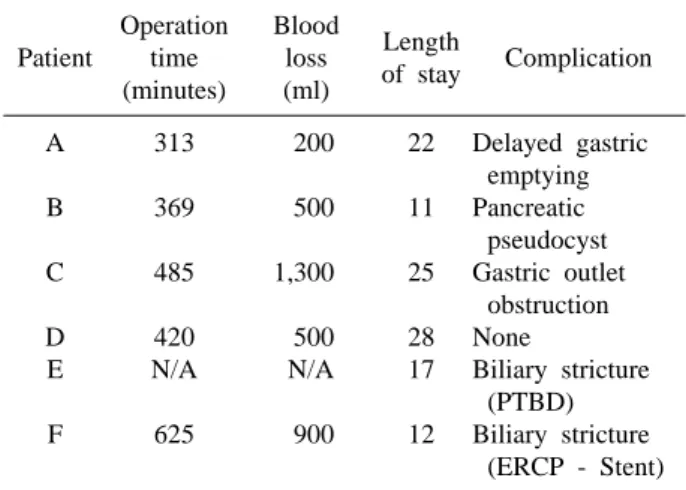
head resection Patient Operation time (minutes) Blood loss (ml) Length of stay Complication A B C D E F 313 369 485 420 N/A 625 200 500 1,300 500 N/A 900 22 11 25 28 17 12 Delayed gastric emptying Pancreatic pseudocyst Gastric outlet obstruction None Biliary stricture (PTBD) Biliary stricture (ERCP - Stent) PTBD, percutaneous transhepatic biliary drainage; ERCP, en-doscopic retrograde cholangiopancreatography; N/A, not available
We performed this study to investigate the efficacies of duodenum-preserving pancreatic head resection for cystic neoplasm of the pancreatic head by analyzing post-operative outcomes.
METHODS
The number of patients who underwent DPPHR in pan-creatic tumor at Yonsei University Severance Hospital (Seoul, Korea) between October 2004 and March 2012 was eight. Among them, six patients underwent operation due to benign or low malignant pancreatic tumor. The ret-rospective analysis was based on the medical records.
RESULTS
The total number of patients who received DPPHR in pancreatic head tumor was six. The average age of pa-tients was 60.3 (27-75) years old, and there were 4 male and 2 female patients. One patient was symptomatic and the remaining five patients were discovered incidentally by imaging studies (Table 1).
The average operation time, blood loss and length of stay were 442.5 minutes, 680 ml and 19.2 days, respec-tively. Combined organ resection was performed for one patient. The patient underwent DPPHR with right radical nephrectomy due to renal cell carcinoma (Table 2).
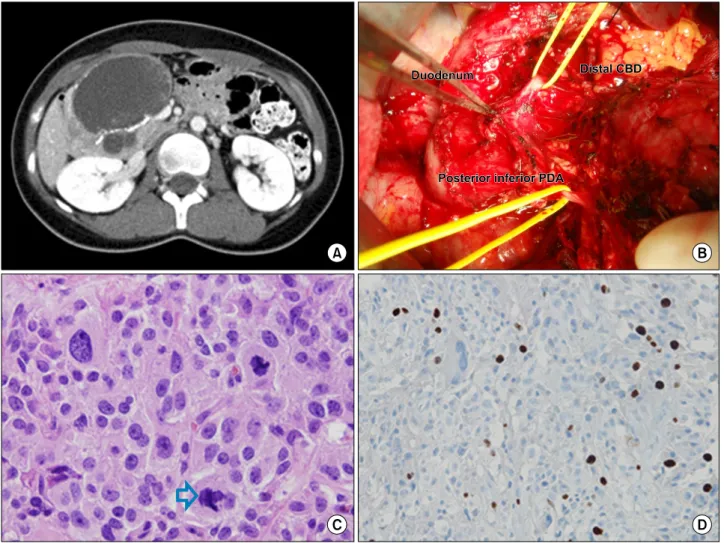
The histopathologic examination showed that 5 of 6 cases were the intraductal papillary mucinous neoplasms and the remaining one case was solid pseudopapillary neoplasm. No lymph node metastases were found among intraductal papillary mucinous neoplasms from the histo-pathologic examinations. Solid pseudopapillary neoplasm showed less than 5% of cytologic atypia and atypical
mi-tosis, and β-catenin was positive to nuclear pattern from the immunohistochemical examination (Fig. 1).
There was no mortality, and five patients showed com-plications including 1 delayed gastric stricture. The de-layed gastric empting was improved by conservative treatment. A pancreatic fistula was found in one patient post-operation due to solid pseudopapillary neoplasm- formed cyst and was treated by cysto-pancreatic dou-ble-sided pigtail insert by the endoscopic approach. Bile duct strictures were found in 2 patients: percutaneous transhepatic biliary drainage (PTBD) was performed for one patient; and endoscopic retrograde biliary drainage was performed for the other patient. One patient suffered from repetitive duodenal ulcer due to ischemia. He experi-enced frequent vomiting from duodenal stricture caused by ulcer. To relieve obstructive symptoms, we conducted endoscopic balloon dilatation, only to be unsuccessful. Finally, we performed gastrojejunostomy (Fig. 2).
No recurrence of pancreatic lesions was found on the clinical shadow tracking. Average observation period was 24 months.
DISCUSSION
The advantage of DPPHR compared to traditional pan-creaticoduodenectomy and pylorus-preserving pancreati-coduodenectomy is the preservation of duodenum, which has a key role in the digestive and absorptive functions.
Fig. 1. A case of solid pseudopapillary neoplasm. (A) A 10 cm-sized, septated, cystic mass in the pancreas head. (B) Duodenum,
distal common bile duct and posterior inferior pancreaticoduodenal artery (PDA) were preserved during the duodenum-preserving pancreatic head resection. (C) Atypical mitosis; Tripolar mitosis (arrow) (H-E, ×400). (D) β-catenin was found to be positive for nuclear pattern (×400).
In addition, preservation of more pancreatic tissues and normal biliary tree makes it possible to improve the pa-tient’s quality of life.6,7 The most significant reason for duodenum resection with pancreas head is the danger of duodenal ischemia.
Duodenum receives arterial blood from the pan-creaticoduodenal artery, which originates from the gastro-duodenal artery and superior mesenteric artery. It forms an arcade, contacting duodenum at the front and pancreas head at the rear. Beger preserved thin pancreatic layers with arcade blood vessels near the internal duodenum to preserve duodenum and they resected pancreas head of chronic pancreatitis patients. Beger’s technique has been modified in various forms, including a complete resection of pancreas head and preservation of duodenal blood vessels. It has been reported that a resection of pancreas
head, bile duct inside the pancreas and the arcade have been performed while maintaining the blood supply from a small artery on the abdominal walls of the duodenum.8 Takada et al.9,10 designed a technique by completely re-secting the pancreas head and preserving posterior arcade Miyakawa et al.11 published a technique which preserved the anterior arcade.
We performed gastrojejunostomy for one patient due to repetitive ulcer and stricture from duodenal ischemia. Extra caution needs to be taken with duodenal stricture, because DPPHR in pancreatic tumor completely resects pancreatic tissues inside the duodenum to secure the boundary surface from the center for pancreatic cystic disease. Multi-detector computed tomography may be considered to check the bloodstream around duodenum before the surgery.12
Fig. 2. Complications presenting
duodenal stricture. (A) Ischemic change at the duodenal 2nd por-tion (arrow). (B) Huge ulcero-in-filtrative lesion at duodenum. (C) Duodenal stricture. (D) Pne-umatic balloon dilatation of the duodenum.
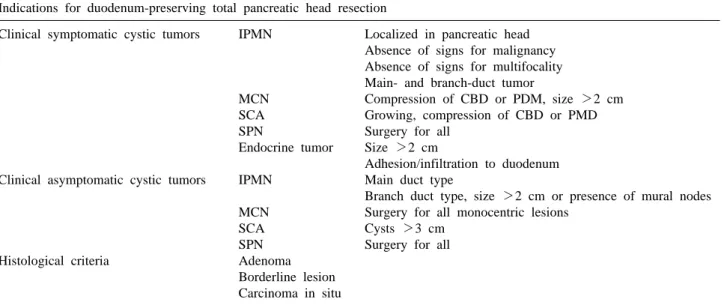
Table 3. Indications for duodenum-preserving total pancreatic head resection for cystic neoplastic tumors
Indications for duodenum-preserving total pancreatic head resection Clinical symptomatic cystic tumors
Clinical asymptomatic cystic tumors
Histological criteria IPMN MCN SCA SPN Endocrine tumor IPMN MCN SCA SPN Adenoma Borderline lesion Carcinoma in situ
Localized in pancreatic head Absence of signs for malignancy Absence of signs for multifocality Main- and branch-duct tumor
Compression of CBD or PDM, size >2 cm Growing, compression of CBD or PMD Surgery for all
Size >2 cm
Adhesion/infiltration to duodenum Main duct type
Branch duct type, size >2 cm or presence of mural nodes Surgery for all monocentric lesions
Cysts >3 cm Surgery for all
IPMN, intraductal papillary mucinous neoplasm; MCN, mucinous cystic neoplasm; SCA, serous cystadenoma; SPN, solid pseudo-papillary neoplasm; CBD, common bile duct; PMD, pancreas main duct
Issues including duodenal ischemia, proper operation indication and securing oncologic radicality are other con-cerns when applying DPPHR to pancreatic head tumor. Frequent pancreatic cystic tumors include intraductal papillary mucinous neoplasm, mucinous cystic neoplasm, serous cystadenoma, and solid pseudopapillary neoplasm.
Indication for DPPHR is a tumor placed on the pancreas head with clinical symptoms. The operative indications shall be judged as depending on the size and features of each lesion and connection with the pancreatic duct, if there are no clinical symptoms. There needs also be no evidence of malignancy or multifocality (Table 3).13,14
Table 4. Indications for oncologic pancreatic head resection (pancreaticoduodenectomy, pylorus-preserving
pancreaticoduodenec-tomy) of cystic neoplastic tumors
Indications for oncologic pancreatic head resection Cystic neoplasia, preoperatively suspected
to be associated with invasive carcinoma
Intraoperative criteria
Jaundice
Malignant cells in juice Mural nodes >0.5 cm New onset diabetes
CEA >110 mg/ml in cystic fluid Duct dilatation >1 cm
Cancer cell positive lymph nodes
Adhesion to portal vein, superior mesenteric vein
Infiltration into proximal duodenum or wall of gastric antrum
Frozen section: suspected cancer cells behind subepithelial level of the duct Cancer cell positive resection margin
Clinical aspects suspicious malignance include jaundice, new diabetes, pancreatic duct expansion (>1 cm), in-creasing carcinoembryonic antigen (CEA) in cystic fluids and existence of mural node. Clinical opinions with strong suspicion of malignance shall be considered for pan-creaticoduodenectomy or pylorus-preserving pancreatico-duodenectomy (Table 4).13
Lastly, oncologic radicality is important in applying DPPHR in precancerous lesions and malignant cystic diseases. Frozen section examination shall be applied in the operation room to secure the sufficient resection mar-gin to prevent recurrence of the precancerous lesion and existence of malignant lesion. Additional resection is re-quired on the resection margin if borderline atypia, pan-creatic intraepithelial neoplasm (PanIN 3) is found.13
In conclusion, DPPHR in pancreas head tumor with precancerous lesions and low malignance may be replaced with a typical operation. It is required to secure a suffi-cient resection margin by utilizing the frozen section ex-amination and checking for indications thorough pre-operative examination. The operation must be performed by experienced surgeons due to the possibility of damag-ing the bile duct and causdamag-ing duodenal ischemia.
REFERENCES
1. Klöppel G, Kosmahl M. Cystic lesions and neoplasms of the pancreas. The features are becoming clearer. Pancreatology 2001; 1:648-655.
2. Ferrone CR, Correa-Gallego C, Warshaw AL, et al. Current trends in pancreatic cystic neoplasms. Arch Surg 2009;144:448- 454.
3. Salvia R, Malleo G, Marchegiani G, et al. Pancreatic resections for cystic neoplasms: from the surgeon's presumption to the
path-ologist's reality. Surgery 2012;152(3 Suppl 1):S135-142. 4. Beger HG, Krautzberger W, Bittner R, et al.
Duodenum-preserv-ing resection of the head of the pancreas in patients with severe chronic pancreatitis. Surgery 1985;97:467-473.
5. Beger HG, Gansauge F, Siech M, et al. Duodenum-preserving to-tal pancreatic head resection for cystic neoplastic lesions in the head of the pancreas. J Hepatobiliary Pancreat Surg 2008;15: 149-156.
6. Möbius C, Max D, Uhlmann D, et al. Five-year follow-up of a prospective non-randomised study comparing duodenum-preserv-ing pancreatic head resection with classic Whipple procedure in the treatment of chronic pancreatitis. Langenbecks Arch Surg 2007;392:359-364.
7. Pedrazzoli S, Canton SA, Sperti C. Duodenum-preserving versus pylorus-preserving pancreatic head resection for benign and pre-malignant lesions. J Hepatobiliary Pancreat Sci 2011;18:94-102. 8. Takada T, Yasuda H, Amano H, et al. A duodenum-preserving
and bile duct-preserving total pancreatic head resection with asso-ciated pancreatic duct-to-duct anastomosis. J Gastrointest Surg 2004;8:220-224.
9. Takada T, Yasuda H, Amano H, et al. A duodenum-preserving and bile duct-preserving total pancreatic head resection with asso-ciated pancreatic duct-to-duct anastomosis. J Gastrointest Surg 2004;8:220-224.
10. Takada T, Yasuda H, Uchiyama K, et al. Duodenum-preserving pancreatoduodenostomy. A new technique for complete excision of the head of the pancreas with preservation of biliary and ali-mentary integrity. Hepatogastroenterology 1993;40:356-359. 11. Miyakawa S, Horiguchi A, Mizuno K, et al. Preservation of
arte-rial arcades during duodenum-preserving total pancreatic head re-section for intraductal papillary tumor. Hepatogastroenterology 2003;50:993-997.
12. Horiguchi A, Miyakawa S, Ishihara S, et al. Surgical design and outcome of duodenum-preserving pancreatic head resection for benign or low-grade malignant tumors. J Hepatobiliary Pancreat Sci 2010;17:792-797.
13. Beger HG, Rau BM, Gansauge F, et al. Duodenum-preserving total pancreatic head resection for cystic neoplasm: a limited but cancer-preventive procedure. Langenbecks Arch Surg 2008;393: 589-598.
14. Tanaka M, Chari S, Adsay V, et al. International consensus guidelines for management ofintraductal papillary mucinous neo-plasms and mucinous cystic neoneo-plasms of the pancreas. Pancrea-tology 2006;6:17-32.