․ 접수 : 2013년 3월 15일 ․ 수정접수 : 2013년 4월 15일 ․ 채택 : 2013년 4월 17일
* 공동교신저자 : 이영준, 대구한의대학교 한의과대학 예방의학교실, 경북 경산시 한의대로 1, 712-715 전화 : 053-819-1296, 팩스 : 053-819-1576, 전자우편 : [email protected]
구세광, 대구한의대학교 한의과대학 해부학교실, 경북 경산시 한의대로 1, 712-715 전화 : 053-819-1549, 팩스 : 053-819-1576, 전자우편 : [email protected]
Effect of Gongjindon a Traditional Korean Polyherbal Formula, on the Pharmacokinetics Profiles of Donepezil in Male SDRats (1)
- Single Oral Combination Treatment of Donepezil 10mg/kg with Gongjindan 100mg/kg within 5 min -
Dae-Kyoo Chung,
1)Oh-Dae Kwon,
2)Soo-Jin Park,
3) 5)Young-Joon Lee,
4), 5)*Sae-Kwang Ku
3), 5)*1)
Department of Neuropsychiatry, College of Korean Medicine, DaeguHaany University, Gyeongsan
2)
Department of Neurology, Catholic University of Daegu School of Medicine, Daegu
3)
Department of Anatomy and Histology, College of Korean Medicine, DaeguHaany University, Gyeongsan
4)
Department of Preventive Medicine, College of Korean Medicine, DaeguHaany University, Gyeongsan
5)
The Medical Research center for Globalization of Herbal Formulation, DaeguHaany University, Gyeongsan
Abstract
Objectives : This study was aim to evaluate effects of pharmacodynamics and toxicity in combination therapy of donepezil with Gongjindan.
Methods : After 10mg/kg of donepezil treatment, Gongjindan 100mg/kg was administered within 5 min.
The plasma were collected at 30min before administration, 30min, 1, 2, 3, 4, 6, 8 and 24hrs after end of Gongjindan treatment, and plasma concentrations of donepezil were analyzed using LC-MS/MS methods.
PK parameters of donepezil were analysis as compared with donepezil single administered rats.
Results : Gongjindan markedly inhibited the absorption of donepezil regardless of sample time, from 30min to 8hrs after end of co-administration comparing with donepezil single treated rats. Especially the absorption of donepezil was significantly decreased at 2hrs after co-administration as compared with donepezil single treated rats, in the present study. Accordingly, the Cmax(-27.76%), AUC0-t(-27.22%) and
AUC
0-inf(-26.54%) of donepezil in co-administered rats were significantly decreased as compared with
donepezil single treated rats, respectively.
Conclusions : Based on the results of the present study, co-administration of Gongjindan decreases the
oral bioavailability of donepezil by inhibiting the absorption. It is considered that the more detail pharmacokinetic studies should betested to conclude the effects of Gongjindan on the pharmacokinetics of donepezil, when they were co-administered, like the effects after co-administration with reasonable intervals considering the Tmax of donepezil and after repeated co-administrations.
Key words : Gongjindan , Pharmacokinetics, Drug-drug interactions, Rat, Donepezil
I. Introduction
Donepezil (Aricept
TM) is a centrally acting reversible acetylcholinesterase inhibitor, and main therapeutic use is in the palliative treat- ment of mild to moderate Alzheimer’s disease
1). Donepezil is indicated for symptomatic treatment of patients with mild, moderate and severe dementia of the Alzheimer’s type
2, 3). Donepezil has been tested in other cognitive disorders including Lewy body dementia
4)and vascular dementia
5). Donepezil has also been found to improve sleep apnea in Alzheimer’s patients
6), and recently the evidence that donepezil can improve speech in children with autism was also suggested
7, 8). However, it also showed severe toxicity in preclinical studies, 50% lethal dose (LD
50) in rodents are located between 30~40mg/kg, and No Observed Effect Level(NOEL) of 13 weeks repeat dose toxicity test in rat and dog is 1mg/kg/day, respectively
9)and undesirable side effects in clinical use
10). Common side effects include gastrointestinal upset; include bradycardia, nausea, diarrhea, anorexia, abdominal pain, vivid dreams, and mania
11-13).
As results of combination therapies with other drugs to improve the side effects of
donepezil or to achieve synergic effects,
various drug-drug interactions of donepezil
have been evaluated ; Although, pharmacokinetic
studies showed no significant effects of donepezil
on the pharmacokinetic profiles of cimetidine
14),
combinations containing any of the following
medications, depending on the amount present,
may also interact with anticholinergics -
cholinesterase inhibitors such as donepezil have
the potential to interfere with the activity of
these medications, nonsteroidal anti-inflammatory
drugs (NSAIDs) - donepezil may increase gastric
acid secretion due to increased cholinergic
activity; patients should be monitored for
symptoms of active or occult gastrointestinal
bleeding and carbamazepine, dexamethasone,
phenobarbital, phenytoin or rifampin - They
may induce the isoenzymes CYP2D6 and
CYP3A4, thus increasing the rate of elimination
of donepezil
9). In addition, concurrent use of
cholinergic agonists like bethanechol or
neuromuscular blocking agents metabolized by
plasma cholinesterase like succinylcholine and
mivacurium with donepezil may be expected
with a synergistic effect
9). Ketoconazole also
can be influenced on the pharmacokinetics and
pharmacodynamics of donepezil through
inhibition of the metabolism of donepezil
9), 15).
Interactions with herbal products have not
been established except for some restricted
single herb extracts or natural compounds;
Ginkgo biloba extracts
16), digoxin
17), theophy- lline
18), or warfarin
19), did not influence on the pharmacokinetics of donepezil.
Gongjindan , a traditional Korean polyherbal formula is one of the most famous tonic agents, and consisted of 4 herbs including Angelicaegigas radix, Ginseng steamed red, Cornifructus and Rehmanniae radix preparata, and 2 animal resources - antler and musk.
These 6 agents were plastered using honey, and coated by gold plates. The hypoli- pidemicand immune stimulatory effects of Gongjindan are relatively well documented
20), 21)with anti-oxidative effects
22), anti-gliosis effects on middle cerebral artery occlusion rats
23)and anti-dementia effects
24, 25). In addition, single oral dose toxicity
26)and micronucleus test
27)of Gongjindan itself were already reported.
In the present study, the effects of Gong - jindan co-administration on the pharmaco- kinetics of donepezil were observed as a process of the comprehensive and integrative medicine, combination therapy of donepezil with Gongjindan to achieve synergic pharma- codynamics and reduce toxicity. After 10mg/kg of donepezil treatment, Gongjindan 100mg/kg was administered within 5 min. The plasma were collected at 30min before administration, 30min, 1, 2, 3, 4, 6, 8 and 24hrs after end of Gongjindan treatment, and plasma concent- rations of donepezil were analyzed using LC-MS/MS methods. PK parameters of donepezil (Tmax, Cmax, AUC, t
1/2and MRT
inf) were analysis as compared with donepezil single administered.
II. Materials and Methods
1. Animals and husbandry
Total tenmale Sprague-Dawley (SD)rats (6-wk old upon receipt, SLC, Japan) were used after acclimatization for 16 days. Animals were allocated five per polycarbonate cage in a temperature (20-25℃) and humidity (40-45%) controlled room. Light : dark cycle was 12hr : 12hr and feed (Samyang, Korea) and water were supplied free to access. All animals were marked by picric acid, and overnight fasted (about 18 hrs; water was not restricted) before treatment, and further fasted during 3 hrs after end of treatment.
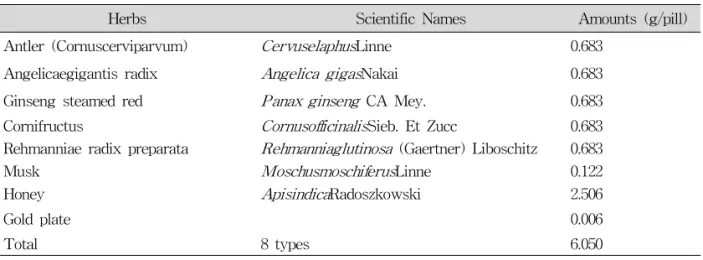
2. Test articles and formulation Gongjindan , prepared and purchase from Daegu Oriental Hospitals, DaeguHaany University (Table 1; Daegu, Korea) and donepezil(Jeil Pharm., Co., Ltd, Youngin, Korea) was used as control drug. Donepezil and Gongjindan were stored in a refrigerator at 4℃ to protect from light and degeneration until use. Both drugs are well suspended or dissolved (up to 20 mg/ml suspensions in Gongjindan and up to2mg/ml solutions in donepezil) in distilled water as vehicle, respectively.
3. Groupings and administration
Five rats per group (two groups) were used
in this study as follows. The doses of test
materials were selected based on theirtoxicity
Herbs Scientific Names Amounts (g/pill)
Antler (Cornuscerviparvum) Cervuselaphus Linne 0.683
Angelicaegigantis radix Angelica gigas Nakai 0.683
Ginseng steamed red Panax ginseng CA Mey. 0.683
Cornifructus Cornusofficinalis Sieb. Et Zucc 0.683
Rehmanniae radix preparata Rehmanniaglutinosa (Gaertner) Liboschitz 0.683
Musk Moschusmoschiferus Linne 0.122
Honey Apisindica Radoszkowski 2.506
Gold plate 0.006
Total 8 types 6.050
Gongjindan used in this study was purchased from Daegu Oriental Hospital of DaeguHanny University (Daegu, Korea)
Table 1. Composition of Gongjindan Used in This Study
and pharmacodynamics - 10mg/kg of donepezil with 100mg/kg of Gongjindan . After 10mg/kg of donepezil treatment, Gongjindan 100mg/kg was administered, within 5 min. In donepezil single treated rats, 10mg/kg of donepezil was orally administered and 5 min after treatment, only distilled water 5ml/kg was orally admini- stered, instead of Gongjindan suspensions.
Each donepezil or Gongjindan was single orally administered, in a volume of 5ml/kg, dissolved in distilled water.
4. Plasma collections
All rats were slightly anesthesia under ethyl ether (Duksan Pure Chemical, Seoul, Korea) and blood samples (0.5 ml) were collected into 50IU heparinized tubes via the orbital plexus at 30min before treatment (as a control), 30min, 1, 2, 3, 4, 6, 8 and 24hrs after end of oral administration. Blood samples were immediately centrifuged for 10 min at 13,000 rpm and about 0.3ml aliquots of plasma were stored in a −70℃ deep freezer until
analysis of donepezil.
5. Sample preparation and calibrations Primary stock solution, 1.0mg/ml of donepezil in acetonitrile (Sigma, MO, USA) and internal standard working solution, carbamazepine (Sigma, MO, USA) 500ng/ml in acetonitrile were prepared. Working standard solutions were prepared by dilution with acetonitrile. All standard solutions were stored at -20℃ in the dark when not in use, and calibrated the standard samples as 100μl of blank plasma, working standard solutions and internal standard working solution were mixed with 100μl of acetonitrile. The mixtures were mixed by vortex-mixing and centrifuged at 12,000rpm for 10min at 4℃. The clear supernatants were transferred to injection vials and the aliquot was injected into the LC-MS/MS system. In addition, 100μl of sample plasma and internal standard working solution were mixed with 200μl of acetonitrile.
The mixtures were mixed by vortex-mixing
and centrifuged at 12,000rpm for 10min at 4℃.
Clear supernatants (3.5μl) were directly trans- ferred to injection vials and the aliquot was injected into the LC-MS/MS system.
6. LC-MS/MS conditions
Concentrations of donepezilin the rat plasma samples were determined LC-MS/MS method.
Chromatographic analysis was performed using an Agilent 1100 Series HPLC (Agilent Tech- nologies, CA, USA) equipped with on-line degasser, binary pump, autosampler and column compartment. Separation of the analyte from potentially interfering material was achieved at ambient temperature using Waters Xterra MS C18 columns (2.1×50mm, 3.5μm) (Waters Corp., MA, USA) at column oven 30℃. The mobile phase used for the chromatographic separation was composed of 2% acetonitrile/98% distilled water (0.1%
formic acid) to 98% acetonitrile/2% distilled water (0.1% formic acid), and was delivered isocratically at a flow rate of 0.35ml/min. The column effluent was monitored using an API 2000 triple-quadruple mass-spectometric det- ector (Applied Biosystems, CA, USA). The instrument was equipped with an electrospray interface in positive ion mode, and controlled by the Analyst version 1.4.2 software (Applied Biosystems, CA, USA). Samples were intro- duced to the interface through a Turbo IonSpray with the temperature set at 400℃. A high positive voltage of 5.0kV was applied to the ion spray. Nitrogen was used as the nebulizer gas, curtain gas, and collision gas with the settings of 12, 6, and 8, respectively.
The multiple reaction monitoring (MRM)
detection method was employed for the detection of donepezil ; the transitions monitored were carbamazepine (IS): m/z 237>194 (Reten- tion time: 2.4 min), donepezil: 380>91 (Retention time: 2.3 min). Calibration curves of donepezil were linear over the ranges studied with r
2> 0.999. The lower limit of quantification of the donepezil in the rat plasma was 1ng/ml.
7. Pharmacokinetic analysis
The plasma concentration data were analyzed using a noncompartmental method on com- mercial pharmacokinetics data analyzer programs (PK solutions 2.0; Summit, CO, USA)
28, 29). The eliminationrate constant (K
el) was calcul- ated by the log-linear regression of donepezil concentration data during the elimination phase, and the terminal half-life(t
1/2) was calculated by 0.693/K
el. The peak concentration (Cmax) and time to reach the peak concen- tration(Tmax) of donepezil in the plasma were obtained by visual inspection of the data in the concentration-time curve. The area under the plasma concentration-time curve (AUC
0-t) from time zero to the time of the last measured concentration (C
last)was calculated using the linear trapezoidal rule
30). The AUCzero to infinity(AUC
0-inf) was obtained by adding AUC
0-tandthe extrapolated area was determined by C
last/K
el. The mean residencetime infinity (MRT
inf) was calculated by dividing the first moment of AUC(AUMC
0-inf) by AUC
0-inf.
8. Statistical analyses
All the means are presented with their
standard deviation of five rats (Mean ± SD of
five rat plasma concentrations of donepezil).
The pharmacokinetic parameters were compared using a non-parametric comparison test, Mann-Whitney U (MW) test, on the SPSS for Windows (Release 14.0K, SPSS Inc., USA). A p-value <0.05 was considered statistically significant. In addition, the percent changes between donepezil single treated rats and donepezil with Gongjindan co-administered rats were calculated to help the understanding of the effects of co-administration.
III. Results
1. Changes on the plasma concent- rations of donepezil
Donepezil was detected from 30min to 8hrs after end of administration in the both donepezil single and co-administered rats with Gongjindan , respectively. Gongjindan significantly (p<0.01) inhibited the absorption of donepezil at 2hrs after co-administration of donepezil 10mg/kg and Gongjindan 100mg/kg as compared with donepezil single treated rats, and the absorption of donepezil were also non-sig- nificant but markedly decreased at 30 min, 1, 3, 4, 6 and 8hrs after co-administration comparing with donepezil single treated rats (Fig 1).
The plasma donepezil concentrations at 30min, 1, 2, 3, 4, 6 and 8hrs after end of treatment were changed as -15.71, -30.25, -28.84, -24.63, -37.96, -17.80 and -19.40% in donepezil + Gongjindan treated rats as compared with donepezil single treated rats, respectively.
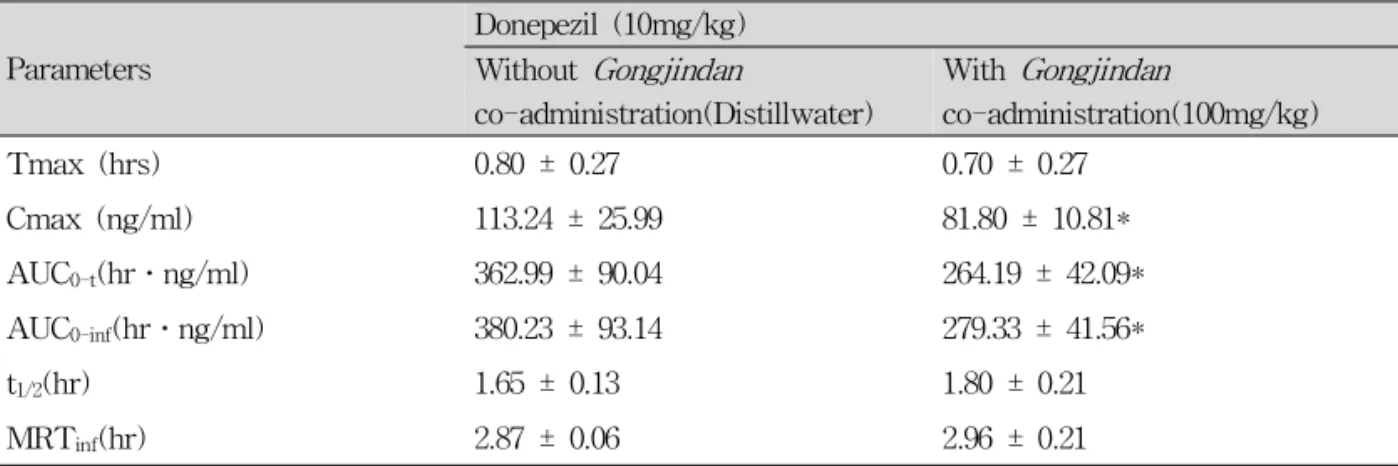
2. Changes on the Tmax of donepezil The Tmax of donepezil were slightly and non-significantly decreased as -12.50% in co-administrated rats with donepezil 10mg/kg and Gongjindan 100mg/kg (0.70±0.27hr) as compared with donepezil single treated rats (0.80±0.27hr)(Table 2).
3. Changes on the Cmax of donepezil The Cmax of donepezil were significantly (p<0.05) decreased as -27.76% in co-administrated rats with donepezil 10mg/kg and Gongjindan 100mg/kg (81.80±10.81ng) as compared with donepezil single treated rats (113.24±2.41ng) (Table 2).
4. Changes on the AUC of donepezil The AUC
0-tof donepezil were significantly (p<0.05) decreased as -27.22% in co-admini- strated rats with donepezil 10mg/kg and Gongjindan 100mg/kg (264.19±42.09hr․ng/ml) as compared with donepezil single treated rats (362.99±90.04hr․ng/ml). In addition, AUC
0-infof donepezil were also significantly (p<0.05) decreased as -26.54% in co-administrated rats with donepezil 10mg/kg and Gongjindan 100mg/kg (279.33±41.56hr․ng/ml) as compared with donepezil single treated rats (380.23±
93.14hr․ng/ml)(Table 2).
5. Changes on the t
1/2of donepezil
The t
1/2of donepezil were slightly and non-
significantly increased as 8.79% in co-admi-
nistrated rats with donepezil 10mg/kg and
Fig 1. Plasma Concentrations of Donepezil with and without Gongjindan Co-administration in Male Rats. Donepezil was detected from 30min to 8hrs after end of administration in the both donepezil single and co-administered rats with Gongjindan , respectively.
Gongjindan significantly (p<0.01) inhibited the absorption of donepezil at 2hrs after co-administration of donepezil 10mg/kg and Gongjindan 100mg/kg as compared with donepezil single treated rats, and the absorption of donepezil were also non-significant but markedly decreased at 30min, 1, 3, 4, 6 and 8hrs after co-administration as compared with donepezil single treated rats, in the present study. Values are expressed as mean ± SD of five rats (ng/ml). D, donepezil; GJD, Gongjindan .* p<0.05 as compared with donepezil single treated rats by MW test
Parameters
Donepezil (10mg/kg) Without Gongjindan
co-administration(Distillwater)
With Gongjindan
co-administration(100mg/kg)
Tmax (hrs) 0.80 ± 0.27 0.70 ± 0.27
Cmax (ng/ml) 113.24 ± 25.99 81.80 ± 10.81*
AUC
0-t(hr․ng/ml) 362.99 ± 90.04 264.19 ± 42.09*
AUC
0-inf(hr․ng/ml) 380.23 ± 93.14 279.33 ± 41.56*
t
1/2(hr) 1.65 ± 0.13 1.80 ± 0.21
MRT
inf(hr) 2.87 ± 0.06 2.96 ± 0.21
Values are expressed as mean ± SD of five rats. Cmax: The peak plasma concentration; Tmax: Time to reach Cmax; AUC
0-t:The total area under the plasma concentration-time curve from time zero to time measured; AUC
0-inf: The total area under the plasma concentration-time curve from time zero to time infinity; t
1/2: half life; MRT
inf: mean residence to time infinity. * p<0.05 as compared with donepezil single treated rats by MW test
Table 2. Pharmacokinetic Parameters of Donepezil with and without Gongjindan Co-administration in Male Rats
Gongjindan 100mg/kg (1.80±0.21hr) as compared with donepezil single treated rats (1.65±0.13hr) (Table 2).
6. Changes on the MRT
infof donepezil The MRT
infof donepezil were non-significantly changed as 3.11% in co-administrated rats with donepezil 10mg/kg and Gongjindan 100mg/kg(2.96±0.21hr) as compared with donepezil single treated rats (2.87±0.06hr) (Table 2).
IV. Discussion
Although donepezil is a centrally acting reversible acetylcholinesterase inhibitor, frequ- ently used for palliative treatment of mild to moderate Alzheimer’s disease
1)and for symp- tomatic treatment of patients with mild, moderate and severe dementia of the Alzheimer’s
type
2), 3), it also showed severe toxicity in
preclinical studies
9)and undesirable side effects in clinical use
10-13). In addition, donepezil has been showed various drug-drug interactions
9),15)
, but the interactions with herbal natural products have not been established except for some restricted single herb extracts or natural compounds
16-19). Gongjindan , a traditional Korean polyherbal formula is one of the most famous tonic agents and the hypolipidemic and immune stimulatory
20), 21), anti-oxidative
22), anti-gliosis effects
23)and anti-dementia effects
24), 25)of Gongjindan are relatively well documented. In the present study, the effects of Gongjindan co-administration on the pharmacokinetics of donepezil after single oral administration were observed as a process of the comprehensive
and integrative medicine, combination therapy of donepezil with Gongjindan to achieve synergic pharmacodynamics and reduce toxicity. After 10mg/kg of donepezil treatment, Gongjindan 100mg/kg was administered within 5 min. The plasma were collected at 30min before admini- stration, 30min, 1, 2, 3, 4, 6, 8 and 24hrs after end of Gongjindan treatment, and plasma concentrations of donepezil were analyzed using LC-MS/MS methods. PK parameters of donepezil (Tmax, Cmax, AUC, t
1/2and MRT
inf) were analysis as compared with donepezil single administered rats using noncompart- mental pharmacokinetics data analyzer programs.
Gongjindan markedly inhibited the absorption of donepezil regardless of sample time, from 30min to 8hrs after end of co-administration as compared with donepezil single treated rats. Especially the absorption of donepezil were significantly (p<0.05) decreased at 2hrs after co-administration as compared with donepezil single treated rats, in the present study.
Accordingly, the Cmax (-27.76%), AUC
0-t(-27.22%) and AUC
0-inf(-26.54%) of donepezil in co-administered rats were significantly (p<0.05) decreased as compared with donepezil single treated rats, respectively. These findings are considered as direct evidences that Gongjindan decreased oral bioavailability of donepezil as inhibited the absorptions, when they were co-administered.
Donepezil was well absorbed, with a relative
oral bioavailability of 100%
31). The rate and
extent of absorption are not influenced by
food intake or the time of administration
32).
Donepezil showed very high protein bindings,
it showed approximately 96% protein bindings
33),
mainly to albumins (about 75%) and α1-acid
glycoprotein (about 21%). Tmax of donepezil in human subject after oral administration is 3 to 4 hours and slowly eliminated through renal and biliary system
34), t
1/2of donepezil in healthy human volunteers is about 70 hours
35,36)