pISSN 1598-9992 eISSN 2233-6869
ORIGINAL ARTICLE
메타분석: 한국에서 Helicobacter pylori 제균에 순차치료가 기존치료보다 우월하다
정준원, 하민수, 윤성철1, 김정호, 이종준, 김윤재, 김경오, 권광안, 박동균, 이동호2
가천대 길병원 내과, 서울아산병원 임상통계학과1, 분당서울대학교병원 내과2
Meta-analysis: Sequential Therapy Is Superior to Conventional Therapy for Helicobacter pylori Infection in Korea
Jun-Won Chung, Minsu Ha, Sung-Cheol Yun1, Jung Ho Kim, Jong Jun Lee, Yoon Jae Kim, Kyoung Oh Kim, Kwang An Kwon, Dong Kyun Park and Dong Ho Lee2
Department of Internal Medicine, Gil Medical Center, Gachon Graduate School of Medicine, Incheon, Department of Clinical Epidemiology, Asan Medical Center1, Seoul, Department of Internal Medicine, Seoul National University Bundang Hospital2, Seongnam, Korea
Background/Aims: Conventional triple therapy (CT) for Helicobacter pylori infection fails in up to one-third of patients. Sequential therapy (ST) seem be more effective than CT in other countries. However, there is no systemic literature review that directly compares CT and ST in Korea. The aim of this study was to compare ST with CT for H. pylori infection in Korea.
Methods: Six randomized, prospective controlled trials were used to compare 10-day ST and 7- to 14-day CT in treatment-naive patients with documented H. pylori infection in Korea. Pooled eradication rates and OR with 95% CI were calculated.
Results: The intention-to-treat eradication rates of H. pylori involving 1,529 patients were 79.7% (95% CI, 76.8-82.5%) for ST (n=754) and 68.1% (95% CI, 64.8-71.4%) for CT (n=775) (OR, 1.838; p<0.001). The per-protocol eradication rate of H.
pylori involving 1,366 patients was 86.4% (95% CI, 83.3-88.5%) for ST (n=682) and 76.0% (95% CI, 72.8-79.2%) for CT (n=684) (OR, 1.974; p<0.001).
Conclusions: Ten-day ST was superior to CT in terms of eradicating H. pylori infection. Therefore, ST should be considered as a first-line therapy in Korea. However, ST did not achieve a sufficient eradication rate. More effective therapy should be developed. (Korean J Gastroenterol 2013;62:267-271)
Key Words: Helicobacter pylori; Sequential therapy; Meta-analysis
Received July 8, 2013. Revised August 21, 2013. Accepted August 21, 2013.
CC This is an open access article distributed under the terms of the Creative Commons Attribution Non-Commercial License (http://creativecommons.org/licenses/
by-nc/3.0) which permits unrestricted non-commercial use, distribution, and reproduction in any medium, provided the original work is properly cited.
교신저자: 이동호, 463-307, 성남시 분당구 구미로 173번길 82, 분당서울대학교병원 내과
Correspondence to: Dong Ho Lee, Department of Internal Medicine, Seoul National University Bundang Hospital, 82 Gumi-ro 173beon-gil, Bundang-gu, Seongnam 463-707, Korea. Tel: +82-31-787-7006, Fax: +82-31-787-4051, E-mail: [email protected]
Financial support: None. Conflict of interest: None.
INTRODUCTION
Helicobacter pylori infection is the main cause of peptic ul- cer disease, mucosa-associated lymphoid tissue lymphoma, and gastric cancer. Eradication of H. pylori prevents the re- currence of peptic ulcer disease, including gastric and duo- denal ulcers, and cures mucosa-associated lymphoid tissue lymphoma.1 The first-line worldwide choice for treating H. py-
lori consists of conventional triple therapy (CT), which in- cludes a proton pump inhibitor (PPI), clarithromycin, and amoxicillin for 7-14 days.2-5 In the past few years, the efficacy of CT has decreased to unacceptably low levels, with erad- ication rates of <80%, also in Korea.6 Decreased erad- ication rates are due primarily to increased bacterial resist- ance to clarithromycin, indicating the need for new first-line treatments.
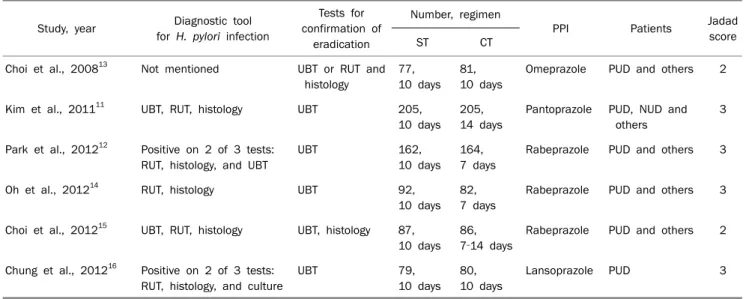
Table 1. Studies of the Efficacy of Sequential Therapy for Treatment of Helicobacter pylori Infection
Study, year Diagnostic tool for H. pylori infection
Tests for confirmation of
eradication
Number, regimen
PPI Patients Jadad
score
ST CT
Choi et al., 200813 Not mentioned UBT or RUT and histology
77, 10 days
81, 10 days
Omeprazole PUD and others 2
Kim et al., 201111 UBT, RUT, histology UBT 205,
10 days 205, 14 days
Pantoprazole PUD, NUD and others
3
Park et al., 201212 Positive on 2 of 3 tests:
RUT, histology, and UBT
UBT 162,
10 days 164, 7 days
Rabeprazole PUD and others 3
Oh et al., 201214 RUT, histology UBT 92,
10 days 82, 7 days
Rabeprazole PUD and others 3
Choi et al., 201215 UBT, RUT, histology UBT, histology 87, 10 days
86, 7‐14 days
Rabeprazole PUD and others 2
Chung et al., 201216 Positive on 2 of 3 tests:
RUT, histology, and culture
UBT 79,
10 days 80, 10 days
Lansoprazole PUD 3
Study design is open labeled.
ST, sequential therapy; CT, conventional triple therapy; PPI, proton pump inhibitor; UBT, urea breath test; RUT, rapid urease test; PUD, peptic ulcer disease; NUD, non-ulcer dyspepsia.
Among the first-line treatment options under development are sequential therapy (ST) regimens, which have shown high- er eradication rates than CT in several recent meta- analyses.7-9 Most clinical trials of sequential regimens have been performed in Italy, and few reports have originated from Asia. In contrast, a recent large-scale trial in Latin America showed that a 14-day CT had a 5.6% higher eradication rate than a 10-day ST.10 Prospective randomized studies have re- cently been conducted in Korea.11-16 Therefore, we performed a systematic literature review and meta-analysis of random- ized, controlled trials (RCTs) comparing these two treatment regimens in Korea to determine whether ST is superior to CT.
SUBJECTS AND METHODS
1. Search strategy and study selection
An article search was performed through December 2012 in PubMed using the following keywords: (Helicobacter pylori, sequential therapy, Korea). Reference lists from the selected trials were hand-searched to identify additional relevant trials. Among them, we enrolled only prospective, random- ized, published articles to ensure study quality, which was rat- ed by scores ranging from 1 to 5, with a higher score indicat- ing higher quality based on method of randomization, level of blinding, concealment of allocation, and accounting for withdrawal and dropouts.17 We considered RCTs with a score
≥2. We collected the year of publication, institution, num- bers of patients in the ST and CT groups; name, dose; length of treatment; methods of diagnosing infection and confirm- ing eradication; and method of data analysis (intention- to-treat [ITT] or per-protocol [PP] analysis) from each report.
2. Statistical analysis
We used Comprehensive Meta-Analysis software (version 2.0, Biostat Inc., Englewood, NJ, USA). The pooled ORs as well as the weighted pooled OR of the eradication rates of H. pylori for ST and CT arms were evaluated using the fixed effects model.
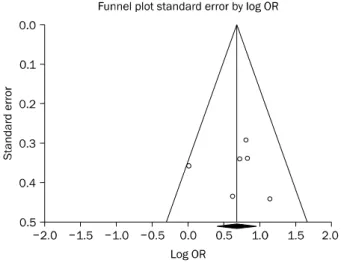
To evaluate a small study effect indicating potential pub- lication bias, we constructed a funnel plot for all examined outcomes (pooled ORs and eradication rates for the PP and ITT results). Egger’s regression intercept and Begg’s rank cor- relation tests were conducted to formally assess this asymmetry.18 We assessed the presence of publication bias by visually inspecting funnel plot asymmetry.
Cochran’s Q and I-squared tests were used to calculate the heterogeneity of the studies; fixed-effects model was used when statistical heterogeneity was not present.
RESULTS
1. Description of the studies
A total of 1,529 participants included in the six published
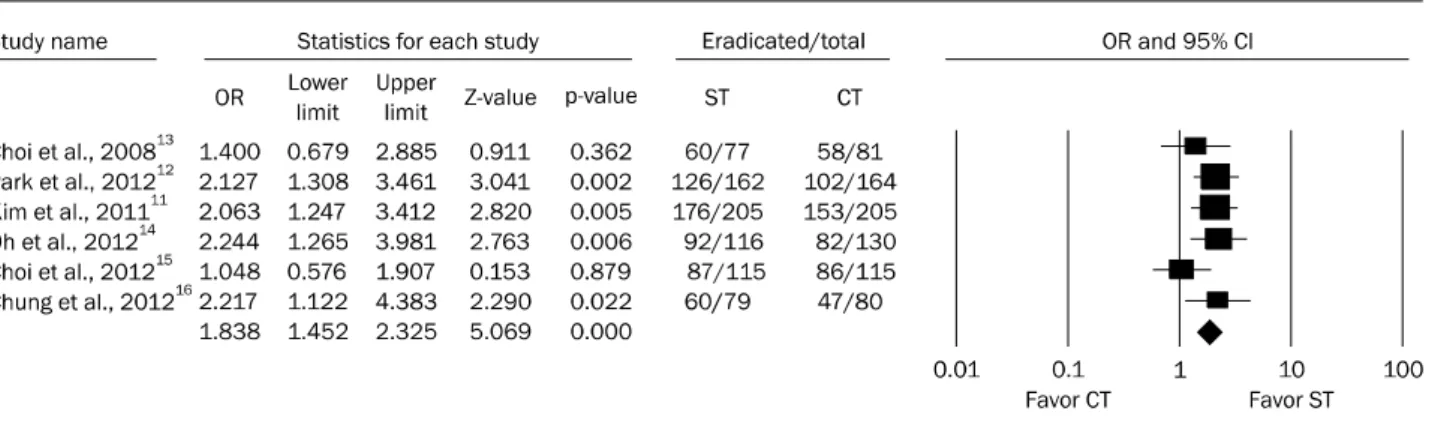
Fig. 1. Forest plot treated with sequential or triple therapy for intention-to-treat (ITT) eradication rate.
ST, sequential therapy; CT, conventional triple therapy.
Fig. 2. Forest plot treated with sequential or triple therapy for per-protocol (PP) eradication rate.
ST, sequential therapy; CT, conventional triple therapy.
studies met the inclusion criteria for this meta-analysis. All six studies were RCTs comparing ST vs. CT. All RCTs were open-la- beled studies. The characteristics and results of the 15 treat- ment arms (six studies) are summarized in Table 1.11-16 Treatment duration was 10 days for ST compared to 7-14 days for CT.
2. H. pylori eradication rates
The six trials compared ST vs. CT in 1,529 patients. In the ITT analysis, successful eradication with ST was achieved in 601 of 754 patients (pooled rate, 79.7%; 95% CI, 76.8- 82.5%) compared with 528 of 775 patients treated with CT (pooled rate, 68.1%; 95% CI, 64.8-71.4%). The OR was 1.838 (p<0.001) which demonstrated superiority of ST over CT therapy (Fig. 1). When examining the risk differences be- tween CT and ST, the results were also in favor of ST with a pooled risk difference of 11.5% in the ITT analysis. There was
no significant heterogeneity between trial results in ITT (Q-value: 5.235, p=0.38; I-square=4.49).
In the PP analysis, successful eradication with ST was ach- ieved in 589 of 682 patients (pooled rate, 86.4%; 95% CI, 83.3-88.5%) compared with 520 of 684 patients treated with CT (pooled rate, 76.0%; 95% CI, 72.8-79.2%). The OR was 1.974 (p<0.001) which demonstrated superiority of ST over CT (Fig. 2). Upon evaluation of the risk differences be- tween CT and ST, the results were also in favor of ST, with a pooled risk difference of 10.4% in the PP analysis. There was also no significant heterogeneity between trial results in PP (Q-value: 4.99, p=0.41; I-square=0.00) There was also no evidence of publication bias for all enrolled studies (Fig. 3).
3. Adverse events
The overall adverse event rates were similar in the CT and ST groups (19.2% vs. 22.3%, p=0.13) with a difference of
Fig. 3. Funnel plot of studies.
3.06% (95% CI, −7.12-1.01%). The pooled OR for side ef- fects was 1.18 (95% CI, 0.92-1.52; p=0.18).
DISCUSSION
Our data suggest that in Korea, ST is superior to CT. Our re- sults are consistent with previous meta-analyses in other countries.7,8 There was concern in early meta-analyses that most studies of ST had been performed in Italy. However, con- siderable data have accumulated in other countries. ST is now a better treatment option; therefore, the Maastricht IV guidelines and textbooks also recommend ST as first-line therapy if the local incidence of clarithromycin resistance is
>20%. We found pooled ITT and PP eradication rates in the ST arm of 79.7% and 86.4%, respectively. In both settings, ST was superior to ITT with approximately 10% higher eradication rate. In addition, ST is cost-effective because the relatively ex- pensive clarithromycin is used only in the short term. In our opinion, ST should be the first-line therapy in Korea. However, there is still a possibility that CT might be superior to CT de- pending on the duration of therapy although we could not per- form subgroup analysis due to the limited numbers. One study shows a better eradication rate of CT when the duration of therapy is extended.15 Further large scale studies are needed.
Despite the higher eradication rate, ST is associated with several problems. The first is whether ST does indeed result in a sufficient eradication rate. Although only one study by Kim et al.11 has reported that ST results in acceptable erad- ication rates, others12-14 have not. An pooled ITT analysis showed a <80% eradication rate (near unacceptable range)
in our meta-analysis,19 which is lower than in other meta- analyses.20,21 The main reason for this discrepancy may be the high prevalence of antibiotic resistance, particularly dual re- sistance to clarithromycin and metronidazole. In one study, a dual resistance rate of 9.6% was reported, which was almost double that in two Italian studies (5%, 4.3%, and 5.5%).22,23 In our pooled analysis, ITT was 79.7% and PP was 86.4%; thus, other first-line treatment options should be considered.18
These options are bismuth-containing quadruple therapy, and concomitant therapy or hybrid (dual-concomitant) therapy. A recent European study found that a three-in-one capsule containing bismuth subcitrate potassium, metroni- dazole, and tetracycline yielded a better eradication rate than CT, with a similar incidence of adverse events.24 However, no study in Korea has compared these therapies di- rectly up to now. Concomitant or hybrid (dual-concomitant:
PPI and amoxicillin for 7 days, followed by quadruple therapy with a PPI, amoxicillin, clarithromycin, and metronidazole for 7 days) regimen therapy is another option25-27 that shows a better rate of eradication of dual-resistant H. pylori stra- ins.25,26 Future studies are needed to determine which ther- apy is most appropriate in Korea.
The second concern is the lack of an appropriate sec- ond-line therapy after ST. ST is actually four drug therapies that combine three antibiotics (clarithromycin, amoxicillin, and metronidazole). In western countries, a levofloxacin- based regimen is used as a second-line therapy. However, this would not be ideal as a second-line therapy in Korea.
Patients have recently been reported to have markedly in- creased resistance (near 20%) to quinolone-based regi- mens.28,29 An alternative second-line regimen is the bis- muth-based quadruple therapy; however, more data are re- quired to determine its suitability as a second-line therapy in Korea. Another drawback of ST is its complex dosing sched- ule; the regimen is changed halfway through the day.
The third problem is that ST could raise the antibiotic re- sistance rate, especially metronidazole. As we mentioned earlier, ST is actually a four-drug therapy. Although ST could increase the first-line eradication, the metronidazole usage could also be increased.
In conclusion, we found that ST regimen yielded a higher H. pylori eradication rate than CT regimen as first-line treat- ment in Korea. However, more effective therapy should be developed. We insist that there should be a paradigm shift to
ST in H. pylori eradication in Korea considering the results presented in this meta-analysis.
REFERENCES
1. Hentschel E, Brandstätter G, Dragosics B, et al. Effect of raniti- dine and amoxicillin plus metronidazole on the eradication of Helicobacter pylori and the recurrence of duodenal ulcer. N Engl J Med 1993;328:308-312.
2. Chey WD, Wong BC; Practice Parameters Committee of the American College of Gastroenterology. American College of Gastroenterology guideline on the management of Helicobacter pylori infection. Am J Gastroenterol 2007;102:1808-1825.
3. Fock KM, Katelaris P, Sugano K, et al; Second Asia-Pacific Conference. Second Asia-Pacific Consensus Guidelines for Helicobacter pylori infection. J Gastroenterol Hepatol 2009;24:
1587-1600.
4. Malfertheiner P, Megraud F, O'Morain CA, et al; European Helicobacter Study Group. Management of Helicobacter pylori infection--the Maastricht IV/Florence Consensus Report. Gut 2012;61:646-664.
5. Kim N, Kim JJ, Choe YH, Kim HS, Kim JI, Chung IS; Korean College of Helicobacter and Upper Gastrointestinal Research; Korean Association of Gastroenterology. Diagnosis and treatment guidelines for Helicobacter pylori infection in Korea. Korean J Gastroenterol 2009;54:269-278.
6. Chung JW, Lee GH, Han JH, et al. The trends of one-week first-line and second-line eradication therapy for Helicobacter pylori in- fection in Korea. Hepatogastroenterology 2011;58:246-250.
7. Zullo A, De Francesco V, Hassan C, Morini S, Vaira D. The sequen- tial therapy regimen for Helicobacter pylori eradication: a pooled-data analysis. Gut 2007;56:1353-1357.
8. Gatta L, Vakil N, Leandro G, Di Mario F, Vaira D. Sequential ther- apy or triple therapy for Helicobacter pylori infection: systematic review and meta-analysis of randomized controlled trials in adults and children. Am J Gastroenterol 2009;104:3069-3079.
9. Jafri NS, Hornung CA, Howden CW. Meta-analysis: sequential therapy appears superior to standard therapy for Helicobacter pylori infection in patients naive to treatment. Ann Intern Med 2008;148:923-931.
10. Greenberg ER, Anderson GL, Morgan DR, et al. 14-day triple, 5-day concomitant, and 10-day sequential therapies for Helico- bacter pylori infection in seven Latin American sites: a rando- mised trial. Lancet 2011;378:507-514.
11. Kim YS, Kim SJ, Yoon JH, et al. Randomised clinical trial: the effi- cacy of a 10-day sequential therapy vs. a 14-day standard proton pump inhibitor-based triple therapy for Helicobacter pylori in Korea. Aliment Pharmacol Ther 2011;34:1098-1105.
12. Park HG, Jung MK, Jung JT, et al. Randomised clinical trial: a com- parative study of 10-day sequential therapy with 7-day standard triple therapy for Helicobacter pylori infection in naïve patients.
Aliment Pharmacol Ther 2012;35:56-65.
13. Choi WH, Park DI, Oh SJ, et al. Effectiveness of 10 day-sequential therapy for Helicobacter pylori eradication in Korea. Korean J Gastroenterol 2008;51:280-284.
14. Oh HS, Lee DH, Seo JY, et al. Ten-day sequential therapy is more effective than proton pump inhibitor-based therapy in Korea: a prospective, randomized study. J Gastroenterol Hepatol 2012;
27:504-509.
15. Choi HS, Chun HJ, Park SH, et al. Comparison of sequential and 7-, 10-, 14-d triple therapy for Helicobacter pylori infection.
World J Gastroenterol 2012;18:2377-2382.
16. Chung JW, Jung YK, Kim YJ, et al. Ten-day sequential versus triple therapy for Helicobacter pylori eradication: a prospective, open-label, randomized trial. J Gastroenterol Hepatol 2012;27:
1675-1680.
17. Jadad AR, Moore RA, Carroll D, et al. Assessing the quality of re- ports of randomized clinical trials: is blinding necessary? Control Clin Trials 1996;17:1-12.
18. Egger M, Davey Smith G, Schneider M, Minder C. Bias in meta-analysis detected by a simple, graphical test. BMJ 1997;
315:629-634.
19. Graham DY, Lu H, Yamaoka Y. A report card to grade Helicobacter pylori therapy. Helicobacter 2007;12:275-278.
20. Sirimontaporn N, Thong-Ngam D, Tumwasorn S, Mahachai V.
Ten-day sequential therapy of Helicobacter pylori infection in Thailand. Am J Gastroenterol 2010;105:1071-1075.
21. Sánchez-Delgado J, Calvet X, Bujanda L, Gisbert JP, Titó L, Castro M. Ten-day sequential treatment for Helicobacter pylori eradication in clinical practice. Am J Gastroenterol 2008;103:2220-2223.
22. Zullo A, Vaira D, Vakil N, et al. High eradication rates of Helicobacter pylori with a new sequential treatment. Aliment Pharmacol Ther 2003;17:719-726.
23. Vaira D, Zullo A, Vakil N, et al. Sequential therapy versus stand- ard triple-drug therapy for Helicobacter pylori eradication: a randomized trial. Ann Intern Med 2007;146:556-563.
24. Malfertheiner P, Bazzoli F, Delchier JC, et al; Pylera Study Group.
Helicobacter pylori eradication with a capsule containing bis- muth subcitrate potassium, metronidazole, and tetracycline giv- en with omeprazole versus clarithromycin-based triple therapy:
a randomised, open-label, non-inferiority, phase 3 trial. Lancet 2011;377:905-913.
25. Wu DC, Hsu PI, Wu JY, et al. Sequential and concomitant therapy with four drugs is equally effective for eradication of H pylori infection. Clin Gastroenterol Hepatol 2010;8:36-41.
26. Hsu PI, Wu DC, Wu JY, Graham DY. Modified sequential Helicobacter pylori therapy: proton pump inhibitor and amox- icillin for 14 days with clarithromycin and metronidazole added as a quadruple (hybrid) therapy for the final 7 days. Helicobacter 2011;16:139-145.
27. Chuah SK, Tsay FW, Hsu PI, Wu DC. A new look at anti-Helico- bacter pylori therapy. World J Gastroenterol 2011;17:3971- 3975.
28. Kim JM, Kim JS, Jung HC, Kim N, Kim YJ, Song IS. Distribution of antibiotic MICs for Helicobacter pylori strains over a 16-year period in patients from Seoul, South Korea. Antimicrob Agents Chemother 2004;48:4843-4847.
29. Chung JW, Lee GH, Jeong JY, et al. Resistance of Helicobacter py- lori strains to antibiotics in Korea with a focus on fluoroquinolone resistance. J Gastroenterol Hepatol 2012;27:493-497.