식물생장촉진
Bacillus
sp. SB19 균주의 케일 처리에 대한 가뭄 스트레스 완화 효과*
1)
김다연**․이상엽**․김정준**․한지희***
Mitigation Effect of Drought Stress by Plant Growth-promoting Bacterium Bacillus sp. SB19 on Kale Seedlings in Greenhouse
Kim, Dayeon․Lee, Sang-Yeob․Kim, Jung-Jun․Han, Ji-Hee
Drought stress is a major agricultural limitation to crop productivity worldwide, especially by which leafy vegetables, plant leaves eaten as vegetable, could be more lethal. The study was carried out to know the effect of drought tolerance plant growth promoting bacteria (PGPB) on water stress of kale seedlings. A total of 146 morphologically distinct bacterial colonies were isolated from bulk soil and rhizosphere soil of leafy vegetables and screened for plant growth promoting microbioassay in greenhouse. Out of them the isolate SB19 significantly promoted the growth of kale seedlings in increasement of about 42% of plant height (14.1
㎝), 148% of leaf area (19.0 ㎠) and 138% of shoot fresh weight (1662.5 ㎎) attained by the bacterially treated plants compared to distilled water treated control (9.9 ㎝, 7.7 ㎠, 698.8 ㎎). Shoot water content of SB19 treated kale seedlings (1393.8 ㎎) was also increased about 152% compared with control (552.5 ㎎). The SB19 isolated from bulk soil of kale plant in Iksan, Korea, was identified as species of Bacillus based on 16S rRNA gene sequencing analysis. We evaluated the effect of drought tolerance by the Bacillus sp. SB19 on kale seedlings at 7th and 14th days following the onset of the water stress and watering was only at 7th day in the middle of test. In the survey of 7th and 14th day, there were mitigation effect of drought stress in kale seedlings treated with 106 and 107 cell mL-1 of SB19 compared to distilled water treated control. Especially, there were more effective mitigation of drought damage in kale seedlings treated with 107 cell mL-1 than 106 cell mL-1. Further, although drought injury of bacterially treated kale seedlings were not improved at 14th day compared with 7th day, drought injury of
***본 연구는 농촌진흥청 국립농업과학원 연구과제(과제번호 : PJ01004904)에 의해 수행되었습니다.
***농촌진흥청 국립농업과학원
***Corresponding author, 농촌진흥청 국립농업과학원, +82-63-238-3052([email protected])
107 cell mL-1 of SB19 treated kale seedlings were not happen rapidly but devel- oped over a longer period of time than 106 cell mL-1 of SB19 or control. The diffidence of results might be caused by the concentration of bacterial suspension.
This study suggests that beneficial plant-microbe interaction could be a important role of enhancement of water availability and also provide a good method for improving quality of leafy vegetables under water stress conditions.
Key words : Bacillus sp., drought stress resistance, leafy vegetable, plant growth promotion
Ⅰ. 서 론
가뭄은 식물의 생장과 발달을 저해하는 비생물적 스트레스 중 하나로 농업의 생산성을 제한하는 주요 원인으로 작용한다(Sandhya et al., 2009). 가뭄은 식물대사와 생장 뿐 아니라 식물 유전자의 발현 패턴까지 변화시켜 많은 생리 화학적 활동 및 생존에도 영향을 미친다 고 알려져 있다(Gan, 2008). 가뭄으로 인한 식물 피해는 냉해(frost injury)처럼 갑자기 발생 하는 것이 아니라 서서히 진행되다가 점점 강도가 증가하고 오래 지속되며 나타난다 (DaMatta and Ramalho, 2006). 식물이 가뭄 스트레스에 노출되면 점차적으로 잎의 노화가 유도되기 때문이다(Gan, 2008). 가뭄 스트레스에 의해 식물 잎의 내생적 cytokinin 함량이 감소하고 abscisic acid 함량이 증가되면서 기공 폐쇄가 빠르게 일어나 증산작용에 의한 식 물 수분 손실이 감소된다. 또한 기공 폐쇄에 의해 이산화탄소 이용률이 감소되어 광합성이 억제된다. 수분 스트레스가 더 지속되고 악화되면 잎은 광합성을 하지 않는 비생산적인 부 위일 뿐이므로 탈리가 진행된다(Munné-Bosch and Alegre, 2004; Figueiredo et al., 2008;
Selvakumar et al., 2012). 광합성이 억제된 식물 내에서는 산소가 전자와 반응하면서 강한 독성을 가지는 활성산소종(ROS; reactive oxygen species)이 과다하게 형성되는데 ROS는 세 포막의 지질과산화와 식물 뿌리에서 질산동화작용 억제 등 산화 스트레스를 일으킨다 (Mittler and Zilinskas, 1994; Sgherri et al., 2000; Caravaca et al., 2005). 신선한 잎을 재배하여 섭취하는 쌈채소(leafy vegetables)의 경우 가뭄에 의한 이러한 작용은 생산성을 감소시키는 원인이 된다. 특히 여름철에는 높은 일사량과 고온에 의해 수분 부족 스트레스가 악화되기 때문에 뿌리나 열매를 재배하는 다른 농작물에 비해 쌈채소는 가뭄에 더 치명적일 수 있다 (DaMatta et al., 2003).
유용미생물과 식물의 상호작용으로 식물 영양이 향상되고 가뭄, 저온, 염류 및 중금속 오 염과 같은 비생물적 스트레스에 대한 식물의 저항성도 증대되는 것으로 알려져 있다(Prasad et al., 2016). 식물생장촉진세균(PGPB; plant growth-promoting bacteria)은 식물의 근권과 토 양에 존재하는 유용한 미생물로서 질소 고정, 불용성 인의 가용화, 식물호르몬 합성, sidero-
phores 생성, antibiotics, lytic enzymes, hydrogen cyanide 생산, 양분 경쟁을 통한 식물병원균 의 방제 등 식물의 생장을 직 ․ 간접적인 방식으로 향상시킨다(Juanda, 2005; Sayyed et al., 2007; Ahmad et al., 2008; Sayyed and Chincholkar, 2009; Kim et al., 2012; Nautiyal et al., 2013). 최근 연구에서는 가뭄 조건 하에서 PGPB 처리구의 식물 생장이 무처리구에 비해 증 가하여, PGPB가 가뭄 스트레스 극복을 돕는 좋은 방안이 될 수 있는 가능성을 시사하였다 (Mayak et al., 2004; Kasim et al., 2013; Seo and Song, 2013; Vurukonda et al., 2016). PGPB에 의한 식물의 가뭄 스트레스 영향을 완화시키는 방법으로는 여러 가지가 있다. 미생물이 생 산하는 유용 물질에 의해 식물에 스트레스 내성이 유도되고(induced systemic tolerance) 당 과 oligopolysaccharide를 함유하는 생물막을 형성하여 미생물과 식물의 상호작용에 의한 뿌 리 표면에서의 물 가용성이 증진되는 방식으로 이루어진다. 또한 미생물이 abscisic acid, gibberellic acid, cytokinin, auxin 등과 같은 식물 호르몬을 생산하거나 식물의 ethylene 함량 을 감소시키는 1-aminocyclopropane-1-carboxylate (ACC) deaminase을 생산하여 이루어진다 (Chang et al., 2007; Cho et al., 2008; Yang et al., 2009; Nadeem et al., 2014). Ethylene은 열매 의 숙성 촉진 등 식물이 성숙하는 동안에 만들어지지만 가뭄, 고온 등 외부 스트레스에 의 해서도 생성되어 식물의 생장을 저해하고 노화를 촉진하기 때문에 ‘stress ethylene’이라고도 한다(Ableles and Abeles, 1972). PGPB에 의해 식물 뿌리 내의 ethylene 발생 수준을 낮춤으 로서 스트레스 환경 하의 식물 생장을 지속시킨다(Glick et al., 1998). 여러 연구에서 PGPB 를 가뭄 조건에서 식물에 접종했을 때 가뭄 내성이 향상되었는데 미생물이 생산하는 ACC deaminase 작용에 의해 ‘stress ethylene’ 생산이 감소하였고 early response to dehydration 15 (ERD15) 유전자의 발현이 증가하였다(Kiyosue et al., 1994; Glick et al., 1998; Timmusk and Wagner, 1999).
본 연구에서는 식물생장촉진 균주를 온실 생물검정으로 선발하였고, 선발한 균주를 식물 에 접종했을 때 가뭄 조건 하에서 수분 부족 환경을 극복하고 식물의 가뭄 피해를 경감시 키는 효과를 나타내는지에 대하여 실험하였다.
Ⅱ. 재료 및 방법
1. 균주의 분리 및 배양케일, 적상추, 치커리와 샐러리 재배지의 토양 및 근권 토양으로부터 균주를 분리하였다.
토양 시료 1 g을 멸균수 9 mL에 희석한 현탁액(10-1~10-6 g mL-1) 100 µL를 Tryptic Soy Agar (TSA; Difco, USA) 배지에 도말하여 28℃에서 48시간 동안 배양하면서 색과 형태의 차이를 보이는 균주의 단일 콜로니를 분리하였다. 순수 분리한 146개의 균주는 생육촉진 생물검정
및 동정을 위해 20% Glycerol에 현탁하여 -70℃에서 보존하였다.
분리 균주를 Tryptic Soy Broth (TSB; Difco, USA)에 접종하여 28℃, 180 rpm 조건으로 48 시간 배양하였다. 배양액을 8000 rpm 으로 15분 간 원심분리한 후 상층액을 제거하여 균체 를 수거하였다. 수거된 균체는 멸균수로 107 cell mL-1 농도로 희석하여 준비하였다.
2. 케일 생육촉진균주의 선발
BM6 상토(Berger Peat Moss, Canada)를 담은 32공 사각포트(1공 당 상토 소요량; 125 mL) 에 케일(Brassica oleracea var. alboglabra Bailey)을 파종하였다(n=8). 케일 파종 7일 후 준비 한 균주 현탁액을 포트 당 50 mL씩 1회 관주 처리하였고 무처리구에는 증류수를 50 mL 처 리하였다. 균주 처리 2주 후 케일의 생육을 조사하였다. 생육 조사는 초장(㎝), 근장(㎝), 엽 폭(㎝), 엽장(㎝), 최대엽면적(㎠), 지상부 생체중(㎎), 뿌리 생체중(㎎), 지상부 건물중(㎎), 뿌리 건물중(㎎)을 대상으로 하였다. 조사 항목 중에서 엽장, 엽폭, 최대엽면적은 엽장 및 엽폭의 길이가 가장 큰 엽을 조사하였다. 2차 균주 선발에서는 바로커 상토(Seoul Bio, Korea) 를 사용하여 1차 균주 선발과 같은 방법으로 포트 검정하였다. 생육 조사 결과의 평균값 간 유의차 검증은 분산분석한 후 α=0.05 수준에서 던칸 다중검정하였다.
3. 내건성 검정
파종한 지 7일이 지난 케일에 균주 현탁액을 106 cell mL-1 및 107 cell mL-1 농도로 1회 관 주 처리하였고 무처리구에는 증류수를 같은 양 관주하였다(n=12). 균주 처리일로부터 10일 후부터 7일 동안 관수하지 않고 수분 스트레스를 주었고 7일째에 피해도를 조사하였다. 조 사 직후 모든 처리구에 포트 당 증류수 50 mL씩 관수하고 다시 7일 동안 수분 스트레스를 준 후 균주 처리일로부터 14일째에 피해도를 조사하였다. 내건성 증진 효과는 Table 1을 기 준으로 피해의 범위를 0~5단계로 나누어 조사하였다. 조사 결과는 다음 계산식 (1)에 의해 결과 값을 %로 환산하였으며 가뭄 피해를 받지 않고 건강한 식물의 피해도는 0%, 고사한 식물의 피해도는 100%로 나타내었다.
Table 1. Severity scale of drought stress injury and extent of damage
Severity scale of drought stress injury Extent of damage
0 healthy
1 1-10% damage
2 11-25% damage
×
×
×
×
×
× × × × × ×
×
(1)
4. 선발 균주의 DNA 추출 및 16S rRNA 유전자 분석
선발 균주를 동정하기 위해 16S rRNA 유전자를 분석하였다. 균주 SB19를 TSB에 접종하 고 28℃에서 30시간 배양한 후 원심 분리하여 균체를 수확하였다. DNA extraction kit (QIAGEN, USA)로 제조사의 매뉴얼에 따라 균주의 genomic DNA를 추출하였다. 16S rRNA 유전자를 증폭하기 위해 27F (5’-GAGTTTGMTCCTGGCTCAG-3’), 1492R (5’-ACGGYTACC TTGTTACGACTT-3’) (M은 A 또는 C, Y는 C 또는 T을 나타냄) 프라이머를 이용하여 (Weisburg et al., 1991) 95℃에서 5분 동안 열을 가한 후, 95℃에서 1분, 55℃에서 1분, 72℃
에서 1분 30초 동안 30회 반응 및 72℃에서 10분 동안 반응시켰다. 증폭된 PCR 산물은 전 기영동 분석으로 길이를 확인한 후 Genotech Co. (Korea)에 염기서열 분석을 의뢰하였다.
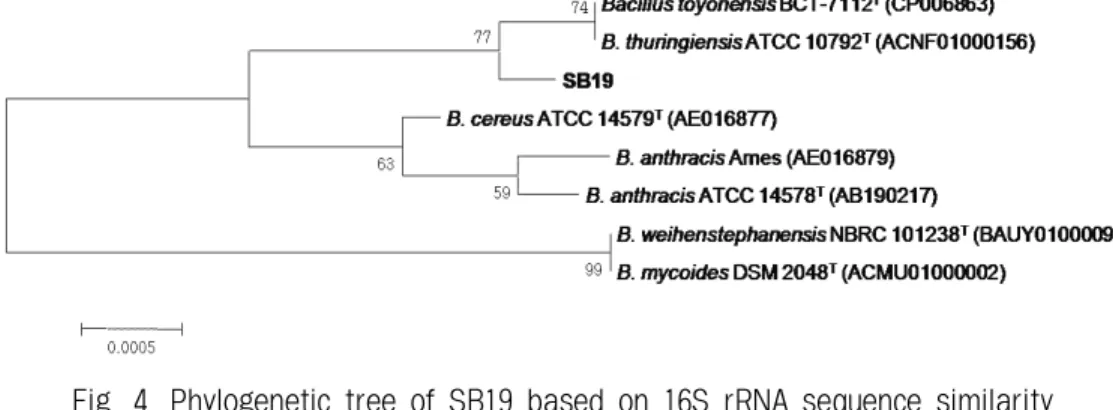
균주의 염기서열은 MEGA 6.06 프로그램을 이용하여 정렬하였고, neighbor-joining 알고리즘 을 사용하여 계통도를 작성하였다(Bootstrapping 1000회 반복).
Ⅲ. 결과 및 고찰
1. 케일 생육촉진균주의 선발쌈채 재배 토양으로부터 분리한 총 146균주의 케일에 대한 생육촉진 효과를 포트 검정한 결과, 12균주의 처리구에서 초장, 엽장, 엽폭, 생체중 값이 무처리구와 비교하여 높은 것으
Severity scale of drought stress injury Extent of damage
3 26-50% damage
4 51-80% damage
5 >80% damage or death
로 조사되었고 지상부 생체중 값이 큰 순서대로 6균주를 1차 선발하였다(Table 2; Fig. 1).
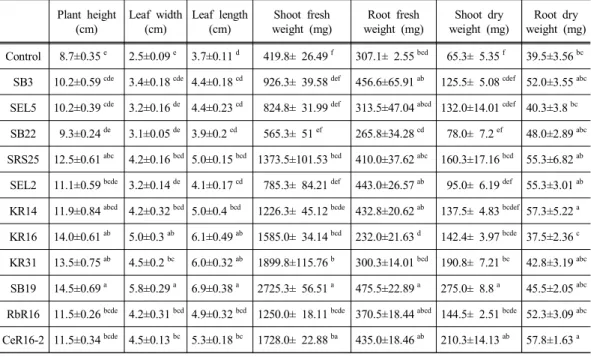
선발한 6균주(SRS25, KR16, KR31, SB19, RbR16, CeR16-2) 처리구는 무처리구와 비교하여 초장은 각각 43.1%, 60.3%, 54.9%, 66.7%, 31.9%, 32.2% 증가하였고, 엽폭은 각각 69.0%, 100.0%, 79.0%, 130.0%, 69.0%, 79.0% 증가하였으며, 엽장은 각각 35.4%, 66.0%, 62.6%, 86.4%, 33.3%, 44.9% 증가하였다. 또한 지상부 생체중은 각각 227.2%, 277.6%, 352.6%, 549.3%, 197.8%, 311.7%로 모두 증가하였다.
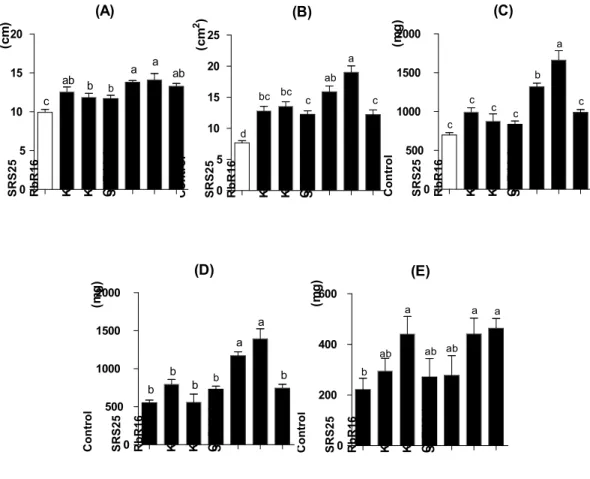
1차 선발된 6 균주를 대상으로 한 2차 균주 선발 결과 모든 처리구에서 생육 촉진 효과 가 나타났다. SRS25, KR16, KR31, SB19, RbR16, CeR16-2 처리구에서는 무처리구와 비교하 여 초장은 각각 26.7%, 17.7%, 39.0%, 42.2%, 19.7%, 33.8% 증가하였고, 최대엽면적은 각각 67.1%, 59.6%, 107.0%, 147.9%, 76.5%, 59.0% 증가하였으며, 지상부 생체중은 각각 42.2%, 19.9%, 88.7%, 138.0%, 25.6%, 41.9% 증가하였다(Fig. 2). Bacillus에 의한 식물생육촉진 활성 은 여러 연구에서도 보고되었다(Kloepper et al., 2004; Kumar et al., 2011; Nautiyal et al., 2013). Kwon 등(2007)은 Bacillus subtilis 균주를 107 cell mL-1 농도로 상추에 처리했을 때 무 처리 대비 균주 처리구의 생체중이 15.4% 증가하였으며 균주로부터 IAA (indole acetic acid) 생성을 확인하였다고 보고하였다. 미생물에 의해 생성되는 식물생육촉진 물질은 IAA와 gibberellic acid 등 식물호르몬 이외에도 siderophore 생산, 질소 고정 등 다양하게 보고되어 있으며, 본 연구에서 이용된 분리 균주에 의한 식물생육촉진 활성 기작에 대해서는 추후 연구가 필요할 것으로 판단된다(Ahmad et al., 2008; Sayyed and Chincholkar, 2009).
Table 2. Plant growth promotion effect of selected strains on kale seedlings Plant height
(cm)
Leaf width (cm)
Leaf length (cm)
Shoot fresh weight (mg)
Root fresh weight (mg)
Shoot dry weight (mg)
Root dry weight (mg) Control 8.7±0.35e 2.5±0.09e 3.7±0.11d 419.8± 26.49f 307.1± 2.55bcd 65.3± 5.35f 39.5±3.56bc SB3 10.2±0.59cde 3.4±0.18cde 4.4±0.18cd 926.3± 39.58def 456.6±65.91ab 125.5± 5.08cdef 52.0±3.55abc SEL5 10.2±0.39cde 3.2±0.16de 4.4±0.23cd 824.8± 31.99def 313.5±47.04abcd 132.0±14.01cdef 40.3±3.8bc SB22 9.3±0.24de 3.1±0.05de 3.9±0.2cd 565.3± 51ef 265.8±34.28cd 78.0± 7.2ef 48.0±2.89abc SRS25 12.5±0.61abc 4.2±0.16bcd 5.0±0.15bcd 1373.5±101.53bcd 410.0±37.62abc 160.3±17.16bcd 55.3±6.82ab
SEL2 11.1±0.59bcde 3.2±0.14de 4.1±0.17cd 785.3± 84.21def 443.0±26.57ab 95.0± 6.19def 55.3±3.01ab KR14 11.9±0.84abcd 4.2±0.32bcd 5.0±0.4bcd 1226.3± 45.12bcde 432.8±20.62ab 137.5± 4.83bcdef 57.3±5.22a KR16 14.0±0.61ab 5.0±0.3ab 6.1±0.49ab 1585.0± 34.14bcd 232.0±21.63d 142.4± 3.97bcde 37.5±2.36c KR31 13.5±0.75ab 4.5±0.2bc 6.0±0.32ab 1899.8±115.76b 300.3±14.01bcd 190.8± 7.21bc 42.8±3.19abc SB19 14.5±0.69a 5.8±0.29a 6.9±0.38a 2725.3± 56.51a 475.5±22.89a 275.0± 8.8a 45.5±2.05abc RbR16 11.5±0.26bcde 4.2±0.31bcd 4.9±0.32bcd 1250.0± 18.11bcde 370.5±18.44abcd 144.5± 2.51bcde 52.3±3.09abc CeR16-2 11.5±0.34bcde 4.5±0.13bc 5.3±0.18bc 1728.0± 22.88ba 435.0±18.46ab 210.3±14.13ab 57.8±1.63a
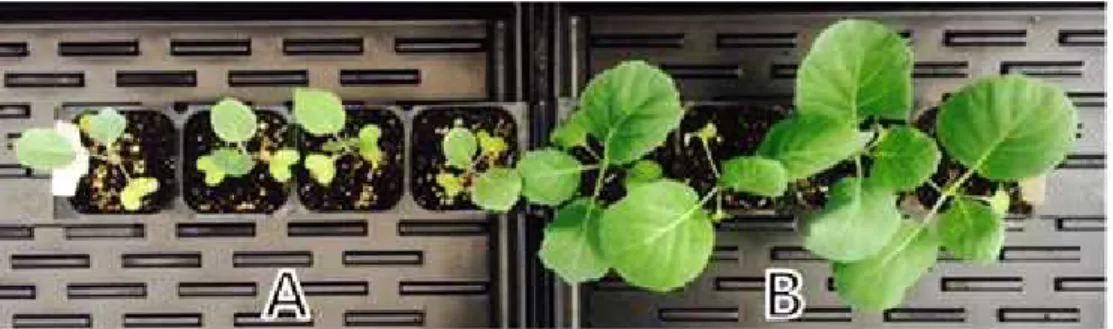
Fig. 1. Effect on growth promotion of kale seedlings by treatment of microorganisms.
(A) Distilled water treated control and (B) SB19.
2차 균주 선발 결과, 무처리구 대비 균주 처리구의 케일 생육은 1차 균주 선발 결과에 비 해 감소하였다. BM6 상토를 이용한 1차 균주 선발에서 무처리구의 초장은 8.7 ㎝, 지상부 생체중은 419.8 ㎎, 바로커 상토를 이용한 2차 균주 선발에서는 무처리구의 초장이 9.9 ㎝, 지상부 생체중 698.6 ㎎으로 케일의 무처리구 생육은 바로커 상토에서 더 양호하였지만, 균 주 처리구의 생육촉진 활성은 BM6 상토에서 대체적으로 더 크게 나타났기 때문이다. 또한 SRS25를 제외한 나머지 5균주 처리구(KR16, KR31, SB19, RbR16, CeR16-2)는 BM6 상토에 서 생육촉진 활성이 바로커 상토보다 크게 나타났지만, 뿌리 생체중은 BM6 상토보다 바로 커 상토에서 더 양호하였다(Table 3). 배수 조건, 유기물 함량, pH 등 토양의 특성에 따라 작물생육 뿐만 아니라 미생물에 의한 식물 생육촉진 활성에 차이가 있다고 알려져 있다 (Toledo et al., 1988; Gholami et al., 2009; Smirnova et al., 2016). 따라서 생물 검정으로 식물 생육촉진 균주를 선발하고자 할 때에는 물리 ․ 화학적 특성이 다른 여러 조건의 토양을 대 상으로 하는 것이 바람직하다고 판단된다.
Table 3. Growth promotion comparison with two different soil conditions Soil
condition Treatment
Plant height (cm) Shoot fresh weight (mg) Root fresh weight (mg)
BM6 Baroker BM6 Baroker BM6 Baroker
Control 8.7±0.35b 9.9±0.35c 419.8± 26.49c 698.8±28.91c 307.1± 2.55bc 277.5±20.82b SRS25 12.5±0.61a 12.6±0.58ab 1373.5±101.53b 993.8±52.56bc 410.0±37.62ab 350.0±36.57b KR16 14.0±0.61a 11.7±0.42bc 1585.0± 34.14b 837.5±39.68c 232.0±21.63c 357.5±45.37b KR31 13.5±0.75a 13.8±0.22a 1899.8±115.76ab 1318.8±43.89ab 300.3±14.01bc 360.0±36.66b SB19 14.5±0.69a 14.1±0.76a 2725.3± 56.51a 1662.5±113.26a 475.5±22.89a 486.3±54.80a RbR16 11.5±0.26ab 11.9±0.47b 1250.0± 18.11bc 877.5±87.55c 370.5±18.44ab 545.0±27.89a CeR16-2 11.5±0.34ab 13.3±0.34ab 1728.0± 22.88b 991.3±32.66bc 435.0±18.46ab 500.0±35.58a
케일 지상부의 수분함량은 KR31 균주 처리구와 SB19 균주 처리구에서 유의하게 높았으며 뿌리의 수분함량은 RbR16, SB19, CeR16-2 처리구에서 유의하게 높았다. 결과적으로, 무처리 구와 비교하여 초장, 엽면적, 생체중 및 수분함량 값이 각각 42.19%, 147.86%, 137.92%, 152.26
% 유의하게 증가하여 생육촉진 효과가 가장 크게 나타난 SB19 균주를 최종 선발하였다.
(A)
Control SRS25 RbR16 KR16 KR31 SB19CeR16-2
0 5 10 15 20
ab b b
a a ab c
(cm)
(B)
Control SRS25 RbR16 KR16 KR31 SB19CeR16-2
0 5 10 15 20 25
ab c a
bc bc c
d
(cm2 )
(C)
Control SRS25 RbR16 KR16 KR31 SB19CeR16-2
0 500 1000 1500 2000
c c
c b
a
c c
(mg)
(D)
Control SRS25 RbR16 KR16 KR31 SB19CeR16-2
0 500 1000 1500 2000
b b b
a b a
b
(mg) (E)
Control SRS25 RbR16 KR16 KR31 SB19CeR16-2
0 200 400 600
ab a a
ab a
ab b
(mg)
Fig. 2. Plant growth promotion on kale seedlings treated 50 mL of 107 cell mL-1 microor- ganisms per kale seedling.
(A) Plant height (㎝) (B) Leaf area (㎠) (C) Shoot fresh weight (㎎) (D) Shoot water content (㎎) and (E) Root water content (㎎). Means± standard error (n=8) are presented as bars, which show how the data are spread. Bars with lowercase letters are significantly different between treatments; p < 0.05 using Duncan's multiple range test.
2. 내건성 검정
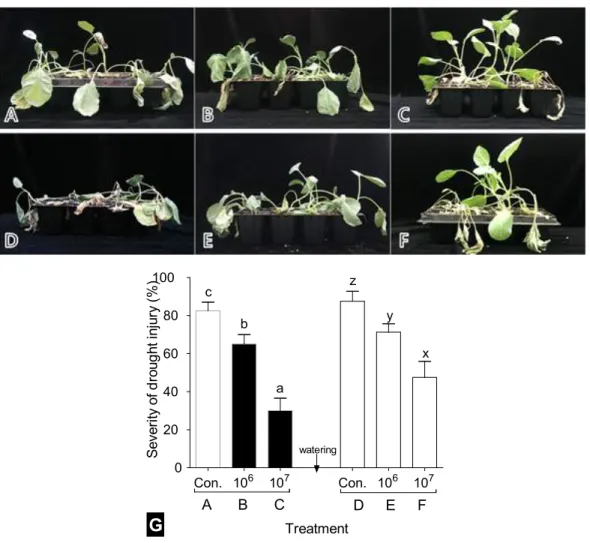
가뭄 조건 하에서 케일에 생육촉진 균주를 처리했을 때 수분 스트레스 극복 효과가 있는 지 알아보기 위해 수행하였다. SB19 균주 처리에 의한 케일의 내건성을 검정한 결과, 106와 107 cell mL-1 농도의 SB19 균주 현탁액을 처리하였을 때 무처리와 비교하여 내건성 증진 효과가 있었다(Fig. 3). 균주 처리 후 7일째에 무처리구의 피해도는 82.5%에 달한 반면 106 와 107 cell mL-1 SB19 균주 처리구의 피해도는 각각 65%, 30%로 무처리와 비교하여 내건 성이 증진된 것으로 나타났다. 균주 처리 후 14일째 무처리구의 피해도는 87.5%에 달하였 고 106와 107 cell mL-1 SB19 균주 처리구는 각각 71.3%, 47.5%로 7일째 보다는 피해가 증가 하였지만, 무처리구와 비교하여 균주 처리구에서 케일에 대한 가뭄 피해가 경감된 것을 관 찰할 수 있었다. 처리 농도에 따른 가뭄피해 경감 효과는 가뭄 스트레스 유발 후 7일째, 14 일째 모두 106 cell mL-1 처리구보다 107 cell mL-1 처리구에서 우수하였다.
가뭄 스트레스 유발 후 7일째가 될 때까지 SB19 균주의 106 cell mL-1 농도에서 수분 부 족에 의한 피해가 더 빠르게 발생하였기 때문에 초기에는 107 cell mL-1 농도에서 가뭄 스트 레스 극복에 더 효과적인 것으로 보인다. 또한 7일째와 14일째 조사 결과를 보았을 때 농도 106 cell mL-1에서 가뭄에 의한 피해도가 무처리와 비교하여 모두 유의하게 적으므로, 107 cell mL-1 농도보다는 덜 효과적이지만 106 cell mL-1 농도에서도 수분 부족 스트레스를 극복 하는데 효과가 있는 것으로 보인다. 따라서 SB19 균주의 처리는 식물 생장을 향상시키는 동시에 수분 부족으로 유도되는 케일의 노화를 억제하여 가뭄 스트레스 경감에 효과가 있 는 것으로 판단된다.
Mayak 등(2004)은 ACC deaminase를 합성하는 식물생육촉진 균주를 토양에서 선발하여 식물에 처리하고 가뭄 스트레스를 준 뒤 12일째에 관수하고 다시 가뭄 스트레스를 준 5일 뒤에 식물 생육을 조사하였다. 그 결과 무처리구의 생체중은 증가하지 않은 반면 균주 처 리구에서는 생체중이 계속 증가하였으며, 가뭄 조건 이후 관수했을 때 균주 처리구에서 수 분함량이 가장 많이 증가하였다고 하였다. 본 연구에서 SB19 균주 처리구의 수분함량이 무 처리구와 비교하여 유의하게 높고, 가뭄 조건 이후 관수하였을 때 수분 부족 스트레스 극 복 효과가 균주 처리구에서 더 높았다는 결과와 일치하였다. Seo와 Song (2013)의 연구에서 도 가뭄 조건 하에서 ACC deaminase 합성 균주를 처리했을 때 7일 후 토마토 유묘의 뿌리 신장을 35% 증가시켜 ACC deaminase 활성이 가뭄 스트레스에 노출된 식물에 작용해 뿌리 생장을 촉진한 것으로 보인다고 보고하였다. 여러 연구 결과에서 볼 때 균주에서 생성되는 ACC deaminase가 가뭄 조건에서 식물의 물 이용률을 높여 내건성을 향상하는데 일조하는 것으로 판단된다. 그러므로 본 연구에서 선발한 SB19 균주는 ACC deaminase 생성능을 지 닌 식물생육촉진 균주로서 식물의 내건성 향상에 도움을 주는지에 대해 추후 연구가 더 필 요하다.
Con. 106 107 Con. 106 107 0
20 40 60 80 100
b
a
z y
x c
A B C D E F
watering
G
TreatmentSeverity of drought injury (%)
Fig. 3. Drought tolerance test on kale seedlings.
(A, D) Distilled water treated control (B, E) 106 cell mL-1 of SB19 (C,F) 107 cell mL-1 of SB19. (A~C) 7 days after drought and (D~F) 14 days after drought. (G) Means ± standard error (n=12) are presented as bars, which show how the data are spread. Bars with lowercase letters are significantly different between treatments; p<0.05 using Duncan's multiple range test.
3. 선발 균주의 DNA 추출 및 16S rRNA 유전자 분석
최종 선발 균주 SB19의 16S rRNA 유전자 염기서열을 바탕으로 분자계통도를 작성한 결 과 SB19 균주는 Bacillus 속의 여러 균주들과 가까운 근연관계에 속하며, B. thuringiensis ATCC 10792T, B. toyonensis BCT-7112T 균주와 가장 높은 상동성(각각 99.93%)을 보이는 것으로 확인되었다(Fig. 4). 계통도의 안정성을 나타내는 Bootstrap 값도 77%로 비교적 높은 것으로 나타났다. 그러나 정확한 종 동정을 위해서는 여러 가지 생리 생화학적 검사와 비 교 균주들과의 DNA-DNA 상동성 검사가 필요하다(Wayne et al., 1987). B. thuringiensis 균주
는 식물 및 토양에 자연적으로 흔하게 존재하는 미생물로서 주로 bio-insecticide로 잘 알려 져 있지만 최근 연구를 통해 높은 식물생육촉진효과와 항균효과에 의한 식물병 억제능 및 수분 부족 스트레스 극복에도 효과가 있는 것으로 보고되고 있다(Hyakumachi et al., 2013;
Prudent et al., 2015; Armada et al., 2016). Bacillus sp. SB19 균주의 이러한 분류학적 위치는 계통유전학적으로도 높은 생육촉진 및 환경내성 활성을 보유하고 있음을 뒷받침하고 있다.
Fig. 4. Phylogenetic tree of SB19 based on 16S rRNA sequence similarity.
Branching values determined using 1000 bootstraps.
Ⅳ. 적 요
가뭄은 농작물의 생산성을 저해하는 주요 원인 중 하나이며, 잎을 먹는 쌈채류의 경우 물 부족 스트레스에 더 치명적일 수 있다. 본 연구는 케일 유묘에 대한 식물생육촉진 균주 (PGPB)의 가뭄 내성 효과를 알아보기 위해 수행되었다. 쌈채류의 토양 및 근권 토양으로부 터 형태학적으로 구분되는 146개의 콜로니를 분리하고 온실 생물검정을 통해 케일 생육촉 진이 우수한 균주 SB19를 최종 선발하였다. SB19 균주는 케일 재배 토양으로부터 분리하 였으며 16S rRNA 유전자 염기서열 분석 결과 Bacillus sp.로 확인되었다. Bacillus sp. SB19 균주를 처리한 케일에 7일 간 수분 부족 스트레스를 유도하고 7일째에 가뭄 피해 조사 후 모든 처리구에 1회 관수하였다. 이후 다시 7일 간 수분 부족 스트레스를 주어 14일째에 케 일의 내건성 증진 여부를 조사하였다. 가뭄 조건 7일째에 106와 107 cell mL-1 농도의 SB19 균주를 처리한 케일에서 무처리와 비교하여 가뭄 스트레스 경감 효과를 보였다. 7일째에 모든 처리구에 관수 후 다시 가뭄 스트레스를 주었을 때에도 106와 107 cell mL-1 농도의 SB19 균주 처리구에서 무처리구와 비교하여 가뭄 피해 경감 효과가 있었으며, 7일째와 14 일째 모두에서 107 cell mL-1 농도의 SB19 균주 처리구에서 가뭄 피해의 완화 정도가 가장 효과적인 것으로 나타났다. 106 cell mL-1 SB19 균주 처리구에서는 물 부족으로 인한 잎의
노화가 107 cell mL-1 농도 처리구에 비해 빠르게 발생하였다. 본 연구 결과를 바탕으로 유 용 미생물과 식물의 상호작용이 식물의 물 이용률을 증진시키는 중요한 역할을 하고 약한 가뭄 조건에서 쌈채류의 품질을 향상시킬 수 있는 방안이 될 수 있을 것이라고 예측한다.
즉, 미생물학적인 환경 스트레스 극복 방법으로서의 가치를 뒷받침하는 것이라 할 수 있다.
[Submitted, September. 27, 2016 ; Revised, November. 13, 2016 ; Accepted, November. 14, 2016]
References
1. Abeles, A. and F. Abeles. 1972. Biochemical pathway of stress-induced ethylene. Plant Physiol. 50(4): 496-498.
2. Ahmad, F., I. Ahmad, and M. Khan. 2008. Screening of free-living rhizospheric bacteria for their multiple plant growth promoting activities. Microbiol. Res. 163(2): 173-181.
3. Armada, E., A. Probanza, A. Roldán, and R. Azcón. 2016. Native plant growth promoting bacteria Bacillus thuringiensis and mixed or individual mycorrhizal species improved drought tolerance and oxidative metabolism in Lavandula dentata plants. J. Plant Physiol. 192: 1-12.
4. Caravaca, F., M. Alguacil, J. A. Hernández, and A. Roldán. 2005. Involvement of antioxidant enzyme and nitrate reductase activities during water stress and recovery of mycorrhizal
Myrtus communis and Phillyrea angustifolia plants. Plant Sci. 169(1): 191-197.
5. Chang, W.-S., M. van de Mortel, L. Nielsen, G. N. de Guzman, X. Li, and L. J. Halverson.
2007. Alginate production by Pseudomonas putida creates a hydrated microenvironment and contributes to biofilm architecture and stress tolerance under water-limiting conditions. J.
Bacteriol. 189(22): 8290-8299.
6. Cho, S. M., B. R. Kang, S. H. Han, A. J. Anderson, J.-Y. Park, Y.-H. Lee, B. H. Cho, K.- Y. Yang, C.-M. Ryu, and Y. C. Kim. 2008. 2R, 3R-butanediol, a bacterial volatile produced by Pseudomonas chlororaphis O6, is involved in induction of systemic tolerance to drought in Arabidopsis thaliana. Mol. Plant-Microbe Interact. 21(8): 1067-1075.
7. DaMatta, F. M., A. R. Chaves, H. A. Pinheiro, C. Ducatti, and M. E. Loureiro. 2003. Drought tolerance of two field-grown clones of Coffea canephora. Plant Sci. 164(1): 111-117.
8. DaMatta, F. M. and J. D. C. Ramalho. 2006. Impacts of drought and temperature stress on coffee physiology and production: a review. Braz. J. Plant Physiol. 18(1): 55-81.
9. Figueiredo, M. V., H. A. Burity, C. R. Martínez, and C. P. Chanway. 2008. Alleviation of
drought stress in the common bean (Phaseolus vulgaris L.) by co-inoculation with
Paenibacillus polymyxa and Rhizobium tropici. Appl. soil ecol. 40(1): 182-188.
10. Gan, S. 2008. Annual plant reviews, Senescence processes in plants. John Wiley & Sons, pp.
119-121
11. Gholami, A., S. Shahsavani, and S. Nezarat. 2009. The effect of plant growth promoting rhizobacteria (PGPR) on germination, seedling growth and yield of maize. Int. J. Biol. Life Sci. 1(1): 35-40.
12. Glick, B. R., D. M. Penrose, and J. Li. 1998. A model for the lowering of plant ethylene concentrations by plant growth-promoting bacteria. J. Theor. Biol. 190(1): 63-68.
13. Hyakumachi, M., M. Nishimura, T. Arakawa, S. Asano, S. Yoshida, S. Tsushima and H.
Takahashi. 2013. Bacillus thuringiensis suppresses bacterial wilt disease caused by Ralstonia
solanacearum with systemic induction of defense-related gene expression in tomato. Micro-
bes Environ. 28(1): 128-134.14. Juanda, J. 2005. Screening of soil bacteria for plant growth promoting activities in vitro. J.
Agric. Sci. 4: 27-31.
15. Kasim, W. A., M. E. Osman, M. N. Omar, I. A. A. El-Daim, S. Bejai, and J. Meijer. 2013.
Control of drought stress in wheat using plant-growth-promoting bacteria. J. Plant Growth Regul. 32(1): 122-130.
16. Kim, B.-Y., J.-H. Ahn, H.-Y. Weon, J. Song, S.-I. Kim, and W.-G. Kim. 2012. Isolation and characterization of Bacillus species possessing antifungal activity against ginseng root rot pathogens. Korean J. Pestic. Sci. 16(4): 357-363.
17. Kiyosue, T., K. Yamaguchi-Shinozaki, and K. Shinozaki. 1994. ERD15, a cDNA for a dehydration-induced gene from Arabidopsis thaliana. Plant Physiol. 106(4): 1707.
18. Kloepper, J. W., C.-M. Ryu, and S. Zhang. 2004. Induced systemic resistance and promotion of plant growth by Bacillus spp. Phytopathol. 94(11): 1259-1266.
19. Kumar, A., A. Prakash and B. Johri. 2011. Bacillus as PGPR in crop ecosystem. Bacteria in agrobiology: crop ecosystems, Springer. pp. 37-59.
20. Kwon, J.-S., H.-Y. Weon, J.-S. Suh, W.-G. Kim, K.-Y. Jang, and H.-J. Noh. 2007. Plant growth promoting effect and antifungal activity of Bacillus subtilis S37-2. Korean J. Soil Sci. Fertil. 40(6): 447-453.
21. Mayak, S., T. Tirosh, and B. R. Glick. 2004. Plant growth-promoting bacteria that confer resistance to water stress in tomatoes and peppers. Plant Sci. 166(2): 525-530.
22. Mittler, R. and B. A. Zilinskas. 1994. Regulation of pea cytosolic ascorbate peroxidase and other antioxidant enzymes during the progression of drought stress and following recovery
from drought. Plant J. 5(3): 397-405.
23. Munné-Bosch, S. and L. Alegre. 2004. Die and let live: leaf senescence contributes to plant survival under drought stress. Funct. Plant Biol. 31(3): 203-216.
24. Nadeem, S. M., M. Ahmad, Z. A. Zahir, A. Javaid and M. Ashraf. 2014. The role of mycorrhizae and plant growth promoting rhizobacteria (PGPR) in improving crop produc- tivity under stressful environments. Biotechnol. Adv. 32(2): 429-448.
25. Nautiyal, C. S., S. Srivastava, P. S. Chauhan, K. Seem, A. Mishra and S. K. Sopory. 2013.
Plant growth-promoting bacteria Bacillus amyloliquefaciens NBRISN13 modulates gene expression profile of leaf and rhizosphere community in rice during salt stress. Plant Physiol.
Biochem. 66: 1-9.
26. Prasad, V., V. Sandhya, and S. Z. Ali. 2016. Plant-rhizobacteria interactions mitigates drought stress.: Sayyed, R. Z., M. S. Reddy and A. I. Al-Turki. (eds). Recent Trends in PGPR Research for Sustainable Crop Productivity, Asian PGPR. p. 97.
27. Prudent, M., C. Salon, A. Souleimanov, R. N. Emery, and D. L. Smith. 2015. Soybean is less impacted by water stress using Bradyrhizobium japonicum and thuricin-17 from Bacillus
thuringiensis. Agron. Sustain. Dev. 35(2): 749-757.
28. Sandhya, V., M. Grover, G. Reddy, and B. Venkateswarlu. 2009. Alleviation of drought stress effects in sunflower seedlings by the exopolysaccharides producing Pseudomonas
putida strain GAP-P45. Biol. Fertil. Soils 46(1): 17-26.
29. Sayyed, R. and S. Chincholkar. 2009. Siderophore-producing Alcaligenes feacalis exhibited more biocontrol potential Vis-à-Vis chemical fungicide. Curr. Microbiol. 58(1): 47-51.
30. Sayyed, R., B. Naphade, and S. Chincholklar. 2007. Siderophore producing A. feacalis pro- moted the growth of Safed musali and Ashwagandha. J. Med. Aromat. Plants 29: 1-5.
31. Selvakumar, G., P. Panneerselvam, and A. N. Ganeshamurthy. 2012. Bacterial mediated alleviation of abiotic stress in crops. Bacteria in Agrobiology: Stress Management, Springer.
pp. 205-224.
32. Seo, M.-S. and H.-G. Song. 2013. Growth promotion of tomato plant under drought condi- tions by treatment of rhizobacteria producing ACC deaminase and phytohormones. Korean J.
Microbiol. 49(1): 46-50.
33. Sgherri, C. L. M., M. Maffei, and F. Navari-Izzo. 2000. Antioxidative enzymes in wheat subjected to increasing water deficit and rewatering. J. Plant Physiol. 157(3): 273-279.
34. Smirnova, I., A. Sadanov, and R. S. Galimbaeva. 2016. Biological method for improving germinating and productivity of melilot.: Sayyed, R. Z., M. S. Reddy and A. I. Al-Turki.
(eds). Recent Trends in PGPR Research for Sustainable Crop Productivity, Asian PGPR. p. 21.
35. Timmusk, S. and E. G. H. Wagner. 1999. The plant-growth-promoting rhizobacterium
Paenibacillus polymyxa induces changes in Arabidopsis thaliana gene expression: a possible
connection between biotic and abiotic stress responses. Mol. Plant Microbe Interact. 12(11):951-959.
36. Toledo, M. M., J. Gonzalez-Lopez, T. De la Rubia, J. Moreno, and A. Ramos-Cormenzana.
1988. Effect of inoculation with Azotobacter chroococcum on nitrogenase activity of Zea
mays roots grown in agricultural soils under aseptic and non-sterile conditions. Biol. Fertil.
Soils 6(2): 170-173.
37. Vurukonda, S. S. K. P., S. Vardharajula, M. Shrivastava, and A. SkZ. 2016. Enhancement of drought stress tolerance in crops by plant growth promoting rhizobacteria. Microbiol. Res.
184: 13-24.
38. Wayne, L., D. Brenner, R. Colwell, P. Grimont, O. Kandler, M. Krichevsky, L. Moore, W.
Moore, R. Murray, and E. Stackebrandt. 1987. Report of the ad hoc committee on recon- ciliation of approaches to bacterial systematics. Int. J. Syst. Evol. Microbiol. 37(4): 463-464.
39. Weisburg, W. G., S. M. Barns, D. A. Pelletier, and D. J. Lane. 1991. 16S ribosomal DNA amplification for phylogenetic study. J. Bacteriol. 173(2): 697-703.
40. Yang, J., J. W. Kloepper, and C.-M. Ryu. 2009. Rhizosphere bacteria help plants tolerate abiotic stress. Trends Plant Sci. 14(1): 1-4.