Korean Journal of Microbiology (2018) Vol. 54, No. 4, pp. 471-473 pISSN 0440-2413
DOI https://doi.org/10.7845/kjm.2018.8075 eISSN 2383-9902
Copyright ⓒ 2018, The Microbiological Society of Korea
Complete genome sequence of Variovorax sp. PMC12, a plant
growth-promoting bacterium conferring multiple stress resistance in plants
Shin Ae Lee, Hyeon Su Kim, Yiseul Kim, Mee Kyung Sang, Jaekyeong Song, and Hang-Yeon Weon*
Agricultural Microbiology Division, National Institute of Agricultural Sciences, Rural Development Administration (RDA), Wanju 55365, Republic of Korea
다양한 스트레스에 대한 식물의 내성을 유도하는 식물생육촉진 세균Variovorax sp. PMC12 균주의 유전체 염기서열
이신애 ・ 김현수 ・ 김이슬 ・ 상미경 ・ 송재경 ・ 원항연*
국립농업과학원 농업생물부 농업미생물과
(Received October 22, 2018; Revised December 9, 2018; Accepted December 10, 2018)
*For correspondence.
E-mail: [email protected];Tel.: +82-63-238-3042; Fax: +82-63-238-3834
Variovorax sp. PMC12 is a rhizobacterium isolated from tomato rhizosphere and enhanced the plant resistance to abiotic and biotic stresses. Here we present the complete genome sequence of strain PMC12. The genome is comprised of two circular chromosomes harboring 5,873,297 bp and 1,141,940 bp, respectively. A total of 6,436 protein-coding genes, 9 rRNAs, 64 tRNAs, 3 ncRNAs, and 80 pseudogenes were identified. We found genes involved in 1-aminocyclopropane-1-carboxylate (ACC) deaminase, antioxidant activity, phosphate solubilization, and biosynthesis of proline and siderophore. Those genes may be related to capability of improving plant resistance to various stresses including salinity, cold temperature, and phytopathogen.
Keywords: Variovorax, plant growth-promoting rhizobacteria, plant stress
Members of Variovorax are a Gram-nagative bacteria be- longing to the family Comamonadaceae, the class Betaproteo- bacteria (Willems et al., 1991). They were initially isolated
from contaminated soil and tolerate to various metals including
Cd, Co, Cu, Ni, and Zn and capable of degrading a wide range
of substrates (Willems et al., 1991; Belimov et al., 2005; Satola
et al., 2013). In addition, some strains of Variovorax inhabit
interior and exterior of plant roots and confer beneficial effect
on plant growth (Han et al., 2011). It has been reported that
V. paradoxus 5C-2 with 1-aminocyclopropane-1-carboxylate
(ACC) deaminase activity enhanced plant growth in arid soil
(Belimov et al., 2009) and V. paradoxus S110 isolated form
potato plant has been well studied its metabolic diversity and
various properties associated with host plants (Han et al.,
2011). In the previous study, strain PMC12 was isolated from
tomato rhizosphere and exhibited potential for application as
biostimulant and biocontrol agent; promoting tomato (Solanum
lycopersicum L.) plant growth in abiotic stress conditions such
as salinity and low temperature (10°C) and enhancing the
resistance to bacterial wilt disease caused by Ralstonia solana-
cearum (Kim et al., 2018). To gain better knowledge about
molecular mechanisms of Variovorax, we carried out complete
genome sequencing of strain PMC12 and found out genes that
472
∙ Lee et al.미생물학회지 제54권 제4호
(A)(B)
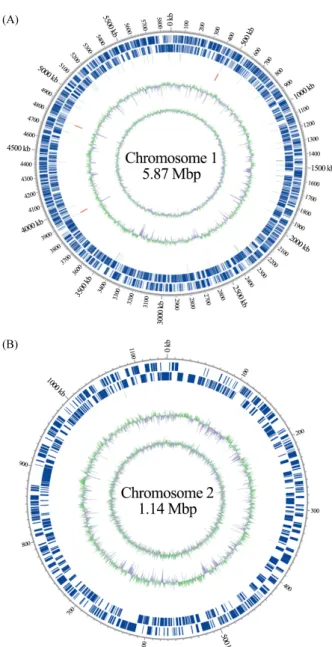
Fig. 1. Circular maps of chromosomes 1 (A) and 2 (B) of Variovorax sp.
PMC12. Each circle from outside to the center represents the GC skew, the black CDS on forward strand, CDS on reverse strand, tRNA, rRNA, GC content, and GC skew.
Table 1. Genome features of Variovorax sp. PMC12
Genome feature Chromosome 1 Chromosome 2 Total Accession number CP027773 CP027774
Genome size (bp) 5,873,297 1,141,940 7,015,237
G + C content (%) 67.6 67.7 67.61
Protein-coding genes 5,438 998 6,436
tRNAs 62 2 64
rRNAs (5S, 16S, 23S) 9 (3, 3, 3) - 9 (3, 3, 3)
Pseudogenes 56 24 80
are predicted to be involved in plant growth promotion under abiotic and biotic stress conditions.
The genome of strain PMC12 was sequenced using the PacBio RSII and Illumina HiSeq platforms at Microgen Inc.
The sequences generated by PacBio RSII were assembled de novo using RSHGAP assembly version 3.0 (Chin et al., 2013) and HiSeq reads were subsequently used for error correction of the draft genome assemblies by using Pilon version 1.21 (Walker et al., 2014). Gene prediction and functional annotation
were carried out using the NCBI prokaryotic genomes annotation pipeline (Tatusova et al., 2016) and the RAST server (Aziz et al., 2008). The genes involved in the secondary metabolite production were analyzed using antiSMASH version 4.0.0 (Blin et al., 2017).
The complete genome of strain PMC12 is composed of two circular chromosomes; one is a 5,873,297 bp chromosome with 67.6% G + C content and the other is an 1,141,940 bp chromo- some with 67.7% G + C content (Fig. 1). The genome contains 6,436 protein-coding genes, 9 rRNAs, 64 tRNAs, 3 ncRNAs, and 80 pseudogenes (Table 1). Functional annotation reveals that the genome of strain PMC12 possesses a numbers of genes associated with plant growth promotion and stress tolerance.
ACC deaminase gene (acdS) is well-known to promote plant growth by reducing phytohormone ethylene. The genes involved in proline biosynthesis (proA, proB, and proC) are related to produce organic osmoytes increasing plant stress tolerance.
There are 7 genes encoding the antioxidant enzymes, superoxide dismutase (SOD), catalase (CAT), and peroxidase (PRX), that scavenge reactive oxygen species. Strain PMC12 possesses phnA and phnX genes involved in hydrolysis of phosphonoacetate and phosphonoacetaldehyde, respectively that could increase biologically available phosphate for plants. The homologous gene cluster for biosynthesis of variochelin, a lipopeptide siderophore (Kurth et al., 2016), were found in the chromosome 2 of strain PMC12 genome. This study will provide basic information for understanding of molecular mechanisms where rhizobacteria enhances plant growth under environmental stresses and resistance to bacterial wilt disease.
Nucleotide sequence accession numbers
The genome sequences of two chromosomes described in
Complete genome sequence of Variovorax sp. PMC12 ∙
473
Korean Journal of Microbiology, Vol. 54, No. 4 this study were available under the accession numbers CP027773
and CP027774 in GenBank database.
적 요
본 연구에서 생물 및 비생물학적 스트레스에 내성을 유도하 는 식물 생육 촉진 세균인 Variovarx sp. PMC12 균주의 유전체 염기서열을 분석하였다. PMC12 균주의 유전체는 5,873,297 bp와 1,141,940 bp 크기의 원형 염색체 2개로 구성되었다. 총 6,436개 단백질 유전자, rRNA 9개, tRNA 64개, ncRNA 3개 와 유사유전자 80개가 확인되었다. 유전체상에서 발견된 1- aminocyclopropane-1-carboxylate (ACC) deaminase, 항산화 활성, 인산 가용화, 프롤린 생합성, 시드로포어 생합성과 관련 된 유전자들은 PMC12 균주가 염, 온도, 병원균에 대한 스트레 스에 대한 식물의 내성 유도와 관련되어 있을 것으로 판단된다.
Acknowledgements
This study was carried out with the support of “Research Program for Agricultural Science & Technology Development (Project No. PJ01185002)” from the National Institute of Agricultural Sciences, Rural Development Administration, Republic of Korea.
References
Aziz RK, Bartels D, Best AA, DeJongh M, Disz T, Edwards RA, Formsma K, Gerdes S, Glass EM, Kubal M, et al. 2008. The RAST server: rapid annotations using subsystems technology.
BMC Genomics 9, 75.
Belimov AA, Dodd IC, Hontzeas N, Theobald JC, Safronova VI, and Davies WJ. 2009. Rhizosphere bacteria containing 1- aminocyclopropane-1-carboxylate deaminase increase yield of plants grown in drying soil via both local and systemic hormone
signalling. New Phytol. 181, 413–423.
Belimov AA, Hontzeas N, Safronova VI, Demchinskaya SV, Piluzza G, Bullitta S, and Glick BR. 2005. Cadmium-tolerant plant growth-promoting bacteria associated with the roots of indian mustard (Brassica juncea L. Czern.). Soil Biol. Biochem. 37, 241–250.
Blin K, Wolf T, Chevrette MG, Lu X, Schwalen CJ, Kautsar SA, Suarez Duran HG, de Los Santos ELC, Kim HU, Nave M, et al.
2017. antiSMASH 4.0-improvements in chemistry prediction and gene cluster boundary identification. Nucleic Acids Res. 45, W36–W41.
Chin CS, Alexander DH, Marks P, Klammer AA, Drake J, Heiner C, Clum A, Copeland A, Huddleston J, Eichler EE, et al. 2013.
Nonhybrid, finished microbial genome assemblies from long-read SMRT sequencing data. Nat. Methods 10, 563–569.
Han JI, Choi HK, Lee SW, Orwin PM, Kim J, Laroe SL, Kim TG, O'Neil J, Leadbetter JR, Lee SY, et al. 2011. Complete genome sequence of the metabolically versatile plant growth-promoting endophyte Variovorax paradoxus S110. J. Bacteriol. 193, 1183– 1190.
Kim HS, Lee SA, Kim Y, Sang MK, Song J, Chae JC, and Weon HY.
2018. Enhancement of tomato tolerance to biotic and abiotic stresses by Variovorax sp. PMC12. Res. Plant Dis. 24, 221–232.
Kurth C, Schieferdecker S, Athanasopoulou K, Seccareccia I, and Nett M. 2016. Variochelins, lipopeptide siderophores from Variovorax boronicumulans discovered by genome mining. J. Nat. Prod. 79, 865–872.
Satola B, Wubbeler JH, and Steinbuchel A. 2013. Metabolic charac- teristics of the species Variovorax paradoxus. Appl. Microbiol.
Biotechnol. 97, 541–560.
Tatusova T, DiCuccio M, Badretdin A, Chetvernin V, Nawrocki EP, Zaslavsky L, Lomsadze A, Pruitt KD, Borodovsky M, and Ostell J. 2016. NCBI prokaryotic genome annotation pipeline. Nucleic Acids Res. 44, 6614–6624.
Walker BJ, Abeel T, Shea T, Priest M, Abouelliel A, Sakthikumar S, Cuomo CA, Zeng Q, Wortman J, Young SK, et al. 2014. Pilon:
An integrated tool for comprehensive microbial variant detection and genome assembly improvement. PLoS One 9, e112963.
Willems A, Deley J, Gillis M, and Kersters K. 1991. Comamonadaceae, a new family encompassing the acidovorans rRNA complex, including Variovorax-paradoxus gen. nov., comb. nov., for Alcaligenes-paradoxus (Davis 1969). Int. J. Syst. Bacteriol. 41, 445–450.