Korean Journal of Microbiology (2019) Vol. 55, No. 3, pp. 300-302 pISSN 0440-2413
DOI https://doi.org/10.7845/kjm.2019.9087 eISSN 2383-9902
Copyright ⓒ 2019, The Microbiological Society of Korea
Complete genome sequence of drought tolerant plant
growth-promoting rhizobacterium
Glutamicibacter halophytocola
DR408
Susmita Das Nishu, Hye Rim Hyun, and Tae Kwon Lee*
Department of Environmental Engineering, Yonsei University, Wonju 26493, Republic of Korea
내건성 식물생장 촉진 균주인 Glutamicibacter halophytocola DR408의
유전체 분석
수스미타 다스 니슈 ・ 현혜림 ・ 이태권*
연세대학교 환경공학부
(Received August 9, 2019; Revised September 5, 2019; Accepted September 5, 2019)
*For correspondence. E-mail: [email protected]; Tel.: +82-33-760-2446; Fax: +82-33-760-5524
Glutamicibacter halophytocola DR408 isolated from the rhi-zospheric soil of soybean plant at Jecheon showed drought tolerance and plant growth promotion capacity. The complete genome of strain DR408 comprises 3,770,186 bp, 60.2% GC- content, which include 3,352 protein-coding genes, 64 tRNAs, 19 rRNA, and 3 ncRNA. The genome analysis revealed gene clusters encoding osmolyte synthesis and plant growth pro-motion enzymes, which are known to contribute to improve drought tolerance of the plant.
Keywords: Glutamicibacter halophytocola, complete genome, drought tolerance, plant growth promotion
The genus Glutamicibacter newly reclassified from Arthro-bacter, grouped in the family Micrococcaceae (Busse, 2016; Feng et al., 2017). Glutamicibacter strains isolated from coastal halophyte root and coastal soil have been reported as a plant growth-promoting Actinobacteria showing high tolerance to osmotic and salt stress (Siddikee et al., 2010; Qin et al., 2018). We have isolated the strain DR408 from the
rhizo-spheric soil of the soybean (Glycine max) exposed to periodic drought in Jecheon, Republic of Korea. Phylogenetic analysis of its 16S rRNA gene sequence revealed that the strain DR408 closed to genus Glutamicibacter and had the highest similarity to Glutamicibacter halophytocola KCTC 39692 (99%) (Feng et al., 2017). Unexpectedly, only one complete genome se-quence belonging to this species are available in public database (NZ_CP012750). Here, we describe the complete genome sequence and annotation of Glutamicibacter halo-phytocola DR408. The strain was deposited in the Korean Culture Center of Microorganisms with accession number of KCCM 43330.
The strain DR408 was cultured in tryptic soy broth (BD BactoTM) and shaken at 120 rpm in 28°C for 3 days. The genomic DNA was extracted and purified using the FastDNA SPIN KIT (MP Biomedicals) following the protocol recom-mended by the manufacturer. The purified genomic DNA was quantitated through fluorescence measurements made with the PicoGreenTM dsDNA quantitation kit and sequenced by the Macrogen facility (Macrogen). Size, purity, and concentration of the sample were determined by Agilent Technologies 2100
Genome sequence of G. halophytocola DR408∙
301
Korean Journal of Microbiology, Vol. 55, No. 3
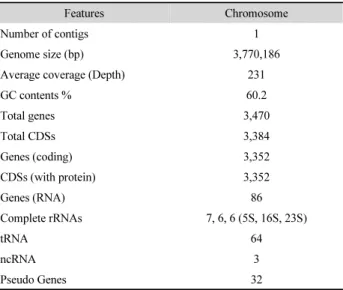
Table 1. General features of Glutamicibacter halophytocola DR408 genome
Features Chromosome
Number of contigs 1
Genome size (bp) 3,770,186 Average coverage (Depth) 231
GC contents % 60.2 Total genes 3,470 Total CDSs 3,384 Genes (coding) 3,352 CDSs (with protein) 3,352 Genes (RNA) 86 Complete rRNAs 7, 6, 6 (5S, 16S, 23S) tRNA 64 ncRNA 3 Pseudo Genes 32
Bioanalyzer to confirm the initial quality of DNA. Genome sequencing was performed using the PacBio RSII (Pacific Biosciences Inc.) and the Illumina HiSeq 2500 (Illumina). The sequence reads were assembled using a de novo assembler HGAP3 (The subreads were extracted using the following parameters: min. subread length: 500 bp; min. polymerase read quality: 0.80; min polymerase read length: 100 bp), and the contigs were polished by using Pilon (v1.21). Gene prediction and genome annotation was performed using the NCBI Prokaryotic Genome Annotation Pipeline (https://www.ncbi. nlm.nih.gov/genome/annotation_prok) with best-placed reference protein set GeneMarkS 2 (v4.7). Default parameters were used for all software.
The complete genome of the strain DR408 consists of one circular chromosome that is 3,770,186 bp with 60.2% GC- content. A total of 3,470 predicted genes, 3,352 protein coding genes, 64 tRNA, 19 rRNA, 3 ncRNA, and 32 pseudo genes were annotated (Table 1). The genome of the strain DR408 contains the osmolyte synthesis genes and osmoregulation proteins such as trehalose-6-phosphate synthase (QDY67375.1), trehalose phosphatase (QDY67374.1), glutamate synthase (QDY 67977.1), proline dehydrogenase (QDY66062.1), Na+/H+ anti-porter (QDY66084.1, QDY66082.1, QDY66081.1), and OsmC family protein (QDY66334.1). It also contains essential fun-ctional genes and proteins for the plant-bacteria symbiosis including 1-aminocyclopropane-1-carboxylate deaminase
(ri-bosome maturation factor, RimM QDY65158.1), tryptophan synthase (QDY65559.1, QDY65560.1), siderophore-interacting protein (QDY67200.1), iron-siderophore ABC transporter substrate-binding protein (QDY66743.1), glucose-6-phosphate dehydrogenase (QDY65509.1), phosphate ABC transporter permease (QDY68095.1, QDY67034.1, QDY67033.1), which contribute to plant growth promotion activity (Bruto et al., 2014; Gupta et al., 2014; He et al., 2018; Li et al., 2018). The strain DR408 possesses around 14 genes related to antioxidant biosynthesis genes potentially contributing to reduce the en-vironmental stress. The complete genome sequence of G. halophytocola provides a framework for further genetic studies to understand the mechanism of drought tolerance regulated through the plant-bacteria symbiosis.
Nucleotide sequence accession numbers
The complete genome sequence of Glutamicibacter halo-phytocola DR408 has been deposited to GenBank under acce-ssion number CP042260.
적 요
제천에서의 콩 근권 시료로부터 분리한 Glutamicibacter halophytocola DR408 균주는 내건성 식물생장촉진력을 보이 고 있다. 본 연구에서 DR408 균주의 완전한 유전체 서열을 해 독한 결과, 유전체의 크기는 3.77 Mbp였으며, G + C 함량이 60.2%였다. 또한 총 3,352개의 유전자 서열과 65개의 tRNA, 19개의 rRNA, 3개의 ncRNA가 존재하였다. 유전체 분석을 통 해 식물의 내건성을 향상시킬 수 있는 삼투질 합성과 식물생 장촉진 효소를 코딩하는 유전자를 다수 포함하는 것을 확인하 였다.Acknowledgements
This work supported by a grant from the National Institute of Agricultural Sciences (NAS) funded under Rural Development Administration (No. PJ013176).
302
∙ Nishu et al.미생물학회지 제55권 제3호
References
Bruto M, Prigent-Combaret C, Muller D, and Moënne-Loccoz Y. 2014. Analysis of genes contributing to plant-beneficial fun-ctions in plant growth-promoting rhizobacteria and related proteobacteria. Sci. Rep. 4, 6261.
Busse HJ. 2016. Review of the taxonomy of the genus arthrobacter, emendation of the genus Arthrobacter sensu lato, proposal to reclassify selected species of the genus Arthrobacter in the novel genera Glutamicibacter gen. nov., Paeniglutamicibacter gen. nov., Pseudoglutamicibacter gen. nov., Paenarthrobacter gen. nov. and Pseudarthrobacter gen. nov., and emended description of Arthrobacter roseus. Int. J.Syst. Evol. Microbiol. 66, 9–37. Feng WW, Wang TT, Bai JL, Ding P, Xing K, Jiang JH, Peng X, and
Qin S. 2017. Glutamicibacter halophytocola sp. nov., an endo-phytic actinomycete isolated from the roots of a coastal halo-phyte, Limonium sinense. Int. J. Syst. Evol. Microbiol. 67, 1120– 1125.
Gupta A, Gopal M, Thomas GV, Manikandan V, Gajewski J, Thomas G, Seshagiri S, Schuster SC, Rajesh P, and Gupta R. 2014. Whole genome sequencing and analysis of plant growth
promoting bacteria isolated from the rhizosphere of plantation crops coconut, cocoa and arecanut. PLoS One 9, e104259. He AL, Niu SQ, Zhao Q, Li YS, Gou JY, Gao HJ, Suo SZ, and Zhang
JL. 2018. Induced salt tolerance of perennial ryegrass by a novel bacterium strain from the rhizosphere of a desert shrub Haloxylon ammodendron. Int. J. Mol. Sci. 19, 469.
Li M, Guo R, Yu F, Chen X, Zhao H, Li H, and Wu J. 2018. Indole-3-acetic acid biosynthesis pathways in the plant-beneficial bacterium Arthrobacter pascens ZZ21. Int. J. Mol. Sci. 19, E443. Qin S, Feng WW, Zhang YJ, Wang TT, Xiong YW, and Xing K. 2018.
Diversity of bacterial microbiota of coastal halophyte Limonium sinense and amelioration of salinity stress damage by symbiotic plant growth-promoting actinobacterium Glutamicibacter halo-phytocola KLBMP 5180. Appl. Environ. Microbiol. 84, e01533– 01518.
Siddikee MA, Chauhan PS, Anandham R, Han GH, and Sa T. 2010. Isolation, characterization, and use for plant growth promotion under salt stress, of acc deaminase-producing halotolerant bac-teria derived from coastal soil. J. Microbiol. Biotechnol. 20, 1577–1584.