Halotolerant Plant Growth Promoting Bacteria Mediated Salinity Stress Amelioration in Plants
Wansik Shin, Md. Ashaduzzaman Siddikee
1, Manoharan Melvin Joe
1, Abitha Benson
1, Kiyoon Kim
1, Gopal Selvakumar
1, Yeongyeong Kang
1, Seonyoung Jeon
1, Sandipan Samaddar
1, Poulami Chatterjee
1,
Denver Walitang
1, Mak Chanratana
1, and Tongmin Sa
1*
Korea Institute of Planning and Evaluation for Technology in Food, Agriculture, Foresty and Fisheries, Anyang-si, Gyeonggi-do 14055, Korea
1
Department of Environmental and Biological Chemistry, Chungbuk National University, Cheongju, Chungbuk 26844, Republic of Korea
(Received: April 27 2016, Revised: August 23 2016, Accepted: August 26 2016)
Soil salinization refers to the buildup of salts in soil to a level toxic to plants. The major factors that contribute to soil salinity are the quality, the amount and the type of irrigation water used. The presented review discusses the different sources and causes of soil salinity. The effect of soil salinity on biological processes of plants is also discussed in detail. This is followed by a debate on the influence of salt on the nutrient uptake and growth of plants. Salinity decreases the soil osmotic potential and hinders water uptake by the plants. Soil salinity affects the plants K uptake, which plays a critical role in plant metabolism due to the high concentration of soluble sodium (Na + ) ions. Visual symptoms that appear in the plants as a result of salinity include stunted plant growth, marginal leaf necrosis and fruit distortions. Different strategies to ameliorate salt stress globally include breeding of salt tolerant cultivars, irrigation to leach excessive salt to improve soil physical and chemical properties. As part of an ecofriendly means to alleviate salt stress and an increasing considerable attention on this area, the review then focuses on the different plant growth promoting bacteria (PGPB) mediated mechanisms with a special emphasis on ACC deaminase producing bacteria. The various strategies adopted by PGPB to alleviate various stresses in plants include the production of different osmolytes, stress related phytohormones and production of molecules related to stress signaling such as bacterial 1-aminocyclopropane-1-carboxylate (ACC) derivatives. The use of PGPB with ACC deaminase producing trait could be effective in promoting plant growth in agricultural areas affected by different stresses including salt stress. Finally, the review ends with a discussion on the various PGPB activities and the potentiality of facultative halophilic/halotolerant PGPB in alleviating salt stress.
Key words: Soil salinity, Saline, Sodic, Saline-sodic, Plant growth promoting bacteria, 1-amino cyclopropane- 1-carboxylate (ACC)
Effect of salt stress in plants and different strategies of amelioration by halotolerant bacteria.
1)
*Corresponding author: Phone: +82432612561, Fax: +82432715921, E-mail: [email protected]
§
Acknowledgement: This work was supported by the intramural research grant of Chungbuk National University in 2015.
Introduction
Soil salinity is a severe problem affecting agricultural productivity in about 1/3
rdof World’s irrigated lands (Munns and Tester, 2008). Soil salinization is a worldwide land degradation process occurring in either arid and semi-arid regions as a result of natural or man process through irrigation (Mashmbye et al., 2012). In general soils are considered to be saline if they have concentration sufficient to interfere with the growth of most crop species (Bui, 2013). Though data pertaining to salt-affected areas vary, it is understood that about 7% of the earth’s content equal to an area of about 1 billion hectare is affected by soil salinity (Ghassemi et al., 1995). In general soils are considered to be saline if they have concentration sufficient to interfere with the growth of most of crop species (Bui, 2013).
Soil salinity has it influence on plant growth and yield by direct or indirect effect. The accumulation of salts in the root zone affects plant growth due to its low osmotic potential, which exerts ion imbalance and ion toxicity and decrease the availability of water to the plants (Setia et al., 2013). Indirect influence includes its effect on the composition and activity of microbial community of soil (Chowdhury et al., 2011). The other effects of salt injury includes changes in the allocation pattern such as increased root at the expense of leaf growth (Brugnoli and Biorkman, 1992), decreased photosynthetic rate due to premature leaf senasance and partial stomatal closure and nutritive imbalance due to excessive Cl
-and Na
+in saline soils (Munns and Tester, 2008).
Various strategies involved to mitigate salt stress include:
development of salt resistant cultivars, use of excessive irrigation to leach the salts from upper to lower soil depths, reduction of salt by harvesting salt accumulating aerial parts (Asada, 1992).
Increased labor intensiveness and cultivation cost involved in the above mentioned methods have led to search for other viable alternatives and one such alternative is the user of plant growth promoting bacteria (PGPB) to alleviate salt stress, nowadays (Mayak et al., 2004). The use of bacteria to promote plant growth under different environmental conditions are reported by numerous workers (Kloepper et al., 1989; Glick and Bashan, 1997; Grichko and Glick, 2001; Mayak et al., 2004a,b; Zahir et al., 2009. Bacteria that improve health and yield of plant have been explored from the rhizosphere soil of different crop plants (Park et al., 2005; Ahmed et al., 2008;
Duan et al., 2009), sewage sludge (Krause et al., 2003), milk (Das Gupta et al., 2006), cow dung (Swain et al., 2008) and insect gut (Indiragandhi et al., 2007), saline soil (Upadhyay et al., 2009),petroleum contaminated saline alkaline soil (Liu et al., 2009), and nickel contaminated soil (Durand et al., 2015).
PGPR promote plant growth by either direct or indirect mechanisms or a combination of both (Glick et al., 1998).
Indirect mechanisms of plant growth include the pathogen
supression through the action of siderophores, or the production of antibiotics or extra-cellular hydrolytic enzymes (Kloepper et al., 1989; Glick and Bashan, 1997). Direct mechanisms may include altered nutrition by provision of fixed nitrogen, iron through siderophores, soluble phosphate and Zn (Hariprasad and Niranjana, 2009; Iqbal et al., 2010); production of phytohormones such as indole-3-acetic acid (IAA), cytokinin and gibberellins (Madhaiyan et al., 2006; Kang et al., 2009) or by the activity of ACC deaminase. ACC deaminase is an enzyme that can lowers plant ethylene levels, which are typically increased by a wide variety of environmental stress such as organic contaminants, salt stress, drought, flooding, heavy metals, and pathogen attack (Grichko and Glick, 2001;
Indiragandhi et al., 2008; Reed and Glick, 2005; Cheng et al., 2007; Zahir et al., 2009).
This review deals with problems associated with salinity in plants, their impact in nutrient uptake and stress ethylene synthesis and the role of PGPB with 1-amino cyclopropane-1- carboxylate (ACC) deaminase in promoting plant growth under these conditions. The scope of this review also extends to the potential application of halotolerant ACC deaminase containing PGPB in agricultural lands affected by stress particularly salinization.
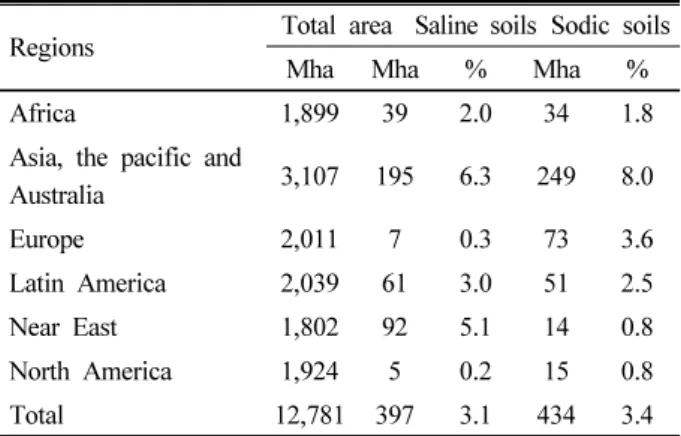
Soil salinity in Agriculture Salinity of soils and ground water is a serious land degradation problem, which is growing steadily in many parts of the world and its affects about 10%
of the total land surface. This salt affected area is estimated to be 9000 *10 ha (Flowers, 2004) and the deterioration rate is about 2 × 10
6ha per year (~1%) (Shilpi et al., 2008),with a predicted rise of 50% of arable lands by the year 2050 (Ashraf, 1994). In addition, about 20% of the irrigated agricultural land that contributes more than 30% of global agricultural production (Hillel, 2000) is adversely affected by salinity every year (Ghassemi et al., 1995). At present, around 100 countries are affected by salinity-sodicity induced abiotic stress and this is one of the world’s most serious problem in agriculture (Rueda-Puente et al., 2007).
Excess accumulation of salt leads to degradation of soil
structure, deflocculation, prevalence of anaerobic conditions
and increase in osmotic pressure, at the same time, water
potential decreases, turgor potential of the cells (plant and
microbes) declines and cells ultimately cease to grow. Microbial
diversity, biomass and enzyme activity are severely inhibited
in saline soils, which interferes with soil fertility and productivity
becoming more acute in induced conditions (Tripathi et al.,
2007; Ibekwe et al., 2010). In addition, salt stress also causes
physiological drought, ion toxicity, nutrient imbalance, increased
production of reactive oxygen species and stress ethylene
level, resulting im decreased growth and premature activation
of programmed cell death (PCD) (Feng et al., 2002; Mayak et
al., 2004a; Jahromi et al., 2008). Production of ethylene by
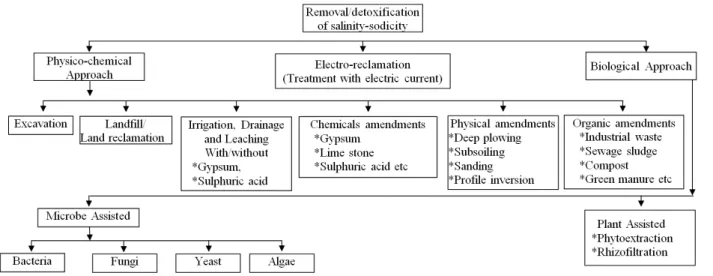
Fig. 1. Current approaches in the remediation of salinity-sodicity in salt affected soils.
Table 1. Classification of salt affected soils.
Classification Electrical conductivity
(dS m
-1)
aSoil pH Sodium adsorption ratio (SAR)
bExchangeable sodium
percentage (ESP) Soil physical condition
Normal <4.0 <13 6.5-7.51 <15 below Good
Saline >4.0 <8.5 <13 <15 Normal to poor
Sodic <4.0 >8.5 >13 >15 Very poor
Saline-sodic >4.0 <8.5 >13 >15 Poor
a
dS m
-1= mmho cm
-1.
b