• 검색 결과가 없습니다.

Isolation of Bacillus sp. SHL-3 from the Dry Soil and Evaluation of Plant Growth Promoting Ability

N/A
N/A
Protected

Academic year: 2021

Share "Isolation of Bacillus sp. SHL-3 from the Dry Soil and Evaluation of Plant Growth Promoting Ability"

Copied!
8
0
0

로드 중.... (전체 텍스트 보기)

전체 글

(1)

Isolation of Bacillus sp. SHL-3 from the Dry Soil and Evaluation of Plant Growth Promoting Ability

Sun Hwa Hong, Ji Seul Kim, Jun Gyu Sim, and Eun Young Lee*

Department of Environmental and Energy Engineering, Suwon University, Gyeonggi 445-743, Korea (Received: December 4 2014, Revised: February 21 2015, Accepted: February 24 2015)

Excess use of chemical fertilizer causes soil acidification and accumulation of salt, and thus might bring to desertification of soil. To overcome this problem, it needs limited usage of chemical fertilizer and increased usage of natural fertilizer as an alternative. In this study, dry soil-borne Bacillus sp. SHL-3, which was isolated from arid and barren soil, with plant growth promoting activity was isolated for identification and to determine optimal culture condition. A bacterial strain SHL-3 had the IAA productivity (5.16 ± 0.10 mg L

-1

), ACC deaminase activity (0.36±0.09 at 51 hours) and siderophore synthesis. It was identified as genus Bacillus sp..

Also, optimal culture condition of SHL-3 were 20°C and pH 7 in LB medium. Bacillus sp. SHL-3 had up to 4%

salt tolerance in the medium. We evaluated the plant growth promotion ability of SHL-3 using yam (Dioscorea japonica Thunb.). As a result, Bacillus sp. SHL-3 was effective on the increase of the shoot length (202.4% increase for 91 days). These results indicate that Bacillus sp. SHL-3 can serve as a promising microbial resource for the biofertilizers of soil.

Key words: ACC, Biofertilizers, IAA, Plant growth promoting rhizobacteria, Yam

Shoot length of Dioscorea japonica Thunb. was improved by the inoculation of Bacillus sp. SHL-3 (202.4% improvement).

1)

*Corresponding author : Phone: +82312202614, Fax: +82312202533, E-mail: [email protected]

§Acknowledgement: This subject is supported by Korea Ministry of Environment as “EI Project” (Project No. E314-00013-0301-1), for which the authors are grateful.

(2)

Introduction

오늘날의 농업은 화학비료와 농약의 과다사용으로 토양 의 산성화, 부영양화, 염류집적 등이 발생하여 작물의 품질 저하와 환경오염문제를 발생시키고 있다. 따라서 이러한 문 제를 해결하고자 화학비료의 사용을 줄이고 이를 대체할 생 물학적 처리에 관한 연구가 진행되고 있다. 특히, 생물학적 방제를 위한 다양한 미생물의 개발이 많은 연구자에 의해 이루어지고 있다 (Lee and Hong, 2013). 미생물 중에서도 뿌리의 근권에서 식물 제공하는 뿌리 삼출물을 통해 성장하 며 식물의 성장을 향상시키는 근권미생물의 연구가 활발이 이루어지고 있다 (Johnson et al., 2005). 근권토양은 식물 이 없는 토양과 비교 하였을 때 10-1000배의 미생물이 존재 하며 (Lugtenberg and Kamilova, 2009), 식물의 뿌리 주변 에서 서식하는 미생물은 식물의 성장에 직·간접적인 영향을 미친다. 근권미생물은 항생물질을 생산하여 토양 내의 병원 균으로부터 발생하는 식물의 질병으로부터 식물을 보호하 거나 (Chin-A-Woeng et al., 1998; Lucy et al., 2004), indole acetic acid (IAA)와 같은 식물성 호르몬을 합성하며, 인과 같은 미네랄을 가용시켜 식물이 보다 쉽게 영양물질을 흡수하여 이용할 수 있게 도와준다(Lebeau et al., 2008).

이 밖에도 식물성호르몬인 동시에 과다하게 분비될 경우 식 물뿌리의 성장을 저해시키는 에틸렌의 농도를 조절하거나 (1-aminocyclopropane-1-carboxylic acid (ACC) deaminase activity), 식물 성장의 필수 영양물질이지만 토양에 난용성 으로 존재해 식물의 이용이 용이하지 않은 철을 식물의 체 내에 흡수할 수 있게 도와주는 역할 (siderophore synthesis) 등을 한다. 그러므로 합성비료의 오염문제를 해결하는 동시 에 환경친화적인 미생물비료의 개발은 매우 중요하며 식물 성장촉진 능력이 있는 근권미생물의 탐색과 그 특성에 관한 연구는 미생물 비료의 실용화를 위해서 반드시 수행해야 할 과제이다.

건조지역의 토양은 특히 수분 보유력이 낮고, 무기물 성 분도 부족하며, 토양의 CEC가 낮아 식물의 성장에 적합하 지 않은 지역이다. 전세계적으로 산업화에 따른 사막화가 진행되어 건조지역이 확대됨에 따라 황사 및 미세먼지 등이 환경문제로 대두되고 있다. 건조지역의 식생화가 성공적으 로 이루어지게 되면 빠른 속도로 확산되는 사막화 문제를 다소 해결할 수 있을 것으로 기대된다.

본 연구에서는 토양의 산성화를 막기 위해 잿물을 살포 하여 토양의 알칼리화가 진행되고 있는 Nigeria의 토양에서 자라고 있는 토착식물로부터 식물성장촉진 능력이 있는 미 생물을 분리하고 그들의 식물성장촉진 능력을 평가하고 그 들 사이의 상관관계를 분석하였다. 또한, 식물성장촉진 능 력이 우수한 균주를 선별하고 이를 대상으로 나이지리아에 서 가장 흔하게 재배하는 yam의 생장 촉진 능력을 평가하

였다. 분리 균주는 건조한 환경에서 생존능이 우수한 것으로 알려져 있는 그람 양성의 Bacillus sp에 속하는 균주이다.

Bacillus sp.는 생육을 위한 최적 pH, 온도 (20~65°C) 등이 매우 다양한 범위의 것으로 알려져 있다 (Amanda and Adriano, 2008; Kim et al., 2001; Pillai and Archana, 2008; Williams et al., 1990). 따라서, 본 연구에서는 분리된 균주를 염류가 집적된 극한 환경에서 생물비료로 이용하기 위해서 염내성, 최적 온도 및 최적 pH등과 같은 생리적 특성을 알아보았고, 식물성장촉진 등을 평가하여 생물비료로써의 가능성을 평 가하였다.

Materials and Methods

토양 시료 채취와 colony library 구축 본 연구에 이 용된 미생물 분리원이 된 토양은 아프리카 Nigeria의 Abia 공대 지역 (5°49'41.4"N 7°23'31.6"E), Lagos 지역 (6° 26' 30.0"N 3° 15' 0.0"E), 그리고 Enugu지역 (6° 22' 37.9566"N 7° 28' 59.252"E)에서 채취하였다. 토양 중 시료 A는 Nigeria Lagos지역 작물 재배지에서 채취한 토양이었고 시료 B는 Enugu지역 작물 재배지 토양을 채취하였으며, 시료 C는 Abia공대 내 작물 재배지 토양으로 이곳은 특히 주변 잡초 를 태워 만든 잿물을 비료로 사용하고 있는 지역이었다. 토 양의 채취는 서식하고 있는 식물을 채취한 후 뿌리에 있는 근권토양을 약 10 cm깊이로 채취하였다. 각각 채취된 토양 을 대상으로 시료에 서식하고 있는 세균의 library를 다음과 같이 준비하였다. 토양 1 g에 멸균수 9 mL을 넣고 30분간 250 rpm으로 교반하고 30분간 정치 한 후, 상등액을 멸균 수로 희석 (10

0

- 10

-6

) 하였다. 각각의 희석용액을 LB-agar 배지 (Difco, USA)에 100 µL씩 접종하여 도말 한 후, 30°C 에서 3일간 배양하였다. 배양된 colony 중에서 형성 모양 및 색 등의 형태적 특성에 따라 세균을 선별한 후에 새로운 배지에 옮겼다. Abia토양에서는 5개, Lagos토양에서는 5개, Enugu토양에서는 7개로 총 17개 colony가 선별되었다.

토양의 특성 채취한 토양의 특성을 분석하기 위해 pH,

전기전도도, 양이온 치환용량, 질소함량, 유효인산 및 치환

성 칼리, 칼슘 그리고 마그네슘 함량을 측정하였다. pH는

토양 1 g에 멸균수 5 mL (w:v)을 첨가한 후 1시간 동안 교반

하고 30분 정치한 후 pH meter (Orion mode 921A, USA)를

이용하여 측정하였다. 전기전도도 (EC)는 토양 1 g에 멸균

수 5 mL (w:v)을 첨가한 후 1시간 동안 교반하고 30분 정치

한 후 whatman no. 42 filter paper를 이용해 필터한 후 EC

meter (Orion model 50, USA)를 이용하여 즉시 측정하였

다. 전질소함량은 건식화학법을 이용하여 Vario Max CN

(Elementar Analy sensysteme Gmbh, Germany)으로 측정하였

다. 유효인산 농도는 Lancaster법을 이용하여 UV-Spectrometer

(3)

(Varian Carry4000, Australia)로 측정하였다 (NIAST, 1988).

치환성 칼리, 칼슘 그리고 마그네슘은 1N CH

3

COONH

4

(pH 7.0) 완충용액으로 침출하여 Atomic Absorption Spectrometer (AA280FS, USA)를 이용하여 측정하였다.

식물성장촉진 근권세균 분리 및 동정 채취한 토양

으로부터 구축한 colony library를 대상으로 식물성 호르몬 인 IAA 생산능을 다음과 같은 방법으로 평가하였고, 모든 실험은 3반복 하였다. 균주를 각각 0.5 mg/mL의 tryptophane 을 첨가한 DF 배지 (Hong et al., 2012) 5 mL에 접종하여 30°C에서 180 rpm으로 5일간 배양하였다. DF 배지의 조성 은 다음과 같다: (NH

4

)

2

SO

4

, 2 g; KH

2

PO

4

, 4 g; Na

2

HPO

4

· 12H

2

0, 15 g; MgSO

4

·7H

2

O, 0.2 g; FeSO

4

·7H

2

O, 1.0 mg;

B(as H

3

BO

3

), 10 µg; Mn(as MnSO

4

·H

2

O), 11 µg; Zn(as ZnSO

4

· 7H

2

O), 125 µg; Cu(as CuSO

4

·5H

2

O), 78 µg; Mo(as Na

2

MoO

4

· 2H

2

O), 17 µg; 증류수, 1 L. 선별 균주를 DF 배지에서 5일간 배양한 후, 배양액과 Salkowski's reagent (진한 H

2

SO

4

, 150 mL; 증류수, 250 mL; 0.5 M FeCl

3

·6H

2

O, 7.5 mL 혼합액)를 1 : 2 (v/v)의 비율로 섞은 후, 분홍색으로 발색되는 동안 상온 에서 20분간 정치하였다. 발색되는 정도는 흡광광도계 (HACH, USA)를 이용하여 530 nm에서 흡광도를 측정하였다. 표준 물질로는 3-Indole acetic acid (C

8

H

6

N-CH

2

COOH, SHOWA chemical co., Japan)를 이용하였고, 동일한 방법으로 실험 한 후 검량선을 작성하였다 (Hong and Lee, 2014).

ACC deaminase 활성은 다음과 같은 방법으로 평가하였 다 (실험에 사용된 배지는 (NH

4

)

2

SO

4

대신 3 mM의 ACC를 넣은 DF 배지이다). 각각의 colony들을 배지에 접종하여 30°C에서 180 rpm으로 48시간 동안 배양하였다. 배양기간 동안 흡광광도계를 이용하여 4시간마다 600 nm에서 흡광 도를 측정하였다 (Hong et al., 2012).

Siderophores 합성능은 chrom azurol S (CAS) blue agar plate assay 방법을 이용하였다 (Hong et al., 2012). 1 L의 CAS agar를 만드는 방법은 다음과 같다: (1) siderophores indicator인 dark-blue dye solution은 60.5 mg의 CAS를 50 mL 증류수에 녹인 다음 1 mM FeCl

3

·6H

2

O과 10 mM HCl 이 첨가된 iron (Ⅲ) solution을 10 mL 첨가한 후, 40 mL 증 류수에 72.9 mg HDTMA을 녹인 solution을 함께 하여 멸균 한다. 또한, (2) medium solution (750 mL 증류수에 100 mL 10X MM9 salts (60 g/L Na

2

HPO

4

; 0.9 g/L KH

2

PO

4

; 5 g/L NaCl; 10 g/L NH

4

Cl), 15 g agar, 30.24 g PIPES 그리고 12.0 g의 50% (w/w) NaOH를 넣고 멸균하여 50°C로 식힌 후, 멸균된 30 mL casamino acids (10%, w/v), 멸균된 10 mL glucose (20%, w/v), 1 mL thiamine·HCl (0.2%, w/v), 그리고 3 mL L-tryptophane (1%, w/v)를 첨가한다)을 제조 한 후, (1)과 (2)를 잘 섞은 후, petri dish에 30 mL씩 굳혀 CAS blue agar plate를 만들었다. 각각의 세균을 CAS blue

agar plate에 접종하여 30°C에서 24시간 동안 배양하였으며, colony 주변에 orange halo가 형성되는 경우를 siderophores 합 성 양성으로 평가하였다.

분리균주의 동정은 16s rDNA분석법을 이용하여 동정하 였다. 콜로니 (colony)를 0.5N NaOH 30 μL에 현탁시킨 후 95°C에서 30분간 가열하여 균체를 lysis 시켰고, 이에 따라 추출된 genomic DNA를 template로 하여 polymerase chain reaction (PCR)을 수행하였다. DNA template 1 μL, primer 27f과 1492r를 각각 20 pmol, BSA를 0.5 mg/mL, dNTP를 0.2 mM, 10xbuffer 2.5 μL를 넣고 dH

2

O로 총 부피를 25 μL 로 하였다. 이때 사용한 primer는 universal primer로 27f (5’-AGA GTT TGA TCM TGG CTC AC-3’)와 1492r (5’-TAC GGY TAC CTT GTT ACG ACT-3’)이다. PCR 조건은 93°C에 서 2분 동안 pre-denaturation한 후, 92°C에서 denaturation 1분, 55°C에서 annealing 1분, 68°C에서 extension 45초 과 정을 35 cycle 반복한 후, 72°C에서 2분 동안 최종 extension 한 후 4°C에서 holding 하였다. PCR로 증폭된 DNA의 염기 서열을 분석하였다 (Hong and Lee, 2014).

Bacillus sp. SHL-3의 생리적 특성

식물성장 촉진능 력이 우수한 Bacillus sp . SHL-3의 생리적 특성을 다음과 같 은 방법으로 조사하였다. 15 mL test tube에 LB broth를 5 mL을 넣고 SHL-3을 100 µL (2%, v/v)접종하여 진탕 배양 하였다. 이때 NaCl을 1, 2 그리고 3% (v/w)첨가하여 30°C incubator에서 배양하였다. 배양온도와 균주의 접종량은 같 게 하고 phosphate buffer를 이용하여 pH를 4, 5, 6, 7, 8, 9 그리고 10로 하여 균주의 성장능을 측정하였다 (Hong et al., 2011). 또한, 같은 배지에 배양 온도만 20, 30 그리고 50°C로 달리 설정하여 균주의 성장능을 평가하였다. 균주의 성장은 흡광광도계를 이용하여 600 nm에서 흡광도를 측정하였다.

분리한 근권세균이 식물성장에 미치는 영향 평가 식물성장촉진능이 우수한 Bacillus sp. SHL-3을 대상으로 Nigeria의 대표 작물인 yam ( Dioscorea japonica Thunb .)을 이용하여 성장 촉진 여부를 평가하였다. 실험 토양은 현지 토양을 이용하는 것이 가장 이상적이나, 국제적 이송에 어 려움이 있다. 따라서, 현지상태를 고려하여 가장 유사한 사 토를 사용하였다. 연구에서 분석한 세 지역은 나이지리아의 남쪽과 남서쪽에 위치하고 있으며 모래가 58~95%로 구성 되어있다 (Olabiyi et al., 2009; Elias and Gbadegesin, 2012; Romanus, 2013). 화분의 크기는 직경 36 cm, 높이 33 cm의 원형 화분을 사용하였다. 일반토양에서 발아되어 재배된 yam을 구매하여 평균 길이가 약 5 cm인 식물을 화 분에 2개씩 하여 2반복으로 정식하였다.

분리된 근권세균은 1.5 L의 LB배지에 3일간 배양 (20°C)

배양한 배양액을 10000 rpm으로 10분간 원심분리 하였다.

(4)

Table 1. Physico-chemical properties of the soils.

pH OM4

(%)

Av.P2O5

(mg/kg)

Total N (mg/kg)

Exchangeable

(Cmol+/kg) EC

(dS/m)

K Ca Mg

Sample A1 6.22 1.86 47.92 11.76 0.05 0.88 0.17 0.01

Sample B2 5.94 1.73 27.18 11.26 0.05 4.17 2.00 0.03

Sample C3 8.25 1.87 43.15 13.94 0.58 5.96 1.06 0.05

Sample A1; Soil collected from Lagos.

Sample B2; Soil collected from Enugu.

Sample C3; Soil collected from Abia.

OM; Organic matter content (%)

회수된 균주에 멸균수를 첨가하여 현탁한 후 다시 동일 조 건으로 원심분리 하는 과정을 2차례 반복하여 균주를 세척 해 주었다. 세척한 균주는 첨가된 생균수가 약 1.8 ⅹ10

8

cfu/g 되도록 멸균수 150 mL에 현탁한 후 토양에 주입하고 충분히 혼합하였다. 실험군과 근권세균을 접종하지 않는 조 건을 대조군으로 하여 91일간 실험을 수행하였다. 실험은 기온이 약 26~28℃인 온실에서 수행하였으며, 5일에 한번 씩 수분을 공급하였다. 5일의 관수 조건을 설정한 이유는 수분이 제한적으로 공급되는 건기에 근권미생물의 접종을 통해 yam의 생장에 영향을 줄 수 있는지 알아보기 위해 극 단적인 환경을 인위적으로 조성한 것이었다. 또한, 국내의 봄-겨울의 대략적인 평균 강우량은 250~300 mm인데 반해 나이지리아는 봄-가을 평균인 200 mm, 겨울은 17~77 mm 로 건기의 강우량이 매우 낮다 (www.naver.com). 이에 인 위적인 건기 환경을 조성하기 위해 관수 주기를 5일의 한번 으로 하였다. 재배 91일 후에는 yam 줄기를 정식하기 전의 초기값 (4.1~5.3 cm)을 실험종료후의 줄기 길이 값에서 뺀 후 이를 생장 길이로 간주하였다.

Results and Discussion

토양의 특성 식물성장촉진 근권세균의 분리를 위한 토

양 시료의 물리 · 화학적 특성을 분석하여 Table 1에 나타내 었다. 이들 토양의 pH는 각각 6.22, 5.94 그리고 8.25로 나 타났으며 특히, 잿물을 비료로 사용한 C토양의 경우 pH 가 장 높게 나타났다. 이는 앞서 언급 했듯이 이 지역 토양이 잿물을 주기적으로 주입 되었기 때문에 토양의 알칼리화가 진행되고 있는 것으로 사료된다.

유기물함량의 경우 각각의 시료가 1.86, 1.73 그리고 1.87%

(평균, 1.82%)로 나타났다. 일반적으로 시비를 하는 국내 경 작지의 유기물 함량은 10~38%로 나타나는데 (Jun and Park, 2001; Ko et al., 2011; Yook et al., 2011) 반해 본 시료의 유기물 함량은 매우 낮게 나타났다. 이는 나이지리아 토양 의 경우 일반적으로 유기물 함량이 2.2~3.8%로 보고되어있 는데 (Oguike and Mbagwu, 2009) 이보다도 낮은 농도의

유기물 함량이 나타났다. 이는 매우 토양이 건조하고 경작 지에 유기질 비료를 투여하지 않았지 때문에 다소 낮은 유 기물 함량이 나타난 것으로 사료된다.

유효인산과 총질소 함량은 각 시료당 27.18~47.92 mg/kg 과 11.26~13.94 mg/kg으로 일반 농경지에 비해 유효인산의 농도가 낮았다 (Table 1). 국내 농가의 경우 유효인산의 농 도가 평균적으로 136 mg/kg으로 알려져 있다 (Choi et al., 2006). 알칼리 토양의 경우 중성 토양에 비해 유효인산의 농도가 낮아진다는 보고가 있는데 (Ha et al., 1998), 이는 본 연구에서 사용한 나이지리아 경작지 토양이 잡초를 태워 만든 잿물을 비료로 사용하여 토양의 알칼리화가 진행되기 때문이라 사료된다. 또한, 국내 경작지의 경우, 유기물 비료 의 지속적인 사용으로 나이지리아 토양에 비해 유효인산과 총질소 함량이 높을것으로 사료된다.

분석된 치환성 칼리, 칼슘 그리고 마그네슘의 경우도 0.05~

0.58, 0.88~5.96, 0.17~2.00 Cmol

+

/kg의 범위로 나타났다 (Table 1) 이는 국내의 일반 농경지가 각각 0.21~1.41, 6.3

~13.5, 1.6~4.2 Cmol

+

/kg인 값 (Jun and Park, 2001; Choi et al., 2006; Uhm et al., 2012)인 것과 비교하면, 모든 원 소의 함량이 매우 낮았다. 하 등 (1998)의 연구에 따르면 알 칼리 토양의 치환성 칼리, 칼슘 그리고 마그네슘의 농도가 각각 0.56~1.11, 2.40~2.60 그리고 1.35~1.49 Cmol

+

/kg로 본 연구에서 사용한 토양과 비슷하거나 다소 높았다. 이들 알카리 토양은 개량제를 이용해 중성화하면 유효인산을 비 롯해 치환성 칼리, 칼슘 그리고 마그네슘의 농도도 향상된 다고 보고하였다 (Ha et al., 1998).

식물성장촉진 근권세균 분리 및 동정 형태적 (모양

과 색 등)으로 다르게 나타난 colony를 대상으로 식물성장 능력을 평가 하였다. 그 중 식물성 호르몬인 IAA 생산능과 Siderophores 합성능 그리고 ACC deaminase 활성이 우수 한 SHL-3을 분리하였다. SHL-3의 IAA 생산능은 5.16±

0.10 mg/L였고 (Fig. 1(a)), Siderophores 합성능은 양성이였 으며 (Fig. 1(b)), ACC deaminase 활성을 나타냈다 (Fig. 2).

분리 균주 SHL-3의 16S-rDNA부분 염기서열을 분석하

(5)

Fig. 1. IAA productivity and Siderophore synthesis of Bacillus sp. SHL-3. (a) IAA productivity, (b) Siderophore synthesis. ●, control; ○, SHL-3. Star(*) means the difference from control (*, 0.01< p≤0.05; **, 0.001< p≤0.01; ***, p≤0.001).

Fig. 2. Time courses of ACC deaminase activity of the representative PGPR(●, control; ○, SHL-3). Star (*) means the difference from control (*, 0.01< p≤0.05; **, 0.001< p

≤0.01; ***, p≤0.001).

여 동정한 결과 Bacillus aryabhattai 였다. IAA를 생산하는 Bacillus 종들에 대한 보고가 있다. 특히, Bacillus tequilensis NII0943은 127.5 µg/mL (Dastager et al., 2011), Bacillus sp. Q3는 3.76-10.62 μg/mL (Starovic et al., 2012), Bacillus licheniformis MML2501는 23 μg/mL (Prashanth, 2010), Bacillus sp. 33~67은 0.81~4.32 μg/mL (Wahyudi et al., 2011), Bacillus aerius MH1RS1는 8.43±0.05 mg/L (Lee and Hong, 2013), 그리고 Bacillus subtilis 는 12.67±0.33 μg/mL (Reetha et al., 2014)의 활성을 가진 것으로 보고되어있다.

스트레스 요인이 많이 작용하는 환경에서는 식물의 뿌리 에 식물성 호르몬인 에틸렌과 그 전구체인 ACC의 축적이 야기된다 (Koo and Cho, 2011). 다량의 ACC축적은 식물의 성장에 스트레스 물질로 작용하여 식물의 뿌리 성장을 저해시 킨다 (Glick, 2006). 이렇게 ACC가 풍부해진 근권 환경은 ACC 를 질소원으로 이용할 수 있는 근권세균의 군집화를 유도한다

(Belimov et al., 2005). 이들 근권세균은 ACC deaminase 효소활성을 가지며 식물의 뿌리 내부와 외부의 에틸렌의 농 도를 조절해 식물의 뿌리 성장을 향상시킨다. 지금까지 알 려진 연구결과로는 이러한 세균들에 의해 다양한 식물의 뿌 리 성장이 향상 되었다는 보고가 있다 (Hall et al., 1996; Glick et al., 2008). 본 연구에서 분리된 Bacillus sp. SHL-3 균 주의 ACC deaminase 활성은 배양 51시간째 0.36±0.09로 가장 높았다 (Fig. 2). Common bean ( Phaseolus vulgaris L. )에서 분리한 Bacillus sp. BPR7는 ACC deaminase 활성 을 가지고 있고 (Kumar et al., 2012), Soybean ( Glycine max L. Merrill )에서 분리한 Bacillus amyloliquefaciens Strain sks_bnj_1도 ACC deaminase 활성 (Sharma et al., 2013)을 가지고 있다고 보고되었다. 또한, Bacillus sp. SH1RP8은 0.44±0.00의 ACC deaminase 활성을 가지고 있어 줄무늬 갈대와 갯기름나물의 성장을 향상 시킨다는 보고가 있다 (Hong and Lee, 2014). 본 연구에서 분리한 SHL-3는 24시간째에 0.31±0.12로 SH1RP8 균주에 비해 다소 낮은 ACC deaminase 활성을 가지고 있었다. 다른 균주에 비해 ACC deaminase 활성이 다소 낮지만 SHL-3는 사질 토양에서 얌의 성장을 향상시킬 수 있는 특성을 가지는 근권세균으로서 특이적인 미생물이라고 사료된다. 이밖에도 홍(2012) 등의 보고에 의 하면 Bacillus pumilus JS2RP2, Bacillus megaterium JS2RP3 그리고 Bacillus aryabhattai MH1RS6의 ACC deaminase 활 성이 48시간째에 각각 0.14±0.00, 0.15±0.00 그리고 0.25±

0.00으로 보고되었다 (Hong et al., 2012). 이들 균주는 본 연구에서 개발한 Bacillus sp. SHL-3보다 낮은 ACC deaminase 활성을 가졌다.

Bacillus sp. SHL-3 균주의 생리 특성

분리된 Bacillus

sp . SHL-3 균주의 생리 특성을 평가하기 위해 염분농도, pH

그리고 배양 온도를 달리하여 실험을 수행하였다 (Fig. 3).

(6)

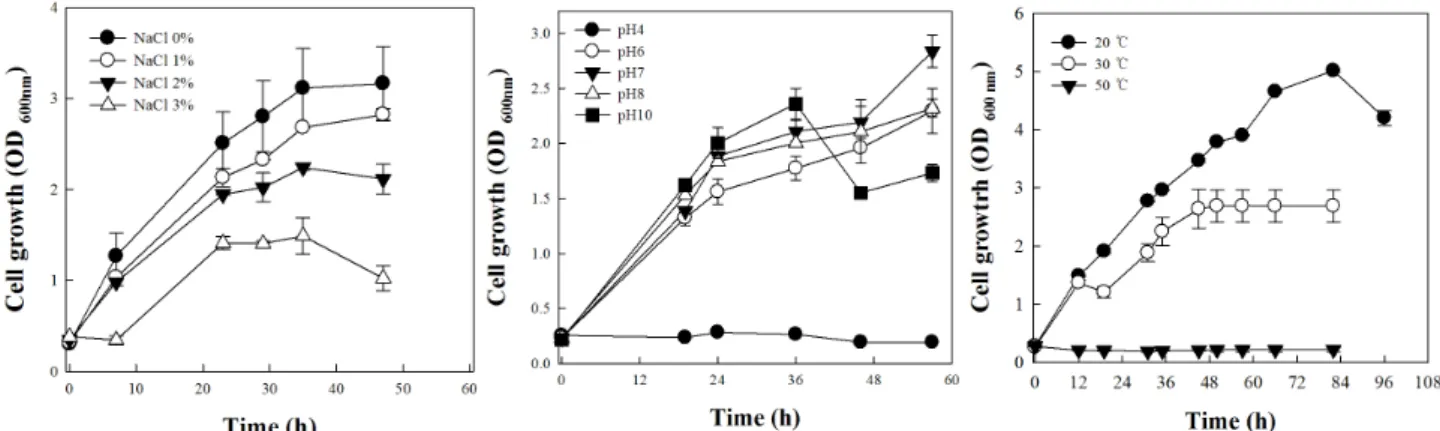
Fig. 3. Physiological characteristics of the Bacillus sp. SHL-3. (a) Salinity tolerance, (b) pH and (c) temperature.

Fig. 4. Effects of the inoculations of Bacillus sp. SHL-3 on the growth of yam (Dioscorea japonica Thunb.) in sand dune soil mesocosm (●, control; ○, SHL-3). An asterisk (*) means the statistically significant differences from control (*, 0.01< p≤0.05; **, 0.001< p≤0.01; ***, p≤0.001).

1%, 2% 및 3%의 NaCl를 첨가한 LB 배지에서의 미생물 성장 은 배양 종료 시점인 47시간째에 각각 OD 값으로 2.82±

0.07, 2.12±0.16 및 1.02±1.14로 염분의 농도가 낮을수록 미생물의 성장이 우수 하였다 (Fig. 3(a)). 본 연구의 실험 조건인 염분 농도가 3%인 경우까지 큰 저해 없이 원할하게 생장함을 알 수 있었다.

생태계의 염류화 현상은 건조한 지역에서 특히 많이 발 생하며, 지구 온난화에 의한 증발량 증가는 토양의 염류화 를 촉진하고 있다 (Singleton and Bohool, 1984). 염농도가 증가되면 단백질이 파괴되고, 단백질 합성이 저해되기 때문 에 (Pessarakli et al., 1989) 미생물의 성장이 저해될 수 있 는 것으로 사료된다.

pH 변화에 따른 영향을 살펴보기 위해 pH가 4, 6, 7, 8 그 리고 10에서 SHL-3의 성장을 조사하였다 (Fig. 3(b)). SHL-3 의 성장은 배양 57시간째에 pH 7에서 2.84±0.15로 가장 우 수하였다. 그러나 배양 46시간 까지는 pH의 범위가 6-8 사 이의 범위에서 골고루 성장하였다. 또한, 토양의 알칼리화 가 진행된 곳에서 분리된 균주의 특성을 반영하여 초기 pH 가 10의 매우 높은 알칼리 환경에서도 큰 저해 없이 원할한 생장을 보여 분리균주는 중성에서 알칼리까지의 넓은 pH영 역을 생장 환경으로 가짐을 알 수 있었다. 이는 SHL-3는 Bacillus sp.의 한 종으로 Bacillus sp.가 일반적으로 pH의 범위가 5-9 사이의 넓은 범위에서 성장한다는 보고 (Park et al., 2004)와 일치되는 결과이다.

온도는 미생물 성장의 중요한 인자이다. 온도를 20, 30 그리고 50°C로 달리하여 SHL-3의 성장을 평가하였다 (Fig.

3(c)). 배양 82시간째의 각 농도에서 SHL-3는 각각 5.01±

0.03, 2.60±0.27 그리고 0.22±0.03으로 20°C일 때 가장 성 장이 우수하였고 50°C일 때는 SHL-3가 성장하지 못했다.

나이지리아 Lagos지역의 일년 기온은 22~33°C사이이며 토 양의 이보다 낮은 기온이 유지된다 (www.accuweather.com).

따라서, 사막지역이라 하여도 상대적으로 저온의 기후에 적 응된 식물에서 분리된 균주인 SHL-3의 경우 낮은 온도 적 응성을 보이는 것으로 나타났다.

분리한 근권세균이 식물성장에 미치는 영향 평가 Bacillus sp . SHL-3의 식물성장 향상 능력을 평가하기 위해 나이지 리아에서 생산하는 주요 작물인 yam ( Dioscorea japonica Thunb .)을 대상으로 이용하여 pot 실험을 수행하였다. 총 91일 동안 식물을 재배하였으며 식물의 성장 향상여부는 줄기 성장으로 평가하였다 (Fig. 4). 그 결과, Bacillus sp. SHL-3 가 첨가되지 않은 대조군은 14일까지 성장하다가 그 이후에 서 줄기의 성장이 매우 느려지는 반면에 Bacillus sp. SHL-3 가 참가된 실험군은 재배 기간 동안 지속적으로 빠르게 성 장하였다. 실험이 종료된 91일에 길이를 측정한 결과, 대조 군은 20.38±3.88 cm였고, 실험군은 62.83±15.94 cm였다.

길이 성장률을 계산하면 Bacillus sp. SHL-3에 길이의 성장

률이 202.4%로 크게 향상되었다. 지금까지 Bacillus sp.의

식물성장촉진 능력에 대해서는 많은 보고가 되어있다. 특히,

Bacillus subtilis GB03과 Bacillus amyloliquefacienc 937a

는 pepper의 뿌리와 줄기의 mass를 26%과 47% 향상시켜주었으

며, tomato의 경우는 각각 59%와 63%고 보고하였다 (Kloepper

(7)

et al., 2007). 또한, Bacillus subtilis EBE는 tomato의 무 게와 줄기를 16~28% 향상시켰고 (Mena-Violante et al., 2007), Bacillus subtilis DSM8563은 lettuce의 식물성장을 77% 향상시켰다는 연구 결과가 있다 (Kohler et al., 2007).

Bacillus tequilensis NII0943은 black pepper의 줄기와 뿌 리 길이를 50% 이상 향상 시켰다고 보고하였다 (Dastager et al., 2011). 본 연구에서 분리한 Bacillus sp. SHL-3은 yam 의 줄기 성장을 200% 이상 향상시킬 수 있었다. 이는 지금 까지 보고된 Bacillus sp.와 비교하였을 때 분리균 SHL-3의 식물성장촉진 능력은 매우 우수한 것으로 사료된다. 이러한 결과는 Bacillus sp . SHL-3가 yam의 생산량을 증대시켜 줄 수 있는 유용한 생물비료로 활용할 수 있는 잠재력을 가지 고 있음을 시사한다.

Conclusion

과도한 화학비료의 사용은 토양의 산성화와 염류 집적을 초래하며 그로 인해 토양 사막화를 촉진한다. 이러한 문제를 해결하기 위해서는 화학비료의 사용을 제한하고 친환경적 생 물비료의 사용을 통해 문제해결을 시도해 볼 수 있다. 본 연 구에서는 척박한 건조토양에서 서식하고 있는 토착식물의 근 권으로부터 Bacillus sp. SHL-3를 분리하였고, 분리 균주의 식물성장촉진 능력을 평가하였다. Bacillus sp. SHL-3은 식물 성 호르몬인 IAA 생산능 (5.16±0.10 mg/L)과 Siderophores 합성능 그리고 ACC deaminase 활성 (배양 51시간째 0.36±

0.09)을 가지고 있었다. 또한, SHL-3은 3%의 염분농도에서 성 장하였고, 최적 pH 및 온도는 7과 20°C로 나타났다. Bacillus sp. SHL-3는 건조한 환경이 조성된 토양에서 yam의 줄기 성 장을 202.4%로 크게 향상시켰다. 이는 Bacillus sp. SHL-3가 생물비료로써의 잠재적 능력을 가지고 있음을 시사한다.

References

Amanda, S. M., and B. Adriano. 2008. Evaluation of envi- ronmental conditions for production of bacteriocin-like sub- stance by Bacillus sp. Strain P34. World J. Microbiol Biotechnol.

24:641-646.

Belimov, A. A., N. Hontzeas, V. I. Safronova, S. V. Demchinskaya, G. Piluzza, S. Bullitta, and B. R. Glick. 2005. Cadmium-tolerant plant growth-promoting bacteria associated with the roots of Indian mustard (Brassica juncea L. Czern.). Soil Biol. Biochem.

37:241-250.

Chin-A-Woeng, T. F. C., G. V. Bloemberg, A. J. van der Bij, K.

M. G. M. van der Drift, J. Schripsema, and F. J. de Bruijn. 1998.

Biocontrol by phenazine-1-carboxamideproducing Pseudomonas chlororaphis PCL1391 of tomato root rot caused by Fusarium

oxysporum f. sp. Radicis lycopersici. Mol. Plant–Microbe

Interact. 11:1069-1077.

Chio, M. H., W. Y. Choi, H. K. Park, J. K. Nam, M. H. Back, J.

H. Lee, S. S. Kim, and C. K. kim. 2006. Influences of site-specific N application on rice grain yield and quality in small size paddy field. Korean J. Crop. Sci. 51:369-378.

Dastager, S. G., C. K. Deepa, and A. Panday. 2010. Isolation and characterization of novel plant growth promoting Micrococcus sp. NII-0909 and its interaction with cowpea. Plant Physiol.

Biochem. 48:987-992.

Elias, P. O., and A. S. Gbadegesin. 2012. Comparative Study of Soils Derived from Sedimentary and Basement Rock Formations of the Lower Ogun River Floodplain, South Western Nigeria.

J. Geogr. Geol. 4:71-80.

Glick, B. R., D. M. Penrose, and J. Li. 2008. A model for the lowering of plant ethylene concentration by plant growth- promoting bacteria. J. Theor. Biol. 190:63-68.

Glick, B.R. 2006. Phytoremediation: synergistic use of plants and bacteria to clean up the environment. Biotechnol. Adv. 21:

383-393.

Ha, H. S., U. G. Kang, H. Lee, and Y. B. Lee. 1998. Effects of fly ash, gypsum, and shell on the chemical properties of soil and growth of Chinese cabbage in plastic film housed paddy.

Korean J. Environ. Agric. 17:65-69.

Hall, J. A., D. Person, and B. R. Glick. 1996. Root elongation in various agronomic crops by the plant growth promoting rhizobacterium Pseudomonas putida GR12-2. Isr. J. Plant Sci.

44:37-42.

Hong, S. H., and E. Y. Lee. 2014. Vegetation restoration and prevention of coastal sand dunes erosion using ion exchange resins and the plant growth-promoting rhizobacteria Bacillus sp. SH1RP8 isolated from indigenous plants. Int. Biodeterior.

Biodegradation. 95:262-269.

Hong, S. H., H. W. Ryu, J. S. Kim, and K. S. Cho. 2011.

Rhizoremediation of diesel-contaminated soil using the plant growth-promoting rhizobacterium Gordonia sp. S2RP-17.

Biodegradation. 22:593-601.

Hong, S. H., M. H. Lee, G. S. Kim, and E. Y. Lee. 2012. An evaluation of plant growth promoting activities and salt tolerance of rhizobacteria isolated from plants native to coastal sand dune. Korean J. Microbiol. Biotechnol. 40:261--267.

Johnson, D. L., D. R. Anderson, and S.P. McGrath. 2005. Soil microbial response during the phytoremediation of a PAH contaminated soil. Soil Biol. Biochem. 37:2334-2336.

Jun, H. S., and W. C. Park. 2001. Soil chemical characteristics and comparison with infested status of nematode (Meloidogyne spp.) in plastic house continuously cultivated oriental melon in songju. Korean J. Environ. Agric. 20:127-132.

Kim, J. M., W. J. Lim, and H. J. Suh. 2001. Feather-degrading

Bacillus species from poultry waste. Process biochem. 37:

287-291.

Kloepper, J. W., A. Gutierrwz-estrada, and J. A. Mclnroy. 2007.

Photoperiod regulates elicitation of growth promotion but not

induced resistance by plant growth promoting rhizobacteria.

(8)

Can. J. Microbiol. 53:159-167.

Kohler, J., F. Caravaca, L. Carrasco, and A. Roldan. 2007.

Interactions between a plant growth-promoting rhizobacterium an AM fungus and a phosphate-solubilising fungus in the rhizosphere of Lactuca sativa. Appl. Soil Ecol. 35:480-487.

Ko, J., J. Lee, K. Woo, S. Song, J. Kang, M. Seo, D. Kwak, B. Oh, and M. Nam. 2011. Effects of soil organic matter contents, paddy types and agricultural climatic zone on CH4 emissions from rice paddy field. Korean J. Soil Sci. Fert. 44:887-894.

Koo, S. Y., and K. S. Cho. 2011. Characterization of Serratia sp.

K1RP-49 for Application to the Rhizoremediation of Heavy Metals. Environ. Earth Sci. 1:3-13.

Kumar, P., R. C. Dubey, and D. K. Maheshwari. 2012. Bacillus strains isolated from rhizosphere showed plant growth promoting and antagonistic activity against phytopathogens. Microbiol.

Res. 167:493-9

Lee, E. Y., and S. H. Hong. 2013. Plant growth-promoting ability by the newly isolated bacterium Bacillus aerius MH1RS1 from indigenous plant in sand dune. J. Kor. Soc. Environ. Eng.

35:687-693.

Lebeau, T., A. Braud, and K. Jézéquel, 2008. Performance of bioaugmentation-assisted phytoextraction applied to metal contaminated soils: A review. Environ. Pollut. 153:497-522.

Lucy, M., E. Reed, and B. R. Glick. 2004. Application of free living plant growth promoting rhizobacteria. Antonie van Leeuwenhoek Int. J. Gen. and Mol. Microbiol. 86:1-25.

Lugtenberg. B., and F. Kamilova. 2009. Plant-growth-promoting rhizobacteria. Annu. Rev. Microbiol. 63:541-556.

Mena-Violante, H. G., and V. Olade-Portuga. 2007. Alteration of tomato fruit quality by root inoculation with plant growth- promoting rhizobacteria (PGPR): Bacillus subtilis BEB-13bs.

Sci. Hortic. 113:103-106.

Oguike, P. C., and J. S. C. Mbagwu. 2009. Variations in some physical properties and organic matter content of soils of coastal plain sand under different land use types. World J. Agr. Sci.5:

63-69.

Olabiyi, T. I., A.O. Olayiwolat and G.O. Oyediran. 2009. Influence of soil textures on distribution of phytonematodes in the South Western Nigeria. 2009. World J. Agr. Sci. 5:557-560.

Park, J. C., J. H. Yoo, J. Y. Cha, M, S. Kim, and Y. S. Cho. 2004.

Isolation, identification and optimal culture condition of Bacillus sp. FF-9 having antifungal activity on the turf grass pathogens caused by Rhizoctonia solani AG II-II. J. Korean Soc. Appl.

Biol. Chem. 47:373-378.

Pessarakli, M., J. T. Huber, and T. C. Tucker. 1989. Protein

synthesis in green beans under salt stress conditions. J. Plant Nutr. 12:1105-1121.

Pillai, P., and G. Archana. 2008. Hide depilation and feather disintegration studies with keratinolytic serine protease from a novel Bacillus subtilis isolate. Appl. Microbiol. Biotechnol.

78:643-650.

Prashanth, S., and N. Mathivanan. 2010. Growth promoting of groundnut by IAA producing rhizobacteria Bacillus licheniformis MML2501. Arch. Phytopathol. Plant Prot. 43:191-208.

Reetha, S., G. Bhuvanswari, P. Thamizhiniyan, and T. Ravi Mycin. 2014. Isolation of indole acetic acid (IAA) producing rhizobacteria of Pseudomonas fluorescens and Bacillus subtilis and enhance growth of onion (Allim cepa. L). Int. J. Curr.

Microbiol. App. Sci. 3:568-574.

Romanus, O. 2013. Erosion and flood vulnerability of soils: A climatic challenge in Southern Nigeria. Int. J. Sci. Technol. 2:

675-684.

Sharma, S. K., A. Ramesh, and B. N. Johri. 2013. Isolation and characterization of plant growth-promoting Bacillus amylo-

liquefaciens strain sks_bnj_1 and its influence on rhizosphere

soil properties and nutrition of soybean (Glycine max L. Merrill).

J. Virol. Microbiol. 1:1-19.

Singleton, P. W., and B. Bohool. 1984. Effect of salinity on nodule formation by soybean. Plant Physiol. Jan. 74:72-76.

Starovic, M., D. Josic, S. Pavlovic, S. Drazic, D. Postic, T.

Popovic, and S. Stojanovic. 2013. The effect of IAA producing

Bacillus sp. Q3 strain on marshmallow seed germination. Bulg.

J. Agric. Sci. 19:572-577.

Uhm, M. J., J. J. Noh, H. G. Chon, S. W. Kwon, and Y. J. Song.

2012. Application effect of organic fertilizer and chemical fertilizer on the watermelon growth and soil chemical properties in greenhouse. Korean J. Environ. Agric. 31:1-8.

Wahyudi, A.T., R. P. Astuti, A. Widyawati, A. Meryandini, and A. A. Nawangsih. 2011. Characterization of Bacillus sp.

strains isolated from rhizosphere of soybean plants for their use as potential plant growth for promoting Rhizobacteria. J. Microbiol.

Antimicrob. 3:34-40.

Williams, C. M.,C. S. Richter, J. M. Mackenzie, and J. C. H. Shih.

1990. Isolation idification and characterization of a feather- degrading bacterium. Appl. Environ. Microbiol. 56:1509-1515.

Yook, B. Y., C. K. Choi, K. B. Lee, Y. S. Kang, and C. Yoon.

2009. Effects of forage cropping system and cattle slurry

application on productivity of rice and forage crops and nutrient

movement in paddy land. J. Kor. Grassl. Forage Sci. 31:55-64.

수치

Table 1. Physico-chemical properties of the soils. pH OM 4 (%) Av.P 2 O 5(mg/kg) Total N(mg/kg) Exchangeable(Cmol+/kg) EC (dS/m) K Ca Mg Sample A 1 6.22 1.86 47.92 11.76 0.05 0.88 0.17 0.01 Sample B 2 5.94 1.73 27.18 11.26 0.05 4.17 2.00 0.03 Sample C 3 8.
Fig. 1. IAA productivity and Siderophore synthesis of Bacillus sp. SHL-3. (a) IAA productivity, (b) Siderophore synthesis
Fig. 3. Physiological characteristics of the Bacillus sp. SHL-3. (a) Salinity tolerance, (b) pH and (c) temperature.

참조

관련 문서

A laboratory experiment was performed to investigate the removal of nitrogen and phosphorus from plating factory effluent using the soil column.. Soil,

This study was conducted on elementary school children aged 11 to 13 from displaced North Korean (NK) families to compare their growth and nutritional status with those

The average surface area from which the dental artificial plaque was removed using the standard manual toothbrushes was 116.41 ㎟ and using the slim bristle toothbrushes it

During culture, culture aliquots were withdrawn to monitor bacterial growth and to meas- ure β -galactosidase activity, and culture supernatants and

To obtain data for the optimal growth conditions for crops in this intelligent plant growing system, sensors were used to measure and control the

In this paper, it has been investigated that how to determine the growth conditions such as the growth temperature, the ratio of Ⅵ/Ⅱ and the growth rate

Substitution-effect of animal and plant protein sources for fishmeal in diet for juvenile abalone (Haliotis discus hannai), and effect of dietary additive on

This abnormal condition at the water purification plant lasted from