Pseudomonas fluorescens DR397 is a potential plant growth- promoting rhizobacterium that enhances plant tolerance to drought stress. We isolated this Gram-negative, rod-shaped strain from soybean plant rhizosphere, grown in drought-prone area of Gangwon-do province and obtained the whole-genome sequence using the Pacific Biosciences (PacBio) RS II platform.
The complete genome of strain DR397 comprises 6,418,441 bp, 60.6% G + C content, which include 5,667 protein-coding genes, 74 tRNAs, 19 rRNA, 4 ncRNA, and 32 pseudo genes.
The genome analysis revealed osmoadaptive drought re- gulatory pathway and plant growth promoting genes in P.
fluorescens DR397, employing symbiotic strategy to promote plant drought resistance.
Keywords: Pseudomonas fluorescens, complete genome, drought tolerance, plant growth promotion
Drought stress limits the growth and yield of crops, affecting the plant water relation at cellular and whole plant level causing severe damages (Sandhya et al., 2010). Plant growth-promoting rhizobacteria (PGPR) colonize the rhizosphere/endorhizosphere and promote plant growth through phytohormone production
(including auxins, cytokinins, and gibberellins), solubilization of mineral phosphates, fixation of atmospheric nitrogen, and iron sequestration by siderophores (Olanrewaju et al., 2017;
Kour et al., 2019). Alleviation of drought stress in plant by PGPR is a complex phenomenon induced from clusters of gene networks involved in the compatible osmolyte production, 1-aminocyclopropane-1-carboxylic acid (ACC) production, root colonization, and plant growth promotion. Pseudomonas spp. have received increased attention as promising PGPR because of their potential to exhibit various plant-beneficial traits and systemic resistance to adapt environmental stresses (Sarma and Saikia, 2014; Kumar et al., 2016; Chandra et al., 2018; Niu et al., 2018; Saikia et al., 2018; Kour et al., 2019).
We have isolated Pseudomonas fluorescens DR397 from the rhizospheric soil of the soybean (Glycine max) grown in drought-prone area of Gangwon-do, Republic of Korea. Phylo- genetic analysis of its 16S rRNA gene sequence revealed that the strain DR397 closed to antifungal bacterium Pseudomonas fluorescens strain MS82 (99.2%) (Ma et al., 2019). However, these two strains only share 94.4% genomic similarity in nucleotide-level. Here, we describe the complete genome sequence and annotation of P. fluorescens DR397.
The strain DR397 was cultured in tryptic soy broth (BD
Korean Journal of Microbiology (2020) Vol. 56, No. 3, pp. 331-333 pISSN 0440-2413
DOI https://doi.org/10.7845/kjm.2020.0050 eISSN 2383-9902
Copyright ⓒ 2020, The Microbiological Society of Korea
Complete genome sequence of Pseudomonas fluorescens DR397, a drought tolerant plant growth-promoting rhizobacterium
Susmita Das Nishu, Hye Rim Hyun, and Tae Kwon Lee*
Department of Environmental Engineering, Yonsei University, Wonju 26493, Republic of Korea
내건성 식물생장 촉진 균주인 Pseudomonas fluorescens DR397의 유전체 분석
수스미타 다스 니슈 ・ 현혜림 ・ 이태권*
연세대학교 환경공학부
(Received June 5, 2020; Revised September 1, 2020; Accepted September 1, 2020)
*For correspondence. E-mail: [email protected];
Tel.: +82-33-760-2446; Fax: +82-33-760-5524
332
∙ Nishu et al.미생물학회지 제56권 제3호
Bacto
TM) and shaken at 120 rpm in 30 ± 2ºC for 3 days. The genomic DNA was extracted and purified using the FastDNA SPIN KIT (MP Biomedicals) following the protocol recom- mended by the manufacturer. The purified genomic DNA was quantitated through fluorescence measurements made with the PicoGreen
TMdsDNA quantitation kit (Invitrogen
TM) and sequenced by a sequencing company (Macrogen). Size, purity, and concentration of the sample were determined by 2100 Bioanalyzer (Agilent Technologies) to confirm the initial quality of DNA. Genome sequencing was performed using the PacBio RSII (Pacific Biosciences) and the Illumina HiSeq 2500 (Illumina). The sequence reads were assembled using a de-novo assembler HGAP3, and the contigs were polished by using Pilon (v1.21). Gene prediction and genome annotation was performed using the NCBI Prokaryotic Genome Annotation Pipeline (https://www.ncbi.nlm.nih.gov/genome/annotation_
prok) with best-placed reference protein set GeneMarkS 2 (v4.7) (Lomsadze et al., 2018).
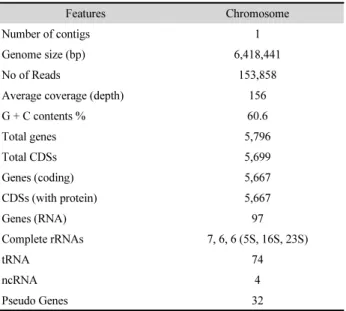
The complete genome of the strain DR397 consisted of one circular chromosome that is 6,418,441 bp with 60.6% G + C-content. A total of 5,699 predicted genes, 5,667 protein coding genes, 74 tRNAs, 19 rRNA, and 4 ncRNA and 32 pseudo genes were annotated (Table 1). The genomic sequence analysis revealed that the strain DR397 possessed a large number of genes associated with plant growth promotion and systemic resistance to drought stress tolerance. The genome
contained the osmolyte synthesis genes such as Trehalose synthase/amylase TreS (WP_163975072), glutamate synthesis (WP_045121906, WP_163976608, WP_074690160), glycine betaine/L-proline ABC transporter ATP-binding protein (WP_
052266509), sodium/proline symporter (WP_039766513), spermidine synthase (WP_039770449), choline dehydrogenase (WP_039767991), betaine-aldehyde dehydrogenase (WP_039 767992), 5 Na
+/H
+antiporter genes (WP_039769658, WP_
039769658), and 4 OsmC family proteins (WP_011331817, WP_007959010, WP_163975226,WP_016772921). The strain DR397 also contains essential functional genes and proteins for the plant-bacteria symbiosis including 1-aminocyclopropane- 1-carboxylate deaminase (RimM; WP_011332613, D-cysteine desulfhydrase; WP_163973837), indole-3-acetic acid and tryptophan synthesis (WP_039768100, WP_085667266, WP_
103385843), siderophore biosynthesis genes (WP_163974875), glucose-6-phosphate dehydrogenase (WP_074690946), inorganic phosphate (Pi) uptake under Pi starvation conditions, PstABCS and PhoU proteins (WP_007954334, WP_007954334) (Bruto et al., 2014; Gupta et al., 2014; He et al., 2018; Li et al., 2018).
The strain possesses around 22 genes related to antioxidant biosynthesis genes potentially contributing to reduce the oxidative stress. We found the presence of core gene clusters involved in effective compatible solutes (osmolyte) biosynthesis in the DR397 genome which are vital in improving drought stress resistance in plants. The complete genome sequence of P.
fluorescens DR397 improves our understanding of the mole- cular mechanism that remains underexplored for plant drought tolerance regulated through the plant-bacteria symbiosis.
Nucleotide sequence accession numbers
The strain was deposited at the Korean Culture Center of Microorganisms with accession number KCCM 12710P and the complete genome sequence has been deposited in NCBI GenBank under accession number CP048408.
적 요
Pseudomonas fluorescens DR397는 식물의 내건성을 향상 시키는 식물 생장 촉진 균주이다. 균주는 가뭄으로 피해를 입 은 콩 재배지역(강원도)에서 분리되었다. Pacific Biosciences
Table 1. General features of Pseudomonas fluorescens DR397 genome
Features Chromosome
Number of contigs 1
Genome size (bp) 6,418,441
No of Reads 153,858
Average coverage (depth) 156
G + C contents % 60.6
Total genes 5,796
Total CDSs 5,699
Genes (coding) 5,667
CDSs (with protein) 5,667
Genes (RNA) 97
Complete rRNAs 7, 6, 6 (5S, 16S, 23S)
tRNA 74
ncRNA 4
Pseudo Genes 32
Genome sequence of Pseudomonas fluorescens DR397∙
333
Korean Journal of Microbiology, Vol. 56, No. 3 RS II 플랫폼을 이용한 DR397 균주의 유전체 서열을 분석하
였다. 유전체는 60.6%의 DNA G + C 함량, 5,667개의 유전자, 74개의 tRNA, 19개의 rRNA, 4개의 ncRNA로 구성되었으며, 염색체의 크기는 6,418,441 bp 구성되어 있다. 유전체 분석 결 과 식물 내건성 향상에 도움이 되는 삼투압 조절과 식물생장 촉진 관련 유전자를 다수 발견하였다.
Acknowledgments
This work supported by a grant from the National Institute of Agricultural Sciences (NAS) funded under Rural Development Administration (No. PJ013176).
References
Bruto M, Prigent-Combaret C, Muller D, and Moënne-Loccoz Y.
2014. Analysis of genes contributing to plant-beneficial functions in plant growth-promoting rhizobacteria and related Proteobacteria.
Sci. Rep. 4, 6261.
Chandra D, Srivastava R, Glick BR, and Sharma AK. 2018. Drought- tolerant Pseudomonas spp. Improve the growth performance of finger millet (Eleusine coracana (L.) gaertn.) under non-stressed and drought-stressed conditions. Pedosphere 28, 227–240.
Gupta A, Gopal M, Thomas GV, Manikandan V, Gajewski J, Thomas G, Seshagiri S, Schuster SC, Rajesh P, and Gupta R. 2014.
Whole genome sequencing and analysis of plant growth promoting bacteria isolated from the rhizosphere of plantation crops coconut, cocoa and arecanut. PLoS ONE 9, e104259.
He AL, Niu SQ, Zhao Q, Li YS, Gou JY, Gao HJ, Suo SZ, and Zhang JL. 2018. Induced salt tolerance of perennial ryegrass by a novel bacterium strain from the rhizosphere of a desert shrub Haloxylon ammodendron. Int. J. Mol. Sci. 19, 469.
Kour D, Rana KL, Sheikh I, Kumar V, Yadav AN, Dhaliwal HS, and Saxena AK. 2019. Alleviation of drought stress and plant growth promotion by Pseudomonas libanensis EU-LWNA-33, a drought- adaptive phosphorus-solubilizing bacterium. Proc. Natl. Acad.
Sci., India, Sect. B Biol. Sci. 1–11.
Kumar M, Mishra S, Dixit V, Kumar M, Agarwal L, Chauhan PS, and Nautiyal CS. 2016. Synergistic effect of Pseudomonas putida and Bacillus amyloliquefaciens ameliorates drought stress in chickpea (Cicer arietinum L.). Plant Signal. Behav. 11, e1071004.
Li M, Guo R, Yu F, Chen X, Zhao H, Li H, and Wu J. 2018. Indole- 3-acetic acid biosynthesis pathways in the plant-beneficial bacterium Arthrobacter pascens ZZ21. Int. J. Mol. Sci. 19, 443.
Lomsadze A, Gemayel K, Tang S, and Borodovsky M. 2018. Modeling leaderless transcription and atypical genes results in more accurate gene prediction in prokaryotes. Genome Res. 28, 1079–
1089.
Ma L, Qu S, Lin J, Jia J, Baird SM, Jiang N, Li H, Hou L, and Lu SE.
2019. The complete genome of the antifungal bacterium Pseudo- monas sp. strain MS82. J. Plant Dis. Prot. 126, 153–160.
Niu X, Song L, Xiao Y, and Ge W. 2018. Drought-tolerant plant growth-promoting rhizobacteria associated with foxtail millet in a semi-arid agroecosystem and their potential in alleviating drought stress. Front. Microbiol. 8, 2580.
Olanrewaju OS, Glick BR, and Babalola OO. 2017. Mechanisms of action of plant growth promoting bacteria. World J. Microbiol.
Biotechnol. 33, 197.
Saikia J, Sarma RK, Dhandia R, Yadav A, Bharali R, Gupta VK, and Saikia R. 2018. Alleviation of drought stress in pulse crops with ACC deaminase producing rhizobacteria isolated from acidic soil of Northeast India. Sci. Rep. 8, 3560.
Sandhya V, Ali SZ, Grover M, Reddy G, and Venkateswarlu B. 2010.
Effect of plant growth promoting Pseudomonas spp. on compatible solutes, antioxidant status and plant growth of maize under drought stress. Plant Growth Regul. 62, 21–30.
Sarma RK and Saikia R. 2014. Alleviation of drought stress in mung bean by strain Pseudomonas aeruginosa GGRJ21. Plant Soil 377, 111–126.