Influence of Short-term Application of Abscisic Acid in Nutrient Solution on Growth and Drought Tolerance of Tomato Seedlings
Il-Seop Kim1*, Ngoc-Thang Vu1, Hoang-Tung Vo2, Ki-Young Choi3,and Young Shik Kim4
1Department of Horticulture, Kangwon National University, Chuncheon 200-701. Korea
2Department of Medical Biotechnology, Kangwon National University, Chuncheon 200-701, Korea
3Department of Controlled Agriculture, Kangwon National University, Chuncheon. Korea
4Department of Plant and Food Sciences, Sangmyung Univ.Cheonan 330-720, Korea
Abstract. This study was conducted to evaluate influence of short-term application of abscisic acid (ABA) in nutri- ent solution on growth and drought tolerance of tomato seedlings. The treatments included four ABA concentrations (0.5, 1, 2, 3mg·L-1) and control (non-treatment) were applied to the nutrient solution in a hydroponic system. On the 5th and 10th day after growing in the nutrient solution containing ABA, seedlings were transferred to -5 bars of PEG- 8000 in a growth chamber to induce water stress. Except for stem diameter and fresh and dry weight of root, there were no statistical differences in other growth parameters among control, 0.5 and 1mg·L-1 of ABA treatments. Seed- lings growths were strongly inhibited in nutrient solution containing 2 and 3mg·L−1 of ABA. The root growth such as fresh and dry weigh of root, total root surface area, and average root diameter was slightly enhanced in 1mg·L−1 of ABA treatment. The elevation of ABA concentrations in nutrient solution resulted in the decrease in transpiration rate and increase in stomatal diffusive resistance and leaf temperature of tomato seedlings. The initiations of seed- ling wilting after treating in -5 bars of PEG were delayed from 10 hrs in control to 30 hrs in ABA applied treat- ments. Additionally, the high percentages of recovered seedlings were observed in 0.5 and 1mg·L−1 of ABA treatments after re-irrigation. Therefore, short-term application of 1mg·L−1 of ABA in the nutrient solution stimu- lated the root growth and drought tolerance of tomato seedlings by delaying the start time of wilting point and enhancing the recovery after re-irrigation.
Additional key words : hydroponic system, root morphology, stomatal diffusive resistance, transpiration rate, water stress
Introduction
Abscisic acid (ABA) is an important signaling hormone which makes resistance and adaptation in plants against various abiotic stress conditions (Bakhsh et al., 2011; Li et al., 2010). ABA protects plants from water stress damage by inducing stomatal closure (Li et al., 2000) and increas- ing hydraulic conductance for water movement from roots to leaves (Ludewig et al., 1988; Zhang et al., 1995). Addi- tionally, ABA has been reported to improve drought toler- ance in various plant species, including Tradescantia virginiana L. (Frank and Farquhar, 2001), Pinusbanksiana L. (Rajasekaran and Blake, 1999), and Capsicum annuum L. (Leskovar and Cantliffe, 1992). Generally, ABA is regarded as an inhibitor of shoot and root growth of plants (Munns and Cramer, 1996). However, under certain condi-
tions low concentrations of ABA applied either to intact roots, root segments, or excised roots growing in liquid cul- ture has been found to stimulate the plant growth (Pilet, 1983; Pilet and Rebeaud, 1983; Takahashi et al., 1993). In addition, Pilet and Barlow (1987) reported that high or low concentrations of ABA can either inhibit or stimulate root growth, respectively.
The importance of ABA in stress regulation is widely recognized for a long time. While ABA can be produced in the roots of many plants and is transferred through the xylem to the leaves when the plant is exposed to low moisture conditions (Jiang and Hartung, 2008), informa- tion about the effect of the application of ABA in nutri- ent solution on growth and physiology and alleviation in drought stress of tomato seedlings is limited. Therefore, the objective of this study was to examine effect of short- term ABA application to the nutrient solution on the maintaining of the quality of tomato seedlings in water stress condition.
*Corresponding author: [email protected]
*Received January 19, 2015; Revised February 02, 2015;
*Accepted February 10, 2015
Materials and Methods
1. Plant materials and growing conditions
Seeds of ‘Dotaerang Dia’ tomato were sown in the 128- cell plug trays filled with commercial growing substrate (BM2, Berger Group Ltd, Canada). Twenty-five days after sowing, the seedlings were transplanted to a hydro- ponic(NFT) system in a plastic house at Kangwon National University from June to July 2014. The nutrient solution was adjusted to EC 1.5dS·m−1 by using 1g·L−1 of ‘Wonder Grow’(Chobi Co., Ltd., Korea) fertilizer, consisting per- centage of N: P: K: Mg: B: S: Mn: Fe: Zn such as 10: 8:
25: 2: 0.1: 5: 0.05: 0.05: 0.01, respectively.
2. ABA application and water stress treatment Four ABA concentrations (0.5, 1, 2, and 3mg·L−1) and control (non-treatment) were applied to the nutrient solu- tion in the DFT system (Fig. 3-A). On the 5th and 10th day after transplant to the hydroponic solution containing ABA with various concentrations, seedlings were transferred to - 5 bars of PEG-8000 (Sigma-Aldrich, Co., St. Louis, MO, USA) in a growth chamber (Hanbaek Co., Ltd., Bucheon, Korea) to induce water stress. The osmotic pressure was selected in various osmotic pressures (-1, -5, -10, -15 bars) of our pre- experiments (Data not showed). Sixty hours after treating in -5 bars of PEG solution, the seedlings were re-irrigated by transferring to the normal nutrient solution.
Growth chamber conditions were as follows: relative humidity was maintained at 40-50%; light intensity was approximately 100 mmol·m−2·s−1 PFD provided by fluores- cent lamps (Orex Co., Ltd., Goyang, Korea); temperature was set at 25oC. The osmotic pressure (OP) of PEG-8000 solution was calculated by equation (1) according to Michel (1983).
OP = 1.29× C2× T − 140 × C2− 4.0 × C (1)
Where C = PEG concentration; T = Temperature (25oC).
3. Data collection and analysis
On the 10 days after transplant to the hydroponic solu- tion with various ABA concentrations, the seedlings were evaluated for growth and physiological characteristics. The growth measurements included the seedling height (cm), number of leaves, leaf area (cm2) by leaf area meter (Area meter, Delta-T, UK), leaf chlorophyll content by using a
chlorophyll meter (SPAD-502, Minolta, Japan), and fresh and dry weights of shoot and root. The dry weight of shoot and root were taken through oven-dry method at 80oC for 72 h until constant weight was achieved. The T/R ratio (shoot dry weight/root dry weight ratio) and compactness (shoot dry weight/plant height) were calculated according to Kim et al. (2008).
The root morphology such as total root surface area, total root length, average root diameter, and number of root tips was analyzed using Epson 10000XL scanner equipped with the WIN MAC RHIZO V 2009c program (Regent Instru- ments Inc., Canada) according to Arsenault et al. (1995).
The roots were detached from their shoots and then placed in a tray (40 cm length× 30cm width × 2cm height) with water.
The physiological characteristics such as stomatal diffu- sive resistance, transpiration, and leaf temperature were assessed with an LI-1600 steady state porometer (LI-COR, Lincoln, Nebraska, USA) for the 4th leaf from the top of 5 plants of each treatment. Data were collected between 11.00-13.00 hrs.
The wilted or recovered seedlings were calculated when 75% of leaves per seedling withered or recovered, respec- tively.
The experiments were arranged in completely random- ized design. For the statistical analysis of growth and phys- iological parameters, six seedlings per treatment were randomly selected. Data were analyzed using SASv.9.3 software (SAS Institute Inc., Cary, NC, USA). Mean sepa- rations were calculated using Duncan’s multiple range test at P≤ 0.05.
Results and Discussion
1. The effect of short-term application of ABA to nutrient solution on growth characteristics of tomato seedlings
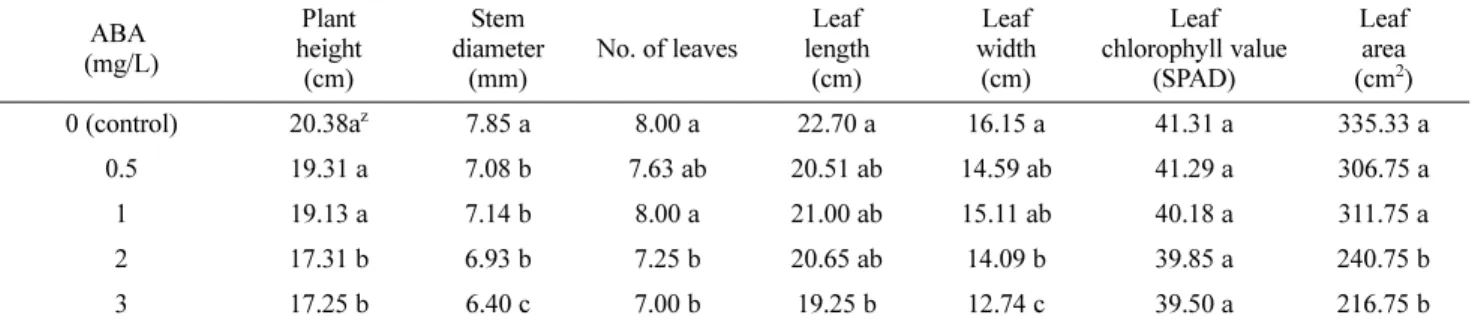
The changes of the plant growth characteristics to ABA treatment are given in Table 1, 2 and Fig. 1. Plant height and stem diameter of tomato seedlings were significantly decreased with ABA concentration. These results agree with previous reports that ABA acts as an inhibitor of shoot growth (Munns and Cramer, 1996). In this study, the tall- est plant height and thicker stem diameter were observed in the control, but for the plant height the difference was not statistically significant among the control, 0.5, and 1mg·L−1
ABA treatments. For the stem diameter, no statistical dif- ferences were observed in the 0.5, 1, and 2mg·L−1 treat- ments, but all were lower than the control. The height and stem diameter decreased at 2 and 3mg·L−1 ABA concentra- tion.
The inhibition of leaf growth by ABA was reported in many papers (Alves and Setter, 2000; Carrow, 1996; Sharp et al., 1994). Thus not surprisingly in this study, the leaf number, leaf length, leaf width, and leaf area decreased with increasing ABA concentration. The leaf number and leaf area, however, were similar in the control, 0.5, and 1mg·L−1, but significantly decreased in the seedlings treated with 2 and 3mg·L−1 of ABA. There was no statisti- cally significant difference observed in the leaf length among control, 0.5, 1, and 2mg·L−1 of ABA, but a signifi- cant decrease was found in the 3mg·L−1 treatment. The leaf width was similar in seedlings treated with 0.5, 1, and 2mg·L−1 of ABA, but lower than that in the control. The lowest value of leaf width was observed in seedlings treated at 3mg·L−1 of ABA. Leaf chlorophyll value decreased with increasing ABA concentration. The highest value of chlorophyll content was observed in seedlings in the control and the lowest value was observed in the
3mg·L−1 treatment. These results agree with Farooq and Bano, (2006) and Iqbal et al. (2010) who observed that ABA application causes decreases in chlorophyll contents in wheat, mungbean, and chickpea plants. However, in this study the differences in the chlorophyll values were not sta- tistically different in all treatments (Table 1).
ABA added to the nutrient solution of intact plants causes a greater inhibition of shoot growth than root growth (Creelman et al., 1990; Robertson et al., 1990), and sometimes it causes a sustained increase in root growth (Biddington and Dearman, 1982; Watts et al., 1981). In this study, the fresh and dry weight of shoot decreased with increasing ABA concentration. However, there were no sta- tistical differences between the control, 0.5, and 1mg·L−1 of ABA treatments, but it decreased with ABA concentration of 2 and 3mg·L−1. The highest value of fresh and dry weight of root was observed in the 1mg·L−1 of ABA treat- ment (Table 2). The root weight increase may be caused indirectly by ABA inhibiting shoot growth, thus resulting in a redistribution of assimilates to the roots. Alternatively, ABA may actively promote root growth and in so doing direct the movement of metabolites away from the grow- ing point of the shoot to the root. These results agree with Table 1. Effect of ABA concentrations in nutrient solution on growth characteristics of tomato seedlings at 10 days after treatment.
ABA (mg/L)
Plant height (cm)
Stem diameter
(mm)
No. of leaves
Leaf length
(cm)
Leaf width
(cm)
Leaf chlorophyll value
(SPAD)
Leaf area (cm2)
0 (control) 20.38az 7.85 a 8.00 a 22.70 a 16.15 a 41.31 a 335.33 a
0.5 19.31 a 7.08 b 7.63 ab 20.51 ab 14.59 ab 41.29 a 306.75 a
1 19.13 a 7.14 b 8.00 a 21.00 ab 15.11 ab 40.18 a 311.75 a
2 17.31 b 6.93 b 7.25 b 20.65 ab 14.09 b 39.85 a 240.75 b
3 17.25 b 6.40 c 7.00 b 19.25 b 12.74 c 39.50 a 216.75 b
zMean separation within columns by Duncan’s multiple range test at P = 0.05.
Table 2. Effect of ABA concentrations in nutrient solution on fresh and dry weight of shoot and root, T/R, and compactness of tomato seedlings at 10 days after treatment.
ABA concentration (mg/L) Fresh weight (g) Dry weight (g)
T/R ratioz Compactnessy (mg/cm)
Shoot Root Shoot Root
0 (control) 26.41 ax 3.91 b 1.98 a 0.26 b 7.62 a 9.71 a
0.5 25.74 a 4.08 b 1.80 a 0.25 b 7.34 a 9.32 a
1 24.72 a 4.89 a 1.85 a 0.30 a 6.14 b 9.65 a
2 17.95 b 4.14 b 1.34 b 0.23 c 5.91 b 7.75 b
3 16.64 b 3.77 c 1.17 c 0.22 c 5.63 b 6.80 b
zT/R ratio = Shoot dry weight/root dry weight.
yCompactness = Shoot dry weight (mg)/plant height (cm).
xMean separation within columns by Duncan’s multiple range test at P = 0.05.
Abou-Mandour and Hartung (1980) who also shown that ABA increases the weight of adventitious roots on the hypocotyls of Phaseoluscoccineus seedlings. The seed- lings treated with 0.5 and 1mg·L−1 ABA were similarly compact as in the control, but the compactness decreased in the 2 and 3mg·L−1 treatments. The T/R ratio decreased with ABA concentration (Table 2), similarly as reported for the root to shoot dry weight ratio of Capsicum annuum and
Zea mays (Watts et al., 1981).
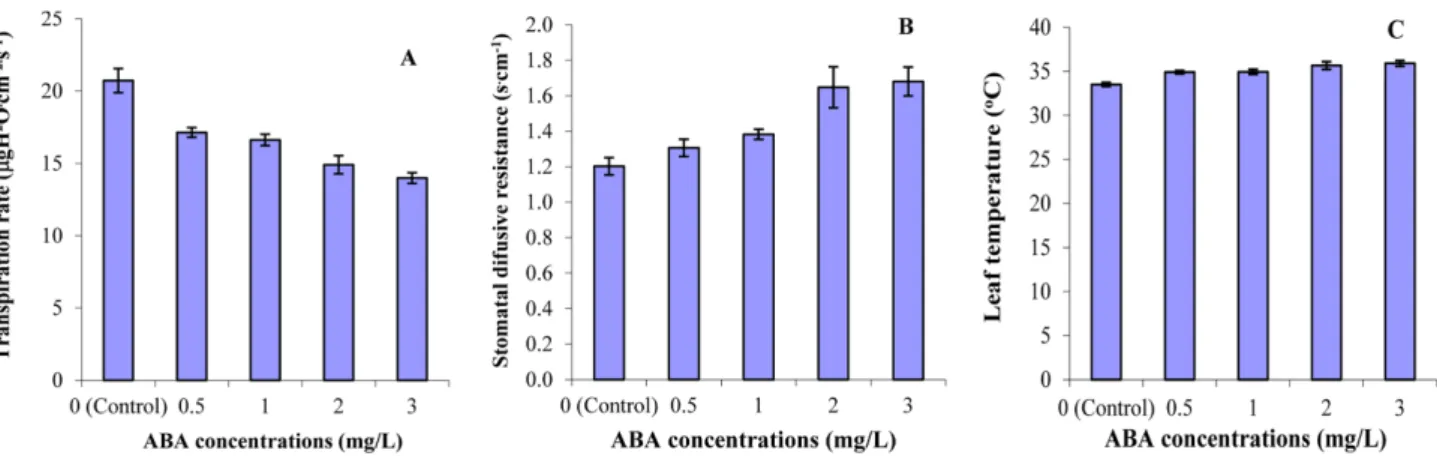
The transpiration rate decreased significantly with increasing ABA concentration, while the stomatal diffu- sive resistance and leaf temperature increased (Fig. 1), which agrees that ABA induces stomatal closure, resulting in decreased transpiration (Arteca et al., 1985; Mansfield and Jones, 1971; Mittelheuser and Van Steveninck, 1969).
Jones and Mansfield (1972) also showed that ABA reduces Fig. 1. Effect of ABA concentration in nutrient solution on (A) transpiration rate (mgH2O·cm−2·s-1), (B) stomatal diffusive resistance (s·cm−1), and (C) leaf temperature (oC) of tomato seedlings at 10 days after treatment. Vertical error bars represent standard errors (n=6).
Fig. 2. Effect of ABA concentrations in nutrient solution on root morphology of tomato seedlings at 10 days after treatment. (A) Total root surface area (cm2), (B) total root length (cm), (C) average root diameter (mm), and (D) number of root tips of tomato seedlings.
Vertical error bars represent standard errors (n=6).
transpiration in barley (Hordeumvulgare L.). Moreover, Takahashi et al. (1993) reported that the leaf temperature of upper, middle, and lower leaves of tomato plants increased with increasing ABA concentration in the culture solution.
2. The effect of short-term application of ABA to nutri- ent solution on root morphology of tomato seedlings
The changes in root morphology in response to ABA treatment are summarized in Fig. 2. The total root surface area, total root length, average root diameter, and number of toot tips were significantly different among the various ABA treatments. Compared with control, the total root sur- face area increased at 0.5, 1, and 2mg·L−1 of ABA, but decreased in seedlings treated with 3mg·L−1 of ABA. The highest value of total root surface area was observed at 1mg·L−1 of ABA. The total root length increased at 0.5 and 1mg·L−1 of ABA, but decreased at 3mg·L−1 of ABA. The decrease in the total root length may be caused directly by ABA inhibition of the root development. These results agree with Liao et al. (2008) who found that ABA expo- sure at low concentration (0.5µM) increased the root length and at higher concentrations (1 and 5µM) the root length decreased in mutant soybean plants. Moreover, it has been previously shown that ABA does not increase the length of the roots (Gaither et al., 1975; Watts et al., 1981; Yamagu- chi and Street, 1977). The highest value of the average root diameter was observed at 1mg·L−1 of ABA, while it was similar in the control or 0.5, 2, and 3mg·L−1 of ABA. The number of root tips increased with ABA treatment, but decreased with high concentration (Fig. 2), which is simi- lar with the results of Biddington and Dearman (1982) who
reported that the most obvious effect of ABA on cauli- flower root growth was to increase the number of lateral branches and to increase both the number and length of the root hair.
3. The effect of short-term application of ABA to nutrient solution on drought stress of tomato seedlings
ABA accumulation protects plants from drought damage by inducing stomata closure to reduce water loss via tran- spiration (Borel et al., 1997; Li et al., 2000) and increasing hydraulic conductance for water movement from roots to leaves (Ludewig et al., 1988; Zhang et al., 1995). In this study, the application of ABA in nutrient solution enhanced the drought tolerance of tomato seedlings by delaying the starting time of wilting point under drought conditions and enhancing the recovery after re-irrigation. The starting time of wilting point was observed at 10 hrs in the control treat- ment, but it was observed at 30 hrs in all ABA treatments.
The 100% of wilted plant was observed in the control treat- ment after 20 hrs of water stress, but it was observed at 40 hrs in treated seedlings with 2 and 3mg·L−1 of ABA for 5 days and at 50 hrs in other ABA treatments. The seedlings grown in nutrient solution with ABA for 5 days, 83.3% and 66.7% of surviving seedlings were found in the 0.5 and 1mg·L−1 treatments after re-irrigation, while no surviving seedlings were found in the control, 2 and 3mg·L−1 of ABA treatment. In the seedlings grown in nutrient solution with ABA for 10 days, the highest recovery of the seedlings post re-irrigation was observed in the 0.5 and 1mg·L−1 ABA treatments. The seedlings in the 2 and 3mg·L−1 of ABA treatment had 66.7% and 50% survival seedlings, Table 3. Effect of ABA concentrations in nutrient solution on drought tolerance of tomato seedlings grown in nutrient solution with ABA
for 5 and 10 days.
ABA treating Duration
(days)
ABA (mg/L)
Percentage of wilted plant after treating in -5 bars of PEG
Recovered seedlings after 2 days in normal solution (%) 10 hours 20 hours 30 hours 40 hours 50 hours
0 (control) 33.3 100 100 100 100 0
5
0.5 0 0 16.7 50.0 100 83.3
1 0 0 16.7 66.7 100 66.7
2 0 0 33.3 100 100 0
3 0 0 50.0 100 100 0
10
0.5 0 0 16.7 50.0 100 100
1 0 0 16.7 50.0 100 100
2 0 0 33.3 83.3 100 66.7
3 0 0 33.3 83.3 100 50.0
respectively (Table 3). These results agree with those of Waterland et al. (2010) who reported that both spray and drench applications of 500mg·L−1 of ABA on a variety of popular bedding plants delayed the time to wilting as much as 3 days for marigolds and 4 days for petunia. Moreover, pansy maintained higher turgor when receiving ABA as a spray, whereas other crops, including petunia and impa- tiens, were more receptive to drench applications.
In conclusions, the application of ABA in the nutrient solution enhanced the drought tolerance of tomato seed- lings by delaying the start time wilting point and enhanc- ing the recovery after re-irrigation. Short-term application of 1mg·L−1 of ABA in the nutrient solution stimulated the root growth and drought tolerance of tomato seedlings.
Acknowledgements
This study was supported by Export Promotion Technol- ogy Development Program, Ministry of Agriculture, Food and Rural Affairs, Republic of Korea. This research was supported by Kangwon National University Research Fund, 2013.
Literature Cited
Abou-Mandour, A.A. and W. Hartung. 1980. The effect of abscisic acid on growth and development of intact seed- lings, root and callus cultures, and stem and root segments of Phaseoluscoccineus. Zeischrift fur Pflanzenphysiolgie.
100:25-33.
Alves, A.A.C. and T.L. Setter. 2000. Response of cassava to water deficit: Leaf area growth and abscisic acid. Crop Sci.
40:131-137.
Arsenault, J.L., S. Pouleur, C. Messier, and R. Guay. 1995.
WinRHIZO, a root-measuring system with a unique over- lap correction method. HortScience.30:906.
Arteca, R.N., D. Tsia, and C. Schlagnhaufer. 1985. Abscisic acid effects on photosynthesis and transpiration in gera- nium cuttings. HortScience. 20:370-372.
Bakhsh, I., I. Awan, M. Sadiq, M. Niamatullash, K.U. Zaman, and M. Aftab. 2011. Effect of plant growth regulator appli- cation at different growth stages on the economical yield potential of coarse rice (Oriza sativa L.). J. Anim. Plant Sci.
21:612-616.
Biddington, N.L. and A.S. Dearman. 1982. The effect of abscisic acid on root and shoot growth of cauliflower plants.
Plant Growth Regul. 1:15-24.
Borel, C., T. Simonneau, D. This, and F. Tardieu. 1997. Sto- matal conductance and ABA concentration in the xylem sap of barley lines of contrasting genetic origins. Austral. J.
Plant. Physiol. 24:607-615.
Carrow, R.N. 1996. Drought avoidance characteristics of diverse tall fescue cultivars. Crop Sci. 36:371-377.
Creelman, R.A., H.S. Mason, R.J. Bensen, J.S. Boyer, and J.E.
Mullet. 1990. Water deficit and abscisic acid cause differen- tial inhibition of shoot versus root growth in soybean seed- lings. Plant Physiol. 92:205-214.
Farooq, U. and A. Bano. 2006. Effects of abscisic acid and chlorocholine chloride on nodulation and biochemical con- tent of Vignaradiata L. under water stress. Pakistan J. Bot.
38:1511-1518.
Franks, P.J. and G.D. Farquhar. 2001. The effect of exogenous abscisic acid on stomatal development, stomatal mechanics, and leaf gas exchange in Tradescantiavirginiana. Plant Physiol. 125:935-942.
Gaither, D.H., D.H. Lutz, and L.E. Forrenc. 1975. Abscisic acid stimulates elongation of excised pea root tips. Plant Physiol. 55:948-949.
Iqbal, S., A. Bano, N. Ilyas. 2010. Drought and abscisic acid (ABA) induced changes in protein and pigment contents of four wheat (Triticumaestivum L.) accessions. J. Agric. Res.
48: 1-13.
Jiang, F. and W. Hartung. 2008. Long-distance signaling of abscisic acid (ABA): the factors regulating the intensity of the ABA signal. J. Exp. Bot. 59:37-43.
Jones, R.J. and T.A. Mansfield. 1972. Effect of abscisic and its Fig. 3. Views of tomato seedlings in experimental hydroponic system (A). Tomato seedlings 10 days after treatment with ABA (B). Roots
of tomato seedlings at 10 days after treatment with ABA (C).
esters on stomatal aperture and the transpiration ratio. Phys- iol. Plant. 26: 321-327.
Kim, I.S., C.H. Zhang, H.M. Kang, and B. Mackay. 2008.
Control of stretching cucumber and tomato plug seedlings using supplemental light. Hort. Environ. Biotechnol.
49:287-292.
Leskovar, D.I. and D.J. Cabtliffe. 1992. Pepper seedling growth response to drought stress and exogenous abscisic acid. J. Amer. Soc. Hort. Sci. 117:389-393.
Li, J., X.Q. Wang, M.B. Watson, and S.M. Assman. 2000.
Regulation of abiotic acid-induced stomatal closure and anion channels by guard cell AAPK kinase. Science.
287:300-303.
Li, X.J., M.F. Yang, H. Chen, L.Q. Qu, F. Chen, and S.H.
Shen. 2010. Abscisic acid pretreatment enhances salt toler- ance of rice seedlings: Proteomic evidence. Biochim. Bio- phys. Acta. 1804:924-940.
Liao, Y., J.S. Zhang, S. Chen, and W. Zhang. 2008. Role of soybean GmbZIP132 under abscisic acid and salt stresses. J.
Intergr. Plant Biol. 50:221-230.
Ludewig, M., K. Doerffling, and H. Seifert. 1988. Abscisic acid and water transport in sunflowers. Planta. 175:325-333.
Mansfield, T.A and R.J. Jones. 1971. Effect of abscisic acid on potassium uptake and starch content of stomatal guard cells.
Planta. 101:147-158.
Michel B.E. 1983. Evaluation of the water potentials of solu- tions of polyethylene glycol 8000. Plant Physiol. 72:66-70.
Mittelheuser, C.J. and R.F.M. Van Stevenninck. 1969. Sto- matal closure and inhibition of transpiration induced by (R.S)-abscisic acid. Nature. 21:281-282.
Munns, R. and G.R. Cramer. 1996. Is coordination of leaf and root growth mediated by abscisic acid? Opinion. Plant Soil.
185:33-49.
Pilet P.E. 1983. The effect of abscisic acid on aseptically cul- tured maize roots. Physiol Veg. 21:495-500.
Pilet P.E and J.E. Rebeaud. 1983. Effect of abscisic acid on growth and indolyl-3-acetic acid levels in maize roots. Plant
Sci. Letts. 31:117-122.
Pilet P.E and P.W. Barlow. 1987. The role of abscisic in root growth and gravireaction: A critical review. Plant Growth Regul. 6:217-265.
Rajasekaran, L.R and T.J. Blake. 1999. New plant growth reg- ulators protect photosynthesis and enhance growth under drought of jack pine seedlings. J. Plant Growth Regul.
18:175-181.
Robertson, J.M., K.T. Hubick, E.C. Yeung, and D.M. Reid.
1990. Developmental responses to drought and abscisic acid in sunflower roots. I. Root growth, apical anatomy, and osmotic adjustment. J. Exp. Bot. 41:325-327.
Seiler, J.R. and J.D. Johnson. 1988. Physiological and mor- phological responses of three half-sib families of loblolly pine to water-stress conditioning. For. Sci. 34:487-495.
Sharp, R.E., Y. Wu, G.S. Voetberg, I.N. Saab, and M.E. LeNo- ble. 1994. Confirmation that abscisic acid accumulation is required for maize primary root elongation at low water potentials. J. Exp. Bot. 45:1743-1751.
Takahashi, H., K. Koshio, and Y. Ota. 1993. Effects of ABA application to the culture solution on the growth, water rela- tions and temperature stress in tomato plants, J. Jpn. Soc.
Hort. Sci. 62: 389-397.
Waterland, N., J.J. Finer, and M.L. Jones. 2010. Abscisicacid applications decrease stomatal conductance and delay wilt- ing in drought-stressed chrysanthemums. HortTechnology.
20:896-901.
Watts, S., J.L. Rodriguez, E. Evans, and W.J. Davies. 1981.
Root and shoot growth of plants treated with abscisic acid.
Ann. Bot. 47:595-602.
Yamaguchi, T and H.E. Street. 1977. Stimulation of growth of excised cultured roots of soya bean by abscisic acid. Ann.
Bot. 41:1129-1133.
Zhang. J., X. Zhan, and J. Liang. 1995. Exudation rate and hydraulic conductivity of maize roots are enhanced by soil drying and abscisic acid treatment. New Phytol. 131:329- 336.
토마토 육묘과정에서 단기간 ABA처리가 묘소질과 건조내성에 미치는 영향
김일섭1*·넉탕부1·후앙텅부2·최기영3·김영식4
1강원대학교 원예학과, 2강원대학교 의생명학과, 3강원대학교 시설농업학과, 4상명대학교 식물식품학과
적 요. 본 실험은 단기간 ABA처리가 토마토 묘의 생장과 증산율, 기공 저항성 및 건조 내성에 미치는 영향
을 검토하기 위하여 수행되었다. 실험은 25일간 플러그 트레이에서 육묘한 토마토 묘를 간이 수경재배 키트에 이식하여 양액 육묘하면서 ABA처리 효과와 건조 내성을 검토하였다. 배양액에 ABA를 0.5, 1, 2, 및 3mg·L−1 의 농도로 첨가한 4개의 처리구와 무처리구를 설계하여 5일과 10일간 양액육묘한 뒤 묘소질, 엽온, 증산율, 기 공확산 저항성을 측정하였다. 건조 내성을 검토하기 위한 수분 스트레스 처리는 PEG 8,000을 이용하여 -5bar로 조정한 고삼투압 용액에 ABA처리 직후의 묘를 이식한 뒤, 묘의 위조 정도를 조사하였다. 저농도(0.5와 1mg·L−1) 의 ABA처리구에서 묘소질은 경경을 제외하고 대부분의 생육에서 통계적 유의차는 나타나지 않았으나, 2와 3mg·L−1의 농도에서는 지상부의 생장이 억제되었다. 근권부의 생장은 1mg·L−1의 농도처리에서만 뿌리의 건물 중과 생체중, 전표면적, 근장, 근경, root tip수 모두가 유의적으로 증가하였으며, 그 외의 처리농도에서는 일부 의 생육지표를 제외하고는 유의적 차이가 나타나지 않았다. ABA처리 농도가 증가함에 따라 기공확산 저항성 은 증가하고 증산율은 감소하는 경향을 보였다. 또, ABA처리는 묘의 건조 내성을 증가시켜 ABA가 첨가된 배 양액에서 5일 또는 10일간 육묘한 묘를 -5bar 용액에 치상하였을 경우 대조구는 치상후 10시간 후부터 묘의 위조가 시작되어 20시간 후에는 모든 개체가 위조하였으나, ABA처리구는 치상 30시간 후부터 위조가 시작되 어 50시간이 경과해서야 모든 개체가 위조되었다. 또, 수분 스트레스처리로 위조된 묘를 재관수하였을 경우 ABA 0.5와 1mg·L−1처리구는 100%, 그 이상 농도 처리구에서도 50%이상 회복되었으나, 무처리구의 경우는 전개체가 고사하였다. 이상의 결과 토마토 육묘과정에서 저농도의 ABA처리를 통한 근권부의 생장 촉진과 건 조 내성 증진 가능성이 시사되었으나, 상업적 활용을 위해서는 추가적인 검토가 필요할 것으로 판단된다.
추가주제어 : 수경재배, 뿌리형태, 기공확산 저항, 증산율, 수분 스트레스