• 검색 결과가 없습니다.

Heavy Metals Immobilization in Soil with Plant-growth-promoting Rhizobacteria and Microbial Carbonate Precipitation in Support of Radish Growth

N/A
N/A
Protected

Academic year: 2021

Share "Heavy Metals Immobilization in Soil with Plant-growth-promoting Rhizobacteria and Microbial Carbonate Precipitation in Support of Radish Growth"

Copied!
7
0
0

로드 중.... (전체 텍스트 보기)

전체 글

(1)

Heavy Metals Immobilization in Soil with Plant-growth- promoting Rhizobacteria and Microbial Carbonate

Precipitation in Support of Radish Growth

Jing He

1,2

, Qiuzhuo Zhang

2

, and Varenyam Achal

1,2

*

1

Environmental Engineering Program, Guangdong Technion Israel Institute of Technology, Shantou, P. R. China

2

School of Ecological and Environmental Sciences, East China Normal University, Shanghai, P. R. China

Received: December 16, 2019 / Revised: February 26, 2020 / Accepted: March 23, 2020

Introduction

With the increasing use of legumes as part of a bal- anced diet, their safety has become an important con- cern. Soil not only supports plant growth but also determines the composition of food and feed at the bot- tom of the food chain [1]. However, cadmium (Cd), lead (Pb) and other heavy metal pollutants are frequently reported worldwide in agricultural soil due to the long- term use of phosphoric fertilisers, sewage sludge appli- cation, dust from smelters, industrial waste and unsuit- able watering practices in agricultural lands [2]. As

heavy metal-polluted soil is closely associated with plant growth and agricultural productivity, heavy metals can easily enter the food chain and pose a significant risk to human health and the environment [3].

Metal pollutants in contaminated soils are hard to degrade or transform into safer products and cannot be effectively separated from the environment [4]. In addi- tion, trace amounts of heavy metals in agricultural crops, such as Pb, copper and Cd, can cause iron-defi- ciency symptoms in microorganisms and have a negative effect on plant photosynthesis, as well as binding to mer- capto groups in proteins and inhibiting enzyme activity [5, 6]. Therefore, there is great interest in the remedia- tion of heavy metals in soil by immobilising heavy met- als through physical, chemical and biological means to improve the physical and chemical properties of soil so The application of plant-growth-promoting rhizobacteria (PGPR) supports the growth of plants in contam- inated soil while ureolytic bacteria can immobilise heavy metals by carbonate precipitation. Thus, dual treatment with such bacteria may be beneficial for plant growth and bioremediation in contaminated soil.

This study aimed to determine whether the PGPR Pseudomonas fluorescens could work in synergy with ureolytic bacteria to assist with the remediation of cadmium (Cd)- and lead (Pb)-contaminated soils. Pot experiments were conducted to grow radish plants in Cd- and Pb-contaminated soils treated with PGPR P.

fluorescens and the results were compared with dual inoculation of P. fluorescens combined with ureolytic Staphylococcus epidermidis HJ2. The removal rate of the metals from the soil was more than 83% for Cd and Pb by the combined treatment compared to 17% by PGPR alone. Further, the dual treatment reduced the metal accumulation in the roots by more than 80%. The translocation factors for Cd and Pb in plant tis- sues in both treatments remained the same, suggesting that PGPR combined with the carbonate precipita- tion process does not hamper the transfer of essential metal ions into plant tissues from the soil.

Keywords: Heavy metals, PGPR, carbonate, urease, bioremediation

*Corresponding author

Tel: +86-754-88077092, Fax: +86-754-88077034 E-mail: [email protected]

© 2020, The Korean Society for Microbiology and Biotechnology

(2)

that the land can be rehabilitated in contaminated sites [7].

Bioremediation, an environmentally friendly and cost- effective technique, has begun to replace the physical and chemical strategies commonly used in the past [8].

The use of microbial bioremediation of heavy metals in soil can effectively reduce the transfer of metals to the soil ecosystem and ensure the safety of vegetable produc- tion. Microbially induced carbonate precipitation (MICP), which is mainly performed by ureolytic bacteria, can effectively immobilise heavy metals from the soil [9 −11].

However, MICP alone may not be enough to meet the requirements of practical application in contaminated agriculture fields and we speculate that plant-growth- promoting rhizobacteria (PGPR) may increase the effec- tiveness of bioremediation.

Plant-promoted rhizosphere microbes can cause chem- ical conversion and helpful in chelating metal in the soil, while at the same time can also induce precipitation or biosorption to reduce the availability of heavy metals.

Rhizosphere-related bacteria can produce hormones that stimulate plant growth and provide nutrients to plants, thus increasing metal bioaccumulation [12]. The PGPR, including Pseudomonas sp., Bacillus sp., Paenibacillus sp., Enterobacter sp. and Geobacillus sp., not only inhibit the negative effects of heavy metals on plants but also offer the potential for novel crop production strategies [13]. Furthermore, adding chelant alongside the PGPR can improve the efficiency of the immobilisation of heavy metals from the soil [6, 7, 14]. Thus, instead of adding chemicals as the chelant, MICP could be a more environ- mentally friendly alternative. Further, heavy metal- resistant MICP bacteria may improve the interactions between plants and beneficial rhizosphere microorgan- isms by efficiently immobilising toxic metals.

Considering the advantages of MICP and PGPR, we hypothesised that, together, they would be highly effi- cient for heavy metal remediation in soil. Therefore, we

tested whether combining MICP by Staphylococcus epi- dermidis HJ2 with PGPR Pseudomonas fluorescens increased the remediation of heavy metals in soil while growing radish plants. Staphylococcus epidermidis HJ2 was reported to have metal immobilization capability based on ureolytic activity [9], while Pseudomonas fluo- rescens is well known as plant growth promoting rhizo- bacteria.

Materials and Methods

Seed planting and soil remediation with bacteria

Field pot experiments were performed in September to November 2018 in an agricultural soil contaminated by the artificial addition of heavy metals (25 mg kg

-1

PbCl

2

and 25 mg kg

-1

CdCl

2

) in Minhang district (China), for 50 days. The outdoor experiment was used to study the effect of combined bacterial strains on plant growth and Cd(II) and Pb(II) uptake. Two strains were selected to remediate soil contaminated with Cd and Pb. Staphylo- coccus epidermidis HJ2, which leads to MICP, was iso- lated from an electronic industrial area in Nantong, Jiangsu province, China [10]. Pseudomonas fluorescens CGMCC1.55 was used as the PGPR and was procured from CGMCC (China). Commercial-variety radish seeds were obtained from the Station for Popularizing Agricul- tural Technique, China.

Each plastic pot was filled with 6 kg of soil that had been spiked with 25 mg kg

-1

CdCl

2

and 25 mg kg

-1

PbCl

2

. The seeds were separated into two groups: the first group was dipped in sterile water (uninoculated control) and the other in bacterial suspensions for 2 h in Petri plates before being placed in separate pots. For inocula- tion treatments, approximately 2 ml of P. fluorescens and/or 2 ml S. epidermidis HJ2 inoculum was injected into the rhizosphere of radish seedlings at the first leaf stage. After growing five true leaves, 4 ml of bacterial suspensions were added to each experimental group.

Table 1. Experimental treatment pots of the present study.

Code Treatments Combination type

S1 Pb + Cd + P. fluorescens Pb + Cd contaminated soil, mono inoculation

S2 Pb + Cd + S. epidermidis HJ2 + P. fluorescens Pb + Cd contaminated soil, dual inoculation

C0 The original soil None

C1 Original soil spiked with Pb + Cd Pb + Cd contaminated soil, non-inoculation

(3)

The metal-immobilisation efficiency of S. epidermidis HJ2 has been reported previously [10]. Thus, one bacte- rial treatment was with P. fluorescens (S1) while another combined P. fluorescens and S. epidermidis HJ2 (S2). Original soil (unspiked with metals) and spiked soil pots without bacterial treatment were irrigated with an identical volume of deionised water and served as con- trols (C0 and C1). The experiment was carried out in a completely randomised design with four treatments and three repetitions per pot (Table 1). After 50 days of treat- ment, plants, including roots, were carefully removed from the pots. The plant stem fresh weight was mea- sured immediately after harvesting and the stem part (dry weight) was weighed after drying at 65 ℃.

Physicochemical properties of soil

After harvesting, the pots were divided into three lay- ers (top, middle and bottom) of 10 cm each to explore the changes in nutrients in the different soil levels. The soil samples were air-dried and ground using a ceramic mill and then sieved (2 mm). Physicochemical properties of soil, including organic matter (OM), pH, total nitrogen (TN), total phosphate (TP) and available phosphate (available P), were measured according to standard pro- tocols [15]. Heavy metal contents (Pb and Cd) were anal- ysed by Inductively coupled plasma mass spectrometry, ICP-MS (Shimadzu, Japan).

Analysis of Cd and Pb in plant roots, stems and leaves Radish samples were collected in sampling bags prior to rinsing twice with deionised water. The white radish was divided into three parts (root, stem and leaves) that were dried at 65 ℃, ground and sieved with 40-mesh.

The accumulation of Pb and Cd was analysed by ICP- MS after nitric acid and H

2

O

2

(5:2, v/v) treatment via the microwave-oven digestion method [16].

Estimation of bioconcentration and translocation factors The bioconcentration factor (BCF) and translocation factor (TF) were calculated to estimate the metal uptake in different parts of the plant [17, 18]. The factors were calculated as follows:

BCF = Concentration of heavy metals in the aerial parts of plant/concentration of heavy metals in the soil

TF = Concentration of heavy metals in the stem (leaves)/concentration of heavy metals in the root (stem)

Statistical analysis

All data are presented as the mean values of three rep- licates. The data were analysed using the statistical package OriginPro (Version 8.6) and Excel. For pot experiments, data are represented as the mean ± stan- dard deviation of three replicates. On the point of testing for the assumptions, the outcomes of the tests and the application of transformations were not required and not tested. Wherever applied, in order to mention the signif- icant differences in particular data, the different letters associated with bar indicated significant differences at p < 0.05, according to Tukey’s test after an ANOVA was conducted.

Results and Analysis

Physicochemical properties of soil

In this study, plant-growth-promoting and ureolytic bacteria were evaluated for their role in the immobilisa- tion of Cd and Pb in contaminated soil while growing radish plants, the effect of the treatment on plant growth and metal accumulation in radish tissues, as well as the mechanism involved in growth promotion and metal remediation.

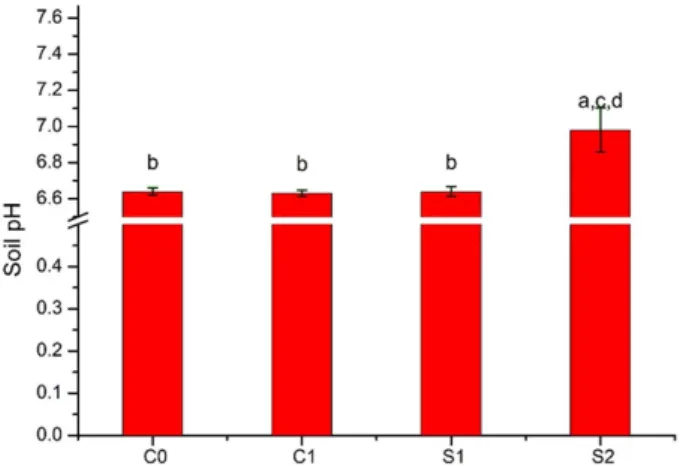
After the pot experiment and bacterial treatment, the soil pH in each pot was measured. There were no obvi- ous pH changes compared to the control when the soil was inoculated with P. fluorescens (S1). However, when the soil was inoculated with both P. fluorescens and S.

epidermidis HJ2 (S2), it led to the pH value of the initial

Fig. 1. The variation of pH after soil remediation. Error bars

are ± standard deviation (n = 3). Bars indicated by the different

letters indicate significant differences at p < 0.05 according to

Tukey’s test.

(4)

soil increasing from 6.62 to 7.12 (Fig. 1). The pH change was due to the carbonate precipitation ability of S.

epidermidis HJ2, which was confirmed in our previous research [10]. The enzyme urease is produced by S. epi- dermidis HJ2 that catalyses the hydrolysis of urea into carbonate and ammonium ions that ultimately increase the pH.

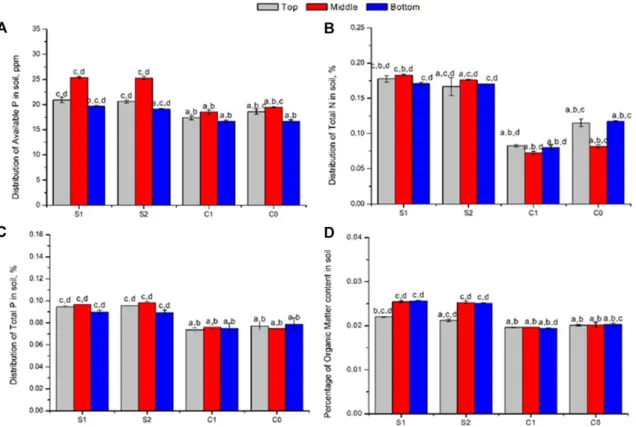
To determine the distribution of nutrients in the soil, vertical soil samples were collected from the pots. With the dual inoculum of P. fluorescens and S. epidermidis HJ2, there was a significant improvement (p < 0.05) in available P, TP, TN and OM in soil compared to inocula- tion with P. fluorescens alone (Fig. 2). Overall, the mid- dle layer of the soil (10 −20 cm) showed the highest amount of nutrients. The variation in different soil lay- ers could be due to the degree of eluvation and illuvia- tion of Al and Fe oxides from one layer into another, in addition to the varying distribution of carbonate precipi- tation in the different layers [19].

The soil properties after remediation were compared

with those of the original soil. PGPR had a positive effect on solubilising phosphate, especially, for the wide distri- bution of rhizosphere. However, the addition of S.

epidermidis HJ2 caused little variation in the soil prop- erties, except for a change in pH due to its ability to form carbonate ion with ammonia production that also led to increased total N in S2 [10]. The concentrations of essen- tial nutrients were significantly less in untreated metal- spiked soil (C1) when compared with unspiked soil (C0), indicating a stressful environment for plants due to the presence of heavy metals.

Plant growth

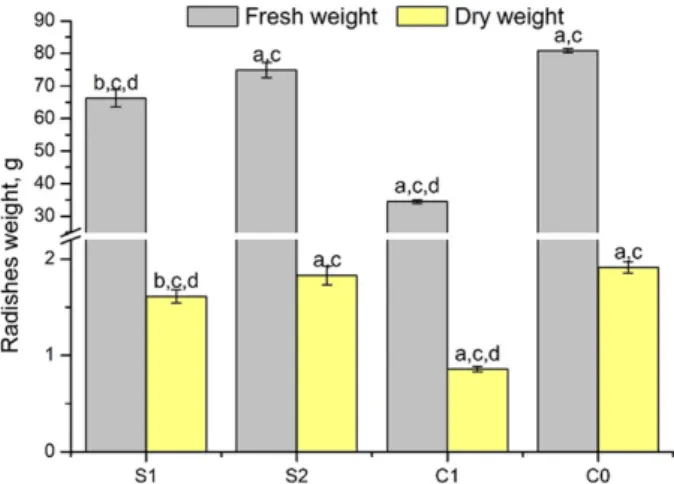
Growing plants under soluble Pb and Cd stress can indirectly affect biomass production. As Fig. 3 depicts, there was a significant reduction in the fresh weight and dry weight of radish in C1 (soil spiked with metals) com- pared to soil without metals (C0). The fresh plant weight (~81 g) in the original soil reduced to 34 g fresh weight when grown in metal-contaminated soil. However, the

Fig. 2. Distribution of nutrients in soil among various treatments and control (A) Available phosphate; (B) Total nitrogen;

(C) Total phosphate; (D) Organic matter. Error bars are means ± standard errors (n = 3). Bars indicated by the different letters indi-

cate significant differences at p < 0.05 according to Tukey’s test. Top, middle and bottom layers denote height of 0-10, 10-20, and

20-30 cm, respectively.

(5)

addition of PGPR resulted in a reduction in this negative effect and the radish fresh weight in S1 was 66 g.

The results in Fig. 3 indicate that inoculation with PGPR enhances radish fresh weight and dry weight during metal contamination, which agrees with previous studies [12]. The reason that PGPR inoculation supports plant growth is attributed to indole acetic acid produc- tion and excretion [20]. In addition, the PGPR may reduce the negative phytotoxic effect of metals by shar- ing the metal load due to its biosorption and bioaccumu- lation [21].

The significant improvement ( p < 0.05) in the growth of radish weights (75 g fresh weight and 1.8 g dry weight) with the dual treatment of P. fluorescens and S.

epidermidis HJ2 indicates that MICP led to the addi- tional promotion of plant growth. The carbonate precipi- tation by S. epidermidis HJ2 likely immobilised the metal ions thus alleviating biosorption and bioaccumula- tion, which resulted in increased radish growth. Bio- available metals can be stabilised using calcite- precipitating bacteria [9, 22]. In addition, the production of siderophores in the presence of bacteria may stimu- late plant growth directly under iron limitation condi- tions or indirectly by forming stable complexes with heavy metals, such as Zn, Al, Cu and Pb, to alleviate the metal stress [23]. Siderophores secreted by PGPR strains can decrease the formation of free radicals, thus protecting microbial auxins from degradation and enhancing plant growth [17].

Metal accumulation in plant tissues, translocation factors and soil remediation

The metal concentrations in the root, stem and leaf tis- sues of radish grown in artificially metal-contaminated soil (C0 = 25 mg kg

-1

Pb

2+

and 25 mg kg

-1

Cd

2+

) with and without treatment are given in Fig. 4. With dual P. fluo- rescens and S. epidermidis HJ2 treatment of soil, 50- day-old cultivars of radish plants contained significantly lower amounts of Cd and Pb in the roots, shoot and leaves compared to when treated only with P. fluo- rescens (S1) or the control (C1). The metal contents in the shoot and root systems of radish increased with the metal concentration in soil that was not treated with P.

fluorescens and S. epidermidis HJ2 (Fig. 4). Without bioremediation, high concentrations of both Cd and Pb were transferred into roots (> 19 mg kg

-1

of Cd/Pb) and around 10 mg kg

-1

of each metal into the shoots and leaves.

Compared to S1, when combined with carbonate pre- cipitation induced by S. epidermidis HJ2, the metal accumulation for Cd and Pb was reduced in the roots by 82.7% and 84%, respectively. The trend was similar for Cd accumulation in the stems and there was an 87%

reduction in Pb in the stems. Inoculation with PGPR alone was not effective in alleviating Pb stress in radish plant in other reports in which Bacillus sp. CIK-512 was used [24], while the combination of bacteria performing different roles was successful in other studies [25]. More- Fig. 3. The comparasion of radish weights both in terms of

fresh weight and dry weight. Error bars are means ± standard errors (n = 3). Bars indicated by the different letters indicate sig- nificant differences at p < 0.05 according to Tukey’s test.

Fig. 4. Distribution of metals accumulated in radish tissues.

Error bars are means ± standard errors (n = 3). Bars indi-

cated by the different letters indicate significant differences at

p < 0.05 according to Tukey’s test.

(6)

over, the impact of different treatments showed a simi- lar bioaccumulation tendency for radish tissues. Among them, the transferred concentration of metals from the root to the stem decreased, while the concentration of metals from the stem to the leaves increased. The mini- mum accumulation of heavy metals in the edible parts of plants achieved in this study could satisfy safe food demands [26].

The translocation factor is an important parameter to measure while studying metal accumulation in plants [27]. Although there were differences in the value of the TF between all treatments and the control, the TF showed a similar pattern, suggesting that PGPR com- bined with MICP does not hamper the transfer of essen- tial metal ions into plant tissues from soil (Fig. 5). The TF in Root to Stem (RS) and Stem to Leaves (SL) in S1 was 0.55 and 1.15 for Cd compared to 0.57 and 1.07 for Pb, respectively. In S2, the TF values in RS and SL were 0.52 and 1.17 for Cd and 0.45 and 1.24 for Pb, respec- tively.

After soil remediation with PGPR combined with MICP, the soil metal removal rate reached 83% for Cd and 85% for Pb, compared to 17% for Cd and Pb by PGPR alone (Fig. 6). Conversely, natural attenuation or external factors did not alleviate metal-contaminated soil that contained more than 23 mg kg

-1

of both metals.

High metal concentrations led to limited radish growth.

The addition of PGPR is generally not associated with the bioremediation of heavily metal-contaminated soil

while there are many reports on the role of carbonate precipitation induced by bacteria in the immobilisation of heavy metals including Cd and Pb [11, 22, 28]. More- over, the results of the present study revealed that PGPR combined with the MICP process could be a sus- tainable approach for plant growth under soil metal stress.

Microbially induced carbonate precipitation is proved as an efficient process in the immobilization of heavy metals from the soil. However, as PGPR are common bacteria in rhizosphere helping plant growth, the pro- cess of MICP together could bring sustainability in agri- culture. The present study revealed that the combined treatment of soil with plant-growth-promoting bacteria and ureolytic bacteria, which are capable of immobilis- ing metals via carbonate precipitation, are capable of treating metal-contaminated soils, thus leading to sig- nificant increases in plant growth. Such bacteria and MICP could be complementary to each other in bioreme- diation studies.

Acknowledgments

This research is supported by National Natural Science Foundation of China under grant number 41950410576.

Conflict of Interest

The authors have no financial conflicts of interest to declare.

Fig. 5. Translocation of metals from root to stem and stem to leaves, treatments vs control. Error bars are means ± standard errors (n = 3).

Fig. 6. Soil metals remediation by different treatments.

Error bars are means ± standard errors (n = 3). Bars indicated by

the different letters indicate significant differences at p < 0.05

according to Tukey’s test.

(7)

References

1. Tóth G, Hermann T, Da Silva MR, Montanarella L. 2016. Heavy metals in agricultural soils of the European Union with implica- tions for food safety. Environ. Int. 88: 299-309.

2. Saadani O, Fatnassi IC, Chiboub M, Abdelkrim S, Barhoumi F, Jebara M, et al. 2016. In situ phytostabilisation capacity of three legumes and their associated Plant Growth Promoting Bacteria (PGPBs) in mine tailings of northern Tunisia. Ecotoxicol. Environ.

Saf. 130: 263-269.

3. Płociniczak T, Kukla M, Wątroba R, Piotrowska-Seget Z. 2013. The effect of soil bioaugmentation with strains of Pseudomonas on Cd, Zn and Cu uptake by Sinapis alba L. Chemosphere 91: 1332-1337.

4. Chen Y, Ding Q, Chao Y, Wei X, Wang S, Qiu R. 2018. Structural development and assembly patterns of the root-associated microbiomes during phytoremediation. Sci. Total Environ. 644:

1591-1601.

5. Guo H, Luo S, Chen L, Xiao X, Xi Q, Wei W, et al. 2010. Bioremedia- tion of heavy metals by growing hyperaccumulaor endophytic bacterium Bacillus sp. L14. Bioresour. Technol. 101: 8599-8605.

6. Hussain A, Kamran MA, Javed MT, Hayat K, Farooq MA, Ali N, et al.

2019. Individual and combinatorial application of Kocuria rhizo- phila and citric acid on phytoextraction of multi-metal contami- nated soils by Glycine max L. Environ. Experi. Bot. 159: 23-33.

7. Islam F, Yasmeen T, Arif MS, Riaz M, Shahzad SM, Imran Q, et al.

2016. Combined ability of chromium (Cr) tolerant plant growth promoting bacteria (PGPB) and salicylic acid (SA) in attenuation of chromium stress in maize plants. Plant Physiol. Biochem. 108:

456-467.

8. Kamran MA, Xu RK, Li JY, Jiang J, Nkoh JN. 2018. Effect of different phosphorus sources on soybean growth and arsenic uptake under arsenic stress conditions in an acidic ultisol. Ecotoxicol.

Environ. Saf. 165: 11-18.

9. Achal V, Pan X, Zhang D. 2011. Remediation of copper-contami- nated soil by Kocuria flava CR1, based on microbially induced cal- cite precipitation. Ecol. Engin. 37: 1601-1605.

10. He J, Chen X, Zhang Q, Achal V. 2019. More effective immobiliza- tion of divalent lead than hexavalent chromium through carbon- ate mineralization by Staphylococcus epidermidis HJ2. Inter.

Biodeter. Biodegrad. 140: 67-71.

11. Zhu X, Li W, Zhan L, Huang M, Zhang Q, Achal V. 2016. The large- scale process of microbial carbonate precipitation for nickel remediation from an industrial soil. Environ. Pollut. 219: 149-155.

12. Rajkumar M, Freitas H. 2008. Effects of inoculation of plant- growth promoting bacteria on Ni uptake by Indian mustard.

Bioresour. Technol. 99: 3491-3498.

13. Das S, Jean JS, Kar S, Chou ML, Chen CY. 2014. Screening of plant growth-promoting traits in arsenic-resistant bacteria isolated from agricultural soil and their potential implication for arsenic bioremediation. J. Hazard. Mater. 272: 112-120.

14. Luo C, Wang S, Wang Y, Yang R, Zhang G, Shen Z. 2015. Effects of EDDS and plant-growth-promoting bacteria on plant uptake of trace metals and PCBs from e-waste–contaminated soil. J. Hazard.

Mater. 286: 379-385.

15. Xu X, Huang Q, Huang Q, Chen W. 2012. Soil microbial augmen- tation by an EGFP-tagged Pseudomonas putida X4 to reduce phy- toavailable cadmium. Inter. Biodeter. Biodegrad. 71: 55-60.

16. Davies Jr FT, Puryear JD, Newton RJ, Egilla JN, Grossi JAS. 2001.

Mycorrhizal fungi enhance accumulation and tolerance of chro- mium in sunflower (Helianthus annuus). J. Plant Physiol. 158: 777- 786.

17. Tirry N, Joutey NT, Sayel H, Kouchou A, Bahafid W, Asri M, et al.

2018. Screening of plant growth promoting traits in heavy met- als resistant bacteria: prospects in phytoremediation. J. Genet.

Eng. Biotechnol. 16: 613-619.

18. Becerra-Castro C, Monterroso C, Prieto-Fernández A, Rodríguez- Lamas L, Loureiro-Viñas M, Acea MJ, et al. 2012. Pseudometallo- phytes colonising Pb/Zn mine tailings: a description of the plant–microorganism–rhizosphere soil system and isolation of metal-tolerant bacteria. J. Hazard. Mater. 217: 350-359.

19. van der Wal A, de Boer W, Lubbers IM, van Veen JA. 2007. Con- centration and vertical distribution of total soil phosphorus in relation to time of abandonment of arable fields. Nutr. Cycl. Agro- ecosystems 79: 73.

20. Carlos MHJ, Stefani PVY, Janette AM, Melani MSS, Gabriela PO.

2016. Assessing the effects of heavy metals in ACC deaminase and IAA production on plant growth-promoting bacteria. Micro- biol. Res. 188: 53-61.

21. Zaidi S, Musarrat J. 2004. Characterization and nickel sorption kinetics of a new metal hyper-accumulator Bacillus sp. J. Environ.

Sci. Health A Tox. Hazard Subst. Environ. Eng. 39: 681-691.

22. Kang CH, Kwon YJ, So JS. 2016. Bioremediation of heavy metals by using bacterial mixtures. Ecol. Eng. 89: 64-69.

23. Sharma A, Johri BN. 2003. Growth promoting influence of sidero- phore-producing Pseudomonas strains GRP3A and PRS9 in maize (Zea mays L.) under iron limiting conditions. Microbiol. Res. 158:

243-248.

24. Ahmad I, Akhtar MJ, Mehmood S, Akhter K, Tahir M, Saeed MF, et al. 2018. Combined application of compost and Bacillus sp. CIK- 512 ameliorated the lead toxicity in radish by regulating the homeostasis of antioxidants and lead. Ecotoxicol. Environ. Saf.

148: 805-812.

25. Han H, Sheng X, Hu J, He L, Wang Q. 2018. Metal-immobilizing Serratia liquefaciens CL-1 and Bacillus thuringiensis X30 increase biomass and reduce heavy metal accumulation of radish under field conditions. Ecotoxicol. Environ. Saf. 161: 526-533.

26. Etesami H. 2018. Bacterial mediated alleviation of heavy metal stress and decreased accumulation of metals in plant tissues:

Mechanisms and future prospects. Ecotoxicol. Environ. Saf. 147:

175-191.

27. Alaboudi KA, Ahmed B, Brodie G. 2018. Phytoremediation of Pb and Cd contaminated soils by using sunflower (Helianthus ann- uus) plant. Ann. Agr. Sci. 63: 123-127.

28. Yang J, Pan X, Zhao C, Mou S, Achal V, Al-Misned FA, et al. 2016.

Bioimmobilization of heavy metals in acidic copper mine tailings

soil. Geomicrobiol. J. 33: 261-266.

수치

Table 1. Experimental treatment pots of the present study.
Fig. 1. The variation of pH after soil remediation. Error bars are  ± standard deviation (n = 3)
Fig. 2. Distribution of nutrients in soil among various treatments and control (A) Available phosphate; (B) Total nitrogen;
Fig. 4. Distribution of metals accumulated in radish tissues.
+2

참조

관련 문서