1322
ⓒ The Korean Society of Food Science and Technology
Volatile Compounds of Orange Wines Produced with and without
Peel Contact
Gang Fan, Xiaolin Yao, Yongxia Xu, Huanhuan Li, Hongfei Fu, Kexing Wang, and Siyi Pan* College of Food Science and Technology, Huazhong Agricultural University, Wuhan 430070, PR China
Abstract The present study focused on the effects of peel contact on the volatile compounds of orange wines. The volatile compounds were analyzed by sensory and instrumental analyses. Solid-phase microextraction (SPME) was used for extraction of volatile compounds. A total of 19 and 27 volatile compounds were identified in without and with peel contact wines respectively. Esters were quantitatively the dominant group of volatile compounds in without peel contact wines, while terpenes were the most abundant compounds in peel contact wines. Totally 11 and 14 new formed compounds were found in without and with peel contact wines, mainly were esters, alcohols, and acids. According to sensory analysis, the peel contact wine showed a more citrus-like and fruity aroma than the wines without peel contact.
Keywords: orange, wine, volatile compound, peel contact, solid-phase microextraction
Introduction
Citrus flavors are the most popular of all soft drinks flavors, and orange flavor is the favorite of consumers worldwide (1). Up to now, numerous studies have widely reported the volatile compounds in orange juice and essential oil. Esters, aldehydes, ketones, terpenes, and alcohols were the important contributors to orange juice flavor (2).
Aroma is one of the important factors determining wine character and quality. Previous studies showed that over 1,300 volatile compounds were identified in alcoholic beverages (3). These volatile compounds mainly were higher alcohols, aldehydes, ketones, esters, acids, monoterpenes, and C13-norisoprenoids (4). The flavor of grape wine has
been widely investigated and depends on the grape variety used, the aroma produced during fermentation and those developed during the ageing process (5), as well as the choice of production method. The must skin contact technique before fermentation has been proposed to increase the aroma of white wines (6). Contact between juice and peel, prior to fermentation, generally results in higher concentrations of potential aroma compounds both in juice and wine (7). Selli et al. (8) studied that peel-contact treatment could be used to enrich Narince wine both in free and bound aroma compounds. Palomo et al. (4) concluded that pre-fermentation maceration of musts with grape peel, together with glycosidic-enzyme treatment of wines, provides a viable alternative to traditional methods for enhancing the varietal character of Albillo wines.Similar result was also obtained by them in muscat wines (9).
It is reported that oranges, mandarin, and grapefruit have been used for winemaking.Researches on orange wines
have seldom been reported (10,11). Selli et al. (3) studied the flavor components of orange wine made from a Turkish cv. Kozan using spontaneous yeasts.Subsequently, they investigated the most odor-active volatile compounds of the wines and found that ethyl butanoate, 3-methyl-1-pentanol, linalool, γ-butyrolactone, 3-(methylthio) propanol, geraniol, and 2-phenylethanol were the most important contributors to the aroma of the wines (12).Wine aroma varied from climate, region, fruit variety, yeast, as well as wine-making techniques. However, there was no studies focused on the effect of peel contact on the volatile compounds of orange wines.
Solid-phase microextraction (SPME) was developed by Pawliszyn and coworkers, and this technique has been applied to a wide range of environmental and food applications (13,14).It has been extensively used for the analysis of orange juice aroma with the characteristics of being rapid, solventless, and relatively inexpensive (15).
‘Qixue cheng’ is an orange cultivar belonging to the subgroup Citrus sinensis Osbeck, and is widely cultivated in Yichang, Hubei. This fruit harvested in January and February has very good commercial quality for processing with a good balance of sweet taste, a refreshing aroma, and very novel color. No studies worked on the orange wines made from this cultivar.
The aim of the following study was to investigate the effects of peel contact on volatile compounds of orange wine. In addition, sensory evaluation of the orange wines was performed by using descriptive flavor profile analysis. Materials and Methods
Reagents and reference samples Standards of n-paraffins (C6-C20) were purchased from Sigma-Aldrich (St Louis,
MO, USA). The aroma standards hexanal, benzaldehyde, d-limonene, nonanal, ethyl acetate, α-terpinene, isoamyl acetate, ethyl propanoate, copaene, sabinene, β-elemene, β -citral, carvone, (E)-3-hexen-1-ol, geranyl acetate, linalool, α-terpineol, and valencene were gifts from Gld-boton
*Corresponding author: Tel: +86-027-87283778; Fax: +86-027-87288373 E-mail: [email protected]
Received March 15, 2009; Revised July 30, 2009; Accepted August 26, 2009
Essential Company (Shenzhen, Guangdong, China). Ethyl butanoate, β-myrcene, 2-hexenal, α-pinene, methyl octanoate, ethyl octanoate, 1-octen-3-ol, 1-hexanol, ethyl 3-hydroxyhexanoate, benzyl alcohol, hexanoic acid, δ -cadinene, ethyl laurate, decanal, undecanal, nootkatone, γ -terpinene, 4-terpineol, cis-carveol, ethyl 2-methylbutanoate, α-cubebene, ethyl hexanoate, caryophyllene, 2-phenylacetaldehyde, octanol, phenylethyl alcohol, 1-pentanol, octanoic acid, ethyl decanoate, and phenethyl acetate were obtained from Fluka (Buchs, Switzerland). The water used in the study was purified by a Millipore-Q system (Millipore Corp., Saint-Quentin, France). An internal standard solution (IS) of cyclohexanone, 99.5% purity (Fluka) in ethyl alcohol was prepared at a concentration of 0.946 mg/mL.
Wine preparation Laboratory fermentations using 3-L vessels were used for wine producing. The mature oranges of ‘Qixue cheng’ variety were purchased from Yichang city which were harvested in the middle of January (China). Fruits were washed and dried, and then were divided into 2 batches.
One batch was treated in the way without peel contact. The pulp was obtained by hand separation from the peels, and was extracted into juice using a centrifugal juice extractor. The finished juice had a Brix value of 10°Bx, a pH value of 4.24, a total acid content of 0.51%, a Brix/acid ratio of 19.61 and juice content of 41.56%. Another batch was used for the peel contact experiments. The intact oranges were also extracted into juice using a centrifugal juice extractor. The 2 orange juices were then diluted with water at a ratio of 1.5:1 (juice:water) and 50 mg/L potassium metabisulfite was added to the juice. Before the alcoholic fermentation, 192 g/L sugar was added to reach 22oBx.
Fermentation was performed by inoculating active dry yeast (Angel, Yichang, China) at 20oC. The yeast was
activated in 2% sugar solution at 35oC for 1 hr. The
activated yeast (2 g/kg) was then added to the 2 orange juices.
A model orange juice was also prepared for fermentation as control wine containing the matrix compounds (16.8 g/ L fructose, 16.1 g/L glucose, 0.482 g/L vitamin C, 3.8 g/L citric acid, 50 mg/L potassium metabisulfite, and 198 g/L sugar). The pH of the model juice was adjusted to 4.24 using 0.1 N NaOH. Inoculated fermentation was applied for the control wine making as described above. Each fermentation was performed in duplicate.
Compositions and color analysis of control and orange wines The pH value was measured using a digital pH meter (Orion A410+; Thermo Electron Corporation, Woburn, MA, USA). Total acidity was determined by titration of 10 mL orange juice or wines with a solution of 0.1 N NaOH. Total sugar was measured using anthrone-sulfuric acid method. Reducing sugar was measured according to the method of Haixia et al. (16). Ethyl alcohol and total SO2
was determined in orange wines (17). Orange juice and wines color (L*, a*, and b* values) were recorded using a Hunter Lab color-Flex 45/0 Spectrophotometer (Hunter Associates Laboratory, Inc., Reston, VA, USA). Each determination was performed in duplicate. Results are
expressed as mean±standard deviation (SD).
Extraction of the volatile compounds The SPME manual device equipped with a 50/30µm DVB/CAR/PDMS fiber (Supelco, Bellfonte, PA, USA) was used for extraction of orange juice and orange wines. The fiber was conditioned in gas chromatography (GC) injector port at 270oC for 1 hr
prior to use. Ten mL of orange juice and orange wines with 3.6 g NaCl, previously added to 50µL of cyclohexanone (0.946 mg/mL of ethyl alcohol) as an internal standard (IS) to each sample, was placed into a 20-mL vial containing a microstirring bar. The sample was equilibrated at 40oC for
15 min and extracted by DVB/CAR/PDMS fiber for 40 min at the same temperature under stirring (500 rpm). After extraction, the fiber was inserted into the injection port of GC to desorb the analytes for 5 min. Each analytical sample was measured in duplicate.
Sensory analysis of control and orange wines
Descriptive flavor profile analysis was performed by 9 assessors (7 females and 2 males) from College of Food Science and Technology,Huazhong Agricultural University. Most of the assessors were previously trained in sensory evaluation techniques and had experience in gas chromatography-olfactometry (GC-O). Panelists were first familiarized with the 2 orange wines and control wine and asked to agree on a common list of 9 descriptors (fruity, citrus-like, orange, grassy, minty, floral, vanilla, alcohol, and spicy). All of the 9 assessors were then trained to smell the standards of the 9 consensual odor descriptors. They had to memorize the odor and then describe it using the descriptors list. Five mL of each sample was placed into a 10-mL coded flask for sensory tests. About 2 cm of the extremity of the fragrance blotter paper (142×6 mm) was immerged into the wine for 0.5 min and then presented to the assessors. The tests were performed at room temperature. The intensity of each character was evaluated on a 1-9 scale (1=very weak intensity, 3=weak intensity, 5=moderate intensity, 7=strong intensity, and 9=very strong intensity) (12). All tests were performed in duplicate.
GC-mass spectrometry (GC-MS) analysis of volatile compounds Volatile compounds were subjected to GC analysis on an Agilent 6890N GC coupled to an Agilent 5975B mass spectrometer (Agilent Technologies, Santa Clara, CA, USA), and equipped with a J&W HP-5MS fused silica capillary column (30 m×0.25 mm i.d., 0.25µm film thickness). Mass spectral ionization was set at 230oC.
The mass spectrometer was operated in the electron ionization mode at a voltage of 70 eV. The flow rate of helium on HP-5MS column was 1.2 mL/min. A 0.75 mm liner was used and analysis performed in the splitless mode and injector temperature was 250oC. The column was held
at 40oC for 3 min, and then increased from 40 to 160oC at
3oC/min, held at 160oC for 2 min, and finally increased to
220oC at a rate of 8oC/min, held for 3 min.
Identification of compounds detected by GC-MS analysis was done by comparing mass spectra and retention indices (RI) with the authentic standards and published data, as well as by comparing their mass spectra with the MS library of Wiley7.0 and NIST 0.5. Retention indices were calculated using a mixture of n-paraffin C6-C20 as standards.
Semi-quantitative determinations were obtained by using cyclohexanone as an IS. The contents of the volatile compounds were calculated from the GC-peak areas relating to the GC-peak area of the IS.
Statistical analysis The statistical significance of the effect on the flavor of the wines produced with and without peel contact was determined by one-way analysis of variance (ANOVA). The mean rating and Fisher’s least significant difference (LSD) for each sensory descriptor were calculated by ANOVA. Statistical analyses were done with the SPSS 13.0 for Windows statistical package (Chicago, IL, USA).
Results and Discussion
Sensory analysis of orange wines The sensory analysis of the orange wines were performed by 9 panelists, using 9 descriptors (fruity, citrus-like, orange, grassy, minty, floral, vanilla, alcohol, and spicy) previously agreed upon as the best for describing sensorial characteristics of wines, which were generated mainly by our panelists as well as the published papers (9,12).
The average aroma-intensity scores of the wines produced with and without peel contact on a ‘spider-web’ graph are shown in Fig. 1. As shown in the figure, the flavor profiles of the 3 wines are similar. It’s in agreement with the result of statistical analysis that the one-way ANOVA analysis on the mean scores of each sensory descriptor showed no significant differences (p>0.05). Nevertheless, a distinct difference on the total aroma between the wines produced with and without peel contact was perceived by all panelists. The peel contact wine showed a more citrus-like and fruity aroma than the wines without peel contact. In other words, peel contact process enhanced the sensory attributes and gave rise to the aromas perceived more comfortable than the wines without peel contact. Similar findings have been reported in other studies (5,9).
Among these 9 descriptors, alcohol was the strongest flavor of the 3 wines with the highest scores. The other descriptors (orange, grassy, minty, floral, vanilla, and spicy) were perceived very weak with low scores in all the 3 wines. Similarly, the fruity and citrus-like aroma of the control wine and without peel contact wine were also perceived very weak, while these 2 descriptors were stronger in peel contact wine with relatively high scores.
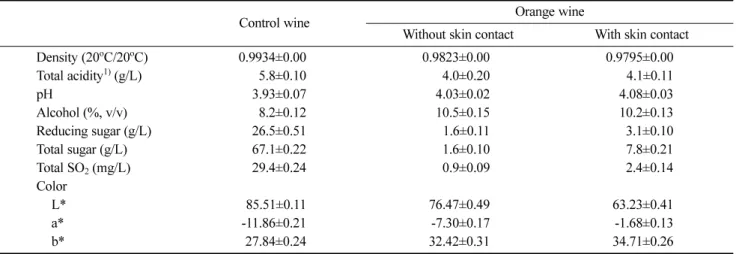
Compositions and color analysis of orange wines The chemical properties, compositions, and colors of the control and orange wines are shown in Table 1. The differences of the compositions and color of the 2 orange wines were not significant. This indicates that there was minor effect of peel contact on the compositions and color of orange wine. There were some differences on the total acidity and sugar between the control wine and orange wines. The pH value of the control wine increased a lot after fermentation, while it was stable in the orange wines. And this mainly because the orange juice is a complex buffer system, the pH value of the juice may be more stable than the model juice.
Volatile compounds of pulp and peels of oranges
Volatile compounds in pulp and peels in Qixue oranges
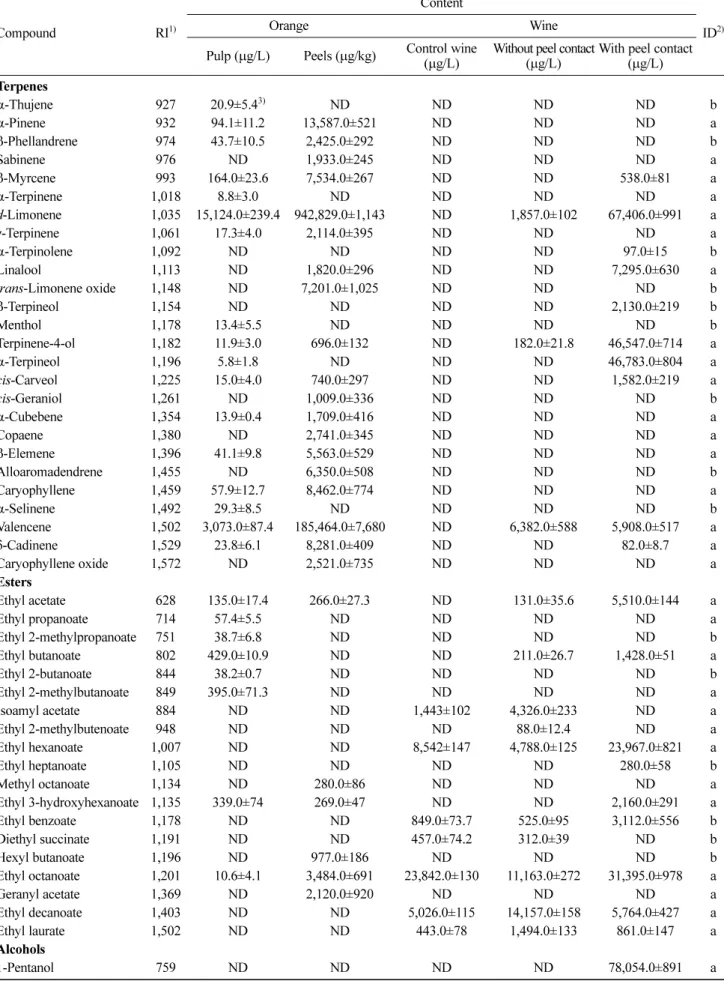
analyzed by SPME-GC-MS are shown in Table 2. A total of 31 and 32 volatile compounds were respectively identified in pulp and peels with a total concentration of 21 mg/L and 1,221 mg/kg. Seventeen and 19 terpenes was found in pulp and peels, respectively, and they were the most abundant compounds representing 91 and 98% of their total volatile compounds contents in pulp and peels. Among these terpenes, d-limonene was the most abundant compound both in pulp and peels, accounting for 74 and 77% of total concentrations, respectively.
Totally 8 esters, 4 aldehydes, 1 alcohol, and 1 ketone were identified in pulp, and 6 esters, 5 aldehydes, and 2 ketones were found in peels. There was a great difference on the volatile compounds between pulp and peels. Only 18 compounds were found both in pulp and peels, including 12 terpenes, 3 esters, 2 aldehydes, and 1 ketone.
Volatile compounds of orange wines Mean values of concentrations and standard deviations of the volatile compounds of control and orange wines are shown in Table 2. A total of 19 and 27 volatile compounds was identified in without and with peel contact orange wines with a total concentration of 81,447 and 353,293µg/L, respectively.
Volatile compounds of orange wines without peel contact
Being different from the volatile compounds of the pulp, esters were quantitatively the dominant group of volatile compounds in without peel contact wines, accounting for 46% of the total volatile compounds with a concentration of 37,195µg/L. Totally 10 esters were found in this wine. Ethyl acetate, ethyl butanoate, ethyl 2-methylbutenoate, and ethyl octanoate were the 4 esters detected also in pulp. Ethyl acetate was considered as index of quality in the aromatic fraction of orange juice (2).While the concentrations of these esters in this orange wine were lower than pulp, and this indicates that these esters decreased after fermentation, except for ethyl octanoate.
Ethyl propanoate, ethyl methylpropanoate, ethyl 2-butanoate, and ethyl 3-hydroxyhexanoate were only found
Fig. 1. Sensory descriptive analyses of orange wines. Mean scores of 9 judges (n=2).
in pulp and absent in without peel contact wine due to their high volatility. While isoamyl acetate, ethyl hexanoate, ethyl benzoate, diethyl succinate, ethyl decanoate, and ethyl laurate were new formed esters in without peel contact wine. They are considered to be the primary metabolites of yeast sugar and amino acid metabolism during fermentation (18).
Most of the terpenes disappeared after winemaking. Only d-limonene, terpinene-4-ol, and valencene were identified in without peel contact wine with a total concentration of 8,421µg/L. The content of d-limonene decreased after fermentation, while terpinene-4-ol and valencene increased in this course. Terpinene-4-ol was also found in the orange wines made from a Turkish cv. Kozan and was considered to be the aroma-active compound of this orange wine with a rancid aroma (12).
2-Ethylhexanol and 2-phenylethanol were the 2 alcohols found in without peel contact wine with a total concentration of 34,929µg/L, accounting for 43% of the total content, and was the 2nd most abundant compounds. They were
new formed compounds in without peel contact wine. These compounds are mainly produced by yeast during fermentation. 2-Phenylethanol was the most abundant compound, accounting for 43% of the total volatile compounds. Similar results were also obtained in some grape wines (19).It might be a very important contributor to the overall aroma of this wine due to its odor threshold values in hydro-alcoholic solution was 10,000µg/L (20). This compound was also found and considered as an aroma-active alcohol in Kozan orange wines with a floral and rose odor (12).
2-Phenylacetaldehyde, hexanoic acid, and geranyl acetone were the other 3 new formed compounds in without peel contact wine. Benzaldehyde increased a lot and it might also be formed during fermentation.
Volatile compounds of orange wines with peel contact
As shown in Table 2, a total of 27 volatile compounds were identified in with peel contact wine, including 10 terpenes, 9 esters, 6 alcohols, 1 ketone, and 1 acid.
Terpenes were the major volatile compounds with the highest concentration of 178,368µg/L, representing 50% of the total volatile compounds. It is in agreement with the
orange pulp and peels. These components are considered to be the most abundant compounds in the peel oil of the oranges and important contributors to the aroma in orange juice (21,22). Among these terpenes, d-limonene was the most abundant. It has a weak, citrus-like aroma, and is considered one of the major contributors to orange flavorif it is under 190 ppm (23,24).This indicates that d-limonene could contribute active to the total aroma of this wine. β -Myrcene, d-limonene, linalool, terpinene-4-ol, α-terpineol, cis-carveol, valencene, and δ-cadinene were the terpenes present both in pulp and wines with peel contact. While α -terpinolene and β-terpineol were new formed compounds in this wine.
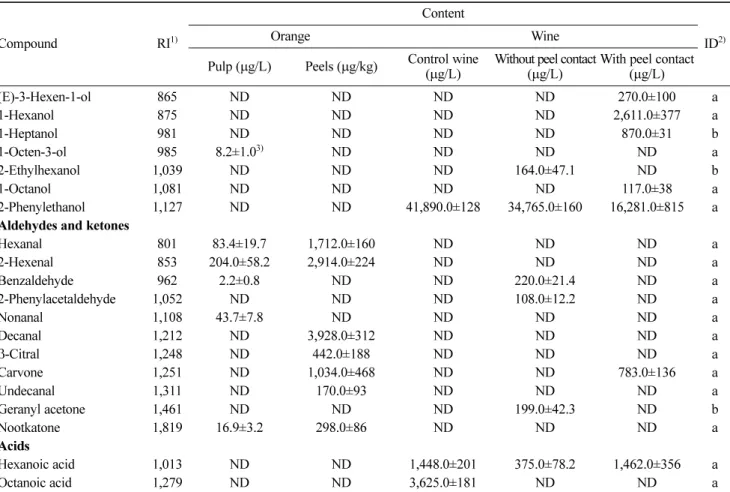
Alcohols were the second most abundant compounds with a total concentration of 98,203µg/L, accounting for 28% of the total concentrations. These higher alcohols are found as quantitatively the largest group of flavor compounds in alcoholic beverages, and are a secondary product of alcoholic fermentation (25).It is reported that concentrations of higher alcohols below 300 mg/L contribute a desirable level of complexity to wine, whereas concentrations exceed 400 mg/L can have a detrimental effect (26).They are formed during fermentation from keto acids produced either catabolically, involving degradation of an amino acid via the so-called Ehrlich pathway, or anabolically via the biosynthesis route from the carbon source (25).Totally 6 alcohols were identified in this wine: 1-pentanol, (E)-3-hexen-1-ol, 1-hexanol, 1-heptanol, 1-octanol, and 2-phenylethanol. None of them were found in orange pulp or peels. Among these alcohols, 1-pentanol, (E)-3-hexen-1-ol, 1-hexanol, 1-octanol, and 2-phenylethanol were also identified in Kozan orange wines, and (E)-3-hexen-ol, 1-octanol, and 2-phenylethanol were considered as aroma-active compounds with green-floral, floral, and citrusy-sweet aroma, respectively (12).
Totally 9 esters were identified in peel contact wines with a total concentration of 74,477µg/L. Ethyl acetate, ethyl butanoate, ethyl 3-hydroxyhexanoate, and ethyl octanoate were also present in orange pulp or peels. Whereas ethyl hexanoate, ethyl heptanoate, ethyl benzoate, ethyl decanoate, and ethyl laurate were only found in peel contact wine and could be considered as new formed compounds by yeast during fermentation.
Table 1. Compositions and color analysis of control and orange wines
Control wine Without skin contactOrange wine With skin contact
Density (20oC/20oC) 0.9934±0.00 0.9823±0.00 0.9795±0.00 Total acidity1) (g/L) 5.8±0.10 4.0±0.20 4.1±0.11 pH 3.93±0.07 4.03±0.02 4.08±0.03 Alcohol (%, v/v) 8.2±0.12 10.5±0.15 10.2±0.13 Reducing sugar (g/L) 26.5±0.51 1.6±0.11 3.1±0.10 Total sugar (g/L) 67.1±0.22 1.6±0.10 7.8±0.21 Total SO2 (mg/L) 29.4±0.24 0.9±0.09 2.4±0.14 Color L* 85.51±0.11 76.47±0.49 63.23±0.41 a* -11.86±0.21 -7.30±0.17 -1.68±0.13 b* 27.84±0.24 32.42±0.31 34.71±0.26 1)Citric acid.
Table 2. Volatile compounds in orange and orange wine
Compound RI1)
Content
ID2)
Orange Wine
Pulp (µg/L) Peels (µg/kg) Control wine(µg/L) Without peel contact(µg/L) With peel contact (µg/L)
Terpenes α-Thujene 927 20.9±5.43) ND ND ND ND b α-Pinene 932 94.1±11.2 13,587.0±521 ND ND ND a β-Phellandrene 974 43.7±10.5 2,425.0±292 ND ND ND b Sabinene 976 ND 1,933.0±245 ND ND ND a β-Myrcene 993 164.0±23.6 7,534.0±267 ND ND 538.0±81 a α-Terpinene 1,018 8.8±3.0 ND ND ND ND a d-Limonene 1,035 15,124.0±239.4 942,829.0±1,143 ND 1,857.0±102 67,406.0±991 a γ-Terpinene 1,061 17.3±4.0 2,114.0±395 ND ND ND a α-Terpinolene 1,092 ND ND ND ND 97.0±15 b Linalool 1,113 ND 1,820.0±296 ND ND 7,295.0±630 a
trans-Limonene oxide 1,148 ND 7,201.0±1,025 ND ND ND b
β-Terpineol 1,154 ND ND ND ND 2,130.0±219 b Menthol 1,178 13.4±5.5 ND ND ND ND b Terpinene-4-ol 1,182 11.9±3.0 696.0±132 ND 182.0±21.8 46,547.0±714 a α-Terpineol 1,196 5.8±1.8 ND ND ND 46,783.0±804 a cis-Carveol 1,225 15.0±4.0 740.0±297 ND ND 1,582.0±219 a cis-Geraniol 1,261 ND 1,009.0±336 ND ND ND b α-Cubebene 1,354 13.9±0.4 1,709.0±416 ND ND ND a Copaene 1,380 ND 2,741.0±345 ND ND ND a β-Elemene 1,396 41.1±9.8 5,563.0±529 ND ND ND a Alloaromadendrene 1,455 ND 6,350.0±508 ND ND ND b Caryophyllene 1,459 57.9±12.7 8,462.0±774 ND ND ND a α-Selinene 1,492 29.3±8.5 ND ND ND ND b Valencene 1,502 3,073.0±87.4 185,464.0±7,680 ND 6,382.0±588 5,908.0±517 a δ-Cadinene 1,529 23.8±6.1 8,281.0±409 ND ND 82.0±8.7 a Caryophyllene oxide 1,572 ND 2,521.0±735 ND ND ND a Esters Ethyl acetate 628 135.0±17.4 266.0±27.3 ND 131.0±35.6 5,510.0±144 a Ethyl propanoate 714 57.4±5.5 ND ND ND ND a Ethyl 2-methylpropanoate 751 38.7±6.8 ND ND ND ND b Ethyl butanoate 802 429.0±10.9 ND ND 211.0±26.7 1,428.0±51 a Ethyl 2-butanoate 844 38.2±0.7 ND ND ND ND b Ethyl 2-methylbutanoate 849 395.0±71.3 ND ND ND ND a Isoamyl acetate 884 ND ND 1,443±102 4,326.0±233 ND a Ethyl 2-methylbutenoate 948 ND ND ND 88.0±12.4 ND a Ethyl hexanoate 1,007 ND ND 8,542±147 4,788.0±125 23,967.0±821 a Ethyl heptanoate 1,105 ND ND ND ND 280.0±58 b Methyl octanoate 1,134 ND 280.0±86 ND ND ND a Ethyl 3-hydroxyhexanoate 1,135 339.0±74 269.0±47 ND ND 2,160.0±291 a Ethyl benzoate 1,178 ND ND 849.0±73.7 525.0±95 3,112.0±556 b Diethyl succinate 1,191 ND ND 457.0±74.2 312.0±39 ND b Hexyl butanoate 1,196 ND 977.0±186 ND ND ND b Ethyl octanoate 1,201 10.6±4.1 3,484.0±691 23,842.0±130 11,163.0±272 31,395.0±978 a Geranyl acetate 1,369 ND 2,120.0±920 ND ND ND a Ethyl decanoate 1,403 ND ND 5,026.0±115 14,157.0±158 5,764.0±427 a Ethyl laurate 1,502 ND ND 443.0±78 1,494.0±133 861.0±147 a Alcohols 1-Pentanol 759 ND ND ND ND 78,054.0±891 a
Hexanoic acid was the only acid identified in wines with peel contact, and was absent in orange pulp or peels. Volatile fatty acids are important contributors to the
fermentation bouquet of wines, and were primary metabolites of yeast sugar and amino acid metabolism (19).
Comparisons of volatile compounds of orange wines produced with and without peel contact Volatile compounds in the orange wines showed an obvious difference. It was in agreement with the result of sensory analysis.
As described above, esters (46%) were the most abundant compounds in wines without peel contact, while terpenes (50%) were quantitatively the dominant group of volatile compounds in peel contact wines. This might be the reason for the difference on the total aroma of the 2 wines, due to terpenes have a low olfactory threshold and are generally associated with floral and citric aromas (20). Palomo et al. (4) found that maceration of must with peel doubled the amount of these compounds in Albillo wines. Similar finding was also obtained in the present study that peel contact enhanced the concentrations of terpenes of orange wines. These terpenes mainly came from orange peels due to most of them were also found in orange peels except for α-terpinolene and β-terpineol. The presence of linalool, β
-terpineol, terpinene-4-ol, α-terpineol, and cis-carveol in peel contact wine indicated that they might be from the peels or released from the glycosidic volatile precursors. α -Terpineol is a well known off-flavor compound present in stored citrus products formed from d-limonene or linalool (27),and is also considered as an indicator of the age of orange juice and its presence becomes a problem at levels higher than 2 ppm (28).
d-Limonene, terpinene-4-ol, and valencene were the 3 terpenes identified both in orange wines produced without and with peel contact. No terpenes were found in control wine. This indicates that terpenes might not be formed during fermentation. However they might be formed or released from the potential glycosidic precursors during orange winemaking.
Most of the esters were found both in the 2 wines, such as ethyl acetate, ethyl butanoate, ethyl hexanoate, ethyl benzoate, ethyl octanoate, ethyl decanoate, and ethyl laurate. While isoamyl acetate, ethyl 2-methylbutenoate, and diethyl succinate were only found in without peel contact wine, and ethyl heptanoate and ethyl 3-hydroxyhexanoate were present only in peel contact wine. Nisperos-Carriedo andShaw (2) reported that ethyl acetate and ethyl butyrate were considered as indices of quality in the aromatic fraction of orange juice.And ethyl acetate may contribute a pleasant, fruity fragrance to the general
Table 2. Continued
Compound RI1)
Content
ID2)
Orange Wine
Pulp (µg/L) Peels (µg/kg) Control wine(µg/L) Without peel contact(µg/L) With peel contact (µg/L)
(E)-3-Hexen-1-ol 865 ND ND ND ND 270.0±100 a 1-Hexanol 875 ND ND ND ND 2,611.0±377 a 1-Heptanol 981 ND ND ND ND 870.0±31 b 1-Octen-3-ol 985 8.2±1.03) ND ND ND ND a 2-Ethylhexanol 1,039 ND ND ND 164.0±47.1 ND b 1-Octanol 1,081 ND ND ND ND 117.0±38 a 2-Phenylethanol 1,127 ND ND 41,890.0±128 34,765.0±160 16,281.0±815 a
Aldehydes and ketones
Hexanal 801 83.4±19.7 1,712.0±160 ND ND ND a 2-Hexenal 853 204.0±58.2 2,914.0±224 ND ND ND a Benzaldehyde 962 2.2±0.8 ND ND 220.0±21.4 ND a 2-Phenylacetaldehyde 1,052 ND ND ND 108.0±12.2 ND a Nonanal 1,108 43.7±7.8 ND ND ND ND a Decanal 1,212 ND 3,928.0±312 ND ND ND a β-Citral 1,248 ND 442.0±188 ND ND ND a Carvone 1,251 ND 1,034.0±468 ND ND 783.0±136 a Undecanal 1,311 ND 170.0±93 ND ND ND a Geranyl acetone 1,461 ND ND ND 199.0±42.3 ND b Nootkatone 1,819 16.9±3.2 298.0±86 ND ND ND a Acids Hexanoic acid 1,013 ND ND 1,448.0±201 375.0±78.2 1,462.0±356 a Octanoic acid 1,279 ND ND 3,625.0±181 ND ND a
1)RI, linear retention index on HP-5MS column.
2)Identification: a, comparison of mass spectra and retention index with authentic standards; b, comparison of mass spectra and retention index
with published data and MS library of Wiley7.0 and NIST 0.5.
wine aroma at concentrations lower than 150 mg/L (25). Esters (46%) were the main volatile compounds in control wine. Totally 7 esters were identified with a total concentration of 40,602µg/L. These compounds are described as fruity or floral (18).Among these esters, ethyl hexanoate, ethyl benzoate, ethyl octanoate, ethyl decanoate, and ethyl laurate were also present in the 2 orange wines, while the other 2 esters isoamyl acetate and diethyl succinate were only found in wines without peel contact. This suggests that most of the esters could be formed during fermentation without regard to the presence of pulp or peels.
With regard to alcohols, 2-phenylethanol was found the only common compound presented in the 2 orange wines, as well as the control wine. 1-Pentanol, (E)-3-hexen-1-ol, 1-hexanol, 1-heptanol, and 1-octanol presented only in peel contact wine, while 2-ethylhexanol was found in without peel contact wines and absent in other wines.
No aldehydes were identified in peel contact and control wine, while benzaldehyde and 2-phenylacetaldehyde were the 2 aldehydes found in wines without peel contact. Benzaldehyde has a bitter almond odor, and it is reported that the presence of benzaldehyde in wines probably formed by the oxidation of the benzyl alcohol or the effect of the microorganisms on the aromatic amino acids or on some secondary compounds such as phenyl acetic acid and p-hydroxybenzoic acid (29).
Hexanoic acid was found in all the 3 wines. However, octanoic acid was identified only in the control wine.
In conclusion, this study highlighted the effect of peel contact treatment on the flavor of the orange wines. Statistical analysis showed no significant differences (p>0.05) on the mean scores of each sensory descriptor, whereas a distinct difference was perceived on the total aroma of the wines produced with and without peel contact. The peel contact wine showed a more citrus-like and fruity aroma than the other 2 wines. It’s in agreement with the results of the GC-MS that great differences were found between the wines produced with and without peel contact. In other words, peel contact treatment could be more suitable for producing orange wines due to its effect on the enhancement of the aroma of orange wines.
Acknowledgments
We thank all of the members of the sensory panel, Qiao Yu for skillful technical assistance with GC-MS, Wang Xiaohong for technical assistance. This work is supported by 948 Project of Ministry of Agriculture, China (2006-Z-25).
References
1. Tan CT. Beverage Emulsions. Marcel Dekker Inc., New York, NY, USA. pp. 491-524 (1997)
2. Nisperos-Carriedo MO, Shaw PE. Comparison of volatile flavour components in fresh and processed orange juices. J. Agr. Food Chem. 38: 1048-1052 (1990)
3. Selli S, Cabaroglu T, Canbas A. Flavour components of orange wine made from a Turkish cv. Kozan. Int. J. Food Sci. Tech. 38: 587-593 (2003)
4. Palomo ES, Gonzalez-Vinas MA, Diaz-Maroto MC, Soriano-Perez A, Perez-Coello MS. Aroma potential of Albillo wines and effect of skin-contact treatment. Food Chem. 103: 631-640 (2007)
5. Rapp A, Mandery H. Wine aroma. Cell. Mol. Life Sci. 42: 873-884
(1986)
6. Cabaroglu T, Canbas A, Baumes R, Bayonnove C, Lepoutre JP, Günata Z. Aroma composition of a white wine of Vitis vinifera L.
cv. Emir as affected by skin contact. J. Food Sci. 62: 680-683 (1997) 7. Dugelay I, Gunata Z, Sapis JC, Baumes RL, Bayonnove CL. Role of cinnamoyl esterase activities from enzyme preparations on formation of volatile phenols during winemaking. J. Agr. Food Chem. 41: 2093-2096 (1993)
8. Selli S, Canbas A, Cabaroglu T, Erten H, Lepoutre JP, Gunata Z. Effect of skin contact on the free and bound aroma compounds of the white wine of Vitis vinifera L. cv Narince. Food Control 17:
75-82 (2006)
9. Palomo ES, Perez-Coello MS, Diaz-Maroto MC, Gonzalez-Vinas MA, Cabezudo MD. Contribution of free and glycosidically-bound volatile compounds to the aroma of muscat “a petit grains” wines and effect of skin contact. Food Chem. 95: 279-289 (2006) 10. Selli S, Kurkcuoglu M, Kafkas E, Cabaroglu T, Demirci B, Baser
KHC, Canbas A. Volatile flavour compositions of mandarin wine obtained from clementine (Citrus reticula Blanco) extracted by
headspace-solid phase microextraction. Flavour Frag. J. 19: 413-416 (2004)
11. Selli S, Canbas A, Unal U. Effect of bottle colour and storage conditions on browning of orange wine. Nahrung 46: 64-67 (2002) 12. Selli S, Canbas A, Varlet V, Kelebek H, Prost C, Serot T. Characterization of the most odor-active volatiles of orange wine made from a Turkish cv. Kozan (Citrus sinensis L. Osbeck). J. Agr.
Food Chem. 56: 227-234 (2008)
13. Hawthorne SB, Miller DJ, Pawliszyn J, Arthur CL. Solventless determination of caffeine in beverages using solid-phase microextraction with fused-silica fibers. J. Chromatogr. A 603: 185-191 (1992)
14. Buchholz KD, Pawliszyn J. Optimization of solid-phase microextraction conditions for determination of phenols. J. Anal. Chem. 66: 160-167 (1994)
15. Rega B, Fournier N, Guichard E. Solid phase microextraction (SPME) of orange juice flavour: Odor representativeness by direct gas chromatography olfactometry (D-GC-O). J. Agr. Food Chem. 51: 7092-7099 (2003)
16. Haixia Z, Ying S, Qingna Z, Yili C. Applying 3,5-dinitrosalicylic acid (DNS) method to analyzing the content of potato reducing sugar. Chinese Potato 19: 266-269 (2005)
17. Ough CS, Amerine MA. Methods for Analysis of Musts and Wines. John Wiley and Sons, Inc., New York, NY, USA. pp. 206-210 (1988)
18. Garde-Cerdan T, Ancin-Azpilicueta C. Effect of the addition of different quantities of amino acids to nitrogen-deficient must on the formation of esters, alcohols, and acids during wine alcoholic fermentation. LWT- Food Sci. Technol. 41: 501-510 (2008) 19. Palomo ES, Hidalgo MCDM, Gonzalez-Vinas MA, Perez-Coello
MS. Aroma enhancement in wines from different grape varieties using exogenous glycosidases. Food Chem. 92: 627-635 (2005) 20. Guth H. Quantitation and sensory studies of character impact
odorants of different white wine varieties. J. Agr. Food Chem. 45: 3027-3032 (1997)
21. Jordan MJ, Tillman TN, Mucci B, Laencina J. Using HS-SPME to determine the effects of reducing insoluble solids on aromatic composition of orange juice. LWT- Food Sci. Technol. 34: 244-250 (2001)
22. Shaw PE. Fruit II. Marcel Dekker, Inc., New York, NY, USA. pp. 305-328 (1991)
23. Tùnder D, Petersen MA, Poll L, Olsen CE. Discrimination between freshly made and stored reconstituted orange juice using GC odour profiling and aroma values. Food Chem. 61: 223-229 (1998) 24. Ahmed EM, Denninson RA, Dougherty RH, Shaw PE. Effect of
non-volatile orange juice components, acid, sugar, and pectin on the flavour threshold of d-limonene in water. J. Agr. Food Chem. 26:
192-194 (1978)
25. Satora P, Sroka P, Duda-Chodak A, Tarko T, Tuszynski T. The profile of volatile compounds and polyphenols in wines produced from dessert varieties of apples. Food Chem. 111: 513-519 (2008) 26. Lambrechts MG, Pretorius IS. Yeast and its importance to wine
27. Gomez-Ariza JL, Garcia-Barrera T, Lorenzo F. Determination of flavour and off-flavour compounds in orange juice by on-line coupling of a pervaporation unit to gas chromatography–mass spectrometry. J. Chromatogr. A 1047: 313-317 (2004)
28. Jordan MJ, Goodner KL, Laencina J. Deaeration and pasteurization
effects on the orange juice aromatic fraction. LWT-Food Sci. Technol. 36: 391-396 (2003)
29. Genovese A, Gambuti A, Piombino P, Moio L. Sensory properties and aroma compounds of sweet Fiano wine. Food Chem. 103: 1228-1236 (2007)