Synthesis and Biological Evaluation of Tetrapeptide Ketones as
Reversible 20S Proteasome Inhibitors
Muhammad Latif,†,‡ Myoung Eun Jung,† Kwangho Lee,†,‡,* and Gildon Choi†,‡,*
†Drug Discovery Division, Korea Research Institute of Chemical Technology, Daejeon 305-600, Korea ‡Medicinal and Pharmaceutical Chemistry, Korea University of Science and Technology, Daejeon 305-350, Korea
*E-mail:[email protected] (K. Lee); [email protected] (G. Choi) Received July 15, 2014, Accepted August 20, 2014
Proteasome, a multicatalytic protease complex, has been validated as a promising therapeutic target in oncology. Carfilzomib (Kyprolis®), a tetrapeptide epoxyketone, irreversibly inhibits the chymotrypsin-like (CT-L) activity of the proteasome and has been recently approved for multiple myeloma treatment by FDA. A chemistry effort was initiated to discover the compounds that are reversibly inhibit the proteasome by replacing the epoxyketone moiety of carfilzomib with a variety of ketones as reversible and covalent warheads at the C-terminus. The newly synthesized compounds exhibited significant inhibitory activity against CT-L activity of the human 20S proteasome. When the compounds were tested for cancer cell viability, 14-8 was found to be most potent in inhibiting Molt-4 acute lymphoblastic leukemia cell line with a GI50 of 4.4 µM. Cytotoxic effects of 14-8 were further evaluated by cell cycle analysis and Western blotting, demonstrating activation of apoptotic pathways.
Key Words : Proteasome, Carfilzomib, Ketones, Reversible and covalent
Introduction
The proteasome, a multicatalytic protease complex, is responsible for ubiquitin-dependent non-lysosomal proteo-lysis of cellular proteins. Proteins that are destined for proteolysis are first tagged with polyubiquitin chains through a cascade of enzyme-catalyzed reactions and then degraded by proteasome complex in an ATP-dependent manner.1,2 The ubiquitin-proteasome pathway plays an important role in regulating numerous cellular processes including cancer.3 The proteasome consists of a 20S proteolytic core and two 19S regulatory caps to form a 26S complex. The 20S proteo-lytic core has three distinct peptidase activities; chymotryp-sin-like (CT-L), trypchymotryp-sin-like, and caspase-like activities.4 Of these, chymotrypsin-like activity has gained much attention since it is thought to be the rate-limiting step of proteolysis in vitro and in vivo.5,6
High proteasome expression has been implicated in many diseases. Blocking the proteasome activity is considered to be a promising therapeutic target in oncology since borte-zomib (1), a dipeptide boronic acid, is approved for the treatment of patients with multiple myeloma (Figure 1).7 In addition, carfilzomib (2), a structural analogue of the micro-bial natural product epoxomicin, has been developed and exhibited more selective inhibition of chymotrypsin-like activity of the 20S proteasome than bortezomib.8 Carfilzo-mib (2) has been evaluated successfully in clinical trials for multiple myeloma patients and got recently approved by U.S. Food and Drug Administration (FDA).9 Currently, its combination therapy with lenalidomide and dexamethasone is ongoing in phase III clinical trials for patients with relapsed multiple myeloma [ASPIRE trial].10
In spite of the clinical success of carfilzomib (2), there are still unmet medical needs for proteasome inhibitor therapies. Due to the instability of the epoxyketone warhead for irrever-sible inhibition, carfilzomib (2) should be administered intravenously, and requires inconvenient intravenous infusion dosing and prolonged treatment for clinical responses.8 From this aspect, we could achieve the improvement of pharmacokinetic parameters of carfilzomib derivatives if the unstable epoxyketone warhead is displaced with more stable one such as ketones.
In this study, we report the design, synthesis, and bio-logical evaluation of a series of 20S proteasome inhibitors that bear various ketones which are able to act as reversible and covalent warheads. The synthesized compounds were found to be active in inhibiting the CT-L activity of the 20S proteasome. In addition, we found that 14-8 is the most potent and able to induce apoptosis resulting in cancer cell death.
Results and Discussion
The starting point of our chemistry effort was carfilzomib (2), a tetrapeptide peptidomimetic compound with epoxy-ketone warhead for irreversible inhibition. We planned to synthesize the compounds having the ketones at the C-terminus for reversible and covalent inhibition instead of the original epoxyketone warheads for irreversible inhibition. A similar warhead for reversible and covalent inhibition has also been utilized in the development of Telaprevir, Hepatitis C Virus NS3·4A serine protease inhibitor.11,12 Telaprevir contains α–ketoamide which is an electrophile as for so-called ‘serine trap’ warhead and found to be effective in
inhibiting the viral protease.12
Scheme 1 and 2 summarize the procedures for synthe-sizing the carfilzomib derivatives having a variety of ketones for reversible inhibition. (S)-2-((tert-butoxycarbonyl)amino)-4-phenylbutanoic acid 3 was coupled with methyl L-leucine hydrochloride using 1-ethyl-3-(3-dimethylaminopropyl)carbo-diimide hydrochloride (EDCI) and 1-hydroxybenzotriazole (HOBt) in dichloromethane to provide N-Boc protected intermediate 4 as shown in Scheme 1. Subsequent saponi-fication with sodium hydroxide in aqueous tetrahydrofuran afforded dipeptide 5, followed by EDCI/HOBt mediated coupling with methyl L-phenylalanine hydrochloride to give
N-Boc protected intermediate 6. Removal of the N-Boc group with 4 N HCl gave 7 hydrochloride salt, followed by coupling with 2-morpholinoacetic acid using EDCI/HOBt to give tripeptide 8 bearing morpholine motif. Finally, further hydrolysis furnished desired acid 9 as left handed key frag-ment.
Synthesis of the right-hand fragment was initiated with formation of the Weinreb amide 11 from (tert-butoxycarbon-yl)-L-leucine 10 using EDCI/HOBt in dichloromethane (Scheme 2). The Weinreb amide 11 was reacted with various Grignard reagents in THF at −78oC to make ketone 12, which was then treated with 4 N HCl to provide the desired aminoketone hydrochloride salt 13 (R1 is summarized in
Table 1).13 Finally 9 underwent EDCI/HOBt mediated amide formation with various aminoketones 13 gave the desired products of 14-1~14-9. The final products were purified using silica gel column chromatography and prep-TLC if necessary.
The ability of compounds (14-1~14-9) to inhibit the CT-L activity of the human 20S proteasome was determined by using fluorogenic peptides as substrate. 14-1 and 14-2 hav-ing small aliphatic R1 group did not show any significant
Figure 1. Structure of bortezomib (1) and carfilzomib (2).
Scheme 1. Synthesis of the left hand fragments.
inhibitory activity for the proteasome CT-L activity. In contrast, the compounds (14-3~14-9) with aromatic side chain as R1 group were found to be effective in inhibiting
CT-L activity of the proteasome whose IC50 values ranging
from 1.3μM to 7.0 μM (Table 1). These results strongly
suggest that bulky aromatic side chain in the ketone warhead is necessary for the inhibitory activity.
When 14-1~14-9 were treated to Molt-4 acute lympho-blastic leukemia cell line, 14-8 was found to be most effec-tive with GI50 of 4.4 μM (Table 1). Cytotoxic effects of the
compound were further investigated by cell cycle assays and immunoblotting. The eukaryotic cell cycle is traditionally divided into four phases, G1, S, G2 and M. Chromosome
duplication occurs during S phase (S for DNA synthesis), and chromosome segregation and cell division occur during M phase (M for mitosis). G1 represents the gap between M
phase and S phase, while G2 is the gap between S phase and
M phase. When 14-8 is treated to the cells and causes cell-cycle arrest, cell population in G1 or G2/M phase would be
increased, while the cell populations of sub-G1 phase
increase if the compound induces cell death.
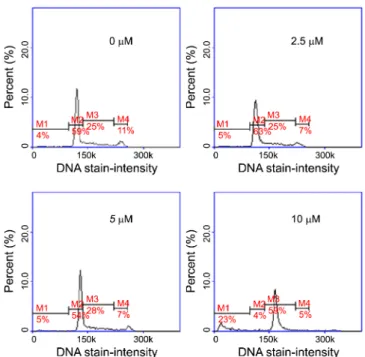
As shown in Figure 2, the DNA content histograms clearly show that cell population in sub-G1 phase exposed to 14-8
(23% for 10μM) was significantly higher than that of the cells treated with DMSO only (4%), strongly indicating that the cells are undergoing apoptosis or necrosis upon compound treatment. In addition, 14-8 increased protein levels of the important apoptosis related protein markers, cleaved caspase-3 and poly ADP-ribose polymerase (PARP) in the cells, consistent with the expectation that the compound inhibits proteasome activity and induce apoptosis in the cells (Figure 3).
Conclusions
Nine carfilzomib analogues were synthesized by replacing its reactive epoxyketone with more stable ketone groups. The compounds with reversible and covalent warheads at the C-terminus were found to be effective in inhibiting the CT-L activity of the human proteasome. The compound was also effective in inhibiting cancer cell growth through apoptotic cell death. These results should provide a pro-mising starting point for proteasome inhibitors overcoming
Table 1. Biological activities of ketone derivativesa
Compound R1 IC50 (µM) GI50 (µM) 14-1 CH3 > 30 > 100 14-2 C2H5 > 30 30.6 8.3 14-3 2.7 ± 1.1 22.3 ± 8.9 14-4 1.8 ± 0.45 15.6 ± 4.0 14-5 3.1 ± 1.1 14.7 ± 2.3 14-6 1.3 ± 0.99 24.6 ± 4.9 14-7 2.9 ± 2.1 19.8 ± 7.6 14-8 4.4 ± 3.2 4.4 ± 1.0 14-9 7.0 ± 5.4 52.7 ± 8.7 aIC
50 and GI50 represent half maximal inhibitory concentration for
proteasome activity and cell viability, respectively.
Figure 2. Apoptotic effects of compound 14-8 on Molt-4 cells. DNA content histograms of the cells treated with various concent-rations of 14-8 for 48 h. The sub- G1 population (M1) was found to be increased upon treatment of the compound from 4% (0 µM) to 24% (10 µM). M1: sub-G1 phase, M2: G1 phase, M3: S phase, M4: G2/M phase.
Figure 3. Western blot of the lysates from Molt-4 cells treated with compound 14-8 for 48 h. Cleaved forms of caspase-3 and PARP were significantly increased by the compound (10 µM) treatment.
the disadvantages of irreversible proteasome inhibitor carfil-zomib.
Experimental
Synthesis in General. 1H NMR spectra were recorded on a Varian Gemini 300 & 500 spectrometer using CDCl3,
CD3OD, DMSO-d6, and acetone-d6 as a solvent, and chemical
shifts are reported in ppm downfield from that of the TMS internal standard. LCMS analysis was performed on a Waters Acquity Ultra Performance LC with waters Acquity UPLC BEH C18 1.7 micrometer 2.1 × 50 mm column and a solv-ent system of 10-100% acetonitrile in water with 0.1% formic acid. The mass spectrometry data were acquired on a Micromass Quattro micro mass spectrometer. All the final products display very broad 1H-NMR spectra due to peptidic conformational isomers. Compound 14-8 preparation was selected to report for representative example.
tert-Butyl (S)-(1-(Methoxy(methyl)amino)-4-methyl-1-oxopentan-2-yl)carbamate (11). To a solution of ( tert-butoxycarbonyl)-L-leucine 10 (10 g, 43.2 mmol) in CH2Cl2
(150 mL) was added 1-ethyl-3-(3-dimethylaminopropyl)-carbodiimide hydrochloride (9.11 g, 47.6 mmol), 1-hydroxy-benzotriazole (6.42 g, 47.6 mmol) and stirred for 20 min. The reaction mixture was added with N,O-dimethylhydroxyl-amine (2.9 g, 47.6 mmol), followed by addition of triethyl-amine (18 mL, 130 mmol). The reaction mixture was allow-ed to stir overnight at room temperature. After reaction completion, solvent was removed in vacuo and partitioned between EtOAc and saturated NaHCO3 solution. The
aque-ous phase was re-extracted with EtOAc. The combined organic phases were washed with brine, dried over an-hydrous MgSO4 and concentrated. The crude product was
purified by silica gel column chromatography using hexanes/ ethyl acetate (10:1) to give the desired product 11 (11.0 g, 93%) as a colorless solid: 1H NMR (300 MHz, CDCl3) δ 5.07-5.03 (m, 1 H), 4.75-4.71 (br, 1 H), 3.07 (s, 3 H), 2.95 (s, 3 H), 1.97 (s, 1 H), 1.76-1.72 (m, 2 H), 1.49 (s, 9 H), 0.96 (d, J = 6.3 Hz, 3 H), 0.93 (d, J = 6.3 Hz, 3 H); LCMS for C13H26N2O4 (M + H)+: m/z = 275.15, Exact Mass: 274.1893. (S)-tert-Butyl (4-Methyl-1-oxo-1-(perfluorophenyl)pentan-2-yl)carbamate (12-8). To a well stirred solution of 11 (500 mg, 1.82 mmol) in anhydrous THF at −78oC was added dropwise pentafluorophenylmagnesium bromide solution (7.28 mL, 7.28 mmol, 1.0 M in THF). The reaction mixture was allowed to stir for 48 h at 0 oC and the reaction progress was monitored by LC-MS. After completion, the reaction mixture was quenched with 1 N HCl solution at 0oC. The solvent was removed in vacuo and partitioned between EtOAc and saturated NaHCO3 solution. The aqueous phase
was re-extracted with EtOAc. The combined organic phases were washed with brine, dried over anhydrous MgSO4 and
concentrated. The crude product was purified by MPLC on silica gel column chromatography using hexanes/ethyl acetate (20:1) to give the desired product 12-8 as a colorless solid in 73% yield: = +20.8 (c 1.0, CHCl3); 1H NMR
(300 MHz, CDCl3) δ 4.97-4.95 (br, 1 H), 4.73 (br, 1 H),
1.79-1.75 (m, 1 H), 1.63-1.45 (m, 2 H), 1.49 (s, 9 H), 0.93 (d, J = 6.5 Hz, 6 H); LCMS for C17H20F5NO3 (M + H)+: m/z
= 382.14, Exact Mass: 381.1363. For 12-1 LCMS for C12H23NO3 (M + H)+: m/z = 230.22, Exact Mass: 229.16779;
12-2 LCMS for C13H25NO3 (M + H)+: m/z = 244.20, Exact
Mass: 243.18344; 12-3 LCMS for C17H25NO3 (M + H)+: m/z
= 292.19, Exact Mass: 291.1834; 12-4 LCMS for C18H27NO4
(M + H)+: m/z = 322.11, Exact Mass: 321.19401; 12-5 LCMS for C17H24NFO3 (M + H)+: m/z = 310.15, Exact Mass:
309.1740; 12-6 LCMS for C17H22NF3O3 (M + H)+: m/z =
346.13, Exact Mass: 345.15518; 12-7 LCMS for C15H23NO3S
(M + H)+: m/z = 298.12, Exact Mass: 297.13986; 12-9 LCMS for C19H23F6NO3 (M + H)+: m/z = 428.13, Exact Mass:
427.15821.
(S)-2-Amino-4-methyl-1-(perfluorophenyl)pentan-1-one hydrochloride (13-8). To a flask containing 12-8 (300 mg, 0.78 mmol) in ethyl acetate (2 mL) was added 4 N HCl (4 mL) at 0oC. The reaction mixture was stirred at room temperature for 3 hr, concentrated in vacuo and used directly without purification as solid (quantitative): = +12.0 (c 1.0, CHCl3); LCMS for C12H12F5NO(M + H)+: m/z = 282.10, Exact Mass: 281.0839. ( S)-4-Methyl-N-((R)-1-(((R)-4-methyl-1-oxo-1-(perfluoro- phenyl)pentan-2-yl)amino)-1-oxo-3-phenylpropan-2-yl)-2-(( S)-4-phenyl-2-(2-(tetrahydro-2H-pyran-4-yl)acetamido)-butanamido)pentanamide (14-8). To a solution of 9 (250 mg, 0.44 mmol) in CH2Cl2 (5 mL) was added
1-ethyl-3-(3-dimethylaminopropyl)carbodiimide hydrochloride (169 mg, 0.88 mmol), 1-hydroxybenzotriazole (119 mg, 0.88 mmol) and stirred for 20 min. The reaction mixture was added with 13-8 (149 mg, 0.53 mmol), followed by addition of triethyl-amine (0.20 mL, 1.32 mmol). The reaction mixture was allowed to stir overnight at room temperature. The reaction mixture was concentrated and partitioned with EtOAc and saturated NaHCO3 solution. The aqueous phase was
re-ex-tracted with EtOAc. The combined organic phases were washed with brine, dried over anhydrous MgSO4 and
con-centrated. The crude product was purified by silica gel column chromatography using hexanes/ethyl acetate/methanol (1:3: 0.5) to give the desired product 14-8 as a colorless solid in 35% yield: = +98.5 (c 1.0, CHCl3); 1H NMR (300
MHz, CDCl3) δ 7.21-7.11 (m, 10 H), 3.75 (br, 1 H),
3.64-3.59 (m, 3 H), 2.63-2.58 (br, 4 H), 2.02-1.93 (br, 4 H), 1.85-1.74 (br, 4 H), 1.64-1.41 (br, 10 H), 1.25 (br, 6 H), 0.96-0.87 (m, 11 H); LCMS for C44H53F5N4O6 (M + H)+: m/z = 829.28,
Exact Mass: 828.3885. For 14-1 LCMS for C38H55N5O6 (M
+ H)+: m/z = 678.50, Exact Mass: 677.41523; 14-2 LCMS for C40H58N4O6 (M + H)+: m/z = 692.50, Exact Mass: 690.43564;
14-3 LCMS for C43H55N5O6 (M + H)+: m/z = 740.50, Exact
Mass: 739.43088; 14-4 LCMS for C45H60N4O7 (M + H)+:
m/z = 769.90, Exact Mass: 768.44620; 14-5 LCMS for C44H57FN4O6 (M + H)+: m/z = 794.50, Exact Mass: 758.50;
14-6 LCMS for C44H55F3N4O6 (M + H)+: m/z = 794.50, Exact
Mass: 792.40737; 14-7 LCMS for C42H56N4O6 S (M + H)+:
m/z = 746.80, Exact Mass: 744.39206; 14-9 LCMS for C45H55F6N5O6 (M + H)+: m/z = 876.30, Exact Mass: 875.40565.
Proteasome Assay. The proteasome activity was deter-α [ ]D20 α [ ]D20 α [ ]D20
mined at 25 °C in a buffer solution containing 20 mM Tris-Cl, pH 7.0, 0.5 mM EDTA, 0.03% SDS and synthetic fluoro-genic peptide substrate, succinyl-Leu-Leu-Val-Tyr-AMC, by measuring the AMC product formation according to the procedures as described previously with a slight modifi-cation.6 The reaction was initiated by the addition of purified 20S proteasomes. Reaction rate was determined based on the reaction velocity measured between 30 and 40 min.
WST-1 Cytotoxicity Assay. Cytotoxic effects were evalu-ated with the reagent WST-1 [2-(4-iodophenyl)-3-(4-nitro-phenyl)-5-(2,4-disulfophenyl)-2H-tetrazolium]. WST-1 pro-duces a highly water soluble formazan upon metabolically active cells, allowing a direct colorimetric measurement of cell viability. Cells were seeded on 96-well plates at a density of 1 × 10⁴ cells per welland treated with the test compounds at various concentrations. After 48 h, cells were incubated with WST-1 for 1 h and the resulting absorbance was measured at 450 nm.
Cell Cycle Analysis. The cell cycles of Molt-4 cells treat-ed with compounds were analyztreat-ed by using NucleoCounter NC-250 system (Chemometec, Denmark). First, the cells were resuspended in lysis buffer (solution 10) containing nuclear stain dye DAPI. Subsequently, 2 × 10⁶ cells were harvested by centrifugation and further treated with stabili-zation buffer (solution 11). Cellular fluorescence is quanti-fied and DNA content histogram was obtained by a two-step cell cycle analysis protocol provided by the company.
Immunoblotting. Cells were seeded at 70% confluence in 6-well plates, treated with the compounds next day and incubated for 48 h. To prepare the whole cell lysates, cells were washed twice with PBS and lysed with RIPA buffer containing protease inhibitors. Subsequently, cell lysates were electrophoretically separated on a 10% SDS-polyacryl-amide gel. Proteins were transferred onto PVDF membranes (polyvinyidenfluoride, Millipore, MA, USA) overnight at 4 ºC. Membranes were blocked with PBS containing 5% skim milk and 0.1% Tween 20, pH 7.4 for 1 h and then incubated sequentially with primary and secondary antibodies
diluted in blocking buffer. Protein bands were detected with chemiluminescence detection system (Cell Signaling, MA, USA) on a LAS-3000 (Fuji, Japan).
Acknowledgments. This study was supported by grants from Korea Research Institute of Chemical Technology (KK-1403-A0 and KK-1403-D0) and Ministry of Science, ICT and Future Planning of Korea (NRF-2012M3A9C1053340).
References
1. Ciechanover, A. Nat. Rev. Mol. Cell Biol. 2005, 6, 79.
2. Kisselev, A. F.; Goldberg, A. L. Methods Enzymol. 2005, 398, 364. 3. Lopes, U. G.; Erhardt, P.; Yao, R.; Cooper, G. M. J. Biol. Chem.
1997, 272, 12893.
4. An, B.; Goldfarb, R. H.; Siman, R.; Dou, Q. P. Cell Death Differ. 1998, 5, 1062.
5. Adams, J. Nat. Rev. Cancer 2004, 4, 349.
6. Demo, S. D.; Kirk, C. J.; Aujay, M. A.; Buchholz, T. J.; Dajee, M.; Ho, M. N.; Jiang, J.; Laidig, G. J.; Lewis, E. R.; Parlati, F.; Shenk, K. D.; Smyth, M. S.; Sun, C. M.; Vallone, M. K.; Woo, T. M.; Molineaux, C. J.; Bennett, M. K. Cancer Res. 2007, 67, 6383. 7. Richardson, P. G.; Barlogie, B.; Berenson, J.; Singhal, S.; Jagannath,
S.; Irwin, D.; Rajkumar, S. V.; Srkalovic, G.; Alsina, M.; Alexanian, R.; Siegel, D.; Orlowski, R. Z.; Kuter, D.; Limentani, S. A.; Lee, S.; Hideshima, T.; Esseltine, D. L.; Kauffman, M.; Adams, J.; Schenkein, D. P.; Anderson, K. C. N. Engl. J. Med. 2003, 348, 2609.
8. Bennett, M. K.; Kirk, C. J. Curr. Opin. Drug Discovery Dev. 2008, 11, 616.
9. Onyx Pharmaceuticals, Inc. Kyprolis® (carfilzomib) prescribing information. South San Francisco, CA, USA: Onyx Pharmaceuticals, Inc.; 2012.
10. http://clinicaltrials.gov/show/NCT01080391.
11. Lin, C.; Kwong, A. D.; Perni, R. B. Infect. Disord. Drug Targets 2006, 6, 3.
12. Perni, R. B.; Pitlik, J.; Britt, S. D.; Court, J. J.; Courtney, L. F.; Deininger, D. D.; Farmer, L. J.; Gates, C. A.; Harbeson, S. L.; Levin, R. B.; Lin, C.; Lin, K.; Moon, Y.-C.; Luong, Y.-P.; O’Malley, E. T.; Rao, B. G.; Thomson, J. A.; Tung, R. D.; Van Drie, J. H.; Wei, Y. Bioorg. Med. Chem. Lett. 2004, 14, 1441.