저작자표시-비영리-변경금지 2.0 대한민국 이용자는 아래의 조건을 따르는 경우에 한하여 자유롭게
l 이 저작물을 복제, 배포, 전송, 전시, 공연 및 방송할 수 있습니다. 다음과 같은 조건을 따라야 합니다:
l 귀하는, 이 저작물의 재이용이나 배포의 경우, 이 저작물에 적용된 이용허락조건 을 명확하게 나타내어야 합니다.
l 저작권자로부터 별도의 허가를 받으면 이러한 조건들은 적용되지 않습니다.
저작권법에 따른 이용자의 권리는 위의 내용에 의하여 영향을 받지 않습니다. 이것은 이용허락규약(Legal Code)을 이해하기 쉽게 요약한 것입니다.
Disclaimer
저작자표시. 귀하는 원저작자를 표시하여야 합니다.
비영리. 귀하는 이 저작물을 영리 목적으로 이용할 수 없습니다.
변경금지. 귀하는 이 저작물을 개작, 변형 또는 가공할 수 없습니다.
교육학석사학위논문
m -step competition graphs of bipartite tournaments
( 방향 지어진 완전 이분 그래프의 m -step 경쟁 그래프 )
2018 년 2 월
서울대학교 대학원
수학교육과
윤 혜 선
m-step competition graphs of bipartite tournaments
A dissertation
submitted in partial fulfillment of the requirements for the degree of Master of Science in Mathematics Education
to the faculty of the Graduate School of Seoul National University
by
Hyesun Yoon
Dissertation Director : Professor Suh-Ryung Kim
Department of Mathematics Education Seoul National University
February 2018
Abstract
Hyesun Yoon Department of Mathematics Education The Graduate School Seoul National University In this thesis, we study the m-step competition graphs of bipartite tourna- ments. We compute the number of distinct bipartite tournaments by P´olya’s theory of counting. Then we study the competition indices and competition periods of bipartite tournaments. We characterize the pairs of graphs that can be represented as the m-step competition graphs of bipartite tournaments.
Finally, we present the maximum number of edges and the minimum num- ber of edges which the m-step competition graph of a bipartite tournament might have.
Key words: complete bipartite graph; bipartite tournament; m-step com- petition graph; competition index; competition period; m-step competition- realizable.
Student Number: 2016–21568
Contents
Abstract i
1 Introduction 1
1.1 Basic graph terminology . . . 1
1.2 Competition graph and its variants . . . 3
1.3 m-step competition graphs . . . 5
1.4 P´olya’s theory of counting . . . 6
1.5 Competition indices and competition periods . . . 9
1.6 Preview of thesis . . . 10 2 The number of distinct bipartite tournaments 12 3 Properties of m-step competition graphs of bipartite tourna-
ments 18
4 m-step competition realizable pairs 23
5 Extremal cases 31
6 Concluding remarks 36
Abstract (in Korean) 43
Chapter 1 Introduction
1.1 Basic graph terminology
Given a graph G, and let S ⊂ V(G) be any subset of vertices of G. Then the induced subgraph of G[S] is the graph whose vertex set is S and whose edge set consists of all of the edges in E(G) that have both endpoints inS.
The same definition works for undirected graphs and directed graphs. The induced subgraph G[S] may also be called the subgraph of G induced by S.
Aclique,C, of a graphGis a subset of the vertices,C ⊂V(G), such that every two distinct vertices are adjacent. This is equivalent to the condition that the induced subgraph ofGinduced byCis a complete graph. Amaximal clique is a clique that cannot be extended by including one more adjacent vertex, that is, a clique which does not exist exclusively within the vertex set of a larger clique.
A graph is bipartite if its vertex set can be partitioned into two subsets V1 and V2 so that every edge has one end in V1 and the other end inV2; such a partition (V1, V2) is called a bipartition of the graph, and V1 and V2 are called its parts. If a bipartite graph is simple and every vertex in one part is joined to every vertex in the other part, then the graph is called a complete bipartite graph. We denote Km,n a complete bipartite graph with bipartition
(V1, V2) if|V1|=m and |V2|=n.
Awalk in a graphGis a sequenceW :=v0e1v1. . .vl−1elvl, whose terms are alternately vertices and edges of G (not necessarily distinct), such that vi−1
andviare the ends ofei, 1 ≤i≤l. In a simple graph, a walkv0e1v1. . .vl−1elvl is determined, and is commonly specified, by the sequence v0v1. . .vl of its vertices. If v0 = x and vl =y, we say that W connects x to y and refer W as an (x, y)-walk. The notation xW y is also used simply to signify a (x, y)- walk W. The vertices x and y are called the ends of the walk, x being its initial vertex and yitsterminal vertex; the verticesv1,. . .,vl−1 are itsinterval vertices. The integer l (the number of edge terms) is thelength of W. Apath is a walk in which no vertices are repeated. For a path P, if xand y are the initial and terminal vertices of P, we refer P as an (x, y)-path. A walk in a graph is closed if its initial and terminal vertices are identical. A cycle on three or more vertices is a closed walk which no vertices except the initial vertex and the terminal vertex are repeated. The length of a path or a cycle is the number of its edges. A path or cycle of length k is called a k-path or k-cycle and denoted by Pk+1 orCk, respectively; the path or cycle is odd or even according to the parity of k. A 3-cycle is often called a triangle. If a graph contains no triangle, then it is triangle-free.
Given a digraph D, we denote by N+(u) (resp. N−(u)) the set of out- neighbors (resp. in-neighbors) of a vertex u in D. The out-degree (resp. in- degree) ofuinDis defined to be|N+(u)| (resp.|N−(u)|). Adirected walk in a digraph D is an alternating sequence of vertices and arcs
W := (v0, a1, v1, . . . , vl−1, al, vl)
such that vi−1 and vi are the tail and head of ai, respectively, 1 ≤ i ≤ l. If x and y are the initial and terminal vertices of W, we refer W as a directed (x, y)-walk. A directed walk in a digraph is closed if its initial and terminal vertices are identical. Directed paths are directed walks in which no vertices are repeated. Directed cycles in digraph are closed directed walks which no
vertices except the initial vertex and the terminal vertex are repeated.
For a digraph D, the underlying graph of D is the graph G such that V(G) = V(D) and E(G) = {uv | (u, v) ∈ A(D)}. An orientation of a graph G is a digraph having no directed 2-cycles, no loops, and no multiple arcs whose underlying graph is G. An oriented graph is a graph with an orientation. A tournament is an oriented complete graph. An orientation of a complete bipartite graph is sometimes called a bipartite tournament and we use whichever of the two terms is more suitable for a given situation throughout this paper.
1.2 Competition graph and its variants
The competition graph C(D) of a digraph D is the (simple undirected) graph G defined by V(G) = V(D) and E(G) = {uv | u, v ∈ V(D), u 6=
v, N+(u)∪N+(v) 6= ∅}. Cohen [11] introduced the notion of competition graph while studying predator-prey concepts in ecological food webs. Co- hen’s empirical observation that real-world competition graphs are usually interval graphs had led to a great deal of research on the structure of com- petition graphs and on the relation between the structure of digraphs and their corresponding competition graphs. For a comprehensive introduction to competition graphs, see [13, 26]. Competition graphs also have applications in coding, radio transmission, and modeling of complex economic systems (see [30] and [31] for a summary of these applications). For recent work on this topic, see [10, 29, 35, 37].
A variety of generalizations of the notion of competition graph have also been introduced, including the m-step competition graph in [7, 17], the common enemy graph (sometimes called the resource graph) in [27, 34], the competition-common enemy graph (sometimes called the competition- resource graph) in [2, 15, 19, 21, 25, 32, 33], the niche graph in [4, 5, 14] and the p-competition graph in [1, 23, 24].
Lundgren and Maybee [27] introduced the common enemy graph of a digraph D which is the graph which has the same vertex set as D and has an edge between two distinct vertices x and y if it holds that both N−(u)∪ N−(v)6=∅. This led Scott [32] to introduce the competition-common enemy graph of D. The competition-common enemy graph of a digraph D is the graph which has the same vertex set as D and has an edge between two distinct verticesxandyif it holds that bothN+(u)∪N+(v)6=∅andN−(u)∪
N−(v)6=∅. This graph is essentially the intersection of the competition graph and the common enemy graph. That is, two vertices are adjacent if and only if they have both a common prey and a common enemy in D. The niche graph is the union of the competition graph and the common enemy graph. If D= (V, A) is a digraph, theniche graphcorresponding toDis the undirected graph G = (V, E) with an edge between two distinct vertices x and y of V if and only if for some z ∈ V, there are arcs (x, z) and (y, z) in D or there are arcs (z, x) and (z, y) in D. For a digraph D, let CE(D) be the common enemy graph, CCE(D) the competition-common enemy graph, and N(D) the niche graph. ThenCCE(D)⊂C(D)⊂N(D). For a digraphD= (V, A), if p is a positive integer, the p-competition graph Cp(D) corresponding to D is defined to have vertex setV with an edge betweenxandyinV if and only if, for some distincta1,. . .,ap inV, the pairs (x, a1), (y, a1), (x, a2), (y, a2),. . ., (x, ap), (y, ap) are arcs. If D is thought of as a food web whose vertices are species in some ecosystem, with an arc (x, y) if and only if xpreys ony, then xy is an edge of Cp(D) if and only if x and y have at least p common prey.
Among the variants, the notion ofm-step competition graph, which we study here, was introduced by Cho and Kim (2005) [7]. Since its introduction, it has been extensively studied (see for example [3, 6, 17, 18, 20, 28, 36]).
1.3 m-step competition graphs
Given a digraph D and a positive integer m, we define the m-step digraph Dm of D as follows: V(Dm) = V(D) and there exists an arc (u, v) in Dm if and only if there exists a directed walk of length m from u to v. If there is a directed walk of length m from a vertex x to a vertex y in D, we call y an m-step prey of x, and if a vertex w is an m-step prey of both vertices u and v, then we say thatw is anm-step common prey ofuand v. Them-step competition graph of D, denoted by Cm(D), has the same vertex set as D and an edge between x andy if and only if xand y have anm-step common prey in D. From the definition of Cm(D) and Dm, the following proposition immediately follows.
Proposition 1.1([7]). For any digraphD(possibly with loops) and a positive integer m,
Cm(D) =C(Dm).
For the two-element Boolean algebra B = {0,1}, Bn denotes the set of all n×n (Boolean) matrices over B. Under the Boolean operations, we can define matrix addition and multiplication in Bn. Let D be a digraph with vertex set {v1, v2, . . . , vn}, and A= (aij) be the (Boolean) adjacency matrix of D such that
aij =
( 1 if (vi, vj) is an arc of D, 0 otherwise.
Notice that for a positive integer m, the (Boolean) mth powerAm = (bij) of A is a Boolean matrix such that bij is one if and only if there is a directed walk of length mfromvi tovj inD. Thus two rowsi andi0 ofAm have non- zero entry in the jth column if and only if vertex vj is an m-step common prey of vertices vi and vi0 in D.
For a Boolean matrix A, the row graph R(A) of A is the graph whose vertices are the rows of A, and two vertices in R(A) are adjacent if and only if their corresponding rows have a non-zero entry in the same column of
A. This notion was studied by Greenberg et al. [16]. From the definition of row graphs andm-step competition graphs, the following proposition follows immediately.
Proposition 1.2 ([7]). A graph G with n vertices is an m-step competition graph if and only if there is a Boolean matrix A in Bn such that Gis the row graph of Am.
Kim et al. [22] studied the competition graphs of bipartite tournaments and Choiet al.[9] studied the (1,2)-step competition graphs of bipartite tour- naments. In this thesis, we study them-step competition graphs of bipartite tournaments, which is a natural extension of their results.
1.4 P´ olya’s theory of counting
This section is written based on Chapter 5 of [12].
Let S be a finite set. A permutation of S is a one-to-one mapping of S onto itself. If σ is a permutation, and sis any element of S, thenσsdenotes the element onto whichsis mapped byσ. Ifσ1 andσ2 are permutations, then the product σ1σ2 is defined as the composite mapping obtained by applying first σ2, then σ1. It is well known that if σ is given, then we can split S in a unique way into cycles, that is, subsets of S that are cyclically permuted by σ. If l is the length of such a cycle, and if s is any element of that cycle, then the cycle consists of
s, σs, σ2s, . . . , σl−1s, where σ2 =σσ, etc.
If S splits into α1 cycles of length 1, α2 cycles of length 2, . . ., then the cycle type of σ is z1α1z2α2· · ·. Obviously, αi = 0 for all but at most a finite number of i0s; certainly, αi = 0 for i > n, where n stands for the number of
elements of S. Furthermore, we clearly have
α1+ 2α2+ 3α3+· · ·=n,
the sum of the lengths of the cycles being the total number of elements inS.
We now define the cycle index of a permutation group. Letting G be a group whose elements are the permutations of S, the group operation being the multiplication introduced previously, we define a special polynomial in n variables z1, . . . , zn, with nonnegative coefficients as follows. For eachσ∈G, taking the sum of cycle type z1α1z2α2· · ·znαn of σ and dividing by the number of elements of G, we get the polynomial
PG(z1, z2, . . . , zn) = 1
|G|
X
σ∈G
z1α1z2α2· · ·znαn
which we call the cycle index of G.
Let D and R be finite sets. We consider functions defined on D, with values in R; in other words, we consider mappings of D into R. The set D is called the domain, andR is called the range. The set of all such functions is denoted by RD. Furthermore, we suppose that we are given a group G of permutations of D. This group introduces an equivalence relation inRD: Two functions f1, f2 (both in RD) are called equivalent (denoted f1 ∼f2) if there exists an element σ ∈G such that
f1(σd) =f2(d) for all d∈D
This equation can be abbreviated to f1σ = f2 since f1σ is the notation for the composite mapping “first σ, then f1.” Since∼is an equivalence relation, the set RD splits into equivalence classes. These equivalence classes will be called patterns.
To each element ofR we assign a weight. This weight may be a number, or a variable, or, more generally, an element of a commutative ring weights,
and rational multiples of weights, and these operations satisfy the usual asso- ciative, commutative, and distributive laws. The weight assigned to element r ∈Rwill be calledw(r). Once these weights have been chosen, we can define the weight W(f) of a function f ∈RD as the product
W(f) = Y
d∈D
w[f(d)].
If f1 and f2 are equivalent, that is, if they belong to the same pattern, then they have the same weight. This follows from the fact that iff1σ =f2, σ∈G, then we have
Y
d∈D
w[f1(d)] = Y
d∈D
w[f1(σd)] = Y
d∈D
w[f2(d)],
since the first and the second product have the same factors, in a different order only, and since multiplication of weights is commutative.
Since all functions belonging to one and the same pattern have the same weight, we may define the weight of the pattern as this common value. Thus if F denotes a pattern, we shall denote the weight of F by W(F).
Thinking ofR as a set from which we have to choose function values, we call R the store. Since the weights can be added, a weight sum exists; this sum is called the store enumerator, or the inventory of R:
inventory ofR =X
r∈R
w(r).
The inventory ofRD is just a power of the inventory ofR, the exponent being the number of elements of D:
inventory of RD =X
f
W(f) =
"
X
r∈R
w(r)
#|D|
.
Theorem 1.3 (P´olya’s Fundamental Theorem). The pattern inventory is X
F
W(F) =PG
( X
r∈R
w(r),X
r∈R
[w(r)]2,X
r∈R
[w(r)]3, . . . )
,
where PG is the cycle index. In particular, if all weights are chosen to be equal to unity, then we obtain
the number of patterns=PG(|R|,|R|,|R|, . . .).
The following theorem is a simplified version of Theorem 1.3.
Theorem 1.4. Let S be a set of elements and G be a group of permutations of S that acts to induce an equivalence relation on the colorings of S. The inventory of nonequivalent colorings of S using colors c1, c2, . . . , cm is given by the generating function
PG
m
X
j=1
cj,
m
X
j=1
c2j, . . . ,
m
X
j=1
ckj
! ,
where k corresponds to the largest cycle length.
1.5 Competition indices and competition pe- riods
Cho and Kim [8] introduced the notions of the competition index and the competition period of D for a strongly connected digraph D, and Kim [20]
extended these notions to a general digraph D.
Consider the competition graph sequence C1(D), C2(D), C3(D), . . ., Cm(D), . . .. (Note that for a digraph D and its adjacency matrix A, the graph sequence C1(D), C2(D),. . .,Cm(D),. . . is equivalent to the row graph sequenceR(A),R(A2),. . .,R(Am),. . .by Proposition 1.1 and Proposition 1.2.)
Since the cardinality of the (Boolean) matrix set Bnis equal to a finite num- ber 2n2, there is a smallest positive integerqsuch thatCq+i(D) = Cq+r+i(D) (equivalently R(Aq+i) =R(Aq+r+i)) for some positive integer r and all non- negative integeri. Such an integerq is called thecompetition index of Dand is denoted by cindex(D). For q =cindex(D), there is also a smallest posi- tive integer p such that Cq(D) = Cq+p(D) (equivalently R(Aq) =R(Aq+p)).
Such an integer p is called the competition period of D and is denoted by cperiod(D).
Proposition 1.5 ([8]). If there is no vertex whose out-degree is zero in a digraph D, we have
cperiod(D) = 1.
Proof. Note that each vertex of D has an outgoing arc. Thus, every edge in Cm(D) is an edge in Cm+i(D) for every positive integer i, since any two vertices having an m-step common prey also have an (m+i)-step common prey. Therefore, we have cperiod(D)=1.
1.6 Preview of thesis
In chapter 2, we apply P´olya’s theory of counting to compute the number of distinct bipartite tournaments by identifying a bipartite tournament with bipartition (V1, V2) with a complete bipartite graph with bipartition (V1, V2) whose edges colored with two colors. In chapter 3, we derive the properties of m-step competition graphs of bipartite tournaments. We also study the com- petition indices and the competition periods of bipartite tournaments when there are no directed cycles. We present the competition indices and the com- petition periods with the length of the longest directed path in the bipartite tournament. In chapter 4, we characterize the pairs of graphs that can be represented as the m-step competition graphs of bipartite tournaments. In chapter 5, we present the maximum number of edges and the minimum num-
ber of edges which the m-step competition graph of a bipartite tournament might have.
Chapter 2
The number of distinct bipartite tournaments
In this chapter, we count the number of distinct bipartite tournaments.
LetSn denote the symmetric group of order n. The following proposition is a well-known result.
Proposition 2.1. The number of permutations with cycle type zα11z2α2· · ·znαn in Sn is
n!
1α12α2· · ·nαnα1!α2!· · ·αn!.
Lemma 2.2. If the group of symmetries that acts on the vertex set of a complete bipartite graph Kn1,n2 is isomorphic to Sn1 ×Sn2, then the cycle index of the group of symmetries that acts on the edge set of a complete bipartite graph Kn1,n2 is
X Q
(k,l)∈[n1]×[n2]zL(k,l)G(k,l)αkβl Qn1
p=1(pαpαp!)Qn2
q=1(qβqβq!).
where the sum is over all nonnegative integer αi, βj such that
α1+ 2α2+· · ·+n1αn1 =n1 and β1+ 2β2+· · ·+n2βn2 =n2. Proof. An element in Sn1 ×Sn2 with cycle notation
(a11a12· · ·a1l1)· · ·(ak1ak2· · ·aklk)(b11b12· · ·b1l01)· · ·(bk01bk02· · ·bk0l0
k0), (2.1) where
C1 := (a11a12· · ·a1l1)· · ·(ak1ak2· · ·aklk)∈Sn1 and
C2 := (b11b12· · ·b1l0
1)· · ·(bk01bk02· · ·bk0l0
k0)∈Sn2,
deduces an element C in the automorphism group on the edge set of Kn1,n2 which is isomorphic to Sn1n2 in the following way. We note that each cycle in C1 independently interacts with each cycle inC2 when C1C2 deduces the element C. Therefore it is sufficient to find the cycle type of an element C0 in a group isomorphic to Slil0
j deduced by (ai1ai2· · ·aili)(bj1bj2· · ·bjl0
j). Let us take a cycle containing ai1bj1. Then it is completed when ai1bj1 appears again. It is easy to see that it appears after edges as many as the least common multiple L(li, l0j) of li and l0j. Therefore the length of the cycle is L(li, lj0), which is independent of the edge ai1bj1. Thus each cycle in C0 has length L(li, l0j). Then the number of cycles in C0 islil0j/L(li, l0j), which equals the greatest common divisor G(li, lj0). Hence the cycle type of C0 is
zG(li,l
0 j) L(li,l0j).
For example, we consider the caseli = 6 andlj0 = 4. Let σ= (ai1ai2· · ·ai6)(bj1bj2bj3bj4)
and σ deduces σ0. Consider the edge ai1bj1. It is mapped to ai2bj2, that is
σ0(ai1bj1) = ai2bj2 and ai3bj3 = σ0(ai2bj2) = σ02(ai1bj1). We can check that σ12(ai1bj1) = ai1bj1 but σk(ai1bj1) 6=ai1bj1 for all k = 1,2, . . . ,11. Therefore (ai1bj1ai2bj2. . . ai6bj4) is a cycle ofσ0. Now by the same way, (ai1bj2ai2bj3. . . ai6bj1) is also a cycle of σ0.
As we have observed, the cycle type ofC is Y
(i,j)∈[k]×[k0]
zG(li,l
0 j)
L(li,l0j) (2.2)
where [n] denotes the set {1,2, . . . , n}. The permutation given in (2.1) has the cycle type
k
Y
i=1
zli
k0
Y
j=1
zl0
j
and we may conclude that a permutation with this cycle type deduces Y
(i,j)∈[k]×[k0]
zG(li,l
0 j) L(li,l0j)
in the group of symmetries that acts on the edge set of a complete bipartite graph Kn1,n2. This implies that
zα11zα22· · ·zαn1n1z1β1z2β2· · ·znβn22
in Sn1 ×Sn2 deduces a permutation with the cycle type Y
(k,l)∈[n1]×[n2]
zL(k,l)G(k,l)αkβl
in the group of symmetries that acts on the edge set of a complete bipartite graphKn1,n2. By Proposition 2.1, the cycle index of the group of symmetries
that acts on the edge set of a complete bipartite graph Kn1,n2 is 1
n1!×n2! X
n1!×n2! Qn1
p=1(pαpαp!)Qn2
q=1(qβqβq!)
Y
(k,l)∈[n1]×[n2]
zL(k,l)G(k,l)αkβl
.
where the sum is over all nonnegative integer αi, βj such that
α1+ 2α2+· · ·+n1αn1 =n1 and β1+ 2β2+· · ·+n2βn2 =n2.
Theorem 2.3. The number of distinct bipartite tournaments with bipartition (V1, V2) satisfying |V1|>|V2| is
X 2P(k,l)∈[n1]×[n2]G(k,l)αkβl Qn1
p=1(pαpαp!)Qn2
q=1(qβqβq!)
where n1 = |V1|, n2 = |V2|, and the sum is over all nonnegative integer αi, βj such that
α1+ 2α2+· · ·+n1αn1 =n1 and β1+ 2β2+· · ·+n2βn2 =n2. Proof. We may identify a bipartite tournament with bipartition (V1, V2) with a complete bipartite graph with bipartition (V1, V2) whose edges colored with red and blue by regarding an arc (x, y) from V1 toV2 as the edge xycolored with red and an arc (x, y) from V2 toV1 as the edge xy colored with blue.
It is easy to see that the group of symmetries that acts on the vertex set of a complete bipartite graphKn1,n2 is isomorphic toSn1×Sn2. Therefore, by Lemma 2.2 and Theorem 1.4, the number of distinct bipartite tournaments with bipartition (V1, V2) is
X 2P(k,l)∈[n1]×[n2]G(k,l)αkβl Qn1
p=1(pαpαp!)Qn2
q=1(qβqβq!)
Theorem 2.4. The number of distinct bipartite tournaments with bipartition (V1, V2), where |V1|=|V2|=n is odd, is
1 2
X 2P(k,l)∈[n]×[n]G(k,l)αkβl
Qn
p=1(pαpαp!)Qn
q=1(qβqβq!)
where the sum is over all nonnegative integer αi, βj such that α1+ 2α2+· · ·+nαn=n and β1+ 2β2+· · ·+nβn=n.
Proof. LetDbe the set of all bipartite tournaments with bipartition (V1, V2) where|V1|=|V2|=nis odd and all the vertices inV1∪V2 are distinguishable.
There are n2 arcs in every digraph inD. The number of digraphs which have r arcs from V1 to V2 and (n2−r) arcs from V2 to V1 is nr2
for nonnegative integer r = 0,1, . . . , n2. Let D1 ⊂ D (resp. D2 ⊂ D) be the set of bipartite tournaments which has more arcs from V1 to V2 (resp. V2 to V1) than the arcs from V2 toV1 (resp. V1 to V2). Since n is odd, D =D1∪ D2. It is easy to see that there is a one-to-one correspondence between D1 and D2.
Now we identify a bipartite tournament with bipartition (V1, V2), where the vertices inV1∪V2 are indistinguishable, with a complete bipartite graph with bipartition (V1, V2) whose edges colored with red and blue by regarding an arc (x, y) from V1 to V2 as the edgexy colored with red and an arc (x, y) from V2 to V1 as the edge xy colored with blue. As there is a one-to-one correspondence between D1 and D2, the number of a bipartite tournament with bipartition (V1, V2) where |V1| = |V2| = n is odd is the same as the number of ways to color the edges of Kn,n with red and blue so that the red edges are more than the blue edges. Therefore the group of symmetries acting on the vertex set of Kn,n is isomorphic toSn×Sn. Thus, by Lemma 2.2 and Theorem 1.4, the cycle index of the group of symmetries that acts on the
edge set of a complete bipartite graph Kn,n is X
Q
(k,l)∈[n]×[n]zL(k,l)G(k,l)αkβl Qn
p=1(pαpαp!)Qn
q=1(qβqβq!).
where the sum is over all nonnegative integer αi, βj such that α1+ 2α2+· · ·+nαn=n and β1+ 2β2+· · ·+nβn=n.
By Theorem 1.4 again, the number of ways to color the edges of Kn,n with red and blue so that the red edges are more than the blue edges is the sum of coefficients of ribn2−i for each integeri, n2 ≥i > n2 −i, in
g(r, b) := X Q
(k,l)∈[n]×[n](rL(k,l)+bL(k,l))G(k,l)αkβl Qn
p=1(pαpαp!)Qn
q=1(qβqβq!) . where the sum is over all nonnegative integer αi, βj such that
α1+ 2α2+· · ·+nαn=n and β1+ 2β2+· · ·+nβn=n.
Since g(r, b) is symmetric function of two variables, the desire number is 1
2g(1,1) = 1 2
X 2P(k,l)∈[n]×[n]G(k,l)αkβl
Qn
p=1(pαpαp!)Qn
q=1(qβqβq!) where the sum is over all nonnegative integer αi, βj such that
α1+ 2α2+· · ·+nαn=n and β1+ 2β2+· · ·+nβn=n.
Chapter 3
Properties of m-step
competition graphs of bipartite tournaments
Lemma 3.1. For a bipartite tournamentD, any non-isolated vertex inCm(D) has out-degree at least one for a positive integer m.
Proof. It is obvious because it must have an m-step prey.
Lemma 3.2. For a bipartite tournament D with bipartition (V1, V2), there is no edge joining a vertex in V1 and a vertex in V2 in Cm(D) for any positive integer m.
Proof. For a vertex inV1, a vertex inV1can be only 2k-step prey for a positive integer k and a vertex in V2 can be only (2k0 −1)-step prey for a positive integer k0 while for a vertex in V2, a vertex in V1 can be only (2l−1)-step prey for a positive integer l and a vertex inV2 can be only 2l0-step prey for a positive integer l0. Therefore a vertex inV1 and a vertex inV2 cannot have an m-step common prey for any positive integer m.
Lemma 3.3. Let D be a bipartite tournament with bipartition (V1, V2). If CM(D) has an edge for a positive integer M, then so does Cm(D) for any positive integer m≤M.
Proof. Letxybe an edge inCM(D). Thenxandybelong to the same part by Lemma 3.2. Without loss of generality, we may assume that x and y belong to V1. In addition, x and y have an M-step common prey z in D. Then there exist a directed (x, z)-path P and a directed (y, z)-path Q of length M in D. Let x1 and y1 be the vertices immediately following x on P and immediately followingyonQ, respectively. Ifx1 andy1 are distinct, thenzis an (M −1)-step common prey ofx1 and y1 and so x1 and y1 are adjacent in C(M−1)(D). Ifx1 and y1 are the same, then the vertex immediately preceding z is an (M −1)-step common prey of x and y and so x and y are adjacent in C(M−1)(D). Therefore there is an edge in C(M−1)(D). We may repeat this argument to show that there is an edge in C(M−2)(D). In this way, we may show that there is an edge in Cm(D) for any positive integer m≤M.
The following corollary is the contrapositive of Lemma 3.3.
Corollary 3.4. Let D be a bipartite tournament with bipartition (V1, V2). If CM(D) is an edgeless graph for a positive integer M, then so does Cm(D) for any positive integer m ≥M.
Proposition 3.5. LetD be a bipartite tournament in which every vertex has out-degree at least one. If two vertices are adjacent in CM(D) for a positive integer M, then they are also adjacent in Cm(D) for any positive integer m ≥M.
Proof. Let x and y are adjacent in CM(D). Then x and y have an M-step common preyz inD. By the hypothesis,zhas an out-neighborwinD. Then wis an (M+ 1)-step common prey of xandy. Hence xandyare adjacent in C(M+1)(D). We may repeat this argument to show that xand yare adjacent inC(M+2)(D). In this way, we may show thatxand yare adjacent inCm(D) for any positive integer m ≥M.
Corollary 3.6. Let D be a bipartite tournament in which every vertex has out-degree at least one. Then any vertices having an i-step common prey in D for some positive integer iform a clique in Cm(D)for any positive integer m ≥i.
Proof. Since each vertex has out-degree at least one, any vertices having an i-step common prey inDfor some positive integerihave anm-step common prey for any m≥i.
Corollary 3.7. Let D be a bipartite tournament in which every vertex has out-degree at least one. If CM(D) is triangle-free for some positive integer M, then every vertex has in-degree at most two in D.
Proof. Since the in-neighbors of a vertex in D form a clique in Cm(D) for every positive integer m by Corollary 3.6, the corollary immediately follows.
Lemma 3.8. LetD be a bipartite tournament with bipartition(V1, V2)which has a directed cycle. Then there is a directed 4-cycle in D.
Proof. SinceDis a bipartite tournament, there is no odd cycle inD. Let 2kbe a length of a cycle inDfor a positive integerk ≥2, and we prove by induction on k. If k = 2, it is done. Now suppose that if there is a directed 2(k−1)- cycle inD, then there is a directed 4-cycle inD. Let v1v2. . . v2k be a directed cycle in D. Then v1, v3, . . . , v2k−1 and v2, v4, . . . , v2k are in different partite sets. Without loss of generality, we may assume v1, v3, . . . , v2k−1 belong to V1 and v2, v4, . . . , v2k belong to V2. Since D is a bipartite tournament, there exists an arc between v1 and v4. If (v4, v1) is an arc in D, then v1v2v3v4v1 is a directed 4-cycle in D. If (v1, v4) is an arc in D, then v1v4v5. . . v2kv1 is a directed 2(k−1)-cycle in D and, by the induction hypothesis, there is a directed 4-cycle in D. Hence we have shown that there is a directed 4-cycle in D.
Proposition 3.9. Let D be a bipartite tournament with bipartition (V1, V2) which has a directed cycle for satisfying |V1| ≥ |V2| ≥2. There is no edge in Cm(D) for some positive integer m if and only if |V1|=|V2| = 2. Moreover, if |V1|=|V2|= 2, then there is no edge in Cm(D) for any positive integerm.
Proof. Suppose that D1 is a bipartite tournament with bipartition (V1, V2) which has a directed cycle for |V1| ≥3 and |V2| ≥2. By Lemma 3.8, there is a directed 4-cycle inD1. Letu1v1u2v2u1 be a directed 4-cycle inD1. Without loss of generality, we may assume u1, u2 ∈V1 and v1, v2 ∈V2. Since|V1| ≥3, there is a vertex u3 distinct from u1 and u2. Since D1 is a bipartite tour- nament, there exists an arc between u3 and vi for each i = 1,2. If (u3, v1) is an arc in D1, then u1u3 is an edge in C(D1). If (u3, v2) is an arc in D1, then u2u3 is an edge in C(D1). We note that each vertex has out-degree at least one in the subdigraph D0 of D1 induced by {u1, u2, u3, v1, v2}. Then, by Proposition 3.5, Cm(D0) has an edge and so Cm(D) has an edge for any positive integerm if (u3, v1) or (u3, v2) is an arc inD1. If (v1, u3) and (v2, u3) are arcs inD1, then, utilizing the directed 4-cycleu1v1u2v2u1,u3 becomes an m-step common prey foru1 andu2 if mis even and forv1 andv2 ifm is odd, and so there is an edge in Cm(D1) for any positive integerm.
IfD2 is an orientation ofK2,2 which has a directed cycle, then D2 itself is a directed 4-cycle and thereforeCm(D2) is an edgeless graph for any positive integer m.
Competition index and competition period are defined in terms of m- step competition graphs of a digraph. In this vein, it is interesting to find the competition index and the competition period of a bipartite tournament.
Theorem 3.10. Let D be a bipartite tournament with bipartition (V1, V2) which has no directed cycle and let l be the length of a longest directed path in D. Then cperiod(D) = 1 and
l−1≤cindex(D)≤l+ 1.
Proof. Since there is no directed cycle, every directed walk is a directed path.
Thus, by the hypothesis that the length of the longest directed path in D is l, any vertex x in D cannot have an m-step prey in D for any integer m ≥l+ 1. Therefore Cm(D) is an edgeless graph for m≥l+ 1 and we have cindex(D)≤l+ 1 and cperiod(D) = 1.
Ifl≤2, then l−1≤1≤cindex(D). Now supposel ≥3. Letv1v2· · ·vl+1 be a longest path in D. Since the underlying graph ofDis a bipartite graph, v1, v3, . . . , v2bl
2c+1 and v2, v4, . . . , v2bl+1
2 c are in different partite sets. With- out loss of generality, we may assume v1, v3, . . . , v2bl
2c+1 belong to V1 and v2, v4, . . . , v2bl+1
2 c belong to V2. Since D is a bipartite tournament, there ex- ists an arc between v1 and v4. Since D has no directed cycle, (v1, v4) is an arc ofD. Then vl+1 is an (l−2)-step common prey ofv1 andv3 and Cl−2(D) is not an edgeless graph. Therefore l −1 ≤ cindex(D). As we have shown l−1≤cindex(D) in both cases, we have completed the proof.
Chapter 4
m-step competition realizable pairs
Definition 4.1. LetG1 and G2 be graphs with n1 vertices and n2 vertices, respectively. The pair (G1, G2) is said to be m-step competition realizable through Kn1,n2 for a positive integer m (in this paper, we only consider ori- entations of Kn1,n2 and therefore we omit “through Kn1,n2”) if the disjoint union ofG1 andG2is them-step competition graph of a bipartite tournament with bipartition (V(G1), V(G2)).
Kimet al.[22] characterized 1-step competition realizable pair (Kn1, Kn2) as competition realizable is 1-step competition realizable. Now we character- ize the pairs (Kn1, Kn2) which are m-step competition realizable for m ≥2.
Lemma 4.2. Letn1 andn2 be positive integers satisfying n1 ≥n2. If the pair (Kn1, Kn2)isM-step competition realizable for a positive integer M, then the pair (Kn1, Kn2) is also m-step competition realizable for any positive integer m ≥M.
Proof. Suppose that the pair (Kn1, Kn2) is M-step competition realizable for a positive integer M. Then there exists a bipartite tournament D such that Kn1 ∪Kn2 is an M-step competition graph ofD. Since every vertex in
CM(D), which is Kn1 ∪Kn2, is non-isolated, every vertex has out-degree at least one inD. Furthermore every pair of vertices in the same part is adjacent inCM(D). By Proposition 3.5, for any positive integerm≥M, every pair of vertices in the same part is adjacent inCm(D), which implies thatKn1∪Kn2 is them-step competition graph ofD. Therefore the pair (Kn1, Kn2) ism-step competition realizable for any positive integer m ≥M.
Theorem 4.3. Let n1 and n2 be positive integers satisfying n1 ≥ n2. If the pair (Kn1, Kn2)is m-step competition realizable for some integer m≥2then n1 = n2 = 1 or n1 ≥ n2 ≥ 3. Furthermore, if n1 = n2 = 1 or n1 ≥ n2 ≥ 3, then the pair (Kn1, Kn2) is m-step competition realizable for any integer m ≥2.
Proof. To prove the first part of the statement by contradiction, suppose that (Kn1, K1) and (Kn1, K2) are m-step competition realizable for some m ≥ 2 for some n1 ≥ 2. We first consider the case where (Kn1, K1) is m1-step competition realizable for some m1 ≥2. Then there exists an orientation D of Kn1,1 such that Kn1 ∪K1 is an m1-step competition graph of D. Since n1 ≥ 2, by Lemma 3.1, every vertex in Kn1 has out-degree at least one in D and so the vertex in K1 has no outgoing arc. Thus no vertex has an m1-step prey in D, and therefore Cm1(D) is an edgeless graph, which is a contradiction. Now consider the case where (Kn1, K2) ism2-step competition realizable for somem2 ≥2. Then there exists an orientationD0 of Kn1,2 such thatKn1∪K2is anm2-step competition graph ofD0. Let{u, v}be the vertex set of K2. Since there is no isolated vertex in Cm2(D0), by Lemma 3.1, every vertex has out-degree at least one in D0. Thus N+(u)∩N+(v) = ∅ and so the vertex set of Kn1 is a disjoint union of the following sets:
A:=N−(u)∩N−(v);B :=N−(u)∩N+(v);C :=N+(u)∩N−(v).
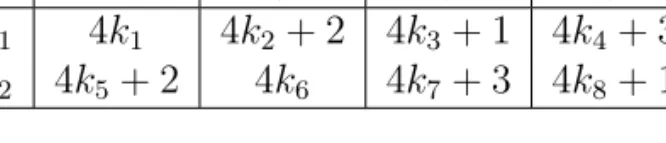
The only possiblem2-step prey ofuorv are vertices inB, vertices inC,u, or v. Yet, a vertex in B (resp.C) can be only 4k1+ 3 (resp. 4k1+ 1)-step prey of
uwhile it is only 4k2+ 1 (resp. 4k2+ 3)-step prey ofv, andu(resp. v) can be only 4k3 (resp. 4k3+ 2)-step prey ofuwhile it is only 4k4+ 2 (resp. 4k4)-step prey ofv for nonnegative integersk1, k2, k3 andk4. Hence there are nom-step common prey of u and v for any integer m ≥ 2, which is a contradiction.
Therefore if the pair (Kn1, Kn2) is m-step competition realizable for some integer m ≥2, thenn1 =n2 = 1 or n1 ≥n2 ≥3.
Now we show the second part of the statement (the “furthermore” part).
Obviously (K1, K1) is m-step competition realizable for any m≥2. Suppose that n1 ≥n2 ≥3. By Lemma 4.2, it is sufficient to consider the case m = 2.
Let V1 = {u1, u2, . . . , un1}, V2 = {v1, v2, . . . , vn2}, V10 = V1 \ {u1, u2} and V20 =V2\ {v1, v2}. Since n1 ≥n2 ≥3, any of V10 andV20 is not empty. LetD00 be a bipartite tournament with bipartition (V1, V2) whose vertex set is
V(D00) =V1∪V2 and whose arc set is
A(D00) = {(u1, v1),(u1, v2),(u2, v1),(v2, u2)}
∪{(x, y)|x∈V10 and y∈V20} ∪ {(v1, x)|x∈V10}
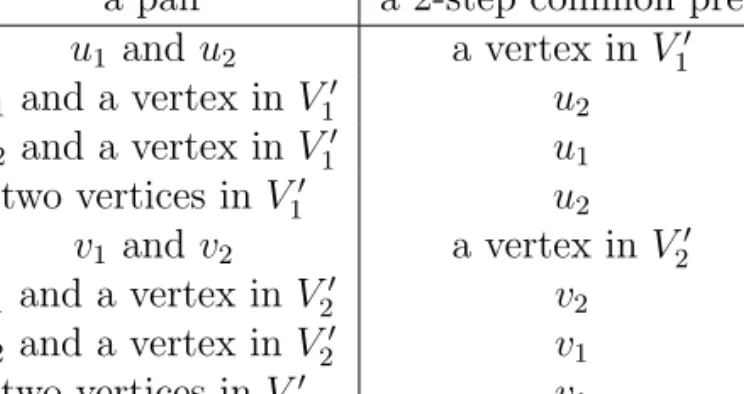
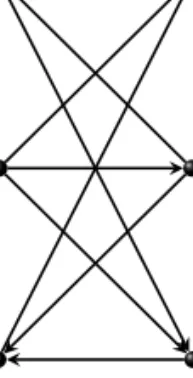
∪{(x, v2)|x∈V10} ∪ {(y, u1)|y∈V20} ∪ {(u2, y)|y∈V20} (see Figure 4.1). Then Table 4.1 matches a pair of vertices and its 2-step common prey in D00. Therefore the pair (Kn1, Kn2) is 2-step competition realizable and so, by Lemma 4.2, the pair (Kn1, Kn2) is m-step competition realizable for m≥2.
Theorem 4.4. Let n1 and n2 be positive integers satisfying n1 ≥n2 ≥3. If the pair (Cn1, Cn2) is m-step competition realizable for some integer m ≥ 2 then n1 = n2 = 3. Furthermore, if n1 = n2 = 3, then the pair (Cn1, Cn2) is m-step competition realizable for any integer m≥2.
a pair a 2-step common prey u1 and u2 a vertex in V10 u1 and a vertex inV10 u2 u2 and a vertex inV10 u1 two vertices in V10 u2
v1 and v2 a vertex in V20 v1 and a vertex inV20 v2 v2 and a vertex inV20 v1 two vertices in V20 v1
Table 4.1: A pair of vertices and its 2-step common prey in D00
u1
u2
v1
v2
V10 V20
Figure 4.1: D00