저작자표시-비영리-변경금지 2.0 대한민국 이용자는 아래의 조건을 따르는 경우에 한하여 자유롭게
l 이 저작물을 복제, 배포, 전송, 전시, 공연 및 방송할 수 있습니다. 다음과 같은 조건을 따라야 합니다:
l 귀하는, 이 저작물의 재이용이나 배포의 경우, 이 저작물에 적용된 이용허락조건 을 명확하게 나타내어야 합니다.
l 저작권자로부터 별도의 허가를 받으면 이러한 조건들은 적용되지 않습니다.
저작권법에 따른 이용자의 권리는 위의 내용에 의하여 영향을 받지 않습니다. 이것은 이용허락규약(Legal Code)을 이해하기 쉽게 요약한 것입니다.
Disclaimer
저작자표시. 귀하는 원저작자를 표시하여야 합니다.
비영리. 귀하는 이 저작물을 영리 목적으로 이용할 수 없습니다.
변경금지. 귀하는 이 저작물을 개작, 변형 또는 가공할 수 없습니다.
의학석사 학위논문
Pharmacokinetics and Tolerability of KM-023
in Healthy Subjects
건강한 자원자에서 KM-023 의 약동학 및 내약성에 대한 연구
2014 년 8 월
서울대학교 대학원 의과학과 의과학 전공
차 유 정
i
ABSTRACT
Introduction: KM-023 is a new second-generation non-nucleoside reverse transcriptase inhibitor that is under development for the treatment of human immunodeficiency virus (HIV) type-1 infection. This study determined KM-023 pharmacokinetic characteristics and tolerability in healthy subjects.
Methods: A randomized, double-blinded, placebo-controlled, dose-escalation study was conducted in 80 healthy Korean male volunteers. The subjects were allocated to single- or multiple-dose (once daily for 7 days) study that received 75, 150, 300, or 600 mg drug or placebo in a 4:1 ratio. The plasma and urine concentrations were quantified using liquid chromatography -tandem mass spectrometry. Plasma concentration-time data of KM-023 was analyzed by using non-compartmental methods. Adverse events were reported and tolerability monitoring was conducted.
Results: The average maximum concentration (Cmax) and area under the concentration-time curve from time 0 to infinity (AUCinf) values of KM-023 for the 75-600 mg doses in the single-dose study ranged from 440.2 ng/mL to 1245.4 ng/mL and 11142.4 ng·h/mL to 33705.6 ng·h/mL, respectively. The mean Cmax at steady-state (Cmax,ss) and area under the concentration-time curve within a dosing interval (AUCτ,ss)values ranged from 385.1 ng/mL to 1096.7 ng/mL and 3698.9 ng·h/mL to 10232.6 ng·h/mL, respectively, following 75-600 mg doses in the multiple-dose study. Dose proportionality was not observed for KM-023. KM-023 showed a 0.6-fold accumulation after multiple doses in the 600-mg dose group.
KM-023 was generally well tolerated.
ii
Conclusions: KM-023 demonstrated dose- and time-dependent nonlinear
pharmacokinetic characteristics after single or multiple doses over a dose range (75-600 mg) in healthy subjects. KM-023 showed favorable tolerability in this study.
---
Keywords: KM-023, pharmacokinetics, tolerability Student number: 2010-23748
iii
CONTENTS
Abstract ... i
Contents ... iii
List of tables ... iv
List of figures ... v
List of abbreviation ... vi
Introduction ... 1
Material and Methods ... 4
Subjects ... 4
Study design ... 5
Determining KM-023 concentration ... 6
Pharmacokinetic analysis ... 8
Tolerability assessments ... 9
Statistical analysis ... 9
Results ... 10
Study population ... 10
Pharmacokinetics ... 12
Tolerability ... 18
Discussion ... 22
References ... 25
Abstract in Korean ... 27
iv
LIST OF TABLES
Table 1. Participants demography
Table 2. Pharmacokinetic parameters following single or multiple doses of KM-023
Table 3. Assessment of KM-023 dose-proportionality
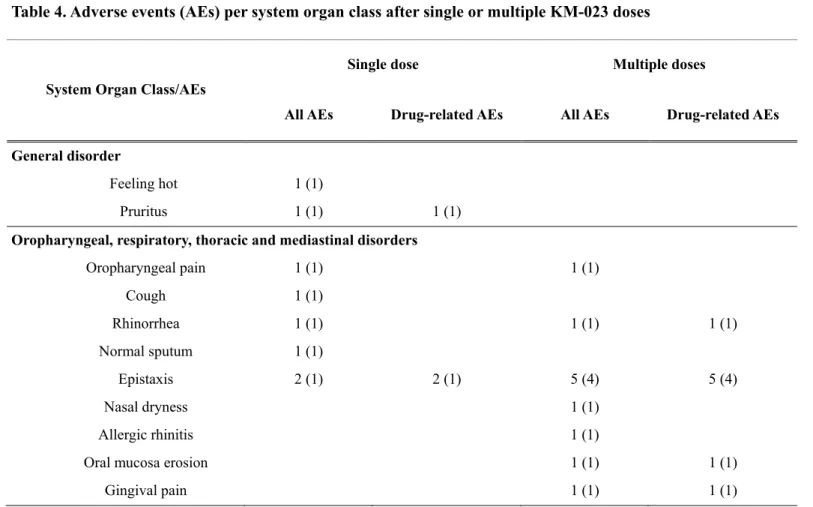
Table 4. Adverse events (AEs) per system organ class after single or
multiple KM-023 doses
v
LIST OF FIGURES
Figure 1. Chemical structure of KM-023
Figure 2. Mean plasma KM-023 concentration-time profiles after oral administration. (A, single dose; B, multiple doses)
Figure 3. Comparisons of C
max/dose (A), AUC
inf/dose (B), C
max,ss/dose
(C), and AUC
τ,ss/dose (D) with respect to KM-023 doses. (A and B,
single dose; C and D, multiple dose)
vi
LIST OF ABBREVIATION
AE Adverse event
AI Accumulation index ANOVA Analysis of variance
AUC Area under the concentration-time curve
AUClast AUC from drug administration to the last quantifiable AUCinf AUC from drug administration to time infinity AUCτ AUC from the dosing to time point of next dosing CI Confidence interval
Cmax Maximum observed plasma concentration CL/F Apparent clearance
PK Pharmacokinetic
Tmax Observed time of maximum plasma concentration t1/2 Terminal elimination half-life
1
INTRODUCTION
Current practice guidelines recommend a combination of two nucleoside reverse transcriptase inhibitors (NRTIs) plus a non-nucleoside reverse transcriptase inhibitor (NNRTI), such as efavirenz or a ritonavir-boosted protease inhibitor, as a first-line therapy for the treatment of human immunodeficiency virus (HIV) type-1 infection (1, 2), which has reduced the mortality and morbidity of HIV-1-infected patients (3, 4). Among these drugs, the use of efavirenz with two NRTIs as an initial therapy regimen resulted in higher overall virological efficacy compared with lopinavir-ritonavir plus two NRTIs in phase III clinical trials (1, 5).
Despite its advantages, the use of efavirenz has been limited by the emergence of both central nervous system toxicities and viral resistance (6-9).
Second-generation NNRTIs, such as rilpivirine and etravirine, were developed to overcome these shortcomings. These drugs showed improved viral resistance profiles with better efficacy and less toxicity compared with first- generation NNRTIs (9, 10).
KM-023 (3-[3-ethyl-5-isopropyl-2,6-dioxo-1,2,3,6-tetrahydro- pyrimidine-4-carbonyl]-5-methyl benzonitrile) has been under development as a novel second-generation NNRTI (Kainos Medicine USA Inc., Morrisville, NC, USA) (Figure 1). KM-023 has displayed favorable safety profiles and pharmacological characteristics in preclinical studies. KM-023 exhibited antiviral activity in the low nanomolar range against laboratory strains and
2
clinical HIV-1 isolates, and it showed activity against K103N (unpublished data), which is the major efavirenz-resistant mutation (11). There were no significant findings in in vivo safety pharmacology studies conducted in mice and dogs. The oral bioavailability and terminal elimination half-life (t1/2) of KM-023 were 64–69% and 5.09–5.75 h in preclinical studies in dogs and monkeys, respectively. KM-023 moderately induced cytochrome P450 (CYP) 3A4 in in vitro studies using human hepatocytes (unpublished data). This study assessed the tolerability and pharmacokinetic characteristics of KM-023 following single or multiple oral doses in healthy subjects.
3 Figure 1. Chemical structure of KM-023
4
MATERIALS AND METHODS
Subjects
Eligibility criteria included adults aged 20-45 years with a body mass index of 18.5 to 25 kg/m2 who had no clinically significant abnormalities upon clinical laboratory evaluation or physical examination. Volunteers who had clinically significant medical conditions or clinical laboratory test abnormalities, history of drug addiction or alcoholism, or positive serological tests (e.g., hepatitis B surface antigen, hepatitis C antibodies, and HIV) were excluded. Written informed consent was obtained from each subject prior to participation.
Subjects who discontinued prior to completing the study were replaced.
The Seoul National University Hospital Institutional Review Board approved the study protocol. This study was performed according to the principles described in the Declaration of Helsinki and Good Clinical Practice (ClinicalTrials.gov identifier: NCT01348516) (12).
5
Study design
This study was conducted as a first-in-human, randomized, double-blind, placebo-controlled, single or multiple doses, dose-escalation clinical trial.
Eligible subjects in the single-dose study were randomly allocated into one of the following KM-023 dose groups: 75 mg, 150 mg, 300 mg, or 600 mg (each n=10). These subjects also randomly received a single oral dose of KM-023 or placebo at a ratio of 4:1.
Subjects in the multiple-dose study were also randomly assigned to one of four dose groups, which were the same as the single-dose study in doses and number of subjects. Subjects received KM-023 or placebo once daily for 7 days.
6
Determining KM-023 concentration
Blood and urine samples were collected to determine the pharmacokinetic characteristics of KM-023.
Blood samples (5 mL) in the single-dose study were collected into heparinized tubes pre-dose and at 0.25, 0.5, 1, 1.5, 2, 3, 4, 6, 8, 12, 16, 24, 36, 48, 60, and 72 h after dosing to determine the KM-023 concentrations. Urine samples (20 mL) were collected at 0 to 4, 4 to 8, 8 to 12, 12 to 24, 24 to 48, and 48 to 72 h after dosing.
Blood samples (5 mL) in the multiple-dose study were collected into heparinized tubes pre-dose and at 0.25, 0.5, 1, 1.5, 2, 3, 4, 6, 8, 12, and 16 h after dosing on days 1 and 7. Samples for trough KM-023 concentration were obtained before dosing on days 2 to 6. Additional samples were collected at 0 h on days 8, 9, and 10. Urine samples were collected over the following time intervals of 0 to 4, 4 to 8, 8 to 12, and 12 to 24 h after dosing on days 1 and 7.
Blood samples were centrifuged at 2,000 g for 10 min at 4°C. Separated plasma samples were stored at -70°C prior to analysis. Urine volume was measured, and 20-mL urine samples were stored at -70°C before analysis.
KM-023 concentrations in plasma and urine were quantified using a validated liquid chromatography-tandem mass spectrometry method (LC-MS/MS). The internal standard was GS-9503 (3-[3-butyl-5-isopropyl-2,6-dioxo-1,2,3,6- tetrahydro-pyrimidine-4-carbonyl]-5-methyl benzonitrile). Mass spectrometric detection was conducted using multiple reaction monitoring transition at mass-to-charge ratios 326.3->298.2 for KM-023 and 354.3->298.3 for GS-
7
9503 in both plasma and urine sample analyses. The assays were validated over a range of 0.5-500 ng/mL (plasma) and 5-5,000 ng/mL (urine). The assay accuracy and precision ranged from 94.2 to 97.1% and ≤ 7.5% in plasma and 88.6 to 97.0% and ≤ 3.6% in urine, respectively.
8
Pharmacokinetic analysis
Individual pharmacokinetic parameters were assessed using non- compartmental analysis using Phoenix® software (ver. 1.0, Certara, St. Louis, MO, USA). Maximal plasma concentrations (Cmax) and time to Cmax (Tmax) were obtained from the observed values. The area under the time versus concentration curve (AUC) from time 0 to the last available measurement (AUClast) and the AUC within a dosing interval (AUCτ) were calculated using the linear up/log down method. The AUC from time 0 to infinity (AUCinf) was the sum of AUClast and Ct/λz, where Ct is the last measurable plasma concentration and λz is the elimination rate constant, as determined by linear regression analysis associated with the terminal (log-linear) portion of the plasma concentration-time curve. The half-life (t1/2) was determined as ln2/λz. The apparent oral clearance (CL/F) was calculated as dose/AUCinf. The fraction of unchanged drug excreted in the urine (fe) was estimated as the amount of unchanged drug excreted in the urine (Ae) over the dose. The accumulation index was estimated by calculating AUC144-168h/AUC0-24h.
9
Tolerability assessments
Tolerability was evaluated by monitoring adverse events (AEs) throughout the study. Physical examination, vital sign measurements, 12-lead electrocardiogram (ECG), computerized impedance cardiography (CIC), and clinical laboratory tests were performed periodically before and after dosing during the study period.
Statistical analysis
Statistical analysis was performed using SPSS® software (version 17.0; SPSS, Inc., Chicago, IL, USA). All safety data and pharmacokinetic parameters were summarized as treatment and dose using descriptive statistics. Dose proportionality was assessed using linear regression on the log transformed Cmax and AUC values. Dose proportionality was also evaluated concerning whether the 95% confidence interval (CI) for the log transformed Cmax and AUC values included 1.0 in the power model. Repeated measures analysis of variance (RM-ANOVA) were used to investigate differences in the plasma trough concentrations in each treatment group to identify whether steady-state conditions were achieved by day 7. A P-value < 0.05 was considered statistically significant.
10
RESULTS
Study population
A total of 41 subjects were enrolled in the single-dose study. One subject who received 75 mg KM-023 discontinued the study because of a withdrawal of informed consent. A total of 41 subjects were enrolled in the multiple dose study. Of these subjects, one subject in the placebo group discontinued due to an influenza infection. No significant differences were observed in the demographic characteristics between the treatment groups (Table 1).
11 Table 1. Participants demography
Single dose Placebo
n=8
75 mg n=9
150 mg n=8
300 mg n=8
600 mg n=8
Total n=41
P-value*
age (years) 27.1 ± 7.2 25.6 ± 4.1 28.1 ± 7.3 25.6 ± 3.5 27.8 ± 3.0 26.8 ± 5.2 0.629
body weight (kg) 66.2 ± 7.3 68.3 ± 6.1 67.4 ± 5.0 64.3 ± 10.4 66.4 ± 6.7 66.6 ± 7.1 0.728
height (cm) 172.4 ± 4.4 173.4 ± 4.4 174.0 ± 6.6 173.3 ± 6.2 174.8 ± 5.4 173.6 ± 5.2 0.806
BMI (kg/m2) 22.3 ± 1.6 22.7 ± 1.1 22.3 ± 1.9 21.4 ± 2.4 21.8 ± 2.0 22.1 ± 1.8 0.658
Multiple doses Placebo n=9
75 mg n=8
150 mg n=8
300 mg n=8
600 mg n=8
Total n=41
P-value*
age (years) 25.4 ± 3.0 25.6 ± 2.2 25.3 ± 2.4 26.4 ± 2.3 27.0 ± 2.7 25.9 ± 2.5 0.695
body weight (kg) 64.5 ± 7.1 67.8 ± 7.9 64.6 ± 4.1 65.4 ± 8.2 67.5 ± 7.0 65.6 ± 6.9 0.827
height (cm) 172.0 ± 4.6 173.0 ± 5.5 172.8 ± 4.7 172.6 ± 4.1 174.1 ± 3.5 172.8 ± 4.3 0.940
BMI (kg/m2) 21.8 ± 2.5 22.6 ± 1.9 21.6 ± 0.9 21.9 ± 2.2 22.2 ± 2.0 22.0 ± 2.0 0.845
The data are represented as the mean ± standard deviation.
BMI, body mass index
* The Kruskal-Wallis test was employed.
12
Pharmacokinetics
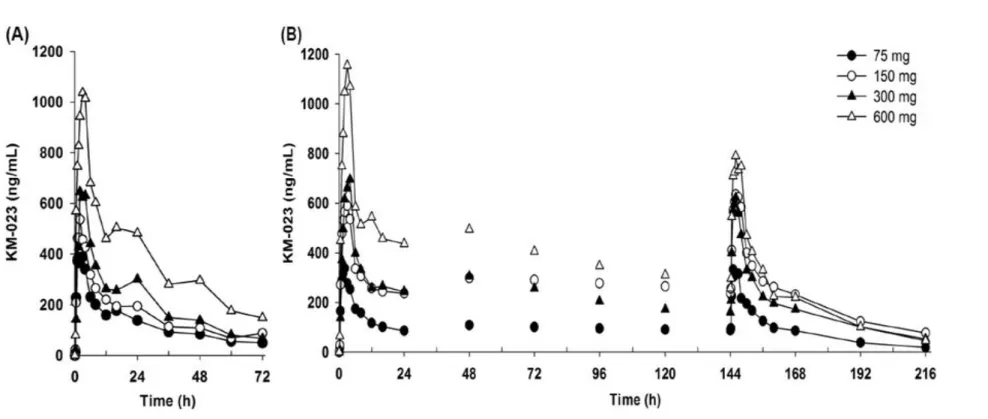
The average KM-023 plasma concentration-time profiles for each treatment group after single or multiple doses are illustrated in Figure 2. The predose concentrations were compared in the multiple-dose study using RM-ANOVA depending on the KM-023 dose, and steady state was attained after day 4 (75 mg) or day 6 (150-600 mg).
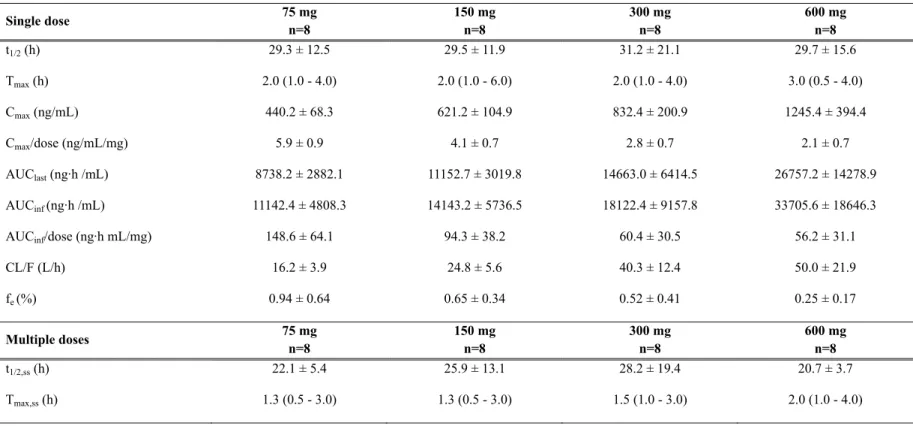
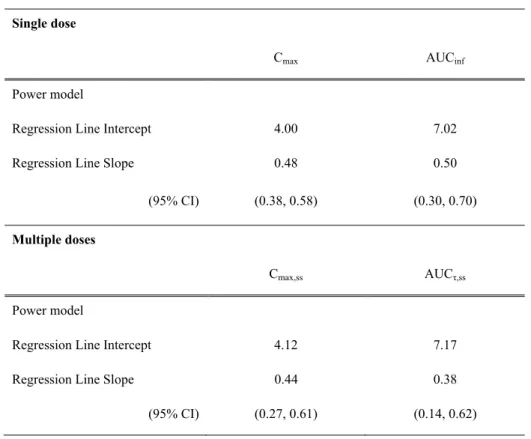
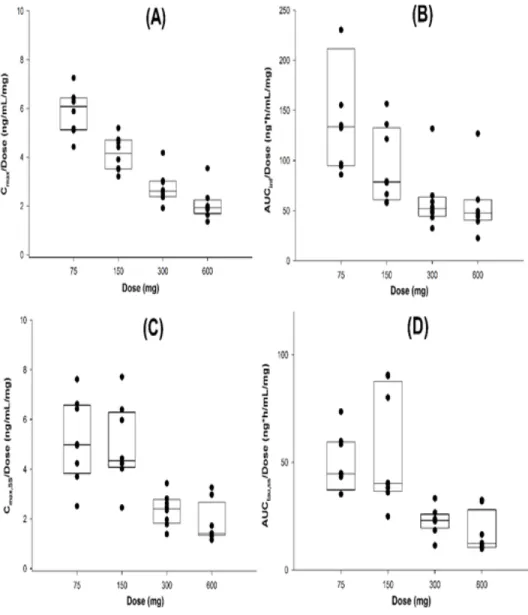
Following single or multiple doses of KM-023, the Tmax values were ranged 0.5-6.0 h and the mean terminal elimination t1/2 values were ranged 20.7-31.2 h. In the single dose study, the mean KM-023 Cmax and AUCinf values ranged from 440.2 to 1245.4 ng/mL and 11142.4 to 33705.6 ng·h/mL, respectively. In the multiple dose study, the mean KM-023 Cmax,ss and AUCτ,ss values ranged from 385.1 to 1096.7 ng/mL and 3698.9 to 10232.6 ng·h/mL, respectively (Table 2). The Cmax and AUC values increased as the dose escalated, but neither Cmax nor AUC showed dose proportionality (Figure 2 and Table 3). After multiple doses of KM-023, the accumulation index ranged from 0.6 to 1.1. Notably, the accumulation index was 0.6 in the 600-mg dose group. The fe values accounted for less than 1% at all dose levels. Therefore, renal clearance was not evaluated (Table 2).
13
Figure 2. Mean plasma KM-023 concentration-time profiles after oral administration. (A, single dose; B, multiple doses)
14
Table 2. Pharmacokinetic parameters following single or multiple doses of KM-023
Single dose 75 mg
n=8
150 mg n=8
300 mg n=8
600 mg n=8
t1/2 (h) 29.3 ± 12.5 29.5 ± 11.9 31.2 ± 21.1 29.7 ± 15.6
Tmax (h) 2.0 (1.0 - 4.0) 2.0 (1.0 - 6.0) 2.0 (1.0 - 4.0) 3.0 (0.5 - 4.0)
Cmax (ng/mL) 440.2 ± 68.3 621.2 ± 104.9 832.4 ± 200.9 1245.4 ± 394.4
Cmax/dose (ng/mL/mg) 5.9 ± 0.9 4.1 ± 0.7 2.8 ± 0.7 2.1 ± 0.7
AUClast (ng·h /mL) 8738.2 ± 2882.1 11152.7 ± 3019.8 14663.0 ± 6414.5 26757.2 ± 14278.9
AUCinf (ng·h /mL) 11142.4 ± 4808.3 14143.2 ± 5736.5 18122.4 ± 9157.8 33705.6 ± 18646.3
AUCinf/dose (ng·h mL/mg) 148.6 ± 64.1 94.3 ± 38.2 60.4 ± 30.5 56.2 ± 31.1
CL/F (L/h) 16.2 ± 3.9 24.8 ± 5.6 40.3 ± 12.4 50.0 ± 21.9
fe (%) 0.94 ± 0.64 0.65 ± 0.34 0.52 ± 0.41 0.25 ± 0.17
Multiple doses 75 mg
n=8
150 mg n=8
300 mg n=8
600 mg n=8
t1/2,ss (h) 22.1 ± 5.4 25.9 ± 13.1 28.2 ± 19.4 20.7 ± 3.7
Tmax,ss (h) 1.3 (0.5 - 3.0) 1.3 (0.5 - 3.0) 1.5 (1.0 - 3.0) 2.0 (1.0 - 4.0)
15
Cmax,ss (ng/mL) 385.1 ± 126.3 740.0 ± 248.1 706.4 ± 192.5 1096.7 ± 489.1
Cmax,ss/dose (ng/mL/mg) 5.1 ± 1.7 4.9 ± 1.7 2.4 ± 0.6 1.8 ± 0.8
AUCτ,ss(ng·h /mL) 3698.9 ± 1006.4 8252.3 ± 4060.7 6813.0 ± 1880.0 10232.6 ± 5710.2
AUCτ,ss/dose (ng·h mL/mg) 49.3 ± 13.4 55.0 ± 27.1 22.7 ± 6.3 17.1 ± 9.5
CL/F (L/h) 21.5 ± 5.4 22.3 ± 10.2 48.0 ± 17.6 71.9 ± 28.1
fe (%) 0.52 ± 0.40 0.75 ± 0.52 0.28 ± 0.15 0.18 ± 0.12
Accumulation index 1.1 ± 0.2 1.1 ± 0.5 0.9 ± 0.2 0.6 ± 0.1
The data are represented as the mean ± standard deviation except for Tmax, for which the median (range) is shown.
t1/2, terminal elimination half-life; Tmax, time to the maximum plasma concentration; Cmax, maximum plasma concentration; AUCinf, area under the plasma concentration-time curve extrapolated to infinity; CL/F, apparent oral clearance; fe, percent of the amount excreted unchanged in urine; Cmax,ss, maximum plasma concentration at steady-state;
AUCτ,ss, area under the plasma concentration-time curve within a dosing interval at steady-state.
16
Table 3. Assessment of KM-023 dose-proportionality
Single dose
Cmax AUCinf
Power model
Regression Line Intercept 4.00 7.02 Regression Line Slope 0.48 0.50
(95% CI) (0.38, 0.58) (0.30, 0.70) Multiple doses
Cmax,ss AUCτ,ss
Power model
Regression Line Intercept 4.12 7.17 Regression Line Slope 0.44 0.38
(95% CI) (0.27, 0.61) (0.14, 0.62) Power model: Ln Y = a + b⋅ln(Dose), Y: parameter (Cmax, AUCinf, Cmax,ss, and AUCτ,ss)
17
Figure 3. Comparisons of Cmax/Dose (A), AUCinf/Dose (B),Cmax,ss/Dose (C), and AUCτ,ss/Dose (D) with respect to KM-023 doses. (A and B, single dose; C and D, multiple dose)
18
Tolerability
Fifteen subjects in the single dose study experienced a total of 17 AEs throughout the study. Nine AEs that occurred in 7 subjects were drug-related.
Twenty-two subjects in the multiple-dose study experienced a total of 24 AEs during the study period. Seventeen AEs that occurred in 16 subjects were drug-related. Epistaxis (7 occurrences; 2 in one subject (single-dose study), 5 in four subjects (multiple-dose study)) was the most frequently reported AE.
All 7 occurrences were deemed to be drug-related AEs by the investigators.
No serious AEs occurred in this study (Table 4). There were no clinically meaningful changes from baseline in clinical laboratory test results, vital signs, ECGs, CICs, or physical examinations.
19
Table 4. Adverse events (AEs) per system organ class after single or multiple KM-023 doses
System Organ Class/AEs
Single dose Multiple doses
All AEs Drug-related AEs All AEs Drug-related AEs General disorder
Feeling hot 1 (1)
Pruritus 1 (1) 1 (1) Oropharyngeal, respiratory, thoracic and mediastinal disorders
Oropharyngeal pain 1 (1) 1 (1)
Cough 1 (1)
Rhinorrhea 1 (1) 1 (1) 1 (1)
Normal sputum 1 (1)
Epistaxis 2 (1) 2 (1) 5 (4) 5 (4)
Nasal dryness 1 (1)
Allergic rhinitis 1 (1)
Oral mucosa erosion 1 (1) 1 (1)
Gingival pain 1 (1) 1 (1)
20
Toothache 1 (1)
Chest discomfort 1 (1) 1 (1)
Influenza A 1 (1)
Ophthalmologic disorders
Corneal erosion Lt. 1 (1) Nervous system disorders
Paresthesia 1 (1) 1 (1) 1 (1) 1 (1)
Dizziness 1 (1)
Somnolence 2 (2) 2 (2)
Neuralgia 1 (1) 1 (1)
Headache 2 (2) 2 (2)
Musculoskeletal disorders
Back pain 2 (1) 2 (1) Gastrointestinal disorders
Upper abdominal pain 1 (1) 1 (1)
Dyspepsia 2 (2) 2 (2)
Genitourinary disorders
Dysuria 1 (1) 1 (1)
21 Skin and subcutaneous tissue disorders
Chapped lips 1 (1) 1 (1)
Eczema 2 (1)
Contact dermatitis 1 (1)
Total 17 (15) 9 (7) 24 (22) 17 (16) The data are represented as the number of events (number of subjects)
22
DISCUSSION
The primary objective of this phase I clinical study was to investigate the pharmacokinetic characteristics of KM-023, a newly developed second- generation NNRTI, and evaluate its tolerability in healthy volunteers. KM-023 showed dose- and time-dependent nonlinear pharmacokinetics. In addition, there was no laboratory or clinical evidence of clinically significant AEs to KM-023. The present study provides initial information on the tolerability and pharmacokinetic characteristics of KM-023 in humans.
We could not calculate the renal CL because the mean fe values were less than 1% in all dose groups. Our findings suggest that non-renal pathways primarily eliminated KM-023. These results are consistent with other NNRTIs, which show negligible renal excretion and extensive hepatic metabolism (13).
However, the detailed metabolites and metabolic pathways of KM-023 have not been characterized. Therefore, an evaluation of the metabolic pathways and a measurement of metabolite concentrations and KM-023 potency are needed.
KM-023 showed less than dose-proportional nonlinear pharmacokinetics over the 75 to 600 mg dose range. This pattern was also observed in first- generation NNRTIs. After a single oral administration of efavirenz (100 to 1600 mg) and nevirapine (2.5 to 400 mg) in healthy subjects, the Cmax or AUC increased less than dose-proportionally, which suggests diminished absorption or enhanced CL at higher doses (14, 15). The reduced absorption may be due
23
to the saturation of influx transporters, and the enhanced CL may result from induced enzymes involved in hepatic/intestinal metabolism (16). Further studies are needed to investigate the mechanism of the less than dose- proportional nonlinear pharmacokinetics of KM-023.
The accumulation index was 0.6-1.1 over the range of the 75-600 mg doses. Interestingly, the average accumulation index decreased to 0.6 in the 600-mg dose group. These findings indicate that the metabolic enzymes related to KM-023 metabolism were induced by multiple KM-023 administrations. A similar auto-induction phenomenon was also observed in efavirenz, nevirapine (13). KM-023 exhibited a moderate potential for pregnane X receptor (PXR) and CYP3A4 messenger RNA (mRNA) activation in primary human hepatocytes (unpublished data). The markedly increased CL/F values after multiple doses of 600 mg, which could be partially explained by an auto-induction of CYP3A4 enzymes due to a sustained relatively high exposure of KM-023, might be the reason for the apparently low accumulation. Therefore, it is anticipated that the exposure of KM-023 will be decreased when using high doses of KM-023 (particularly more than 600 mg) for clinical use.
The most frequent AE after KM-023 administration in the present study was epistaxis; however, there were no statistically significant changes in the occurrence rates between placebo and treatment groups, and the rate was not dose-dependent. Among widely used first-generation NNRTIs, efavirenz demonstrated CNS toxicity, while nevirapine and delavirdine demonstrated hepatotoxicity or hypersensitivity reactions such as a rash (8). We compared
24
the AEs that occurred after multiple doses of KM-023 in healthy subjects with the results obtained from first generation NNRTIs. Nervous system symptoms, headache (2 occurrences), paresthesia (1 occurrence), and neuralgia (1 occurrence) were reported after multiple doses of KM-023; however, these symptoms were not severe and transient. There were also no reported AEs or clinically significant laboratory abnormalities associated with hypersensitivity reactions and liver function.
In conclusion, the pharmacokinetics of KM-023 showed dose- and time- dependent nonlinear pharmacokinetic profiles. Single or multiple doses of KM-023 at 75-600 mg was well tolerated in healthy subjects. Further clinical trials evaluating the efficacy and safety of KM-023 in HIV-1 positive patients are warranted.
25
REFERENCES
1. Riddler SA, Haubrich R, DiRienzo AG, et al. Class-sparing regi mens for initial treatment of HIV-1 infection. N Engl J Med. 2 008 May; 358(20): 2095-2106.
2. Thompson MA, Aberg JA, Hoy JF, et al. Antiretroviral treatmen t of adult HIV infection: 2012 recommendations of the Internati onal Antiviral Society-USA panel. JAMA. 2012 Jul; 308(4):387- 402.
3. Palella FJ, Jr., Delaney KM, Moorman AC, et al. Declining mor bidity and mortality among patients with advanced human immu nodeficiency virus infection. HIV Outpatient Study Investigators.
N Engl J Med. 1998 Mar; 338(13):853-860.
4. Pauwels R. New non-nucleoside reverse transcriptase inhibitors (NNRTIs) in development for the treatment of HIV infections.
Curr Opin Pharmacol. 2004 Oct ; 4(5):437-446.
5. Arasteh K, Rieger A, Yeni P, et al. Short-term randomized proo f-of-principle trial of TMC278 in patients with HIV type-1 who have previously failed antiretroviral therapy. Antivir Ther. 2009;
14(5):713-722.
6. Shubber Z, Calmy A, Andrieux-Meyer I, et al. Adverse events a ssociated with nevirapine and efavirenz-based first-line antiretrovi ral therapy: a systematic review and meta-analysis. AIDS. 2013 Jun; 27(9):1403-1412.
7. Hammer SM, Eron JJ, Jr., Reiss P, et al. Antiretroviral treatmen t of adult HIV infection: 2008 recommendations of the Internati onal AIDS Society-USA panel. JAMA. 2008 Aug; 300(5):555-57 0.
8. Carr A, Cooper DA. Adverse effects of antiretroviral therapy. L ancet. 2000 Oct; 356(9239):1423-1430.
9. Garvey L, Winston A. Rilpivirine: a novel non-nucleoside revers e transcriptase inhibitor. Expert Opin Investig Drugs. 2009 Jul;
26 18(7):1035-1041.
10. Scholler-Gyure M, Kakuda TN, Raoof A, De Smedt G, Hoetelm ans RM. Clinical pharmacokinetics and pharmacodynamics of etr avirine. Clin Pharmacokinet. 2009; 48(9):561-574.
11. Bacheler LT, Anton ED, Kudish P, et al. Human immunodeficie ncy virus type 1 mutations selected in patients failing efavirenz combination therapy. Antimicrob Agents Chemother. 2000 Sep; 4 4(9):2475-2484.
12. Kainos Meidicine Inc., Single ascending dose (SAD)/multiple ascending dose (MAD) safety/pharmacokinetic (PK) study of KM- 023. [ClinicalTrials.gov identifier NCT01348516].
13. Smith PF, DiCenzo R, Morse GD. Clinical pharmacokinetics of non-nucleoside reverse transcriptase inhibitors. Clin Pharmacokine t. 2001; 40(12):893-905.
14. Adkins JC, Noble S. Efavirenz. Drugs. 1998 Dec; 56(6):1055-10 64.
15. Cheeseman SH, Hattox SE, McLaughlin MM, et al. Pharmacoki netics of nevirapine: initial single-rising-dose study in humans.
Antimicrob Agents Chemother. 1993 Feb; 37(2):178-182.
16. Ludden TM. Nonlinear pharmacokinetics: clinical implications. C linical pharmacokinetics. 1991 Jun; 20(6):429-446.
27
국문 초록
서론: KM-023 은 인간 면역 결핍 바이러스 감염의 치료를 목적으 로 새롭게 개발된 2 세대 비뉴클레오사이드 역전사 효소 억제제이다.
본 연구에서는 건강한 자원자에서 KM-023 의 약동학적 특성 및 내약성을 탐색하고자 하였다.
방법: 본 연구는 무작위 배정, 이중맹검, 위약 대조, 용량 증량 형태 로 설계 되었으며, 80 명의 건강한 성인 남성이 연구에 참여 하였다.
자원자들은 KM-023 75, 150, 300, 600 mg 또는 위약을 단회 또 는 반복 (1 일 1 회씩, 7 일 동안) 투여 받았다. 혈중 및 소변 약물 농도 측정에는 liquid chromatography-tandem mass spectrometry 를 이용하였다. 약동학 분석은 비구획 방법 (noncompartmental methods)을 이용하여 분석하였다. 임상시험 기간 동안 이상반응을 수집 하였으며, 내약성을 평가하였다.
결과: KM-023 75-600 mg 용량을 단회 투여시, 평균 최고혈중농 도 (Cmax) 및 체내노출 (area under the concentration-time curve from time 0 to infinity, AUCinf) 값의 범위는 각각 440.2- 1245.4 ng/mL 및 11142.4-33705.6 ng·h/mL 이었다. KM-023 75-600 mg 용량을 반복 투여시, 항정상태에서의 평균 최고혈중농 도 (Cmax,ss) 및 체내노출 (area under the concentration-time curve within a dosing interval, AUCτ,ss) 값의 범위는 각각
28
385.1-1096.7 ng/mL and 3698.9-10232.6 ng·h/mL 이었다. 용 량-비례성은 관찰되지 않았다. KM-023 반복 투여시, 600 mg 용 량군에서 축적 지수(accumulation index)가 0.6 으로 관찰 되었다.
또한 KM-023 75 mg 에서 600 mg 용량 범위에서 내약성이 양호 함을 확인하였다.
결론: 건강한 자원자에서 KM-023 75-600 mg 을 단회 또는 반복 투여시 용량- 및 시간-의존적 비선형적 약동학적 특성을 보였다.
KM-023 약물은 내약성이 양호한 안전한 약물이 될 수 있을 것으 로 기대 된다.
---
주요어 : KM-023, 약동학, 내약성 학 번 : 2010-23748