| Abstract |
Purpose: This study aimed to investigate the impact of resistance on the muscle activities of the long and short heads of the biceps brachii, according to the elbow angle in supination, and the difference in muscle activity between the long and the short heads.
Methods: This study was conducted with 22 men in their 20s who voluntarily agreed to participate. With the glenohumeral joint neutral in a position of supination, the elbow angle was randomly moved to 0°, 30°, 60°, and 90°. Using an 8-channel surface EMG while the participants held a 2-kg. dumbbell, the muscle activities of the long and the short heads of the biceps brachii were measured. The measured data were statistically processed using SPSS for Windows 12.0. For the activities of the short and the long heads according to the angle, a one-way ANOVA was conducted, and subsequently, to check the results of an analysis of the difference between groups, an LSD post-hoc test was conducted. An independent t-test was used to compare the activities of the long head and the short head according to the angles.
Results: The analysis of the impact of the load of the dumbbell at each elbow angle on the muscle activities of the long and short heads of the biceps brachii revealed significant differences in both heads (p < 0.05). The result of the post-hoc analysis showed significant differences in both heads at angles between 0° and 30°, between 0° and 60°, and between 0° and 90°. Analysis of the impact of the load of the dumbbell in supination on the muscle activities of the long and short heads showed a significant difference at the angle between 0° and 30° (p < 0.05).
Conclusion: The long head of the biceps brachii mainly acts in supination; however, in supination at elbow-bending angles
†Corresponding Author : Min-Chull Park ([email protected])
Original Article Open Access
위팔두갈래근의 긴갈래와 짧은갈래의 팔굽관절 굽힘 각도에 따른 근활성도 분석
김정욱⋅박민철1†1)
부산가톨릭대학교 물리치료학과, 1부산가톨릭대학교 물리치료학과
An Analysis of Muscular Activity of the Long and Short Heads of Biceps Brachii Muscle According to the Elbow Flexion Angle
Jeong-Wook Kim, P.T., M.S⋅Min-Chull Park, P.T., Ph.D1†
Department of Physical Therapy, College of Health Sciences, Graduated School, Catholic University of Pusan
1Department of Physical Therapy, College of Health Sciences, Catholic University of Pusan
Received: February 11, 2020 / Revised: March 3, 2020 / Accepted: March 4, 2020
ⓒ 2020 Journal of Korea Proprioceptive Neuromuscular Facilitation Association
This is an Open Access article distributed under the terms of the Creative Commons Attribution Non-Commercial License (http://creativecommons.org/licenses/by-nc/3.0) which permits unrestricted non-commercial use, distribution, and reproduction in any medium, provided the original work is properly cited.
of 60° and 90°, there was no difference in muscle activity between the short head and the long head.
Key Words: Muscle activity, Biceps brachii, Short head, Long head, Supnation
Ⅰ. 서 론
어깨 복합체는 복장뼈, 빗장뼈, 갈비뼈, 어깨뼈 그리 고 위팔뼈로 구성되어 있고, 4개 관절로 이루어져 있 다. 이 중 어깨뼈와 위팔뼈로 이루어진 오목위팔관절 (glenohumeral joint)은 신체의 관절 중 가장 불안정하 며, 근육과 인대에 의해 안정화되는 관절이다 (Neurmann, 2010). 오목위팔관절을 지나는 근육들에 는 돌림근띠, 어깨세모근, 위팔두갈래근 등이 있다 (Itoi et al., 1994; Kido et al., 2003; Xue et al.,1998).
이러한 근육들은 오목위팔관절의 역동적인 안정장치 (dynamic stabilizer)의 역할을 하며, 근수축 동안 윤활 주머니와 인대의 경직성(stiffness)을 증가시켜 안정성 을 부여한다. 또한 위팔뼈와 어깨뼈의 위치를 조절하 는 짝힘(couple force)의 구성요소로 오목위팔관절을 가로지르는 힘이 적절한 방향으로 작용하도록 도와준 다(Poppen et al., 1978).
위팔두갈래근 긴갈래는 어깨뼈의 관절위결절에서 기시하고, 짧은갈래는 어깨뼈 부리돌기에서 기시한다 (Basmajian, 1982). 이러한 기시부의 차이는 기능에서 도 영향을 주게 되는 데 짧은갈래는 위팔뼈 굽힘의 작용을 하게 되고, 긴갈래의 경우 위팔뼈머리의 앞쪽 병진을 제한하며, 위팔뼈머리를 지나가는 힘줄은 위 팔뼈 벌림의 관절운동형상학을 조절하는 데 중요한 힘인 위팔뼈머리의 위쪽 이동에 대한 저항을 제공한 다(Pagnani et al., 1996).
위팔두갈래근과 관련된 선행 연구들을 살펴보면 팔굽관절 각도에 따라 위팔두갈래근과 위팔노근의 상 대적인 근활성도가 결정된다고 하였고(Howard et al., 1988), Choi 등(1996)의 연구에 의하면 팔굽관절 각도 가 증가함에 따라 위팔두갈래근의 상대적인 근활성도 가 위팔노근보다 더 크게 증가하였다. 또한 손목관절
굽힘, 폄에 따른 손목관절 변인과 팔굽관절 각도의 변화는 위팔두갈래근의 활성도 변화에 영향을 주었다 (Kim, 2010). 하지만 팔굽관절 각도에 따른 위팔두갈래 근 내에서의 긴갈래와 짧은갈래의 차이를 분석한 연 구는 부족한 실정이다.
최근 들어 몸쪽 부착부와 유사하게 먼쪽 부착부에 대한 연구도 이루어지고 있다. 긴갈래 먼쪽 건의 경우 짧은갈래보다 노뼈 거친면에서 몸쪽으로 가까이 부착 되어 있고 아래팔뼈 회전축으로부터 멀리 부착된 반 면, 짧은갈래의 경우 노뼈 거친면 몸쪽으로부터 멀리 부착되어 있다(Eames et al., 2007). 몸쪽 부착부의 차이 가 긴갈래와 짧은갈래의 어깨관절에서의 기능적 차이 를 만들어내듯이 먼쪽 부착부의 차이 또한 팔굽관절 의 기능에 미치는 영향이 다를 것이다. 따라서 위팔두 갈래근의 긴갈래와 짧은갈래의 먼쪽 부착부의 해부학 적 차이가 실제 기능적인 차이와 연계되는지에 대한 연구가 필요할 것이다.
이에 본 연구는 아래팔 뒤침자세를 유지하는 동안 팔굽관절 굽힘 각도에 따른 근활성도를 측정하여 비 교함으로써 팔굽관절 굽힘 각도 별 뒤침자세 유지를 위해 작용하는 위팔두갈래근 긴갈래와 짧은갈래의 기 능적 차이를 확인하고자 수행되었다.
Ⅱ. 연구 방법
1. 연구 대상
연구대상자는 부산광역시에 소재하고 있는 P대학 교 22명을 대상으로 실시하였다. 연구에 앞서 대상자 에게 연구에 대한 목적과 실험방법 등에 대해 충분히 설명하였고, 스스로 연구 참여에 동의한 자를 대상자
로 선정하였다. 대상자는 신경계 손상이 없는 자, 최근 6개월간 정형외과적인 문제가 없는 자로 하였다.
2. 측정방법 및 도구
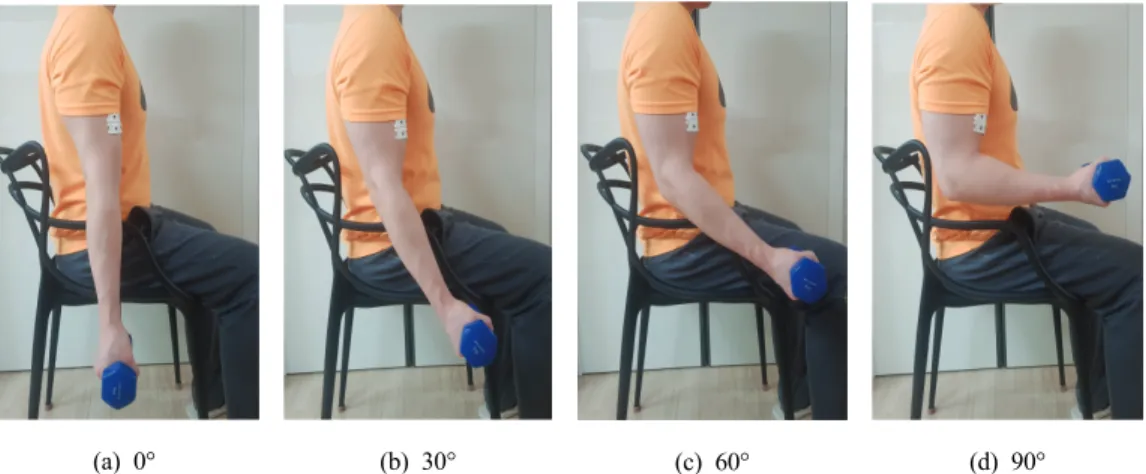
본 연구는 팔굽관절 굽힘 각도에 따른 위팔두갈래 근의 근활성도를 측정하기 위하여 대상자를 의자에 앉힌 자세에서 2kg 아령을 손에 쥐게 한 다음 어깨위팔 관절 중립자세에서 팔굽관절 굽힘 0°, 30°, 60°, 90°
각도를 무작위로 제공하여 수행하도록 하였다. 각도 측정은 Smart Tools co.에서 제공한 스마트폰 각도기 (Smartphone Protractor v1.4, Republic of KOREA) 어플 을 사용하였다. 위팔뼈는 지면과 수직각도를 유지하 였고, 아래팔은 손목관절 0도 굽힘, 뒤침자세에서 시 행하였다. 팔굽관절 굽힘 동작은 5초간 3회 실시하였 으며, 처음과 끝 각 1초를 제외한 3초간의 근활성도를 3회 측정한 값의 평균을 이용하였다. (Fig. 1). 근활성도 는 8 채널 무선 근전도 장치(WEMG-8, LXM 5308 Laxtha, Korea)를 사용하였으며, Telescan 프로그램 (Laxtha, USA)을 이용하여 분석하였다. 표면 전극을 적용 하기전 알콜솜으로 청결함을 유지 한 후, 전극 패드 부착 부위는 전극이 피부에 잘 고정 되고 피부 저항을 줄이기 위해 면도를 실시하였다(Hermens et al., 2000). 표면전극은 긴갈래의 경우 위팔두갈래근의 바깥쪽과 중간 교차점의 3분의 1 몸쪽에서 먼 부위에
부착하였고, 짧은갈래의 경우 위팔두갈래근의 중간과 안쪽 교차점의 3분의 1 몸쪽에서 먼 부위에 부착하였 다. 짧은갈래와 긴갈래의 혼선을 막기 위해 3cm 간격 을 두고 부착하였다(Brown et all., 1993). 표면 전극은 Ag/AgCl 전극(Monitoring Electrode with Foam Tape, 3M, Canada)을 사용하였다. 근전도 신호의 표본 추출 률은 1,024Hz, 대역통과필터 20∼500Hz, 60Hz 노치필 터를 이용하여 필터링하였다. 수집된 신호는 RMS값 으로 정량화 하였다. 팔굽관절 각도 90도, 오목위팔관 절 0도 굽힘 자세에서 최대 등척성 수축시 값을 기준으 로 하여 위팔두갈래근의 긴갈래와 짧은갈래의 근활성 도를 MVIC (maximum voluntary isometric contraction) 로 처리 하였다.
3. 자료 분석
연구를 통해 얻어진 데이터는 SPSS for Windows ver 12.0을 사용하여 분석하였고, 모든 데이터 표기는 평균과 표준오차를 사용하였다. 각각의 팔굽관절 굽 힘 각도에서 아래팔 뒤침자세를 유지하는 동안 위팔 두갈래근 긴갈래와 짧은갈래의 근활성도를 비교하기 위하여 독립표본 t검정(independent t-test)을 실시하였 다. 그리고 각도에 따른 위팔두갈래근 긴갈래와 짧은 갈래의 근활성도를 비교하기 위해 일원배치분산분석 (one-way ANOVA)을 사용하였다. 각각의 각도 사이에
(a) 0°
(b) 30°
(c) 60°
(d) 90°
Fig. 1. The measuring position.
근활성도 차이를 알아보기 위하여 사후검정은 LSD를 사용하였고, 통계적 유의 수준 α는 0.05로 하였다.
Ⅲ. 연구 결과
1. 연구 대상자의 일반적인 특성
본 연구는 우세측이 우측인 신체 건강한 성인남성 22명을 대상으로 실시하였다. 대상자의 평균연령은 20.81±1.36세이며, 평균 체중은 71.54±10.52kg, 평균신 장은 174.31±7.33cm이었다(Table 1).
Characteristics Mean±SD
Age (years) 20.81±1.36
Weight (kg) 71.54±10.52
Height (cm) 174.31±7.33
Table 1. General characteristics of subjects (n=22)
2. 팔굽관절 각도에 따른 위팔두갈래근 긴갈래와 짧은갈래의 근활성도 비교
뒤침자세를 유지하는 동안 팔굽관절 굽힘각도 증 가에 따른 위팔두갈래근의 긴갈래와 짧은갈래의 근활 성도 분석결과, 긴갈래(F=10.34, p <0.05)와 짧은갈래 (F=9.05, p <0.05) 모두 굽힘각도에 따른 유의한 차이가 있었다. 사후 분석 결과 긴갈래와 짧은갈래 모두 0도와 30도, 0도와 60도, 0도와 90도에서 유의한 차이를 보였 다(Table 2).
3. 위팔두갈래근 긴갈래와 짧은갈래의 근활성도 차이 비교
뒤침자세를 유지하는 동안 팔굽관절 굽힘 각도별 위팔두갈래근의 긴갈래와 짧은갈래 사이에서의 근활 성도 차이를 분석한 결과 0도와 30도에서 유의한 차이 를 나타내었으나(p <0.05), 60도와 90도에서는 두 갈래 에서 차이가 없었다(Table 3).
0° 30° 60° 90° F p
LHBM 0.04±0.01 0.21±0.03 0.18±0.02 0.19±0.02 10.34 0.00*
SHBM 0.02±0.00 0.14±0.02 0.15±0.02 0.16±0.02 9.05 0.00*
*: Significant difference (p<0.05) Mean±SE
LHBM: long head of the biceps muscle, SHBM: short head of the biceps muscle
Table 2. Comparison of muscular activity of biceps brachii muscle according to elbow angle (%MVIC)
LHBM SHBM t P
0° 0.04±0.04 0.02±0.01 -2.94 0.00*
30° 0.21±0.12 0.14±0.08 -2.34 0.02*
60° 0.18±0.09 0.15±0.1 -0.89 0.37
90° 0.19±0.02 0.16±0.11 -1.06 0.29
*: Significant difference (p<0.05) Mean±SE
LHBM: long head of the biceps muscle, SHBM: short head of the biceps muscle
Table 3. Comparison of muscular activity long head and short head of biceps brachii muscle according to elbow
angle (%MVIC)
Ⅳ. 고 찰
위팔두갈래근은 아래팔을 뒤침하면서 팔굽관절을 굽힘하는데 중요한 기능을 하는 근육이다. 위팔두갈 래근은 팔굽관절 굽힘 역할 뿐만 아니라 뒤침근과 함 께 뒤침의 주된 역할을 하는 근육으로 생리학적 가로 단면적이 뒤침근의 약 3배이며, 뒤침근은 작은 힘이 요구되는 동작시 활성화되는 반면 위팔두갈래근은 큰 힘을 요구하는 뒤침 동작시 활성화되는 근육이다 (Lehmkuhl & Smith, 1983). 위팔두갈래근에는 팔굽관 절 굽힘, 뒤침, 굽힘-뒤침에 각각 관여하는 3개의 task-specific motor unit이 있다.
본 연구는 아래팔 뒤침자세를 유지하는 동안 팔굽 관절 굽힘 각도에 따른 근활성도를 측정하여 비교함 으로써 팔굽관절 굽힘 각도 별 뒤침자세 유지를 위해 작용하는 위팔두갈래근 긴갈래와 짧은갈래의 기능적 차이를 알아보기 위해 실시하였다.
Eames 등(2007)의 연구 결과에 의하면 위팔두갈래 근 긴갈래와 짧은갈래 먼 쪽 건의 부착부위 차이에 따라 기능에 영향을 미치게 되는데, 긴갈래의 경우 뒤침의 작용을 주로 하며, 짧은갈래의 경우 굽힘의 작용을 주로 한다고 하였다. 본 연구 결과 뒤침시 팔굽 관절 굽힘각도 0도와 30도에서 위팔두갈래근 긴갈래 의 근활성도가 짧은갈래보다 유의하게 큰 것으로 나 타났으나, 60도와 90도에서는 유의한 차이가 없었다.
이러한 결과는 긴갈래의 먼쪽 부위 건이 짧은갈래에 비해 노뼈 거친면의 가까운 쪽에 위치되어 있으므로 (Athwal et al., 2007), 팔굽관절 굽힘 각도 0도와 30도에 서는 긴갈래의 근활성도가 짧은갈래 보다 높게 나타 난 것으로 여겨진다. 이는 위팔두갈래근의 길이가 늘 어남에 따라 급격한 뒤침 동작시 짧은갈래에 비해 긴 갈래의 근 활성도가 증가한 Brown 등(1993)의 연구와 도 일치한다. 하지만 팔굽관절 굽힘각도60도와 90도 에서는 근활성도의 차이를 나타내지 못하였는데 이는 굽힘각도가 증가할 때 긴갈래와 짧은갈래의 해부학적 부착부위나 근길이에 대한 영향이 감소하였기 때문이 라 여겨진다.
본 연구에서는 굽힘에 관여하는task-specific motor unit을 제어하지 못하였기 때문에 차후 연구에서 이러 한 점을 보완하여 뒤침과 관련된 근육들 간의 비교연 구가 필요할 것으로 생각된다. 또한 뒤침 동작 수행이 아닌 뒤침 자세를 유지하는 동안 굽힘각도별 등척성 수축시 나타난 값을 측정하였기 때문에 향후 연구에 서는 원심성, 구심성 수축시 근육 활동에 대한 비교연 구들이 필요할 것으로 생각된다.
Ⅴ. 결 론
뒤침자세를 유지하는 동안 팔꿈치 굽힘 각도별 위 팔두갈래근 긴갈래와 짧은갈래의 근활성도에 미치는 영향과 근활성도 차이를 알아본 결과 위팔두갈래근 긴갈래와 짧은갈래 모두 0도와 30도, 0도와 60도, 0도 와 90도에서 유의한 차이를 보였으나, 30도 이후의 각도에서는 유의한 차이가 없었다. 또한 뒤침자세를 유지하는 동안 팔꿈치 굽힘 각도 0도와 30도에서 긴갈 래가 높은 근활성도를 나타냈고, 60도와 90도에서는 근활성도 차이는 없었다. 따라서 뒤침자세를 유지하 는 데 있어 초기 굽힘자세에서 짧은갈래보다 긴갈래 의 작용이 더 큰 것으로 여겨진다. 이러한 결과는 위팔 두갈래근 긴갈래와 짧은갈래의 진단 및 치료적 운동 프로그램을 작성하는데 기초자료를 제공할 것으로 생 각된다.
Acknowledgements
이 논문은 2018학년도 부산가톨릭대학교 교내연구 비에 의하여 연구되었음.
References
Athwal GS, Steinmann SP, Rispoli DM. The distal biceps tendon: footprint and relevant clinical anatomy. The
Journal of Hand Surgery. 2007;32(8):1225-1229.
Brown JM, Solomon C, Paton M. Further evidence of functional differentiation within biceps brachii. Electromyography Clin Neurophysiology Journal. 1993;33(5):301-309.
Choi HN, Kwak CS, Lee DH. A quantitative analysis of the activation pattern of elbow flexors using autoregressive model. The Korean Journal of Physical Education. 1996;35(4):299∼308.
Eames MH, Bain GI, Fogg QA, et al. Distal biceps tendon anatomy: a cadaveric study. The Journal of Bone
& Joint Surgery. 2007;89(5):1044-1049.
Hermens HJ, Freriks B, Disselhorst-Klug C, et al. Development of recommendations for SEMG sensors and sensor placement procedures. Journal of Electromyography and Kinesiology. 2000;10(5):361-374.
Howard JD. Relative activation of two human elbow flexor under isometric condition. Experimental Brain Research. 1986;62(1):199-202.
Itoi E, Newman SR, Kuechle DK, et al. Dynamic anterior stabiliser of the shoulder with the arm in abduction.
The Journal of Bone and Joint Surgery. British volume.
1994;76(5):834-836.
Jamison JC, Caldwell GE. Muscle synergies and isometric torque production: influence of supination and pronation level on elbow flexion. Journal of
Neurophysiology. 1993;70(3):947-960.
Kido T, Itoi E, Lee SB, Neale PG, et al. Dynamic stabilizing function of the deltoid muscle in shoulders with anterior instability. The American Journal of Sports Medicine. 2003;31(3):399-403.
Kim TW. The analysis of muscle activation about wrist joint flexion & extension during elbow joint extension movement. Han-Yang University. Dissertation of Doctorate Degree. 2010.
Lehmkuhl LD, Smith LK. Brunnstrom’s clinical kinesiology, 4th ed. Philadelphia. FA Davis.1983.
Neumann DA. Kinegiology of the musculoskeletal system:
foundations for rehabilitation, 2th ed. Seoul.
Beommoon-education. 2011.
Pagnani MJ, Deng XH, Warren RF, et al. Role of the long head of the biceps brachii in glenohumeral stability:
a biomechanical study in cavavera. Journal of Shoulder and Elbow Surgery. 1996;5(4):255-262.
Poppen NK, Walker PS. Foreces at the glenohumeral joint in abduction. Clinical Orthopaedics and Related Research. 1978;(135):165-170.
Xue Q, Huang G. Dynamic stability of glenohumeral joint during scapular plane elevation. Chinese Medical Journal. 1998;115(5):447-449.