12
©The Korean Society of Food Science and Technology
GC-MS를 이용한 신선편의 샐러드 중 dichloroacetic acid와 trichloroacetic acid의 분석
김희갑1,*·이성균2·윤아현3
1강원대학교 농업생명과학대학 환경융합학부, 2강원대학교 자연과학대학 환경학과
3강원대학교 산림환경과학대학 제지공학과
Determination of dichloroacetic acid and trichloroacetic acid in fresh-cut salads using gas chromatography-mass spectrometry
Hekap Kim
1,*, Seong-gyun Lee
2, and A-hyeon Yun
31
School of Natural Resources and Environmental Science, Kangwon National University
2
Department of Environmental Science, Kangwon National University
3
Department of Paper Science and Engineering, Kangwon National University
Abstract Dichloroacetic acid (DCAA) and trichloroacetic acid (TCAA) in fresh-cut salads available from the market were determined by gas chromatography-mass spectrometry (GC-MS). The target compounds in 3 g of acidified homogenates were extracted with 20 mL of methyl t-butyl ether (MTBE). The extract was concentrated to 1 mL and heated for 1 h at 55oC. The analytes were separated using a DB-1701 column and detected with a mass spectrometer. The method detection limit was approximately 6µg/kg, and both analytical accuracy and precision were found to be satisfactory. The linearity of the calibration curves expressed as the coefficients of determination was >0.996. The analysis of seven samples using the established method showed that the four samples contained considerable amounts of analytes (25.4-31.2 µg/kg of DCAA and 18.8-46.1 µg/kg of TCAA). These results raised a concern about the impact of fresh-cut salad consumption on human health.
Keywords: Dichloroacetic acid, fresh-cut salad, GC-MS, trichloroacetic acid
서 론
최근에 우리나라의 식품 소비 행태는 건강뿐만 아니라 편의성 이 강조되면서 크게 변화하고 있다. 특히, 즉석식품류의 소비가 급증하면서 즉석섭취식품 및 신선편의식품이 세균 중에서도 병 원성 대장균으로 오염된 사례들이 보고되었다(Jo 등, 2011; Kang 등, 2011; Kim 등, 2011). 이 중 신선편의 샐러드 및 새싹채소는 소비자가 섭취하기 전에 미생물을 없애는 가열 처리가 없고, 세 척 과정에서 미생물들이 완전히 제거되지 않기 때문에, 병원성 미생물로 오염될 가능성이 매우 높은 편이다.
따라서 이와 같은 신선편의식품 중 미생물을 없애기 위한 방 안으로 염소계 살균제를 함유한 세척수를 사용할 수 있으며, 국 내 식품첨가물공전에서 과일류 및 채소류에 대해 사용이 허가된 살균제는 이산화염소(수), 차아염소산나트륨, 차아염소산수 및 차 아염소산칼슘이다(MFDS, 2018). 그렇지만 사용 기준에는 이러한
살균제를 사용한 후에 “최종 식품의 완성 전에 제거하여야 한다.”
고만 명시되어 있고 살균제 및 부산물에 대한 식품 잔류 기준이 없다. 따라서 과일류 및 채소류를 세척수에 담가 놓는 동안 식품 에 흡수될 수 있기 때문에, 물로 충분히 헹구지 않을 경우 살균 제의 산화 생성물인 chlorite나 chlorate가 잔류할 가능성이 있다 (Jung 등, 2017; Kim 등, 2017).
게다가 염소계 살균제는 강한 산화력을 갖기 때문에 수돗물의 원수로 사용되는 지표수에 함유된 유기물(특히 펄빅산)과 반응하 여 소위 염소소독부산물(disinfection by-products, DBPs)을 생성하 는 것으로 알려져 있다(Sadiq와 Rodriguez, 2004). 그 중에서도 가 장 흔히 생성되는 DBPs는 chloroform을 비롯한 trihalomethanes (THMs) 와 dichloroacetic acid (DCAA) 및 trichloroacetic acid (TCAA) 를 비롯한 haloacetic acids (HAAs)이다. 이러한 화합물들 은 WHO 산하의 국제암연구소(IARC) 및 미국 환경보호청(U.S.
EPA) 에서 발암성이 의심되는 물질로 분류되어 있으며, 많은 나 라에서 먹는물 중 수질 기준을 설정하여 관리하고 있다(Sadiq와 Rodriguez, 2004).
게다가 염소계 살균제는 aspartic acid, tryptophan, tyrosine과 같 은 아미노산과 반응하여 THMs을 생성하는 것으로 보고되었다 (Bieber 와 Trehy, 1983; Tan 등, 1987). 따라서 채소류 중 THMs은 세척수로부터 흡수될 뿐만 아니라, 잔류염소가 채소류 중 유기물 과 반응하여 생성되어 잔류할 수 있다(Huang과 Batterman, 2010;
Ölmez 와 Kretzschmar, 2009; Schony, 2010). 실제로, 이탈리아에서 염소로 소독된 신선편의 채소류에서 chloroform의 평균 농도는
*Corresponding author: Hekap Kim, School of Natural Resources and Environmental Science, College of Agriculture and Life Sci- ences, Kangwon National University, Chuncheon, Kangwon 24341, Korea
Tel: +82-33-250-8577 Fax: +82-33-259-5563 E-mail: [email protected]
Received December 12, 2018; revised January 18, 2019;
accepted January 21, 2019
러드의 소비가 증가함에 따라, THMs와 같은 휘발성 DBPs뿐만 아니라 HAAs와 같은 비휘발성 물질에 대한 오염 우려가 증가하 여 그 현황을 파악하는 것이 필요한 시점이 되었다. 더욱이 비휘 발성 물질은 채소류에 흡수되거나 채소류에서 생성된 후, 휘발에 의한 손실이 상대적으로 적으므로 THMs에 비해 더 높은 농도로 잔류할 가능성이 있다.
따라서 본 연구는 신선편의 채소류, 특히 샐러드 중 두 종류 의 대표적인 DBPs 중 HAAs에 대해 분석하고자 수행되었다. 먼 저 한 가지의 채소(양상추)를 선택하여 HAAs에 대한 분석 방법 을 확립하고, 실험실에서 생성 실험을 통해 HAAs의 생성 여부 를 확인한 후, 시중에서 채취한 신선편의 샐러드 시료를 HAAs 에 대해 분석하였다.
재료 및 방법
시약
연구 대상 HAAs는 monochloroacetic acid (MCAA), monobro- moacetic acid (MBAA), dibromoacetic acid (DBAA), bromochlo- roacetic acid (BCAA), DCAA, TCAA, bromodichloroacetic acid (BDCAA), dibromochloroacetic acid (DBCAA), tribromoacetic acid (TBAA) 는 각각이 2,000 mg/mL의 농도로 제조된 Sigma- Aldrich (St. Louis, MO, USA) 사의 ampoule 제품을, 그리고 대체 표준물질(surrogate standard, SS)로 사용된 2-bromopropanoic acid (2-BPA) 와 CH
3OH 은 Honeywell (Charlotte, NC, USA)사의 제품 을 사용하였다. Methyl t-butyl ether (MTBE), Na
2SO
4및 H
2SO
4는 각각 Duksan Chemical Co. (Seongnam, Korea), Daejung Chemical Co. (Siheung, Korea) 및 Showa (Gyoda, Japan)사의 제 품을 사용하였다. NaClO는 Wako Pure Chemical Industries (Osaka, Japan) 의 제품을 사용하였다. HAAs 표준용액은 2,000 mg/L 의 stock solution을 MTBE로 희석하여 15 mg/L의 농도로 제조하 였고, 2-BPA는 MTBE를 용매로 사용하여 20 mg/L의 용액으로 만 들어 사용하였다.
추출, 전처리 및 유도체화
40 mL 의 유리 용기에 3.0 g의 샐러드 시료를 넣고 homogenizer (SHG-15A, Daihan Scientific Co., Wonju, Korea) 를 사용하여 분 쇄한 후, 30 µL의 2-BPA 용액과 0.3 g의 Na
2SO
4를 첨가하였다. 여 기에 2 mL의 4 N H
2SO
4수용액과 20 mL의 MTBE를 첨가한 후, 진탕기(SR-2DS, Taitec, Koshigaya, Japan)로 30분 동안 추출하였
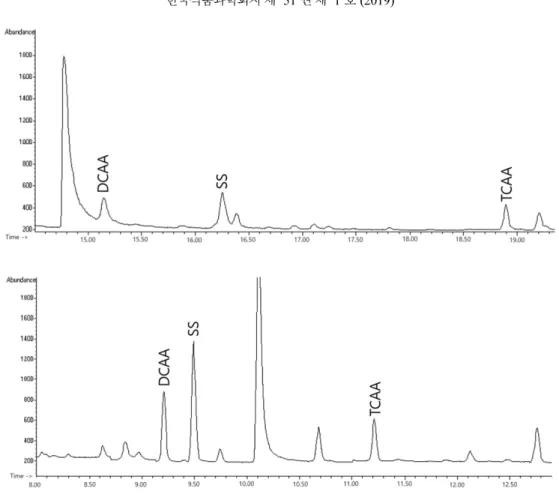
HAAs 의 methyl ester 유도체 분석을 위해 GC-MS (7890A, Agilent Technology, Santa Clara, CA, USA; 5975C, Agilent Technology) 를 사용하였다. 분석용 칼럼으로 처음에는 Agilent사 의 DB-5MS (30 m×0.25 mm×0.25 µm)를 사용하였다가, 피크의 분 리가 더 좋은 DB-1701 (30 m×0.25 mm×0.25 µm)로 변경하여 사 용하였다(Fig. 1). 1 µL의 분석 시료를 Autosampler (CN/7693, Agilent Technologies) 를 사용하여 GC-MS에 주입하였으며, 시료 주입부의 온도는 240
oC 이었고, 분할 주입 비율은 20:1이었다. 질 량분석기는 electron impact (EI) 방식으로 이온화하였고, selected ion monitoring (SIM) 방식으로 정량화하였다. 상세한 기기분석 조 건은 Table 1에 나타냈다.
분석 방법 검증
분석 방법을 검증하기 위하여 살균 처리하지 않은 양상추를 시 중에서 구입하여 사용하였다. 시료에서 DCAA와 TCAA, 두 가 지의 HAA만이 검출되어 이 두 가지 화합물에 대해서만 정량 분 석하였다.
방법검출한계(method detection limit, MDL)는 크로마토그램에 서 signal/noise (S/N)=3으로 얻어진 값의 3배에 해당하는 농도의 표준 시료를 7개 만들어 분석하였으며, 구한 표준편차에 3.14를 곱하여 구하였다. 정량한계(limit of quantitation, LOQ)는 표준편 차에 10을 곱하여 구하였다(U.S. EPA, 2003). 검정곡선은 3 g의 양상추에 SS와 표준물질을 주입하여 작성하였으며, 농도 범위는 정량한계 근처에 해당하는 15 µg/kg (표준용액 3 mL)부터 75 µg/
kg ( 표준용액 15 mL)이었다. 정확도(accuracy) 및 정밀도(precision) 는 각각 30 µg/kg 및 60 µg/kg의 농도에 대하여 각각 3개씩 조제 하여, 반복성(repeatability, relative standard deviation) 및 회수율 (recovery) 을 구하여 나타냈다.
살균 실험 및 현장 시료 채취
채소의 살균 실험을 위해 NaClO 용액을 희석하여 100 mg/L Cl
2의 잔류염소 농도를 갖는 수용액 500 mL를 제조하였다. 여기 에 25 g의 양상추를 5분 동안 침지한 후 꺼내어 초순수로 1분 동 안 세척하였다. 세척한 시료는 유통 기한을 모사하기 위하여 분 석 전까지 7일 동안 4
oC 에서 보관하였다.
이 연구에서 개발한 분석 방법을 적용하고자 시중에서 유통 중
인 신선편의 샐러드 시료를 채취하였다. 춘천의 한 대형 마트에
서 수요가 비교적 많은 7종(A-G)의 서로 다른 회사의 제품을 구
매하여 시료로 사용하였다.
결과 및 고찰
정성 분석 및 Column 선택
정성 분석은 표준 물질과 머무름 시간(retention time, RT) 및
질량 스펙트럼을 비교하여 실시하였다. 시료가 표준 물질에 대해 머무름 시간은 ±0.5%, 그리고 상대 이온 세기는 ±10% 이내에 있 음을 확인하였다(Rivier, 2003).
DB-5MS column 을 사용할 경우, DCAA에 해당하는 피크는 앞 Fig. 1. Comparison of peak resolutions between DB-5MS (top, 100 µg/kg) and DB-1701 (bottom, 75 µg/kg) columns. Peak resolution was increased by using the DB-1701 column.
Table 1. Operating conditions of gas chromatograph-mass spectrometer
Parameters Conditions
GC (7890A, Agilent
Technology)
Column Agilent DB-1701 (30 m ×0.25 mm, 0.25 µm thickness) Carrier gas and flow rate He at 1 mL/min
Temperature programming 35
oC hold for 1 min; 4
oC/min to 65
oC; 2
oC/min to 85
oC; 20
oC/min to 175
oC;
175
oC hold for 5 min; 25
oC/min to 260
oC; 260
oC hold for 15 min Inlet temperature 240
oC
Injection mode Split (ratio 20:1)
MS (5975C, Agilent
Technology)
Ionization mode Electron impact (EI) at 70 eV Ion source temperature 230
oC
Quadrupole operating temperature 150
oMass to charge (m/z) ratio
MCAA*
MBAA DCAA TCAA BCAA DBAA BDCAA DBCAA TBAA 2-BPA
59, 79, 108 59, 93, 95 59, 83, 85 59, 117, 119 59, 127, 129 59, 171, 173 59, 161, 163 59, 207, 209 59, 251, 253 59, 87, 107
*MCAA, monochloroacetic acid; MBAA, monobromoacetic acid; DCAA, dichloroacetic acid; TCAA, trichloroacetic acid; BCAA,
bromochloroacetic acid; DBAA, dibromoacetic acid; BDCAA, bromodichloroacetic acid; DBCAA, dibromochloroacetic acid; TBAA,
tribromoacetic acid; 2-BPA, 2-bromopropanoic acid.
부분에서 다른 피크와 부분적으로 겹치고, 2-BPA 피크는 뒤 부 분에서 다른 작은 피크와 겹쳤다(Fig. 1, 위). DB-1701 column으 로 변경하였을 경우, Fig. 1(아래)에서와 같이 두 피크 모두 전후 에 방해하는 피크가 없어 분해능이 크게 향상되었고, 피크의 모 양도 선명해졌다. MCAA, MBAA, DCAA, TCAA, BCAA, BDCAA, DBAA, DBCAA 및 TBAA에 대한 머무름 시간은 각각 5.91, 8.64, 9.22, 11.23, 12.42, 14.83, 15.01, 16.32 및 17.92분이 었으며, SS로 사용된 2-BPA의 머무름 시간은 9.50분이었다. 따라 서 정량 분석을 위한 column으로 DB-1701을 선택하였다.
우리나라의 먹는물공정시험기준 중 HAAs에 대한 분석 방법에 서는 메틸화된 유도체를 DB-1 또는 DB-5 계열의 column으로 분 리한 후, 질량분석기(MS) 또는 전자포획검출기(electron capture detector, ECD) 로 검출하도록 되어 있다(MOE, 2012a; MOE, 2012b). 반면에 미국 EPA에서는 DB-5.625 column의 사용을 권장 하고 있다(U.S. EPA, 2003). 이 연구에서는 대상 매질이 먹는물 이 아닌 채소류이므로 더 많은 화합물들이 분석 시료에 존재하 여 방해를 줄 수 있기 때문에, 이러한 화합물들에 대한 피크들로 부터의 향상된 분리를 위한 column으로 DB-1701을 사용하였다.
분석 방법 검증
Table 2 에는 분석 방법의 유효성에 대한 검증 결과를 나타냈다.
DCAA 와 TCAA에 대한 MDL은 각각 5.7 µg/kg과 5.5 µg/kg이었 다. 30 µg/kg 및 60 µg/kg에 대한 반복성(RSD, %)은 0.9-3.3%의 범위로 매우 양호하였으며, 정확도를 나타낸 회수율도 92.5-110%
로 양호한 편이었다. 정량한계 이상의 다섯 농도 수준의 범위(15-
예비 실험 및 시료 분석 결과
소독한 양상추 시료를 HAAs 대하여 분석한 결과, Fig. 2에서 와 같이 DCAA와 TCAA의 피크가 검출되었다. 따라서 시료 중 HAAs 에 대한 정량 분석은 이 두 화합물에 대해 실시하였다.
시중에 유통 중인 신선편의 샐러드 제품마다 구성 성분이 다 소 차이가 있었지만, 양상추와 치커리는 모든 제품에 함유되어 있었을 뿐만 아니라 함량도 가장 높은 편이었고, 로메인과 근대 가 다음으로 높았으며, 과채류인 방울토마토도 일부 제품에 포함 되어 있었다. 각 시료에 대한 정보는 Table 3에 제품별로 생산 지역, 샐러드 구성물 및 구성 비율을 나타냈다.
시중에서 유통되고 있는 시료를 분석한 결과, 7개의 시료 중 4 개의 시료(57.1%)에서 정량한계(LOQ) 이상으로 DCAA와 TCAA 가 검출되었다(Table 3). DCAA는 25.4-74.6 µg/kg (평균 46.3 µg/
kg) 의 수준으로, 그리고 TCAA는 18.8-46.1 µg/kg (35.4 µg/kg)의 수준으로 측정되었다. 이러한 농도 분포는 스페인에서 신선편의 채소류(n=22) 중 23%의 시료에서 DCAA와 TCAA가 각각 최대 22 µg/kg와 24 µg/kg 검출된 것에 비하면(Cardador와 Gallego, 2012), 검출 비율과 농도 면에서 모두 높은 편이다.
발암 위해도 및 중요성
이 연구를 통해 시중에서 유통 중인 신선편의 채소류 중 DCAA 와 TCAA의 농도는 비교적 높은 것을 알 수 있었다. 따라서 경 구 섭취를 통해 이 두 화합물에 노출되는 양을 평가하고 위해 평 가를 실시하였다. 두 화합물에 대한 평균 농도인 46.3 µg/kg과 35.3 µg/kg의 농도 자료를 사용하였다. DCAA와 TCAA의 cancer
Fig. 2. Formation of dichloroacetic acid (DCAA) and trichloroacetic acid (TCAA) in fresh-cut vegetables following disinfection with
NaClO (100 mg/L Cl
2) for 5 min.
slope factor (CSF) 는 각각 5.0×10
−2(mg/kg-day)
−1과 7.0×10
−2(mg/
kg-day)
−1이고(U.S. EPA, 2018a; 2018b), 평생(82년) 중 20세부터 63 년 동안 노출되며, 1년 중 24회(월 2회), 한 번에 50 g을 섭취 하는 것을 가정하여 노출 시나리오를 작성하였다. 만성일일섭취 량(chronic daily intake, CDI)은 다음의 수식으로 나타낼 수 있으 며, 이로부터 계산한 CDI는 각각 1.86×10
−6mg/kg-day 와 1.42×10
−6mg/kg-day 이었다.
CDI=(C ×IR×EF×ED)/(BW×LT) 여기에서,
C: concentration (DCAA 및 TCAA에 대해 각각 0.0463 mg/kg 및 0.0353 mg/kg)
IR: intake rate (0.05 kg/day)
EF: exposure frequency (24 day/year) ED: exposure duration (63 year) BW: body weight (62.8 kg) LT: lifetime (82 year)
이로부터 DCAA와 TCAA 각각의 초과발암위해도(excess life- time cancer risk, ELCR) 는 CDI와 CSF를 곱하여 각각 9.31×10
−8와 9.94×10
−8로 산정되었고, 둘 다 허용 위해도(10
−6) 이내에 있다.
따라서 신선편의 채소류의 섭취에 따라 비롯되는 DCAA 및 TCAA 에 대한 노출로 인한 초과 발암성은 우려할 만한 수준이 아니었다.
식품의약품안전청에서 2008년도에 실시한 조사에서는 모든 신 선편의식품 시료에서 THMs이 검출되지 않았다(KFDA, 2008). 그 렇지만, 최근 들어 신선편의식품의 수요와 공급이 증가함에 따라, 생산 과정에서 관리가 소홀이 될 수 있어 이에 대한 대책 방안 을 마련할 필요가 있을 것으로 생각된다. 실제로 이 연구를 통해 살균제의 분해 산물 이외에도, 살균제와 유기물과의 반응에 의해 부산물이 생성되고, 식품에 잔류하는 것을 알 수 있었다. 향후 THMs 과 HAAs 이외에도 생성 후 잔류할 가능성이 있는 모든 DBPs 에 대해 농도 분포를 파악하고, 이러한 식품의 섭취를 통해 노출되는 발암성의 DBPs의 잔류량을 저감하기 위한 방법을 모 색해야 할 것이다.
Fig. 3. Calibration curves for determination of dichloroacetic acid (DCAA; left) and trichloroaceetic acid (TCAA; right).
Table 3. Ingredient contents and concentrations of dichloroacetic acid (DCAA) and trichloroacetic acid (TCAA) in retail packaged ready-to-eat salads
Brand Manufacturing place Contents (%, v/v) DCAA ( µg/kg) TCAA (µg/kg) A Gwacheon-si,
Gyeonggi-do
Bok choy (15), cabbage lettuce (25), chicory (20), paprika (15),
radicchio (10), romaine (15) <LOQ* <LOQ B Eumseong-gun,
Chungcheongbuk-do Cabbage lettuce (30), chicory (30), radicchio (20), Swiss chard (20) 25.4 43.7
C Ansan-si,
Gyeonggi-do
Cabbage lettuce (30), cherry tomato (10), chicory (25),
red mustard (15), Swiss chard (20) 54.4 46.1 D Changnyeong-gun,
Gyeongsangnam-do
Cabbage lettuce (25), cherry tomato (10), chicory (25), romaine (20),
Swiss chard (20) <LOQ <LOQ
E Anseong-si, Gyeonggi-do
Cabbage lettuce (20), carrot (5), chicory (20), red cabbage (20),
romaine (15), Swiss chard (20) 31.2 18.8
F Chilgok-gun,
Gyeongsangbuk-do Cabbage lettuce (40), cherry tomato (10), chicory (30), romaine (20) <MDL* <MDL G Pyeongtaek-si,
Gyeonggi-do
Cabbage lettuce (30), chicory (30), paprika (5), red cabbage (5),
romaine (30) 74.1 32.9
*LOQ, limit of quantitation; MDL, method detection limit.
구 지원을 받아 수행되었으며(관리번호-520150441), 이에 감사 드 립니다.
References