www.jlmqa.org Copyright © 2021 Korean Association of External Quality Assessment Service
pISSN 2384-2458 • eISSN 2288-7261
Implementation and Validation of a Gas
Chromatography-Mass Spectrometry Method for Pristanic Acid and Phytanic Acid Quantification in Plasma Specimens
https://doi.org/10.15263/jlmqa.2021.43.3.162
Ahram Yi* , Jun Hyung Lee* , Gahyun Yoo , Hye Jin Lim , Euna Park , Jungsun Han , Geun Young Kim , Sung-Eun Cho , Sang Gon Lee , and Eun Hee Lee
Department of Laboratory Medicine, Green Cross Laboratories (GC Labs), Yongin, Korea
Corresponding author:
Sung-Eun Cho
Department of Laboratory Medicine, Green Cross Laboratories (GC Labs), 107, Ihyeon-ro 30beon-gil, Giheung-gu, Yongin 16924, Korea
Tel +82-31-260-0947
E-mail [email protected]
*These two authors contributed equally to this manuscript.
Received: July 21, 2021 Revised: August 3, 2021 Accepted: August 9, 2021
This is an Open Access article distributed under the terms of the Creative Commons Attribution Non-Commercial License (http://creativecommons.org/licenses/
by-nc/4.0) which permits unrestricted non-commercial use, distribution, and reproduction in any medium, provided the original work is properly cited.
We validated a gas chromatography-mass spectrometry (GC-MS) method for quantifying pristanic acid (PrA) and phytanic acid (PhA) in plasma specimens.
We developed a GC-MS method based on the analysis of 20 µM
2H
3-pristanic acid (PrA-IS) and 80 µM
2H
3-phytanic acid (PhA-IS) as internal standards. The GC-MS was fitted with a 30 m×0.25 mm×0.25 µm HP-5MS (Agilent, USA) column. The mass spectrometer was operated through the transitions from the precursor to the product ions (m/z [mass-to-charge ratio] 355, 369, 358, and 372 for PrA, PhA, PrA-IS, and PhA-IS, respectively). The retention times of PrA, PhA, PrA-IS, and PhA-IS were 19.33, 20.39, 19.31, and 20.38 minutes in a 26.83-minute analysis, respectively. Linearity, recovery, precision, and carry- over were evaluated to validate the method. The GC-MS method yielded a linear response from 0.032 to 9.951 µmol/L for PrA (R
2=0.9999) and from 0.127 to 39.432 µmol/L for PhA (R
2=0.9998). The limits of quantification by the methods were 0.032 µmol/L for PrA and 0.127 µmol/L for PhA. The recovery of PrA and PhA GC-MS method measurements were within ±10% when evaluated with external quality assessment materials. The within-batch and total coefficients of variation were all below 6% for both PrA and PhA test results. Twenty-interday imprecision (%) were all below 5% for both PrA and PhA test results. Carry-over was found to be 0.001% for PrA and –0.008% for PhA. The GC-MS PrA and PhA assay showed adequate recovery, precision, sensitivity, and linearity. Hence, it is suitable for routine clinical work.
(Lab Med Qual Assur 2021;43:162-165)
Key Words Pristanic acid, Phytanic acid, Gas chromatography-mass spectro- metry, Method validation
EVALUATION BRIEF
페록시좀 질환(peroxisomal disorders) 환자들은 프리스탄산 (pristanic acid) 및 피탄산(phytanic acid) 등과 같은 분지 사슬 지방산(branched-chain fatty acids)의 충분한 섭취가 이루어지 면 혈장 프리스탄산 및 피탄산 농도가 증가한다[1]. 혈장 프리스 탄산 및 피탄산의 신뢰할 수 있는 정량화는 페록시좀 질환 환자를 평가하는 데 필수적이다. 이에 저자들은 혈장 검체에서 프리스탄
산 및 피탄산을 정량화하기 위한 기체 크로마토그래피 질량분석법 (gas chromatography-mass spectrometry, GC-MS) 검사법 을 구현하고 검증했다[1].
20 µM
2H
3-프리스탄산 및 80 µM
2H
3-피탄산(Cambridge
Isotope Laboratories Inc., Andover, MA, USA)을 내부표준
물질로 분석하여 GC-MS 검사법을 개발했다. 검체 전처리에는
163 Lab Med Qual Assur 2021;43:162-165
www.jlmqa.org
Ahram Yi et al
●Method Validation for Pristanic/Phytanic Acid
아세토니트릴(acetonitrile)을 혼합한 HCl을 이용한 산 가수분 해 및 메탄올(methanol)을 혼합한 NaOH를 이용한 알칼리 가 수분해, 헥산(hexane)을 이용한 액체-액체 추출(liquid-liquid extraction), 유기 용매의 증발, N-Methyl-N-tert-butyldimeth ylsilyltrifluoroacetamide (MTBSTFA) 및 피리딘(pyridine)에 의한 유도체화가 포함되었다. 길이 30 m, 내경(inner diameter) 0.25 mm, 필름 두께 0.25 µm인 HP-5MS (Agilent, Folsom, CA, USA) 컬럼이 장착된 7890B-5977B GC-MS (Agilent, Waldbronn, Germany) 장비를 사용하였고, 헬륨은 운반가스로 사용되었다. 질량분석기는 전구체(precursor)에서 생성물 이온 (product ions)으로의 전이(transition)를 통해 구동되었다. 프 리스탄산, 피탄산, 프리스탄산-내부표준물질 및 피탄산-내부표준 물질 각각의 mass-to-charge ratio (m/z)은 다음과 같다(m/z:
355, 369, 358, 372). 프리스탄산, 피탄산, 프리스탄산-내부표준
물질 및 피탄산-내부표준물질의 각각의 머무름 시간(retention times)은 다음과 같다(전체 26.83분 분석에서 각각 19.33, 20.39, 19.31, 20.38분).
분석장비 조건은 Table 1 (GC 조건), Table 2 (MS 조건)에 제 시한 바와 같다. 본 연구에서는 검사법을 평가하기 위해 Clinical and Laboratory Standards Institute (CLSI)에 제시된 평가지 침 및 문헌에 따라 GC-MS법을 이용하여 측정한 혈장 프리스탄산 및 피탄산 농도에 대하여 정밀도, 직선성, 회수율 및 잔효를 평가 하였다[2-9]. 각각의 평가에 대한 통계는 Microsoft Office Excel 2013 (Microsoft Corp., Redmond, WA, USA) 프로그램을 이용 하여 분석하였다.
정밀도는 ERNDIM Control Special Assays in Serum(물질번 호 SAS2019.01, SAS2019.04, SAS2019.05, SAS-02.1 [lot. no.
2018.2161], SAS-02.2 [lot. no. 2018.2162]; MCA Laboratory, Winterswijk, Netherlands) 세 가지 각각 다른 농도의 외부정도 관리물질을 이용하여 1일 1시행(run)씩, 시행당 3회, 3일 동안, 그 리고 추가적으로 1일 3시행씩, 시행당 1회, 20일 동안 반복 측정 하여 두 번에 걸쳐 평가하였다. 20일 추가정밀도 평가의 경우, 각 Table 1. Analytical instrument conditions for gas chromatography
Variable Values/features
Columns
Run time (min) 26.83
Flow (mL/min) 1
Pressure (psi) 8.20 Average velocity (cm/sec) 36.62 Holdup time (min) 1.37 Post run (mL/min) 1.30 Front injector
Syringe size (μL) 10.00 Injection volume (μL) 1.50
Plunger speed Fast
Wash vial solvent Hexane Inlets
Carrier gas control Constant flow–helium
Mode Split
Split ratio 10:1
Split flow (mL/min) 10 Oven program
Initial temperature 60℃ for 1.00 min
Ramp 1 30℃/min to 160℃, hold
for 0.00 min
Ramp 2 5℃/min to 230℃, hold for
0.00 min
Ramp 3 20℃/min to 230℃, hold
for 5.00 min
Post run 300℃
Table 2. Analytical instrument conditions for mass spectrometry
Variable Values/features
Ion mode Electron ionization
Source temperature (℃) 250
Quadrupole temperature (℃) 150
Electron energy (eV) 70
Emission ( µ A) 34.60
Repeller (V) 31.11
Entrance lens (V) 17.60
Extractor lens (V) 0.00
Table 3. Precision of pristanic acid and phytanic acid measure- ments by gas chromatography-mass spectrometry with high-, medium-, and low-level quality control materials
Items Level
(μmol/L)
Mean±standard deviation
(μmol/L)
Coefficient of variation
(%)
Pristanic acid Low 0.63±0.02 2.60
Medium 1.27±0.05 4.24
High 3.70±0.15 3.97
Phytanic acid Low 2.58±0.07 2.87
Medium 5.33±0.24 4.58
High 13.76±0.44 3.20
164 Lab Med Qual Assur 2021;43:162-165 www.jlmqa.org Ahram Yi et al
●Method Validation for Pristanic/Phytanic Acid
각의 정도관리물질을 20일 동안 매일 3시행씩, 시행당 1회씩 반복 측정하여 평가하였다[2,3]. 정밀도의 허용기준은 <±15%로 설정 하였다[4].
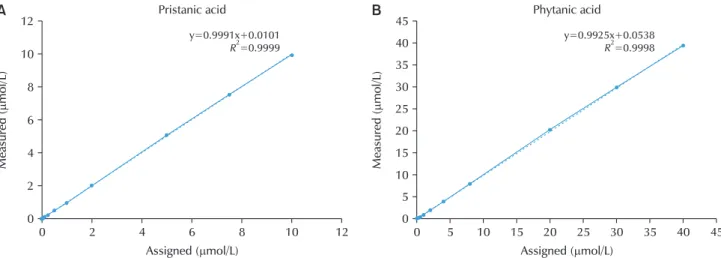
직선성은 CLSI EP06-A에 따라 평가하였다[5]. 프리스탄산 및 피탄산 표준품(Sigma Aldrich, St. Louis, MO, USA)을 톨루엔 (toluene)으로 희석하여 검량선(calibration curve) 시료를 제조 하는 방법과 동일한 방법으로 직선성을 확인할 수 있는 농도의 물 질을 조제하였다. 이들을 각각 3회씩 반복 측정하여 그 결과를 이 용하여 직선성을 평가하였다.
회수율은 ERNDIM Control Special Assays in Serum(물질번 호 SAS2019.01, SAS2019.04, SAS2019.05; MCA Laboratory, Winterswijk, Netherlands) 세 가지의 각각 다른 농도의 외부정 도관리물질을 이용하여 1일 3회, 3일간 분석하여 평가하였다[6].
잔효는 [(L1–L3)/(H2–L3)]×100 계산식으로 구하여 평가하였 고, 허용기준은 <±1.0%로 설정하였다[7-9]. 프리스탄산 및 피탄 산의 잔효는 각각 0.001%, –0.008%로 허용기준을 만족하였다.
각 종목별 정밀도 평가결과를 Table 3에 제시하였다. 각 종목별 정밀도 평가결과 총 변이계수는 2.60%에서 4.58% 수준의 값을 보였다[4]. Fig. 1은 프리스탄산 및 피탄산 검사항목의 직선성 평 가결과를 보여주는 그래프이다. 직선성 평가에서 두 종목 모두 결 정계수가 0.99 이상이었다. 각 종목별 회수율 평가결과를 Table 4 에 제시하였다. 각 종목별 회수율 평가결과 회수율은 92.30%에서 109.09% 수준의 값을 보였다[4].
GC-MS법을 이용한 혈장 프리스탄산 및 피탄산의 농도 측정은 정밀도, 직선성, 회수율, 잔효에 있어서 매우 만족할 만한 결과를 보였다. 따라서 혈장 프리스탄산 및 피탄산 GC-MS 검사법은 연구 목적뿐 아니라 임상검사 목적으로도 유용하게 사용할 수 있을 것 으로 판단된다.
ORCID
Ahram Yi https://orcid.org/0000-0002-3107-936X Jun Hyung Lee https://orcid.org/0000-0002-8682-3694 Gahyun Yoo https://orcid.org/0000-0002-4417-8172 Hye Jin Lim https://orcid.org/0000-0002-2339-3877 Euna Park https://orcid.org/0000-0002-3230-1364 Jungsun Han https://orcid.org/0000-0003-1160-0776 Geun Young Kim https://orcid.org/0000-0002-5867-5655 Sung-Eun Cho https://orcid.org/0000-0001-8082-3100 Sang Gon Lee https://orcid.org/0000-0002-4672-5811 Eun Hee Lee https://orcid.org/0000-0002-2517-175X
Measured ( mol/L)
12
10
8
6
4
2
0
12 Assigned ( mol/L)
0
Pristanic acid
y=0.9991x+0.0101
2
=0.9999
2 4 6 8 10
Measured ( mol/L)
45 40 35 30 25 20 15 10 5 0
45 Assigned ( mol/L)
0
Phytanic acid
y=0.9925x+0.0538
2