332
and Safety
Available online at http://www.foodhygiene.or.kr
Development and Validation of Analytical Methods for Picoxystrobin Determination in Agricultural Products by GC-ECD and GC-MS
Jung-Ah Do, Min-Hye Lee, Hyejin Park, IL-Hyun Kang, Kisung Kwon, and Jae-Ho Oh* Food Chemical Residues Division, National Institute of Food and Drug Safety Evaluation, KFDA,
Osong, Cheongwon, Chungbuk 363-700, Korea
(Received September 11, 2012/Revised November 15, 2012/Accepted November 20, 2012)
ABSTRACT - A simple and sensitive analytical method was developed using gas chromatography with electron capture detector (GC-ECD) and gas chromatography-mass spectrometry (GC-MS) for determination of Picoxystrobin in agricultural products (apple, hulled rice, mushroom, pepper, soybean, and mandarin). Picoxystrobin residues were extracted with acetonitrile, partitioned with saline water, and then they were cleaned up on a florisil solid-phase extraction (SPE) cartridge to obtain an extract suitable for analysis by GC-ECD and GC-MS. The method was vali- dated using 6 agricultural product samples spiked with Picoxystrobin at different concentration levels (0.02, 0.05 and 0.5 mg/L). Average recoveries of Picoxystrobin (using each concentration three replicates) ranged 64.0~98.3% with relative standard deviations less than 10%, calibration solutions concentration in the range 0.1~5 mg/L, and limit of detection (LOD) and limit of quantification (LOQ) were 0.005 and 0.02 mg/L, respectively. The result showed that the developed analytical method is suitable for Picoxystrobin determination in agricultural products.
Key words: Picoxystrobin, acetonitrile extraction, GC-ECD, GC-MS
Introduction
Picoxystrobin, methyl (E)3-methoxy-2-{2-[6-(trifluoromethyl)- 2-pyridyloxymethyl]phenyl}acrylate, is the broad spectrum strobilurin fungicide for the control of yellow, brown and crown rusts, powdery mildew, sooty mold, net and leaf blotch, and tan spot on cereal crops, including wheat, barley, and oats1-3). It discovered and developed as Acanto by Zeneca Agrochemicals (now Syngenta) in 20024). It blocks the electron transport between cytochrom b and cytochrom c1, which causes inhibition of ATP formation and mitochondrial respiration4,5).
Picoxystrobin was approved in the European Union (EU) in 20036) and it has been registered at the U.S. Environmental Protection Agency (EPA) as a new chemical candidate7). The European Commission (EC) has stated a maximum residue limit (MRL) of 0.05 mg/kg for Picoxystrobin residue in oat in 20058). In republic of Korea, Picoxystrobin was approved in 20119) and it has been registered for controlling anthracnose, downy mildew, phytophthora blight and phomopsis blight in persimmon, pepper, apple and cucumber10). The MRL of Picoxystrobin in republic of Korea was set to pepper (0.5 mg/
kg), apple (0.3 mg/kg), persimmon (1.0 mg/kg), and cucumber (1.0 mg/kg)11,12).
Picoxystrobin has a wide range of applications and is commonly used in agriculture; so it is necessary to determine levels of Picoxystrobin residues in agricultural products.
Therefore, very reliable and sensitive analytical method for determining Picoxystrobin residues is required. A number of analytical methods have been reported for the determination of fungicide residues, using solid-phase micro extraction (SPME)13), supercritical fluid extraction (SFE)14), and matrix solid-phase dispersion (MSPD)15). These methods have the advantages of simplicity and rapidity. However, it is difficult to use those methods in research and official laboratories because of the need of specific and expensive laboratory tools and skilled personnel. Moreover, there is little work to develop the analytical method using high-performance liquid chromatography (HPLC) or gas chromatography (GC). There- fore, the objective of this study was to develop a routine analytical method including liquid-liquid partition, solid- phase extraction, and GC analysis for Picoxystrobin in apple, hulled rice, mushroom, pepper, soybean, and mandarin.
Materials and Methods
Standards, Reagents, and Samples
A certificated analytical standard of Picoxystrobin (99.9%) was obtained from Dupont Products (USA). The physic-
*Correspondence to: Jae-Ho Oh, Food Chemical Residues Division, National Institute of Food and Drug Safety Evaluation, KFDA, Osong, Cheongwon, Chungbuk 363-700, Korea
Tel: 82-43-719-4207, E-mail: [email protected]
chemical properties of Picoxystrobin are shown in Table 1.
Pesticide grade acetone, acetonitrile, and n-hexane were purchased from Merck (Darmstadt, Germany). Other reagents such as sodium chloride and sodium sulfate anhydrous were purchased from Wako (Japan). Florisil cartridge (SPE, 6CC, 1 g) and 0.45µm GHP syringe filter were purchased from Waters (USA) and General Electric Company (USA), re- spectively.
To prepare applicability in a variety of agricultural products, apple and mandarin (fruits), hulled rice (cereal grains), oyster mushroom (mushrooms), pepper (vegetables), and soybean (beans) were selected as the representative crops. Agricultural products used in this experiment were purchased from nation’s major retailer.
Stock and working standard solution
Standard stock solution of Picoxystrobin was prepared in acetone at 500µg/mL and stored in a freezer at −18oC. The stock standard solutions were used for up to 3 months.
Suitable concentrations of working standards were prepared from stock solutions by serial dilution using acetone, imme- diately prior to sample preparation.
Extraction procedure
Each 20 g of the apple, hulled rice, mushroom, pepper, soybean, and mandarin samples were weighed out and homogenized with 100 mL of acetonitrile for 10 min (In case
of dried samples like hulled rice and soybean water addition hydration step is required prior to acetonitrile extraction).
The homogenized samples were conducted vacuum filtration, and then transferred to 500 mL separatory funnel. 10 g of sodium chloride was added and then vigorously shaken for 30 min. The eluent (acetonitrile layer) which passed through anhydrous sodium sulfate for dehydration was collected into a round bottom flask and evaporated to near dryness by rotary evaporator at 40oC. Finally make up with 5 mL of 20% acetone in n-hexane.
Purification procedure
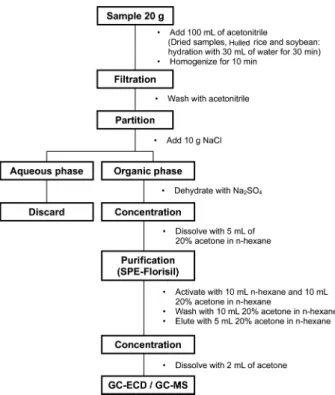
For conditioning the SPE-Florisil cartridge, 10 mL of n- hexane and 10 mL of 20% acetone in n-hexane were added and discarded. Extracted solution in 5 mL of 20% acetone in n-hexane was introduced into the florisil cartridge and the eluate was collected into a 50 mL-round bottomed flask. The analytes were then eluted with 5 mL of 20% acetone in n- hexane. The eluate was evaporated to dryness by a rotary evaporator and the concentrated residue was dissolved in 2 mL of acetone and filtered through a 0.45µm GHP syringe filter. Extraction and purification procedures were illustrated as Fig. 1.
Chromatic Separation Parameters
The acetone solution obtained was analyzed by gas chro- matography (Agilent 7890, USA) equipped with DB-5 (50 m× 0.25 mm i.d × 0.25 µm film thickness) column and Table 1. Physiochemical characteristics and toxicities of Picox-
ystrobin
Property Content
IUPAC name methyl(2E)-3-methoxy-2-{2-[6-(trifluorome- thyl)-2-pyridyloxymethyl]phenyl}acrylate CAS No. 117428-22-5
Classification Strobilurin Melting point 75oC Boiling point -
Density 1.4 (20oC) Log Pow* 3.6 Vapor pressure
(25oC, mPa) 5.5× 10⁻³
pKa** -
Stability Stable at pH 5 and pH7 ; DT50 c. 15 d (pH9, 50oC)(EU Review Report)
Solubility
Water : 3.1 mg/L (20oC) Methanol : 96 g/L (20oC)
1,2-dichloroethane : > 250 g/L (20oC) Acetone : > 250 g/L (20oC)
Xylene : > 250 g/L (20oC) Ethyl Acetate : > 250 g/L (20oC) Toxicity -
*n-Octanol/water partition coefficient
**Dissociation constant at 25oC.
Fig. 1. Scheme of the acetonitrile extraction method for Picox- ystrobin analysis.
electron capture detector (ECD). The injector and detector temperatures were operated at 260oC and 280oC, respectively.
Nitrogen at the flow rate of 1 mL/min was used as carrier gas. Injection volume was 1µL with split mode, split ratio of 10:1. The column was held at 80oC for 2 min after injection, and then programmed at 7oC/min to 250oC and then at 5oC/
min to 280oC, which was held for 5 min (Table 2).
For confirming of Picoxystrobin in agriculture products, Quattro microTM GC - mass spectrometry (Waters, USA) equipped with a DB-5MS (30 m× 0.25 mm and 0.25 µm film thickness) column was used. The GC-MS was operated by in the selected ion monitoring (SIM) mode (Table 3).
Method Validation
Method validation ensures analysis credibility. In this study, the parameters accuracy, precision, linearity, and limit of detection (LOD) and quantification (LOQ) were consi- dered. The accuracy if method was determined by recovery test, using samples spiked at concentration levels of 0.02, 0.05, and 0.5 mg/kg. Linearity was determined by different known concentrations (0.1, 0.5, 1.0, and 5.0µg/mL) were prepared by diluting the stock solution. The LOD (µg/mL) was determined as the lowest concentration giving a response of 3 times the baseline noise defined from the analysis of control (untreated) sample. The LOQ (µg/mL) was determined as the lowest concentration of Picoxystrobin a response of 10 times the baseline noise.
Results and Discussion
Sample preparation
Acetonitrile, acetone, and ethyl acetate are commonly used organic solvents to extract pesticide residues in crops for the solid-liquid extraction step16). In this study acetonitrile was selected for hydrophobic pesticide Picoxystrobin (logPow= 3.6) due to not only its miscibility with the water derived from the sample, but also the relatively poor solubility of the lipophillic plant materials17). In addition, acetonitirle extrac- tion could reduce co-extracts effectively compare to acetone extraction.
Most studies regarding pesticide analysis from crops contain liquid-liquid extraction and column chromatography, or combination of both. However, some studies used only SPE without liquid-liquid partitioning because sample extract was diluted during the sample preparation so that the SPE was capable of cleaning up the extract18-19). In this study the introduction of saline water-acetonitrile partitioning resulted in good recovery and higher sensitivities. Moreover, saline water-acetonitrile partitioning could reduce costs by reducing the use of other organic solvent such as hexane and dichlo- romethane.
Linearity
Different known concentration of Picoxystrobin (0.1, 0.5, 1.0, and 5.0µg/mL) were prepared in acetone by diluting the stock solution. Each solution was prepared in triplicate.
Standard solutions were injected into GC column and peak area was measured for calculating Picoxystrobin residue. A calibration curve has been plotted of concentration of the standards injected versus peak area observed and the linearity of method was evaluated by analyzing four solutions. The peak area obtained from different concentrations of Picoxy- strobin was used to calculate the residues (r2= 0.999) (Figs.
2 and 3).
Selectivity
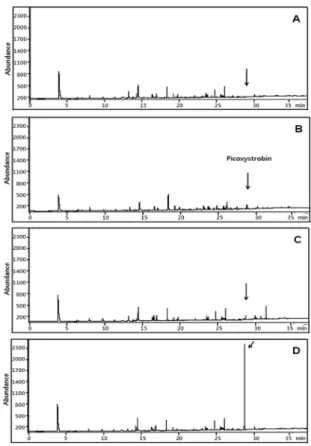
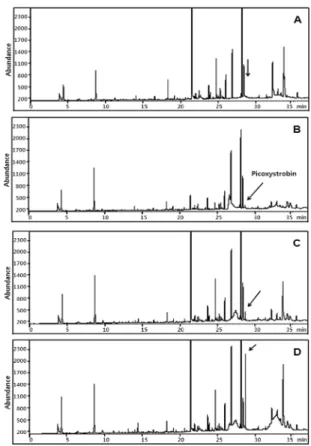
The selectivity (matrix effect) of the analytical method was judged from the absence of interfering peaks at the retention times of the analytes. The retention times of Picoxystrobin was constant at 28.7 ± 0.2 min, and there were no interfering peaks at the retention time of Picoxystrobin [Fig. 4 (apple), 5 (hulled rice), 6 (mushroom), 7 (pepper), 8 (soybean), and 9 (mandarin)].
Accuracy and Precision
Recovery studies was carried out at 0.02, 0.05, and 0.5 mg/
kg fortification levels for Picoxystrobin in apple, hulled rice, mushroom, pepper, soybean, and mandarin (Figs. 4-9). The recovery data and relative standard deviation obtained by Table 2. Instrumental conditions for Picoxystrobin
Instrument GC-ECD
(7890A, Agilent Technologies, USA) Column DB-5 (50 m× 0.25 mm i.d,
0.25µm film thickness)
Oven temperature 80oC
Injector temperature 260oC Detector temperature 280oC
Injection volume 1µL (Split Ratio 10 : 1) Makeup flow (N2) 1 mL/min (N2) Table 3. Confirmative conditions for Picoxystrobin
Instrument GC-MS
(Quattro microTM GC, Waters, USA) Column DB-5MS(30 m× 0.25 mm i.d,
0.25µm film thickness) Oven temperature 70oC(3 min)→ 20oC/min→
180oC→ 5oC/min→ 300oC(7.5 min)
Column flow 1 mL/min (He)
Injector temperature 250oC Interface temperature 280oC Ion source temperature 230oC
Injection volume 1µL (splitless mode)
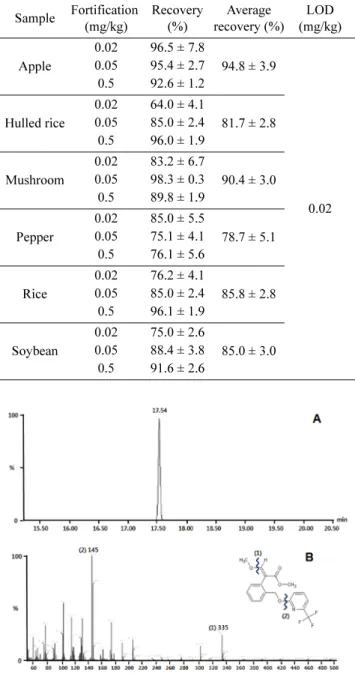
this method is summarized in Table 4. These numbers were calculated from three replicate analyses of given samples made by a single analyst on one day. The repeatability of method was satisfactory (RSDs < 6%). However, there were variations in average recoveries of each sample, this is because of presenting variety of components and remained co-extracts such as water, protein, fat, sugar, and so on. In this study, pepper (high chlorophyll content), hulled rice and soybean (high fat content), and mandarin (high acid and wax contents) gave lower average recoveries compared to mushroom and apple.
In addition, specific confirmation of Picoxystrobin residue was achieved in the GC-MS system. The confirmative condition of GC-MS for Picoxystrobin was set in selected- ion monitoring (SIM) mode with transitions of m/z 367 → Fig. 2. GC-ECD chromatogram of Picoxystrobin standard at 0.1 mg/kg (A), 0.5 mg/kg (B), 1.0 mg/kg (C) and 5.0 mg/kg (D).
Fig. 3. Calibration curve of Picoxystrobin.
Fig. 4. GC-ECD chromatograms of Picoxystrobin, control apple (A), apple at 0.02 mg/kg (B), 0.05 mg/kg (C) and 0.5 mg/kg (D).
Fig. 5. GC-ECD chromatograms of Picoxystrobin, control hulled rice (A), hulled rice at 0.02 mg/kg (B), 0.05 mg/kg (C) and 0.5 mg/kg (D).
Fig. 8. GC-ECD chromatograms of Picoxystrobin, control soybean (A), soybean at 0.02 mg/kg (B), 0.05 mg/kg (C) and 0.5 mg/kg (D).
Fig. 9. GC-ECD chromatograms of Picoxystrobin, control man- darin (A), mandarin at 0.02 mg/kg (B), 0.05 mg/kg (C) and 0.5 mg/kg (D).
Fig. 6. GC-ECD chromatograms of Picoxystrobin, control mush- room (A), mushroom at 0.02 mg/kg (B), 0.05 mg/kg (C) and 0.5 mg/kg (D).
Fig. 7. GC-ECD chromatograms of Picoxystrobin, control pepper (A), pepper at 0.02 mg/kg (B), 0.05 mg/kg (C) and 0.5 mg/kg (D).
335 and m/z 367 → 145 (Fig. 10 and Table 5).
Detection and Quantification Limits
The limit of quantification was determined to be 0.02µg/
mL. The quantification limit was defined as the lowest fortifi- cation level evaluated at which acceptable average recoveries (64~98%, RSDs < 6%) were achieved. This quantification
limit also reflects the fortification level at which an analyte peak is consistency generated at approximately 10 times the baseline noise in the chromatogram. The limit of detection was determined to be 0.005µg/mL at a level of approximately three times the background of control injection around the retention time of the peak of interest.
Conclusions
This study described for the fast, simple, and sensitive analytical method based on GC-ECD and GC-MS was developed and validated for the determination of Picoxy- strobin residue in agricultural products.
The Picoxystrobin extraction procedure of the described method is based on the Korean Food Standards Codex as multi class pesticide multiresidue methods with an acetonitrile.
SPE-Florisil cartridge was used for sample preparation and the process is simple and easy, providing adequate clean-up of the matrix. Most of the sample extracts are very clean, with no interfering peaks at the retention time of the target compound, indicating good sensitivity of the proposed method.
Satisfactory validation parameters such as linearity, recov- ery, precision and very low limits were obtained according to the Korean Food Standards Codex (2011)20).
For Picoxystrobin the sensitivity of the method was suitable enough to ensure reliable determination levels lower than the respective MRLs. Therefore, the proposed analytical method could satisfactorily be useful for regular monitoring of Picoxystrobin residue in agricultural products.
Acknowledgement
This research was supported by a grant (10161KFDA001) from Korea Food and Drug Administration in 2010.
요 약
농산물 중에 있는 Picoxystrobin 잔류량을 검사하기 위 해 가스크로마토그래프-전자포획검출기와 가스크로마토그 래프-질량분석기를 이용한 간단하고 감도가 좋은 분석방법 을 개발하였다. Picoxystrobin 잔류물은 acetonitrile 추출, 포 화식염수를 이용한 액-액 분배, florisil 카트리지 정제 과정 을 거쳐 기기분석을 수행하였다. 개발된 방법으로 Picoxystrobin 잔류허용기준이 설정된 식품인 고추와 사과 외 대표 농산 물 시료 현미, 대두, 버섯, 감귤을 대상으로 농약을 0.02, 0.05, 0.5 mg/kg 농도로 처리하여 회수율을 시험한 결과는 64.0~98.3%이었으며, 상대표준편차는 10% 미만이었다. 검 량선 작성을 위해 0.1~5 mg/L 범위로 표준품을 만들어 실 험한 결과 상관계수(r2)는 0.999로 높은 직선성을 보였으 Table 4. Validation results of analytical method for Picoxystrobin
Sample Fortification (mg/kg)
Recovery (%)
Average recovery (%)
LOD (mg/kg)
Apple
0.02 96.5 ± 7.8
94.8 ± 3.9
0.02 0.05 95.4 ± 2.7
0.5 92.6 ± 1.2
Hulled rice
0.02 64.0 ± 4.1
81.7 ± 2.8 0.05 85.0 ± 2.4
0.5 96.0 ± 1.9
Mushroom
0.02 83.2 ± 6.7
90.4 ± 3.0 0.05 98.3 ± 0.3
0.5 89.8 ± 1.9
Pepper
0.02 85.0 ± 5.5
78.7 ± 5.1 0.05 75.1 ± 4.1
0.5 76.1 ± 5.6
Rice
0.02 76.2 ± 4.1
85.8 ± 2.8 0.05 85.0 ± 2.4
0.5 96.1 ± 1.9
Soybean
0.02 75.0 ± 2.6
85.0 ± 3.0 0.05 88.4 ± 3.8
0.5 91.6 ± 2.6
Fig. 10. Total ion chromatogram and MS spectrum of Picox- ystrobin.
Table 5. Selected-ion of GC-MS for Picoxystrobin Retention time
(min) Molecular weight Fragment monitored (m/z)
17.54 367.3 145, 335
며, 분석방법의 검출한계와 정량한계는 각각 0.005와 0.02
mg/kg이었다. 또한 확인시험을 위하여 질량분석기를 사용
하였으며, 145와 335를 특성이온으로 선정하였다.
References
1. Barlett, D.W., Clough, J.M., J.R. Godwin, J.R., Hall, A.A., Hamer, M., and Parr-Dobrzanski, B.: The strobilurin fungi- cides (review). Pest. Manag. Sci. 58, 649-662 (2002).
2. Genay, J.P., Morand, P., and Dieleman, P.: Picoxystrobin: a fungicide for use on cereals.Phytoma. La Défense des Végé- taux 555, 56-58 (2002).
3. Syngenta Crop (UK): Acanto Product Use, Product Guide.
Available at www.syngenta-crop.co.uk (2005).
4. Godwin, J.R., Bartlett, D.W., Clough, J.M., Godfrey, C.R.A., Harrison, E.G., and Maund, S.: The BCPC Conference: Pests and diseases, Volume 2. Proceedings of an international con- ference held at the Brighton Hilton Metropole Hotel, Brighton, UK pp. 533-540 (2000).
5. Bartlett, D.W., Clough, J.M., Godfrey, C.R.A., Godwin, J.R., Hall, A.A., Heaney, S.P., and Maund, S.J.: Understanding the strobilurin. R. Soc. Chem. (2001).
6. European commission: Commission Directive 2003/84/EC of 25 September 2003 amending Council Directive 91/414/EEC to include flurtamone, flufenacet, iodosulfuron, dimethenamid- P, Picoxystrobin, fosthiazate, and silthiofam as active sub- stances, Off. J. Eur. Union L-247 20-25 (2003)
7. US Environmental Protection Agency: Pesticides: Regulating Pesticides, Multi-Year Work plan for Registration of Conven- tional Pesticides - New Chemicals, EPA, USA. Available at http://www.epa.gov/opprd001/workplan/newchem.html (2012).
8. Vinas, P., Campillo, N., Martinez-Castillo, N., Hernandez-cor- doba, M.: Method development and validation for strobilurin fungicides in baby foods by solid-phase microextraction gas chromatography-mass spectrometry. J. Chromatogr. A 1216, 140-146 (2009).
9. Rural Development Administration: RDA Notice 2012-15 (2012).
10. Korea Crop Protection Association: Pesticide Use Guideline (2011).
11. Korean Food and Drug Administration: KFDA Notice 2011- 23 (2011).
12. Korean Food and Drug Administration: KFDA Notice 2012- 100 (2012).
13. Ho, W., and Hsieh, S.J.: Solid phase micro extraction associ- ated with microwave assisted extraction of organ chlorine pes- ticides in medicinal plants. Anal. Chim. Acta. 428, 111 (2001).
14. Zuin, V.G., Yariwake, J., and Langas, .M.: Analysis of esicide residues in Brazilian plans. Braz. Hem. Soc. 14, 304-09 (2003).
15. Rao, T.N., Ramesh, A., Parnathamma, P., and Suresh, G.:
Development and validation of a HPLC-UV method for simultaneous determination of strobilurin fungicde esidues m tomato fruits followed by matrixs solid-phase dispersion (MSPD). Indian. Sci Res. 113-118 (2012).
16. Gonzalez-Rodriguez, R.M., Cancho-Grande, B., and Simal- Gandara, J.:Multi-residue determination of 11 new fungi- cides in grapes and wines by liquid-liquid extraction/clean- up and programmable temperature vaporization injection with analyte protectants/gas chromatography/ion trap mass spectrometry. J. Chromatogr. A 1216, 6033-6042 (2009).
17. Tekel, J. and Hatrik, S.: Pesticide residue analyses in plant material by chromatographic methods-clean-up procedures and selective detectors. J. Chromatogr. A 754, 397-410 (1996).
18. Topuz, S. Ozhan, G., and Alpertunga, B.: Simultaneous determination of various pesticides in fruit juices by HPLC- DAD. Food Control 16, 87-92 (2005).
19. Mou, R.X., Chen, M.X., and Zhi, J.L.: Simultaneous determi- nation of 15 phenylurea herbicides in rice and corn using HPLC with fluorescence detection combined with UV decom- position and post-column derivatization. J. Chromatogr. B 875, 437-443 (2008).
20. Korean Food and Drug Administration: Korean Food Stan- dards Codex (2011).