46(3) : 260∼ 267 (2015)
260
중국 약용식물의 최종당화산물 생성저해활성 검색(XIII)
최소진1·김영숙1·김주환2·Sun Hang3·김진숙1*
1한국한의학연구원 한의약융합연구부, 2가천대학교 생명과학과, 3중국과학원 곤명식물연구소 생태생물자원연구실
Screening of Herbal Medicines from China with Inhibitory Activity on Advanced Glycation End Products Formation (XIII)
So Jin Choi1, Young Sook Kim1, Joo Hwan Kim2, Sun Hang3 and Jin Sook Kim1*
1Korean Medicine Convergence Research Group, Korea Institute of Oriental Medicine, Daejeon 305-811, Korea,
2Department of Life Science, Gachon University, Seongnam, Kyonggi-do 461-701, Korea
3Laboratory of Biodiversity and Biogeography, Kunming Institute of Botany, Chinese Academy of Sciences, Yunnan 650204, China
Abstract – Advanced glycation end products (AGEs) have been postulated to play a central role in the development of diabetic complications. A variety of different agents that inhibit AGEs have been under investigation. In this study, 111 herbal medicines from China have been investigated with an in vitro evaluation system using AGEs formation inhibitory activity. Of these, 9 herbal medicines (IC50: <5µg/ml) were found to have significant AGEs formation inhibitory activity. Particularly, herbal med- icines Barleria cristata (leaves), Calotropis gigantea (stems), Ardisia virens (leaves), Dalbergia yunnanensis (leaves) Pittosporum runcatum (leaves), Ardisia japonica (leaves), Rhododendron racemosum (twigs), Oxyria sinensiss (aerial parts), Pyrrosia calvata (whole plants), showed more potent inhibitory activity (approximately 15-40 fold) than the positive control aminoguanidine (IC50: 76.47µg/ml).
Key words – Advanced glycation end products (AGEs), Diabetic complications, Herbal medicines
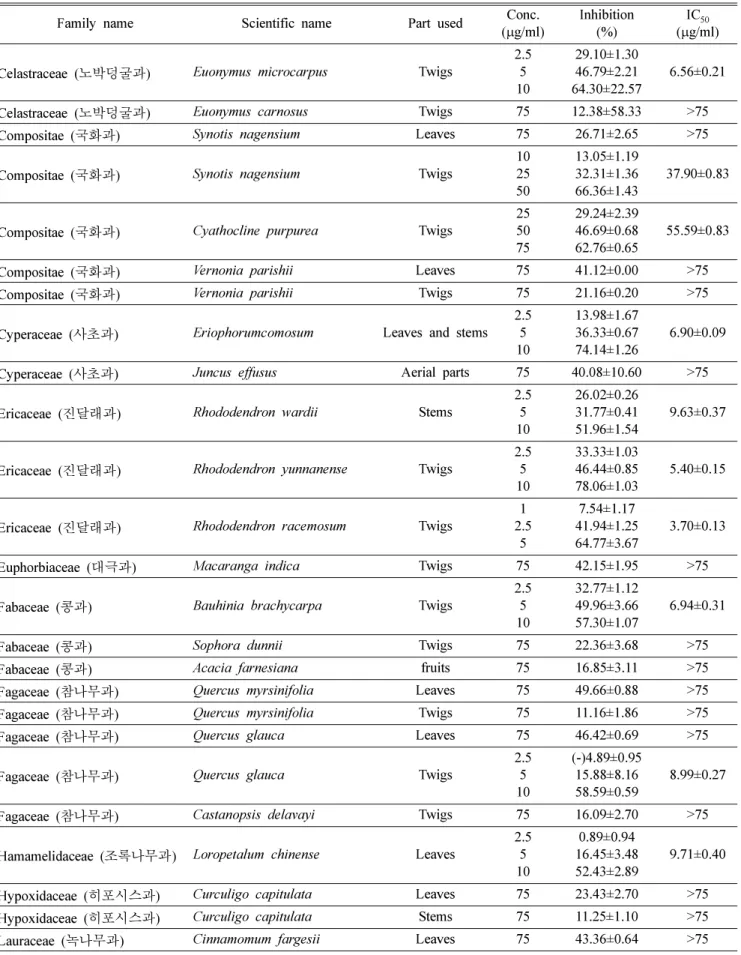
당뇨합병증의 원인으로는 최종당화산물(Advanced gly- cation end products, AGEs)의 생성, polyol pathway flux의 증가 및 protein kinase C 활성화 등이 주요 발병기전으로 알려져 있다.1-3) 그 중 최종당화산물은 혈당이 정상으로 회 복되어도 일단 생성된 최종당화산물은 분해가 되지 않고 단 백질과 교차결합(AGEs-protein cross-link)하여 혈액 단백질 이나 여러 조직에 축적되어 당뇨 합병증을 유발한다.4-7) 따 라서 생체 내에서 최종당화산물의 생성을 저해하거나 이미 생성된 최종당화산물의 단백질과의 교차결합을 억제 또는 절단하여 당뇨합병증을 예방하거나 치료하기 위해 많은 연 구들이 진행되고 있다.8-11) 본 연구에서는 기존에 보고된 바 없는 중국에서 사용되는 약용식물 111종의 에탄올 추출물 에서 최종당화산물 생성 저해 활성을 in vitro에서 검색하 였다.
재료 및 방법
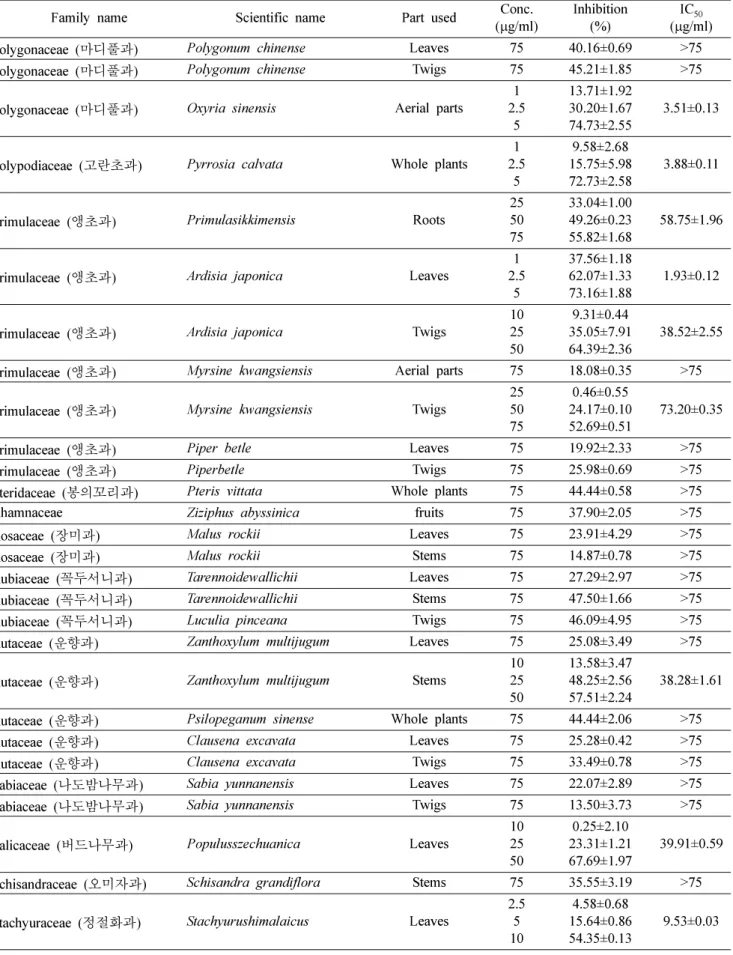
실험재료 – 약용식물은 2011월 6월부터 2013년 9월까지 중국에서 채취되어, 가천대학교 생명과학과 김주환 교수의 감정을 거친 후 실험 재료로 사용되었다(Table I). 사용한 실 험 재료의 증거표본은 한국한의학연구원 표본실에 보관 중 이다.
추출 및 시료조제 – 분쇄한 시료 200 g에 2 L의 에탄올을 넣고 실온상태에서 3일간 3회 추출하였다. 이를 여과하여 40oC의 수욕 상에서 감압농축을 실시한 후, 동결 건조기에 서 건조하였다. 추출물은 실험 수행 전에 감압 하에서 P2O5 를 이용하여 24시간 이상 재건조한 후 DMSO(Sigma, St.
Louis, MO, USA)에 용해시켜 stock solution을 조제하였으 며 최종 DMSO의 농도가 0.2%가 되도록 15% TWEEN 80(Sigma, St. Louis, MO, USA)용액으로 희석하여 사용하 였다. 추출에 이용한 에탄올 및 그 외 시약은 1급 및 특급 시약을 사용하였다.
*교신저자(E-mail):[email protected]
(Tel): +82-42-868-9465, +82-10-8706-4122
(µg/ml) (%) (µg/ml)
Acanthaceae (쥐꼬리망초과) Barleria cristata Leaves
1 2.5
5
16.28±1.09 27.36±0.30 50.71±0.79
4.97±0.10 Apocynaceae (협죽도과) Trachelospermumaxillare Leaves 75 34.34±1.66 >75 Apocynaceae (협죽도과) Trachelospermumaxillare Twigs
25 50 75
1.51±2.04 30.73±1.57 53.75±1.90
70.44±1.52 Aquifoliaceae (감탕나무과) Ilex centrochinensis Leaves 75 15.88±1.67 >75 Aquifoliaceae (감탕나무과) Ilex centrochinensis Twigs 75 12.54±4.41 >75 Araceae (천남성과) Rhaphidophora decursiva Leaves
2.5 5 10
5.72±1.34 49.69±1.36 58.93±3.32
7.72±0.38
Araceae (천남성과) Rhaphidophora decursiva Twigs 75 24.02±2.19 >75
Araceae (천남성과) Rhaphidophora megaphylla Leaves 75 26.48±2.99 >75
Araceae (천남성과) Rhaphidophora megaphylla Twigs 75 35.26±3.13 >75
Araliaceae (두릅나무과) Schefflera venulosa Leaves
10 25 50
29.21±1.70 26.18±0.95 69.15±1.51
36.25±0.75
Asclepiadaceae (박주가리과) Calotropis gigantea Leaves
2.5 5 10
15.18±2.92 31.07±2.68 65.07±0.60
7.76±0.12
Asclepiadaceae (박주가리과) Calotropis gigantea Stems
1 2.5
5
44.70±105 54.53±1.05 57.71±1.65
2.08±0.32 Asparagaceae (아스파라거스과) Aspidistra fenghuangensis Whole plants 75 -34.46±1.48 >75 Asteraceae (국화과) Saussurea stella Maxim. fruits
5 10 25
19.32±2.67 34.17±2.19 53.93±1.00
21.99±0.75
Betulaceae (자작나무과) Betulautilis Leaves 75 19.30±0.85 >75
Betulaceae (자작나무과) Betula utilis Stems 75 32.04±1.14 >75
Bombacaceae (판야과) Bombax malabaricum Leaves
25 50 75
33.16±0.46 45.88±0.84 54..60±1.16
62.81±1.83
Buxaceae (회양목과) Buxus henryi Twigs 75 46.97±0.17 >75
Buxaceae (회양목과) Pachysandra terminalis Whole plants 75 -20.29±2.06 >75
Celastraceae (노박덩굴과) Euonymus hederaceus Leaves 75 -5.39±1.02 >75
Celastraceae (노박덩굴과) Euonymus hederaceus Twigs 75 23.23±1.91 >75
Celastraceae (노박덩굴과) Euonymus nitidus Leaves
10 25 50
16.68±2.13 32.62±1.13 54.96±3.39
44.46±2.97
Celastraceae (노박덩굴과) Euonymus nitidus Twigs
10 25 50
43.76±2.23 52.57±2.82 63.66±0.17
21.27±3.94
Celastraceae (노박덩굴과) Euonymus microcarpus Leaves
5 10 25
30.33±1.30 44.98±2.25 53.34±1.00
21.59±2.80
Table I. Continued
Family name Scientific name Part used Conc.
(µg/ml)
Inhibition (%)
IC50 (µg/ml) Celastraceae (노박덩굴과) Euonymus microcarpus Twigs
2.5 5 10
29.10±1.30 46.79±2.21 64.30±22.57
6.56±0.21
Celastraceae (노박덩굴과) Euonymus carnosus Twigs 75 12.38±58.33 >75
Compositae (국화과) Synotis nagensium Leaves 75 26.71±2.65 >75
Compositae (국화과) Synotis nagensium Twigs
10 25 50
13.05±1.19 32.31±1.36 66.36±1.43
37.90±0.83
Compositae (국화과) Cyathocline purpurea Twigs
25 50 75
29.24±2.39 46.69±0.68 62.76±0.65
55.59±0.83
Compositae (국화과) Vernonia parishii Leaves 75 41.12±0.00 >75
Compositae (국화과) Vernonia parishii Twigs 75 21.16±0.20 >75
Cyperaceae (사초과) Eriophorumcomosum Leaves and stems 2.5
5 10
13.98±1.67 36.33±0.67 74.14±1.26
6.90±0.09
Cyperaceae (사초과) Juncus effusus Aerial parts 75 40.08±10.60 >75
Ericaceae (진달래과) Rhododendron wardii Stems
2.5 5 10
26.02±0.26 31.77±0.41 51.96±1.54
9.63±0.37
Ericaceae (진달래과) Rhododendron yunnanense Twigs
2.5 5 10
33.33±1.03 46.44±0.85 78.06±1.03
5.40±0.15
Ericaceae (진달래과) Rhododendron racemosum Twigs
1 2.5
5
7.54±1.17 41.94±1.25 64.77±3.67
3.70±0.13
Euphorbiaceae (대극과) Macaranga indica Twigs 75 42.15±1.95 >75
Fabaceae (콩과) Bauhinia brachycarpa Twigs
2.5 5 10
32.77±1.12 49.96±3.66 57.30±1.07
6.94±0.31
Fabaceae (콩과) Sophora dunnii Twigs 75 22.36±3.68 >75
Fabaceae (콩과) Acacia farnesiana fruits 75 16.85±3.11 >75
Fagaceae (참나무과) Quercus myrsinifolia Leaves 75 49.66±0.88 >75
Fagaceae (참나무과) Quercus myrsinifolia Twigs 75 11.16±1.86 >75
Fagaceae (참나무과) Quercus glauca Leaves 75 46.42±0.69 >75
Fagaceae (참나무과) Quercus glauca Twigs
2.5 5 10
(-)4.89±0.95 15.88±8.16 58.59±0.59
8.99±0.27
Fagaceae (참나무과) Castanopsis delavayi Twigs 75 16.09±2.70 >75
Hamamelidaceae (조록나무과) Loropetalum chinense Leaves
2.5 5 10
0.89±0.94 16.45±3.48 52.43±2.89
9.71±0.40 Hypoxidaceae (히포시스과) Curculigo capitulata Leaves 75 23.43±2.70 >75 Hypoxidaceae (히포시스과) Curculigo capitulata Stems 75 11.25±1.10 >75
Lauraceae (녹나무과) Cinnamomum fargesii Leaves 75 43.36±0.64 >75
(µg/ml) (%) (µg/ml) Lauraceae (녹나무과) Cinnamomum wilsonii Leaves and twigs 75 47.34±0.43 >75
Leguminosae (콩과) Indigofera szechuensis Stems
2.5 5 10
6.46±1.91 27.72±1.00 78.37±0.79
7.12±0.09
Leguminosae (콩과) Sennasiamea Leaves
10 25 50
27.26±2.92 40.84±2.12 72.51±0.90
31.05±0.87
Leguminosae (콩과) Senna siamea Stems
10 25 50
13.31±1.55 48.46±0.53 56.64±1.14
38.82±0.43
Leguminosae (콩과) Indigoferapendula Stems
2.5 5 10
12.88±1.75 23.81±0.81 59.22±1.71
8.69±0.24
Leguminosae (콩과) Dalbergia yunnanensis Leaves
1 2.5
5
29.30±0.25 29.63±0.41 69.77±5.73
3.52±0.30
Leguminosae (콩과) Dalbergia yunnanensis Stems
10 25 50
41.45±0.62 46.60±1.77 60.11±0.68
29.61±2.01
Linaceae (아마과) Tirpitzia sinensis Twigs 75 40.33±2.91 >75
Malvaceae Hibiscus indicus Twigs 75 23.62±2.80 >75
Moraceae (뽕나무과) Ficus sarmentosa Leaves 75 45.43±3.18 >75
Moraceae (뽕나무과) Ficus sarmentosa Twigs 75 17.71±1.76 >75
Moraceae (뽕나무과) Ficus tinctoria Twigs 75 11.08±3.74 >75
Moraceae (뽕나무과) Ficus auriculata Leaves 75 46.67±1.23 >75
Myrsinaceae (자금우과) Ardisia virens Leaves
1 2.5
5
25.11±1.18 44.84±0.56 76.24±073
2.93±0.06
Myrsinaceae (자금우과) Ardisia virens Stems
1 2.5
5
21.65±0.12 38.53±1.22 72.36±0.54
6.69±0.02
Myrtaceae (도금양과) Psidium guajava Twigs 75 40.33±1.06 >75
Oleaceae (물푸레나무과) Ligustrum strongylophyllum Leaves 75 42.59±4.77 >75 Oleaceae (물푸레나무과) Ligustrum strongylophyllum Twigs 75 31.99±3.63 >75
Oleaceae (물푸레나무과) Ligustrum gracile Twigs 75 24.46±2.45 >75
Pinaceae (소나무과) Pinuskesiya Leaves 75 19.84±0.69 >75
Pittosporaceae (돈나무과) Pittosporum truncatum Leaves
1 2.5
5
37.12±2.42 63.15±2.38 71.92±1.26
1.93±0.11 Pittosporaceae (돈나무과) Pittosporum truncatum Twigs 75 39.43±1.23 >75 Pittosporaceae (돈나무과) Pittosporum brevicalyx Leaves 75 38.10±1.36 >75 Pittosporaceae (돈나무과) Pittosporum brevicalyx Twigs 75 37.97±1.51 >75 Poaceae (벼과) Drepanostachyum fractiflexum Aerial parts 75 25.22±1.06 >75
Poaceae (벼과) Anthoxanthum hookeri Aerial parts 75 28.29±2.94 >75
Polygonaceae (마디풀과) Rheum alexandrae Stems 75 39.69±4.16 >75
Table I. Continued
Family name Scientific name Part used Conc.
(µg/ml) Inhibition (%)
IC50 (µg/ml)
Polygonaceae (마디풀과) Polygonum chinense Leaves 75 40.16±0.69 >75
Polygonaceae (마디풀과) Polygonum chinense Twigs 75 45.21±1.85 >75
Polygonaceae (마디풀과) Oxyria sinensis Aerial parts
1 2.5
5
13.71±1.92 30.20±1.67 74.73±2.55
3.51±0.13
Polypodiaceae (고란초과) Pyrrosia calvata Whole plants
1 2.5
5
9.58±2.68 15.75±5.98 72.73±2.58
3.88±0.11
Primulaceae (앵초과) Primulasikkimensis Roots
25 50 75
33.04±1.00 49.26±0.23 55.82±1.68
58.75±1.96
Primulaceae (앵초과) Ardisia japonica Leaves
1 2.5
5
37.56±1.18 62.07±1.33 73.16±1.88
1.93±0.12
Primulaceae (앵초과) Ardisia japonica Twigs
10 25 50
9.31±0.44 35.05±7.91 64.39±2.36
38.52±2.55 Primulaceae (앵초과) Myrsine kwangsiensis Aerial parts 75 18.08±0.35 >75
Primulaceae (앵초과) Myrsine kwangsiensis Twigs
25 50 75
0.46±0.55 24.17±0.10 52.69±0.51
73.20±0.35
Primulaceae (앵초과) Piper betle Leaves 75 19.92±2.33 >75
Primulaceae (앵초과) Piperbetle Twigs 75 25.98±0.69 >75
Pteridaceae (봉의꼬리과) Pteris vittata Whole plants 75 44.44±0.58 >75
Rhamnaceae Ziziphus abyssinica fruits 75 37.90±2.05 >75
Rosaceae (장미과) Malus rockii Leaves 75 23.91±4.29 >75
Rosaceae (장미과) Malus rockii Stems 75 14.87±0.78 >75
Rubiaceae (꼭두서니과) Tarennoidewallichii Leaves 75 27.29±2.97 >75
Rubiaceae (꼭두서니과) Tarennoidewallichii Stems 75 47.50±1.66 >75
Rubiaceae (꼭두서니과) Luculia pinceana Twigs 75 46.09±4.95 >75
Rutaceae (운향과) Zanthoxylum multijugum Leaves 75 25.08±3.49 >75
Rutaceae (운향과) Zanthoxylum multijugum Stems
10 25 50
13.58±3.47 48.25±2.56 57.51±2.24
38.28±1.61
Rutaceae (운향과) Psilopeganum sinense Whole plants 75 44.44±2.06 >75
Rutaceae (운향과) Clausena excavata Leaves 75 25.28±0.42 >75
Rutaceae (운향과) Clausena excavata Twigs 75 33.49±0.78 >75
Sabiaceae (나도밤나무과) Sabia yunnanensis Leaves 75 22.07±2.89 >75
Sabiaceae (나도밤나무과) Sabia yunnanensis Twigs 75 13.50±3.73 >75
Salicaceae (버드나무과) Populusszechuanica Leaves
10 25 50
0.25±2.10 23.31±1.21 67.69±1.97
39.91±0.59 Schisandraceae (오미자과) Schisandra grandiflora Stems 75 35.55±3.19 >75 Stachyuraceae (정절화과) Stachyurushimalaicus Leaves
2.5 5 10
4.58±0.68 15.64±0.86 54.35±0.13
9.53±0.03
In vitro에서 최종당화산물 생성저해 실험 – Vinson과 Howard12)의 방법을 변형하여 실험을 실시하였다. 본 실험 에서는 10 mg/ml의 우혈청 알부민(bovine serum albumin, Sigma)을 0.2 M phosphate buffer(pH 7.4)에 용해시키고, 0.2 M의 fructose와 glucose를 처리하였다. 이 때 0.2 M phosphate buffer에 0.02% sodium azide를 넣어 반응기간 동 안 박테리아의 생성을 방지하였다. 이 반응액에 추출물 또 는 최종당화산물 생성저해제인 aminoguanidine을 넣은 후 37oC에서 7일 동안 반응시켰다. 이때 시료의 IC50값을 구하 기 위해 1, 2.5, 5, 10, 25, 50, 75 µg/ml의 7개 농도에서 실 험 하였다. 배양 후에는 spectrofluorometric detector(Bio- TEK, Synergy HT, USA)를 이용하여 형광도를 측정하였다 (Ex: 350, Em: 450nm). IC50값은 n=3으로 하여 계산되었다.
결과 및 고찰
최종당화산물은 신장, 안구, 뇌 등 조직 내 단백질과 반응 하여 각 장기에 축적되어 당뇨병성 신증(Diabetic nephro- pathy), 망막증(D. retinopathy), 백내장(D. cataract), 신경병 증(D. neuropathy) 등의 당뇨합병증으로 진행된다.4,5) 본 연 구팀은 최종당화산물 생성을 강력하게 억제하는 천연물 소 재를 발굴하기 위하여 많은 천연소재들의 효능을 검색 발 표하였다.13-22)
본 연구에서도 중국에서 자생하는 약용식물 111종의 에 탄올 추출물을 이용하여 최종당화산물 생성 저해 효능을 측정하였다. 양성 대조 약물인 aminoguanidine의 IC50값
(76.47±4.81µg/ml)을 근거로 하여, 추출물이 IC50: <50µg/
ml이면 효능이 있다고 판단하였다. 24종의 식물 추출물에서 IC50: <10µg/µl로 최종당화산물 생성 저해 효능을 보였고, 그 중에서 9종의 추출물 Barleria cristata의 잎(4.97±0.10 µg/ml), Calotropis gigantea의 줄기(2.08±0.32 µg/ml), Ardisia virens의 잎(2.93±0.06 µg/ml), Dalbergia yunnanensis의 잎 (3.52±0.30µg/ml) Pittosporum runcatum의 잎(1.93±0.11 µg/
ml), Ardisia japonica의 잎(1.93±0.12 µg/ml), Rhododendron racemosum의 소지(3.70±0.13 µg/ml), Oxyria sinensiss의 지 상부(3.51±0.13 µg/ml), Pyrrosia calvata의 전초(3.88±0.11 µg/ml)는 IC50가 5 µg/ml 이하로 aminoguanidine보다 약 15- 40배 이상의 우수한 효능이 있음을 알 수 있었다.
쥐꼬리망초과 B. cristata의 잎은 항염효과가 있으며,23) 간 손상이 유발된 쥐에서 간보호 효과가 있다고 보고되었다.24) 또한 잎에 함유되어 있는 alkaloids, flavonoids, glycosides, saponins, phenols, tannins가 항산화효과가 있다고 보고되었 다.25) 잎의 분획에서 얻은 saponin은 Klebsiella Pneumonia, Staphylococcus aureus, E.coli, Aspergillus parasites에 대해 항균작용을 한다고 보고되었다.26) 또한 건조한 씨앗이 당뇨 모델 쥐에서 혈당을 낮추어 항당뇨 소재로서 가능성이 있 다고 보고되었다.27) 박주가리과의 C. gigantea는 지상부가 지사제작용,28)뿌리는 해열작용,29) 항균작용30)구강암세포와 백혈병세포에 대해 세포독성을 나타내 항암작용에 효과가 있다고 보고되었다.31) 꽃은 진통작용,32) 잎은 항균작용을 한 다고 보고되었고,33) 꽃과 잎의 추출물은 당뇨 모델 쥐에서 free radical 소거 활성을 나타낸다고 보고되었다.34) C.
(µg/ml) (%) (µg/ml)
Thelypteridaceae (처녀고사리과) Pronephrium gymnopteridifrons Leaves
25 50 75
22.09±0.71 44.90±1.82 66.27±1.38
56.34±0.99
Thymelaeaceae (팥꽃나무과) Daphneaurantiaca Leaves
2.5 5 10
13.75±3.26 42.02±2.34 63.10±0.58
7.49±0.14
Thymelaeaceae (팥꽃나무과) Daphneaurantiaca Stems
10 25 50
16.15±1.77 35.43±1.73 75.18±0.39
33.53±0.65
Urticaceae (쐐기풀과) Pilea plataniflora Twigs
25 50 75
26.57±1.65 45.95±2.53 65.05±1.74
55.34±0.66
Woodsiaceae (우드풀과) Allantodia dilatata Leaves
2.5 5 10
9.01±2.90 31.30±2.88 68.17±0.71
7.60±0.16
Woodsiaceae (우드풀과) Allantodiadilatata Stems 75 34.81±3.47 >75
Aminoguanidine 76.47
IC
50values were calculated from the dose inhibition curve.
gigantea는 carbon tetrachloride로 인해 간손상이 유발된 쥐 의 간보호 효과가 있다고 보고되었다.35) 자금우과의 Ardisia virens의 뿌리와 줄기에서 분획한alkyl benzoquinones 성분 이 유방암과 중추신경계암세포에서 세포독성을 나타내 항 암작용을 한다고 보고되었다.36) 콩과의 D.yunnanensis는 당 뇨합병증의 발병기전 중 하나인 알도즈 환원 효소의 억제 제로서 효과가 있다고 보고되었다.37) 앵초과의 A. japonica 의 지상부는 anti-humanimmunodeficiency virus(HIV-1) 효 과가 있으며,38) 인슐린 신호억제에 관여하여 당뇨병 치료제 개발의 표적이 되고 있는 protein tyrosin phosphatase 1B(PTP1B) 억제 효과가 있다고 보고되었다.39)또한 생리활 성 물질인 triterpenoid saponin이 함유되어 있으며, 이는 간 암세포에 대해 항암효과가 있다고 보고되었다.40-42) 돈나무 과의 P. runcatum, 진달래과의 R. racemosum, 마디풀과의 O. sinensiss, 고란초과의 P. calvata는 효능 및 성분에 관한 연구가 진행된 바 없으며, 위 언급된 9종의 약용 식물은 최 종당화산물 생성 억제 효능이 보고된 바 없었다. 9종 모두 양성 대조 약물 보다 15-40배 이상 최종당화산물 생성 억 제 효능이 우수한 것으로 확인되었으므로, 전임상 실험을 통해 in vivo효능 확인이 필요하다고 생각된다. 본 연구 결 과는 중국 약용식물로부터 안전하고 효능이 좋은 최종당화 산물 생성 저해제 후보를 발굴하기 위한 기초 자료로 활용 될 수 있으며, 당뇨에 의해 나타나는 합병증 치료제 개발의 기반을 구축하는데 기여할 수 있을 것이다.
결 론
기원이 확인된 중국산 약용식물 111종의 에탄올 추출물 이 in vitro에서 최종당화산물 생성저해 효능이 검색되었다.
그 결과 24종이 양성대조군인 aminoguanidine 보다 우수한 효능이 있음을 확인하였고, 특히 B. cristata의 잎, C.
gigantea의 줄기, A. virens의 잎, D. yunnanensis의 잎 P.
runcatum의 잎, A. japonica의 잎, R. racemosum의 소지, O.
sinensiss 의 지상부, P. calvata 의 전초, 9종의 추출물은 양 성대조군 보다 15-40배 억제 효능이 우수하므로 당뇨합병 증 예방 및 치료제로 개발될 가능성이 있다.
사 사
본 연구는 한국한의학연구원 기관고유사업(K14040, K15270)의 지원으로 수행되었으며 이에 감사드립니다.
인용문헌
1. Sakurai, T. and Tsuchiya, S. (1988) Superoxide production from nonenzymatically glycated protein. FEBS Lett. 236:
406-410.
2. Shinohara, R., Mano, T., Nagasaka, A., Sawai, Y., Uchimura, K., Hayashi, R., Hayakawa, N., Nagata, M., Makino, M., Kakizawa, H., Itoh, Y., Nakai, A. and Itoh, M. (1998) Effects of thyroid hormone on the sorbitol pathway in streptozotocin- induced diabetic rats. Biochim. Biophys. Acta 1425: 577-586.
3. Bucala, R., Cerami, A., Vlassara, H. (1995) Advanced gly- cosylation end products in diabetic complications. Diabetes Rev. 3: 258-268.
4. Larkins, R. G. and Dunlop, M. E. (1992) The link between hyperglycaemia and diabetic nephropathy. Diabetologia 35:
499-504.
5. Ahmed, N. (2005) Advanced glycation endproducts-role in pathology of diabetic complications. Diabetes Res. Clin.
Pract. 67: 3-21.
6. Yokozawa, T., Nakagawa, T. and Terasawa, K. (2001) Effects of oriental medicines on the production of advanced gly- cation endproducts. J. Trad. Med. 18: 107-112.
7. Huebschmann, A. G., Vlassara, H., Regensteiner, J. G. and Reusch, J. (2006) Diabetes and advanced glycoxidation end products. Diabetes Care 29: 1420-1432.
8. Rahbar, S. and Figarola, J. L. (2003) Novel inhibitors of advanced glycation endproducts. Arch. Biochem. Biophys.
419: 63-79.
9. Wilkinson-Berka, J. L., Kelly, D. J., Koerner, S. M., Jaworski, K., Davis, B., Thallas, V. and Cooper, M. E. (2002) ALT-946 and aminoguanidine, inhibitors of advanced glycation, improve severe nephropathy in the diabetic transgenic (mREN-2) 27 rat. Diabetes 51: 3283-3289.
10. Peppa, M., Brem, H., Cai, W., Zhang, J. G., Basgen, J., Li, Z., Vlassara, H. and Uribarri, J. (2006) Prevention and reversal of diabetic nephropathy in db/db mice treated with alage- brium (ALT-711). Am. J. Nephrol. 26: 430-436.
11. Yang, S., Litchfield, J. E. and Baynes, J. W. (2003) AGE breakers cleave model compounds, but do not break maillard crosslinks in skin and tail collagen from diabetic rats. Arch.
Biochem. Biophys. 412: 42-46.
12. Vinson, J.A. and Howard, III T.B. (1996) Inhibition of protein glycation and advanced glycation end products by ascorbic acid and other vitamins and nutrients. J. Nutr. Biochem. 7:
659-663.
13. Jang, D. S., Lee, Y. M., Kim, Y. S. and Kim, J. S. (2006) Screening of Korean traditional herbal medicines with inhib- itory activity on advanced glycation end products (AGEs) formation. Kor. J. Pharmacogn. 37: 48-52.
14. Lee, Y. M., Kim, Y. S., Kim, J. M., Jang, D. S., Kim, J. W., Yoo, J. L. and Kim, J. S. (2008) Screening of Korean herbal med- icines with inhibitory activity on advanced glycation end prod- ucts (AGEs) formation (II). Kor. J. Pharmacogn. 39: 223-227.
15. Jeong, I. H., Kim, J. M., Jang, D. S., Kim, J. H., Cho, J. H.
and Kim, J. S. (2009) Screening of Korean herbal medicines with inhibitory activity on advanced glycation end products
Vietnam with inhibitory activity on advanced glycation end products (AGEs) formation (IV). Kor. J. Pharmacogn. 40:
388-393.
17. Kim, Y. S., Choi, S. H. Kim, J. H. and Kim, J. S. (2011) Screening of herbal medicines from China with inhibitory activity on advanced glycation end products (AGEs) for- mation (V). Kor. J. Pharmacogn. 42: 46-53.
18. Lee, Y. M., Kim, Y. S., Kim, J. H. and Kim, J. S. (2011) Screening of herbal medicines from China with inhibitory activity on advanced glycation end products (AGEs) for- mation (VI). Kor. J. Pharmacogn. 42: 161-168.
19. Choi, S. J., Kim, Y. S., Song, Y. J., Lee, Y. M., Kim, J. H. and Kim J. S. (2012) Screening of Korean herbal medicines with inhibitory Activity on advanced glycation end products for- mation (VII). Kor. J. Pharmacogn. 43: 345-351.
20. Choi, S. J., Song, Y. J., Kim, Y. S., Kim, J. H., Hang, S., Bach, T. T. and Kim J. S. (2012) Screening of herbal med- icines from China and Vietnam with inhibitory activity on advanced glycation end products (AGEs) formation (VIII).
Kor. J. Pharmacogn. 43: 338-344.
21. Lee, Y. M., Kim, Y. S., Kim, J. H. and Kim, J. S. (2013) Screening of Korean herbal medicines with inhibitory Activ- ity on advanced glycation end products formation (IX). Kor.
J. Pharmacogn. 44: 298-304.
22. Choi, S. J., Song, Y. J., Kim, Y. S., Kim, J. H. and Kim, J. S.
(2013) Screening of Korean herbal medicines with inhibitory Activity on advanced glycation end products formation (XI).
Kor. J. Pharmacogn. 44: 372-378.
23. Gambhire, M. N., Wankhede, S. S. and Juvejar, A. R. (2009) Anti-inflammatory activity of aqueous extract of Barleria cristata leaves. J. Young Pharm. 3: 220-224.
24. Balaji. P., Kishor, G. and Verma, Y. (2013) In-vivo hepato- protective activity of Barleria cristata L. ethanoic leaf extracts against CCl4 induced hepatic injury in wistar rats.
Pharmacie Globale 4: 1-6.
25. Amutha, K. and Doss, D. V. A. (2009) In vitro antioxidant activity of ethanolic extract of Barleria cristata L. leaves.
Res. J. Pharmacogn. Phytochem. 1: 209-212.
26. Amutha, K. and Doss, D. V. A. (2009) Identification and anti- microbial activity of saponin fraction from the leaves of Bar- leria cristata L. IJPSR 3: 4040-4044.
27. Singh, R., Rajasree, P. and Sankar, C. (2012) Screening for anti-diabetic activity of the ethanolic extract of Barleria cris- tata seeds. Int. J. Pharm. Life Sci. 3: 2044-2047.
28. Chitme, H. R., Chandra, R. and Kaushik, S. (2004) Studies on anti-diarrhoeal activity of calotropis gigantea R.BR. in experimental animals. J. Pharm. Pharmaceut, Sci. 7: 70-75.
29. Chitme, H. R., Chandra, R. and Kaushik, S. (2005) Eval-
30. Alam, M. A., Habib, M. R., Nikkon, R., Rahman, M. and Karim. R. (2008) Antimicrobial activity of Akanda (Cal- otropis gigantea L.) on some pathogenic bacteria. Bang- ladesh J. Sci. Ind. Res. 43: 397-404.
31. Kiuchi, F., Fukao, Y., Maruyama, T., Obata, T., Tanaka, M., Sasaki, T., Mikage, M., Haque, M. E. and Tsuda, Y. Cytotoxic principles of a Bangladeshi crude drug, Akond Mul (roots of Calotropis gigantea L.) Chem. Pharm. Bull. 46: 528-530.
32. Pathak, A. K. and Argal, A. (2007) Analesic activity of Cal- otropis gigantea flower. Fitoterapia 78: 40-42.
33. Kumar, G., Karthik, L. and Rao, K. V. B. (2010) Antibacterial activity of aqueous extract of Calotropis gigantea leaves-an in vitro study. Int. J. Pharm. Sci. Res. 4: 141-144.
34. Rathod, N. R., Raghuveer, I., Chitme, H. R. and Chandra, R.
(2009) Free radical scavenging activity of Calotropis gigantea on streptozotocin-induced diabetic rats. Indian J. Pharm. Sci.
71: 615-621.
35. Lodhi, G., Singh, H. K., Pant, K. K. and Hussan, Z. (2009) Hepatoprotective effects of Calotropis gigantean extract against carbon tetrachloride induced liver injury in rats. Acta Pharm. 59: 89-96.
36. Chang, H. S., Lin, Y. J., Lee, S. J., Yang, C. W., Lin, W. Y., Tsai, I. L. and Chen, I. S. (2009) Cytotoxic alkyl benzo- quinones and alkyl phenols from Ardisia virens. Phytochem- istry 70: 2064-2071.
37. Choi, S. J., Kim, Y. S., Kim, J. H. and Kim, J. S. (2014) Screening of Chinese herbal medicines with inhibitory effect on aldose reductase (X). Kor. J. Pharmacogn. 45: 359-365.
38. Piacente, S., Pizza, C., Tommasi, N. D. and Mahmood, N.
(1996) Constituents of Ardisia japonica and their in vitro anti-HIV activity. J. Nat. Prod. 59: 565-569.
39. Li, Y. F., Hu, L. H., Lou, F. C., Li, J. and Shen, Q. (2005) PTP1B inhibitors from Ardisia japonica. J. Asian Nat. Prod.
Res. 7: 13-18.
40. Chang, X., Li, W., Lia, Z., Sayou, T., Fushiya, S. and Koike, K. (2007) Biologically active triterpenoid saponins from Ard- isia japonica. J. Nat. Prod. 70: 179-187.
41. Li, Q., Li, w., Hui, L. P., Zhao, C. Y., He, L. and Koike, K.
(2012) 13,28-epoxy triterpenoid saponins from Ardisia japonica selectively inhibit proliferation of liver cancer cells without affecting normal liver cells. Bioorg. Med. Chem. Lett.
22: 6120-6125.
42. Zhao, C. Y., Hui, L. P., He, L. and Li, Q. (2013) Study on inhibitory effect of triterpenoid saponin from Ardisia japon- ica TSP02 on proliferation and metastasis of human hepa- tocellular carcinoma cells and its mechanism. China J.
Chinese Mater. Med. 38: 861-865.
(2015. 8. 3 접수; 2015. 8. 31 심사; 2015. 9. 17 게재확정)