Kor. J. Pharmacogn.
46(3) : 250∼ 259 (2015)
250
한국 약용식물의 최종당화산물 생성저해활성 검색 (XII)
최소진1·김영숙1·김주환2·김진숙1*
1한국한의학연구원 한의약융합연구부, 2가천대학교 생명과학과
Screening of Herbal Medicines from Korea with Inhibitory Activity on Advanced Glycation End Products Formation (XII)
So Jin Choi1, Young Sook Kim1, Joo Hwan Kim2 and Jin Sook Kim1*
1Korean Medicine Convergence Research Group, Korea Institute of Oriental Medicine, 1672 Yuseongdae-ro, Yuseong-gu, Daejeon 305-811, Korea
2Department of Life Science, Gachon University, Seongnam, Kyonggi-do 461-701, Korea
Abstract – Advanced glycation end products (AGEs) have been implicated in diabetic complications. In this study, the inhib- itory effect on AGEs formation of 156 Korean herbal medicines has been evaluated. Among them, 15 Korean herbal medicines were showed to have significant effect (IC50:<10 µg/ml) compared to positive reference, aminoguandine (IC50: 76.47±4.81 µg/
ml). Especially, four herbal medicines, Alnus firma (leaves, IC50: 3.25±0.10 µg/ml), Juncus decipiens (whole plants, IC50: 4.30±0.44 µg/ml), Smilax china (stems, IC50: 3.55±0.21 µg/ml), and Vicia amoena (Aerial parts, IC50: 4.25±0.06 µg/ml) showed more potent inhibitory activity approximately 8-24 fold) than the positive control aminoguanidine.
Key words – Advanced glycation end products (AGEs), Diabetic complications, Herbal medicines
만성적인 고혈당이 지속되면 당이 비효소적 반응(non- enzymatic glycation)으로 단백질과 결합하여 Amadori adducts를 형성하고, 이 반응이 지속적으로 진행되어 비가역 적인 최종당화산물을 생성한다.1-4) 최종당화산물(advanced glycation end products, AGEs)은 polyol pathway flux의 증 가 및 protein kinase C 활성화 등과 함께 주요 당뇨합병증 의 발병기전으로 알려져 있다.5-7)혈당이 정상으로 회복되어 도 일단 생성된 최종당화산물은 분해가 되지 않고 단백질 과 교차결합(AGEs-protein cross-link)하여 혈액 단백질이나 여러 조직에 축적되어 당뇨 합병증을 유발한다.1-4) 이러한 합병증은 당뇨병성 말초신경장해, 당뇨병성 망막증, 당뇨병 성 신증, 당뇨병성 백내장, 각막증, 당뇨병성 동맥경화증 등 이 유발될 수 있다.8,9)따라서 생체 내에서 최종당화산물의 생성을 저해하거나 이미 생성된 최종당화산물의 단백질과 의 교차결합을 억제 또는 절단하여 당뇨합병증을 예방하거 나 치료하기 위해 많은 연구들이 진행되고 있다.10-13) 본 연 구에서는 기존에 보고된 바 없는 한국에서 자생하는 약용 식물 156종의 에탄올 추출물에서 최종당화산물 생성 저해
활성을 in vitro에서 검색하였다.
재료 및 방법
실험재료 – 약용식물은 2011월 10월부터 2014년 8월까지 전국에서 채취되어, 가천대학교 생명과학과 김주환 교수의 감정을 거친 후 실험 재료로 사용되었다(Table I). 사용한 실 험 재료의 증거표본은 한국한의학연구원 표본실에 보관 중 이다.
추출 및 시료조제 – 분쇄한 시료 200 g에 2 L의 에탄올을 넣고 실온상태에서 3일간 3회 추출하였다. 이를 여과하여
40의 수욕 상에서 감압농축을 실시한 후, 동결 건조기에서
건조하였다. 추출물은 실험 수행 전에 감압 하에서 P2O5를 이용하여 24시간 이상 재건조한 후 DMSO(Sigma, St.
Louis, MO, USA)에 용해시켜 stock solution을 조제하였으 며 최종 DMSO의 농도가 0.2%가 되도록 15% TWEEN 80(Sigma, St. Louis, MO, USA)용액으로 희석하여 사용하 였다. 추출에 이용한 에탄올 및 그 외 시약은 1급 및 특급 시약을 사용하였다.
In vitro에서 최종당화산물 생성저해 실험 − Vinson과
*교신저자(E-mail):[email protected]
(Tel): +82-42-868-9465, +82-10-8706-4122
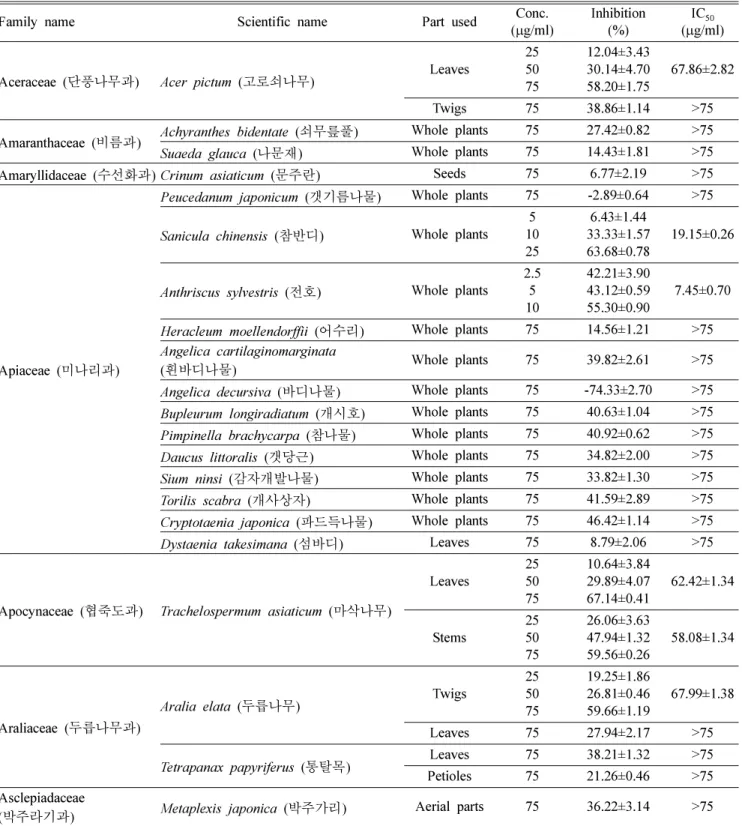
Table I. Inhibitory activity of the ethanol extracts of the herbal medicines on AGEs formation in vitro
Family name Scientific name Part used Conc.
(µg/ml)
Inhibition (%)
IC50 (µg/ml)
Aceraceae (단풍나무과) Acer pictum (고로쇠나무) Leaves
25 50 75
12.04±3.43 30.14±4.70 58.20±1.75
67.86±2.82
Twigs 75 38.86±1.14 >75
Amaranthaceae (비름과) Achyranthes bidentate (쇠무릎풀) Whole plants 75 27.42±0.82 >75 Suaeda glauca (나문재) Whole plants 75 14.43±1.81 >75 Amaryllidaceae (수선화과) Crinum asiaticum (문주란) Seeds 75 6.77±2.19 >75
Apiaceae (미나리과)
Peucedanum japonicum (갯기름나물) Whole plants 75 -2.89±0.64 >75 Sanicula chinensis (참반디) Whole plants
5 10 25
6.43±1.44 33.33±1.57 63.68±0.78
19.15±0.26
Anthriscus sylvestris (전호) Whole plants
2.5 5 10
42.21±3.90 43.12±0.59 55.30±0.90
7.45±0.70 Heracleum moellendorffii (어수리) Whole plants 75 14.56±1.21 >75 Angelica cartilaginomarginata
(흰바디나물) Whole plants 75 39.82±2.61 >75
Angelica decursiva (바디나물) Whole plants 75 -74.33±2.70 >75 Bupleurum longiradiatum (개시호) Whole plants 75 40.63±1.04 >75 Pimpinella brachycarpa (참나물) Whole plants 75 40.92±0.62 >75 Daucus littoralis (갯당근) Whole plants 75 34.82±2.00 >75 Sium ninsi (감자개발나물) Whole plants 75 33.82±1.30 >75 Torilis scabra (개사상자) Whole plants 75 41.59±2.89 >75 Cryptotaenia japonica (파드득나물) Whole plants 75 46.42±1.14 >75 Dystaenia takesimana (섬바디) Leaves 75 8.79±2.06 >75
Apocynaceae (협죽도과) Trachelospermum asiaticum (마삭나무)
Leaves
25 50 75
10.64±3.84 29.89±4.07 67.14±0.41
62.42±1.34
Stems
25 50 75
26.06±3.63 47.94±1.32 59.56±0.26
58.08±1.34
Araliaceae (두릅나무과)
Aralia elata (두릅나무) Twigs
25 50 75
19.25±1.86 26.81±0.46 59.66±1.19
67.99±1.38 Leaves 75 27.94±2.17 >75 Tetrapanax papyriferus (통탈목) Leaves 75 38.21±1.32 >75 Petioles 75 21.26±0.46 >75 Asclepiadaceae
(박주라기과) Metaplexis japonica (박주가리) Aerial parts 75 36.22±3.14 >75 Howard14)의 방법을 변형하여 실험을 실시하였다. 본 실험
에서는 10 mg/ml의 우혈청 알부민(bovine serum albumin, Sigma)을 0.2 M phosphate buffer(pH 7.4)에 용해시키고, 0.2 M의 fructose와 glucose를 처리하였다. 이 때 0.2 M phosphate buffer에 0.02% sodium azide를 넣어 반응기간 동안 박테리
아의 생성을 방지하였다. 이 반응액에 추출물 또는 최종당 화산물 생성저해제인 aminoguanidine을 넣은 후 37oC에서 7일 동안 반응시켰다. 이때 시료의 IC50값을 구하기 위해 1, 2.5, 5, 10, 25, 50, 75µg/ml의 7개 농도에서 실험 하였다.
배양 후에는 spectrofluorometric detector(Bio-TEK, Synergy
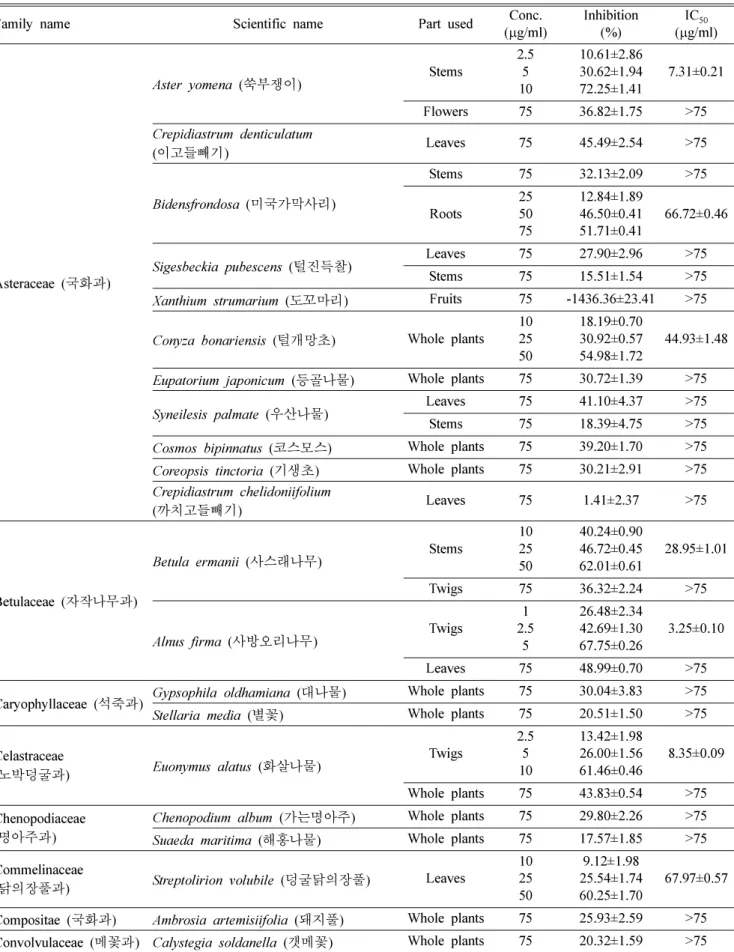
Table I. Continued
Family name Scientific name Part used Conc.
(µg/ml) Inhibition (%)
IC50 (µg/ml)
Asteraceae (국화과)
Aster yomena (쑥부쟁이) Stems
2.5 5 10
10.61±2.86 30.62±1.94 72.25±1.41
7.31±0.21 Flowers 75 36.82±1.75 >75 Crepidiastrum denticulatum
(이고들빼기) Leaves 75 45.49±2.54 >75
Bidensfrondosa (미국가막사리)
Stems 75 32.13±2.09 >75 Roots
25 50 75
12.84±1.89 46.50±0.41 51.71±0.41
66.72±0.46
Sigesbeckia pubescens (털진득찰) Leaves 75 27.90±2.96 >75 Stems 75 15.51±1.54 >75 Xanthium strumarium (도꼬마리) Fruits 75 -1436.36±23.41 >75 Conyza bonariensis (털개망초) Whole plants
10 25 50
18.19±0.70 30.92±0.57 54.98±1.72
44.93±1.48 Eupatorium japonicum (등골나물) Whole plants 75 30.72±1.39 >75 Syneilesis palmate (우산나물) Leaves 75 41.10±4.37 >75 Stems 75 18.39±4.75 >75 Cosmos bipinnatus (코스모스) Whole plants 75 39.20±1.70 >75 Coreopsis tinctoria (기생초) Whole plants 75 30.21±2.91 >75 Crepidiastrum chelidoniifolium
(까치고들빼기) Leaves 75 1.41±2.37 >75
Betulaceae (자작나무과)
Betula ermanii (사스래나무) Stems
10 25 50
40.24±0.90 46.72±0.45 62.01±0.61
28.95±1.01 Twigs 75 36.32±2.24 >75
Alnus firma (사방오리나무) Twigs
1 2.5
5
26.48±2.34 42.69±1.30 67.75±0.26
3.25±0.10
Leaves 75 48.99±0.70 >75 Caryophyllaceae (석죽과) Gypsophila oldhamiana (대나물) Whole plants 75 30.04±3.83 >75 Stellaria media (별꽃) Whole plants 75 20.51±1.50 >75 Celastraceae
(노박덩굴과) Euonymus alatus (화살나물) Twigs
2.5 5 10
13.42±1.98 26.00±1.56 61.46±0.46
8.35±0.09 Whole plants 75 43.83±0.54 >75 Chenopodiaceae
(명아주과)
Chenopodium album (가는명아주) Whole plants 75 29.80±2.26 >75 Suaeda maritima (해홍나물) Whole plants 75 17.57±1.85 >75 Commelinaceae
(닭의장풀과) Streptolirion volubile (덩굴닭의장풀) Leaves
10 25 50
9.12±1.98 25.54±1.74 60.25±1.70
67.97±0.57 Compositae (국화과) Ambrosia artemisiifolia (돼지풀) Whole plants 75 25.93±2.59 >75 Convolvulaceae (메꽃과) Calystegia soldanella (갯메꽃) Whole plants 75 20.32±1.59 >75
Cornaceae (층층나무과) Cornus controversa (층층나무)
Stems
10 25 50
9.62±2.12 25.53±2.11 55.79±1.88
45.30±1.53
Leaves
25 50 75
24.94±1.78 35.22±1.07 59.57±1.69
64.67±1.65
Twigs
10 25 50
37.98±0.73 46.57±1.57 60.56±1.03
31.22±1.06
Cucurbitaceae (박과)
Weigela florida (붉은병꽃나무) Stems
2.5 5 10
13.33±2.92 22.65±4.54 64.20±4.45
8.22±0.48
Sicyos angulatus (가시박)
Leaves
25 50 75
28.54±1.47 43.43±1.54 74.09±2.00
51.45±1.18
Stems
10 25 50
22.42±1.35 33.48±2.38 70.43±0.76
36.44±2.05
Ipomoea hederacea (미국나팔꽃)
Stems 75 26.87±2.11 >75 Fruits
10 25 50
17.51±3.70 25.36±1.51 60.77±2.78
42.23±2.04 Trichosanthes kirilowii (하눌타리) Whole plants 75 34.08±1.39 >75 Cyperaceae (사초과) Carex kobomugi (통보리사초) Whole plants 75 8.93±1.07 >75
Ebenaceae (감나무과) Diospyros lotus (고욤나무) Twigs
2.5 5 10
22.57±1.68 46.22±2.98 60.05±0.21
7.33±0.25 Aerial parts 75 46.14±3.48 >75
Elaeagnaceae
(보리수나무과) Elaeagnus glabra (보리장나무)
Twigs
2.5 5 10
7.74±0.38 44.12±2.52 67.24±4.22
7.23±0.20
Leaves
25 50 75
20.09±0.82 41.97±0.59 64.70±1.55
58.70±0.53
Elaeocarpaceae
(담팔수과) Elaeocarpus sylvestris (담팔수) Leaves 75 42.41±3.13 >75
Twigs 75 42.72±0.24 >75 Equisetaceae (속쇄과) Equisetum arvense (쇠뜨기) Aerial parts
5 10 25
3.68±0.64 47.88±1.64 53.78±1.47
20.73±0.36
Fabaceae (콩과)
Chamaecrista nomame (차풀) Whole plants 25 50 75
21.39±0.22 39.30±0.77 54.79±0.37
67.23±0.76
Lespedeza maximowiczii (흰조록싸리) Leaves
5 10 25
19.39±0.37 34.57±0.48 50.08±2.22
24.22±1.48 Twigs 75 37.82±1.93 >75 Table I. Continued
Family name Scientific name Part used Conc.
(µg/ml)
Inhibition (%)
IC50 (µg/ml)
Fagaceae (참나무과) Quercus aquifolioides (상록도토리나무) Leaves 75 32.12±0.88 >75 Twigs 75 35.76±1.68 >75
Castanea crenata (밤나무) Leaves 75 41.26±1.87 >75
Fumariaceae (현호색과) Corydalis platycarpa (갯괴불주마니) Aerial parts 75 33.43±1.46 >75
Gramineae (벼과) Themeda triandra (솔새) Leaves
10 25 50
36.52±1.61 37.09±1.82 65.09±1.02
34.63±1.39
Lamiaceae (꿀풀과)
Juncus decipiens (등심초) Whole plants 1 2.5
5
36.49±2.03 40.99±0.52 53.83±3.12
4.30±0.44
Elsholtzia splendens (꽃향유)
Leaves 75 43.62±0.64 >75 Stems 75 27.01±2.06 >75 Flowers
10 25 50
12.63±1.57 15.12±0.60 59.11±6.34
45.91±3.76
Clerodendrum trichotomum (누리장나무)
Leaves 75 33.78±0.84 >75 Twigs
25 50 75
19.49±2.14 38.91±1.09 56.06±0.54
66.19±0.64
Stems
25 50 75
17.38±1.04 32.91±2.39 51.18±0.75
73.92±1.01 Robinia pseudoacacia (아까시나무) Flowers 75 34.28±1.71 >75 Glechoma grandis (간병꽃풀) Whole plants
10 25 50
19.13±0.13 45.58±1.43 59.30±1.50
37.40±0.69
Phlomoides umbrosa (속단) Leaves 75 29.59±2.29 >75
Stems 75 37.15±3.06 >75
Leguminosae (콩과)
Lespedeza cuneate (비수리) Lespedeza cuneate (비수리)
Leaves 75 36.82±1.75 >75 Twigs 75 43.68±1.07 >75
Lespedeza cuneate (비수리) Stems
10 25 50
17.80±0.28 33.68±0.84 51.40±1.68
47.38±1.59
Pisum sativum (완두) Aerial parts 75 40.72±1.37 >75
Trifolium pretense (붉은토끼풀) Whole plants 75 48.94±1.76 >75 Vicia amoena (갈퀴나물) Aerial parts
1 2.5
5
12.28±0.00 30.21±2.66 58.44±1.31
4.25±0.06
Lythraceae (부처꽃과) Lythrum anceps (부처꽃) Whole plants 75 43.08±1.70 >75 Magnoliaceae (목련과) Magnolia denudate (백목련) Fruits
10 25 50
29.47±1.81 49.43±0.65 60.65±0.78
22.30±3.87 Malvaceae (아욱과) Abutilon theophrasti (어저귀) Whole plants 75 24.83±4.31 >75 Menispermaceae
(새모래덩굴과) Cocculus trilobus (댕댕이덩굴) Aerial parts 75 37.50±1.40 >75 Table I. Continued
Family name Scientific name Part used Conc.
(µg/ml) Inhibition (%)
IC50 (µg/ml)
Moraceae (뽕나무과)
Broussonetia papyrifera (꾸지나무)
Whole plants 25 50 75
25.33±2.56 45.45±2.72 62.49±0.45
57.51±0.48
Leaves
25 50 75
12.60±8.30 23.45±5.41 56.11±0.56
71.99±1.79
Twigs
10 25 50
19.29±1.02 48.80±0.74 53.89±3.01
40.22±2.37 Stems 75 48.09±1.65 >75
Ficus erecta (천선과나무) Leaves 75 33.54±2.51 >75
Twigs 75 31.11±1.55 >75 Nyctaginaceae (분꽃과) Mirabilis jalapa (분꽃) Whole plants
25 50 75
24.91±2.50 46.48±0.93 61.70±0.46
57.61±1.18
Oleaceae (물푸레나무과) Fraxinus chinensis (백랍수) Leaves 75 156.42±1.54 >75 Twigs 75 -973.04±282.89 >75 Papaveraceae (양귀비과) Corydalis ochotensis (눈괴불주머니) Stems
10 25 50
22.44±2.61 42.79±4.42 64.78±2.38
34.81±2.12
Pinaceae (소나무과)
Larix kaempferi (일본잎갈나무)
Twigs
2.5 5 10
8.08±2.78 26.14±1.76 63.54±2.40
8.19±0.29
Leaves
10 25 50
31.24±2.30 47.96±0.28 65.78±1.56
30.30±1.20
Abies holophylla (전나무) Twigs 75 43.13±2.12 >75
Leaves 75 47.68±2.20 >75 Plantaginaceae
(질경이과) Plantago depressa (털질경이) Whole plants 75 45.90±2.31 >75
Plumbaginaceae
(갯질경이과) Limonium tetragonum (갯질경)
Flowers
2.5 5 10
21.07±2.82 33.30±1.64 53.18±1.57
9.17±0.30
Leaves
2.5 5 10
30.06±2.60 37.09±1.74 53.18±1.71
8.97±0.50
Roots
25 50 75
26.09±1.34 40.02±0.58 53.57±0.44
68.43±0.82
Poaceae (벼과)
Phragmites communis (갈대) Leaves 75 34.12±0.97 >75
Rottboellia cochinchinensis Aerial parts 75 30.80±3.10 >75 Alopecurus aequalis (뚝새풀) Whole plants
25 50 75
14.91±0.95 42.42±1.45 58.16±0.67
63.30±0.23 Polypogon fugax (쇠돌피) Whole plants 75 36.01±0.61 >75 Table I. Continued
Family name Scientific name Part used Conc.
(µg/ml)
Inhibition (%)
IC50 (µg/ml)
Polygonaceae (마디풀과)
Rumex crispus (소리쟁이) Aerial parts 75 38.94±2.56 >75 Persicaria nodosa (명아자여뀌) Whole plants 75 33.52±3.13 >75 Rumex acetosella (애기수영) Whole plants
5 10 25
5.50±0.23 34.08±1.14 63.96±0.60
19.05±0.05 Polygonum senticosum (며느리밑씻개) Leaves 75 40.98±0.11 >75 Reynoutria sachalinensis (왕호장) Stems 75 44.65±1.59 >75 Leaves 75 43.07±1.62 >75 Portulacaceae (쇠비름과) Portulaca oleracea (마치현) Whole plants 75 34.38±1.08 >75
Primulaceae (앵초과) Lysimachia mauritiana (갯까치수영)
Whole plants 75 25.81±1.62 >75 Whole plants
2.5 5 10
(-)4.43±2.24 19.00±1.15 56.83±1.92
9.08±0.15 Ranunculaceae
(미나리아재비과) Clematis terniflora (참으아리) Aerial parts 75 32.16±1.60 >75
Rosaceae (장미과)
Rosa rugose (해당화) Aerial parts 75 44.38±3.24 >75
Crataegus pinnatifida (산사나무)
Twigs
5 10 25
21.05±1.25 49.69±0.94 63.06±0.52
16.30±0.21
Leaves
10 25 50
28.20±2.64 41.80±0.62 59.77±1.36
36.93±1.57 Potentilla fragarioides (양지꽃) Whole plants 75 46.46±1.13 >75 Potentilla freyniana (세잎양지꽃) Whole plants
2.5 5 10
6.80±3.77 23.22±1.52 57.21±1.00
8.94±0.16
Rubiaceae (꼭두서니과) Rubia hexaphylla (가지꼭두서니)
Leaves
10 25 50
8.53±2.81 19.58±3.88 52.58±2.12
48.98±2.60
Stems 75 -
1875.86±363.95 >75
Sapindaceae (무환가나무과)
Acer triflorum (복자기) Twigs 75 13.97±1.66 >75
Leaves 75 23.66±7.01 >75
Acer mandshuricum (복장나무) Twigs 75 11.94±2.30 >75
Whole plants 75 41.08±1.53 >75 Saxifragaceae (범의귀과) Hydrangea petiolaris (등수국) Leaves 75 55.09±2.52 >75 Twigs 75 23.51±2.91 >75
Mukdenia rossii (돌단풍) Leaves 75 48.89±1.14 >75
Smilacaceae
(청미래덩굴과) Smilax china (청미래덩굴)
Leaves 75 34.47±2.10 >75 Stems
1 2.5
5
27.99±0.34 44.81±0.00 60.53±3.21
3.55±0.21
Solanaceae (가지과) Solanum nigrum (까마종이) Whole plants 75 35.10±1.72 >75 Solanum lyratum (배풍등) Whole plants 75 27.82±3.90 >75 Taxodiaceae (낙우송과) Cryptomeriajaponica (삼나무) Leaves 75 15.82±2.19 >75 Table I. Continued
Family name Scientific name Part used Conc.
(µg/ml) Inhibition (%)
IC50 (µg/ml)
HT, USA)를 이용하여 형광도를 측정하였다(Ex.: 350, Em.:
450 nm). IC50값은 n=3으로 하여 계산되었다.
결과 및 고찰
최근 당뇨병의 치료방법이 발달되고 청년 당뇨 환자의 증 가와 함께 평균 수명이 연장 되고 급성 대사성 합병증으로 인한 사망률이 감소되고 있지만, 당뇨로 인한 합병증이 만 성으로 진행되어 발생이 증가함으로 인해 당뇨환자의 합병 증 문제가 심각하게 대두되고 있다. 따라서 최근에는 천연 물을 이용하여 당뇨 합병증의 요인 중의 하나인 최종당화 산물의 생성을 억제하는 약물의 검색을 위해 많은 연구들 이 진행되고 있다. 대표적인 최종당화산물의 억제제인 aminoguanidine15,16)은 독성 문제가 제기되어 임상 3상에서 중단되었다. 본 연구팀은 최종당화산물 생성을 강력하게 억 제하는 천연물 소재를 발굴하기 위하여 많은 천연소재들의 효능을 검색 발표하였다.17-26)
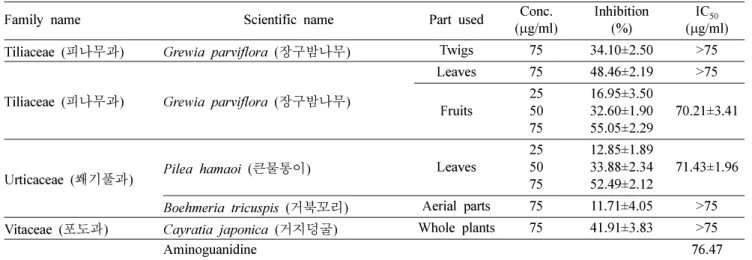
본 연구에서도 국내에서 자생하는 약용식물 156종의 에 탄올 추출물을 이용하여 최종당화산물 생성 저해 효능을 측 정하였다. 양성 대조 약물인 aminoguanidine의 IC50값 (76.47±4.81µg/ml)을 근거로 하여, 추출물이 IC50<50µg/ml 이면 효능이 있다고 판단하였다. 15종의 식물 추출물에서 IC50<10µg/ml로 최종당화산물 생성 저해 효능을 보였고, 그 중에서 4종의 추출물 Alnus firma 의 잎(3.25±0.10 µg/ml), Juncus decipiens 의 전초(4.30±0.44 µg/ml), smilax china의 줄기(3.55±0.21 µg/ml), Vicia amoena의 지상부(4.25±0.06 µg/ml)는 IC50가 5 µg/ml 이하로 aminoguanidine보다 약 8- 24배 이상의 우수한 효능이 있음을 알 수 있었다.
자작나무과의 A. firma(사방오리나무)에서 분리된 tri- terpenoids와 flavonoids가 humanimmunodeficiency virus
(HIV-1) 단백질 분해효소에 대해 억제효과를 가지는 것으로
보고되었으며,27)간성상세포에서 항섬유화 작용을 하여 간
질환 치료에 효과가 있다고 보고되었다.28) 또한 A. firma의 잎은 항산화능력이 있다고 알려진 carotenoid, superoxide dismutase(SOD), catalase(CAT)가 함유되어 있다고 보고되 었다.29) 또한 pancreatin과 salivary α-amylase, aldose reductase, yeast α-glucosidase를 억제하여 항당뇨 효과가 있다고 보고 되어 당뇨합병증에도 효과가 있을 것으로 예상된다.30) 골풀 과의 J. decipiens(등심초)는 이뇨적으로 작용하여, 세뇨관에 서 carbonic anhydrase를 억제하여, 개의 신기능에 영향을 끼친다고 보고되었다.31) 백합과의 S. china(청미래덩굴)는 lipoxygenase를 억제하고,32) lipopolysaccharide(LPS) 유도된 macrophage cells에서 cyclooxygenase-2(COX-2)와 같은 염 증유발 단백질의 발현을 억제하고 항염과 항통증 작용을 한 다고 보고되었다.33) 또한 S. china에서 분리된 steroidal saponin도 cyclooxygenase-2(COX-2)와 종양괴사인자인 tumor necrosis factor(TNF-α)의 생성을 억제한다고 보고되 었다.34) 뿌리와 줄기에서 분리된 polyphenol 성분들이 유방 암 세포사멸에 효과가 있고,35)분리된 flavonoid glycoside가 자궁암 세포, 백혈병 세포, 흑색종 세포 등의 암세포에서 apoptosis를 유도한다고 보고되었다.36) S. china 추출물에서 얻은 phenol 성분들이 HIV-1의 활성을 억제하고,37)고요산 혈증 동물에서 고요산혈증과 신장병을 억제한다고 보고되 었다.38) 또한 S. china의 잎은 α-glucosidase의 활성과 지방 축적을 억제하여 항당뇨와 항비만 효과가 있다고 보고되었 다.39)콩과의 V. amoena(갈퀴나물)은 지상부에 높은 Ca 함 량을 나타내고, 지하부에 높은 중금속 함량과 함께 질소의 함량도 높게 유지하면서 오염된 지역에서 생장 적응한다고 보고되었다.40)
위 언급된 4종의 약용 식물은 최종당화산물 생성 억제 효 Tiliaceae (피나무과) Grewia parviflora (장구밤나무) Twigs 75 34.10±2.50 >75
Tiliaceae (피나무과) Grewia parviflora (장구밤나무)
Leaves 75 48.46±2.19 >75 Fruits
25 50 75
16.95±3.50 32.60±1.90 55.05±2.29
70.21±3.41
Urticaceae (쐐기풀과) Pilea hamaoi (큰물통이) Leaves
25 50 75
12.85±1.89 33.88±2.34 52.49±2.12
71.43±1.96 Boehmeria tricuspis (거북꼬리) Aerial parts 75 11.71±4.05 >75 Vitaceae (포도과) Cayratia japonica (거지덩굴) Whole plants 75 41.91±3.83 >75
Aminoguanidine 76.47
IC
50values were calculated from the dose inhibition curve.
Table I. Continued
Family name Scientific name Part used Conc.
(µg/ml)
Inhibition (%)
IC50 (µg/ml)
능이 보고된 바 없으며, 양성 대조 약물 보다 8-24배 이상 최종당화산물 생성 억제 효능이 우수한 것으로 확인되었으 므로, 전임상 실험을 통해 in vivo효능 확인이 필요하다고 생각된다. 본 연구 결과는 국내 약용식물로부터 안전하고 효능이 좋은 최종당화산물 생성 저해제 후보를 발굴하기 위 한 기초 자료로 활용될 수 있으며, 당뇨에 의해 나타나는 합 병증 치료제 개발의 기반을 구축하는데 기여할 수 있을 것 이다.
결 론
기원이 확인된 한국산 약용식물 156종의 에탄올 추출물 이 in vitro에서 최종당화산물 생성저해 효능이 검색되었다.
그 결과 15종이 양성대조군인 aminoguanidine 보다 우수한 효능이 있음을 확인하였고, 특히 사방오리나무 잎(IC50: 3.25±0.10µg/ml), 등심초 전초(IC50: 4.30±0.44µg/ml), 청미 래덩굴 줄기(IC50: 8.14±0.20µg/ml)과 갈퀴나물 지상부(IC50: 4.25±0.06µg/ml) 4종의 추출물은 양성대조군(aminoguani- dine: IC50: 76.47±4.81µg/ml)보다 8-24배 억제 효능이 우수 하므로 당뇨합병증 예방 및 치료제로 개발될 가능성이 있다.
사 사
본 연구는 한국한의학연구원 기관고유사업(K14040, K15270)의 지원으로 수행되었으며 이에 감사드립니다.
인용문헌
1. Larkins, R. G. and Dunlop, M. E. (1992) The link between hyperglycaemia and diabetic nephropathy. Diabetologia 35:
499-504.
2. Ahmed, N. (2005) Advanced glycation endproducts-role in pathology of diabetic complications. Diabetes Res. Clin.
Pract. 67: 3-21.
3. Yokozaw, T., Nakagawa, T. and Terasawa, K. (2001) Effects of oriental medicines on the production of advanced gly- cation end products. J. trad. Med. 18: 107-112.
4. Huebschmann, A. G., Vlassara, H., Regensteiner, J. G. and Reusch, J. (2006) Diabetes and advanced glycoxidation end products. Diabetes care 29: 1420-1432.
5. Sakurai, T. and Tsuchiya, S. (1988) Superoxide production from nonenzymatically glycated protein. FEBS Lett. 236:
406-410.
6. Shinohara, R., Mano, T., Nagasaka, A., Sawai, Y., Uchimura, K., Hayashi, R., Hayakawa, N., Nagata, M., Makino, M., Kakizawa, H., Itoh, Y., Nakai, A. and Itoh, M. (1998) Effects of thyroid hormone on the sorbitol pathway in streptozotocin- induced diabetic rats. Biochim. Biophys. Acta. 1425: 577-586.
7. Bucala, R., Cerami, A. and Vlassara, H. (1995) Advanced glycosylation end products in diabetic complications. Dia- betes Rev. 3: 258-268.
8. Pipie, A. and Vanheyninger, R. (1964) Effect of diabetes on the content of sorbitol, glucose, fructose and inositol in the human lens. Exp. Eye Res. 3: 124-131.
9. Heath, H. and Hamlett, Y. C. (1976) The sorbitol pathway:
effect of streptozotocin induced diabetes and the feeding of a sucrose rich diet on glucose, sorbitol and fructose in the retina blood and liver of rats. Diabetoloqia 12: 43-46.
10. Rahbar, S. and Figarola, J. L. (2003) Novel inhibitors of advanced glycation endproducts. Arch. Biochem. Biophys.
419: 63-79.
11. Wilkinson-Berka, J. L., Kelly, D. J., Koerner, S. M., Jaworski, K., Davis B., Thallas, V. and Cooper, M. E. (2002) ALT-946 and aminoguanidine, inhibitors of advanced glycation, improve severe nephropathy in the diabetic transgenic (mREN-2) 27 rat. Diabetes 51: 3283-3289.
12. Peppa, M., Brem, H., Cai, W., Zhang, J. G., Basgen, J., Li, Z., Vlassara, H. and Uribarri, J. (2006) Prevention and reversal of diabetic nephropathy in db/db mice treated with alage- brium (ALT-711). Am. J. Nephrol. 26: 430-436.
13. Yang, S., Litchfield, J. E. and Baynes, J. W. (2003) AGE breakers cleave model compounds, but do not break maillard crosslinks in skin and tail collagen from diabetic rats. Arch.
Biochem. Biophys. 412: 42-46.
14. Vinson, J. A. and Howard, T. B. (1996) Inhibition of protein glycation and advanced glycation endproducts by ascorbic acid and other vitamins and nutrients. J. Nutr. Biochem. 7:
659-663.
15. Edelstein, D. and Brownlee, M. (1992) Mechanistic studies of advanced glycosylation end product inhibition by ami- noguanidine. Diabetes 41: 26-29.
16. Soulis, T., Cooper, M. E., Bucala, R. and Jerums, G. (1996) Effects of aminoguanidine in preventing experimental dia- betic nephropathy are related to the duration of treatment.
Kidney Int. 50: 627-634.
17. Jang, D. S., Lee, Y. M., Kim, Y. S. and Kim, J. S. (2006) Screening of Korean traditional herbal medicines with inhib- itory activity on advanced glycation end products (AGEs) formation. Kor. J. Pharmacogn. 37: 48-52.
18. Lee, Y. M., Kim, Y. S., Kim, J. M., Jang, D. S., Kim, J. W., Yoo, J. L. and Kim, J. S. (2008) Screening of Korean herbal medicines with inhibitory activity on advanced glycation end products (AGEs) formation (II). Kor. J. Pharmacogn. 39:
223-227.
19. Jeong, I. H., Kim, J. M., Jang, D. S., Kim, J. H., Cho, J. H.
and Kim, J. S. (2009) Screening of Korean herbal medicines with inhibitory activity on advanced glycation end products (AGEs) formation (III). Kor. J. Pharmacogn. 40: 382-387.
20. Kim, J. M., Kim, Y. S., Kim, J. H., Yoo, J. M. amd Kim, J.
S. (2009) Screening of herbal medicines from China and
Vietnam with inhibitory activity on advanced glycation end products (AGEs) formation (IV). Kor. J. Pharmacogn. 40:
388-393.
21. Kim, Y. S., Choi, S. H. Kim, J. H. and Kim, J. S. (2011) Screening of herbal medicines from China with inhibitory activity on advanced glycation end products (AGEs) for- mation (V). Kor. J. Pharmacogn. 42: 46-53.
22. Lee, Y. M., Kim, Y. S., Kim, J. H. and Kim, J. S. (2011) Screening of herbal medicines from China with inhibitory activity on advanced glycation end products (AGEs) for- mation (VI). Kor. J. Pharmacogn. 42: 161-168.
23. Choi, S. J., Kim, Y. S., Song, Y. J., Lee, Y. M., Kim, J. H. and Kim, J. S. (2012) Screening of Korean herbal medicines with inhibitory Activity on advanced glycation end products for- mation (VII). Kor. J. Pharmacogn. 43: 345-351.
24. Choi, S. J., Song, Y. J., Kim, Y. S., Kim, J. H., Hang, S., Bach, T. T. and Kim, J. S. (2012) Screening of herbal med- icines from China and Vietnam with inhibitory activity on advanced glycation end products (AGEs) formation (VIII).
Kor. J. Pharmacogn. 43: 338-344.
25. Lee, Y. M., Kim, Y. S., Kim, J. H. and Kim, J. S. (2013) Screening of Korean herbal medicines with inhibitory Activ- ity on advanced glycation end products formation (IX). Kor.
J. Pharmacogn. 44: 298-304.
26. Choi, S. J., Song, Y. J., Kim, Y. S., Kim, J. H. and Kim, J. S.
(2013) Screening of Korean herbal medicines with inhibitory Activity on advanced glycation end products formation (XI).
Kor. J. Pharmacogn. 44: 372-378.
27. Yu, Y. B., Miyashiro, H., Nakamura, N., Hattori, M. and Park, J. C. (2007) Effects of triterpenoids and flavonoids iso- lated from Alnus firma on HIV-1 viral enzymes. Arch Pharm Res. 30: 820-826.
28. Lee, M., Lee, M. K., Kim, Y. C. and Sung S. H. (2011) Anti- fibrotic constituents of Alnus firma on hepatic stellate cells.
Bioorg Med Chem. 21: 2906-2910.
29. Han, S. H., Lee, J. C., Oh, C. Y., Kim, J. K. and Kim, P. G.
(2006) Seasnal changes pigment content and antioxidant capacity in leaves of Alnus firma at polluted area. KJAFM. 8:
107-115.
30. Choi, H. J., Jung, Y. K., Kang, D. W. and Ju, W. H. (2008) Inhibitory effects of four solvent fractions of Alnus firma on α-amylase and α-glucosidase. J Life Sci. 18: 1005-1010.
31. Moon, Y. H. (1975) Influence of Juncus decipiens Nakai on the renal function of dog. Kor. J. Pharmacog. 6: 101-110.
32. Khan, I., Nisar, M., Ebad, F., Nadeem, S., Saeed, M., Khan, H., Samiullah, Khuda, F., Karim, N. and Ahmad, Z. (2009) Anti-inflammatory activities of Sieboldgenin from Smilax china Linn.: Experimental and computational stidies. J. Eth- nopharmacol. 121: 175-177.
33. Shu, X. S., Gao, Z. H. and Yang, X. L. (2006) Anti-inflam- matory and anti-nociceptive activities of Smilax china L.
aqueous extract. J. Ethnopharmacol. 103: 327-332.
34. Shao, B., Guo, H., Cui, Y., Ye, M., Han, J. and Guo, D.
(2007) Steroidal saponins from Smilax china and their anti- inflammatory activities. Phytochemistry. 68: 623-630.
35. Wu, L. S., Wang, X. J., Wang, H., Yang H. W., Jia, A. Q. and Ding, Q. (2010) Cytotoxic polyphenols against breast tumor cell in Smilax china L. J. Ethnopharmacol. 130: 460-464.
36. Li, Y. L., Gan, G. P., Zhang, H. Z., Wu, H. Z., Li, C. L., Huang, Y. P., Liu, Y. W. and Liu, J. W. (2007) A flavonoid glycoside isolated from Smilax china L. rhizome in vitro anti- cancer effects on human cancer cell lines. J. Ethnophar- macol. 113: 115-124.
37. Wang, W. X., Qian, J. Y., Wang, X. J., Jiang, A. P. and Jia, A.
Q. (2014) Anti-HIV-1 activities of extracts and phenolics from Smilax china L. Pak. J. Pharm. Sci. 27: 147-151.
38. Chen, L., Yin, H., Lan, Z., Ma, S., Zhang, C., Yang, Z., Li, P. and Lin, B. (2011) Anti-hyperuricemic and nephropro- tective effects of Smilax china L. J. Ethnopharmacol. 135:
399-105.
39. Kang, Y. H., Kim, D. J., Kim, T. W., Kim, K. K. and Choe, M. (2014) Anti-diabetes effects of Smilax china L. extract.
The FASEB Journal. 28: 959.17.
40. Park, Y. M., Park, T. G., Song, S. D. and Song, E. J. (1999) Changes of nitrogen fixation activity and heavy metal accu- mulation of Vicia amoena community from Kumho Riv- erside. Korean J. Environ. Ecol. 89: 131-137.
(2015. 8. 3 접수; 2015. 8. 31 심사; 2015. 9. 17 게재확정)