D I A B E T E S & M E T A B O L I S M J O U R N A L
This is an Open Access article distributed under the terms of the Creative Commons Attribution Non-Commercial License (http://creativecommons.org/licenses/by-nc/4.0/) which permits unrestricted non-commercial use, distribution, and reproduction in any medium, provided the original work is properly cited.
The Role of Advanced Glycation End Products in Diabetic Vascular Complications
Sang Youl Rhee, Young Seol Kim
Department of Endocrinology and Metabolism, Kyung Hee University School of Medicine, Seoul, Korea
In cases of chronic hyperglycemia, advanced glycation end-products (AGEs) are actively produced and accumulated in the circu- lating blood and various tissues. AGEs also accelerate the expression of receptors for AGEs, and they play an important role in the development of diabetic vascular complications through various mechanisms. Active interventions for glucose and related risk factors may help improve the clinical course of patients by reducing AGEs. This review summarizes recent updates on AGEs that have a significant impact on diabetic vascular complications.
Keywords: Diabetes complications; Glycation end products, advanced; Receptor for advanced glycation end products
Corresponding author: Young Seol Kim https://orcid.org/0000-0002-5384-7008 Department of Endocrinology and Metabolism, Kyung Hee University School of Medicine, 23 Kyungheedae-ro, Dongdaemun-gu, Seoul 02447, Korea E-mail: [email protected]
The Sulwon Award for Scientific Achievement is the Korean Diabetes Association’s highest scientific award and honors an individual who has excellently contributed to the progress in the field of diabetes and metabolism. Sulwon Award is named after an emeritus professor Eung Jin Kim, who found- ed Korean Diabetes Association. Prof. Young Seol Kim re- ceived the ninth Sulwon Award at 2017 International Confer- ence on Diabetes and Metabolism, September 28 to 30, 2017 at Seoul, Korea.
INTRODUCTION
Chronic hyperglycemia, a contributing factor in diabetic vas- cular complications, has been evaluated through experimental and large-scale clinical studies, such as the Diabetes Control and Complications Trial (DCCT) and the UK Prospective Dia- betes Study (UKPDS) [1-3]. A follow-up DCCT study found that when the regulation of blood glucose was controlled strictly for 6.5 years at the initial stage of type 1 diabetes melli- tus (T1DM), the effect lasted so long that the progression of microvascular complications was delayed for at least 8 years af-
ter the termination of the initial study, and the occurrence of cardiovascular events was delayed for 11 years [2]. According to the UKPDS follow-up study, patients with type 2 diabetes mellitus (T2DM) also had the legacy effect stemming from the strict regulation of blood sugar from the initial stage of the dis- ease, which suggests that the phenomenon of metabolic mem- ory exists in the vascular complications of diabetes [3].
Recent studies have suggested that advanced glycation end- products (AGEs) may be a key factor in the development of metabolic memory in diabetic complications, because AGEs are produced and accumulated irreversibly in the body, de- pending on the degree of blood sugar regulation and duration [4]. Once produced, the material is metabolized so slowly that it can well explain the phenomenon of metabolic memory or legacy effect [5]. Direct evidence of the relationship between the accumulation of AGEs and development of diabetic vascu- lar complications was reported recently [6].
In this review, we summarized the recent AGE-related up- dates that have an important influence on the occurrence and deterioration of these diabetic vascular complications.
https://doi.org/10.4093/dmj.2017.0105 pISSN 2233-6079 · eISSN 2233-6087
ADVANCED GLYCATION END-PRODUCTS
AGEs are produced by the Maillard reaction. A reducing sugar, such as glucose, reacts non-enzymatically with the amino group of proteins to produce a Schiff base that rearranges into Amadori compounds [5]. These Amadori adducts then very slowly undergo irreversible dehydration and condensation re- actions, eventually producing AGEs, which are yellowish- brown materials with particular fluorescence [5].
AGEs are produced not only from glucose but also from the dicarbonyl compound produced from autoxidation and the degradation products of glucose, such as glyoxal, methylglyox- al, and 3-deoxyglucosone, or α-hydroxy aldehydes such as glyceraldehyde and glycolaldehyde [7,8]. In the case of chronic hyperglycemia, AGEs are actively produced and accumulate in the circulating blood and various tissues, resulting in vascular complications in diabetes [5].
Although AGEs are produced endogenously by oxidative stress or hyperglycemia, they can be consumed exogenously
through food. About 6% to 7% of AGEs derived from meals are known to be present in the body for a certain period of time [9,10].
AGE-RAGE SYSTEM IN DIABETIC VASCULAR COMPLICATIONS
AGEs accelerate the expression of receptors for advanced gly- cation end-products (RAGEs). The constant activation of the AGE-RAGE system is presumed to create the long-term meta- bolic memory or legacy effect [11]. Upon the recognition of AGEs by RAGE in endothelial cells, the production of oxida- tive stress is accelerated in the cells, and various cytokines and growth factors are secreted through the activation of nuclear factor κB, thereby inducing the expression of adhesion factor and causing an inflammatory response (Fig. 1) [12]. In patients with diabetes, RAGE expression is accelerated in atheroscle- rotic lesions in proportion to aggravation of blood sugar regu- lation [13].
Fig. 1. Suggested mechanism of advanced glycation end-products (AGEs) in diabetic vascular complications. RAGE, receptor for advanced glycation end-product; NF-κB, nuclear factor κB; RAS, renin-angiotensin system; TZD, thiazolidinediones; GLP-1, glu- cagon like peptide-1; DPP-4, dipeptidylpeptide-4; sRAGE, soluble receptor for advanced glycation end-product; ROS, reactive oxygen species; eNOS, endothelial nitric oxide synthase; NADPH, nicotinamide adenine dinucleotide phosphate; IL, interleukin;
TNF-α, tumor necrosis factor α.
The oxidative stress accelerated by AGE-RAGE inactivates nitric oxide and then either causes an inflammatory response or aggravates a thrombotic tendency that leads to the progres- sion of arteriosclerosis [14,15]. In endothelial cells, the AGE- RAGE system promotes the gene expression of p22phox and gp- 91phox, which are components of the reduced form of nicotin- amide adenine dinucleotide phosphate (NADPH) oxidase, and accelerates the production of oxidative stress by activating the cell membrane transport of Rac family small GTPase 1 (Rac1) to cause endothelial cell dysfunction [16].
AGEs promote the production of vascular endothelial growth factor (VEGF) in the endothelial cells, which then in- duces pathological angiogenesis [17]. VEGF is known to be in- volved in the increasing atheroma in an atherosclerotic lesion [18]. This suggests that the AGE-RAGE system, through the production of VEGF, activates angiogenesis in atheroma and aggravates inflammation in the plaque, possibly by a hemor- rhage or an increase in the atheroma [19].
In addition, the AGE-RAGE system inhibits the production of prostacyclin (PGI2) in endothelial cells and promotes the de novo synthesis of plasminogen activator inhibitor-1, thereby inhibiting fibrinolytic activity and then contributing to stabili- zation of the thrombus [19]. A decrease in cyclic adenosine monophosphate production through the AGE-RAGE system is expected to be involved in the thrombotic tendency [20].
AGEs are known to promote not only platelet aggregation but also the blood coagulation cascade through tissue factor produc- tion [21]. The thrombotic tendency induced by AGEs is consid- ered the cause of acute coronary syndromes, such as unstable an- gina or acute myocardial infarction through atheroma rupture and subsequent thrombogenesis in the coronary artery [21].
The low density lipoproteins (LDLs) oxidized and denatured by AGEs are recognized by scavenger receptors, which then activate foam cell formation from macrophages and the secre- tion of chemokines or growth factors therein. The LDLs there- fore accelerate the migration, proliferation, and transformation of smooth-muscle cells or the endothelial invasion by mono- cytes [22].
A clear progression of atherosclerosis and plaques accompa- nied by calcified lesions is observed in patients with diabetes [23]. In addition, the appearance of calcified lesions in athero- sclerotic lesions is considered a predictive factor of future car- diovascular events and a marker of poor prognosis resistance to coronary intervention [23]. AGEs act on blood vessel wall cells, such as pericytes, promoting their differentiation into os-
teoblasts and thus causing calcification deposition [24]. There- fore, AGEs present in atherosclerotic lesions are presumed to be involved in the occurrence and progression of calcified le- sions by acting on pericytes of the angiogenesis induced by an increase in atheroma [25].
AGE-RAGE SYSTEM WITH OTHER PATHWAYS
The oxidative stress accelerated by the AGE-RAGE system not only causes vascular disorder by activating the renin-angioten- sin system (RAS) but also aggravates organ failure, because RAS activation causes NADPH oxidase-derived oxidative stress that again leads to an increase in RAGE expression as well as AGE production [26,27]. This fact suggests that inhibi- tion of the AGE-RAGE system is involved in some of the long- term protective effects of RAS inhibitors [27].
It is known that in hyperglycemia, the de novo synthesis of diacylglycerol is accelerated and protein kinase Cβ (PKCβ) is activated, and sorbitol or fructose is accumulated in the cells as a result of polyol pathway hyperactivity [28]. PKCβ activation is presumed to accelerate the activity of NADPH oxidase and then causes vascular complications in diabetes in connection with the AGE-RAGE system [28]. Fructose has a 10-time stronger glycation activity than glucose, and AGE formation from intracellular protein and fructose may be involved in vas- cular disorders [29]. The mitochondrial-derived oxidative stress produced by the hyperglycemic load causes AGE pro- duction, PKCβ activation, and polyol pathway hyperactivity [28]. These three hypotheses, which have existed for many years, and the AGE-RAGE system have a mutual role in the development of diabetic vascular complications [30].
AGE AND sRAGE AS INDICATORS OF VASCULAR COMPLICATIONS
Serum levels of AGEs are known to constitute an independent risk factor of endothelial dysfunction in patients with T2DM [4]. In addition, serum levels of AGEs were shown to be an in- dependent factor for predicting death from cardiovascular events in women with T2DM or in nondiabetic patients in an 18-year follow-up study [30]. It is also known that serum AGE levels are related to left ventricular diastolic dysfunction and vascular stiffness in patients with T1DM [31].
RAGE has three splice variants of full-length RAGE, an N- terminal variant that does not contain an AGE-binding do-
main, a soluble receptor for advanced glycation end-product (sRAGE), and a C-terminal splice variant that does not include transmembrane and effector domains [32]. The physiological function of sRAGE has not yet been fully characterized, but it is known to be produced through cleavage of cell-surface RAGE and is known to reflect endothelial cell damage [33].
However, it is known that sRAGE can modulate the AGE- RAGE system as an antagonist of full-length RAGE [34].
Although serum levels of sRAGEs are only about 1/1,000 to 1/5,000 of the AGE concentrations in circulation, sRAGE could become an indicator for predicting the degree of vascu- lar disorders because it reflects the RAGE expression in tissues [30]. One study also demonstrated that serum sRAGE levels were significantly higher in T2DM patients than in non-dia- betic subjects and positively associated with the presence of coronary artery disease [33].
AGEs IN FOODS
Because the AGE reaction is also referred to as the browning reaction, the browning change of foods can be a measure of their AGE content. In general, it is known that a large amount of AGEs are produced when meats or fatty foods are heated or baked at a high temperature [35]. On the other hand, AGEs are
not produced in a significant amount when foods are slowly steamed or heated with a lot of water for a long time [35]. For example, chicken shows a clear browning reaction, and grilled chicken skewers in particular have about 10 times higher levels of AGEs than chicken boiled in water [35].
Because assessments of their eating history and eating habits suggest a correlation between the amount of AGE intake and serum AGE level, a decrease in the amount of food-derived AGE intake is considered to inhibit vascular complications in diabetic patients [35,36]. In this regard, some experiments also reported that the long-term consumption of AGE-limiting foods in mice reduced oxidative stress markers and inhibited insulin resistance and organ failure, resulting in an extension of life span [37]. Therefore, the limitation of food-derived AGEs can become a significant therapeutic target for inhibit- ing organ failure due to diabetes or aging.
Indeed, when patients with T2DM consumed AGE-restrict- ed diet, the serum levels of AGEs decreased by around 30% to 40% in 2 to 6 weeks, resulting in a 20% decrease in markers of vascular complications, such as soluble vascular cell adhesion molecule-1 or C-reactive protein, or inflammatory markers [38]. In addition, it is known that in diabetic patients who lim- ited food-derived AGEs, the AGE formation or oxidative de- generation of blood LDL-cholesterol is inhibited, and vascular
Table 1. Agents known to modulate AGEs
Agents Suggested effects References
Pravastatin Reduce tubular damage in diabetic nephropathy in tubular cells and attenuate AGEs-induced
apoptosis [41]
Atorvastatin Inhibit AGE formation through its anti-oxidative activity [42]
Telmisartan Inhibit the expression of oxidative stress and inflammatory markers by inhibiting signal transduc-
tion by AGEs and expression of arteriosclerosis-related genes [43,44]
Ramipril Inhibit the expression of oxidative stress and inflammatory markers by inhibiting signal transduc-
tion by AGEs [45]
Rosiglitazone Reduce the expression of RAGE on the myocardium and attenuate cardiac fibrosis and ventricular
diastolic function [46]
Exendin-4 Inhibit the AGE-RAGE mediated damage in tubular cells to attenuate the development and pro-
gression of diabetic nephropathy [47]
Linagliptin Inhibit AGE-RAGE–evoked oxidative stress generation [48,49]
Aminoguanidine Prevent cardiac hypertrophy and arterial stiffening in diabetic cardiomyopathy [50-52]
ALT-711 AGE cross-link breaker [52]
Alagebrium AGE cross-link breaker [45]
sRAGE Competitive inhibitor of RAGE [32]
AGE, advanced glycation end-product; RAGE, receptor for advanced glycation end-product; sRAGE, soluble receptor for advanced glycation end-product.
complications due to LDL-cholesterol are also decreased [39].
However, it is not yet known whether the long-term, AGE- limiting diets can inhibit vascular complications in diabetic patients and improve their prognosis. In addition, differences in the absorption capacity of the gastrointestinal tract; the binding capacity with RAGE; and organ failure, depending on the type of AGEs taken up by the body, should be considered.
AGENTS KNOWN TO MODULATE AGEs
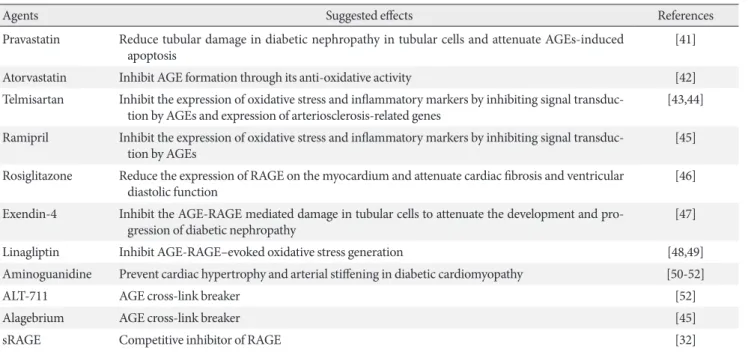
Several drugs are known to modulate AGEs (Table 1). Statin could slow the AGE-RAGE-mediated activation of NADPH oxidase by inhibiting the prenylation of Rac1, which subse- quently inhibits post-RAGE-induced signal transduction [40].
Pravastatin is known to reduce tubular damage in diabetic ne- phropathy in tubular cells and attenuate AGEs-induced apop- tosis [41]. Atorvastatin is also known to inhibit AGE formation through its anti-oxidative activity [42].
Telmisartan, an angiotensin receptor blocker with selective peroxisome proliferator-activated receptor γ activation, is known to inhibit RAGE expression in endothelial cells, renal mesangial cells, and hepatocytes [43]. It is known to inhibit the expression of oxidative stress and inflammatory markers by inhibiting signal transduction by AGEs and expression of arte- riosclerosis-related genes [43,44]. It is also known that ramipril, an angiotensin-converting enzyme inhibitor, can regulate AGEs with a similar mechanism of action [45].
The AGE modulatory potential is also known in some anti- diabetic medications. Rosiglitazone could reduce the expres- sion of RAGE on the myocardium and attenuates cardiac fi- brosis and ventricular diastolic function in experimental mod- els [46]. Exendin-4 could inhibit the AGE-RAGE–mediated damage in tubular cells to attenuate the development and pro- gression of diabetic nephropathy [47]. Linagliptin also has beneficial effects on diabetic nephropathy, partially inhibiting AGE-RAGE–evoked oxidative stress generation [48,49].
Therefore, these agents are regarded as AGE-RAGE modula- tors in a broad sense. However, it is still unclear whether the modulation of AGEs by these drugs plays an important role in the improvement of diabetic macrovascular complications, compared to the main effects of these drugs.
Recently, the efficacy of aminoguanidine has been evaluated as a novel intervention for AGEs. Studies have shown that ami- noguanidine inhibits the formation of AGEs and inhibits mi- cro- and macrovascular complications in apolipoprotein
knockout mice [50-52]. It is also known that AGE cross-link breakers such as ALT-711 or alagebrium may help prevent dia- betic vascular complications [45,52]. In addition, the effect of direct antagonism on AGE of sRAGE has been demonstrated in some experimental studies [32]. However, the effect of the AGE modulator on advanced complications is unclear. In ad- dition, there are few intervention studies of the actual clinical usefulness.
CONCLUSIONS
The formation of AGEs in diabetes patients occurs as a conse- quence of chronically elevated blood glucose levels. Some of the AGEs are known to be ingested through food. These AGEs could be one of the major contributing factors to the develop- ment of diabetic complications. It increases oxidative stress in the body according to various mechanisms and induces an in- flammatory reaction, which has an important influence on the occurrence and exacerbation of diabetic vascular complica- tions.
Recently, several clinical and preclinical studies have shown that interventions for these AGEs may play an important role in the reduction and prevention of diabetic vascular complica- tions. This can be achieved not only by proper blood glucose control but also through diet and medical intervention. Re- cently, new compounds for the regulation of AGEs in the body have been studied.
In the future, further research results will clarify the role of AGEs in diabetic vascular complications, and we hope that successful intervention will help prevent complications and improve the quality of life for diabetic patients.
CONFLICTS OF INTEREST
No potential conflict of interest relevant to this article was re- ported.
ACKNOWLEDGMENTS
Professor Young Seol Kim received the ninth Sulwon Award at the 2017 International Conference on Diabetes and Metabo- lism, September 28 to 30, 2017, at Seoul, Korea. The work was supported by a grant from the Korea Healthcare Technology R&D Project, Ministry of Health and Welfare Republic of Ko- rea (HI10C2020).
REFERENCES
1. Vlassara H, Palace MR. Diabetes and advanced glycation end- products. J Intern Med 2002;251:87-101.
2. Writing Team for the Diabetes Control and Complications Tri- al/Epidemiology of Diabetes Interventions and Complications Research Group. Sustained effect of intensive treatment of type 1 diabetes mellitus on development and progression of diabetic nephropathy: the Epidemiology of Diabetes Interventions and Complications (EDIC) study. JAMA 2003;290:2159-67.
3. Holman RR, Paul SK, Bethel MA, Matthews DR, Neil HA. 10- Year follow-up of intensive glucose control in type 2 diabetes.
N Engl J Med 2008;359:1577-89.
4. Singh R, Barden A, Mori T, Beilin L. Advanced glycation end- products: a review. Diabetologia 2001;44:129-46.
5. Yamagishi S, Imaizumi T. Diabetic vascular complications:
pathophysiology, biochemical basis and potential therapeutic strategy. Curr Pharm Des 2005;11:2279-99.
6. Koska J, Saremi A, Howell S, Bahn G, De Courten B, Ginsberg H, Beisswenger PJ, Reaven PD; VADT Investigators. Advanced glycation end products, oxidation products, and incident car- diovascular events in patients with type 2 diabetes. Diabetes Care 2018;41:570-6.
7. Lo TW, Westwood ME, McLellan AC, Selwood T, Thornalley PJ. Binding and modification of proteins by methylglyoxal un- der physiological conditions. A kinetic and mechanistic study with N alpha-acetylarginine, N alpha-acetylcysteine, and N al- pha-acetyllysine, and bovine serum albumin. J Biol Chem 1994;269:32299-305.
8. Ahmed N, Thornalley PJ, Dawczynski J, Franke S, Strobel J, Stein G, Haik GM. Methylglyoxal-derived hydroimidazolone advanced glycation end-products of human lens proteins. In- vest Ophthalmol Vis Sci 2003;44:5287-92.
9. Uribarri J, Cai W, Sandu O, Peppa M, Goldberg T, Vlassara H.
Diet-derived advanced glycation end products are major con- tributors to the body’s AGE pool and induce inflammation in healthy subjects. Ann N Y Acad Sci 2005;1043:461-6.
10. Yamagishi S, Ueda S, Okuda S. Food-derived advanced glyca- tion end products (AGEs): a novel therapeutic target for vari- ous disorders. Curr Pharm Des 2007;13:2832-6.
11. Bierhaus A, Hofmann MA, Ziegler R, Nawroth PP. AGEs and their interaction with AGE-receptors in vascular disease and diabetes mellitus. I. The AGE concept. Cardiovasc Res 1998;37:
586-600.
12. Naka Y, Bucciarelli LG, Wendt T, Lee LK, Rong LL, Ramasamy
R, Yan SF, Schmidt AM. RAGE axis: animal models and novel insights into the vascular complications of diabetes. Arterio- scler Thromb Vasc Biol 2004;24:1342-9.
13. Schmidt AM, Stern D. Atherosclerosis and diabetes: the RAGE connection. Curr Atheroscler Rep 2000;2:430-6.
14. Xu B, Ji Y, Yao K, Cao YX, Ferro A. Inhibition of human endo- thelial cell nitric oxide synthesis by advanced glycation end- products but not glucose: relevance to diabetes. Clin Sci (Lond) 2005;109:439-46.
15. Bucala R, Tracey KJ, Cerami A. Advanced glycosylation prod- ucts quench nitric oxide and mediate defective endothelium- dependent vasodilatation in experimental diabetes. J Clin In- vest 1991;87:432-8.
16. Yamagishi S, Nakamura N, Suematsu M, Kaseda K, Matsui T.
Advanced glycation end products: a molecular target for vas- cular complications in diabetes. Mol Med 2015;21 Suppl 1:S32- 40.
17. Treins C, Giorgetti-Peraldi S, Murdaca J, Van Obberghen E.
Regulation of vascular endothelial growth factor expression by advanced glycation end products. J Biol Chem 2001;276:43836- 41.
18. Chung NA, Lydakis C, Belgore F, Li-Saw-Hee FL, Blann AD, Lip GY. Angiogenesis, thrombogenesis, endothelial dysfunc- tion and angiographic severity of coronary artery disease.
Heart 2003;89:1411-5.
19. Yamagishi S, Adachi H, Takeuchi M, Enomoto M, Furuki K, Matsui T, Nakamura K, Imaizumi T. Serum level of advanced glycation end-products (AGEs) is an independent determinant of plasminogen activator inhibitor-1 (PAI-1) in nondiabetic general population. Horm Metab Res 2007;39:845-8.
20. Yamagishi S. Role of advanced glycation end products (AGEs) and receptor for AGEs (RAGE) in vascular damage in diabetes.
Exp Gerontol 2011;46:217-24.
21. Singh VP, Bali A, Singh N, Jaggi AS. Advanced glycation end products and diabetic complications. Korean J Physiol Phar- macol 2014;18:1-14.
22. Takenaka K, Yamagishi S, Matsui T, Nakamura K, Imaizumi T.
Role of advanced glycation end products (AGEs) in thrombo- genic abnormalities in diabetes. Curr Neurovasc Res 2006;3:
73-7.
23. Chait A, Bornfeldt KE. Diabetes and atherosclerosis: is there a role for hyperglycemia? J Lipid Res 2009;50 Suppl:S335-9.
24. Wei Q, Ren X, Jiang Y, Jin H, Liu N, Li J. Advanced glycation end products accelerate rat vascular calcification through RAGE/oxidative stress. BMC Cardiovasc Disord 2013;13:13.
25. Cipollone F, Iezzi A, Fazia M, Zucchelli M, Pini B, Cuccurullo C, De Cesare D, De Blasis G, Muraro R, Bei R, Chiarelli F, Schmidt AM, Cuccurullo F, Mezzetti A. The receptor RAGE as a progression factor amplifying arachidonate-dependent in- flammatory and proteolytic response in human atherosclerotic plaques: role of glycemic control. Circulation 2003;108:1070-7.
26. Cheng CL, Tang Y, Zheng Z, Liu X, Ye ZC, Wang C, Lou TQ.
Advanced glycation end-products activate the renin-angioten- sin system through the RAGE/PI3-K signaling pathway in podocytes. Clin Invest Med 2012;35:E282.
27. Geronikaki A, Gavalas A, Dislian V, Giannoglou G. Inhibition of renin-angiotensin system and advanced glycation end prod- ucts formation: a promising therapeutic approach targeting on cardiovascular diseases. Cardiovasc Hematol Agents Med Chem 2007;5:249-64.
28. Gleissner CA, Galkina E, Nadler JL, Ley K. Mechanisms by which diabetes increases cardiovascular disease. Drug Discov Today Dis Mech 2007;4:131-40.
29. Yamagishi S, Nakamura K, Matsui T, Noda Y, Imaizumi T. Re- ceptor for advanced glycation end products (RAGE): a novel therapeutic target for diabetic vascular complication. Curr Pharm Des 2008;14:487-95.
30. Nakamura K, Yamagishi S, Adachi H, Kurita-Nakamura Y, Matsui T, Yoshida T, Imaizumi T. Serum levels of sRAGE, the soluble form of receptor for advanced glycation end products, are associated with inflammatory markers in patients with type 2 diabetes. Mol Med 2007;13:185-9.
31. Berg TJ, Snorgaard O, Faber J, Torjesen PA, Hildebrandt P, Mehlsen J, Hanssen KF. Serum levels of advanced glycation end products are associated with left ventricular diastolic func- tion in patients with type 1 diabetes. Diabetes Care 1999;22:
1186-90.
32. Yonekura H, Yamamoto Y, Sakurai S, Petrova RG, Abedin MJ, Li H, Yasui K, Takeuchi M, Makita Z, Takasawa S, Okamoto H, Watanabe T, Yamamoto H. Novel splice variants of the receptor for advanced glycation end-products expressed in human vas- cular endothelial cells and pericytes, and their putative roles in diabetes-induced vascular injury. Biochem J 2003;370(Pt 3):
1097-109.
33. Nakamura K, Yamagishi S, Adachi H, Kurita-Nakamura Y, Matsui T, Yoshida T, Sato A, Imaizumi T. Elevation of soluble form of receptor for advanced glycation end products (sRAGE) in diabetic subjects with coronary artery disease. Diabetes Metab Res Rev 2007;23:368-71.
34. Hanford LE, Enghild JJ, Valnickova Z, Petersen SV, Schaefer
LM, Schaefer TM, Reinhart TA, Oury TD. Purification and characterization of mouse soluble receptor for advanced glyca- tion end products (sRAGE). J Biol Chem 2004;279:50019-24.
35. Uribarri J, Woodruff S, Goodman S, Cai W, Chen X, Pyzik R, Yong A, Striker GE, Vlassara H. Advanced glycation end prod- ucts in foods and a practical guide to their reduction in the diet. J Am Diet Assoc 2010;110:911-6.
36. Luevano-Contreras C, Chapman-Novakofski K. Dietary ad- vanced glycation end products and aging. Nutrients 2010;2:1247- 65.
37. Liu G, Zong G, Hu FB, Willett WC, Eisenberg DM, Sun Q.
Cooking methods for red meats and risk of type 2 diabetes: a prospective study of U.S. Women. Diabetes Care 2017;40:1041- 9.
38. Luevano-Contreras C, Garay-Sevilla ME, Wrobel K, Malacara JM, Wrobel K. Dietary advanced glycation end products re- striction diminishes inflammation markers and oxidative stress in patients with type 2 diabetes mellitus. J Clin Biochem Nutr 2013;52:22-6.
39. Wu CH, Huang SM, Lin JA, Yen GC. Inhibition of advanced glycation endproduct formation by foodstuffs. Food Funct 2011;2:224-34.
40. Kwok JM, Ma CC, Ma S. Recent development in the effects of statins on cardiovascular disease through Rac1 and NADPH oxidase. Vascul Pharmacol 2013;58:21-30.
41. Ishibashi Y, Yamagishi S, Matsui T, Ohta K, Tanoue R, Takeu- chi M, Ueda S, Nakamura K, Okuda S. Pravastatin inhibits ad- vanced glycation end products (AGEs)-induced proximal tu- bular cell apoptosis and injury by reducing receptor for AGEs (RAGE) level. Metabolism 2012;61:1067-72.
42. Yamagishi S. Possible involvement of advanced glycation end products in carry-over benefits of atorvastatin in ASCOT-BP- LA. Eur Heart J 2008;29:1922.
43. Yamagishi S, Nakamura K, Matsui T. Potential utility of telmis- artan, an angiotensin II type 1 receptor blocker with peroxi- some proliferator-activated receptor-gamma (PPAR-gamma)- modulating activity for the treatment of cardiometabolic disor- ders. Curr Mol Med 2007;7:463-9.
44. Yamagishi S, Nakamura K, Matsui T. Regulation of advanced glycation end product (AGE)-receptor (RAGE) system by PPAR-gamma agonists and its implication in cardiovascular disease. Pharmacol Res 2009;60:174-8.
45. Coughlan MT, Thallas-Bonke V, Pete J, Long DM, Gasser A, Tong DC, Arnstein M, Thorpe SR, Cooper ME, Forbes JM.
Combination therapy with the advanced glycation end product
cross-link breaker, alagebrium, and angiotensin converting en- zyme inhibitors in diabetes: synergy or redundancy? Endocri- nology 2007;148:886-95.
46. Ihm SH, Chang K, Kim HY, Baek SH, Youn HJ, Seung KB, Kim JH. Peroxisome proliferator-activated receptor-gamma activa- tion attenuates cardiac fibrosis in type 2 diabetic rats: the effect of rosiglitazone on myocardial expression of receptor for ad- vanced glycation end products and of connective tissue growth factor. Basic Res Cardiol 2010;105:399-407.
47. Ojima A, Ishibashi Y, Matsui T, Maeda S, Nishino Y, Takeuchi M, Fukami K, Yamagishi S. Glucagon-like peptide-1 receptor agonist inhibits asymmetric dimethylarginine generation in the kidney of streptozotocin-induced diabetic rats by blocking advanced glycation end product-induced protein arginine methyltranferase-1 expression. Am J Pathol 2013;182:132-41.
48. Nakashima S, Matsui T, Takeuchi M, Yamagishi SI. Linagliptin blocks renal damage in type 1 diabetic rats by suppressing ad- vanced glycation end products-receptor axis. Horm Metab Res 2014;46:717-21.
49. Matsui T, Nakashima S, Nishino Y, Ojima A, Nakamura N, Arima K, Fukami K, Okuda S, Yamagishi S. Dipeptidyl pepti- dase-4 deficiency protects against experimental diabetic ne- phropathy partly by blocking the advanced glycation end products-receptor axis. Lab Invest 2015;95:525-33.
50. Thornalley PJ, Yurek-George A, Argirov OK. Kinetics and mechanism of the reaction of aminoguanidine with the alpha- oxoaldehydes glyoxal, methylglyoxal, and 3-deoxyglucosone under physiological conditions. Biochem Pharmacol 2000;60:
55-65.
51. Soulis-Liparota T, Cooper M, Papazoglou D, Clarke B, Jerums G. Retardation by aminoguanidine of development of albu- minuria, mesangial expansion, and tissue fluorescence in streptozocin-induced diabetic rat. Diabetes 1991;40:1328-34.
52. Forbes JM, Yee LT, Thallas V, Lassila M, Candido R, Jandeleit- Dahm KA, Thomas MC, Burns WC, Deemer EK, Thorpe SR, Cooper ME, Allen TJ. Advanced glycation end product inter- ventions reduce diabetes-accelerated atherosclerosis. Diabetes 2004;53:1813-23.