43(4) : 338∼ 344 (2012)
338
중국·베트남 약용식물의 최종당화산물 생성저해활성 검색(VIII)
최소진1·송유진1·김영숙1·김주환2·Sun Hang3·Tran The Bach4·김진숙1*
1한국한의학연구원 한약연구본부 한의신약연구그룹, 2가천대학교 생명과학과,
3중국과학원 곤명식물연구소 생태생물자원연구실, 4베트남과학기술원 생태생물자원연구소 식물학과
Screening of Herbal Medicines from China and Vietnam with Inhibitory Activity on Advanced Glycation End Products (AGEs) Formation (VIII)
So-Jin Choi1, Yoo Jin Song1, Young Sook Kim1, Joo Hwan Kim2, Sun Hang3, Tran The Bach4 and Jin Sook Kim1*
1Korean Medicine-Based Herbal Drug Research Group, Herbal Medicine Research Division, Korea Institute of Oriental Medicine, 1672 Yuseongdae-ro, Yuseong-gu, Daejeon, 305-811, Korea
2Department of Life Science, Gachon University, Seongnam, Kyonggi-do 461-701, Korea
3Laboratory of Biodiversity and Biogeography, Kunming Institute of Botany, Chinese Academy of Sciences, Kunming, Yunnan 650204, Peoples Republic of China
4Department of Botany, Institute of Ecology and Biological Resources,Vietnamese Academy of Science and Technology, 18 Hoang Quoc Viet, Cau Giay, Hanoi, Vietnam
Abstracts − Advanced glycation end products (AGEs) have been postulated to play a central role in the development of dia- betic complications. A variety of different agents that inhibit AGEs have been under investigation. In this study, 62 herbal med- icines from China and Vietnam have been investigated with an in vitro evaluation system using AGEs formation inhibitory activity. Of these, 5 herbal medicines (IC50<5µg/ml) were found to have significant AGEs formation inhibitory activity. Par- ticularly, herbal medicines Albizia odoratissima (twigs and leaves), Rhododendron spinuliferum (twigs and leaves), Dioscorea cirrhosa (stems and leaves), Illicium verum (stems and leaves) and Aglaia perviridis (stems and leaves), showed more potent inhibitory activity (approximately 16-26 fold) than the positive control aminoguanidine (IC50=76.47µg/ml).
Key words − Advanced glycation end products (AGEs), Diabetic complications, Herbal medicines
만성적인 고혈당에 의해 생성된 최종당화산물(Advanced glycation end products, AGEs)은 당뇨합병증의 주요 원인 중 하나로, 최근 천연물을 이용한 최종당화산물 생성 억제 제를 개발하려는 연구가 활발히 이루어지고 있다.1-6) 본 연 구에서는 지난 보고에 이어,7-12) 중국과 베트남에서 사용되 는 약용식물 62종의 에탄올 추출물을 대상으로 최종당화산 물 생성 저해 활성을 in vitro에서 검색하여, 후보물질을 선 별하고자 하였다.
재료 및 방법
실험재료 − 천연소재는 2007월 12월부터 2010년 5월까지
중국, 베트남에서 채취되어, 가천대학교 생명과학과 김주환 교수, 중국과학원 곤명식물연구소 Sun Hang 박사, 베트남 과학기술원 Tran The Bach 박사의 감정을 거친 후 실험 재 료로 사용되었다(Table I). 사용한 실험 재료의 증거표본은 한국한의학연구원 한약연구본부 한의신약연구그룹 당뇨합 병증 연구팀 표본실에 보관 중이다.
추출 및 시료조제 − 분쇄 또는 절단한 시료 200 g에 2 L 의 에탄올을 넣고 실온상태에서 3일간 3회 추출하였다. 이 를 여과하여 40oC의 수욕 상에서 감압농축을 실시한 후, 동 결 건조기에서 건조하였다. 추출물은 효능 스크리닝 실험 수행 전에 감압 하에서 P2O2를 이용하여 24시간 이상 재건 조한 후 DMSO (Sigma, St. Louis, MO, USA)에 용해시켜 stock solution을 조제하였으며 최종 DMSO의 농도가 0.2%
가 되도록 15% TWEEN 80 (Sigma, St. Louis, MO, USA)
*교신저자(E-mail):[email protected] (Tel): +82-42-868-9465
용액으로 희석하여 사용하였다. 추출에 이용한 에탄올 및 그 외 시약은 1급 및 특급시약을 사용하였다.
In vitro에서 최종당화산물 생성저해 실험 − Vinson과 Howard13)의 방법을 변형하여 실험을 실시하였다. 본 실험 에서는 10 mg/ml의 우혈청 알부민(bovine serum albumin, Sigma)을 0.2 M phosphate buffer (pH 7.4)에 용해시키고, 0.2 M의 fructose와 glucose를 처리하였다. 이 때 0.2 M phosphate buffer에 0.02% sodium azide를 넣어 반응기간 동 안 박테리아의 생성을 방지하였다. 이 반응액에 추출물 또 는 양성 대조 약물로 최종당화산물 생성저해제인 amino- guanidine(AG)을 넣은 후 37oC에서 7일 동안 반응시켰다.
배양 후에는 spectrofluorometric detector (Bio-TEK, Synergy HT, USA)를 이용하여 형광도를 측정하였다(Ex:350, Em:
450 nm). IC50값은 n=3으로 하여 계산되었다.
결과 및 고찰
최종당화산물은 만성적인 고혈당과 체내 단백질의 비가 역적 반응으로 생성되며, 수명이 다 할 때까지 혈관 및 조 직 내 단백질과 교차결합(cross-link)하여, 조직 손상을 유발
시키는 합병증의 원인물질로 알려져 있다.1) 천연물로부터
최종당화산물의 조직 내 생성을 억제하여, 당뇨합병증 예방 /치료제를 개발하고자 하는 연구들이 많이 진행되고 있다.2) 본 연구에서는 지난 보고에 이어 천연물로부터 당뇨 합병 증의 진행을 억제하는 약물 검색을 위해, 국내에서 자생하 는 식물 62종의 에탄올 추출물을 이용하여 최종당화산물 생 성 저해 효능을 7일간 반응시킨 후 측정하였다. 양성 대조 약물인 aminoguanidine의 IC50값(76.47 µg/ml)을 근거로 하 여, 추출물이 IC50<50µg/ml이면 효능이 있다고 판단하였다.
Table I. Inhibitory activity of ethanol extracts of the herbal medicines and aminoguanidine on AGEs formation in vitro Family name Scientific name Part used Conc. (µg/ml) Inhibition (%) IC50 (µg/ml) Acanthaceae
(쥐꼬리망초과)
Cystacanthus yunnanensis Leaves 75 28.36±1.21 > 50
Acanthaceae (쥐꼬리망초과)
Cystacanthus yunnanensis Twigs 75 42.71±5.78 > 50
Asteraceae (국화과)
Artemisia indica Stem and leaves 5
10 25
15.78±0.92 38.25±0.19 51.95±0.49
22.49±0.23
Buddlejiaceae (마전과)
Buddleja davidii Twigs and leaves 2.5 5 10
12.35±4.22 38.59±2.50 51.95±2.33
9.07±0.37
Buddlejiaceae (마전과)
Buddleja crispa Twigs and leaves 10
25 50
37.72±3.27 42.42±0.90 52.25±3.21
44.54±7.39
Caesalpiniaceae (실거리나무과)
Gleditsia australis Stem and leaves 75 34.43±0.40 > 50 Capparaceae
(풍접초과)
Capparis cantoniensis Stem and leaves 5 10 25
25.60±2.96 39.50±5.36 51.66±1.02
22.54±1.43
Caprifoliaceae (인동과)
Weigela florida Twigs and leaves 2.5 5 10
19.73±4.24 33.26±4.53 65.10±2.96
7.58±0.33
Celastraceae (노박덩굴과)
Celastrus gemnatus Stem and leaves 10 25 50
22.24±1.30 45.15±0.95 51.00±1.92
44.11±2.15
Clusiaceae (클루시아과)
Garciniaaff.gaudichaudii Stem and leaves 75 19.39±5.94 > 50 Connaraceae
(콘나루스과)
Ellipanthus tomentosus Stem and leaves 2.5 5 10
20.22±6.20 46.70±2.35 56.51±0.71
7.80±0.36
Convolvulaceae (메꽃과)
Argyreia acuta Stem and leaves 2.5
5 10
0.55±6.99 25.83±3.33 67.42±2.83
7.94±0.37
Table I. Continued
Family name Scientific name Part used Conc. (µg/ml) Inhibition (%) IC50 (µg/ml) Cupressaceae
(측백나무과)
Taiwania flousiana Twigs and leaves 75 19.39±3.05 > 50 Cupressaceae
(측백나무과)
Fokienia hodginsii Leaves 5
10 25
21.64±4.03 41.59±1.96 66.68±1.69
16.46±1.04
Cupressaceae (측백나무과)
Fokienia hodginsii Twigs 2.5
5 10
20.98±3.81 37.79±6.77 61.91±5.52
7.68±1.07
Dioscoreaceae (마과)
Dioscorea cirrhosa Stem and leaves 1 2.5
5
12.68±3.05 49.19±2.33 65.98±3.05
3.42±0.20
Elaeocarpaceae (담팔수과)
Sloanea hemsleyana Fruits 75 30.60±3.18 > 50
Ericaceae (진달래과)
Rhododendron spinuliferum Twigs and leaves 1 2.5
5
5.75±8.82 32.10±3.17 56.97±3.37
4.33±0.18
Euphorbiaceae (대극과)
Sapium sebiferum Twigs and leaves 10 25 50
44.15±0.68 46.03±0.32 51.39±1.39
44.09±5.29
Euphorbiaceae (대극과)
Phyllanthus emblica Stem and leaves 75 38.17±7.33 > 50 Fabaceae
(콩과)
Acacia teniana Twigs 10
25 50
15.27±9.30 42.13±9.02 64.25±4.19
35.89±5.18
Fabaceae (콩과)
Millettia dielsiana Stem and leaves 10 25 50
42.06±1.25 46.03±1.90 55.29±3.43
35.63±6.30
Fabaceae (콩과)
Millettia dielsiana Stem and leaves 75 31.80±3.62 > 50 Fabaceae
(콩과)
Millettia diptera Stem and leaves 75 41.09±3.87 > 50 Fagaceae
(참나무과)
Quercus variabilis Twigs and leaves 10 25 50
20.61±0.34 49.97±1.36 52.47±0.62
40.26±0.37
Illiciaceae (붓순나무과)
Illicium verum Stem and leaves 1
2.5 5
36.39±2.72 41.63±1.44 62.08±2.83
3.33±0.28
Juglandaceae (가래나무과)
Cyclocarya paliurus Leaves 10
25 50
21.90±7.41 47.49±2.33 67.67±1.39
31.99±2.67
Juglandaceae (가래나무과)
Cyclocarya paliurus Twigs 2.5
5 10
14.98±1.95 35.68±3.21 51.53±0.55
9.27±0.22
Lauraceae (녹나무과)
Cinnamomum iners Stem and leaves 75 37.31±2.53 > 50
Loganiaceae (마전과)
Strychnos nitida Stem and leaves 75 -11.90±7.91 > 50 Malvaceae
(아욱과)
Kydia calycina Stem and leaves 5
10 25
33.69±3.62 44.25±3.44 56.69±0.47
18.46±2.18
Meliaceae (멀구슬나무과)
Aglaia perviridis Stem and leaves 1 2.5
5
38.39±3.10 45.19±1.89 65.79±1.56
2.86±0.16
Table I. Continued
Family name Scientific name Part used Conc. (µg/ml) Inhibition (%) IC50 (µg/ml) Mimosaceae
(미모사과)
Albizia odoratissima Twigs and leaves 1 2.5
5
17.93±2.45 37.43±5.26 51.96±3.98
4.57±0.30
Mimosaceae (미모사과)
Tamarindus indica Stem and leaves 2.5 5 10
9.77±2.02 31.83±3.03 61.00±0.99
8.19±0.22
Oleaceae (물푸레나무과)
Jasminum subtriplinerve Stem and leaves 2.5 5 10
18.54±1.46 33.18±4.06 50.26±0.30
9.73±0.31
Papilionaceae (콩과)
Salweenia bouffordiana Twigs and leaves 75 6.70±2.75 > 50 Papilionaceae
(콩과)
Piptanthus nepalensis Twigs and leaves 75 35.59±1.19 > 50 Pinaceae
(소나무과)
Picea likiangensis Leaves 5
10 25
17.06±1.66 32.16±2.78 58.43±2.19
20.41±1.12
Pinaceae (소나무과)
Picea likiangensis Twigs 2.5
5 10
22.58±1.87 45.45±2.70 82.66±0.70
5.80±0.21
Piperaceae (후추과)
Piper cambodiana Stem and leaves 75 39.44±2.32 > 50
Poaceae (벼과)
Themeda trianda var. japonica Whole plants 75 48.60±2.50 > 50 Poaceae
(벼과)
Capillipedium parviflorum Whole plants 10 25 50
2.73±0.71 37.10±2.77 56.98±2.78
42.04±1.66
Poaceae (벼과)
Eremopogon delavayi Whole plants 10
25 50
14.94±4.85 37.19±2.36 57.15±3.63
41.71±2.33
Podocarpaceae (담팔수과)
Podocarpus macrophyllus Leaves 10
25 50
39.50±4.52 51.93±4.00 67.61±1.06
23.69±2.92
Podocarpaceae (담팔수과)
Podocarpus macrophyllus Twigs 5
10 25
23.26±1.55 32.50±1.59 61.52±2.88
19.05±1.23
Rhamnaceae (갈매나무과)
Paliurus orientalis Leaves 5
10 25
22.11±3.73 39.73±4.26 66.98±1.42
16.58±1.22
Rhamnaceae (갈매나무과)
Paliurus orientalis Twigs 5
10 25
15.01±3.12 28.12±3.01 52.48±2.07
23.30±1.17
Rhamnaceae (갈매나무과)
Berchemia loureiriana Stem and leaves 5 10 25
19.28±1.32 40.72±5.48 56.49±5.62
20.23±2.93
Rosaceae (장미과)
Sorbus rehderiana Twigs and leaves 10 25 50
20.77±1.05 42.41±0.71 55.41±1.15
40.96±0.65
Rosaceae (장미과)
Photinia glomerata Leaves 75 -52.45±5.88 > 50
Rosaceae (장미과)
Photinia glomerata Stem 75 -131.82±10.58 > 50
Rosaceae (장미과)
Photinia glomerata Fruits 75 -319.00±16.66 > 50
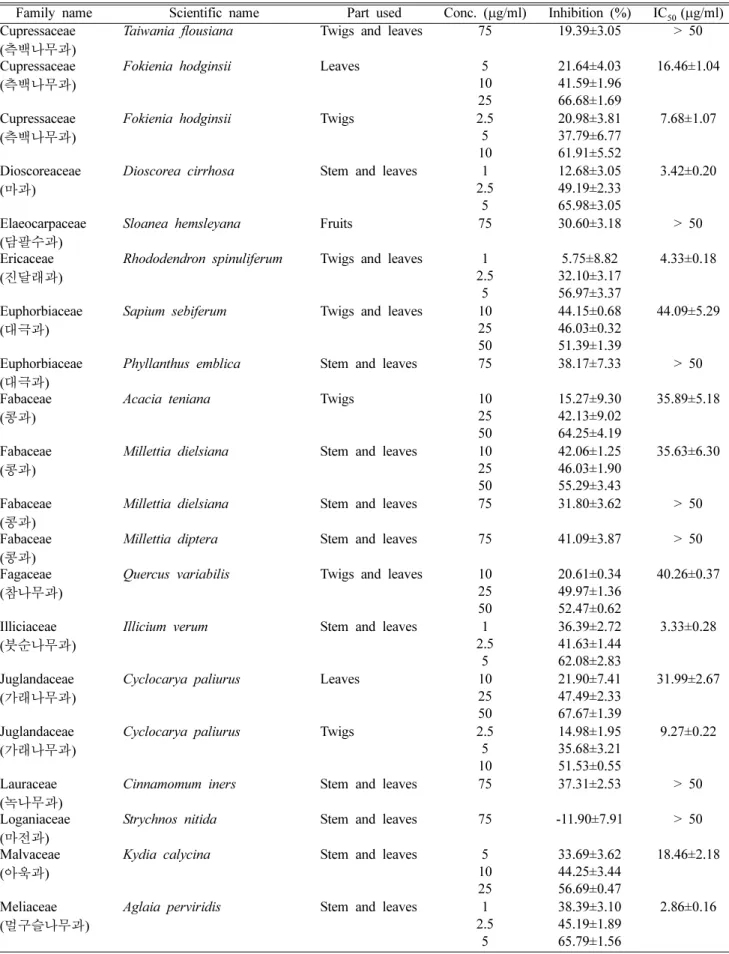
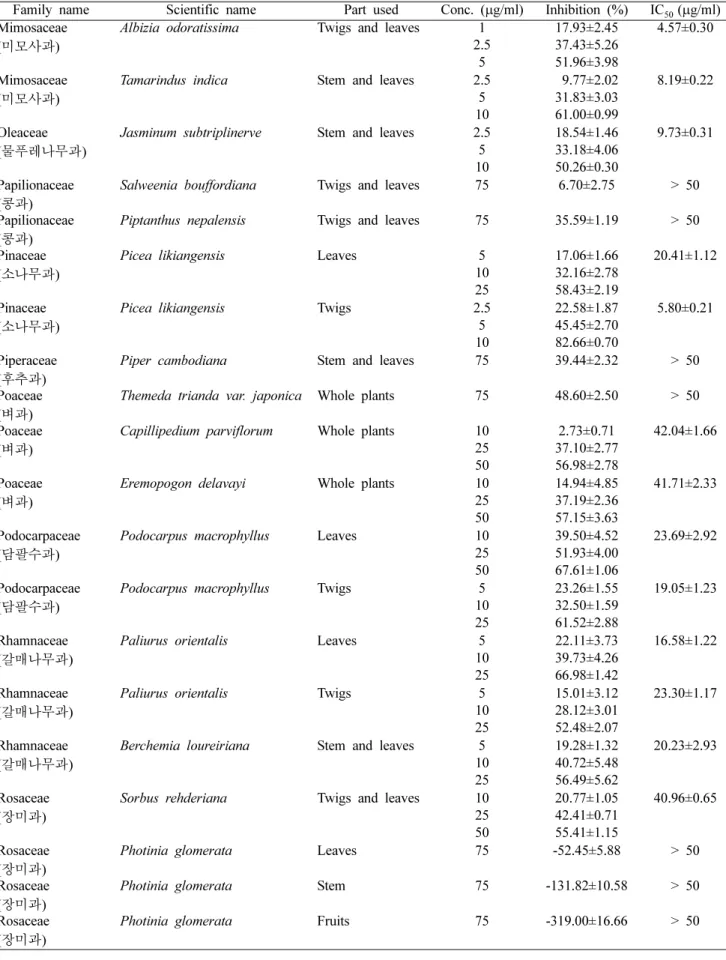
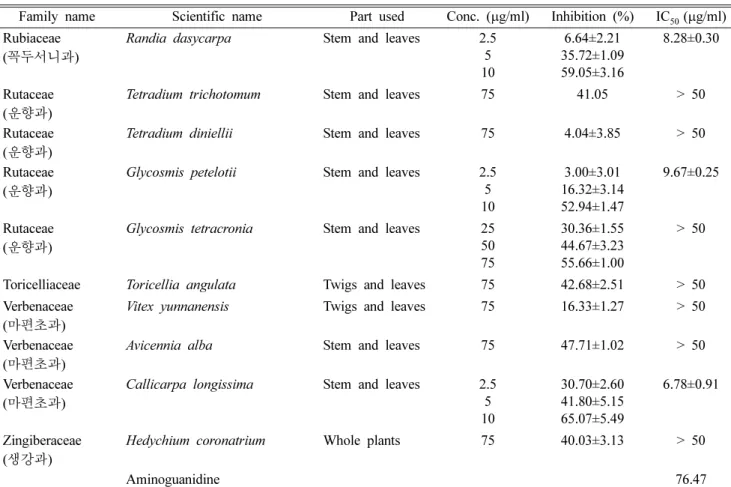
Table I에서 보여 주는 것과 같이 37종의 식물 추출물에서 IC50<50µg/ml로 최종당화산물 생성 저해 효능을 보였고 그 중 5종의 식물 추출물에서 IC50<5µg/ml로 탁월한 최종당화 산물 생성 저해 효능을 보였다. Albizia odoratissima의 가지, 잎(4.57 µg/ml), Rhododendron spinuliferum의 가지, 잎 (4.33µg/ml), Dioscorea cirrhosa의 줄기, 잎(3.42 µg/ml), Illicium verum의 줄기, 잎(3.33 µg/ml), Aglaia perviridis의 줄기, 잎(2.86 µg/ml)의5종 추출물은 IC50가 5 µg/ml이하로 aminoguanidine보다 약 16-26배 이상의 우수한 효능이 있음 을 알 수 있었다.
미모사과의 A. odoratissima cortex의 methanol 추출물에 flavonoids, saponin, triterpenoids 및 phenolics가 함유되어 있으며, 이 물질들은 그람 양성 세균과 효모에 대해 항균 활 성을 가지고 있다고 보고되었다.14) 또한 alloxan으로 유도된 당뇨쥐에서 serum cholesterol, triglyceride, serum glutamic oxaloacetic transaminase, serum glutamic transaminase, glutamic-pyruvic transaminase, alkaline phosphatase의 수준 을 줄이고 혈당과 총 단백질의 수준을 낮추어 당뇨병과 당
뇨합병증에 효과가 있다고 보고되었으며,15)본 연구결과에
서도 최종당화산물 생성 억제 효능이 우수하여 당뇨합병증
지연효과가 있을 것으로 사료된다. 진달래과의 R. spinu- liferum는 항암, 항균, 항비만 등에 효과가 있다고 보고된 ursolic acid,16-18) 항균에 효과가 있다고 알려진 oleanolic acid,19) 항산화, 항염 등에 효과가 있다고 알려진 quercetin,20) 항산화, 항암에 효과가 있다고 알려진 catechin,21,22)항산화, 항균에 효과가 있다고 알려진 epicatechin23)을 함유되어 있 다고 보고되었다.24) 그 중 ursolic acid, quercetin, catechin, epicatechin은 최종당화산물 생성 저해 효능이 보고되었다.25,26) 마과의 D. cirrhosa는 tannin이 주요활성 성분으로 혈액순환 촉진, 통증완화, 지혈의 효능이 있다고 보고되었고,27) tannin 은 최종당화산물 생성 억제 효능이 있음이 알려져 있다.28) 붓순나무과의 I. verum는 total polyphenol과 flavonoids를 함 유하여 DPPH, hydroxyl radical, nitrite(NO)를 소거하여 항 산화, 항염 활성 있다고 보고되었다.29) 또한 I. verum는 항 균효과가 뛰어난 것으로 알려진 anethole 성분을 함유하고 있어 박테리아, 곰팡이, 효모를 억제한다고 보고되었다.30) 멀구슬나무과의 A. perviridis는 항염, 항암 효과가 있다고 알려진 triterpenoids31)와 항산화 효과가 있다고 알려진 pregnane32)이 함유되어 있으며, 이 물질들이 LPS 유도된 Raw 264.7 cell에서 염증발생의 원인이 되는 NO의 생성을 Table I. Inhibitory activity of ethanol extracts of the herbal medicines and aminoguanidine on AGEs formation in vitro
Family name Scientific name Part used Conc. (µg/ml) Inhibition (%) IC50 (µg/ml) Rubiaceae
(꼭두서니과)
Randia dasycarpa Stem and leaves 2.5 5 10
6.64±2.21 35.72±1.09 59.05±3.16
8.28±0.30
Rutaceae (운향과)
Tetradium trichotomum Stem and leaves 75 41.05 > 50
Rutaceae (운향과)
Tetradium diniellii Stem and leaves 75 4.04±3.85 > 50 Rutaceae
(운향과)
Glycosmis petelotii Stem and leaves 2.5 5 10
3.00±3.01 16.32±3.14 52.94±1.47
9.67±0.25
Rutaceae (운향과)
Glycosmis tetracronia Stem and leaves 25 50 75
30.36±1.55 44.67±3.23 55.66±1.00
> 50
Toricelliaceae Toricellia angulata Twigs and leaves 75 42.68±2.51 > 50 Verbenaceae
(마편초과)
Vitex yunnanensis Twigs and leaves 75 16.33±1.27 > 50 Verbenaceae
(마편초과)
Avicennia alba Stem and leaves 75 47.71±1.02 > 50
Verbenaceae (마편초과)
Callicarpa longissima Stem and leaves 2.5 5 10
30.70±2.60 41.80±5.15 65.07±5.49
6.78±0.91
Zingiberaceae (생강과)
Hedychium coronatrium Whole plants 75 40.03±3.13 > 50
Aminoguanidine 76.47
IC
50values were calculated from the dose inhibition curve.
억제한다고 보고되었다.33)
위 언급된 5종의 약용식물은 양성 대조 약물 보다 16-26 배 이상 최종당화산물 생성 억제 효능이 우수한 것으로 확 인되었으므로, in vivo효능 확인이 필요하다 사료된다. 본 연 구 결과는 중국, 베트남산 약용식물로부터 안전하고 효능이 좋은 최종당화산물 생성 저해제 후보를 발굴하기 위한 기 초 자료로 활용될 수 있으며, 만성 당뇨에 의한 합병증 치 료제 개발의 기반을 구축하는데 기여할 수 있을 것이다.
결 론
기원이 확인된 중국, 베트남산 약용식물 62종의 에탄올 추출물이 in vitro에서 최종당화산물 생성저해 효능이 검색 되었다. 그 결과 A. odoratissima (가지, 잎), R. spinuliferum (가지, 잎), D. cirrhosa (줄기, 잎), I. verum (줄기, 잎), A.
perviridis (줄기, 잎)의 5종의 추출물은 양성대조군 보다 16- 26배 억제 효능이 우수한 것으로 나타냈다.
사 사
본 연구는 한국한의학연구원 기관고유사업(K11040, K12040)의 지원으로 수행되었으며 이에 감사드립니다.
인용문헌
1. Sakurai, T. and Tsuchiya, S. (1988) Superoxide production from nonenzymatically glycated protein. FEBS Lett. 236:
406-410.
2. Huebschmann, A. G., Vlassara, H., Regensteiner, J. G. and Reusch J. (2006) Diabetes and advanced glycoxidation end products. Diabetes care 29: 1420-1432.
3. Rahbar, S. and Figarola, J. L. (2003) Novel inhibitors of advenced glycation endproducts. Arch. Biochem. Biophys.
419: 63-79.
4. Wilkinson-Berka, J. L., Kelly, D. J., Koerner, S. M., Jaworski, K., Davis, B., Thallas, V. and Cooper, M. E. (2002) ALT-946 and aminoguanidine, inhibitors of advanced glycation, improve severe nephropathy in the diabetic transgenic (mREN-2) 27 rat. Diabetes 51: 3283-3289.
5. Peppa, M., Brem, H., Cai, W., Zhang, J. G., Basgen, J., Li, Z., Vlassara, H. and Uribarri, J. (2006) Prevention and reversal of diabetic nephropathy in db/db mice treated with alage- brium (ALT-711). Am. J. Nephrol. 26: 430-436.
6. Yang, S., Litchfield, J. E. and Baynes, J. W. (2003) AGE breakers cleave model compounds, but do not break maillard crosslinks in skin and tail collagen from diabetic rats. Arch.
Biochem. Biophys. 412: 42-46.
7. Jang, D. S., Lee, Y. M., Kim, Y. S. and Kim, J. S. (2006) Screening of Korean traditional herbal medicines with inhib-
itory activity on advanced glycation end products (AGEs) formation. Kor. J. Pharmacogn. 37: 48-52.
8. Lee, Y. M., Kim, Y. S., Kim, J. M., Jang, D. S., Kim, J. W., Yoo, J. L. and Kim, J. S. (2008) Screening of Korean herbal medicines with inhibitory activity on advanced glycation end products (AGEs) formation (II). Kor. J. Pharmacogn. 39:
223-227.
9. Jeong, I. H., Kim, J. M., Jang, D. S., Kim, J. H., Cho, J. H.
and Kim, J. S. (2009) Screening of Korean herbal medicines with inhibitory activity on advanced glycation end products (AGEs) formation (III) Kor. J. Pharmacogn. 40: 382-387.
10. Kim, J. M., Kim, Y. S., Kim, J. H., Yoo, J. M. and Kim, J. S.
(2009) Screening of herbal medicines from China and Viet- nam with inhibitory activity on advanced glycation end prod- ucts (AGEs) formation (IV) Kor. J. Pharmacogn. 40: 388- 393.
11. Kim, Y. S., Choi, S. H., Kim, J. H. and Kim, J. S. (2011) Screening of herbal medicines from China with inhibitory activity on advanced glycation end products (AGEs) for- mation (V) Kor. J. Pharmacogn. 42: 46-53.
12. Lee, Y. M., Kim, Y. S., Kim, J. H. and Kim, J. S. (2011) Screening of herbal medicines from China with inhibitory activity on advanced glycation end products (AGEs) for- mation (VI) Kor. J. Pharmacogn. 42: 161-168.
13. Vinson, J. A. and Howard, III T. B. (1996) Inhibition of pro- tein glycation and advanced glycation endproducts by ascor- bic acid and other vitamins and nutrients. J. Nutr. Biochem. 7:
659-663.
14. Kumar, D., Kohli, S., Kumar, S., Gupta, J., Jein, P. and Kumar, P. R. (2011) Screening of methanolic bark extract of Albizia odoratissima for antimicrobial activity. Phcog Commn. 1: 47-49.
15. Kumar, D., Kumar, S., Kohli, S., Arya, R. and Gupta, J.
(2011) Antidiabetic activity of methanolic bark extract of Albizia odoratissima Benth. in alloxan induced diabetic albino mice. APJTM. 12: 900-903.
16. Novotny, L., Vachalkova, A. and Biggs, D. (2001) Ursolic: an anti-tumorigenic and chemopreventive activity. Neoplasma 48: 241-246.
17. Collins, M. A. and Charles, H. P. (1987) Antimicrobial activ- ity of Carnosol and Ursolicacid: two anti-oxidant constituents of Rosmarinus officinalis L. Food Microbiol. 4: 311-315.
18. Kim, J. H., Jang, D. S., Kim, H. J. and Kim, J. S. (2009) Anti- lipase and lipolytic activities of ursolic acid isolated from the roots of Actinidia arguta. Arch. Pharmacol. Res. 32: 983-987.
19. Yoon, Y. H. and Choi, K. H. (2010) Antimicrobial Activity of oleanolic Acid on Listeria monocytogenes under sublethal stresses of NaCl and pH. Korean J. Food Sci. 30: 717-721.
20. Choi, S. J., Tai, B. H., Cuong, N. M., Kim, Y. H. and Jang, H. D. (2012) Antioxidative and anti-inflammatory effect of quercetin and its glycosides isolated from mampat (Cra- toxylum formosum). Food Sci. Biotechnol. 21: 587-595.
21. Chen, Z. Y., Wang, L. Y., Chan, P. T. Zhang, Z., Chung, H. Y.
and Liang, C. (1998) Antioxidative activity of green tea cat- echin extract compared with that of rosemary extract. J. Am.
Oil Chem. Soc. 75: 1141-1145.
22. Park, J. H., Shon, H. S., Sung, H. K., Liu, Y, Kim, J.Y., Sung, E. K. and Lee, Y. C. (2000) Anti-tumor effect of green tea catechin on cancer cell lines. Korean J. Anat. 33: 447-458.
23. Bae, Y. I., Jeong, C. H. and Shim, K. W. (2005) Antioxidative and antimicrobial activity of epicatechin isolated from leaves of loquat (Eriobotrya japonica). J. Food Sci. Nutr. 10: 118- 121.
24. Chen, G., Jin, H., Li, X., Zhang, Q., Shen, Y. Yan, S. and Zhang, W. (2009) Chemical constituents from Rhododendron spinuliferum. Chem. Nat. Comp. 45: 5.
25. Jang, D. S., Lee, G. Y., Kim, Y. S., Sun, H., Kim, D. H. and Kim, J. S. (2009) Flavan-3-ols having a g-lactam from the roots of Actinidia arguta inhibit the formation of advanced glycation end products In Vitro. Chem. Pharm. Bull. 57: 397- 400.
26. Kim, J. M., Jang, D. S., Lee, Y. M., Yoo, J. L., Kim, Y. S., Kim, J. H. and Kim, J. S. (2008) Aldose-reductase- and Pro- tein-glycation-inhibitory principles from the whole Plant of Duchesnea chrysantha. Chem. Biodivers. 5: 352-356.
27. Wang, Q. R., Ma, L. L. and Cheng, X. (2009) Medicinal
value of Dioscorea Cirrhosa Lour. Occup. Health 6: 52.
28. Nakagawa, T., Yokozawa, T., Kim, Y. M., Kang, K. S. and Tanaka, T. (2005) Activity of Wen-Pi-Tang, and purified con- stituents of Rhei Rhizoma and Glycyrrhizae Radix against glucose-mediated protein damage. Am. J. Chin. Med. 33:
817-829.
29. Chung, H. J. (2009) Evaluation of the biological activity of extracts from Star-Anise (Illicium verum). J. Food Sci. Nutr.
14: 195-200.
30. De, M. De, A. K., Sen, P. and Banerjee, A. B. (2002) Anti- microbial properties of star anise (Illicium verum). Phytother.
Res. 16: 94-95.
31. Saleem, M. (2009) Lupeol, a novel anti-inflammatory and anti-cancer dietary triterpene. Cancer Lett. 285: 109-115.
32. Sethi, A., Bhatia, A., Srivastava, S., Bhatia, G., Khan, M. M., Khanna, A. K. and Saxena, J. K. (2010) Pregnane glycoside from Hemidesmus indicus as a potential anti-oxidant and anti-dyslipidemic agent. Nat. Prod. Res. 24: 1371-1378.
33. Chin, Y. W., Chae, H. S., Lee, J. K., Bach, T. T., Ahn, K. S.
and Lee, H. K. (2010) Bisamides from the twigs of Aglaia perviridis collected in Vietnam. Bull. Korean Chem. Soc. 31:
2665-2667.
(2012. 10. 20 접수; 2012. 11. 4 심사; 2012. 11. 6 게재확정)