Kor. J. Pharmacogn.
42(2) : 161∼ 168 (2011)
161
중국약용식물의 최종당화산물 생성저해활성 검색 (VI)
이윤미·김영숙·김주환1*·김진숙*
한국한의학연구원 한의융합연구본부 당뇨합병증연구센터, 1경원대학교 생명과학과
Screening of Herbal Medicines from China with Inhibitory Activity on Advanced Glycation End Products (AGEs) Formation (VI)
Yun Mi Lee, Young Sook Kim, Joo Hwan Kim 1* and Jin Sook Kim*
Diabetic Complications Research Center, Division of Traditional Korean Medicine (TKM) Integrated Research, Korea Institute of Oriental Medicine, Daejeon 305-811, Korea,
1Department of Life Science, Kyungwon University, Seongnam, Kyonggi-do 461-701, Korea
Abstracts − Advanced glycation end products (AGEs) has been shown to play an important role in the development of the dia- betic complications. The AGEs inhibitors or cross-link breakers attenuate various functional and structural manifestations of diabetic complications. In this study, 69 China herbal medicines have been investigated with an in vitro evaluation system using AGEs inhibitory activity. Of these, 28 herbal medicines (IC50=<50µg/ml) were found to have stronger AGEs inhibitory activity compared with aminoguanidine (IC50=59.77µg/ml). Particularly, 5 herbal medicines, Camptotheca acuminata (stem, leaf), Eurya groffii (stem, leaf), Cornus Capitata (leaf), Mucuna birdwoodiana (root), Nelumbo nucifera (fruit, seed) showed more potent inhibitory activity (approximately 6-27 fold) than the positive control aminoguanidine.
Key words − Advanced glycation endproducts (AGEs), Diabetic complications, Herbal medicines
당뇨 합병증의 원인 중 하나인 최종당화산물 (Advenced glycation end products, AGEs)은 정상적인 상태에서는 단백 질과 당이 서로 결합하여 Schiff base가 생성이 되는데 이는 가역반응으로 항상성을 유지한다. 그러나 만성 고혈당 상태 에서 당은 비효소적 반응으로 단백질과 결합하여 amadori adducts를 형성하고, 이 반응이 지속적으로 진행되어 비가역 적인 최종당화산물을 생성한다. 이것은 혈당이 정상으로 회 복이 되더라도, 일단 생성된 최종당화산물은 분해가 되지 않고 단백질과 cross-link하여 혈액 단백질이나 여러 조직에 축적되어 당뇨성 망막증 (Diabetic retinopathy), 신경증 (D.
neuropathy), 신증 (D. nephropathy) 백내장 (D. cataract), 동맥 경화 (Atherosclerosis) 등과 같은 당뇨 합병증이 나타난다.1-4) 따라서 생체 내에서 최종당화산물의 생성을 저해하거나, 이 미 생성된 최종당화산물의 조직 내 교차결합 (AGEs-protein cross-link)을 억제하여 당뇨합병증의 치료나 예방 하고자 많 은 연구들이 진행되고 있다.5-8) 본 연구팀에서도 갈근 (Pueraria lobata),9)도라지 (Platycodon grandiflorum),10)다래 (Actinidia
arguta),11) 개망초 (Actinidia arguta),12) 뱀딸기 (Duchesnea chrysantha),13) 대극 (Knoxia valerianoides),14) 결명자 (Cassia tora),15)산수유 (Cornus officinalis)16)의 추출물 및 화합물 들이 최종당화산물 생성 저해와 교차결합 억제하는 효능을 나타냈다. 또한 KIOM-79는 당뇨병성 망막증17)과 당뇨병성
신증18,19)의 진행을 지연시키는 효능 이외에 제 2형 당뇨 동
물 모델의 대동맥에서 최종당화산물 축적 억제와 염증 관 련 인자들을 감소시켰다.20) 본 연구에서는 지난 보고에 이
어,21-24) 중국에서 사용되는 약용 식물 69종의 에탄올 추출
물을 대상으로 최종당화산물 생성 저해 활성을 in vitro에서 검색하였다.
재료 및 방법
실험재료 − 본 실험에 사용된 약용 식물 (Table I)들은 2006년부터 2008년까지 채집되어, 경원대학교 생명과학과 김주환 교수의 감정을 거친 후 실험 재료로 사용되었다. 사 용한 실험 재료의 증거표본은 한국한의학연구원 한의융합 연구본부 당뇨합병증연구센터 표본실에 보관 중이다.
*교신저자(E-mail):[email protected], [email protected] (Tel): +82-42-868-9465, +82-31-750-8827
Family name Scientific name Part used Conc. (µg/ml) Inhibition (%) IC50 (µg/ml) Amarantaceae
(비름과)
Achyranthes Asper (우슬)
leaf 10
25 50
-16.91±0.60 -15.53±0.55 -12.01±0.83
>50
Adiantaceae (공작고사리과)
Adiantum davidii (백배철선궐)
whole plant 10
25 50
4.13±1.21 14.28±0.36 46.11±0.81
>50
Compositae (국화과)
Artemisia anomala (기호)
aerial part 10
25 50
12.87±1.98 32.21±1.96 76.28±0.75
34.28
Loganiaceae (마전과)
Bauhinia brachycarpa (안협양제갑)
leaf, stem 5
10 25
-14.96±0.21 2.47±0.32 66.13±0.42
21.17
Scrophulariaceae (현삼과)
Brandisia hancei (래강등)
branch, fruit 5 10 25
9.90±0.30 38.58±1.96 81.93±0.54
15.23
Nyssaceae (니사과)
Camptotheca acuminata (희수나무)
stem, leaf 1.25 2.5
10
25.66±1,06 54.01±0.19 83.00±0.48
2.05
Leguminosae (콩과)
Campylotropis polyantha (소작화)
leaf, stem 10
25 50
6.01±0.81 17.61±0.77 54.61±1.46
47.61
Compositae (국화과)
Carpesium nepalense (니박이천명정)
whole plant 10
25 50
-7.64±2.37 -1.57±2.70 4.39±3.17
>50
Celastraceae (노박넝굴과)
Celastrus gemmatus (대아남사등)
stem, leaf 10
25 50
-7.79±3.69 12.90±5.55 59.84±1.78
44.89
Ulmaceae (느릅나무과)
Celtis tetrandra (박수)
twig, leaf 10
25 50
-1.14±6.83 20.06±1.22 34.26±3.43
>50
Plumbaginaceae (갯질경이과)
Ceratostigma minus (소람설화)
whole plant 5
10 25
16.01±1.85 27.24±0.98 71.55±2.09
17.50
Chenopodiaceae (명아주과)
Chenopodium foetidum (덕어)
whole plant 10
25 50
5.46±1.92 10.38±2.82 19.34±1.79
>50
Ranunculaceae (미나리아재비과)
Cimicifuga mairei (황새승마)
root 10
25 50
-2.54±1.02 2.79±1.83 9.21±3.79
>50
Thymeleaceae (팥꽃나무과)
Edgeworthia gardneri (전결향)
seed 10
25 50
-29.00±4.12 -18.02±1.98 -7.70±0.22
>50
Cornaceae (층층나무과)
Cornus Capitata (두상사조화)
leaf 2.5
5 10
13.22±1.0 49.71±0.87 77.53±0.45
6.22
Rosaceae (장미과)
Cotoneaster dammeri (백자단)
leaf, stem 5
10 25
17.40±0.67 39.90±3.45 93.66±0.81
13.25
Rosaceae (장미과)
Cotoneaster glaucophylus leaf, stem 5 10 25
7.91±2.89 21.80±1.58 88.20±0.57
15.93
Table I. Continued
Family name Scientific name Part used Conc. (µg/ml) Inhibition (%) IC50 (µg/ml) Ericaceae
(진달래과)
Craibiodendron yunnanense (운남가목하)
leaf, stem 5
10 25
11.12±2.27 17.36±4.42 82.08±1.36
16.86
Rosaceae (장미과)
Crataegus scabrifolia (운남산사)
fruit 10
25 50
-7.93±7.90 0.57±9.12 22.42±5.65
>50
Asclepiadaceae (박주가리과)
Cynanchum paniculatum (산해박)
aerial part 10
25 50
0.72±2.45 7.61±1.12 12.42±0.54
>50
Boraginaceae (지치과)
Cynoglossum amabile (중국물망초)
leaf 10
25 50
-1.46±1.14 1.28±0.42 20.04±0.16
>50
Fabaceae (콩과)
Dumasia villosa (유모산흑두)
whole plant 10
25 50
7.97±1.34 12.31±1.04 26.46±1.96
>50
Compositae (국화과)
Eclipta prostrate (한련초)
aerial part 10
25 50
19,95±1.71 37.49±2.90 65.84±1.27
36.1
Labiatae (꿀풀과)
Elsholtzia fruticosa (계골시)
whole plant 10
25 50
12.18±3.30 28.78±1.80 81.29±2.72
33.59
Labiatae (꿀풀과)
Elsholtzia rugulosa (야발자)
whole plant 10
25 50
14.10±2.14 28.77±1.10 56.03±3.10
44.57
Theaceae (차나무과)
Eurya groffii (강령)
stem, leaf 0.5
1.25 2.5
0.97±3.31 8.89±5.65 64.87±1.82
2.17
Rutaceae (운향과)
Evodia officinalis (오수유)
fruit 10
25 50
-1.47±11.86 29.42±3.30 67.65±0.23
38.83
Moraceae (뽕나무과)
Ficus tikoua (지과)
whole plant 10
25 50
0.11±1.74 -0.72±1.71 -1.10±1.68
>50
Gentianaceae (용담과)
Gentiana veitchiorum (람옥잠룡단)
flower 10
25 50
11.81±1.11 24.06±2.71 37.53±0.58
>50
Leguminosae (콩과)
Gleditsia japonica (주엽나무)
twig 10
25 50
10.30±3.03 41.59±3.13 61.66±1.11
38.13
Composita (국화과)
Gynura Segetum (삼칠초)
whole plant 10
25 50
-13.69±0.72 -15.78±0.57 -14.87±0.96
>50
Caryophyllaceae (석죽과)
Gypsophila oldhamiana (대나물)
root 10
25 50
-4.90±2.74 -3.29±4.05 -0.70±2.24
>50
Rubiaceae (꼭두서니과)
Hedyotis diffusa (백운풀)
aerial part 10
25 50
7.35±1.79 15.76±0.82 26.92±0.90
>50
Flacourtiaceae (산유자나무과)
Hydnocarpus anthelmintica (대풍자)
fruit 10
25 50
6.13±1.20 10.54±0.41 12.78±0.80
>50
50
Leguminosae (콩과)
Indigofera hancockii (창산목람)
leaf, stem 10
25 50
2.75±1.28 14.18±0.64 43.43±0.59
>50
Fabaceae (콩과)
Indigofera pseudotinctoria (낭아초)
stem, leaf 10
25 50
-11.17±5.07 1.54±2.20 20.56±2.95
>50
Labiatae (꿀풀과)
Isodon polystachys whole plant 10 25 50
3.85±1.93 10.05±2.64 33.09±0.23
>50
Solanaceae (가지과)
Leptodermis pilosa (천전야정향)
whole plant 10 25 50
1.09±1.51 3.09±1.69 5.64±1.07
>50
Caprifoliaceae (인동과)
Leycesteria formosa (귀취소)
whole plant 10 25 50
11.79±0.61 17.18±2.03 47.30±16.19
>50
Oleaceae (물푸레나무과)
Ligustrum compactum (장협녀정)
branch, fruit 10 25 50
7.83±2.57 18.45±1.15 43.18±3.21
>50
Oleaceae (물푸레나무과)
Ligustrum lucidum (제주광나무)
leaf 10
25 50
-10.16±0.36 0.31±0.75 35.69±0.75
>50
Borraginaceae (지치과)
Lithospermum erythrorhizon (지치)
root 10
25 50
16.61±1.04 25.36±3.09 43.41±1.76
>50
Lauraceae (녹나무과)
Litsea pungens (목강자)
branch 5
10 25
15.67±1.63 25.34±0.90 75.86±1.43
16.91
Caprifoliaceae (인동과)
Lonicera Japonica (붉은인동)
leaf, flower 10 25 50
-6.47±0.45 28.71±0.33 77.27±0.33
36.43
Labiatae (꿀풀과)
Lycopus lucidus (쉽싸리)
aerial part 10 25 50
-20.13±0.36 -19.81±0.72 -10.18±0.77
>50
Ericaceae (진달래과)
Lyonia ovalifolia (남촉)
leaf, stem, fruit
5 10 25
7.84±2.55 16.01±0.11 67.32±0.30
19.40
Fabaceae (콩과)
Millettia velutina (융모애두)
stem, leaf 5
10 25
-1.94±3.67 80.08±6.46 61.88±4.43
21.66
Leguminosae (콩과)
Mucuna birdwoodiana (백화유마등)
root 2.5
5 10
1.79±3.28 27.89±1.71 71.54±1.49
7.59
Nymphaceae (수련과)
Nelumbo nucifera (연꽃)
fruit, seed 2.5 5 10
-4.55±2.16 11.72±2.80 62.99±1.71
8.73
Crassulaceae (돌나물과)
Orostachys japonica (바위솔)
whole plant 10 25 50
-22.24±3.31 -13.33±0.96 17.56±2.63
>50
Bignoniaceae (능소화과)
Oroxylum indicum (목호접)
seed 5
10 25
8.85±1.73 18.06±3.20 58.05±2.23
21.99
Table I. Continued
Family name Scientific name Part used Conc. (µg/ml) Inhibition (%) IC50 (µg/ml) Ericaceae
(진달래과)
Pieris formosa (마취목)
twig, leaf 5
10 25
6.98±13.82 35.71±5.90 92.94±3.92
14.45
Cupressaceae (측백나무과)
Platycladus orientalis (측백)
seed 10
25 50
-11.42±0.62 -14.23±0.12 -13.75±0.59
>50
Pteridaceae (고사리과)
Pteridium excelsum (궐채)
whole plant 10
25 50
2.45±1.94 11.10±0.66 41.78±0.77
>50
Rosaceae (장미과)
Pyrus pyrifolia (돌배나무)
fruits 10
25 50
20.76±1.14 16.78±4.26 25.91±0.70
>50
Rubiaceae (운향과)
Rubia cordifolia (갈퀴꼭두서니)
whole plant 10
25 50
4.40±2.65 11.47±5.68 20.34±2.07
>50
Caprifoliaceae (인동과)
Sambucus chinensis (륙영)
leaf, stem 10
25 50
-13.56±4.35 -12.11±4.53 -5.16±6.44
>50
Compositae (국화과)
Saussurea deltoides (대만청목향)
whole plant 10
25 50
-7.50±2.99 -2.82±3.01 13.78±4.12
>50
Compositae (국화과)
Saussurea Laniceps (면두설련화)
whole plant 10
25 50
-3.63±1.32 6.33±2.61 24.12±0.76
>50
Labiatae (꿀풀과)
Scutellaria orthocalyx (소황금)
whole plant 10
25 50
-2.10±1.14 33.62±3.24 73.92±1.89
36.28
Selaginellaceae (부처손과)
Selaginella pulvinata (점상권백)
whole plant 10
25 50
12.99±2.87 18.22±0.68 25.25±2.11
>50
Pedaliaceae (참깨과)
Sesamum indicum (참깨)
fruit 10
25 50
-6.39±2.20 8.37±2.28 27.70±0.60
>50
Liliaceae (백합과)
Smilax menispermoidea (방기협발계)
leaf, stem 10
25 50
12.22±1.19 16.20±0.58 18.37±0.25
>50
Menispermaceae (방기과)
Stephania Delavayi (일문전)
aerial part 10
25 50
-6.45±0.65 1.91±0.41 20.43±0.65
>50
Rosaceae (장미과)
Stranvaesia davidiana (홍과수)
stem, leaf 10
25 50
40.02±2.69 40.89±30.7 45.50±2.61
>50
Gentianaceae (용담과)
Swertia macrosperma (만대당약)
whole plant 10
25 50
-8.55±3.46 2.10±3.70 19.36±1.39
>50
Zygophyllaceae (남가새과)
Tribulus terrestris
(남가새) fruit 10
25 50
-8.74±3.56 -5.96±4.19 -2.46±0.77
>50
추출 및 시료조제 − 분쇄한 시료 200 g에 1 L의 에탄올 을 넣고 실온상태에서 3일간 3회 추출하였다. 이를 여과하 여 40oC이하의 수욕 상에서 감압농축을 실시한 후, 동결 건 조기에서 건조하였다. 추출물은 실험 수행 전에 감압 하에 서 이산화인(P2O2)를 이용하여 12시간 이상 재 건조한 후 DMSO (Sigma, St. Louis, MO, USA)에 용해시켜 stock solution을 조제하였으며 최종 DMSO의 농도가 0.2%가 되 도록 15% TWEEN 80 (Sigma, St. Louis, MO, USA)용액 으로 희석하여 사용하였다. 추출에 이용한 에탄올 및 그 외 시약은 1급 및 특급시약을 사용하였다.
In vitro에서 최종당화산물 생성저해 실험 − Vinson과 Howard25)의 방법을 변형하여 실험을 실시하였다. 본 실험 에서는 50 mM phosphate buffer (pH 7.4)에 용해시킨10 mg/ml의 우혈청 알부민 (bovine serum albumin, Sigma) 0.7 ml과 0.2 M의 fructose와 glucose 0.1 ml을 여러 농도의 추 출물0.2 ml과 함께 혼합하여 1 ml이 되도록 처리하였다. 이 를 37oC에서 14일 동안 당화 반응시켰다. 이 때 50 mM phosphate buffer에 0.02% sodium azide를 넣어 반응기간 동 안 박테리아의 생성을 방지하였다. 양성 대조군으로 추출물 대신 최종당화산물 생성저해제인 aminoguanidine을 사용하 였다. 배양 후에는 spectrofluorometric detector (Bio-TEK, Synergy HT, USA)를 이용하여 형광도를 측정하였다 (Ex : 350, Em : 450 nm). 모든 시료는 triplicate로 수행하여 IC50 값으로 계산되었다.
결과 및 고찰
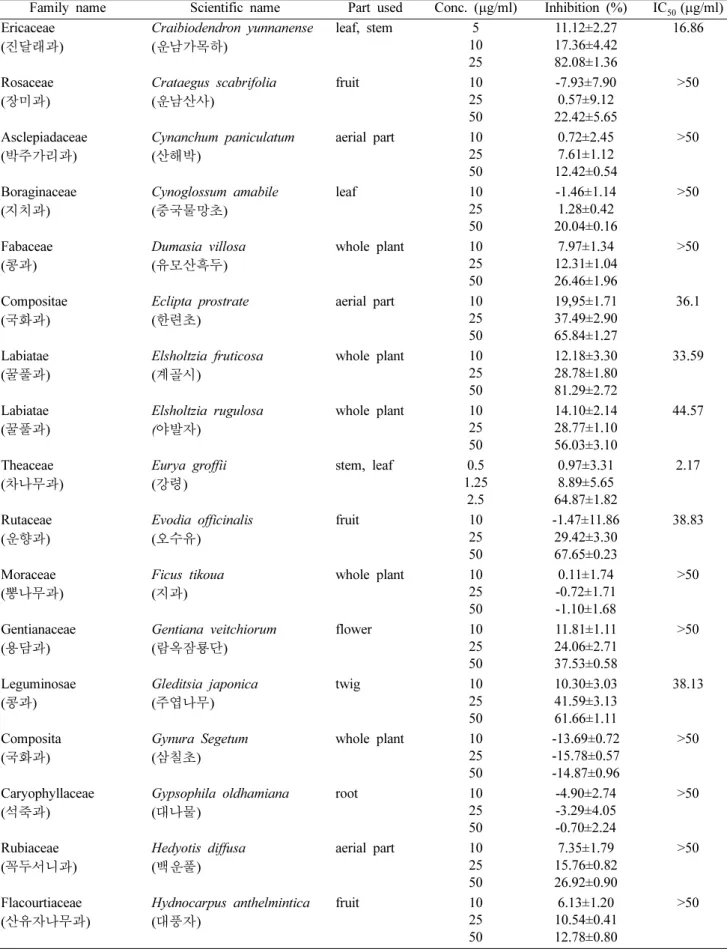
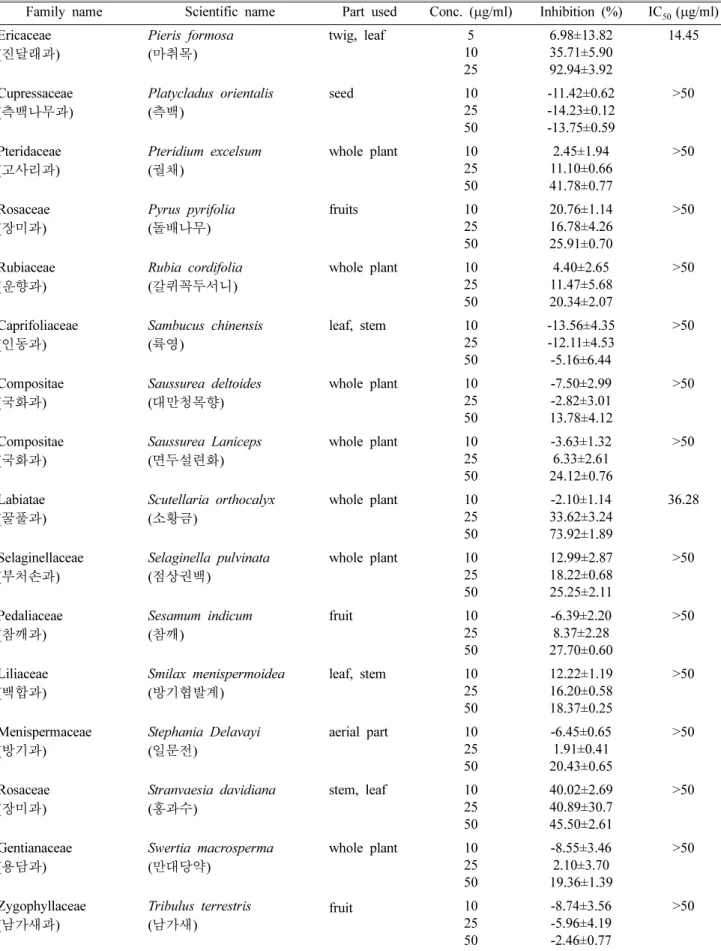
천연물로부터 최종당화산물 생성 억제 약물을 검색하기 위해 중국산 69종의 에탄올 추출물을 이용해 효능을 검색 하여 Table I과 같은 결과를 얻었다. 양성 대조 약물인 aminoguanidine의 IC50 값 (59.77 µg/ml)을 근거로 하여, 추 출물이 IC50 값이50 µg/ml이하 이면 효능이 있다고 판단하 였다. Table I에서 보여 주는 것과 같이 28종의 식물 추출 물에서 IC50 값이 50 µg/ml이하로 최종당화산물 생성 저해
효능을 보였고, 그 중에서 Camptotheca acuminata의 줄기, 잎 (2.05 µg/ml), Eurya groffii의 줄기, 잎 (2.17 µg/ml), Cornus Capitata의 잎 (6.22 µg/ml), Mucuna birdwoodiana의 뿌리 (7.59µg/ml), Nelumbo nucifera의 열매, 종자 (8.73 µg/ml) 5 종의 추출물 IC50 값이 10 µg/ml 이하로 aminoguanidine보 다 약 6-27배 이상의 우수한 효능이 있음을 알 수 있었다.
Camptotheca acuminate는 항균활성26)을 가지며, 추출물과 화합물들의 항암효능27,28)이 보고되었다. Cornus Capitata 뿌 리의 성분 연구29) 및 항균활성30), 잎의 항바이러스 활성31) 과 종자의 alkaloids 성분 연구32)가 보고되었다. Mucuna birdwoodiana의 덩굴줄기는 중국에서 전통적으로 손목 무 릎 등의 관절 통증, 생리불순에 사용된 식물로 isoflavone glycosides, Triterpenes 등의 성분 연구가 보고되었다.33-35) Nelumbo nucifera 중국에서 전통 의약품으로 신경질환, 불 면증, 고열, 고혈압과 부정맥과 같은 혈관질환에 쓰였으며, 최근에는 추출물과 화합물에서 항 HIV 효능과 in vitro와 in
vivo에서 인슐린 분비를 촉진시키고 혈당을 조절하는 효능
이 보고되었다.36-41) Eurya groffii 에 관한 연구는 아직까지 보고되지 않았으며, 위 언급된 5종의 최종당화산물 생성 억 제 효능 및 효능을 나타내는 유효 성분에 대한 보고가 이뤄 지지 않아 이에 대한 구체적인 연구가 필요하다고 사료된 다. 본 연구 결과는 약용 식물로부터 안전하고 효능이 우수 한 최종당화산물 생성 저해제 후보를 발굴하기 위한 기초 자료로 활용될 수 있으며, 당뇨합병증 예방 및 치료제 개발 에 이용될 수 있을 것이다.
결 론
기원이 확인된 중국 약용 식물 69종의 에탄올 추출물이 in vitro에서 최종당화산물 생성저해 효능이 검색되었다. 그 결과 28종이 양성대조군인 aminoguanidine보다 우수한 효능 이 있음을 확인하였고, 그 중 Camptotheca acuminata (줄기, 잎), Eurya groffii (줄기, 잎), Cornus Capitata (잎), Mucuna birdwoodiana (뿌리), Nelumbo nucifera (열매, 종자) 등 5종
µg/ml) 50 µg/ml)
Celastraceae (노박덩굴과)
Tripterygium hypoglaucum (곤명산해당)
leaf, stem, fruit 5 10 25
13.15±1.94 28.09±2.08 80.95±0.28
16.04
Rutaceae (운향과)
Zanthoxylum acanthopodium (모자화초)
stem, leaf 2.5
5 25
16.38±0.26 21.18±3.68 50.04±5.85
24.93
Aminoguanidine (Positive Control)
37 55.5
74
39.12±2.87 48.66±1.89 56.30±1.87
59.77
IC
50values were calculated from the dose inhibition curve.
의 추출물은 양성대조군 보다 6-27배 우수한 효능을 나타 냈다.
사 사
본 연구는 한국한의학연구원 기관고유사업비 (K10040)로 수행되었으며 이에 감사드립니다.
인용문헌
1. Ahmed, N. (2005) Advanced glycation endproducts-role in pathology of diabetic complications. Diabetes Res. Clin.
Pract. 67: 3-21.
2. Larkins, R. G. and Dunlop, M. E. (1992) The link between hyperglycaemia and diabetic nephropathy. Diabetologia 35:
499-504.
3. Yokozawa, T., Nakagawa, T. and Terasawa, K. (2001) Effects of oriental medicines on the production of advanced gly- cation endproducts. J. trad. Med. 18: 107-112.
4. Huebschmann, A. G., Vlassara, H., Regensteiner, J. G. and Reusch, J. (2006) Diabetes and advanced glycoxidation end products. Diabetes care. 29: 1420-1432.
5. Rahbar, S. and Figarola, J. L. (2003) Novel inhibitors of advenced glycation endproducts. Arch. Biochem. Biophys.
419: 63-79.
6. Wilkinson-Berka, J. L., Kelly, D. J., Koerner, S. M., Jaworski, K., Davis, B., Thallas, V. and Cooper, M. E. (2002) ALT-946 and aminoguanidine, inhibitors of advanced glycation, improve severe nephropathy in the diabetic transgenic (mREN-2) 27 rat. Diabetes 51: 3283-3289.
7. Peppa, M., Brem, H., Cai, W., Zhang, J. G., Basgen, J., Li, Z., Vlassara, H. and Uribarri, J. (2006) Prevention and reversal of diabetic nephropathy in db/db mice treated with alage- brium (ALT-711). Am. J. Nephrol. 26: 430-436.
8. Yang, S., Litchfield, J. E. and Baynes, J. W. (2003) AGE- breakers cleave model compounds, but do not break maillard crosslinks in skin and tail collagen from diabetic rats. Arch.
Biochem. Biophys. 412: 42-46.
9. Jang, D. S., Kim, J. M., Lee, Y. M., Kim, Y. S., Kim. J. H. and Kim, J. S. (2006) Puerariafuran, a new inhibitor of advanced glycation end products (AGEs) isolated from the roots of Pueraria lobata. Chem. Pharm. Bull. 54:1315-1317.
10. Jang, D. S., Lee, Y. M., Jeong, I. H. and Kim, J. S. (2010) Constituents of the flowers of Platycodon grandiflorum with inhibitory activity on advanced glycation end products and rat lens aldose reductase in vitro. Arch. Pharm. Res. 33: 875-880.
11. Jang, D. S., Lee, G. Y., Lee, Y. M., Kim, Y. S., Sun, H., Kim, D. H. and Kim, J. S. (2009) Flavan-3-ols having a gamma- lactam from the roots of Actinidia arguta inhibit the for- mation of advanced glycation end products in vitro. Chem.
Pharm. Bull. 57: 397-400.
12. Jang, D. S., Yoo, N. H., Kim, N. H., Lee, Y. M., Kim, C. S., Kim, J. Kim, J. H. and Kim, J. S. (2010) 3,5-Di-O-caffeoyl- epi-quinic acid from the leaves and stems of Erigeron annuus inhibits protein glycation, aldose reductase and cataracto- genesis. Biol. Pharm. Bull. 33: 329-333.
13. Kim, J. M., Jang, D. S., Lee, Y. M., Yoo, J. L., Kim. Y. S., Kim, J. H and Kim, J. S. (2008) Aldose reductase and protein glycation inhibitory principles from the whole plant of Duch- esnea chrysantha. Chem. Biodivers. 5: 352-356.
14. Yoo, N. H., Jang, D. S., Lee, Y. M., Jeong, I. H., Cho, J. H., Kim, J. H. and Kim, J. S. (2010) Anthraquinones from the roots of Knoxia valerianoides inhibit the formation of advanced glycation end products and rat lens aldose reduc- tase in vitro. Arch. Pharm. Res. 33: 209-214.
15. Lee, G. Y., Jang, D. S., Lee, Y. M., Kim, J. M. and Kim, J. S.
(2006) Naphthopyrone glucosides from the seeds of Cassia tora with inhibitory activity on advanced glycation end prod- ucts (AGEs) formation. Arch. Pharm. Res. 29: 587-590.
16. Lee, J., Jang, D. S., Kim, N. H., Lee, Y. M., Kim, J. and Kim, J. S. (2011) Galloyl glucoses from the seeds of Cornus offi- cinalis with inhibitory activity against protein glycation, aldose reductase, and cataractogenesis ex vivo. Biol. Pharm.
Bull. 34: 443-446.
17. Sohn, E. J., Kim, Y. S., Kim, C. S., Lee, Y. M. and Kim, J.
S. (2009) KIOM-79 prevents apoptotic cell death and AGEs accumulation in retinas of diabetic db/db mice. J. Ethnop- harmacol. 121: 171-174.
18. Kim, Y. S., Lee, Y. M., Kim, C. S., Sohn, E. J., Jang, D. S.
and Kim, J. S. (2006) Inhibitory effect of KIOM, a new herbal prescription, on AGEs formation and expression of type IV collagen and TGF-β1 in STZ-induced diabetic rats.
Kor. J. Pharmacogn. 37: 103-109.
19. Kim, Y. S., Kim, J., Kim, C. S., Sohn, E. J., Lee, Y.M., Jeong, I. H., Kim, H., Jang, D. S. and Kim, J. S. (2009) KIOM-79, an inhibitor of AGEs–protein cross-linking, prevents pro- gression of nephropathy in Zucker diabetic fatty rats. Evid.
Based Complement. Alternat. Med. 2009 Jul 15. [Epub ahead of print]
20. Sohn, E., Kim, J., Jeong, I. H., Kim, C. S., Kim, Y. S. and Kim, J. S. (2011) Combination of medicinal herbs KIOM-79 reduces advanced glycation end product accumulation and the expression of inflammatory factors in the aorta of Zucker diabetic fatty rats. Evid. Based Complement. Alternat. Med.
2011:784136. Epub 2011 Feb 15.
21. Jang, D. S., Lee, Y. M., Kim, Y. S. and Kim, J. S. (2006) Screening of Korean traditional herbal medicines with inhib- itory activity on advanced glycation end products (AGEs) formation. Kor. J. Pharmacogn. 37: 48-52.
22. Lee, Y. M., Kim, Y. S., Kim, J. M., Jang, D. S., Kim, J. H., Yoo, J. L. and Kim, J. S. (2008) Screening of Korean herbal medicines with inhibitory activity on advanced glycation end products (AGEs) formation (II). Kor. J. Pharmacogn. 39:
and Kim, J. S. (2009) Screening of Korean herbal medicines with iInhibitory activity on advanced glycation end products (AGEs) formation (III). Kor. J. Pharmacogn. 40: 382-387.
24. Kim, J. M., Kim, Y. S., Kim, J. H., Yoo, J. L. and Kim, J. S.
(2009) Screening of herbal medicines from China and Viet- nam with inhibitory activity on advanced glycation end prod- ucts (AGEs) formation (IV). Kor. J. Pharmacogn. 40: 388- 393.
25. Vinson, J. A. and Howard III, T. B. (1996) Inhibition of pro- tein glycation and advanced glycation endproducts by ascor- bic acid and other vitamins and nutrients. J. Nutr. Biochem. 7:
659-663.
26. Ding, T., Jiang, T., Zhou, J., Xu, L. and Gao, Z. M. (2010) Evaluation of antimicrobial activity of endophytic fungi from Camptotheca acuminata (Nyssaceae). Genet .Mol. Res. 9:
2104-2112.
27. Ping, Y. H., Lee, H. C., Lee, J. Y., Wu, P. H., Ho, L. K., Chi, C. W., Lu, M. F. and Wang, J. J. (2006) Anticancer effects of low-dose 10-hydroxycamptothecin in human colon cancer.
Oncol. Rep. 15: 1273-1279.
28. Zhanga, J., Yu, Y., Liua, D. and Liua, Z. (2007) Extraction and composition of three naturally occurring anti-cancer alka- loids in Camptotheca acuminata seed and leaf extracts. Phy- tomedicine 14: 50-56.
29. Tanaka, N., Tanaka, T., Fujioka, T., Fujii, H., Mihashi, K., Shimomura, K. and Ishimaru. K. (2001) An ellagic com- pound and iridoids from Cornus capitata root cultures. Phy- tochemistry 57: 1287-1291.
30. Tanaka, N., Nishikawa, K. and Ishimaru, K. (2003) Anti- oxidative capacity of extracts and constituents in Cornus cap- itata adventitious roots. J. Agric. Food Chem. 51: 5906-5910.
31. Bhakuni, D. S., Dhar, M., Ar, M. L., Dhawan, B. N. and Mehrotra, B. N. (1969) Screening of Indian plants for bio- logical activities. Part . Indian J. Exp. Biol. 7: 250-262.
32. Smolenski, S. J., Silinis, H. and Farnsworth, N. R. (1974) Alkaloid screening. J. Nat. Prod. 37: 506-536.
33. Chiang Su New Medical College, Dictionary of Chinese Medicine (Shanghai Science and Technology Press, Shang- hai, 1977, Vol. I, p. 2071.
birdwoodiana. J. Asian Nat. Prod. Res. 12: 199-203.
35. Ding, Y., Kinjo, J., Yang, C. R. and Nohara, T. (1991) Trit- erpenes from Mucuna birdwoodiana. Phytochemistry 30:
3703-3707.
36. Chen, Y., Fan, G. R., Wu, H. L., Wu, Y. T. and Mitchell, A.
(2007) Separation, identification and rapid determination of liensine, isoliensinine and neferine from embryo of the seed of Nelumbo nucifera Gaertn by liquid chromatography cou- pled to diode array detector and tandem mass spectrometry. J.
Pharm. Biomed. Anal. 43: 99-104.
37. Liu, C. P., Tsai, W. J., Lin, Y. L., Liao, J. F., Chen, C. F. and Kuo, Y. C. (2004) The extracts from Nelumbo Nucifera sup- press cell cycle progression, cytokine genes expression, and cell proliferation in human peripheral blood mononuclear cells. Life Sci. 75: 699-716.
38. Mukherjee, P. K., Saha, K., Balasubramanian, R., Pal, M. and Saha, B. P. (1996) Studies on psychopharmacological effects of Nelumbo nucifera Gaertn. rhizome extract. J. Ethnop- harmacol. 54: 63-67.
39. Kashiwada, Y., Aoshima, A., Ikeshiro, Y., Chen, Y. P., Furukawa, H., Itoigawa, M., Fujioka, T., Mihashi, K., Cosen- tino, L. M., Morris-Natschke, S. L. and Lee, K. H. (2005) Anti-HIV benzylisoquinoline alkaloids and flavonoids from the leaves of Nelumbo nucifera, and structure-activity cor- relations with related alkaloids. Bioorg. Med. Chem. 13: 443- 448.
40. Chen, Y., Fan, G., Wu, H., Wu, Y. and Mitchell, A. (2007) Separation, identification and rapid determination of liensine, isoliensinine and neferine from embryo of the seed of Nelumbo nucifera Gaertn. by liquid chromatography coupled to diode array detector and tandem mass spectrometry. J.
Pharm. Biomed. Anal. 43: 99-104.
41. Huang, C. F., Chen, Y. W., Yang, C. Y., Lin, H. Y., Way, T.
D., Chiang, W. and Liu, S. H. (2011) Extract of Lotus leaf (Nelumbo nucifera) and its active constituent catechin with insulin secretagogue activity. J. Agric. Food Chem. 59: 1087- 1094.
(2011. 4. 14 접수; 2011. 6. 16 심사; 2011. 6. 16 게재확정)