Print ISSN: 2288-4637 / Online ISSN 2288-4645 doi:10.13106/jafeb.2019.vol6.no2.173
Inward Technology Licensing, Financial Slack, and Internal Innovation in New Technology-Based Firms Located in Isolated Areas
Yongseok JANG 1 , Brandy HADLEY 2 , Woo Jin LEE 3
Received: March 12, 2019 Revised: March 21, 2019 Accepted: March 30, 2019
Abstract
The paper aims to evaluate the combination of strategies that influence the success of New Technology Based Firms (NTBFs) located in isolated areas with resource constraints. We utilize the Kauffman Firm Survey to construct a subset of 224 firms operating in primary metal manufacturing industries and who are located in non-thriving areas. We focus on the impact of technological strategy, in the form of Inward Technology Licensing (ITL), combined with financial strategy, in the form of increased financial slack. Using a negative binomial-specification technique to model these relations, we find that ITL positively impacts internal innovat ion in the firm and this relation is strengthened by the presence of greater financial slack. This positive impact of financial slack supports the behavioral theory of the firm rather than agency theory in that financial slack enables further innovation rather than stifling it. This research confirms the importance of resource acquisition, suggesting that entrepreneurs may utilize external sources of knowledge in an effort to build a favorable situation when facing the challenges of location. Finally, by presenting evidence showing the compatibility of a financial strategy with a knowledge strategy (ITL), this study emphasizes the importance to entrepreneurs of choosing the proper combination of varying strategies.
Keywords: Innovation, Financial Slack, Inward Technology Licensing (ITL), Entrepreneurship.
JEL Classification Code: G31, G32, O16, O32, O34.
1. Introduction 1
Financial slack refers to the possession of financial resources in excess of the needs required to maintain the current operation of an organization (Lee, 2011). Behavioral theory of the firm (Cyert & March, 1963; Mishina, Pollock, &
Porac, 2004) asserts that financial slack stabilizes firms by protecting them from external shocks and helps firms to adapt in fast-paced economies (Bradley, Wiklund, &
Shepherd, 2010; Lee, 2011). On the other hand, agency
1 First Author and Corresponding Author. Assistant Professor, Department of Management, California State University San Bernardino, USA [Postal Address: 5500 University Parkway, San Bernardino, CA 92407, USA] E-mail: [email protected] 2 Assistant Professor, Department of Finance, Banking & Insurance,
Appalachian State University, United States.
E-mail: [email protected]
3 Assistant Professor, Department of Global Entrepreneurship, Kookmin University, Korea. E-mail: [email protected]
© Copyright: Korean Distribution Science Association (KODISA)
This is an Open Access article distributed under the terms of the Creative Commons Attribution Non- Commercial License (https://creativecommons.org/licenses/by-nc/4.0/) which permits unrestricted non- commercial use, distribution, and reproduction in any medium, provided the original work is properly cited.
theory contends that managers tend to make safe choices due to the complacency provided by resource slack.
Therefore, managers are motivated little to mobilize excess resources in a productive way to promote firm growth (Jensen & Meckling, 1976; Nohria & Gulati, 1996; Denis, Denis, & Sarin, 1999). In contrast to the perspective that relates slack with risk-taking, managers with financial slack are discouraged to accept risk under agency theory (Miller &
Leiblein, 1996). Therefore, these mixed theories fail to guide managers on how to view and approach excess resources.
Moreover, the nuanced implications of resource slack in different contexts remain underexplored.
This study tackles this issue by testing the role of resource slack for firms using external sources of knowledge in isolated areas. We posit that resource slack may help firms’ innovative performance in a supportive way.
Specifically, resource slack would help firms by allowing
them to explore external sources of knowledge. We
examine these roles in a context where firms experience
scarce resources where they are located, thus, they
experience additional stress to leverage their network
through contractual relationships.
By responding to the emerging question, what are the strategies that influence the success of New Technology Based Firms (NTBFs) in challenging locations, this paper makes the following contributions. First, this research adds to the extant literature by highlighting the role of utilizing formal contractual relationships through licensing external sources of knowledge. Second, this research improves the understanding of how Inward Technology Licensing (ITL) is strengthened by interactions with firm heterogeneity in financial slack, which remains an unexplored area (Alcácer
& Chung, 2007). An implication of this research is aligned with existing research that finds a significant relationship between highly educated employees and ITL in software companies (Harison & Koski, 2010). Third, this research provides insight into resource slack by specifying its role for firms facing challenges generated by locational disadvantage. Finally, this research confirms the importance of resource acquisition, which is in line with previous research that suggests entrepreneurs may utilize external sources of knowledge in an effort to build a favorable situation when facing challenges of location (Sullivan & Ford, 2013).
This study proceeds as following. Drawing upon the theory of social ecology, we provide a theoretical discussion about the role of financial slack in regard to the mechanism of open innovation for firms located in isolated areas. A set of relevant hypotheses will be presented accordingly. Then our data collection strategy and the empirical approach will follow. Finally, the paper concludes with major findings, potential contributions, and implications for firm strategy.
2. Literature Review and Hypothesis Development
2.1. Social Ecology Theory of Open Innovation (OI)
Social ecology literature asserts that information flows along the network of employees and across firms (Singh, 2005). According to this perspective, these network channels also allow for access to critical resources, which ultimately leads to enhanced performance (Singh, 2005).
Extending on that line of reasoning, researchers have investigated the mutual dynamics between location effects and social structure (Whittington, Owen-Smith, & Powell, 2009). Echoing Jang (2009) who found significant positive externalities from similar firms being co-located, Qiu, Jang, and Zhang (2016) found that firms located in industrial parks benefit from being co-located with highly innovative tenants. Through this agglomeration effect, NTBFs gain
most benefits from the flow of knowledge. However, Alcácer and Chung (2007) argue that technologically advanced firms prefer operating in areas with high levels of academic activity rather than industrial activity in order to stay away from competitors. This conflicts with existing frameworks that rely heavily on the agglomeration of industrial activities to explain location dynamics. However, the preference of academic activity over industrial also implies the importance of tapping into sources of knowledge.
Therefore, firms located in isolated areas can be viewed as at a disadvantage in terms of access to sources of knowledge (Jang, 2014). Due to the small size and young age of NTBFs, most NTBFs are resource constrained.
Given the preference of many young firms to be located close to their owners’ origins, which rarely happens to be in an area enjoying positive externalities from industrial agglomeration, and the high cost of rent associated with thriving areas, moving to an area benefitting from knowledge transfer would be a privilege only for a few selected firms due to resource constraints. Despite this reality, much research has focused on providing relevant strategies for firms with geographic advantages while significantly less has been provided for those NTBFs located in isolated areas, struggling with resource acquisition.
2.2. Open Innovation and Resource Slack
Open innovation might be an effective strategic option for those isolated firms, deprived of relevant access to critical resources, as a strategy of resource acquisition to overcome locational disadvantages. When aiming to accelerate internal innovation processes, firms may use purposive inflows of knowledge to stimulate current technological development (Van de Vrande, De Jong, Vanhaverbeke, &
De Rochemont, 2009). Particularly, for firms with minimal social networks due to being locating in isolated areas, contractual relationships may be available through licensing technologies. ITL strategy is seemingly one of the only options available for isolated firms as they work to expand their networks. Informal networks or mentoring relationships are not the focus of this study as they are less plausible options since they are most effective at close distances.
Therefore, NTBFs require financial support that allows for the exploration of knowledge available outside the firms.
In general, financial slack may provide discretionary
resources in searching for a new opportunity, innovation in
existing projects, or in setting managerial practices (Bradley,
Shepherd, & Wiklund, 2011). The role of financial slack has
been explored by many researchers. One of the most recent
studies, Bradley, Shepherd, and Wiklund (2011),
investigated the linkage between financial slack and
performance when firms face a challenging industry context.
Older studies have investigated the impact on shareholder value, suggesting a negative impact on performance (Jensen, 1986). With regard to the impact on performance, some studies have concluded that there is an inverted U- shaped relationship (George, 2005; Tan & Peng, 2004).
Most of these studies measured the impact on firms’ growth (Bradley et al., 2010).
Given the implications of excess resources for innovative organizations, it is likely that innovative organizations will benefit from more financial slack as they require capital as a buffer during their early stages when revenue is limited (Cyert & March, 1963; Pfeffer & Salancik, 1978). Extant studies have also found that resource slack encourages experimentation which eventually leads to organizational innovation and growth (Bourgeois, 1981; Cyert & March, 1963; Meyer, 1982; Nohria & Gulati, 1996).
2.3. Hypotheses
2.3.1. Inward Technology Licensing (ITL) and Internal Innovation
Given the prior literature, we aim to explain firms’
innovation as a function of financial slack. When firms lack the capability to engage in research and development, they can secure technological resources by licensing those resources from external sources. This mode of innovation strategy has received relatively little attention, despite its importance for NTBFs (Anand & Khanna, 2000). Research in this area has explored the forms of cooperation between research-oriented startups and incumbents (Katz & Shapiro, 1987). Lerner and Merges (1998) present a case study about licensing agreements by collaborating with incumbents to investigate the determinants of control rights.
The authors find a positive correlation between the allocation of control rights to R&D firms and the firm’s financial resources. Kasch and Dowling (2008) focus on the commercialization strategies of young biotechnology companies, specifically intermediate forms of collaboration such as hierarchical or bilateral cooperation, to investigate the factors that impact commercialization strategy in the biotechnology industry in the United States. The literature has found that adopting technology from outside improves the speed of commercialization (Clarke, Ford, & Saren, 1989; Ford, 1988; Kessler, Bierly, & Gopalakrishnan, 2000), reduces uncertainty (Markman, Gianiodis, Phan, & Balkin, 2005), and speeds up product development (Kessler et al., 2000). Given its advantages, using a licensing strategy may encourage additional investment in R&D; therefore, knowledge creation by NTBFs would be positively associated with a licensing-in strategy.
H1: There is a positive association between ITL and the internal innovation of NTBFs.
2.3.2. Quality of Entrepreneurs
The quality of entrepreneurs is of interest to this study as it is one of the critical elements for successful innovation at an organizational level. With a high level of technical capability, firms need to rely on resources only available from external players (Chen, Zou, & Wang, 2009). Based on the resource-based view of the firm (RBV), firms’ technical capability is tied to human resources, which are both critical for a firm’s competitive advantage, as they are inimitable and irreplaceable resources (Barney, 1991). Prior literature provides support for positive relations between the overall success and survival of the new firm and entrepreneurs’
experience (Cooper, Gimeno-Gascon, & Woo, 1994;
Cooper & Bruno, 1977; Schoonhoven, Eisenhardt, & Lyman, 1990; Van de Ven, Hudson, & Schroeder, 1984). In this sense, entrepreneurs’ skills obtained from prior education or experience have been found to relate positively to performance (Jang, 2013, 2015; Kim & Song, 2016). Given the implications of the education of entrepreneurs, we hypothesize that firms’ innovation is greatly affected by owners’ degree of formal education.
H2: Entrepreneurs’ level of educational attainment is positively related to firms’ internal R&D.
2.3.3. Financial Slack and Innovation of NTBFs
Entrepreneurs of NTBFs are likely to need excess resources due to the high risk of the business. In addition, the capital-intensive nature of research and development may increase the pressure for entrepreneurs to reserve financial resources to buffer potential crises stemming from external financial turmoil. In this sense, we posit slack may play a critical role by facilitating the experimental operation of firms which translates into an increased capacity to test new and innovative ideas (Cyert & March, 1963; Woodman, Sawyer, & Griffin, 1993). We suggest slack will enable development of new products, services, and procedures.
Therefore, we hypothesize a positive association between resource slack and knowledge creation.
H3a: Financial slack has a positive impact on the knowledge creation of NTBFs.
2.3.4. Interaction between ITL and Financial Slack
Open Innovation (OI) theory asserts a positive relation for
patents from firms with a strong orientation toward relying
on external sources of knowledge as they stimulate internal innovation (Chesbrough, 2003). We suggest that this premise may also hold true for NTBFs located in isolated areas. Maintaining excess resources can provide a strong advantage when the firm might struggle due to limited access to capital. Therefore, we hypothesize that the effect of resource slack on innovation may be even stronger when firms utilize external sources of knowledge to stimulate internal innovation.
H3b: Financial slack may impact the positive impact of ITL on internal innovation of NTBFs
3. Methodology
Our empirical investigation measures knowledge creation as a function of multiple activities, focusing on financial slack, strategic innovativeness, and entrepreneurs’
characteristics. Specifically, we expect to highlight the effect of resource slack on the short-term innovation activities of firms, measured by the number of patents registered at the very early stage of the venture. To meet this goal, our strategy in this investigation is to construct models only with full financial management data while including strategy and entrepreneur characteristics as control variables using a blocked approach. For the purpose of this study, a lag between measuring slack, covariates, and performance is needed. Therefore, most of the covariates are measured in the first year.
3.1. Sampling Strategy
NORC Data Enclave is the confidential, restricted-access version of the novel dataset, Kauffman Firm Survey (KFS).
Using the NORC Data Enclave provided by the Kauffman Foundation was critical. Using the database, we constructed a subset of 224 firms operating in primary metal manufacturing industries who are located in non-thriving areas defined by a Location Quotient lower than a value of one.
Focusing on an industry sector (2-digit NAICS code 33) provides control over industry-specific R&D intensity. This is particularly important for this study because we use inward technology licensing (ITL) and the number (and value) of patents as proxies for innovation of NTBFs and these are industry dependent. As indicated by an anonymous reviewer in the previous version of this paper, patent filing activities are industry sensitive, as the protective powers and appropriate mechanisms differ by industry.
3.2. Variables and Measures 3.2.1. Dependent Variable
The dependent variable, internal innovation, is measured by counting the number of patents reported throughout the lifetime of a firm. According to the RBV theory, obtaining critical resources is likely to create competitive advantages for firms (Barney, 1991; Foss, Klein, Kor, & Mahoney, 2008;
Penrose, 1985). For NTBFs, resources related to IP provide strong leverage for both growth and survival.
3.2.2. Independent Variables
To indicate the use of external sources of knowledge, we observe whether or not firms licensed external patents. We then coded this in a binary format with a dummy variable.
Open Innovation refers to firms incorporating intellectual property and knowledge developed by other companies into their innovation strategy. Formal education is measured in estimated years of education by converting the categorical variables into a continuous variable. In the KFS NORC enclave database, the level of education is indicated by various categories such as ‘less than ninth grade’ or ‘some graduate school but no degree’. Using the K-12 year schema, these categories are converted into the number of years and the maximum value from each category is assigned to firms.
3.2.3. Interacting Variables
Financial slack is obtained by dividing the difference between total cash available and net operating working capital (NOWC) by total cash available, as presented in the following formula. We obtained both linear and quadratic forms of slack, acknowledging the curvilinear slack- performance relationship guided by previous studies (Bradley et al., 2011; George, 2005; Tan, 2003; Tan & Peng, 2004). We use the median values of financial slack observed from all sample firm years. This study is relatively free from potential differences in the slack levels in various industries because the sample population was collected from similar sectors within the same industry, using NAICS codes.
3.2.4. Control Variables
To control for differences in size, size is assessed by measuring the number of owners and employees at the first year as well as the total amount of financial capital held.
Firm ages are included since the number of patents is
sensitive to the time firms have committed to the business.
Average house values (collected from Census 2000) are included to control for differences in home prices in varying firm locations, as they are often correlated with the costs of NTBFs. A dummy variable is included to control for firms’
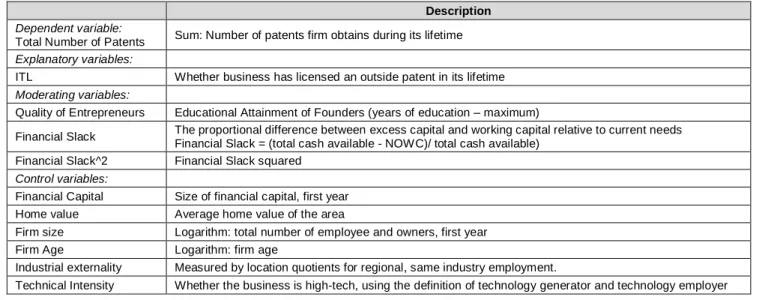
strategic innovativeness, defined by the database as the degree to which firms rely on technological innovation. This way we avoid the bias inherent in relying on industry codes, which classify high-tech firms only by the goods and services they provide. Table 1 provides descriptive statistics of the variables used in this study.
4. Results
A negative binomial-specification technique is used to model the relations between our predictors and the numbers of patents. Employing a negative binomial-specification technique is appropriate given the count nature (positive, integer values) and distribution of our response variable, the over-dispersion of the variance, and a typical Poisson pattern (Allison & Waterman, 2002; Long & Freese, 2005).
The distribution not only violates the normality assumption, but also demonstrates a disproportionate amount of observations between 0 and 5 resulting in positive skewness. Excessive zeroes exist because not all respondents have engaged in the process of patent filing. In this specification, the sources of initial firm heterogeneity are included by those covariates measured at the time of the initial founding of each firm. This is consistent with previous research which suggests that firms’ initial heterogeneity makes a persistent impact on firm performance (Dunne, Roberts, & Samuelson, 1988; Shane & Delmar, 2004).
Table 2 provides a pairwise correlation matrix of variables, excluding the dummy variables.
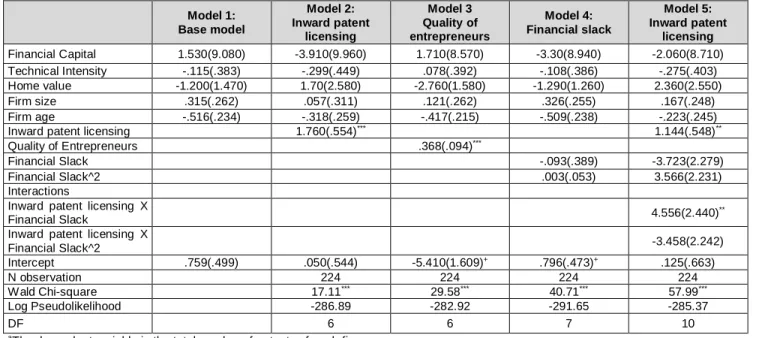
The results of the negative binomial regression are presented in Table 3. We estimate the main effects of the independent variables and the moderating variables in Models 2, 3 and 4 after presenting a baseline control model in Model 1. The two-way interaction effects of the independent variables and the moderating variables are examined in Model 5.
Table 1: Variable Descriptions
Description Dependent variable:
Total Number of Patents Sum: Number of patents firm obtains during its lifetime Explanatory variables:
ITL Whether business has licensed an outside patent in its lifetime Moderating variables:
Quality of Entrepreneurs Educational Attainment of Founders (years of education – maximum)
Financial Slack The proportional difference between excess capital and working capital relative to current needs Financial Slack = (total cash available - NOWC)/ total cash available)
Financial Slack^2 Financial Slack squared Control variables:
Financial Capital Size of financial capital, first year Home value Average home value of the area
Firm size Logarithm: total number of employee and owners, first year
Firm Age Logarithm: firm age
Industrial externality Measured by location quotients for regional, same industry employment.
Technical Intensity Whether the business is high-tech, using the definition of technology generator and technology employer Table 2: Correlation Matrix
aa
Correlations are not shown for indicator variables
N Mean (SD) 1 2 3 4 5 6 7
1 Total Number of Patents 228 1.907(7.385)
2 Quality of entrepreneurs 228 15.526(2.194) .247
3 Financial slack 228 .435(.683) -.018 .092
4 Financial slack^2 228 .654(3.761) .031 .075 -.661
5 Financial Capital 228 166613.2
(9385.6) .019 .006 .013 -.015
6 Home value 224 148680.4
(124235.1) -.041 .158 -.076 -.029 -.058
7 Firm size 228 .813(.791) .035 .156 .050 -.008 .091 .011
8 Firm age 228 .461(.715) -.084 .114 .054 -.042 -.022 -.053 .062
In Model 2, we evaluate Hypothesis 1 to determine if Inward Technology Licensing (ITL), has a positive impact on the internal R&D of NTBFs in non-thriving areas. We find strong support in favor of our hypothesis (β = 1.760, p
< .001). Next, we test Hypothesis 2 in Model 3 and find a positive relation between entrepreneur quality and internal R&D (β = .368, p < .001). We also evaluate the direct impact of financial slack on both a linear and curvilinear basis in Model 4. However, the main effect of financial slack (β = –.093, ns) reveals, interestingly, a negative, non-significant association; thus, Hypotheses 3a is not supported. Finally, in Model 5, we interact ITL with financial slack and observe a positive and significant coefficient on the interaction (β = 4.556, p < .01) as well as on ITL. Given the significant positive relation, we conclude that ITL has a positive impact on firm innovation and this impact is strengthened when the firm has adequate financial slack in support of Hypothesis 3b.
5. Discussion
In this study, we have investigated the role of financial slack in relation to the internal R&D of NTBFs, taking geographical constraints into consideration. We find that ITL enhances the internal innovation of NTBFs for firms located in non-thriving areas. We also find that the positive effect of ITL gets stronger when firms maintain excessive financial
resources, while financial slack does not contribute to internal R&D by itself. These findings make the following contributions to the existing literature on entrepreneurship and management research.
First, this research highlights the role of utilizing formal contractual relationships through licensing external sources of knowledge. As mentioned earlier, the economic geography literature tends to pay little attention to strategic insights for firms located in isolated areas. This research highlights the potential role of ITL for firms in isolated areas, thereby bridging the two groups of literature.
Second, this research advances the understanding of ITL by addressing whether and how the effect of ITL is moderated by interactions with firm heterogeneity in financial slack, which has remained an unexplored area (Alcácer & Chung, 2007). As Shaver and Flyer (2000) suggest, firms with the greatest human capital are less motivated to locate in agglomerated areas, as they can expect to lose more to competitors than they gain. This study provides evidence to support this argument by showing a positive correlation between quality of entrepreneurs and internal innovation. The implication of this research— highlighting the role of the level of education—is aligned with the existing research that has found a significant, positive relationship between highly educated employees and ITL in software companies (Harison & Koski, 2010).
Table 3: Negative binomial estimates for knowledge creation (DV: Total number of patents)
Model 1:
Base model
Model 2:
Inward patent licensing
Model 3 Quality of entrepreneurs
Model 4:
Financial slack
Model 5:
Inward patent licensing Financial Capital 1.530(9.080) -3.910(9.960) 1.710(8.570) -3.30(8.940) -2.060(8.710)
Technical Intensity -.115(.383) -.299(.449) .078(.392) -.108(.386) -.275(.403)
Home value -1.200(1.470) 1.70(2.580) -2.760(1.580) -1.290(1.260) 2.360(2.550)
Firm size .315(.262) .057(.311) .121(.262) .326(.255) .167(.248)
Firm age -.516(.234) -.318(.259) -.417(.215) -.509(.238) -.223(.245)
Inward patent licensing 1.760(.554)
***1.144(.548)
**Quality of Entrepreneurs .368(.094)
***Financial Slack -.093(.389) -3.723(2.279)
Financial Slack^2 .003(.053) 3.566(2.231)
Interactions
Inward patent licensing X
Financial Slack 4.556(2.440)
**Inward patent licensing X
Financial Slack^2 -3.458(2.242)
Intercept .759(.499) .050(.544) -5.410(1.609)
+.796(.473)
+.125(.663)
N observation 224 224 224 224
Wald Chi-square 17.11
***29.58
***40.71
***57.99
***Log Pseudolikelihood -286.89 -282.92 -291.65 -285.37
DF 6 6 7 10
a
The dependent variable is the total number of patents of each firm
b