ABSTRACT
The engineering college in Yonsei University started the RCP(Residential College Program) at Song-do International Campus in 2013.
. Every first-year engineering student is required to live on-campus at their first semester. They had integrated educational experiences combined with extracurricular community activities as well as curricular activities. The residential learning communities were to decrease the number of students in probation and enrich campus culture. The living and learning communities could help students achieve academic success and to lower the rate in dropping. We ran a survey over the students’ satisfaction on RCP. Academic achievement and retentions were compared between the ones in 2011 and 2013.
Keywords: Residential college, Living and learning community, Educational effects
I. Introduction
1)Recently Korean faculty members have been looking into the residential learning communities to improve the quality of undergraduates’ experience. Residential learning communities are subject to bring together academic affairs and student affairs to create educationally powerful learning environments, which are characterized by interactions between faculty and students. Small classroom size, co-curricular experiences that complement the academic curriculum and student leadership experiences (Leinwall, 2006).
Yonsei University has started residential college education at Incheon Songdo International Campus since 2013. All the first year students should reside and study in on-campus housing during their first semester. They are required to take regular courses, do extracurricular activities, get individual supports for holistic and creativity education.
The purpose of this study was to explore the educational effects of the engineering residential college programs.
Received 24 September, 2014; Revised 29 September, 2014 Accepted 29 September, 2014
† Corresponding Author: [email protected]
II. Literature Review
Previous studies have shown us the effects of residential campus living. Pascarella & Terenzini(1991) found that students living in the residence halls persisted and graduated at significantly higher rates than did residential students lacking the residential experience. Students who lived in residence halls were more satisfied with the college experience than those who lived off campus (Blimling, 1993).
Specially residential college experiences gave students advantages of social interaction and positive involvement with peers, faculty and communities (Bollou, Reavill &
Shultz, 1995).The most important factors in the satisfaction in residence halls is the interaction with other students(EBI, 2002). Students who choose to reside in the Engineering Residential College have an overall sense of community and satisfaction in their college experience and increased academic success. Although academic success in science courses and laboratories was comparable to other groups, retention of Engineering Residential College students was much higher (Miller et al., 2009).
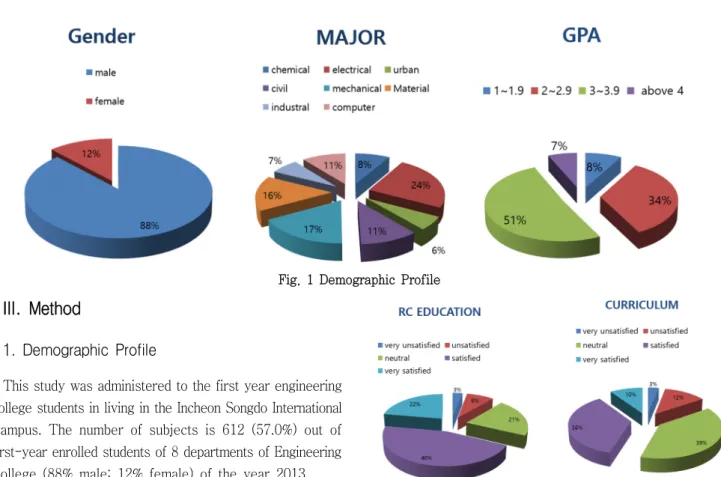
Fig. 1 Demographic Profile
III. Method
1. Demographic Profile
This study was administered to the first year engineering college students in living in the Incheon Songdo International Campus. The number of subjects is 612 (57.0%) out of first-year enrolled students of 8 departments of Engineering College (88% male; 12% female) of the year 2013.
2. Survey Instrument
The survey instrument was developed at the Yonsei Center for the Innovation of Engineering Education. It Included 42 items, 2 of which were qualitative questions (the most memorable experience, suggestion for improvement.
Students were asked to the level of satisfaction (1 = very unsatisfactory; 5 = very satisfactory).
IV. Result
1. Engineering Students’Satisfaction with Residential College Education
The result of survey was as follows. 68% of the engineering students were satisfied with RC Education and the satisfaction level of RC curriculum was relatively low(46% of the engineering students were satisfied).
The fact, which 74% of the engineering students were willing to recommend RC program to juniors, strongly showed that students with RC Program experiences actually
Fig. 2 Engineering Students’ Satisfaction with Residential College Education
Fig. 3 Willingness to recommend RC program to juniors
considered those desirable.
Participant students responded that desirable duration of RC program would be only one or two semester(s); they seemed reluctant to the prolonged RC programs even though they admitted those programs could be helpful to their college lives.
Fig. 4 Appropriate duration of Residential College
2. The Effects of RC Education First- Year Students Perceive
The teamwork was ranked as the far most important effect of RC followed by communication. However, compared to the perceived improvements of such interpersonal skills due to RC programs, the extent that students recognized academic benefit such as better understanding of engineering, math, and science was substantially lower than expected. This result elucidates that students’ perceived benefits from RC education was more closely related to the improvement of interpersonal skills than academic chievements.
Fig. 5 The Effects of RC Education First-Year Students Perceive
• Gather at house party and meetings
• Do homework with residents at 3 a.m.
• Do volunteer: mentoring for middle school students
• Interaction with peers
• Develop autonomy and time management skills
• Do collaborative work and Share the learning experiences
• Increase the sense of belonging
4.4. The Change of First–Year Student Retention Rate in Engineering College
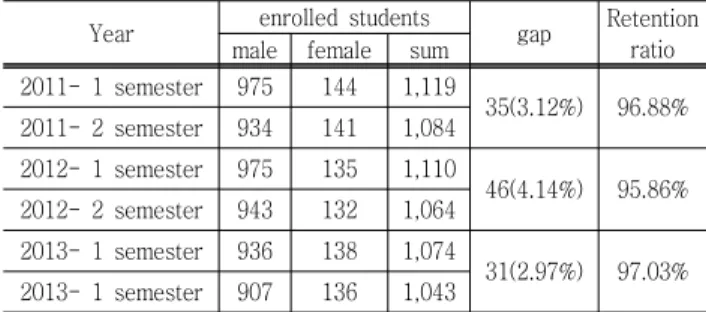
Augmented retention ratio had been traditionally considered as one of the biggest benefits of RC program. Reflecting the trend, in 2013 after the implementation of RC program, the number of students who dropped became less than before.
Table 2 The Change of First –Year Student Retention
Year enrolled students
gap Retention ratio male female sum
2011- 1 semester 975 144 1,119
35(3.12%) 96.88%
2011- 2 semester 934 141 1,084 2012- 1 semester 975 135 1,110
46(4.14%) 95.86%
2012- 2 semester 943 132 1,064 2013- 1 semester 936 138 1,074
31(2.97%) 97.03%
2013- 1 semester 907 136 1,043
4.5. The Change of Achievements
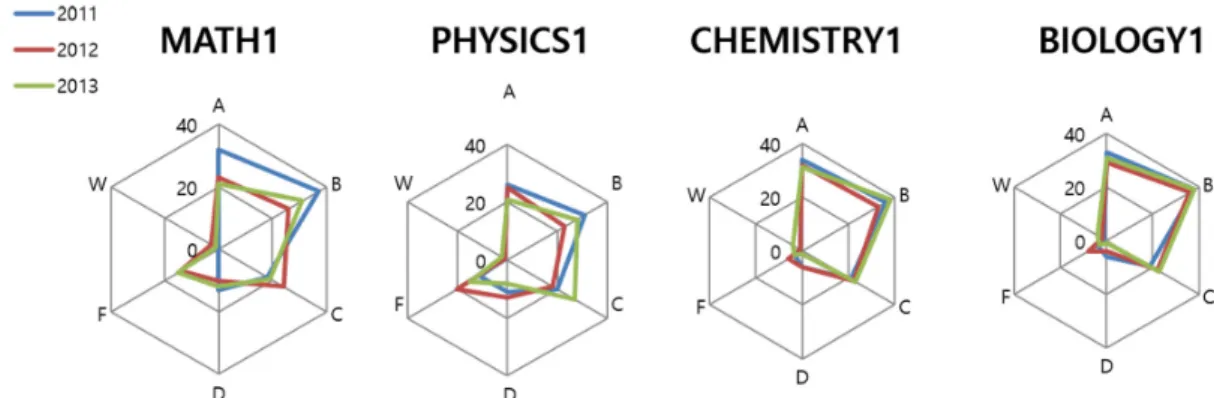
After the launch of RC program in 2013, the number of probation imposed to failed students was significantly dropped. Even though it is hard to say that the initiation of RC program was a direct cause of decreased number of probation in 2013, it seems reasonable to extract the certain relationship between the benefit of RC program and a decline in the number of academic probation.
However, the precipitation in the number of academic
Fig. 6 The change of achievement in each course
Table 3 The Number of Academic Probation the Number of Academic Probation
2011-1 semester 113
2012-1 semester 136
2013-1 semester 93
probation did not necessarily represent that overall academic status of students was improved. Analysis the overall of three-year grade in each course showed that the distribution of grade had been almost same. This phenomenon seemed largely attributed to the grading system which was not the absolute evaluation but the relative one. Therefore, even though RC program could be considered beneficial to decrease the number of students in probation, academic improvement was not necessarily translated into the increased number in groups with better grades.
4.6. Students Complaints
Most of students complained that they could not interact with engineering faculty frequently. They need Learning Advisors and Academic Coordinators who respond to academic questions and help with academic issues in the residence hall.
Table 4 The List of Students Complaints
• Yonsei Engineering Residential College admits only freshmen with declared majors in 10 undergraduate programs
• Increase strong connections with peers, but decrease connections with upperclassmen
• Engineering faculty member don’t live in residence hall house
• Limit the informal interactions with faculty
• There is scarcely housing program for pursuing hobbies and student organizations
• Need to develop more the cultural participation program in residence halls
V. Suggestions
Results of this study revealed that students who reside in residential college had an overall sense of community and satisfaction in RC college experience. Students perceived that the RC programs enhanced qualitative life skills. But the academic performance and the retention slightly higher or similar to that of 2011, 2012 first year students in non-residential college. It is necessary to provide environments in which students study and discuss academic issues together, either the residential assistants or the academic assistants should help the first year students’ learning
Table 5 Things to be improved
• Make fun in residential college lives
• Develop academic and curricular experience to enhance learning environments
• Create partnerships to enrich students educational experiences
• Increase the faculty and first-year students interaction program
VI. Conclusions
The RC program of Yonsei engineering college at the Songdo International Campus in 2013 turned out quite successful in developing interpersonal skills within students. However, student-faculty interaction, which may be a key element in enhancing learning environments, necessitates further improvements. Therefore, it is highly recommended for the engineering faculty members to build reciprocal interactions with students living in residence hall for more number of and casual interactions with freshmen in engineering residential program 2014.
3. Leinwall F.(2006). A Residential Learning Community and Its Affect on the Psychosocial Development of College Students.
Unpublished doctoral dissertation, University of Virginia.
4. Miller, S., Pyke P., Moll A., Wintrow M., Schrader C., Callahan, j, (2009). Success of an Engineering Residential College Program within an Emerging residential Culture. ASEE Proceedings.
5. Pascarella, E. T. & Terenzini, P. T. (1991). How college affects students. San Francisco, CA:Jassey-Bass.
So Yeon Kang
Associate Professor, Yonsei Innovation Center for Engineering Education, Yonsei University
Received BS (1985) in English Language & Literature from Yonsei University, MA (1987) and Ed.D. (1996) in Educational Psychology from Yonsei University
The member of Presidential Advisory Council on Education Science & Technology ((2008~2009)
Her current research focuses on Accreditation, Creativity, Problem Based Learning.
Phone: 02‐2123‐5732 E‐mail: [email protected]
and techniques including emerging technology and its applications to construction technologies.
Phone: 02-2123-7493 Fax: 02-364-5300
E-mail: [email protected]
Hyung Hee Cho
Degree in mechanical engineering from the University of Minnesota, Minneapolis, in 1992. Since 1995, he has been with the Department of Mechanical Engineering, Yonsei University, Seoul, Korea, where he is currently a full professor in the School of Mechanical Engineering. He is currently an associate editor of the International Journal of Fluid Machinery and Systems, and an editorial board member of Advances in Mechanical Engineering. His research interests include thermal management and cooling of high temperature devices.
He is a fellow of the American Society of Mechanical Engineers, a scientific council member of the International Centre for Heat and Mass Transfer, a general member of the National Academy of Engineering of Korea, and the president of Korean Society for Fluid Machinery.
E-mail: [email protected]