INTRODUCTION
The annual volume of coronary revascularization in Korea is
continuously increasing since 2006, although this trend differs according to procedure type. A high percentage of drug-eluting stent (DES) procedures are noted.1
DES with a polymer surface and a controlled release of anti- proliferative agents represent a breakthrough in stent manu- facturing technology. This has reduced the incidence of reste- nosis and the need for revascularization compared with bare- metal stents (BMS).2-4 However, concerns have emerged regarding late and very late stent thrombosis with first genera- tion DES that in turn are associated with a high rate of death and myocardial infarction (MI).5,6 The remaining polymer ma- terial after the complete release of the drug coating is a poten- tial hazard for inflammatory reactions that end up with incom- plete endothelialization of stent struts and positive remodeling, hence, stent thrombosis and MI.7,8
Nobori-Biolimus-Eluting Stents versus Resolute Zotarolimus-Eluting Stents in Patients Undergoing Coronary Intervention: A Propensity Score Matching
Ayman Tantawy
1,2*, Chul-Min Ahn
1*, Dong-Ho Shin
1, Jung-Sun Kim
1, Byeong-Keuk Kim
1, Young-Guk Ko
1, Donghoon Choi
1, Yangsoo Jang
1, and Meong-Ki Hong
11Division of Cardiology, Department of Internal Medicine, Yonsei University College of Medicine, Seoul, Korea;
2Department of Cardiology, Faculty of Medicine, Zagazig University, Zagazig, Egypt.
Purpose: To compare the 1-year outcomes of a durable polymer Zotarolimus-eluting stent (ZES) versus a biodegradable polymer Biolimus-eluting stent (BES) in patients undergoing percutaneous coronary intervention.
Materials and Methods: A total of 2083 patients from 2 different registries, 1125 treated with BES in NOBORI registry and 858 re- ceived ZES in CONSTANT registry were included in this study. Clinical outcomes were compared with the use of propensity score matching (PSM). The primary endpoint was a composite of major adverse cardiovascular and cerebrovascular events (MACCEs) in- cluding cardiac death, myocardial infarction, clinically driven target lesion revascularization and stroke. Secondary end points were individual components of MACCEs as well as the incidence of stent thrombosis at 1-year follow-up.
Results: After PSM, 699 matched pairs of patients (n=1398) showed no significant difference between BES and ZES in the risk of composite MACCEs at 1 year (2.6% vs. 1.7%; p=0.36). Cardiac death was not statistically different between groups (0.7% vs. 0.4%, p=0.73). Target lesion revascularization rate was also similar between BES and ZES (1.1% vs. 0.7%, p=0.579). Non-Q wave myocardial infarction, as well as target-vessel revascularization rate, was similar between the two groups (0.14% for BES and 0.72% for ZES). Both stent types were excellent with no cases of stent thrombosis and rate of Q wave myocardial infarction reported during the follow-up period.
Conclusion: In this cohort of patients treated with BES or ZES, the rate of MACCEs at 1 year was low and significantly not different between both groups.
Key Words: Percutaneous coronary intervention, drug-eluting stents, polymers, biolimus A9, zotarolimus, propensity score pISSN: 0513-5796 · eISSN: 1976-2437
Received: July 4, 2016 Revised: October 22, 2016 Accepted: October 31, 2016
Corresponding author: Dr. Myeong-Ki Hong, Division of Cardiology, Department of Internal Medicine, Severance Cardiovascular Hospital, Yonsei University College of Medicine, 50-1 Yonsei-ro, Seodaemun-gu, Seoul 03722, Korea.
Tel: 82-2-2228-8460, Fax: 82-2-2227-7732, E-mail: [email protected]
*Ayman Tantawy and Chul-Min Ahn contributed equally to this work.
•The authors have no financial conflicts of interest.
© Copyright: Yonsei University College of Medicine 2017
This is an Open Access article distributed under the terms of the Creative Com- mons Attribution Non-Commercial License (http://creativecommons.org/licenses/
by-nc/3.0) which permits unrestricted non-commercial use, distribution, and repro- duction in any medium, provided the original work is properly cited.
Yonsei Med J 2017 Mar;58(2):290-295 https://doi.org/10.3349/ymj.2017.58.2.290
In order to overcome this issue, new devices have been de- veloped; the second generation DES with new metal alloys and durable polymers (biocompatible polymer) to lower the risk of inflammation or biodegradable polymers combined with stain- less steel platforms that are absorbed leaving the stent surfaces similar to that of BMS. Different types of durable polymer DES have been extensively studied in randomized clinical trials, however, few studies so far have compared durable vs. biode- gradable polymer stents.9,10
We herein compared a durable polymer Zotarolimus-eluting stent (ZES) with a biodegradable polymer Biolimus-eluting stent (BES).
MATERIALS AND METHODS
Study population and design
The CONSTANT registry was a prospective, open labeled, multi- center registry including single center randomized study. It in- cluded patients undergoing single lesion per single vessel per- cutaneous coronary intervention (PCI) with Resolute integrity DES. The NOBORI registry, on the other hand, is an open label, multi-center observational registry that also included patients undergoing PCI with Biolimus A9-eluting stent (Nobori DES) for all-comer patients per single coronary lesion. Patient’s en- rollment was all-comer diagnosed as stable angina and acute coronary syndrome who are indicated for coronary revascu- larization as targeted lesion which was significant (>70% by quantitative angiographic analysis) and a single lesion per sin- gle vessel, confirmed by stress test, imaging study or cardiac enzymes.
Outcome parameters
The primary endpoint was a composite of major adverse car- diovascular and cerebrovascular events (MACCEs), including cardiac death, MI, clinically driven target lesion revasculariza- tion and stroke. Deaths were classified as cardiac or non-car- diac, and death of any unidentified cause or in which a cardiac cause could not be excluded was classified as cardiac in this study. MI was classified as Q wave or non-Q wave, and was de- fined as a rise in creatine kinase enzyme concentrations above twice the normal upper limit. Re-interventions inside the im- planted stent or within 5 mm proximal or distal to the stent were classified as target lesion revascularization (TLR). The definition of TLR had been registered according to the SIRIUS criteria. That is, TLR is defined as any “clinically-driven” repeat percutaneous intervention of the target lesion or bypass sur- gery of the target vessel. Clinically-driven revascularizations are those in which the patient has a positive functional study, isch- emic electrocardiographic changes at rest in a distribution con- sistent with the target vessel, or ischemic symptoms, and an in-lesion diameter stenosis ≥50% by QCA. Revascularization of a target lesion with an in-lesion diameter stenosis ≥70% (by
QCA) in the absence of the above-mentioned ischemic signs or symptoms was also considered clinically driven. In the absence of QCA data for relevant follow-up angiograms, clinical need for revascularization was adjudicated using the presence or ab- sence of ischemic signs and symptoms. Repeated PCI to the same vessel with the exception of TLR was counted as non- target lesion (TL) target vessel revascularization (TVR). Target vessel failure was defined as all target vessel-related events, which included cardiac death, MI, thrombosis, and TVR. Ac- cording to the Academic Research Consortium Classification, definite and probable stent thrombosis was considered stent thrombosis.11
Statistical analysis
Statistical analysis was performed using SPSS (version 18.0.0, SPSS Inc., Chicago, IL, USA) and R (version 2.8.0, R Foundation for Statistical Computing, Vienna, Austria). Continuous vari- ables are presented as mean ±standard deviation and were compared using a Student unpaired t-test. Categorical variables are presented as counts and percentages, and were compared using chi-square test. Control of confounders between both registries was undertaken by propensity score matching (PSM).
The propensity score is the probability of treatment assignment conditional on observed baseline characteristics. The propen- sity score allows one to design and analyze an observational (nonrandomized) study, so that it mimics some of the particu- lar characteristics of a randomized controlled trial.12
Propensity scores were estimated by fitting a logistic regres- sion model using the following variables for Nobori and Reso- lute stents: age over 65 years old, gender, diabetes mellitus, prior history of MI, PCI, and coronary artery bypass graft (CABG), clinical presentation of acute coronary syndrome, and angio- graphic coronary artery disease findings. Propensity scores yielded a C statistic of 0.635, indicating a good ability to differen- tiate between two groups of patients. Nearest neighbor match- ing with a caliper of 0.001 was used. The Hansen and Bowers balance test p value was 1.000, indicating good covariate bal- ance. Table 1 shows a list of variables used to construct the pro- pensity score. If a subject of the NOBORI group could not be matched to any subject of the CONSTANT group, that subject was discarded from the matched analysis. Finally, of 2083 pa- tients in both groups, 1398 patients (67%) were matched. Finally, the baseline covariates were compared between the two groups with statistical tests for matched data. All p values are 2-sided, and p values <0.05 were considered to indicate statistical signifi- cance.
RESULTS
Characteristics of the study group
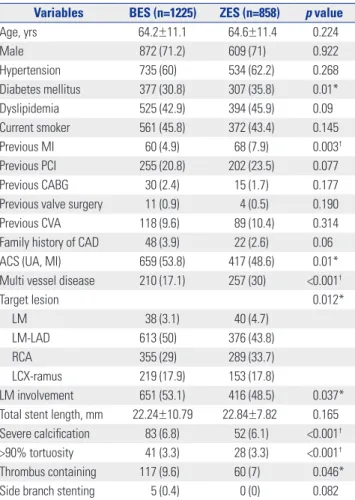
Studied patients were derived from our Nobori and CON- STANT Korea registries. In brief, 1225 patients were undergoing
PCI with BES and 858 patients with ZES. The two groups dif- fered significantly in terms of some potential confounders (Ta- ble 1). Particularly, patients who received BES were more likely to present with diabetes and to be managed as acute coronary syndromes. On the other hand, those who received ZES were more likely insulin-dependent diabetes and had previous his- tory of MI. In coronary intervention, Nobori group had more left main and left anterior descending coronary artery involve- ment, and their lesions were more severely calcific, tortuous and thrombus with a need for more than one stent in compari- son with Resolute group. The use of intravascular ultrasound evaluation IVUS and bifurcation side-branch stenting was high- er in Nobori group, while multivessel involvement was higher in the Resolute group.
The two groups did not differ significantly in terms of age, gender, hypertension, hyperlipidemia, past history of coronary bypass surgery, previous percutaneous interventions, and his- tory of cerebrovascular accidents. Nobori group had higher
tendency to present with hyperlipidemia. After PSM (Table 2) was performed for the entire group (n=2083), there were 699 matched pairs of patients. In matched analysis, two propensity- matched groups (699 pairs, n=1398 patients) were generated and the baseline characteristics of these two groups were bal- anced. In this matched cohort, the mean age was 64.5 years, men accounted for 72.7%, 32.9% were diabetes mellitus, 61.2%
were hypertensive, and 45.9% were hyperlipidemic. Clinically, 52.9% presented with acute coronary syndromes. 22.3% had a multivessel disease, 6.7% had severely calcific lesions, 8.7% of lesions were thrombus containing and 11.8% were bifurcated lesions. The mean total stent length was 22.4 mm and mean minimal stent diameter was 22.3 mm. In matched group, there was no significant difference between the Nobori and Reso- lute group in any other covariates.
Table 1. Baseline Characteristics of both Groups (before Matching) Variables BES (n=1225) ZES (n=858) p value
Age, yrs 64.2±11.1 64.6±11.4 0.224
Male 872 (71.2) 609 (71) 0.922
Hypertension 735 (60) 534 (62.2) 0.268
Diabetes mellitus 377 (30.8) 307 (35.8) 0.01*
Dyslipidemia 525 (42.9) 394 (45.9) 0.09
Current smoker 561 (45.8) 372 (43.4) 0.145
Previous MI 60 (4.9) 68 (7.9) 0.003†
Previous PCI 255 (20.8) 202 (23.5) 0.077
Previous CABG 30 (2.4) 15 (1.7) 0.177
Previous valve surgery 11 (0.9) 4 (0.5) 0.190
Previous CVA 118 (9.6) 89 (10.4) 0.314
Family history of CAD 48 (3.9) 22 (2.6) 0.06
ACS (UA, MI) 659 (53.8) 417 (48.6) 0.01*
Multi vessel disease 210 (17.1) 257 (30) <0.001†
Target lesion 0.012*
LM 38 (3.1) 40 (4.7)
LM-LAD 613 (50) 376 (43.8)
RCA 355 (29) 289 (33.7)
LCX-ramus 219 (17.9) 153 (17.8)
LM involvement 651 (53.1) 416 (48.5) 0.037*
Total stent length, mm 22.24±10.79 22.84±7.82 0.165 Severe calcification 83 (6.8) 52 (6.1) <0.001†
>90% tortuosity 41 (3.3) 28 (3.3) <0.001†
Thrombus containing 117 (9.6) 60 (7) 0.046*
Side branch stenting 5 (0.4) 0 (0) 0.082
BES, Biolimus-eluting stent; ZES, Zotarolimus-eluting stent; ACS, acute coro- nary syndrome; UA, unstable angina; MI, myocardial infarction; CABG, coro- nary artery bypass graft; CAD, coronary artery disease; PCI, percutaneous coronary intervention; CVA, cerebrovascular accidents; LM, left main; LAD, left anterior descending; RCA, right coronary artery; LCX, left circumflex.
Values are mean±SD or n (%). p values are from t-test for continuous vari- ables and chi-square for binary variables.
*Significant, †Highly significant.
Table 2. Baseline Characteristics of both Groups (after Matching) Variable BES (n=699) ZES (n=699) p value
Age, yrs 64.9±10.8 64.5±11.6 0.479
≥65 yr-old 380 (54.4) 382 (54.6) 0.914
Male 508 (72.7) 508 (72.7) 1.000
Hypertension 271 (38.8) 271 (38.8) 1.000
Diabetes mellitus 231 (33.0) 229 (32.8) 0.909
Dyslipidemia 306 (43.8) 335 (47.9) 0.120
Current smoker 316 (45.2) 312 (44.6) 0.830
Previous myocardial infarction 21 (3.0) 23 (3.3) 0.759
Previous PCI 122 (17.5) 124 (17.7) 0.888
Previous CABG 5 (0.7) 5 (0.7) 1.000
Acute coronary syndrome 369 (52.8) 371 (53.1) 0.915
Previous CVA 118 (9.6) 89 (10.4) 0.603
FH of CAD 48 (3.9) 22 (2.6) 0.108
CAD 1.000
One vessel 295 (42.2) 295 (42.2)
Two vessel 248 (35.5) 248 (35.5)
Three vessel 156 (22.3) 156 (22.3)
Target lesion 0.932
LM 13 (1.9) 15 (2.1)
LM-LAD 347 (49.6) 352 (50.4)
RCA 212 (30.3) 213 (30.5)
LCX-ramus 119 (17) 127 (18.2)
LM involvement 360 (51.5) 367 (52.5) 0.748
Total stent length, mm 22.24±10.79 22.84±7.22 0.154
Severe calcification 52 (7.4) 41 (5.9) 0.283
>90% tortuosity 29 (4.1) 23 (3.3) 0.48
Thrombus containing 62 (8.9) 59 (8.4) 0.849
Side branch stenting 5 (0.4) 0 (0) 0.082
BES, Biolimus-eluting stent; ZES, Zotarolimus-eluting stent; CABG, coronary artery bypass graft; CAD, coronary artery disease; PCI, percutaneous coro- nary intervention; CVA, cerebrovascular accidents; LM, left main; LAD, left anterior descending; RCA, right coronary artery; LCX, left circumflex.
Values are mean±SD or n (%).
1-year clinical outcomes of the matched cohorts Table 3 shows 12-months clinical outcomes after PSM. Among MACCEs components, there was no significant difference be- tween Nobori and Resolute groups in terms of either target le- sion revascularization (1.1% Nobori vs. 0.7% Resolute, p=0.579) or TVR [5 cases in either group (0.72%)]. Cardiac death was also similar, occurring in 0.7% in patients who received Nobori vs.
0.4% in those received Resolute (p=0.73), as was non-Q wave MI, 0.14% in both groups. There was neither Q wave MI nor stent thrombosis in the matched cohorts. Hemorrhagic stroke occurred once in the Nobori group 0.1%, and bleeding was also similar; four cases (0.6%) in either group. Non-TVR was simi- lar between Nobori and Resolute [11% vs. 10%, respectively (p=1.000)].
DISCUSSION
The main findings of this observational study with 2083 pa- tients, comparing the safety and efficacy profile of second-gen- eration Resolute Integrity durable polymer ZES with Nobori biodegradable polymer BES, can be summarized as follows.
First, patients who received BES in the NOBORI registry had very different characteristics from those who were implanted with ZES in CONSTANT registry. They were presented with more coronary risk factors and comorbidities, were more likely to be treated in the context of acute coronary syndromes, had more left main- left anterior descending artery involvement had more severe, calcific, thrombus containing lesions. Second, after accounting for these multiple confounders by PSM, there were no differences between BES and ZES at 1 year in terms of a composite endpoint of cardiovascular death, target vessel MI, and clinically driven target lesion revascularization. These findings suggest a different degree of patients and lesion subset
selection in daily use of the third generation Nobori BES, trans- lating into 12- month outcomes that resemble those of matched second-generation Resolute integrity ZES. Excellent outcomes were seen for both stent types regarding stent thrombosis.
This is important in view of disease complexity, including a high frequency of acute coronary syndromes.
Our event rates for the primary endpoints in patients who received the durable polymer ZES were consistent with previous trials.13 A randomized controlled Scandinavian Organization for Randomized Trials with Clinical Outcome (SORT-OUT VI) showed that durable polymer Resolute Integrity stent (Medtron- ic, Santa Rosa, CA, USA) was not inferior to the biodegradable polymer Biolimus stent (Terumo Corporation, Tokyo, Japan), since there were no significant differences in the individual co- mponents of the primary endpoint (cardiac death, target-ves- sel-related MI, and clinically indicated TVR). Although similar in non-significance, our event rates were lower (composite pri- mary end point was 2.6% vs. 5.3% in Nobori BES group, 1.7%
vs. 5% in Resolute integrity ZES group, respectively).
In DUTCH PEERS trial, ZES (Medtronic) was studied against the durable polymer Everolimus-eluting Promus Element stent (Boston Scientific, Natick, MA, USA), and no significant differ- ences were found in cardiac death, target vessel related MI or clinically indicated TVR; The stent thrombosis rate at 12 months was low: 0.3% for the ZES and 0.7% for the Everolimus-eluting stent.14 The lower rate of stent thrombosis in Resolute Integrity ZES was consistent with our findings.
Final 5-year report of RESOLUTE All-Comers trial showed that the Resolute durable-polymer ZES was not inferior to the Xience durable polymer Everolimus-eluting stent (Abbott Vas- cular, Abbott Park, IL, USA) with regard to the primary endpoint defined as a composite of cardiac death, MI or clinically driven target-lesion revascularization at 12 months.15 The event rate for the primary endpoint for the Resolute stent was 8.2% and stent thrombosis rate was 4.2%. This is much higher than our rate for Resolute ZES and might be attributable to their higher non-Q wave MI rate.
The Resolute Integrity is a 91-μm strut made from a single strand of cobalt chromium alloy designed in a continuous sinu- soid technology to optimize deliverability and radial strength.16 The low rates of stent thrombosis might be due to its thin strut thickness and the altered dynamics of drug release which is slow in comparison to its first generation counterpart which had a rapid drug release and hence a reported higher rate of stent thrombosis.17,18
Many methods were evaluated with the aim of removing polymers from stent design, because of potential hazard of late stent thrombosis. The newer metal alloys with increased st- rength have allowed for abluminal scoring without affecting overall stent strength.19 The biodegradable polymer in Biolimus eluting stent consists of polylactic acid (PLA), applied to the abluminal surface of the stent and is fully degraded into car- bon dioxide and water within 6 months. The Nobori BES stent Table 3. MACCEs at One-Year Follow-Up Period
Variables BES (n=699) ZES (n=699) p value Target lesion revascularization 8 (1.1) 5 (0.7) 0.579 Target vessel revascularization 5 (0.72) 5 (0.72) NS Non-Q myocardial infarction 1 (0.14) 1 (0.14) NS
Q wave myocardial infarction 0 (0) 0 (0) NS
Stent thrombosis 0 (0) 0 (0) NS
All cause death 7 (1) 4 (0.6) 0.55
Cardiac death 5 (0.7) 3 (0.4) 0.73
CVA 1 (0.1) 0 (0) NS
Ischemic stroke 0 (0) 0 (0) NS
Hemorrhagic stroke 1 (0.14) 0 (0) NS
Bleeding 4 (0.6) 4 (0.6) NS
MACCEs 18 (2.6) 12 (1.7) 0.36
NS, non-significant; BES, Biolimus-eluting stent; ZES, Zotarolimus-eluting stent; CVA, cerebrovascular accidents; MACCEs, major adverse cardiovascu- lar and cerebrovascular events.
Values are mean±SD or n (%).
(Terumo Corporation, Tokyo, Japan) uses 316L stainless steel and abluminal PLA polymer.20
Patients with biodegradable polymer stents had fewer TVR and stent thrombosis than those treated with first-generation DES.21 This new design was expected to be better in terms of safety and efficacy compared to durable polymer one. How- ever, subsequent studies showed somewhat different findings, which is consistent with our present results.
The Nobori biodegradable-polymer stent (Terumo, Tokyo, Ja- pan) was not inferior to the Xience stent with durable polymer coating in the COMPARE II trial.22
LEADERS trial23 showed that compared with Cypher Sirolim- us durable eluting stent SES (Cordis, Miami Lakes, FL, USA), the Biomatrix Biolimus biodegradable eluting stent was not in- ferior in safety at 9 months. However, in their follow-up report beyond the first year, they reported that the risk of MACE was lower in patients treated with BES than in those treated with SES (18.7% vs. 22.6%; p=0.050). The relative risk of definite stent thrombosis ST was 0.62 (p=0.09), which was largely attributed to a lower risk of very late definite ST between years 1 and 4 in the BES compared to the SES group (RR 0.20, p=0.004), demon- strating 80% relative risk reduction.
Similarly, BES did not fare well enough to be declared non- inferior versus a cypher Sirolimus-eluting standard-polymer stent with respect to a combined 9 month safety/efficacy end- point in a randomized trial of patients with chronic stable angi- na,13 indicating that evolving durable polymers might be at least as efficacious as biodegradable polymers.
The two stents in our study have different characteristics. The Nobori BES platform is composed of stainless steel with a strut thickness of 112 μm. It is coated with a PLA polymer on its ablu- minal surface, which is metabolized within 6–9 months to lactic acid, water, and carbon dioxide. The stent elutes an antiprolif- erative drug, Biolimus (15.6 μg/mm), for up to 30 days. The coating design as well as the lipophilicity of the drug is thought to optimize local drug distribution and to reduce its release into circulation. At the end, the Nobori stent will leave only a bare metal stent BMS in place.24 On the other hand, Resolute Integ- rity is made of cobalt-chromium alloy with a lesser strut thick- ness of 91 μm, and the 5.6-μm-thick BioLinx multi-polymeric system, which covers the entire stent platform, elutes Zotaroli- mus as the antiproliferative agent in a controlled manner.25
Some previous studies suggested that the stent strut thick- ness and design are responsible for DES safety profile irre- spective of the drug coating.26 In our present study, we found no difference between the two stent types in spite of the differ- ence in strut thickness and design. Therefore, we are not cer- tain whether the stent design and strut thickness affect safety and efficacy. This is consistent with the findings of BIOSCI- ENCE randomized controlled trial, stating that an ultrathin strut biodegradable polymer Sirolimus-eluting stent at 12 months was non-inferior to a durable polymer Everolimus-eluting stent for percutaneous coronary revascularization.27
Further studies are needed to clarify this concept. Although a large number of patients in our study experienced fewer events, particularly MIs, and stent thrombosis, this might be due to a short follow-up duration of 12 months. Therefore, more time is needed to assess the risk of late stent thrombosis and the inci- dence of MIs.
The rate of major adverse cardiac and cerebrovascular events was lower in the Resolute ZES than those in Nobori BES. This might be due to higher risk patients in Nobori BES group and the more difficult coronary lesions subsets. Furthermore, the results for our endpoints might be limited by the short follow- up period.
In conclusion, in this large cohort of patients undergoing PCI with Nobori BES or Resolute Integrity ZES, we found that the rate of major cardiac and cerebrovascular adverse events at 1 year was low, and that the difference different between both groups was statistically insignificant.
Limitations
We have some limitations about this article. First, this article is not a randomized controlled clinical trial; therefore, our com- parison between new generation stents even after propensity matching to overcome the limitation should be carefully ana- lyzed and applied individually for real world practice. Second, intravascular imaging tools such as intravascular ultrasound, and optical coherence tomography can unravel strong clue for final discrimination about information of neointimal coverage and failure of apposition between different designs and charac- ter of stents. However, because of limitation of registry data, we are not able to suggest about parameters for vascular imaging.
ACKNOWLEDGEMENTS
This study was supported by a grant from the Korea Healthcare Technology Research & Development Project, Ministry for Health & Welfare, Republic of Korea (Nos. A085136 and HI 15C1277), the Mid-career Researcher Program through a NRF grant funded by the MEST, Republic of Korea (No. 2015R1A 2A2A01002731), and the Cardiovascular Research Center (Seoul, Korea).
REFERENCES
1. Choi YJ, Kim JB, Cho SJ, Cho J, Sohn J, Cho SK, et al. Changes in the practice of coronary Rrvascularization between 2006 and 2010 in the Republic of Korea. Yonsei Med J 2015;56:895-903.
2. Morice MC, Serruys PW, Sousa JE, Fajadet J, Ban Hayashi E, Perin M, et al. A randomized comparison of a sirolimus-eluting stent with a standard stent for coronary revascularization. N Engl J Med 2002;346:1773-80.
3. Moses JW, Leon MB, Popma JJ, Fitzgerald PJ, Holmes DR, O’Sh- aughnessy C, et al. Sirolimus-eluting stents versus standard stents in patients with stenosis in a native coronary artery. N Engl J Med 2003;349:1315-23.
4. Stone GW, Ellis SG, Cox DA, Hermiller J, O’Shaughnessy C, Mann
JT, et al. A polymer-based, paclitaxel-eluting stent in patients with coronary artery disease. N Engl J Med 2004;350:221-31.
5. Camenzind E, Steg PG, Wijns W. Stent thrombosis late after im- plantation of first-generation drug-eluting stents: a cause for con- cern. Circulation 2007;115:1440-55.
6. Daemen J, Wenaweser P, Tsuchida K, Abrecht L, Vaina S, Morger C, et al. Early and late coronary stent thrombosis of sirolimus-eluting and paclitaxel-eluting stents in routine clinical practice: data from a large two-institutional cohort study. Lancet 2007;369:667-78.
7. Sabate M, Cequier A, Iñiguez A, Serra A, Hernandez-Antolin R, Mainar V, et al. Everolimus-eluting stent versus bare-metal stent in ST-segment elevation myocardial infarction (EXAMINATION): 1 year results of a randomised controlled trial. Lancet 2012;380:1482- 90.
8. Windecker S, Serruys PW, Wandel S, Buszman P, Trznadel S, Linke A, et al. Biolimus-eluting stent with biodegradable polymer versus sirolimus-eluting stent with durable polymer for coronary revas- cularisation (LEADERS): a randomised non-inferiority trial. Lan- cet 2008;372:1163-73.
9. Bangalore S, Kumar S, Fusaro M, Amoroso N, Attubato MJ, Feit F, et al. Short- and long-term outcomes with drug-eluting and bare- metal coronary stents: a mixed-treatment comparison analysis of 117 762 patient-years of follow-up from randomized trials. Circu- lation 2012;125:2873-91.
10. Palmerini T, Biondi-Zoccai G, Della Riva D, Stettler C, Sangiorgi D, D’Ascenzo F, et al. Stent thrombosis with drug-eluting and bare- metal stents: evidence from a comprehensive network meta-anal- ysis. Lancet 2012;379:1393-402.
11. Cutlip DE, Windecker S, Mehran R, Boam A, Cohen DJ, van Es GA, et al. Clinical end points in coronary stent trials: a case for standardized definitions. Circulation 2007;115:2344-51.
12. Austin PC. An introduction to propensity score methods for re- ducing the effects of confounding in observational studies. Multi- variate Behav Res 2011;46:399-424.
13. Christiansen EH, Jensen LO, Thayssen P, Tilsted HH, Krusell LR, Hansen KN, et al. Biolimus-eluting biodegradable polymer-coat- ed stent versus durable polymer-coated sirolimus-eluting stent in unselected patients receiving percutaneous coronary interven- tion (SORT OUT V): a randomised non-inferiority trial. Lancet 2013;381:661-9.
14. von Birgelen C, Sen H, Lam MK, Danse PW, Jessurun GA, Hautv- ast RW, et al. Third-generation zotarolimus-eluting and everolim- us-eluting stents in all-comer patients requiring a percutaneous coronary intervention (DUTCH PEERS): a randomised, single- blind, multicentre, non-inferiority trial. Lancet 2014;383:413-23.
15. Iqbal J, Serruys PW, Silber S, Kelbaek H, Richardt G, Morel MA, et al. Comparison of zotarolimus- and everolimus-eluting coronary stents: final 5-year report of the RESOLUTE all-comers trial. Circ Cardiovasc Interv 2015;8:e002230.
16. Turco MA. The Integrity bare-metal stent made by continuous si- nusoid technology. Expert Rev Med Devices 2011;8:303-6.
17. Rasmussen K, Maeng M, Kaltoft A, Thayssen P, Kelbaek H, Tilsted
HH, et al. Efficacy and safety of zotarolimus-eluting and sirolimus- eluting coronary stents in routine clinical care (SORT OUT III): a randomised controlled superiority trial. Lancet 2010;375:1090-9.
18. Leon MB, Kandzari DE, Eisenstein EL, Anstrom KJ, Mauri L, Cutlip DE, et al. Late safety, efficacy, and cost-effectiveness of a zotarolim- us-eluting stent compared with a paclitaxel-eluting stent in patients with de novo coronary lesions: 2-year follow-up from the EN- DEAVOR IV trial (Randomized, controlled trial of the medtronic endeavor drug [ABT-578] eluting coronary stent system versus the taxus paclitaxel-eluting coronary stent system in de novo native coronary artery lesions). JACC Cardiovasc Interv 2009;2:1208-18.
19. O’Brien B, Carroll W. The evolution of cardiovascular stent mate- rials and surfaces in response to clinical drivers: a review. Acta Biomater 2009;5:945-58.
20. Nikam N, Steinberg TB, Steinberg DH. Advances in stent technol- ogies and their effect on clinical efficacy and safety. Med Devices (Auckl) 2014;7:165-78.
21. Stefanini GG, Byrne RA, Serruys PW, de Waha A, Meier B, Mass- berg S, et al. Biodegradable polymer drug-eluting stents reduce the risk of stent thrombosis at 4 years in patients undergoing per- cutaneous coronary intervention: a pooled analysis of individual patient data from the ISAR-TEST 3, ISAR-TEST 4, and LEADERS randomized trials. Eur Heart J 2012;33:1214-22.
22. Smits PC, Hofma S, Togni M, Vázquez N, Valdés M, Voudris V, et al.
Abluminal biodegradable polymer biolimus-eluting stent versus durable polymer everolimus-eluting stent (COMPARE II): a ran- domised, controlled, non-inferiority trial. Lancet 2013;381:651-60.
23. Serruys P, Buszman P, Linke A, Ischinger T, Antoni D, Klauss V, et al.
TCT-44 LEADERS: 5-year follow-up from a prospective, random- ized trial of biolimus A9-eluting stents with a biodegradable poly- mer vs. sirolimus-eluting stents with a durable polymer: final report of the LEADERS study. J Am Coll Cardiol 2012;60 Supl:B13-4.
24. Schurtz G, Delhaye C, Hurt C, Thieuleux H, Lemesle G. Biodegrad- able polymer Biolimus-eluting stent (Nobori®) for the treatment of coronary artery lesions: review of concept and clinical results. Med Devices (Auckl) 2014;7:35-43.
25. Lam MK, Sen H, Tandjung K, van Houwelingen KG, de Vries AG, Danse PW, et al. Comparison of 3 biodegradable polymer and du- rable polymer-based drug-eluting stents in all-comers (BIO-RE- SORT): rationale and study design of the randomized TWENTE III multicenter trial. Am Heart J 2014;167:445-51.
26. Kolandaivelu K, Swaminathan R, Gibson WJ, Kolachalama VB, Nguyen-Ehrenreich KL, Giddings VL, et al. Stent thrombogenicity early in high-risk interventional settings is driven by stent design and deployment and protected by polymer-drug coatings. Circu- lation 2011;123:1400-9.
27. Pilgrim T, Heg D, Roffi M, Tüller D, Muller O, Vuilliomenet A, et al.
Ultrathin strut biodegradable polymer sirolimus-eluting stent ver- sus durable polymer everolimus-eluting stent for percutaneous coronary revascularisation (BIOSCIENCE): a randomised, single- blind, non-inferiority trial. Lancet 2014;384:2111-22.