• 검색 결과가 없습니다.

Diffuse Long Coronary Artery Disease is Still an Obstacle for Percutaneous Coronary Intervention in the Second-Generation Drug-Eluting Stent Era?

N/A
N/A
Protected

Academic year: 2022

Share "Diffuse Long Coronary Artery Disease is Still an Obstacle for Percutaneous Coronary Intervention in the Second-Generation Drug-Eluting Stent Era?"

Copied!
3
0
0

로드 중.... (전체 텍스트 보기)

전체 글

(1)

721 https://e-kcj.org

Diffuse long coronary artery lesions consist of approximately 20% of all percutaneous coronary intervention (PCI) and represent a therapeutic challenge, as these often require implantation of multiple stents which have been associated with poor clinical outcomes including increased risk of stent thrombosis and restenosis.

1)2)

However, the evolution of coronary stent technology including newer antiproliferative drugs, thinner and flexible stent architecture, and more biocompatible polymer with improved elution dynamics might provide a better clinical outcome in patients with diffuse long lesions.

In a current issue, Park et al.

3)

investigated the efficacy and safety of the Resolute™

zotarolimus-eluting stent (R-ZES; Medtronic Inc., Santa Rosa, CA, USA) in patients with diffuse long coronary lesions ≥25 mm from a prospective, relatively large-scale and real-world registry. Current analysis showed the incidence of major adverse cardiac events (MACE, the composite of cardiac death, non-fatal myocardial infarction, and clinically-driven target vessel revascularization) and definite stent thrombosis at 1 year were 3.0% and 0.3%

respectively. In subgroups analysis, multiple overlapping stents implantation is significantly associated with high rates of MACE compared with single stent implantation (7.1% vs. 1.5%, respectively, p<0.001).

R-ZES uses a cobalt chromium platform with a continuous sinusoidal design to further enhance the flexibility and deliverability in the complex lesion. A BioLink™ durable polymer is adapted to allow a slower drug elution and provide good biocompatibility. The RESOLUTE all-comers trial comparing R-ZES with everolimus-eluting stent (EES) demonstrated similar safety and efficacy for the R-ZES and EES through 4-year follow-up.

4)

In addition, there were comparable clinical outcomes between R-ZES and EES in patients with very long (>30 mm) coronary artery stenosis.

5)

Traditionally, lesion and stent length have been known as an important predictor of in-stent restenosis or adverse events, especially for bare-metal stent from the early stage of coronary intervention. Concern over high doses of the anti-proliferative drug, overlapping stent layer Korean Circ J. 2019 Aug;49(8):721-723

https://doi.org/10.4070/kcj.2019.0150 pISSN 1738-5520·eISSN 1738-5555

Editorial

Received: May 20, 2019 Accepted: May 28, 2019 Correspondence to Seung Hwan Han, MD

Division of Cardiology, Department of Internal Medicine, Gachon University College of Medicine, Gachon University Gil Medical Center, 21, Namdong-daero 774beon-gil, Namdong-gu, Incheon 21565, Korea.

E-mail: [email protected] [email protected]

Copyright © 2019. The Korean Society of Cardiology

This is an Open Access article distributed under the terms of the Creative Commons Attribution Non-Commercial License (https://

creativecommons.org/licenses/by-nc/4.0) which permits unrestricted noncommercial use, distribution, and reproduction in any medium, provided the original work is properly cited.

ORCID iDs Pyung Chun Oh

https://orcid.org/0000-0002-9955-223X Seung Hwan Han

https://orcid.org/0000-0002-7315-7557 Conflict of Interest

The authors have no financial conflicts of interest.

Pyung Chun Oh , MD and Seung Hwan Han , MD

Division of Cardiology, Department of Internal Medicine, Gachon University College of Medicine, Gachon University Gil Medical Center, Incheon, Korea

Diffuse Long Coronary Artery Disease is Still an Obstacle for Percutaneous Coronary Intervention in the Second- Generation Drug-Eluting Stent Era?

See the article “Effectiveness and Safety of Zotarolimus-Eluting Stent (Resolute™ Integrity) in

Patients with Diffuse Long Coronary Artery Disease” in volume 49 on page 709.

(2)

Author Contributions

Conceptualization: Oh PC, Han SH;

Investigation: Oh PC, Han SH; Supervision:

Han SH; Validation: Han SH; Visualization: Oh PC, Han SH; Writing - original draft: Oh PC, Han SH; Writing - review & editing: Oh PC, Han SH.

The contents of the report are the author's own views and do not necessarily reflect the views of the Korean Circulation Journal.

and extensive vascular injury were associated with higher rates of restenosis and very late stent thrombosis. However, the impact of lesion length on clinical outcomes could be different in the bare-metal stent and drug-eluting stent (DES), especially second-generation.

6)

Although Park et al.'s study

3)

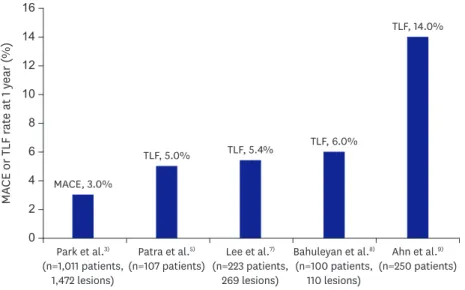
is not a randomized or comparative study, the clinical result of R-ZES for diffuse long coronary lesions is comparable to those in previous studies (Figure 1).

5)7-9)

Thus, PCI with R-ZES appears to be safe and effective in Korean patients with diffuse long coronary artery disease.

However, there is a significant increase of MACE rate (7.1% vs. 1.5%, p<0.001) in multiple overlapping stenting (13.8% of the study group) than in single stenting (86.2% of the study group) for long coronary lesions in this study.

3)

Overlapping stents are a potential source of neointimal hyperplasia due to the physical double layer of stent struts. A short gap can be inadvertently lapsed out between multiple stents, which increases the risk of restenosis and stent thrombosis. Compared to the current study, LONG Native Coronary Lesions With Drug- Eluting Stent-IV (LONG-DES IV) trial

9)

showed higher target lesion failure rate (14%) of R-ZES at 1-year follow-up which may be derived more implantation of multiple stents (52.8%, more than 2 stents) and longer length of stents used (45.9±17.1 mm) than those in the current study (implantation of multiple stents, 13.8%, mean stent length, 28.27±6.97 mm, respectively).

3)

Therefore, implantation of the second-generation DES is a reasonable strategy in diffuse long coronary lesions which can be covered by a single long stent. However, in case of very long coronary lesions which cannot be covered by single long stent and need for multiple overlapping stents, MACE rate is still high

3)9)

and further investigations for better angiographic and clinical outcome are needed. Regarding this topic, IVUS-guided optimal implantation strategy reduced MACE rate than in angiography-guided implantation, mainly derived by the reduction of ischemia-driven target lesion revascularization, in diffuse long lesions.

10)

Taken together, the implantation of the second-generation DES such as R-ZES in diffuse long coronary lesions is the optimal strategy in real clinical practice. In very long coronary lesions, avoidance of overlapping stents, use of IVUS may improve clinical outcome. Still, we have a long way to go in very long coronary artery lesions.

722 https://e-kcj.org https://doi.org/10.4070/kcj.2019.0150

Diffuse Long CAD is Still an Obstacle for PCI?

0 12 14 16

8 10

4 6

2

MACE, 3.0%

TLF, 5.0% TLF, 5.4% TLF, 6.0%

TLF, 14.0%

Park et al.

3)

(n=1,011 patients,

1,472 lesions)

Patra et al.

5)

(n=107 patients) Ahn et al.

9)

(n=250 patients) Lee et al.

7)

(n=223 patients, 269 lesions)

Bahuleyan et al.

8)

(n=100 patients,

110 lesions)

MA CE or TLF r at e at 1 y ear (%)

Figure 1. One-year incidence of MACE or TLF after implantation of R-ZES for diffuse long coronary artery disease.

MACE = major adverse clinical event; R-ZES = Resolute™ zotarolimus-eluting stent; TLF = target lesion failure.

(3)

REFERENCES

1. Gwon HC, Jeon DW, Kang HJ, et al. The practice pattern of percutaneous coronary intervention in Korea:

based on year 2014 cohort of Korean percutaneous coronary intervention (K-PCI) registry. Korean Circ J 2017;47:320-7.

PUBMED | CROSSREF

2. Bourassa MG, Lespérance J, Eastwood C, et al. Clinical, physiologic, anatomic and procedural factors predictive of restenosis after percutaneous transluminal coronary angioplasty. J Am Coll Cardiol 1991;18:368-76.

PUBMED | CROSSREF

3. Park KH, Ahn Y, Koh YY, et al. Effectiveness and safety of zotarolimus-eluting stent (Resolute™ integrity) in patients with diffuse long coronary artery disease. Korean Circ J 2019;49:709-20.

CROSSREF

4. Taniwaki M, Stefanini GG, Silber S, et al. 4-year clinical outcomes and predictors of repeat revascularization in patients treated with new-generation drug-eluting stents: a report from the RESOLUTE All-Comers trial (A Randomized Comparison of a Zotarolimus-Eluting Stent With an Everolimus-Eluting Stent for Percutaneous Coronary Intervention). J Am Coll Cardiol 2014;63:1617-25.

PUBMED | CROSSREF

5. Patra S, Chakraborty RN, Pande A, et al. Zotarolimus-eluting resolute integrity versus everolimus-eluting Xience Xpedition stents in the management of very long (>30mm) de novo coronary artery stenosis.

Cardiovasc Revasc Med 2017;18:160-4.

PUBMED | CROSSREF

6. Chang SH, Chen CC, Hsieh MJ, Wang CY, Lee CH, Hsieh IC. Lesion length impacts long term outcomes of drug-eluting stents and bare metal stents differently. PLoS One 2013;8:e53207.

PUBMED | CROSSREF

7. Lee M, Hiremath S, Zambahari R, Leon M, Mauri L, Yeung A; RESOLUTE US and RESOLUTE Asia Investigators. One-year outcomes of percutaneous coronary intervention with the 38-mm Resolute zotarolimus-eluting stent. Am J Cardiol 2013;112:1335-41.

PUBMED | CROSSREF

8. Bahuleyan CG, Krishna Kumar VV, Babu S. Prospective study to evaluate safety and efficacy of Zotarolimus Eluting Stent (PSEZES) in patients with long coronary artery lesions. Indian Heart J 2015;67:233-8.

PUBMED | CROSSREF

9. Ahn JM, Park DW, Kim YH, et al. Comparison of resolute zotarolimus-eluting stents and sirolimus- eluting stents in patients with de novo long coronary artery lesions: a randomized LONG-DES IV trial. Circ Cardiovasc Interv 2012;5:633-40.

PUBMED | CROSSREF

10. Hong SJ, Kim BK, Shin DH, et al. Effect of Intravascular ultrasound-guided vs angiography-guided everolimus-eluting stent implantation: the IVUS-XPL randomized clinical trial. JAMA 2015;314:2155-63.

PUBMED | CROSSREF

723 https://e-kcj.org https://doi.org/10.4070/kcj.2019.0150

Diffuse Long CAD is Still an Obstacle for PCI?

수치

Figure 1. One-year incidence of MACE or TLF after implantation of R-ZES for diffuse long coronary artery disease

참조

관련 문서

3VD, 3 vessel disease; PES, paclitaxel-eluting stent; BEST, Bypass Surgery and Everolimus-Eluting Stent Implantation in the Treatment of Patients with Multivessel

EES ⫽ everolimus-eluting stent(s); CABG ⫽ coronary artery bypass graft; MI ⫽ myocardial infarction; PRECOMBAT ⫽ Premier of Randomized Comparison of Bypass Surgery

On the basis of previous clinical trials (SIRIUS [Sirolimus-Eluting Balloon-Expandable Stent in the Treatment of Patients with De Novo Native Coronary- Artery Lesions]

Study protocol for a randomised controlled trial: harmonising optimal strategy for treatment of coronary artery stenosis — coronary intervention with next-generation drug-eluting

Drug-Eluting Stent Used to Treat a Case of Recurrent Right Coronary Artery In-Stent Restenoses often Accompanied by Acute Inferior Wall Myocardial Infarction Si-Hoon Park, M.D.1,

Coronary stenting for long lesions ( lesion leng- th &gt; 20 mm ) in native coronary arteries : comparison of three different types of stent. 22) Zollikofer C, Chain

Comparison of coronary artery bypass surgery with percutaneous coronary intervention with drug-eluting stents for unprotected left main coronary artery disease..

The major findings of our study are that (1) CAAs after second- generation DES implantation were detected at incidence rates of 0.80% per lesion and 1.02% per patient, which