ABSTRACT
Background and Objectives: There are no data comparing clinical outcomes of complex percutaneous coronary intervention (PCI) between biodegradable polymer-biolimus-eluting stents (BP-BES) and durable polymer-everolimus-eluting stents (DP-EES). We sought to evaluate the safety and efficacy of BP-BES compared with DP-EES in patients undergoing complex PCI.
Methods: Patients enrolled in the SMART-DESK registry were stratified into 2 categories based on the complexity of PCI. Complex PCI was defined as having at least one of the following features: unprotected left main lesion, ≥2 lesions treated, total stent length >40 mm, minimal stent diameter ≤2.5 mm, or bifurcation as target lesion. The primary outcome was target lesion failure (TLF), defined as a composite of cardiac death, target vessel-related myocardial infarction (TV-MI), or target lesion revascularization (TLR) at 2 years of follow-up.
Results: Of 1,999 patients, 1,145 (57.3%) underwent complex PCI: 521 patients were treated with BP-BES and 624 with DP-EES. In propensity-score matching analysis (481 pairs), the risks of TLF (3.8% vs. 5.2%, adjusted hazard ratio [HR], 0.578; 95% confidence interval [CI], 0.246–1.359; p=0.209), cardiac death (2.5% vs. 2.5%, adjusted HR, 0.787; 95% CI, 0.244–2.539;
p=0.689), TV-MI (0.5% vs. 0.4%, adjusted HR, 1.128; 95% CI, 0.157–8.093; p=0.905), and TLR
Original Article
Pil Sang Song , MD
1,*, Kyu Tae Park , MD
2,*, Min Jeong Kim , MD
1,
Ki-Hyun Jeon , MD
1, Jin-Sik Park , MD, PhD
1, Rak Kyeong Choi , MD, PhD
1, Young Bin Song , MD, PhD
2, Seung-Hyuk Choi , MD, PhD
2,
Jin-Ho Choi , MD, PhD
2, Sang Hoon Lee , MD, PhD
2, Hyeon-Cheol Gwon , MD, PhD
2, Jin-Ok Jeong , MD, PhD
3,
Eul Soon Im , MD, PhD
4, Sang Wook Kim , MD, PhD
5, Woo Jung Chun , MD, PhD
6, Ju Hyeon Oh , MD, PhD
6, and Joo-Yong Hahn , MD, PhD
21 Division of Cardiology, Cardiovascular Center, Mediplex Sejong General Hospital, Incheon, Korea
2 Division of Cardiology, Department of Medicine, Heart Vascular Stroke Institute, Samsung Medical Center, Sungkyunkwan University School of Medicine, Seoul, Korea
3 Department of Internal Medicine, Chungnam National University Hospital, Chungnam National University School of Medicine, Daejeon, Korea
4Division of Cardiology, Dongsuwon General Hospital, Suwon, Korea
5Division of Cardiology, Department of Internal Medicine, Chung-Ang University Hospital, Seoul, Korea
6 Division of Cardiology, Department of Internal Medicine, Samsung Changwon Hospital, Sungkyunkwan University School of Medicine, Changwon, Korea
Safety and Efficacy of Biodegradable Polymer-biolimus-eluting Stents (BP-BES) Compared with Durable Polymer-everolimus-eluting Stents (DP-EES) in Patients Undergoing Complex Percutaneous Coronary Intervention
Received: Mar 28, 2018 Revised: Jun 30, 2018 Accepted: Jul 24, 2018 Correspondence to Joo-Yong Hahn, MD, PhD Division of Cardiology, Department of Medicine, Heart Vascular Stroke Institute, Samsung Medical Center, Sungkyunkwan University School of Medicine, 81 Irwon-ro, Gangnam-gu, Seoul 06351, Korea.
E-mail: [email protected] Ju Hyeon Oh, MD, PhD
Division of Cardiology, Department of Internal Medicine, Samsung Changwon Hospital, Sungkyunkwan University School of Medicine, 158 Palyoung-ro, Masanhoewon-gu, Changwon 51353, Korea.
E-mail: [email protected]
*Pil Sang Song and Kyu Tae Park contributed equally to this work.
Copyright © 2019. The Korean Society of Cardiology
This is an Open Access article distributed under the terms of the Creative Commons Attribution Non-Commercial License (https://
creativecommons.org/licenses/by-nc/4.0) which permits unrestricted noncommercial use, distribution, and reproduction in any medium, provided the original work is properly cited.
ORCID iDs Pil Sang Song
https://orcid.org/0000-0001-6427-3911 Kyu Tae Park
https://orcid.org/0000-0002-0822-7694
Min Jeong Kim
https://orcid.org/0000-0001-8398-7020 Ki-Hyun Jeon
https://orcid.org/0000-0002-6277-7697 Jin-Sik Park
https://orcid.org/0000-0001-9847-4439 Rak Kyeong Choi
https://orcid.org/0000-0001-7432-1390 Young Bin Song
https://orcid.org/0000-0003-3986-9152 Seung-Hyuk Choi
https://orcid.org/0000-0001-6716-4884 Jin-Ho Choi
https://orcid.org/0000-0003-4808-8104 Sang Hoon Lee
https://orcid.org/0000-0003-0606-987X Hyeon-Cheol Gwon
https://orcid.org/0000-0002-8967-4305 Jin-Ok Jeong
https://orcid.org/0000-0003-0763-4754 Eul Soon Im
https://orcid.org/0000-0002-3073-7906 Sang Wook Kim
https://orcid.org/0000-0003-4907-4732 Woo Jung Chun
https://orcid.org/0000-0002-4053-0474 Ju Hyeon Oh
https://orcid.org/0000-0002-4277-5707 Joo-Yong Hahn
https://orcid.org/0000-0002-4412-377X Funding
This research was supported by a grant of the Korea Health Technology R&D Project through the Korea Health Industry Development Institute (KHIDI), funded by the Ministry of Health & Welfare, Republic of Korea (Grant number: HI10C2020) and Biosensors Inc.
Conflict of Interest
The authors have no financial conflicts of interest.
Author Contributions
Conceptualization: Song PS, Park JS, Choi RK, Song YB, Choi SH, Lee SH, Gwon HC, Kim SW, Chun WJ, Oh JH, Hahn JY; Data curation:
Song PS, Kim MJ, Jeon KH, Park JS, Choi RK, Choi SH, Gwon HC, Im ES, Kim SW, Chun WJ, Oh JH, Hahn JY; Formal analysis: Song PS, Kim MJ, Jeon KH, Park JS, Choi RK, Song YB, Choi SH, Choi JH, Oh JH, Hahn JY; Funding acquisition: Song PS; Investigation: Song PS, Park JS, Song YB, Choi SH, Gwon HC, Jeong JO, Hahn JY; Methodology: Song PS, Song YB, Choi SH, Lee SH, Gwon HC, Jeong JO, Oh JH, Hahn JY; Project administration: Hahn JY;
Resources: Hahn JY; Supervision: Song PS,
(1.1% vs. 2.9%, adjusted HR, 0.390; 95% CI, 0.139–1.095; p=0.074) did not differ between 2 stent groups after complex PCI.
Conclusions: Clinical outcomes of BP-BES were comparable to those of DP-EES at 2 years after complex PCI. Our data suggest that use of BP-BES is acceptable, even for complex PCI.
Keywords: Coronary artery disease; Percutaneous coronary intervention; Drug-eluting stents
INTRODUCTION
Lasting adverse clinical events such as very late stent thrombosis and late target lesion revascularization (TLR) occurring beyond 1 year have emerged as new complications after implantation of first-generation drug-eluting stents (DES).
1)Inflammatory reactions against the durable polymer (DP) coating on first-generation DES are considered at least partly responsible for these adverse late events. The second-generation DES using biocompatible DP or biodegradable polymer (BP) were designed to overcome the long-term adverse vascular reactions related to the bio-incompatible DP coated on the first-generation DESs.
The use of biocompatible DP-everolimus-eluting stents (EES) or BP-biolimus-eluting stents (BES) was associated with superior safety and efficacy outcomes compared with the first-generation DES in a higher-risk population with complex features.
2)3)In addition, the BP-BES showed similar safety and efficacy profiles at 5 years compared with the gold standard DP-EES in an all-comers percutaneous coronary intervention (PCI) population.
4)However, there are no data comparing clinical outcomes of complex PCI between BP-BES and DP-EES. The likelihood of treatment failure directly correlates with the complexity of underlying coronary artery disease
5)6); and lesion complexity may have a significant impact on the capacity of a stent-versus-stent trial to detect differences between the investigated devices.
7)The BP-BES has a relatively thick strut stainless steel platform (120 μm) and the unfavorable effect of thick struts may be clinically apparent, particularly in vessels with complex features. Therefore, investigating the relative efficacy and safety of BP-BES in these high-risk lesion subsets is of paramount clinical importance. The objectives of the current study were: 1) to evaluate the safety and efficacy of BP-BES compared with DP-EES in patients undergoing complex PCI; and 2) to characterize the effect of procedural complexity for the current generation of DES.
METHODS
Study population
This is a sub-analysis of the SMART-DESK (Real World Drug-Eluting Stenting Registry in Korea: BioMatrix Stents versus Xience stents by Smart Angioplasty Research Team) registry.
The SMART-DESK registry is an unrestricted, prospective, multicenter, and observational
registry. A total of 1,999 patients who underwent PCI with BP-BES (BioMatrix Flex; Biosensors
Inc., Newport Beach, CA, USA) or DP-EES (Xience V or Prime; Abbott Vascular, Santa Clara,
CA, USA) at the 16 major coronary intervention centers in Korea between July 2010 and June
2012 were enrolled.
8)We did not restrict the number, location, size, and length of lesions to
be treated and registered all patients who were older than 20 and underwent PCI with BP-BES
or DP-EES. Principal exclusion criteria were as follows: cardiogenic shock; allergy to study
medication, metal alloys, or contrast media; planned surgery within 1 year of PCI unless
the dual antiplatelet therapy could be maintained throughout the peri-operative period;
Hahn JY; Validation: Song PS, Jeong JO, Hahn JY; Visualization: Song PS, Hahn JY; Writing - original draft: Song PS, Park KT, Gwon HC, Hahn JY; Writing - review & editing: Song PS, Hahn JY.
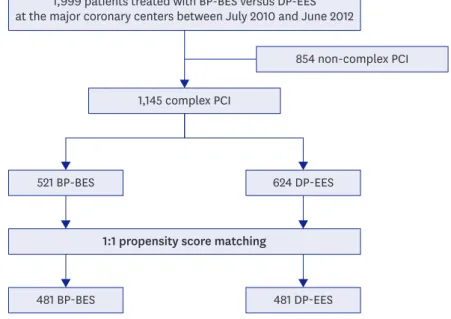
pregnancy; non-cardiac comorbidities with life expectancy of <1 year or that might result in protocol noncompliance according to the investigator's medical judgment; and inability to give informed consent. In the present study, patients enrolled in the SMART-DESK registry were stratified into 2 categories on the basis of the complexity of PCI (Figure 1). Complex PCI was defined as the inclusion of one of the following characteristics: unprotected left main trunk as target vessel, ≥2 lesions treated (stenting), total stent length >40 mm, minimal stent diameter ≤2.5 mm, or bifurcation as target lesion. Outcomes in patients receiving BP-BES were compared with those of patients receiving DE-EES after complex PCI. We also performed an analysis of procedural and clinical outcomes according to PCI complexity.
Procedure and medical treatment
All interventions were performed according to current practice guideline. All patients received loading doses of aspirin (300 mg) and clopidogrel (300–600 mg) before PCI unless antiplatelet medications had previously been prescribed. During the study period, P2Y12 receptor inhibitors other than clopidogrel were not available in Korea. Unfractionated heparin was administered during PCI in order to achieve an activated clotting time of 250 seconds or longer throughout the procedure. Balloon pre-dilation and post-dilation, choice of BP-BES or DP-EES, use of glycoprotein IIb/IIIa inhibitors, and intravascular imaging were performed at the operators' discretion. After the procedure, all patients were recommended to receive optimal pharmacologic therapy including statins, beta-blockers, or renin- angiotensin system blockade following the current guidelines. Duration of dual antiplatelet therapy (aspirin 100 mg/day plus clopidogrel 75 mg/day) was also at the operator's discretion.
Data collection and follow-up
Clinical, angiographic, procedural, and outcome data were collected prospectively by independent research personnel using a web-based reporting system. Patients were followed up at 1, 6, and 12 months after their index procedure and annually thereafter. Additional information was obtained by telephone contact or medical records, if necessary. This study
1,999 patients treated with BP-BES versus DP-EES at the major coronary centers between July 2010 and June 2012
854 non-complex PCI 1,145 complex PCI
521 BP-BES 624 DP-EES
1:1 propensity score matching
481 BP-BES 481 DP-EES
Figure 1. Study population.
BP-BES = biodegradable polymer biolimus-eluting stents; DP-EES = durable polymer everolimus-eluting stents;
PCI = percutaneous coronary intervention.
was conducted according to the principles outlined in the Declaration of Helsinki. This study was approved by ethics committees at each participating institution and all patients provided written informed consent for access to an institutional registry (IRB approved by Samsung Medical Center, 2010-05-085).
Outcomes and definitions
The primary outcome was target lesion failure (TLF) at 2 years after the index procedure, defined as a composite of cardiac death, target vessel-related myocardial infarction (TV- MI), or TLR. The secondary outcome included the individual components of the composite primary outcomes and definite or probable stent thrombosis at various time points. All deaths were considered cardiac unless a definite non-cardiac cause could be established.
Myocardial infarction (MI) was defined as elevated cardiac enzymes (troponin or myocardial band fraction of creatine kinase) greater than the upper limit of the normal value that occurred concurrent with ischemic symptoms or electrocardiography findings indicative of ischemia. TV-MI was defined as MI not clearly attributable to a non-target vessel. TLR was defined as revascularization within the stent or within a 5-mm border of stent deployment.
Definite or probable stent thrombosis was assessed according to the definition of the Academic Research Consortium.
9)Statistical analyses
Continuous variables were expressed as mean±standard deviation or median and
interquartile range, and compared using an independent t-test or the Mann-Whitney U test.
Categorical variables were summarized as numbers with percentages and compared using the χ
2test or Fisher's exact test. Cumulative event rates were estimated using the Kaplan- Meier method and compared using the Log-rank test. Adjusted hazard ratios (HRs) with 95%
confidence intervals (CIs) were derived from multiple imputation estimated Cox regressions adjusting for baseline variables associated with the clinical outcomes. For the DES-level analysis (BP-BES versus DP-EES), DP-EES was the reference category; for the PCI complexity analysis, non-complex PCI was the reference category. To match the patients for various clinical and angiographic characteristics, we used the propensity score matching method in a pairwise manner. The propensity score, which represents the probability of use of BP- BES, was estimated without regard to outcome using multiple logistic regression analysis including all the available covariates.
10)The pairs were matched using one-to-one individual matching between the BP-BES and DP-EES group. The matching was deemed satisfactory when the standardized mean differences were less than 10%. Within the propensity score matched population, the reduction in the risk of an adverse clinical outcome was compared using a clustered Cox regression model.
11)All tests were 2-tailed, and p values less than 0.05 were considered significant. R software version 3.3.2 (R Foundation for Statistical Computing, Vienna, Austria) was used for statistical analysis.
RESULTS
Baseline characteristics in the overall population
Of 1,999 patients included in the registry database, 1,145 (57.3%) underwent complex PCI.
Median age was 65 years (interquartile range, 56–72 years) with 69.1% male patients and
31.8% with diabetes. More than half of the patients (56.5%) presented with acute coronary
syndrome. The median follow-up was 748 days (interquartile range, 721–980 days).
BP-BES versus DP-EES in complex PCI
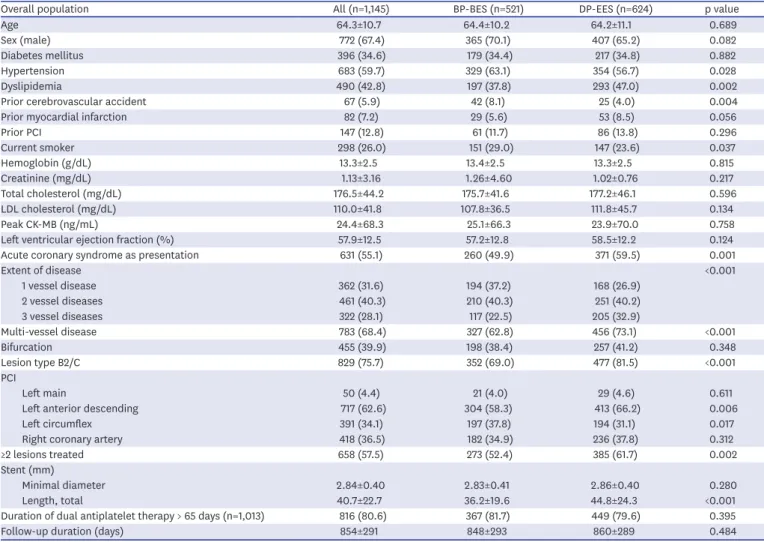
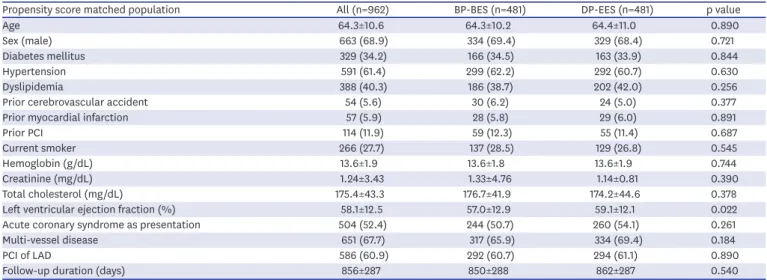
Of 1,145 patients undergoing complex PCI, 521 (45.5%) received BP-BES and 624 (54.5%) received DP-EES. Baseline characteristics according to stent type in patients undergoing complex PCI are reported in Table 1. Compared with the DP-EES group, the BP-BES group had a higher prevalence of hypertension, previous cerebrovascular accident, and current smoking. However, the incidence of dyslipidemia was lower in the BP-BES group than in the DP-EES group. In terms of clinical presentation, patients who were treated with BP- BES had less acute coronary syndrome than those who were treated with DP-EES. Multi- vessel disease was less common in the BP-BES group than in the DP-EES group. PCI for left anterior descending artery was performed less frequently in the BP-BES group than in the DP-EES group. Propensity score matching yielded 481 pairs with complex PCI, and baseline characteristics were well balanced between the 2 groups except for left ventricular ejection fraction on 2D-echocardiography, which showed a significant but small difference (57.0±12.9% for BP-BES versus 59.1±12.1% for DP-EES, p=0.022, Table 2).
The median follow-up was 751 days (interquartile range, 722–1,002 days). The administration of dual antiplatelet therapy was continued similarly between the 2 groups at 1 year (81.7%
Table 1. Baseline characteristics of overall population undergoing complex PCI
Overall population All (n=1,145) BP-BES (n=521) DP-EES (n=624) p value
Age 64.3±10.7 64.4±10.2 64.2±11.1 0.689
Sex (male) 772 (67.4) 365 (70.1) 407 (65.2) 0.082
Diabetes mellitus 396 (34.6) 179 (34.4) 217 (34.8) 0.882
Hypertension 683 (59.7) 329 (63.1) 354 (56.7) 0.028
Dyslipidemia 490 (42.8) 197 (37.8) 293 (47.0) 0.002
Prior cerebrovascular accident 67 (5.9) 42 (8.1) 25 (4.0) 0.004
Prior myocardial infarction 82 (7.2) 29 (5.6) 53 (8.5) 0.056
Prior PCI 147 (12.8) 61 (11.7) 86 (13.8) 0.296
Current smoker 298 (26.0) 151 (29.0) 147 (23.6) 0.037
Hemoglobin (g/dL) 13.3±2.5 13.4±2.5 13.3±2.5 0.815
Creatinine (mg/dL) 1.13±3.16 1.26±4.60 1.02±0.76 0.217
Total cholesterol (mg/dL) 176.5±44.2 175.7±41.6 177.2±46.1 0.596
LDL cholesterol (mg/dL) 110.0±41.8 107.8±36.5 111.8±45.7 0.134
Peak CK-MB (ng/mL) 24.4±68.3 25.1±66.3 23.9±70.0 0.758
Left ventricular ejection fraction (%) 57.9±12.5 57.2±12.8 58.5±12.2 0.124
Acute coronary syndrome as presentation 631 (55.1) 260 (49.9) 371 (59.5) 0.001
Extent of disease <0.001
1 vessel disease 362 (31.6) 194 (37.2) 168 (26.9)
2 vessel diseases 461 (40.3) 210 (40.3) 251 (40.2)
3 vessel diseases 322 (28.1) 117 (22.5) 205 (32.9)
Multi-vessel disease 783 (68.4) 327 (62.8) 456 (73.1) <0.001
Bifurcation 455 (39.9) 198 (38.4) 257 (41.2) 0.348
Lesion type B2/C 829 (75.7) 352 (69.0) 477 (81.5) <0.001
PCI
Left main 50 (4.4) 21 (4.0) 29 (4.6) 0.611
Left anterior descending 717 (62.6) 304 (58.3) 413 (66.2) 0.006
Left circumflex 391 (34.1) 197 (37.8) 194 (31.1) 0.017
Right coronary artery 418 (36.5) 182 (34.9) 236 (37.8) 0.312
≥2 lesions treated 658 (57.5) 273 (52.4) 385 (61.7) 0.002
Stent (mm)
Minimal diameter 2.84±0.40 2.83±0.41 2.86±0.40 0.280
Length, total 40.7±22.7 36.2±19.6 44.8±24.3 <0.001
Duration of dual antiplatelet therapy > 65 days (n=1,013) 816 (80.6) 367 (81.7) 449 (79.6) 0.395
Follow-up duration (days) 854±291 848±293 860±289 0.484
BP-BES = biodegradable polymer-biolimus-eluting stents; CK-MB = myocardial band fraction of creatine kinase; DP-EES = durable polymer-everolimus-eluting stents; LDL = low density lipoprotein; PCI = percutaneous coronary intervention.
versus 79.6%, p=0.395). The cumulative outcomes in patients undergoing complex PCI using BP-BES or DP-EES are summarized in Table 3. At 2 years, the primary outcome of TLF — a composite of cardiac death, TV-MI, or TLR — occurred in 15 patients in the BP-BES group and 29 patients in the DP-EES group. Cumulative rates for the primary outcome at 2 years were 3.5% for the BP-BES group and 5.1% for the DP-EES group (Log-rank p=0.121, Supplementary Figure 1A). There were no significant differences between the 2 treatments with respect to cardiac death (2.3% versus 2.4%, Log-rank p=0.703), TV-MI (0.4% versus 0.7%, Log-rank p=0.694), or definite or probable stent thrombosis (0.8% versus 0.5%, Log-rank p=0.708). However, TLR occurred less frequently in the BP-BES group compared with the DP-EES group (1.1% for BP-BES versus 2.7% for DP-EES, Log-rank p=0.044, Supplementary Figure 1B). After adjustment for several risk factors, the risks of TLF (adjusted HR, 0.607; 95% CI, 0.262–1.404; p=0.244), cardiac death (adjusted HR, 0.777;
95% CI, 0.258–2.337; p=0.653), TV-MI (adjusted HR, 0.665; 95% CI, 0.121–3.651; p=0.638), TLR (adjusted HR, 0.425; 95% CI, 0.154–1.177; p=0.100), or definite or probable stent
Table 2. Baseline characteristics of propensity score matched population undergoing complex PCIPropensity score matched population All (n=962) BP-BES (n=481) DP-EES (n=481) p value
Age 64.3±10.6 64.3±10.2 64.4±11.0 0.890
Sex (male) 663 (68.9) 334 (69.4) 329 (68.4) 0.721
Diabetes mellitus 329 (34.2) 166 (34.5) 163 (33.9) 0.844
Hypertension 591 (61.4) 299 (62.2) 292 (60.7) 0.630
Dyslipidemia 388 (40.3) 186 (38.7) 202 (42.0) 0.256
Prior cerebrovascular accident 54 (5.6) 30 (6.2) 24 (5.0) 0.377
Prior myocardial infarction 57 (5.9) 28 (5.8) 29 (6.0) 0.891
Prior PCI 114 (11.9) 59 (12.3) 55 (11.4) 0.687
Current smoker 266 (27.7) 137 (28.5) 129 (26.8) 0.545
Hemoglobin (g/dL) 13.6±1.9 13.6±1.8 13.6±1.9 0.744
Creatinine (mg/dL) 1.24±3.43 1.33±4.76 1.14±0.81 0.390
Total cholesterol (mg/dL) 175.4±43.3 176.7±41.9 174.2±44.6 0.378
Left ventricular ejection fraction (%) 58.1±12.5 57.0±12.9 59.1±12.1 0.022
Acute coronary syndrome as presentation 504 (52.4) 244 (50.7) 260 (54.1) 0.261
Multi-vessel disease 651 (67.7) 317 (65.9) 334 (69.4) 0.184
PCI of LAD 586 (60.9) 292 (60.7) 294 (61.1) 0.890
Follow-up duration (days) 856±287 850±288 862±287 0.540
BP-BES = biodegradable polymer-biolimus-eluting stents; DP-EES = durable polymer-everolimus-eluting stents; LAD = left anterior descending coronary artery;
PCI = percutaneous coronary intervention.
Table 3. Clinical outcomes of patients undergoing complex PCI
All BP-BES DP-EES p value* Adjusted HR 95% CI p value
Overall population
No. of patients 1,145 521 624
Cardiac death 24 (2.5) 10 (2.3) 14 (2.4) 0.703 0.777 0.258–2.337 0.653
TV-MI 6 (0.6) 2 (0.4) 4 (0.7) 0.694 0.665 0.121–3.651 0.638
TLR 21 (2.0) 5 (1.1) 16 (2.7) 0.044 0.425 0.154–1.177 0.100
ST 7 (0.7) 4 (0.8) 3 (0.5) 0.708 1.836 0.409–8.242 0.428
TLF 44 (4.7) 15 (3.5) 29 (5.1) 0.121 0.607 0.262–1.404 0.244
Propensity score matched population
No. of patients 962 481 481
Cardiac death 21 (2.6) 10 (2.5) 11 (2.5) 0.825 0.787 0.244–2.539 0.689
TV-MI 4 (0.5) 2 (0.5) 2 (0.4) >0.99 1.128 0.157–8.093 0.905
TLR 18 (2.1) 5 (1.1) 13 (2.9) 0.057 0.390 0.139–1.095 0.074
ST 5 (0.6) 4 (0.9) 1 (0.2) 0.374 4.342 0.484–38.927 0.189
TLF 38 (4.8) 15 (3.8) 23 (5.2) 0.185 0.578 0.246–1.359 0.209
TLF: cardiac death, TV-MI, and TLR.
BP-BES = biodegradable polymer-biolimus-eluting stents; CI = confidence interval; DP-EES = durable polymer-everolimus-eluting stents; HR = hazard ratio; ST = stent thrombosis; TLF = target lesion failure; TLR = target lesion revascularization; TV-MI = target vessel-related myocardial infarction.
*Log-rank p value.
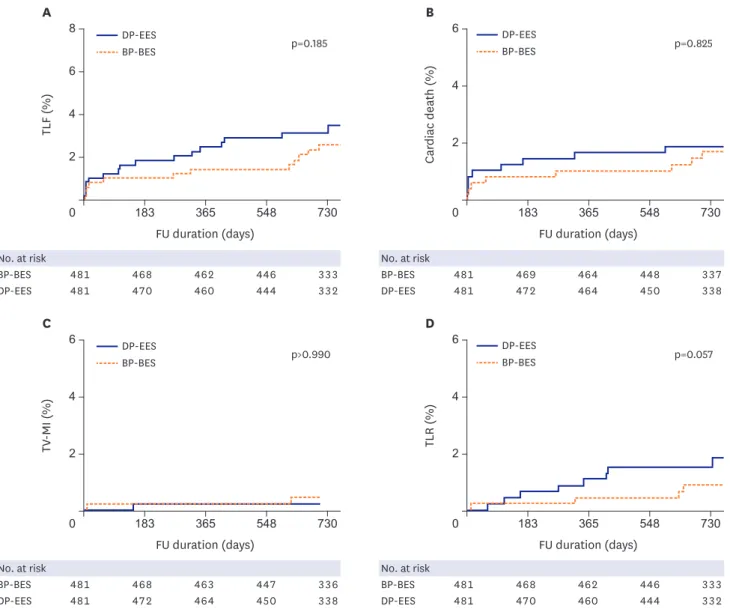
thrombosis (adjusted HR, 1.836; 95% CI, 0.409–8.242; p=0.428) did not differ significantly between stent groups (Table 3). Our main results remained after propensity score matched population analysis: the cumulative rate of TLF was not significantly different between the 2 groups (3.8% versus 5.2%, adjusted HR, 0.578; 95% CI, 0.246–1.359; p=0.209);
and the individual risks of cardiac death (2.5% versus 2.5%, adjusted HR, 0.787; 95% CI, 0.244–2.539; p=0.689), TV-MI (0.5% versus 0.4%, adjusted HR, 1.128; 95% CI, 0.157–8.093;
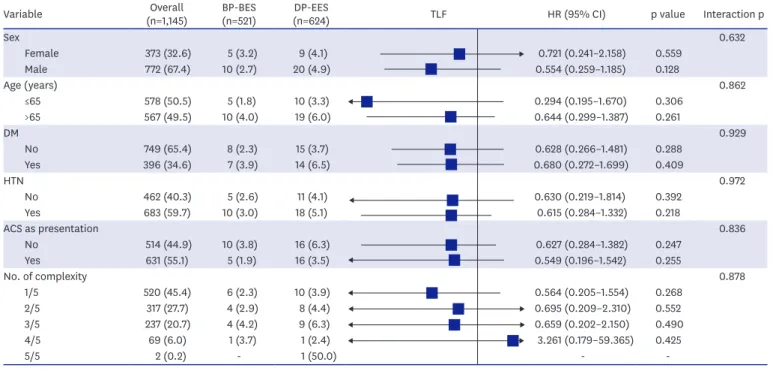
p=0.905), and TLR (1.1% versus 2.9%, adjusted HR, 0.390; 95% CI, 0.139–1.095; p=0.074), were also not significantly different (Table 3 and Figure 2). In the subgroup analyses, safety and the magnitude and direction of the effect on clinical outcomes of BP-BES compared with DP-EES were uniform among patients undergoing complex PCI, without evidence of interaction for the studied outcomes (Figure 3). In a landmark analysis between 6 months and 2 years, there was a strong trend for a lower rate of adjusted TLR (0.8% vs 2.0%;
adjusted HR, 0.375; 95% CI, 0.121–1.164; p=0.090) with BP-BES than DP-EES, but no difference in TLF (Figure 4).
No. at risk
BP-BES 481 468 462 446 333
DP-EES 481 470 460 444 332
No. at risk
BP-BES 481 468 463 447 336
DP-EES 481 472 464 450 338
No. at risk
BP-BES 481 469 464 448 337
DP-EES 481 472 464 450 338
No. at risk
BP-BES 481 468 462 446 333
DP-EES 481 470 460 444 332
FU duration (days) A
4
2
0 183 365 548 730
TLF (%)
6 8
FU duration (days) B
2
0 183 365 548 730
Cardiac death (%) 4 DP-EES 6
BP-BES
DP-EES BP-BES
p=0.185 p=0.825
FU duration (days) C
0 183 365 548 730
TV-MI (%)
FU duration (days) D
2
0 183 365 548 730
TLR (%)
4 6
2 4
6 DP-EES
BP-BES
DP-EES BP-BES
p>0.990 p=0.057
FU duration (days) A
4
2
0 183 365 548 730
TLF (%)
6 8
FU duration (days) B
2
0 183 365 548 730
Cardiac death (%)
4 DP-EES 6
BP-BES
DP-EES BP-BES
p=0.185 p=0.825
FU duration (days) C
0 183 365 548 730
TV-MI (%)
FU duration (days) D
2
0 183 365 548 730
TLR (%)
4 6
2 4
6 DP-EES
BP-BES
DP-EES BP-BES
p>0.990 p=0.057
Figure 2. Kaplan-Meier curves for clinical outcomes in the propensity score matched population. TLF: cardiac death, TV-MI, and TLR.
BP-BES = biodegradable polymer-biolimus-eluting stents; DP-EES = durable polymer-everolimus-eluting stents; FU = follow-up; TLF = target lesion failure; TLR = target lesion revascularization; TV-MI = target vessel-related myocardial infarction.
Complex PCI versus non-complex PCI
Among a total of 1,999 patients included in the registry database, 1,145 (57.3%) patients underwent complex PCI. Clinical, angiographic, and procedural characteristics according to PCI complexity are presented in Supplementary Table 1. The 2-year outcomes according to PCI complexity are reported in Supplementary Table 2 and Supplementary Figure 2. Compared
Variable Overall
(n=1,145) BP-BES
(n=521) DP-EES
(n=624) TLF HR (95% CI) p value Interaction p
Sex 0.632
Female 373 (32.6) 5 (3.2) 9 (4.1) 0.721 (0.241–2.158) 0.559
Male 772 (67.4) 10 (2.7) 20 (4.9) 0.554 (0.259–1.185) 0.128
Age (years) 0.862
≤65 578 (50.5) 5 (1.8) 10 (3.3) 0.294 (0.195–1.670) 0.306
>65 567 (49.5) 10 (4.0) 19 (6.0) 0.644 (0.299–1.387) 0.261
DM 0.929
No 749 (65.4) 8 (2.3) 15 (3.7) 0.628 (0.266–1.481) 0.288
Yes 396 (34.6) 7 (3.9) 14 (6.5) 0.680 (0.272–1.699) 0.409
HTN 0.972
No 462 (40.3) 5 (2.6) 11 (4.1) 0.630 (0.219–1.814) 0.392
Yes 683 (59.7) 10 (3.0) 18 (5.1) 0.615 (0.284–1.332) 0.218
ACS as presentation 0.836
No 514 (44.9) 10 (3.8) 16 (6.3) 0.627 (0.284–1.382) 0.247
Yes 631 (55.1) 5 (1.9) 16 (3.5) 0.549 (0.196–1.542) 0.255
No. of complexity 0.878
1/5 520 (45.4) 6 (2.3) 10 (3.9) 0.564 (0.205–1.554) 0.268
2/5 317 (27.7) 4 (2.9) 8 (4.4) 0.695 (0.209–2.310) 0.552
3/5 237 (20.7) 4 (4.2) 9 (6.3) 0.659 (0.202–2.150) 0.490
4/5 69 (6.0) 1 (3.7) 1 (2.4) 3.261 (0.179–59.365) 0.425
5/5 2 (0.2) - 1 (50.0) - -
Favor DP-EES Favor BP-BES 1
Figure 3. HRs for target lesion failure according to various subgroups in complex PCI. TLF: cardiac death, TV-MI, and TLR. Complexity was defined as left main PCI, bifurcation PCI, ≥2 lesions treated, total stent length >40 mm, or minimal stent diameter ≤2.5 mm.
ACS = acute coronary syndrome; BP-BES = biodegradable polymer-biolimus-eluting stents; CI = confidence interval; DM = diabetes mellitus; DP-EES = durable polymer-everolimus-eluting stents; HR = hazard ratio; HTN = hypertension; PCI = percutaneous coronary intervention; TLF = target lesion failure; TLR = target lesion revascularization; TV-MI = target vessel-related myocardial infarction.
No. at risk
BP-BES 521 506 498 482 345
DP-EES 624 609 596 576 411
No. at risk
BP-BES 521 506 498 482 358
DP-EES 624 609 596 576 424
FU duration (days) A
4 2
0 183 365 548 730
TLF (%)
6 10
8
FU duration (days) B
2
0 183 365 548 730
TLR (%)
4 DP-EES in complex PCI 6
BP-BES in complex PCI
DP-EES in complex PCI BP-BES in complex PCI Log-rank
p=0.207
Log-rank p=0.377 Adjusted HR, 0.426;
95% CI, 0.140–1.297;
p=0.133
Log-rank p=0.768
Log-rank p=0.097 Adjusted HR, 0.375;
95% CI, 0.121–1.164;
p=0.090
Figure 4. Kaplan-Meier curves for clinical outcomes of complex PCI in a landmark analysis between 6 months and 2 years. TLF: cardiac death, TV-MI, and TLR.
BP-BES = biodegradable polymer-biolimus-eluting stents; CI = confidence interval; DP-EES = durable polymer-everolimus-eluting stents; FU = follow-up; HR = hazard ratio, PCI = percutaneous coronary intervention; TLF = target lesion failure; TLR = target lesion revascularization; TV-MI = target vessel-related myocardial infarction.
with non-complex PCI, patients who underwent complex PCI showed a higher 2-year risk of TLR (adjusted HR, 3.209; 95% CI, 1.099–9.370; p=0.033). However, complex PCI was not independently associated with higher risks of TLF, cardiac death, or TV-MI. Similarly, no significant difference was observed between complex PCI and non-complex PCI with regard to definite or probable stent thrombosis (adjusted HR, 4.645; 95% CI, 0.568–38.014; p=0.152).
DISCUSSION
To the best of our knowledge, our investigation provides the first comparison of clinical outcomes for 2 second-generation DES designs, BP-BES versus DP-EES, in the treatment of complex coronary lesions from a multicenter real-world registry. The main findings of our study are: 1) compared with DP-EES, use of BP-BES was associated with similar safety and efficacy even in complex PCI; 2) the treatment effect was consistent after propensity score matching analysis and across various subgroups; and 3) procedural complexity was associated with increased long-term risk of TLR, but not with cardiac death, TV-MI, or stent thrombosis, after BP-BES and DP-EES implantations.
Although several randomized control trials comparing BP-BES with DP-EES showed that BP-BES have similar safety and efficacy profiles to DP-EES,
12)13)recent network meta-analyses have suggested that BP-BES have an excess risk for stent thrombosis or MI compared with second-generation DP-EES.
14-16)It was also reported that BP-BES might be associated with a higher risk of target vessel revascularization up to 3 years after stent deployment compared with DP-EES.
17)The BP-BES is a second-generation DES that consists of a stainless steel platform with a relatively thick strut and an abluminal coating of BP (poly-lactic acid) eluting A9.
18)The thickness of the stent strut may strongly influence the incidence of adverse events after stenting.
19)Compared with thinner struts, thicker strut platforms have been shown to increase platelet aggregation and inflammatory cell adhesion.
20)Especially in complex PCI, a thick stent strut may have an unfavorable influence on clinical outcomes relative to DES with thinner strut platforms. To date, however, there is a paucity of data evaluating clinical outcomes of BP-BES versus DP-EES for complex PCI. In the present study, although the BP-BES had a thicker stent strut than DP-EES (120 μm versus 89 μm) the safety and efficacy outcomes of the 2 DES were similar at 24 months after complex PCI. Optimal PCI techniques such as post-dilation and intracoronary imaging devices, and guideline-adherent medical therapies might mitigate the disadvantage of BP-BES in terms of strut thickness. In landmark analysis in the time window of 6 months to 2 years, patients undergoing PCI with BP-BES had a tendency to have lower risk of TLR than those undergoing PCI with DP-EES. This late benefit of BP-BES might be attributable to biocompatibility through polymer biodegradation, although the lower risk profile of the BP-BES group compared with the DP-EES group could be another explanation. It was reported that BP-BES showed a strong trend of lower inflammation score and had significantly lower fibrin and injury scores than DP-EES in histopathological assessments.
21)Taken together, the possible drawbacks of the thicker strut in BP-BES, which is associated with a higher risk of adverse clinical outcome, might be offset by the advantages of its BP.
The likelihood of treatment failure directly correlates with the complexity of underlying
coronary artery disease.
5)6)PCI for complex lesions (e.g., long lesions, small vessel disease,
bifurcations, or highly calcified lesions) is associated with a higher risk for under expansion,
malapposition, incomplete lesion coverage, and the likelihood of a slower or nonuniform
pattern of endothelialization compared with non-complex PCI.
22)The present study showed that the TLR rate was higher among complex PCI than non-complex PCI: the risk of TLR after complex PCI was approximately 3.6 times higher than that of non-complex PCI at 2 years.
However, the rates of hard outcomes such as cardiac death or TV-MI were similar between the 2 groups in the present study. More importantly, both BP-BES and DP-EES were associated with exceedingly low rates of definite or probable stent thrombosis at 2 years of follow-up, even in complex procedures (0.6%). These findings suggest that procedural complexity does not influence the safety profile of second-generation DES. This is consistent with previous analysis, which reported that for patients with unprotected left main disease, high anatomical complexity as defined by a SYNergy between PCI with TAXus and Cardiac Surgery (SYNTAX) score ≥33 is not predictive of cardiac death, MI, or stroke after PCI.
23)Several important limitations of the present analysis should be noted. First, procedural complexity was defined according to the available variables in the dataset. Although these include most of the high-level complexity scenarios encountered in daily clinical practice, coronary anatomy lesion complexity characteristics were site-reported and not reviewed by an angiographic core laboratory, and the definition of complex PCI in this study was too arbitrary. Also, some important variables, such as SYNTAX score, Medina class of bifurcation, or use of rotational atherectomy, were not available, and therefore not included in the present definition. Second, the study design was non-randomized, observational, and post-hoc, which may have significantly affected results due to confounding factors. Although we performed propensity score matching analysis to adjust for potential confounding factors, we did not correct for all possible and unmeasured variables. Because of subgroup analysis nature of the present study design, this analysis was not designed to address the causal versus associative interrelation of complexity factors with adverse outcomes. Therefore, the results of the present study should be considered as hypothesis generating only, being a post hoc analysis of a trial. A third limitation is that clinical outcomes of BP-BES or DP-EES in the present study were relatively low, and the power of the present study was inadequate to draw any definite conclusion, especially for stent thrombosis. Despite the all-comer nature of the study population the event rates were very low, which may raise the question of under-reporting. One possible reason for the low event rates is that our study population may have tended to be at lower risk. For example, mean left ventricular ejection fraction on 2D-echocardiography was 57.9±12.5% in the present population. In addition, most of the participating patients were treated with prolonged (> 12 months) dual antiplatelet therapies, which may have contributed to the low incidence of adverse clinical outcomes. There also may be an ethnic or genetic protective factor, as trials done in East Asian populations have consistently reported lower event rates.
24)In addition, the present sub-analysis was not pre-specified, and numbers are modest, compromising particularly the robustness of individual endpoint analyses. Finally, the current report was limited to a 2-year follow-up after stent implantation. A median follow-up duration of 2 years may have been insufficient to assess long-term safety and efficacy after BP-BES implantation compared with DP-EES implantation. Therefore, a longer duration of patient assessment is warranted because potential benefits of the BP-BES are expected due to complete polymer degradation at long- term follow-up.
In conclusion, 2-year clinical outcomes of BP-BES are similar to those of the current golden
standard DP-EES in patients undergoing complex PCI. Our data suggest that the results of
previous randomized controlled trials of BP-BES versus DP-EES can be extended to cases of
complex PCI, and that the use of BP-BES is adequate for a high-risk subset of patients.
SUPPLEMENTARY MATERIALS
Supplementary Table 1
Baseline clinical and angiographic characteristics in overall population Click here to view
Supplementary Table 2
Clinical outcomes according to lesion complexity in overall population Click here to view
Supplementary Figure 1
Kaplan-Meier curves for clinical outcomes between BP-BES versus DP-EES after complex PCI.
TLF: cardiac death, TV-MI, and TLR.
Click here to view
Supplementary Figure 2
Kaplan-Meier curves for clinical outcomes of the overall population between complex versus non-complex PCI. TLF: cardiac death, TV-MI, and TLR.
Click here to view
REFERENCES
1. Park DW, Park SW. Stent thrombosis in the era of the drug-eluting stent. Korean Circ J 2005;35:791-4.
CROSSREF
2. Minha S, Barbash IM, Dvir D, et al. Second-generation everolimus-eluting stents compared to first- generation drug-eluting stents in patients treated for multivessel disease. J Interv Cardiol 2013;26:561-9.
PUBMED | CROSSREF
3. Grundeken MJ, Wykrzykowska JJ, Ishibashi Y, et al. First generation versus second generation drug- eluting stents for the treatment of bifurcations: 5-year follow-up of the LEADERS all-comers randomized trial. Catheter Cardiovasc Interv 2016;87:E248-60.
PUBMED | CROSSREF
4. Vlachojannis GJ, Smits PC, Hofma SH, et al. Biodegradable polymer biolimus-eluting stents versus durable polymer everolimus-eluting stents in patients with coronary artery disease: final 5-year report from the COMPARE II trial (abluminal biodegradable polymer biolimus-eluting stent versus durable polymer everolimus-eluting stent). JACC Cardiovasc Interv 2017;10:1215-21.
PUBMED | CROSSREF
5. Im E, Kim GS, Shin DH, et al. Long-term clinical outcomes of a biodegradable polymer-based biolimus- eluting stent. J Interv Cardiol 2016;29:162-7.
PUBMED | CROSSREF
6. Cavalcante R, Sotomi Y, Mancone M, et al. Impact of the SYNTAX scores I and II in patients with diabetes and multivessel coronary disease: a pooled analysis of patient level data from the SYNTAX, PRECOMBAT, and BEST trials. Eur Heart J 2017;38:1969-77.
PUBMED | CROSSREF
7. Hausleiter J, Kastrati A, Mehilli J, et al. Impact of lesion complexity on the capacity of a trial to detect differences in stent performance: results from the ISAR-STEREO trial. Am Heart J 2003;146:882-6.
PUBMED | CROSSREF
8. Lee DH, Park TK, Song YB, et al. Clinical outcomes of biodegradable polymer biolimus-eluting BioMatrix stents versus durable polymer everolimus-eluting Xience stents. PLoS One 2017;12:e0183079.
PUBMED | CROSSREF
9. Cutlip DE, Windecker S, Mehran R, et al. Clinical end points in coronary stent trials: a case for standardized definitions. Circulation 2007;115:2344-51.
PUBMED | CROSSREF
10. Ho DE, Imai K, King G, Stuart EA. MatchIt: nonparametric preprocessing for parametric causal inference. J Stat Softw 2011;42:1-28.
CROSSREF
11. Austin PC. The use of propensity score methods with survival or time-to-event outcomes: reporting measures of effect similar to those used in randomized experiments. Stat Med 2014;33:1242-58.
PUBMED | CROSSREF
12. Smits PC, Hofma S, Togni M, et al. Abluminal biodegradable polymer biolimus-eluting stent versus durable polymer everolimus-eluting stent (COMPARE II): a randomised, controlled, non-inferiority trial.
Lancet 2013;381:651-60.
PUBMED | CROSSREF
13. Kaiser C, Galatius S, Jeger R, et al. Long-term efficacy and safety of biodegradable-polymer biolimus- eluting stents: main results of the Basel Stent Kosten-Effektivitäts Trial-PROspective Validation Examination II (BASKET-PROVE II), a randomized, controlled noninferiority 2-year outcome trial.
Circulation 2015;131:74-81.
PUBMED | CROSSREF
14. Bangalore S, Toklu B, Amoroso N, et al. Bare metal stents, durable polymer drug eluting stents, and biodegradable polymer drug eluting stents for coronary artery disease: mixed treatment comparison meta-analysis. BMJ 2013;347:f6625.
PUBMED | CROSSREF
15. Navarese EP, Tandjung K, Claessen B, et al. Safety and efficacy outcomes of first and second generation durable polymer drug eluting stents and biodegradable polymer biolimus eluting stents in clinical practice: comprehensive network meta-analysis. BMJ 2013;347:f6530.
PUBMED | CROSSREF
16. Kang SH, Park KW, Kang DY, et al. Biodegradable-polymer drug-eluting stents vs. bare metal stents vs.
durable-polymer drug-eluting stents: a systematic review and Bayesian approach network meta-analysis.
Eur Heart J 2014;35:1147-58.
PUBMED | CROSSREF
17. Sakurai R, Burazor I, Bonneau HN, Kaneda H. Long-term outcomes of biodegradable polymer biolimus- eluting stents versus durable polymer everolimus-eluting stents: a meta-analysis of randomized controlled trials. Int J Cardiol 2016;223:1066-71.
PUBMED | CROSSREF
18. Grube E, Buellesfeld L. BioMatrix Biolimus A9-eluting coronary stent: a next-generation drug-eluting stent for coronary artery disease. Expert Rev Med Devices 2006;3:731-41.
PUBMED | CROSSREF
19. Pache J, Kastrati A, Mehilli J, et al. Intracoronary stenting and angiographic results: strut thickness effect on restenosis outcome (ISAR-STEREO-2) trial. J Am Coll Cardiol 2003;41:1283-8.
PUBMED | CROSSREF
20. Kolandaivelu K, Swaminathan R, Gibson WJ, et al. Stent thrombogenicity early in high-risk interventional settings is driven by stent design and deployment and protected by polymer-drug coatings. Circulation 2011;123:1400-9.
PUBMED | CROSSREF
21. Sim DS, Jeong MH, Park DS, et al. Effect of pretreatment of ezetimibe/simvastatin on arterial healing and endothelialization after drug-eluting stent implantation in a porcine coronary restenosis model. Korean Circ J 2015;45:110-6.
PUBMED | CROSSREF
22. Giustino G, Baber U, Aquino M, et al. Safety and efficacy of new-generation drug-eluting stents in women undergoing complex percutaneous coronary artery revascularization: from the win-des collaborative patient-level pooled analysis. JACC Cardiovasc Interv 2016;9:674-84.
PUBMED | CROSSREF
23. Migliorini A, Valenti R, Parodi G, et al. Angiographic and clinical outcomes after everolimus-eluting stenting for unprotected left main disease and high anatomic coronary complexity. JACC Cardiovasc Interv 2016;9:1001-7.
PUBMED | CROSSREF
24. Gwon HC, Hahn JY, Park KW, et al. Six-month versus 12-month dual antiplatelet therapy after implantation of drug-eluting stents: the Efficacy of Xience/Promus Versus Cypher to Reduce Late Loss After Stenting (EXCELLENT) randomized, multicenter study. Circulation 2012;125:505-13.
PUBMED | CROSSREF