A Prospective, Randomized Comparison of Promus Everolimus- Eluting and TAXUS Liberte Paclitaxel-Eluting Stent Systems in Patients with Coronary Artery Disease Eligible for Percutaneous Coronary Intervention: The PROMISE Study
We aimed comparing two-year clinical outcomes of the Everolimus-Eluting Promus and Paclitaxel-Eluting TAXUS Liberte stents used in routine clinical practice. Patients with objective evidence of ischemia and coronary artery disease eligible for PCI were
prospectively randomized to everolimus-eluting stent (EES) or paclitaxel-eluting stent (PES) groups. The primary end-point was ischemia-driven target vessel revascularization (TVR) at 2 yr after intervention, and the secondary end-point was a major adverse cardiac event (MACE), such as death, myocardial infarction (MI), target lesion revascularization (TLR), TVR or stent thrombosis. A total of 850 patients with 1,039 lesions was randomized to the EES (n = 425) and PES (n = 425) groups. Ischemic-driven TVR at 2 yr was 3.8% in the PES and 1.2% in the EES group (P for non-inferiority = 0.021). MACE rates were significantly different; 5.6% in PES and 2.5% in EES (P = 0.027). Rates of MI (0.8% in PES vs 0.2% in EES, P = 0.308), all deaths (1.5% in PES vs 1.2% in EES, P = 0.739) and stent thrombosis (0.3% in PES vs 0.7% in EES, P = 0.325) were similar. The clinical outcomes of EES are superior to PES, mainly due to a reduction in the rate of ischemia-driven TVR.
Key Words: Everolimus-Eluting Stent; Paclitaxel-Eluting Stent Ung Kim,1 Chan-Hee Lee,1
Jung-Hwan Jo,1 Hyun-Wook Lee,1 Yoon-Jung Choi,1 Jang-Won Son,1 Sang-Hee Lee,1 Jong-Seon Park,1 Dong-Gu Shin,1 Young-Jo Kim,1 Myung-Ho Jeong,2 Myung-Chan Cho,3 Jang-Ho Bae,4 Jae-Hwan Lee,5 Tae-Soo Kang,6 Kyung-Tae Jung,7 Kyung-Ho Jung,8 Seung-Wook Lee,9 Jang-Hyun Cho,10 Won Kim,11 Seung-Ho Hur,12 Ki-Sik Kim,13 Heon-Sik Park,14 Moo-Hyun Kim,15 Jin-Yong Hwang,16 Doo-Il Kim,17 and Tae-Ik Kim18
1Division of Cardiology, Yeungnam University Medical Center, Daegu; 2Division of Cardiology, Chonnam National University, Gwangju; 3Division of Cardiology, Chungbuk National University Hospital, Cheongju; 4Division of Cardiology, Kunyang University Hospital, Daejeon; 5Division of Cardiology, Chungnam National University Hospital, Daejeon;
6Division of Cardiology, Dankuk Unversity Hospital, Cheonan; 7Division of Cardiology, Eulji University Hospital, Daejeon; 8Division of Cardiology, Wonkwang University Hospital, Iksan; 9Division of Cardiology, Gwangju Christian Hospital, Gwangju;
10Division of Cardiology, St. Carollo Hospital, Sooncheon; 11Division of Cardiology, Kwangju Veterans Hospital, Gwangju; 12Division of Cardiology, Keimyung Univerisity Dongsan Hospital, Daegu;
13Division of Cardiology, Daegu Catholic University Hospital, Daegu; 14Division of Cardiology, Kyungpook National University Hospital, Daegu; 15Division of Cardiology, Donga University Hospital, Busan;
16Division of Cardiology, Kyungsang National University Hospital, Jinju; 17Division of Cardiology, Inje University Haeundae Paik Hospital, Busan;
18Division of Cardiology, Maryknoll Medical Center, Busan, Korea
Received: 19 June 2013 Accepted: 23 September 2013 Address for Correspondence:
Young-Jo Kim, MD
Division of Cardiology, Yeungnam University Medical Center, 170 Hyunchung-ro, Nam-gu, Daegu 705-717, Korea Tel: +82.53-620-3313, Fax: +82.53-621-3310 E-mail: [email protected]
This work was financially supported by Abbott (Abbott Vascular, Abbott Park, IL, USA) and Boston Scientific (Boston Scientific, Natick, MA, USA) in Korea (2008, DCR-08-02).
http://dx.doi.org/10.3346/jkms.2013.28.11.1609 • J Korean Med Sci 2013; 28: 1609-1614 Cardiovascular Disorders
INTRODUCTION
First generation drug-eluting stent (DES) dramatically reduced in-stent restenosis (ISR) by inhibiting neointimal hyperplasia (1, 2). The principal goal of second generation DES, including the everolimus-eluting stent (EES), was to overcome these con- cerns regarding issues such as stent thrombosis while main- taining efficacy. A considerable amount of comparative data is available concerning the clinical results of second generation DES and first generation DES, such as, the TAXUS express stent.
However, long-term clinical data about the everolimus-eluting stent and the paclitaxel-eluting stent are inadequate. Accord- ingly, the aim of this study was to evaluate the procedural out- comes and short and long-term clinical outcomes of the PRO- MUSTM Everolimus-eluting stent and to compare these with those of the TAXUS LiberteTM Paclitaxel-eluting stent.
MATERIALS AND METHODS Study population
This study was designed as a prospective, randomized, open la- bel, two arm, multicenter trial to compare the PROMUSTM Eve- rolimus-eluting stent (EES; Abbott Vascular, Abbott Park, IL, USA) and the Taxus LiberteTM Paclitaxel-eluting stent (PES; Bos- ton Scientific, Natick, MA, USA) in patients with coronary arter- ies of ≥ 2.5 and ≤ 3.75 mm of diameter with a lesion of length
≤ 46 mm (estimated visually) eligible for percutaneous coro- nary intervention (PCI).
Eight hundred and fifty (850) patients were enrolled at 18 centers in Korea, and randomized on a 1:1 basis to PromusTM EES (n = 425) or TAXUS LiberteTM PES (n = 425) groups. Pa-
tients aged over 18 yr and eligible for PCI were included. The exclusion criteria applied were; any planned treatment of the target vessel other than with a drug-eluting stent, ST-segment elevation myocardial infarction development within 7 days pri- or to the procedure, a history of Paclitaxel or Everolimus allergy or of allergy to stent polymers or metals, serious hepatic or renal dysfunction, a history of a malignant tumor within the previous 5 yr, a history of PCI treatment within the previous year, chronic total occlusion (CTO), a left main coronary artery lesion (steno- sis > 50%), a bifurcation lesion requiring elective stenting of the branch lesion (side branch vessel > 2.5 mm in diameter), in- stent restenosis of a lesion implanted with a bare-metal stent or drug-eluting stent, and a target lesion in saphenous vein graft.
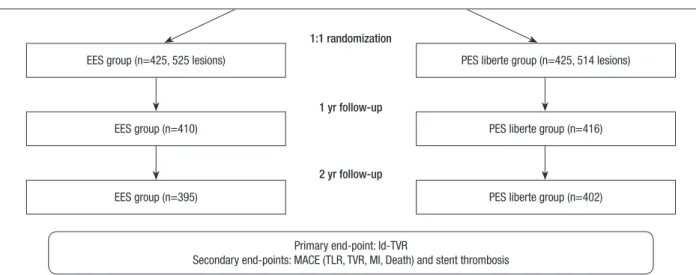
The study hypothesis was that the PROMUS stent would be non-inferior to the Taxus Liberte stent in terms of target vessel revascularization (TVR) at 2 yr after intervention. Initial study design and study flow chart for 2 yr were shown in Fig. 1.
Procedures and medication
PCI was performed using standard techniques. All patients re- ceived ≥ 300 mg aspirin orally and a loading dose of 300 mg of clopidogrel before coronary angiography (CAG), or after PCI for emergency cases. After PCI, patients were routinely treated with aspirin 100 mg/day, clopidogrel 75 mg/day, and/or cilo- stazol 200 mg/day at operator’s discretion. Patients were ad- vised to maintain life-long aspirin therapy. Clopidogrel dura- tion was at operator’s discretion based on considerations of le- sion and procedural complexity.
Study end-points and definitions
Primary end-points were ischemia-driven TVR based on the
Fig. 1. Initial study design and study flow chart. EES, everolimus-eluting stent; PES, paclitaxel-eluting stent; Id-TVR, ischemia-driven target vessel revascularization; MACE, ma- jor adverse cardiac events; TLR, target lesion revascularization; MI, myocardial death.
Primary end-point: Id-TVR
Secondary end-points: MACE (TLR, TVR, MI, Death) and stent thrombosis Eligible patients enrollment (n=850)
Coronary arteries of ≥ 2.5 and ≤ 3.75 mm of diameter with a lesion of length ≤ 46 mm (estimated visually) eligible for percutaneous coronary intervention (PCI).
EES group (n=425, 525 lesions) PES liberte group (n=425, 514 lesions)
EES group (n=410) PES liberte group (n=416)
EES group (n=395) PES liberte group (n=402)
1:1 randomization
1 yr follow-up
2 yr follow-up
presence of symptoms, positive functional test, or restenosis by angiography at 2 yr after PCI. Secondary endpoints were target lesion revascularization (TLR), myocardial infarction, death, and a composite of major adverse cardiac events (MACE) and stent thrombosis (ST). MACEs included all deaths, myocardial infarction (MI), and ischemia-driven target vessel revascular- ization (TVR) at 2 yr. MI was defined as typical ischemic chest pain, ST-segment, or T-wave abnormalities with a creatine ki- nase-MB level ≥ 2 times higher than the reference value, with- out any new pathologic Q waves. Periprocedural MI was not in- cluded as clinical events in this study. TLR was defined as surgi- cal or percutaneous re-intervention driven by significant (> 50%) luminal narrowing within a stent or with 5 mm proximal or dis- tal to a stent in the presence of angina symptoms or objective evidence of ischemia. Ischemia-driven TVR was defined as the need for emergency or elective coronary artery bypass grafting or repeat PCI in a target vessel due to chest pain or a positive test result for ischemia (exercise stress test, stress echocardiogram, 24-hr Holter monitoring, evidence of ST segment depression or increase in > 1 electrocardiogram lead at rest, or a radionuclide study showing a reversible defect). ST was defined as previously described by the Academic Research Consortium (3).
Statistical analysis
Results are expressed as means ± SDs or numbers (%). The chi- square test was used to compare categorical variables, and the Student’s t-test was used to compare continuous variables. P values of < 0.05 were considered statistically significant. Statis- tical was used to determine if TVR at 2 yr after index PCI with the Promus everolimus-eluting stent was non-inferior to the
TAXUS Liberte paclitaxel-eluting stent in all study subjects. Based on the results of TAXUS trials, such as, the ATLAS, SPIRIT I and SPIRIT II trials (4-6), we assumed a TVR rate of 8% in both arms.
Calculation to the sample size was based on a margin of non- inferiority for TVR 5%. Using a 1-sided significance level of 5%, we estimated that 365 patients per group were needed to detect this difference with a statistical power of 80%. Thus, in the ex- pectation that approximately 15% of patients would be lost to follow-up, the total sample size was estimated to be 858 (429 patients per group). Data were analyzed using SPSS ver. 12.0 for Windows (SPSS, Chicago, IL, USA).
Ethics statement
This study was approved by the local institutional review board of the Yeungnam University Medical Center (IRB No. DCR-08- 02) and was in accord with the Declaration of Helsinki. Informed consent was obtained from all patients.
RESULTS
Baseline and procedural characteristics
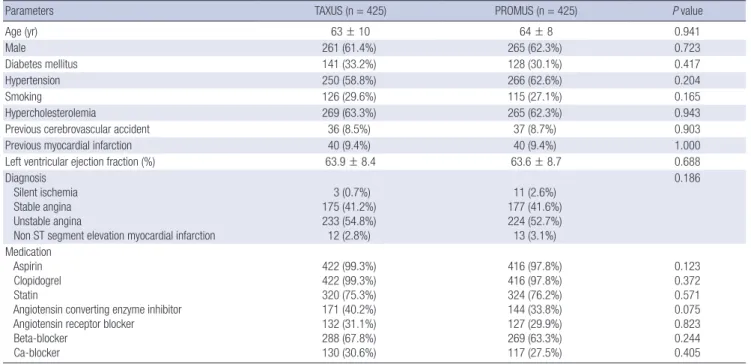
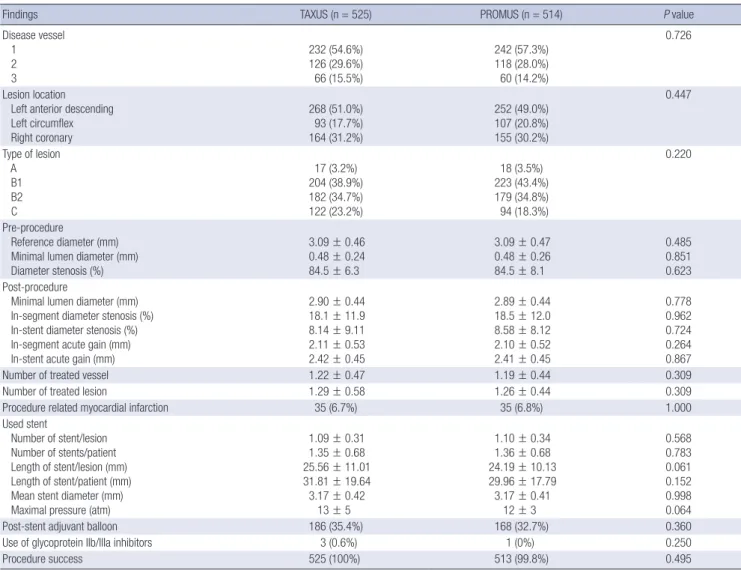
Group baseline characteristics were not statistically different (Table 1). Angiographic and procedural findings are summa- rized in Table 2. A considerable proportion of patients had a single vessel affected with a left anterior descending artery le- sion. Pre- and post-procedural findings were similar in the two groups, as were rates of procedure-related myocardial infarc- tion (6.7% in the PES group vs 6.8% in the EES group, P = 1.000).
Stent length in the PES group tended to be longer (25.5 ± 11.0 mm in PES vs 24.1 ± 10.1 mm in EES, P = 0.061). Procedural
Table 1. Baselline characteristics
Parameters TAXUS (n = 425) PROMUS (n = 425) P value
Age (yr) 63 ± 10 64 ± 8 0.941
Male 261 (61.4%) 265 (62.3%) 0.723
Diabetes mellitus 141 (33.2%) 128 (30.1%) 0.417
Hypertension 250 (58.8%) 266 (62.6%) 0.204
Smoking 126 (29.6%) 115 (27.1%) 0.165
Hypercholesterolemia 269 (63.3%) 265 (62.3%) 0.943
Previous cerebrovascular accident 36 (8.5%) 37 (8.7%) 0.903
Previous myocardial infarction 40 (9.4%) 40 (9.4%) 1.000
Left ventricular ejection fraction (%) 63.9 ± 8.4 63.6 ± 8.7 0.688
Diagnosis Silent ischemia Stable angina Unstable angina
Non ST segment elevation myocardial infarction
3 (0.7%) 175 (41.2%) 233 (54.8%) 12 (2.8%)
11 (2.6%) 177 (41.6%) 224 (52.7%) 13 (3.1%)
0.186
Medication Aspirin Clopidogrel Statin
Angiotensin converting enzyme inhibitor Angiotensin receptor blocker Beta-blocker
Ca-blocker
422 (99.3%) 422 (99.3%) 320 (75.3%) 171 (40.2%) 132 (31.1%) 288 (67.8%) 130 (30.6%)
416 (97.8%) 416 (97.8%) 324 (76.2%) 144 (33.8%) 127 (29.9%) 269 (63.3%) 117 (27.5%)
0.123 0.372 0.571 0.075 0.823 0.244 0.405
Table 3. Cumulative clinical outcomes
Outcomes TAXUS
(n = 410) PROMUS
(n = 416) P value 1-yr outcomes
Major adverse cardiac events Myocardial infarction All death
Target lesion revascularization Target vessel revascularization
16 (3.9%) 3 (0.7%) 3 (0.7%) 6 (1.5%) 10 (2.4%)
8 (1.9%) 0 4 (1.0%) 4 (1.0%) 4 (1.0%)
0.090 0.080 0.510 0.100 0.719 2-yr outcomes
Major adverse cardiac events Myocardial infarction All death
Target lesion revascularization Target vessel revascularization Stent thrombosis
(n = 395) 22 (5.6%) 3 (0.8%) 6 (1.5%) 14 (3.5%) 15 (3.8%) 1 (0.3%)
(n = 402) 10 (2.5%) 1 (0.2%) 5 (1.2%) 5 (1.2%) 5 (1.2%) 3 (0.7%)
0.027 0.308 0.739 0.037 0.021 0.325 Table 2. Angiographic and procedural findings per lesion
Findings TAXUS (n = 525) PROMUS (n = 514) P value
Disease vessel 1 2 3
232 (54.6%) 126 (29.6%) 66 (15.5%)
242 (57.3%) 118 (28.0%) 60 (14.2%)
0.726
Lesion location Left anterior descending Left circumflex Right coronary
268 (51.0%) 93 (17.7%) 164 (31.2%)
252 (49.0%) 107 (20.8%) 155 (30.2%)
0.447
Type of lesion A B1 B2 C
17 (3.2%) 204 (38.9%) 182 (34.7%) 122 (23.2%)
18 (3.5%) 223 (43.4%) 179 (34.8%) 94 (18.3%)
0.220
Pre-procedure
Reference diameter (mm) Minimal lumen diameter (mm) Diameter stenosis (%)
3.09 ± 0.46 0.48 ± 0.24 84.5 ± 6.3
3.09 ± 0.47 0.48 ± 0.26 84.5 ± 8.1
0.485 0.851 0.623 Post-procedure
Minimal lumen diameter (mm) In-segment diameter stenosis (%) In-stent diameter stenosis (%) In-segment acute gain (mm) In-stent acute gain (mm)
2.90 ± 0.44 18.1 ± 11.9 8.14 ± 9.11 2.11 ± 0.53 2.42 ± 0.45
2.89 ± 0.44 18.5 ± 12.0 8.58 ± 8.12 2.10 ± 0.52 2.41 ± 0.45
0.778 0.962 0.724 0.264 0.867
Number of treated vessel 1.22 ± 0.47 1.19 ± 0.44 0.309
Number of treated lesion 1.29 ± 0.58 1.26 ± 0.44 0.309
Procedure related myocardial infarction 35 (6.7%) 35 (6.8%) 1.000
Used stent
Number of stent/lesion Number of stents/patient Length of stent/lesion (mm) Length of stent/patient (mm) Mean stent diameter (mm) Maximal pressure (atm)
1.09 ± 0.31 1.35 ± 0.68 25.56 ± 11.01 31.81 ± 19.64 3.17 ± 0.42
13 ± 5
1.10 ± 0.34 1.36 ± 0.68 24.19 ± 10.13 29.96 ± 17.79 3.17 ± 0.41
12 ± 3
0.568 0.783 0.061 0.152 0.998 0.064
Post-stent adjuvant balloon 186 (35.4%) 168 (32.7%) 0.360
Use of glycoprotein IIb/IIIa inhibitors 3 (0.6%) 1 (0%) 0.250
Procedure success 525 (100%) 513 (99.8%) 0.495
success was achieved in 100% in the PES group and in 99.8% in the EES group (P = 0.495).
One-year clinical outcomes
The overall clinical follow-up rate at 1 yr after PCI was 97.1%
(826/850). Cumulative clinical outcomes at 1 yr after-PCI are summarized in Table 3. Total MACE rates were 3.9% in the PES group and 1.9% in the EES group (P = 0.090). All death rates were similar (0.7% in PES vs 1.0% in EES, P = 0.719) and MI rates were non-significantly different (0.7% in PES vs 0% in EES, P = 0.080). Rates of TLR (1.5% in PES vs 1.0% in EES, P = 0.510) and of ischemia-driven TVR (2.4% in PES vs 1.0% in EES, P = 0.100) were not significantly different. Stent thrombosis rates were similar in the two groups (0% in PES vs 0.7% in EES, P = 0.666).
Two-year clinical outcomes
The two-year clinical follow-up was completed by 93.7% (797/
850); results are summarized in Table 3. Ischemia driven TVR at 2 yr (the primary end-point) was 3.8% in the PES group, and
this was non-inferior to the 1.2% found for the EES group (P for non-inferiority = 0.021). Moreover, TLR rates were higher in the PES than in the EES group (3.5% vs 1.2%, P = 0.037). The cumu- lative MACE rate at 2 yr was higher in the PES group (5.6% vs
2.5%, P = 0.027). However, rates of MI (0.8% for PES vs 0.2% for EES, P = 0.308) and all deaths (1.5% for PES vs 1.2% for EES, P = 0.739) were similar. Stent thrombosis rates at 2 yr were also similar in the two groups (0.3% for PES vs 0.7% for EES, P = 0.325).
One definite stent thrombosis developed in the PES group, two possible STs in the EES group, and one probable ST in the EES group. Three STs were late and one was very late over 1 yr. Fig. 2 shows that ischemia-driven TVR-free survivals were significant- ly different in the two groups (P = 0.023). Fig. 3 shows that group MACE-free survivals at 2 yr were also significantly different (P = 0.030)
DISCUSSION
The PROMISE study shows that the clinical outcomes of Pro- musTM EES at 2 yr after PCI are non-inferior to those of Taxus LiberteTM PES, and that this was mainly due to a reduction in the ischemia-driven TVR rate. Cumulative MACE at 2 yr was excellent for both stents and death and MI rates were no differ- ent in the two groups. Furthermore, group ST rates were similar.
Second generation DES, such as EES, were developed due to safety concerns such as stent thrombosis development. Many trials have compared clinical outcomes between different types of stent, but to date, none of studies has given correct answers.
Nevertheless, but TLR, TVR and stent thrombosis rates have decreased significantly as compared with first generation DES, especially in diabetes patients (7-9).
Recently the results of the retrospective REWARD TLX trial were published. It was found that mortality rates were similar for the Xience V EES and Taxus Liberte PES (10). However, in terms of composite efficacy and safety, EES exceeded PES. The present study also showed mortality rates were no different in the two groups, but in terms of ischemia-driven TVR, EES pro- duced better results than PES. The COMPARE study showed
that EES produced better MACE associated clinical outcomes, such as, for stent thrmobosis, MI, and TLR, than the TAXUS Liberte PES in non-selected patients (8). Contrary to the 1 yr follow-up in the COMPARE study, we found that the beneficial effects of EES continued for 2 yr, especially with respect to isch- emia-driven TVR and TLR. In the COMPARE study, the MI rate was significantly lower in the EES group than in the PES group, and this was attributed due to a significant lower rate of early stent thrombosis. In the present study, 4 cases of ST occurred.
One definite ST was observed in the Taxus Liberte PES group and 3 (two possible and one probable) in the Promus EES group.
These four cases involving three cases of late ST and one of very late ST, but no case of acute or sub-acute ST was encountered.
As was mentioned in the report issued on the REWARDS TLX trial, an early high rate of ST could be associated with technical procedural issues or complex lesions (11).
In the present study, rates of MACE (5.6% in the PES group and 2.5% in the EES group) were lower than those found in pre- vious studies (6, 8, 10, 12). For example, in the REWARD TLX trial, MACE rates were 7.8% in the EES group and 10.8% in the PES Liberte stent group and in the COMPARE study, rates were 6% in the EES group and 9% in the PES Liberte group. We thought that this discrepancy was caused by the exclusion of patients with ST-segment elevation MI in the present study. In the RE- WARD TLX and the COMPARE study, patients were enrolled with ST-segment elevation MI ranging from 6.2% to 27% (10).
Regarding study limitations, first, we did not perform routine angiographic follow-ups after PCI in the absence of chest pain or a need for urgent revascularization, which could have com- promised angiographic findings regarding, for example, late loss. Second, Taxus Liberte stent is not a current trend in the era of second generation DES such as everolimus eluting stent. How- ever, our objective for this study is to compare first generation DES such as Taxus Liberte and second genenration DES such Fig. 2. The primary study end-point was ischemia-driven target vessel revasculariza-
tion (TVR)-free survival rate at 2 yr post-PCI, and a significant difference was found between the two study groups (99% for the PromusTM Everolimus-eluting stent and 96% for the Taxus LiberbeTM Paclitaxel-eluting stent, P = 0.023).
TVR-free survival %
Days
0 90 180 270 360 450 540 630 720 100
95
90
85
EES 99%
PES 96%
P = 0.023
Fig. 3. Major adverse cardiac event (MACE)-free survival at 2 yr post-PCI. A signifi- cant difference was found between the two study groups (97% for the PromusTM Everolimus-eluting stent vs 94% for the Taxus LiberbeTM Paclitaxel-eluting stent, P = 0.030).
MACE-free survival %
Days
0 90 180 270 360 450 540 630 720 100
95
90
85
EES 97%
PES 94%
P = 0.03
as everolimus-eluting stent. From this comparison, we recon- firm additional evidence of superiority of everolimus eluting stent to Taxus Liberte stent and long-term clinical outcomes for 2 yr. Third, although this was an open label study, revascular- ization could be influenced by operator’s intention. So, we ad- ministered Adjudication Committee and they decided whether the clinical events were optimal for our intention or not. Fourth, our follow-up rate was low as 93.7%. This low follow-up rate for 2 yr might have impacted on the overall trial results.
In conclusion, this study shows that second generation DESs, such as, the Taxus Liberte PES and Promus EES, produce excel- lent clinical outcomes. Furthermore, the clinical outcomes of EES at 2 yr post-PCI are found to be superior to those of PES, mainly because of a reduction in ischemia-driven TVR.
DISCLOSURE
The authors have no conflicts of interest to disclose. The authors have received grant supports from Abbott Korea and Boston Scientific Korea. Abbott Korea and Boston Scientific Korea did not participate in scientific assessment and writing this paper.
REFERENCES
1. Popma JJ, Leon MB, Moses JW, Holmes DR Jr, Cox N, Fitzpatrick M, Douglas J, Lambert C, Mooney M, Yakubov S, et al. Quantitative assess- ment of angiographic restenosis after sirolimus-eluting stent implanta- tion in native coronary arteries. Circulation 2004; 110: 3773-80.
2. Stone GW, Ellis SG, Cox DA, Hermiller J, O’Shaughnessy C, Mann JT, Turco M, Caputo R, Bergin P, Greenberg J, et al. A polymer-based, pacli- taxel-eluting stent in patients with coronary artery disease. N Engl J Med 2004; 350: 221-31.
3. Cutlip DE, Windecker S, Mehran R, Boam A, Cohen DJ, van Es GA, Steg PG, Morel MA, Mauri L, Vranckx P, et al. Clinical end points in coronary stent trials: a case for standardized definitions. Circulation 2007; 115:
2344-51.
4. Turco MA, Ormiston JA, Popma JJ, Mandinov L, O’Shaughnessy CD,
Mann T, McGarry TF, Wu CJ, Chan C, Webster MW, et al. Polymer-based, paclitaxel-eluting TAXUS Liberté stent in de novo lesions: the pivotal TAXUS ATLAS trial. J Am Coll Cardiol 2007; 49: 1676-83.
5. Serruys PW, Ong AT, Piek JJ, Neumann FJ, van der Giessen WJ, Wiemer M, Zeiher A, Grube E, Haase J, Thuesen L, et al. A randomized compar- ison of a durable polymer Everolimus-eluting stent with a bare metal coronary stent: the SPIRIT first trial. EuroIntervention 2005; 1: 58-65.
6. Serruys PW, Ruygrok P, Neuzner J, Piek JJ, Seth A, Schofer JJ, Richardt G, Wiemer M, Carrié D, Thuesen L, et al. A randomised comparison of an everolimus-eluting coronary stent with a paclitaxel-eluting coronary stent:the SPIRIT II trial. EuroIntervention 2006; 2: 286-94.
7. Kedhi E, Gomes ME, Lagerqvist B, Smith JG, Omerovic E, James S, Har- nek J, Olivecrona GK. Clinical impact of second-generation everolimus- eluting stent compared with first-generation drug-eluting stents in dia- betes mellitus patients: insights from a nationwide coronary interven- tion register. JACC Cardiovasc Interv 2012; 5: 1141-9.
8. Kedhi E, Joesoef KS, McFadden E, Wassing J, van Mieghem C, Goed- hart D, Smits PC. Second-generation everolimus-eluting and paclitaxel- eluting stents in real-life practice (COMPARE): a randomised trial. Lan- cet 2010; 375: 201-9.
9. Stone GW, Rizvi A, Newman W, Mastali K, Wang JC, Caputo R, Doost- zadeh J, Cao S, Simonton CA, Sudhir K, et al. Everolimus-eluting versus paclitaxel-eluting stents in coronary artery disease. N Engl J Med 2010;
362: 1663-74.
10. Waksman R, Ghali M, Goodroe R, Ryan T, Turco M, Ring M, McGarry T, Dobies D, Shammas N, Steinberg DH, et al. Percutaneous coronary in- tervention with second-generation paclitaxel-eluting stents versus evero- limus-eluting stents in United States contemporary practice (REWARDS TLX Trial). Am J Cardiol 2012; 110: 1119-24.
11. Maluenda G, Mitulescu L, Ben-Dor I, A Gaglia M Jr, Weissman G, Tor- guson R, F Satler L, Pichard AD, Bernardo NL, Waksman R. Retroperi- toneal hemorrhage after percutaneous coronary intervention in the cur- rent practice era: clinical outcomes and prognostic value of abdominal/
pelvic computed tomography. Catheter Cardiovasc Interv 2012; 80: 29- 36.
12. Stone GW, Midei M, Newman W, Sanz M, Hermiller JB, Williams J, Far- hat N, Mahaffey KW, Cutlip DE, Fitzgerald PJ, et al. Comparison of an everolimus-eluting stent and a paclitaxel-eluting stent in patients with coronary artery disease: a randomized trial. JAMA 2008; 299: 1903-13.