Comparison of Full Lesion Coverage versus Spot Drug-Eluting Stent Implantation for Coronary Artery Stenoses
Seunghwan Kim,
1* Kyeong Ho Yun,
2* Woong Chol Kang,
3Dong-Ho Shin,
4Jung-Sun Kim,
4Byeong-Keuk Kim,
4Young-Guk Ko,
4Donghoon Choi,
4Yangsoo Jang,
4,5and Myeong-Ki Hong
4,51Department of Cardiology, Eulji General Hospital, Eulji University College of Medicine, Seoul;
2Department of Cardiovascular Medicine, Regional Cardiovascular Center, Wonkwang University Hospital, Iksan;
3Department of Cardiology, Gil Hospital, Gachon University, Incheon;
4Department of Cardiology, Severance Cardiovascular Hospital, Yonsei University College of Medicine, Seoul;
5Severance Biomedical Science Institute, Yonsei University College of Medicine, Seoul, Korea.
Received: June 17, 2013 Revised: August 6, 2013 Accepted: August 19, 2013
Co-corresponding authors: Dr. Myeong-Ki Hong, Department of Cardiology,
Severance Cardiovascular Hospital, Yonsei University College of Medicine, 50-1 Yonsei-ro, Seodaemun-gu, Seoul 120-752, Korea.
Tel: 82-2-2228-8458, Fax: 82-2-393-2041 E-mail: [email protected] and Dr. Woong Chol Kang, Cardiology Division,
Department of Internal Medicine, Gil Hospital, Gachon University, 21 Namdong-daero 774beon-gil, Namdong-gu, Incheon 405-760, Korea.
Tel: 82-32-460-3054, Fax: 82-32-469-1906 E-mail: [email protected]
*Seunghwan Kim and Kyeong Ho Yun contributed equally to this work.
∙ The authors have no financial conflicts of interest.
© Copyright:
Yonsei University College of Medicine 2014 This is an Open Access article distributed under the terms of the Creative Commons Attribution Non- Commercial License (http://creativecommons.org/
licenses/by-nc/3.0) which permits unrestricted non- commercial use, distribution, and reproduction in any medium, provided the original work is properly cited.
Purpose: The aim of this study was to evaluate and compare the long-term clinical outcomes of the spot drug-eluting stent (DES) implantation strategy, which is used to minimize implanted stent length and the number of stents, versus full lesion cover- age for treatment of coronary artery stenoses. Materials and Methods: We evaluat- ed 1-year clinical outcomes of 1619 patients with stent implantation for a single cor- onary lesion. They were divided into two groups: those treated by full lesion coverage (n=1200) and those treated with the spot stenting strategy (n=419). The combined occurrence of 1-year target vessel failure (TVF), including cardiac death, target-vessel related myocardial infarction, or ischemia-driven target-vessel revascu- larization was evaluated. Results: The spot DES implantation group had a shorter stent length (23.14±9.70 mm vs. 25.44±13.24 mm, respectively; p<0.001) and a fewer number of stents (1.09±0.30 vs. 1.16±0.41, respectively; p<0.001), even though the average lesion length was similar to the full lesion coverage group (21.36±10.30 mm vs. 20.58±10.97 mm, respectively; p=0.206). Spot DES implanta- tion was superior to full DES coverage with respect to 1-year TVF (1.4% vs. 3.3%, p=0.044). Cox proportional hazard model analysis showed that the risk for 1-year TVF was almost 60% lower among patients who received spot DESs compared to those who received full DES coverage after adjustment for other risk factors (HR=0.40, 95% confidence interval=0.17-0.98; p=0.046). Conclusion: Minimizing stent length and the number of stents with overlapping by spot DES implantation may result in reduced rates of 1-year TVF, compared with full DES coverage.
Key Words: Drug-eluting stents, percutaneous coronary intervention, coronary artery disease
INTRODUCTION
To reduce the occurrence of restenosis, a strategy of full lesion coverage is recom-
mended for percutaneous coronary intervention (PCI) of coronary lesions.
1-3The
tion (n=419). All study participants provided written, in- formed consent using documents approved by the Institu- tional Review Board at each participating center.
All interventions were performed according to standard in- terventional techniques. In the full DES coverage group, stents were deployed to cover the full length of the athero- sclerotic lesion without residual stenosis in the reference seg- ment by angiographic analysis. In the spot DES implantation group, selective stent implantation sites of hemodynamically significant portions of the lesions (defined as diameter steno- sis >50%), as identified by angiographic analysis, were cho- sen.
4Pre-PCI, all patients received at least 75 mg of aspirin.
A loading dose of 300 mg clopidogrel was administered at least 12 hours pre-PCI. However, in cases when clopidogrel was not administered 12 hours in advance, the patient re- ceived a 600 mg loading dose in the catheterization labora- tory prior to PCI. Unfractionated heparin was administered to maintain the activated clotting time >250 seconds. The use of the glycoprotein IIb/IIIa inhibitors was left to the op- erator’s discretion. After stent implantation, aspirin (100 mg/day) was prescribed indefinitely, and the duration of clopidogrel (75 mg/day) depended on the randomization assignment: 3-month duration following E-ZES implanta- tion vs.12-month duration following other DES implanta- tion. The use of cilostazol was not allowed.
Quantitative coronary angiography analysis was performed using an off-line quantitative coronary angiographic system (CASS system, Pie Medical Instruments, Maastricht, the Netherlands) before and after stent implantation. Analysts in an independent core laboratory at the Cardiovascular Re- search Center, Seoul, Korea were blinded to clinical infor- mation. The stented segment plus 5-mm distal and proxi- mal reference segments were selected for analysis. Using the guiding catheter for magnification-calibration, the diam- eters of the reference vessel (the average of the proximal and distal reference lumen diameters), the minimal luminal diam- eter, lesion length, and the percent diameter stenosis were measured before and after stenting from diastolic frames in a single, matched view showing the smallest minimal lumi- nal diameter. Lesion length was defined as the distance from the proximal to the distal segment of the lesion site;
that is between the segments with no stenosis evident in the projection assessed by angiogram.
Post-procedure clinical assessment was performed in- hospital and 1, 3, 6, and 12 months after index procedure ei- ther by a clinical visit or a telephone interview. Target vessel failure (TVF), defined as the combined occurrence of car- use of longer or multiple stents could be an inevitable con-
sequence of spanning the full lesion between angiographi- cally “healthy to healthy” segment.
4However, longer stent length has been indicated as an independent prognostic fac- tor predicting adverse clinical outcomes with an increased rate of stent thrombosis and restenosis, even in the era of the drug-eluting stent (DES).
5-7To treat physically long coro- nary lesions in the era of the bare-metal stent, intravascular ultrasound-guided balloon angioplasty with provisional spot stenting was suggested, and the angiographic and clini- cal outcomes of this strategy were favorable compared to the matched control group treated with full lesion coverage.
8Moreover, a recent randomized study examining the impact of length and multiple overlapping on DES effectiveness found favorable short- and long-term clinical outcomes in patients treated with spot DES implantation compared to those with full DES coverage in long coronary lesions.
4However, data investigating the beneficial role of spot DES implantation are still insufficient. Particularly, the effect of this technique has not been systematically examined over all lesion lengths, including long lesions. Therefore, we exam- ined the effect of spot DES implantation for treatment of not only long coronary lesions but all coronary lesions and com- pared the long-term clinical outcomes between full DES cov- erage and spot DES implantation in all DES-treated lesions.
MATERIALS AND METHODS
The real safety and efficacy of 3-month dual antiplatelet ther- apy (DAPT) following Endeavor zotarolimus-eluting stent (E-ZES; Medtronic, Inc., Santa Rosa, CA, USA) implanta- tion trial (RESET trial) was a prospective, open label, ran- domized trial conducted at 26 sites in Korea.
9The primary goal of this trial was to compare the safety and efficacy of two DES+DAPT implantation strategies: E-ZES+3-month DAPT versus standard therapy (other DES+12-month DAPT). Details regarding study design, inclusion and ex- clusion criteria, and primary outcomes are provided in a prior publication.
9All participants were randomly assigned in a 1:1 ratio to receive either E-ZES+3-month DAPT (n=
1059) or standard therapy (n=1058). Among 2117 patients, 1619 patients treated with stent implantation for a single coronary lesion were selected for this study; multi-vessel and multi-lesion PCI were excluded. Selected patients were then divided into two groups according to treatment strategies;
full lesion coverage (n=1200) versus spot DES implanta-
ation, and categorical variables are expressed as number (%). Categorical variables were compared using χ
2statistics and Fisher’s exact test. Student’s t-test or the Mann-Whit- ney U test was used to compare continuous variables. We estimated the cumulative event rate using the Kaplan-Meier method and calculated absolute differences and 95% confi- dence intervals (CIs). The log-rank test was used to assess the significance of different incidences. A multivariable Cox proportional hazards model was used to evaluate the associ- ation between the different stenting strategies (i.e., full DES coverage versus spot DES implantation) and TVF. The pro- portional hazards assumption was evaluated for all variables by generating log-log survival plots for each predictor from the Cox regression model. Statistical analyses were per- formed using the Statistical Package for the Social Sciences (version 18.0, SPSS Inc., Chicago, IL, USA). A p-value
<0.05 was considered statistically significant.
RESULTS
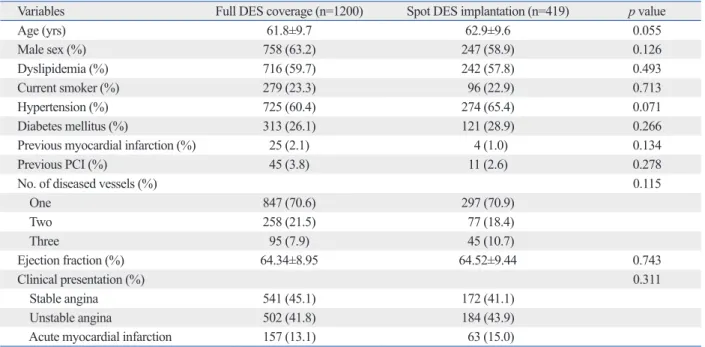
Baseline clinical and angiographic characteristics of the two groups are shown in Table 1 and 2, respectively. Compared to the full DES coverage group, the spot DES implantation group had shorter stent length (25.44±13.24 mm vs. 23.14±
9.70 mm, respectively; p<0.001) and fewer the number of stents (1.16±0.41 vs. 1.09±0.30, respectively; p<0.001), even diovascular death, target vessel-related myocardial infarc-
tion, or target vessel revascularization at one year post-pro- cedure, was compared between the two groups. The patients were not scheduled for routine angiographic follow-up.
Clinical events were defined according to the Academic Research Consortium.
10All deaths were considered cardio- vascular deaths unless a definite non-cardiovascular cause was established. Myocardial infarction was defined as the presence of clinical symptoms, electrocardiographic chang- es, or abnormal imaging findings of myocardial infarction.
Findings were further substantiated with the presence of ei- ther an increase in the creatine kinase myocardial band frac- tion to greater than three times the upper limit of the normal range or an increase in troponin-T/troponin-I to more than the 99th percentile of the upper normal limit, unrelated to an interventional procedure.
10Target-vessel revascularization was defined as a repeat PCI or bypass surgery of the target vessel with either 1) ischemic symptoms or a positive stress test and angiographic diameter stenosis ≥50% by quantita- tive coronary angiographic analysis or 2) angiographic di- ameter stenosis ≥70% by quantitative coronary angiograph- ic analysis without ischemic symptoms or a positive stress test. All clinical events were independently monitored and assessed by a Clinical Event Committee.
Statistical analysis
Continuous variables are expressed as mean±standard devi-
Table 1. Baseline Clinical Characteristics
Variables Full DES coverage (n=1200) Spot DES implantation (n=419) p value
Age (yrs) 61.8±9.7 62.9±9.6 0.055
Male sex (%) 758 (63.2) 247 (58.9) 0.126
Dyslipidemia (%) 716 (59.7) 242 (57.8) 0.493
Current smoker (%) 279 (23.3) 96 (22.9) 0.713
Hypertension (%) 725 (60.4) 274 (65.4) 0.071
Diabetes mellitus (%) 313 (26.1) 121 (28.9) 0.266
Previous myocardial infarction (%) 25 (2.1) 4 (1.0) 0.134
Previous PCI (%) 45 (3.8) 11 (2.6) 0.278
No. of diseased vessels (%) 0.115
One 847 (70.6) 297 (70.9)
Two 258 (21.5) 77 (18.4)
Three 95 (7.9) 45 (10.7)
Ejection fraction (%) 64.34±8.95 64.52±9.44 0.743
Clinical presentation (%) 0.311
Stable angina 541 (45.1) 172 (41.1)
Unstable angina 502 (41.8) 184 (43.9)
Acute myocardial infarction 157 (13.1) 63 (15.0)
PCI, percutaneous coronary intervention; DES, drug-eluting stent.
Values are presented as n (%) or mean±standard deviation.
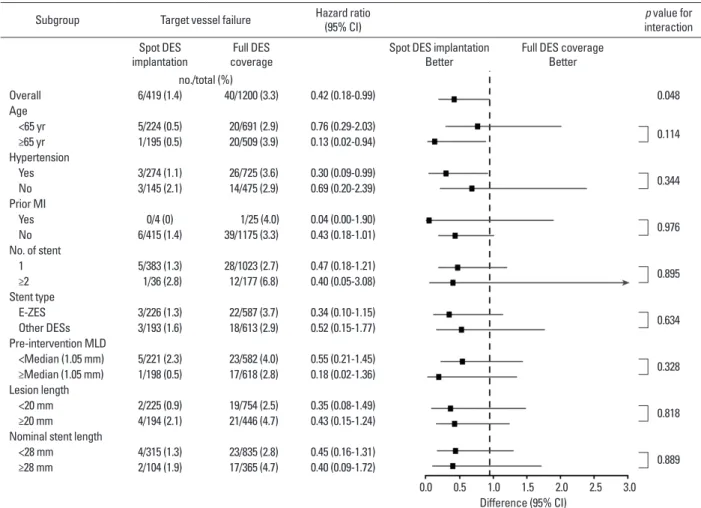
risk for TVF to be almost 58% lower in patients subjected to spot DES implantation compared to those subjected to full DES coverage (HR=0.42, 95% CI=0.18-0.99, p=0.048) (Fig. 2). Subgroup analysis showed that the beneficial ef- fects of spot DES implantation appeared to be more promi- nent in the elderly and those with hypertension (Fig. 2).
DISCUSSION
This study shows a lower rate of 1-year TVF in long lesions as well as other lesions in patients treated with a spot DES implantation compared with those treated with a full length DES. Lesion length was similar between the two groups.
Therefore, we propose that efforts to minimize the implant- ed stent length and the number of stents with overlapping during PCI procedures should be made regardless of lesion length.
In the era of bare-metal stent, longer stent length was found to be an independent factor predicting restenosis, and multiple or physically longer stent implantations have been associated with an increased risk of major adverse cardiac though the average lesion length was similar between the
two groups (20.58±10.97 mm vs. 21.36±10.30 mm, respec- tively; p=0.206). Pre-intervention minimal lumen diameter was significantly smaller in the spot DES implantation group (1.00±0.47 mm vs. 1.09±0.48 mm, p=0.001), and the per- cent diameter stenosis pre-PCI was significantly greater (67.38±14.35% vs. 64.54±14.31%, p=0.001).
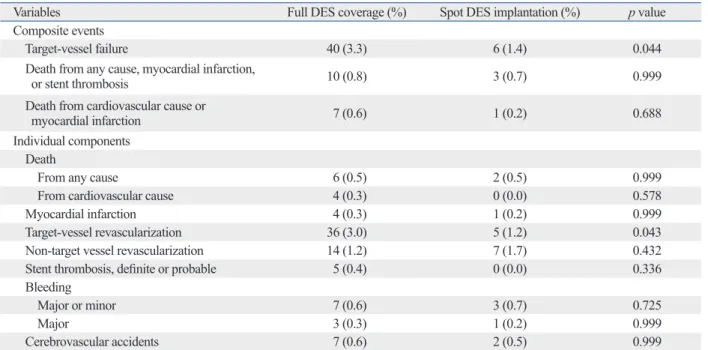
Clinical outcomes through 1-year follow-up are summa- rized in Table 3. At 1 year, the rate of TVF was significantly lower in the spot DES implantation group (1.4% vs. 3.3%, p=0.044). Outcomes for the individual components of TVF at 1-year follow-up were similar between the two groups, except a lower rate of target vessel revascularization in the spot DES implantation group was observed (1.2% vs. 3.0%, p=0.043). A log-rank test revealed that the cumulative inci- dence of TVF at 1-year was significantly lower in patients who underwent spot DES implantation than those subjected to full DES coverage (p=0.041) (Fig. 1). This association remained significant even after controlling for other risk factors including age, hypertension, lesion length, the DES type used, etc. (HR=0.40, 95% CI=0.17-0.98; p=0.046) (Table 4). The Cox proportional hazard model found the Table 2. Angiographic and Procedural Characteristics
Variables Full DES coverage (%) Spot DES implantation (%) p value
Treated artery 0.930
Left anterior descending artery 731 (60.9) 259 (61.8)
Right coronary artery 271 (22.6) 91 (21.7)
Left circumflex artery 198 (16.5) 69 (16.5)
No. of stents 1.16±0.41 1.09±0.30 <0.001
Type of stents 0.253
E-ZES 587 (48.9) 226 (53.9)
Endeavor resolute 257 (21.4) 88 (21.0)
Xience 127 (10.6) 35 (8.4)
Cypher 229 (19.1) 70 (16.7)
Lesion length (mm) 20.58±10.97 21.36±10.30 0.206
Percent diameter stenosis (%)
Pre-intervention 64.54±14.31 67.38±14.35 0.001
Post-intervention 11.50±7.70 12.02±7.50 0.231
Reference diameter (mm)
Pre-intervention 3.04±0.53 3.02±0.50 0.652
Post-intervention 3.10±0.52 3.09±0.49 0.898
Minimal lumen diameter (mm)
Pre-intervention 1.09±0.48 1.00±0.47 0.001
Post-intervention 2.75±0.44 2.73±0.40 0.335
Use of intravascular ultrasound 556 (46.3) 205 (48.9) 0.360
Nominal stent length (mm) 25.44±13.24 23.14±9.70 <0.001
DES, drug-eluting stent; E-ZES, Endeavor zotarolimus-eluting stent.
Values are presented as n (%) or mean±standard deviation.
tively.
18Therefore, with the advent of the DES, the most considerable change in the implantation strategy is that lon- ger or multiple DES implantations for full lesion coverage have usually been performed in an effort to minimize edge restenosis.
However, a physically longer DES length was still asso- ciated with poor clinical outcomes. The main problems of longer length of DES are associated with an increased risk of “hard” clinical outcomes (i.e., stent thrombosis) as well as “soft” clinical outcomes (i.e., restenosis).
5-7In addition, previous studies revealed that DES overlap was an inde- pendent predictor of overall stent thrombosis and was asso- ciated with impaired angiographic and long-term clinical outcome.
19,20Prolonged duration of DAPT would be associ- ated with an increased risk of bleeding after longer DES implantation because of increased potential of stent throm- bosis. Indeed, a large-scale multicenter registry study with 301 patients with definite stent thrombosis (from 23500 DES-treated patients) showed that longer stent length was one of the independent predictors of stent thrombosis.
5An- other study with 3145 patients (4667 DES-treated lesions) showed that the threshold of stent length for predicting stent thrombosis was 31.5 mm; stent lengths greater than or equal to 31.5 mm were associated with higher rates of stent throm- bosis at 3 years, compared with stent length less than 31.5 mm (4.0% vs. 0.7%, respectively, p<0.001).
6The provisional spot stenting technique was initially pro- events.
11-13However, previous studies have shown that treat-
ment of long coronary lesions by a DES significantly re- duced the rates of restenosis and the need for target lesion revascularization compared with the use of bare-metal stent.
14-17An intravascular ultrasound study reported that the residual edge plaque burden was an independent predictor of angiographic edge restenosis after bare-metal and pacli- taxel-eluting stent implantation; the cutoff value of the re- sidual edge plaque burden was 47.7% and 47.1%, respec- Table 3. Clinical Outcomes of Through 1 Year
Variables Full DES coverage (%) Spot DES implantation (%) p value
Composite events
Target-vessel failure 40 (3.3) 6 (1.4) 0.044
Death from any cause, myocardial infarction,
or stent thrombosis 10 (0.8) 3 (0.7) 0.999
Death from cardiovascular cause or
myocardial infarction 7 (0.6) 1 (0.2) 0.688
Individual components Death
From any cause 6 (0.5) 2 (0.5) 0.999
From cardiovascular cause 4 (0.3) 0 (0.0) 0.578
Myocardial infarction 4 (0.3) 1 (0.2) 0.999
Target-vessel revascularization 36 (3.0) 5 (1.2) 0.043
Non-target vessel revascularization 14 (1.2) 7 (1.7) 0.432
Stent thrombosis, definite or probable 5 (0.4) 0 (0.0) 0.336
Bleeding
Major or minor 7 (0.6) 3 (0.7) 0.725
Major 3 (0.3) 1 (0.2) 0.999
Cerebrovascular accidents 7 (0.6) 2 (0.5) 0.999
DES, drug-eluting stent.
Values are presented as n (%).
Fig. 1. Cumulative incidence of target vessel failure at 1 year. One year time-to-event curves are shown for target vessel failure in patients treated with full DES coverage versus spot DES implantation. Event rates represent Kaplan-Meier estimates. The p values are based on the log-rank test. CI, confidence interval; DES, drug-eluting stent.
0 1 2 3 4
Cumulative incidence of target vessel failure (%)
No. at risk Full DES coverage Spot DES implantation
Months 1200 419 1184
419 1172
416 1167
416 1093 392
0 3 6 9 12
Hazard ratio, 0.42 (95% CI, 0.18-0.99) Log rank, p=0.041
3.3
1.4 Full DES coverage
Spot DES implantation
In the DES era, data on the spot DES implantation are scarce.
One randomized study investigating the treatment of long coronary lesions with DESs showed that the 3-year major adverse cardiac event rate was significantly lower in the spot DES implantation group (n=89 patients) compared to the full DES coverage group (n=90 patients) (7.8% vs. 20%, re- posed by Colombo, et al.
8and performed to minimize stent-
ed length for treatment of long coronary lesions in the era of the bare-metal stent. The target lesion revascularization rate was significantly lower in the provisional spot stenting group (n=130 lesions) compared with the traditional stenting group (n=143 lesions) (19% vs. 34%, respectively, p<0.05).
8Table 4. Independent Predictors of 1-Year Target Vessel Failure in Cox ’s Regression Analysis
Predictors Hazard ratio (95% CI) p value
Age (yrs) 1.01 (0.98-1.04) 0.678
History of hypertension 1.10 (0.60-2.02) 0.762
History of prior myocardial infarction 1.25 (0.17-9.19) 0.827
No. of diseased coronary arteries 0.90 (0.57-1.43) 0.652
No. of stents 1.61 (0.51-5.03) 0.416
E-ZES (vs. other DESs) 1.27 (0.71-2.28) 0.421
Pre-intervention MLD (mm) 0.65 (0.35-1.21) 0.170
Lesion length (mm) 1.02 (0.96-1.10) 0.507
Nominal stent length (mm) 0.99 (0.92-1.07) 0.822
Spot DES implantation (vs. full DES coverage) 0.40 (0.17-0.98) 0.046
CI, confidence interval; DES, drug-eluting stent; E-ZES, Endeavor-zotarolimus-eluting stent; MLD, minimal lumen diameter.
Values are presented as n (%) or mean±SD.
Fig. 2. Subgroup analyses of the 1-year rates of target vessel failure. Subgroup analyses are shown for the target vessel failure at 1 year among subgroups of patients treated with full DES coverage versus spot DES implantation. The p value for interaction represents the likelihood of interaction between the vari- able and the relative treatment effect. CI, confidence interval; DES, drug-eluting stent; E-ZES, Endeavor zotarolimus-eluting stent; MI, myocardial infarction;
MLD, minimal lumen diameter.
Subgroup Target vessel failure Hazard ratio
(95% CI) p value for
interaction Spot DES
implantation Full DES
coverage Spot DES implantation
Better Full DES coverage Better no./total (%)
Overall 6/419 (1.4) 40/1200 (3.3) 0.42 (0.18-0.99) 0.048
Age
<65 yr 5/224 (0.5) 20/691 (2.9) 0.76 (0.29-2.03) 0.114
≥65 yr 1/195 (0.5) 20/509 (3.9) 0.13 (0.02-0.94) Hypertension
Yes 3/274 (1.1) 26/725 (3.6) 0.30 (0.09-0.99) 0.344
No 3/145 (2.1) 14/475 (2.9) 0.69 (0.20-2.39) Prior MI
Yes 0/4 (0) 1/25 (4.0) 0.04 (0.00-1.90) 0.976
No 6/415 (1.4) 39/1175 (3.3) 0.43 (0.18-1.01) No. of stent
1 5/383 (1.3) 28/1023 (2.7) 0.47 (0.18-1.21) 0.895
≥2 1/36 (2.8) 12/177 (6.8) 0.40 (0.05-3.08) Stent type
E-ZES 3/226 (1.3) 22/587 (3.7) 0.34 (0.10-1.15) 0.634
Other DESs 3/193 (1.6) 18/613 (2.9) 0.52 (0.15-1.77) Pre-intervention MLD
<Median (1.05 mm) 5/221 (2.3) 23/582 (4.0) 0.55 (0.21-1.45) 0.328
≥Median (1.05 mm) 1/198 (0.5) 17/618 (2.8) 0.18 (0.02-1.36) Lesion length
<20 mm 2/225 (0.9) 19/754 (2.5) 0.35 (0.08-1.49) 0.818
≥20 mm 4/194 (2.1) 21/446 (4.7) 0.43 (0.15-1.24) Nominal stent length
<28 mm 4/315 (1.3) 23/835 (2.8) 0.45 (0.16-1.31) 0.889
≥28 mm 2/104 (1.9) 17/365 (4.7) 0.40 (0.09-1.72)
0.0
Difference (95% CI)
0.5 1.0 1.5 2.0 2.5 3.0
number of patients in the spot DES implantation group.
In conclusion, minimizing the stent length and the num- ber of stents with overlapping by spot DES implantation should be considered in the treatment of all lesions regard- less of lesion length.
ACKNOWLEDGEMENTS
This study was supported by the Cardiovascular Research Center, Seoul, Korea, and grants from the Korea Healthcare Technology R&D Project, Ministry for Health, Welfare &
Family Affairs, Republic of Korea (No. A085012 and A102064), the Korea Health 21 R&D Project, Ministry of Health & Welfare, Republic of Korea (No. A085136).
REFERENCES
1. Tsagalou E, Chieffo A, Iakovou I, Ge L, Sangiorgi GM, Corvaja N, et al. Multiple overlapping drug-eluting stents to treat diffuse disease of the left anterior descending coronary artery. J Am Coll Cardiol 2005;45:1570-3.
2. Grube E, Dawkins KD, Guagliumi G, Banning AP, Zmudka K, Co- lombo A, et al. TAXUS VI 2-year follow-up: randomized compari- son of polymer-based paclitaxel-eluting with bare metal stents for treatment of long, complex lesions. Eur Heart J 2007;28:2578-82.
3. Sakurai R, Ako J, Morino Y, Sonoda S, Kaneda H, Terashima M, et al. Predictors of edge stenosis following sirolimus-eluting stent deployment (a quantitative intravascular ultrasound analysis from the SIRIUS trial). Am J Cardiol 2005;96:1251-3.
4. Katritsis DG, Korovesis S, Tzanalaridou E, Giazitzoglou E, Vori- dis E, Meier B. Comparison of long versus short (“spot”) drug- eluting stenting for long coronary stenoses. Am J Cardiol 2009;
104:786-90.
5. de la Torre-Hernández JM, Alfonso F, Hernández F, Elizaga J, Sanmartin M, Pinar E, et al. Drug-eluting stent thrombosis: results from the multicenter Spanish registry ESTROFA (Estudio ESpa- ñol sobre TROmbosis de stents FArmacoactivos). J Am Coll Car- diol 2008;51:986-90.
6. Suh J, Park DW, Lee JY, Jung IH, Lee SW, Kim YH, et al. The re- lationship and threshold of stent length with regard to risk of stent thrombosis after drug-eluting stent implantation. JACC Cardio- vasc Interv 2010;3:383-9.
7. Caputo RP, Goel A, Pencina M, Cohen DJ, Kleiman NS, Yen CH, et al. Impact of drug eluting stent length on outcomes of percuta- neous coronary intervention (from the EVENT registry). Am J Cardiol 2012;110:350-5.
8. Colombo A, De Gregorio J, Moussa I, Kobayashi Y, Karvouni E, Di Mario C, et al. Intravascular ultrasound-guided percutaneous transluminal coronary angioplasty with provisional spot stenting for treatment of long coronary lesions. J Am Coll Cardiol 2001;38:
1427-33.
9. Kim BK, Hong MK, Shin DH, Nam CM, Kim JS, Ko YG, et al. A new strategy for discontinuation of dual antiplatelet therapy: the
spectively, p=0.019).
4However, no studies have investigat- ed the effect of spot DES implantation on all DES-treated lesions, not just long lesions. In the present study, we made such an analysis, showing a lower rate of 1-year TVF in all DES-treated lesions treated with spot DES implantation.
A previous, randomized study showed that PCI as an ini- tial management strategy did not significantly reduce the composite risk of death, myocardial infarction, and other major cardiovascular events when added to optimal medi- cal therapy in patients with stable coronary disease (20.0%
vs. 19.5%, respectively, p=0.62),
21and an another random- ized study reported that event-free survival was similar be- tween the deferral and PCI groups in a patient population with moderate coronary stenosis for whom PCI was planned when fractional flow reserve was greater than 0.75.
22These studies suggest that reducing unnecessary stent implanta- tion and minimizing the stent length could be associated with improved clinical outcomes after PCI. An angiograph- ic follow-up study found edge restenosis in 27.8% of in- stent restenosis cases utilizing a sirolimus-eluting stent and in 2.5% of in-stent restenosis cases utilizing a paclitaxel- eluting stent.
23Because the rate of target vessel revascular- ization was 3.0% in full DES coverage and 1.2% in spot DES implantation in this study, we believe that actual inci- dence of edge restenosis might be quite lower among the overall study population. Therefore, considering the low in- cidence of edge restenosis and the balance between in-stent restenosis and stent thrombosis, spot DES implantation should be considered as an appropriate strategy alternative to full DES coverage, offering a favorable clinical outcome in all DES-treated lesions.
There are some limitations in this study. First, this was a
retrospectively analyzed cohort study. The nature of the
nonrandomized subgroup analysis may have resulted in a
selection bias and restricted power due to the methodologi-
cal limitations. Nonetheless, a significant strength of the cur-
rent study is that it has a relatively large sample size com-
pared with other randomized trials. Second, the spot DES
implantation group could be underestimated because the
two groups were divided based on the measurements of
quantitative coronary angiographic analysis alone without
reference to other modalities such as intravascular ultra-
sound or fractional flow reserve. Third, there was no data in
the present study regarding platelet function assessment or
the effects by using new antiplatelet agents besides clopido-
grel. Finally, the findings of this study could be underpow-
ered as a result of relatively lower event rates and the small
Cardiol 2007;50:2029-36.
17. Williams DO, Abbott JD, Kip KE; DEScover Investigators. Out- comes of 6906 patients undergoing percutaneous coronary inter- vention in the era of drug-eluting stents: report of the DEScover Registry. Circulation 2006;114:2154-62.
18. Liu J, Maehara A, Mintz GS, Weissman NJ, Yu A, Wang H, et al.
An integrated TAXUS IV, V, and VI intravascular ultrasound anal- ysis of the predictors of edge restenosis after bare metal or pacli- taxel-eluting stents. Am J Cardiol 2009;103:501-6.
19. Costa JR Jr, Sousa A, Moreira AC, Costa RA, Cano M, Maldona- do G, et al. Incidence and predictors of very late (>or=4 years) major cardiac adverse events in the DESIRE (Drug-Eluting Stents in the Real World)-Late registry. JACC Cardiovasc Interv 2010;
3:12-8.
20. Räber L, Jüni P, Löffel L, Wandel S, Cook S, Wenaweser P, et al.
Impact of stent overlap on angiographic and long-term clinical outcome in patients undergoing drug-eluting stent implantation. J Am Coll Cardiol 2010;55:1178-88.
21. Boden WE, O’Rourke RA, Teo KK, Hartigan PM, Maron DJ, Kostuk WJ, et al. Optimal medical therapy with or without PCI for stable coronary disease. N Engl J Med 2007;356:1503-16.
22. Bech GJ, De Bruyne B, Pijls NH, de Muinck ED, Hoorntje JC, Escaned J, et al. Fractional flow reserve to determine the appropri- ateness of angioplasty in moderate coronary stenosis: a random- ized trial. Circulation 2001;103:2928-34.
23. Park CB, Hong MK, Kim YH, Park DW, Han KH, Lee CW, et al.
Comparison of angiographic patterns of in-stent restenosis be- tween sirolimus- and paclitaxel-eluting stent. Int J Cardiol 2007;
120:387-90.
RESET Trial (REal Safety and Efficacy of 3-month dual antiplate- let Therapy following Endeavor zotarolimus-eluting stent implan- tation). J Am Coll Cardiol 2012;60:1340-8.
10. Cutlip DE, Windecker S, Mehran R, Boam A, Cohen DJ, van Es GA, et al. Clinical end points in coronary stent trials: a case for standardized definitions. Circulation 2007;115:2344-51.
11. Kobayashi Y, De Gregorio J, Kobayashi N, Akiyama T, Reimers B, Finci L, et al. Stented segment length as an independent predic- tor of restenosis. J Am Coll Cardiol 1999;34:651-9.
12. Kastrati A, Elezi S, Dirschinger J, Hadamitzky M, Neumann FJ, Schömig A. Influence of lesion length on restenosis after coronary stent placement. Am J Cardiol 1999;83:1617-22.
13. Dietz U, Holz N, Dauer C, Lambertz H. Shortening the stent length reduces restenosis with bare metal stents: matched pair comparison of short stenting and conventional stenting. Heart 2006;92:80-4.
14. Schampaert E, Cohen EA, Schlüter M, Reeves F, Traboulsi M, Ti- tle LM, et al. The Canadian study of the sirolimus-eluting stent in the treatment of patients with long de novo lesions in small native coronary arteries (C-SIRIUS). J Am Coll Cardiol 2004;43:1110-5.
15. Schofer J, Schlüter M, Gershlick AH, Wijns W, Garcia E, Scham- paert E, et al. Sirolimus-eluting stents for treatment of patients with long atherosclerotic lesions in small coronary arteries: dou- ble-blind, randomised controlled trial (E-SIRIUS). Lancet 2003;
362:1093-9.
16. Abbott JD, Voss MR, Nakamura M, Cohen HA, Selzer F, Kip KE, et al. Unrestricted use of drug-eluting stents compared with bare- metal stents in routine clinical practice: findings from the National Heart, Lung, and Blood Institute Dynamic Registry. J Am Coll