뇌전증 소아들에서 주의력결핍과잉행동장애와 뇌 MRI 소견의 연관성
가톨릭대학교 의과대학 소아과학교실1, 영상의학과교실2
문자운
1・윤다혜
1・박선영
1・임수아
2・이인구
1Submitted: 11 June, 2018 Revised: 26 June, 2018 Accepted: 29 June, 2018
Correspondence to In Goo Lee, MD
Department of Pediatrics, Catholic University Hospital, Catholic University of College of Medicine, 222, Banpo-Daero, Seocho-Gu, Seoul 06591, Korea
Tel: +82-2-2258-6186, Fax: +82-2-537-4544 E-mail: [email protected]
The Correlation between ADHD and Brain MRI Findings in Children with Epilepsy
Purpose: We analyze the brain magnetic resonance imaging (MRI) findings of children with epilepsy and concomitant attention deficit hyperactivity disorder (ADHD) to investigate the correlation between brain MRI and ADHD, and to determine whether abnormal MRI finding can be a risk factor for the development of ADHD.
Methods: A total of 55 patients (36 male, 19 female) were diagnosed as ADHD in children with epilepsy at the pediatric neurology department of Seoul St. Mary hospital from March, 2009 to December, 2013. The records of these patients were retrospectively reviewed.
Results: 29 patients (52.7%) had normal MRI findings, and 26 patients (47.3%) had abnormal MRI findings. The inattention type of ADHD (96.5%) was the largest type in a group of normal brain MRI findings, but the combined type (53.8%) and the inattention type (46.2%) occupied the majority in a group of abnormal MRI findings. The score of symptom in inattention was 7.44/9 in a group of normal MRI findings, while 8.2/9 in a group of abnormal MRI findings. And the score of symptom in hyperactivity was 2.93/9 in a group of normal MRI findings, while it was 4.8/9 in a group of abnormal MRI findings (P<0.001). 7 patients (12.7%) revealed hippocampal sclerosis out of 26 abnormal MRI findings, and they had significantly higher scores of ADHD symptoms (8.57/9, 4.8/9) compared to normal group (7.83/9, 4.23/9).
Conclusion: Abnormal MRI findings in children with epilepsy are not only closely related to ADHD but may also be associated with the severity of ADHD.
Key Words: Attention deficit disorder with hyperactivity, Epilepsy, Brain MRI
Ja Un Moon, MD1, Da Hye Yoon, MD1, Sun-Young Park, MD1, Soo-Ah Im, MD2, In Goo Lee, MD1
1Department of Pediatrics, 2Department of Radiology, Seoul St. Mary’s Hospital, College of Medicine, The Catholic University of Korea, Seoul, Korea
Copyright © 2018 by The Korean Child Neurology Society
http://www.cns.or.kr
서론
주의력결핍과잉행동장애(ADHD)는 일정한 나이가 되어도 자신의 행동을 제대로 통 제하거나 조절하지 못하여 학업수행 및 또래 관계에 문제가 생겨 학교 적응에 어려움 을 겪게 되고, 가족 내 갈등에도 쉽게 노출될 수 있어 삶의 질 저하를 흔하게 경험하는 질환이다. 학령기 소아의 4-9%1)에서 진단되며, 뇌전증 환자에서는 유병률이 12-40%2-
5)로 크게 증가한다. ADHD는 뇌전증 치료에도 영향을 미쳐 ADHD가 중복된 환자들의
경우 ADHD가 없는 환자들에 비해 뇌전증 증상이 심각하며, 경련 발 생 빈도가 높아진다5). 또한 ADHD를 동반한 뇌전증 환아의 경우 정 상 소아와 달리 대뇌의 구조적인 차이를 보인다는 연구들6,7)이 보고 되고 있으나, MRI 이상소견에 초점을 맞추어 뇌전증과 ADHD를 연구 한 결과는 흔치 않다.
이에 저자들은 뇌전증으로 치료 받고 있는 소아들 중 ADHD가 중 복된 환자들의 뇌 Magnetic resonance imaging (MRI)를 분석하여 ADHD와의 연관성을 알아 보고, MRI의 이상 소견이 ADHD 발생의 위험인자가 될 수 있는지 여부를 알아보고자 하였다.
대상 및 방법
1. 대상 및 방법
2009년 3월부터 2013년 12월까지 가톨릭대학교 서울성모병원 소 아신경과에 뇌전증으로 등록되어, 항경련제 치료를 받는 6세에서 18 세까지의 환자를 대상으로 정신질환 진단 및 통계편람(DSM-IV, Diagnostic and Statistical Manual of Mental Disorder, 4thedition) 의 기준에 따라 ADHD 검사를 시행하였다. 이렇게 하여 ADHD의 중 복 진단을 받은 환자들 중 최소 1년 이상 추적 관찰이 가능하였던 환 자를 대상으로 하였고, 뇌 MRI를 시행하지 않았거나, 정신질환 또는 뇌전증 이외의 질환으로 약물을 복용하고 있거나, 지적 장애를 진단 받은 환자는 연구에서 제외하였다. 총 68명의 환자들 중 위 기준에 따 라 13명의 환자를 제외한 55명(남자 36명, 여자 19명)의 환자들의 의 무기록을 후향적으로 조사하여 연령, 성별, MRI 소견, ADHD 증상 등 을 비교 분석하였다.
2. ADHD 진단
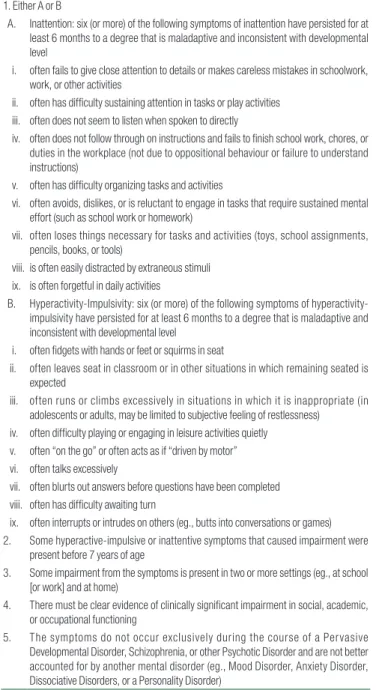
ADHD의 진단은 환자의 부모 및 환자와의 면담을 통하여 증상의 정도, 가정환경, 발달, 학교생활 적응 정도, 또래와의 관계 등을 알아 본 후 DSM-IV의 기준에 따라 주의력 결핍 관련 증상과 과잉행동-충 동관련증상이 각각 9개 항목 중 적어도 6개 이상에서 양성 소견을 보 이고, 이러한 증상이 6개월 이상 지속적으로 나타난다고 보고되며, 환자의 발달 수준에 맞지 않고, 적응에 상당한 문제를 초래하는 경우 에 ADHD로 진단 하였다(Table 1). 그리고 진단된 환자들은 주의력결 핍형, 과잉행동형, 그리고 혼합형으로 분류하였고, 분류된 아형에 따 라 집중력장애와 과다행동에 해당하는 문항의 개수를 비교 분석 하 였다.
3. MRI 검사 및 판독
MRI 검사는 3.0 Tesler(MAGNETOM® Verio 3T; Siemens Medical Solutions, Erlangen, Germany) 혹은 1.5 Tesler (Signa HDxt, GE Healthcare, Milwaukee, WI, USA) 스캐너로 검사하였다.
T1강조영상(TR/TE, 250 ms/3.0 ms; NEX, 2; matrix size, 448×
269; FOV, 210×210), T2 강조영상(TR/TE, 3,300 ms/91 ms; NEX, 1; matrix size, 256×256; FOV, 250×250), 액체감쇠역전회복영상 (FLAIR, TR/TE/TI, 9,000 ms/99 ms/2500 ms; NEX, 1; matrix size,
320×224; FOV, 210×210) 및 조영 증강 후 T1강조영상(TR/TE, 250 ms/70 ms; NEX, 2; matrix size, 448×269; FOV, 210×210)의 횡단 영상, 시상영상, 관상영상을 얻었다. 이후 MRI 영상을 소아 영상의학 전문의가 판독하였으며, 판독 소견을 정상과 비정상으로 분류하여 분 석하였다.
4. 통계 및 분석
통계자료의 분석은 SPSS version 22.0 for window(SPSS Inc., Chicago. IL, USA)을 이용하였다. 통계적 유의성은 chi-square test를 사용하여 판정하였고, P 값이 0.05 이하일 때 통계적으로 유의 하다 고 판정 하였다. 본 연구는 서울성모병원 임상연구심사위원회의 승인 을 받아서 진행하였다(IRB number: KC15RISI0503).
Table 1. Diagnostic Criteria for ADHD(Diagnostic and Statistical Manual of Mental Disorders: DSM-IV-TR)
1. Either A or B
A. Inattention: six (or more) of the following symptoms of inattention have persisted for at least 6 months to a degree that is maladaptive and inconsistent with developmental level
i. often fails to give close attention to details or makes careless mistakes in schoolwork, work, or other activities
ii. often has difficulty sustaining attention in tasks or play activities iii. often does not seem to listen when spoken to directly
iv. often does not follow through on instructions and fails to finish school work, chores, or duties in the workplace (not due to oppositional behaviour or failure to understand instructions)
v. often has difficulty organizing tasks and activities
vi. often avoids, dislikes, or is reluctant to engage in tasks that require sustained mental effort (such as school work or homework)
vii. often loses things necessary for tasks and activities (toys, school assignments, pencils, books, or tools)
viii. is often easily distracted by extraneous stimuli ix. is often forgetful in daily activities
B. Hyperactivity-Impulsivity: six (or more) of the following symptoms of hyperactivity- impulsivity have persisted for at least 6 months to a degree that is maladaptive and inconsistent with developmental level
i. often fidgets with hands or feet or squirms in seat
ii. often leaves seat in classroom or in other situations in which remaining seated is expected
iii. often runs or climbs excessively in situations in which it is inappropriate (in adolescents or adults, may be limited to subjective feeling of restlessness) iv. often difficulty playing or engaging in leisure activities quietly
v. often “on the go” or often acts as if “driven by motor”
vi. often talks excessively
vii. often blurts out answers before questions have been completed viii. often has difficulty awaiting turn
ix. often interrupts or intrudes on others (eg., butts into conversations or games) 2. Some hyperactive-impulsive or inattentive symptoms that caused impairment were
present before 7 years of age
3. Some impairment from the symptoms is present in two or more settings (eg., at school [or work] and at home)
4. There must be clear evidence of clinically significant impairment in social, academic, or occupational functioning
5. The symptoms do not occur exclusively during the course of a Pervasive Developmental Disorder, Schizophrenia, or other Psychotic Disorder and are not better accounted for by another mental disorder (eg., Mood Disorder, Anxiety Disorder, Dissociative Disorders, or a Personality Disorder)
결과
1. 연령 및 성별
연구 대상 55명(남자 36명, 여자 19명)의 평균 연령은 13.4세였는 데, 이를 세분하면 MRI가 정상인 29명(52.7%, 남자 16명, 여자 13명) 의 평균 연령은 14.1±3.37세 이었고, MRI가 비정상인 26명(47.3%, 남 자 20명, 여자 6명)의 평균 연령은 12.6±3.7세 이었다(Table 2).
2. MRI 소견
대상 환자 55명 중 MRI에 이상 소견을 보인 경우가 26명 이었고, 이 상 소견으로는 해마경화증이 7명 (26.9%)으로 가장 많았다. 그 외에 도 양성 낭종 병변(5명), 백질연화증(3명), 뇌 내 출혈(2명) 등이 있었 다(Table 3).
3. MRI 소견에 따른 ADHD 아형별 분류
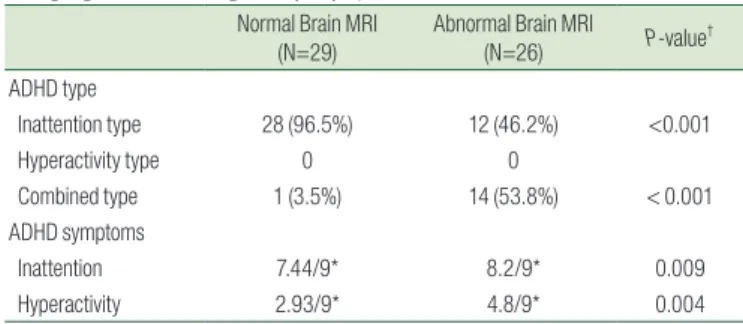
MRI 소견이 정상인 29명에서는 주의력결핍형이 28명(96.5%)으로 환자의 대부분을 차지하고 있었던 반면에, MRI 소견에 이상이 있었던 26명에서는 혼합형이 14명(53.8%)으로 가장 많았고, 주의력결핍형이 12명(46.2%) 이었다. 따라서 MRI 소견의 이상 유무에 따라 ADHD의 아형에 차이가 있었으며, 이는 통계적으로 유의 하였다(P<0.001, Table4).
4. MRI 소견에 따른 ADHD 증상의 비교
DSM-IV-TR을 바탕으로 작성된 주의력결핍 및 과잉행동-충동에 관한 각각의 문항 9개 중 양성을 보인 개수를 MRI 소견의 이상 유무
에 따라 비교해 보았다. 주의력 결핍에 관한 문항에서 양성을 보인 경 우는 MRI 소견이 정상인 군에서는 평균 7.44개 인 반면, MRI 소견에 이상이 있었던 군에서는 평균 8.2개 이었고, 이들의 차이는 통계적으 로 비교적 유의 하였다(P=0.009). 그리고 과잉행동-충동에 관한 문항 의 경우는 MRI소견이 정상인 군에서는 평균 2.93개인 반면, MRI소견 에 이상이 있었던 군에서는 평균 4.8개로 이들의 차이 역시 통계적으 로 유의 하였다(P=0.004, Table 4).
고찰
ADHD는 뇌전증을 앓는 소아 환자에서 삶의 질을 떨어트리는 가 장 흔하게 발생하는 정신신경학적 문제 중 하나로, ADHD와 뇌전증 사이의 연관성은 ADHD의 유병률을 통해서도 잘 알 수 있다. 소아 뇌 전증 환자들에서 ADHD 유병률은 일반인에 비해 4-5배 정도 높아, 미국소아과학회2)는 12-39%로, Dunn 등3)은 30-40% 로 발표하였고, 저자들은 37.5%의 높은 빈도를 보고한 바 있다5).
이와 같이 뇌전증 환자에서 ADHD 유병률이 증가하는 원인은 확 실하지 않으나, 항경련제의 영향, 근본적인 신경발달의 취약성, 만성적 경련, 간질모양 뇌파의 출현 빈도, 뇌전증에 대한 정신 사회적 반응5) 등이 고려되고 있다.
소아 뇌전증 환자가 MRI 검사에서 이상 소견을 보이는 경우는 환 자들의 16-28% 정도로8-10) 보고되고 있다. 하지만 ADHD가 중복된 경우 MRI 검사에서 이상 소견을 보이는 비율은 확인된 것이 없다. 다 만 뇌전증이 없는 성인 ADHD 환자들의 40%에서 구조적인 뇌 이상 을 가지고 있다는 보고가 있다11). 저자들의 연구에서는 ADHD가 중 복된 뇌전증 환자의 47.3%가 MRI에서 이상 소견을 보였다.
ADHD와 뇌 구조 이상의 연관성에 관하여, Jacobson 등12)은 학동 기와 청소년기의 ADHD는 대뇌의 광범위한 구조적 이상과 연관되어 있다고 보고하고 있고, Cubillo 등13)은 억제 조절을 관장하는 전두나 선(fronto-striatal) 영역의 기능 이상과 연관되어 있다고 하였다. 이외 에도 미상핵, 시상 및 해마 부위6) 등의 부피가 감소 한다는 보고가 있 다. 또한, Posner 등14)은 ADHD를 가진 어린이들은 해마의 부피가 감 소하고 다른 대뇌 부위와의 기능적 연관성이 떨어져 우울증이 발생할 Table 2. Demographic Features of the Subjects with Epilepsy and
Attention-Deficit Hyperactivity Disorder (ADHD)
Normal Brain MRI (N=29) Abnormal Brain MRI (N=26)
Mean age (yr) 14.1±3.37 12.6±3.7
Sex number (%)
Male 16 (55.2) 20 (77.0)
Female 13 (44.8) 6 (23.0)
MRI, magnetic resonance imaging.
Table 3. Abnormal Brain Magnetic Resonance Imaging (MRI) Findings in Epilepsy Children with Attention-Deficit Hyperactivity Disorder (ADHD)
Types Number (N=26)
Hippocampal sclerosis 7
Benign cystic lesion 5
Periventricular leukomalacia 3
Intracranial hemorrhage 2
Tuberous sclerosis 1
Infarction 1
Cortical dysplasia 1
Posterior reversible encephalopathy syndrome 1
Dandy walker variant 1
Others (thinning of corpus callosum, ventriculomegaly, mega cisterna magna, meningoencephalitis)
4
Table 4. Comparison of Attention-Deficit Hyperactivity Disorder (ADHD) Type and Symptoms according to Brain Magnetic Resonance Imaging (MRI) Findings in Epilepsy Children with ADHD
Normal Brain MRI
(N=29) Abnormal Brain MRI
(N=26) P-value†
ADHD type
Inattention type 28 (96.5%) 12 (46.2%) <0.001
Hyperactivity type 0 0
Combined type 1 (3.5%) 14 (53.8%) < 0.001
ADHD symptoms
Inattention 7.44/9* 8.2/9* 0.009
Hyperactivity 2.93/9* 4.8/9* 0.004
ADHD, attention-deficit hyperactivity disorder; MRI, magnetic resonance imaging.
* Inattention / Hyperactivity 9 items in DSM-IV, †Calculated by chi-square test.
위험성이 증가 한다고 하였다. 저자들의 연구에서도 뇌 MRI의 이상 중 해마경화증이 가장 많았는데, 이는 앞서의 여러 연구들과 일맥상 통하는 면이 있다고 여겨진다. 그러나 본 연구에서는 우울증에 대한 선별검사가 이루어지지 않아, 향후에는 ADHD 진단 시 우울증에 대 한 검사를 함께 시행하는 것이 좋을 것으로 생각된다.
ADHD가 중복된 뇌전증 환자에서 ADHD 아형의 유병률은 주의력 결핍형이 제일 많고, 다음에 혼합형 순으로 알려져 있다5,6,15). 저자들 의 연구에서도 MRI에서 이상 소견이 없는 경우에는 주의력결핍형이 대상 환자의 대부분을 차지하고 있어 앞서의 연구들과 같은 결과를 보이고 있었다. 그러나, MRI에 이상 소견이 있는 경우에는 혼합형이 가장 많았고(53.8%), 나머지는 주의력결핍형이 차지하고 있었다. 이 는 MRI 소견에 따라 ADHD 아형의 분포가 다르다는 것을 나타내는 의미 있는 결과로 여겨진다. 그러나 이전의 연구들에서는 ADHD 아형 에 따른 MRI 소견에 차이는 없는 것으로 알려져 있다16-19).
또한, 저자들은 MRI 소견에 따라 주의력결핍 및 과잉행동-충동에 관한 증상의 정도에 차이가 있는지를 비교하기 위해 DSM-IV-TR을 바탕으로 작성된 주의력결핍 및 과잉행동-충동에 관한 각각의 문항 들의 양성 소견을 확인하였다. 결과는 MRI에 이상 소견이 있는 군이 정상 소견을 보인 군에 비해 주의력결핍 및 과잉행동-충동에 관한 문 항들 모두에서 더 많은 양성 소견을 보이고 있었는데, 이는 MRI에 이 상 소견이 있는 환자들의 ADHD 증상이 MRI 소견이 정상인 환자들 에 비해 심하다는 것을 나타낸다고 하겠다.
결론적으로 뇌전증 소아 환자들에서 MRI 이상 소견은 ADHD와 밀접한 연관성을 가지고 있을 뿐 아니라 ADHD 의 중증도와 연관될 수 있음을 말해준다고 하겠다. 따라서 MRI에 이상 소견이 발견되는 뇌전증 환자에서는 조기 ADHD 선별검사를 시행해 이에 대한 대책을 수립하는 것이 치료 및 삶의 질 향상에 도움이 될 것이라고 여겨진다.
그러나 본 연구는 후향적으로 의무기록을 분석하였고, 대상자 숫자가 적어 향후 여러 변수를 고려한 후속 연구가 필요할 것으로 보인다.
요약
목적: 뇌전증 소아들 중 주의력 결핍 과잉행동장애가 중복된 소아 들의 뇌 MRI를 분석하여 ADHD와 뇌 MRI의 연관성을 알아 보고, MRI 의 이상 소견이 ADHD 발생의 위험인자가 될 수 있는지의 여부 를 알아보고자 하였다.
방법: 2009년 3월부터 2013년 12월까지 가톨릭대학교 서울성모병 원 소아신경과에서 뇌전증을 진단 받고, 항경련제 치료를 받는 6세에 서 18세까지의 환자들 중 ADHD 가 중복 되었고 최소 1년 이상 추적 관찰이 가능하였던 55명(남자 36명, 여자 19명)의 소아들을 대상으로 하였다. ADHD의 진단은 정신질환 진단 및 통계편람 (DSM-IV, Diagnostic and Statistical Manual of Mental Disorder, 4thedition) 의 기준에 따라 진단하였다.
결과: 뇌 MRI가 정상 소견을 보인 환자들은 대부분 주의력결핍형 의 ADHD였으나(28명, 96.5%), 뇌 MRI가 비정상 소견을 보인 환자들 은 혼합형이 14명(53.8%)으로 가장 많았으며, 주의력결핍형이 12명
(46.2%)으로 MRI이상소견의 유무에 따라 ADHD의 아형에 차이가 있었다. 또한 주의력결핍 및 과잉행동-충동에 관한 각각의 문항 9개 중 양성을 보인 개수를 MRI 소견의 이상유무에 따라 비교한 결과, MRI소견에서 이상이 있는 환자군에서 ADHD 증상이 심한 것으로 평가되었다.
결론: 뇌전증 소아 환자들에서 MRI 이상 소견은 ADHD와 밀접한 연관성을 가지고 있을 뿐 아니라 ADHD 의 중증도와 연관될 수 있음 을 말해준다. 따라서 MRI에 이상 소견이 발견되는 뇌전증 환자에서는 조기 ADHD 선별검사를 시행해 이에 대한 대책을 수립하는 것이 치 료 및 삶의 질 향상에 도움이 될 것이라고 여겨진다.
References
1) Polanczyk G, de Lima MS, Horta BL, Biederman J, Rohde LA.
The worldwide prevalence of ADHD: a systematic review and metaregression analysis. Am J Psychiatry 2007;164:942-8.
2) American academy of Pediatrics. Clinical practice guideline:
diagnosis and evaluation of the child with attention deficit/
hyperactivity disorder. Pediatrics 2000;105:1158-70.
3) Dunn DW, Kronenberger WG. Childhood epilepsy, attention problems, and ADHD: review and practical considerations.
Semin Pediatr Neurol 2005;12:222-8.
4) Thome-Souza S, Kuczynski E, Assumpção F Jr, Rzezak P, Fuentes D, Fiore L, et al. Which factors may play a pivotal role on determining the type of psychiatric disorder in children and adolescents with epilepsy? Epilepsy Behav 2004;5:988-94.
5) Choi HY, Han JY, Kim SJ, Eom TH, Bin JH, Kim YH, et al.
Characteristics of children with epilepsy and concomitant attention-deficit hyperactivity disorder. J Korean Child Neurol Soc 2013;21:162-9.
6) Saute R, Dabbs K, Jones JE, Jackson DC, Seidenberg M, Hermann BP. Brain morphology in children with epilepsy and ADHD.
PLoS One 2014;9:e95269.
7) Nina B, Maja K, Iris KP, Karsten S, Markus K, Klaus S. et al.
Attention-deficit/hyperactivity disorder in childhood epilepsy.:A neuropsychological and functional imaging study. Epilepsia 2012;53:325-33
8) Adelöw C, Andell E, Amark P, Andersson T, Hellebro E, Ahlbom A, et al. Newly diagnosed single unprovoked seizures and epilepsy in Stockholm, Sweden: first report from the Stockholm incidence registry of epilepsy (SIRE). Epilepsia 2009;50:1094- 101.
9) Wirrell EC, Grossardt BR, Wong-Kisiel LC, Nickels KC. Incidence and classification of new-onset epilepsy and epilepsy syndromes in children in Olmsted Country, Minnesota from 1980 to 2004: a population-based study. Epilepsy Res 2011;95:110-8.
10) Berg AT, Mathern GW, Bronen RA, Fulbright RK, DiMario F, Testa FM, et al. Frequency, prognosis and surgical treatment of structural abnormalities seen with magnetic resonance imaging
in childhood epilepsy. Brain 2009;132:2785-97.
11) Bakhshani NM, Babaei S, Raghibi M. Frequency of structural brain abnormalities among adult diagnosed with attention - deficit/hyperactivity disorder. Glob J Health Sci 2013;6:69-75.
12) Jacobson LA, Crocetti D, Dirlikov B, Slifer K, Denckla MB, Mostofsky SH, et al. Anomalous brain development is evident in preschoolers with attention-deficit/hyperactivity disorder. J Int Neuropsychol Soc 2018:1-9.
13) Cubillo A, Halari R, Ecker C, Giampietro V, Taylor E, Rubia K.
Reduced actication and inter-regional functional connectivity of fronto-striatal networks in adults with childhood attention- deficit hyperactivity disorder (ADHD) and persisting symptoms during tasks of motor inhibition and cognitive switching. J Psychiatr Res 2010;44:629-39.
14) Posner J, Siciliano F, Wang Z, Liu J, Sonuga-Barke E, Greenhill L.
A multimodal MRI study of the hippocampus in medication- naive children with ADHD: what connects ADHD and depression? Psychiatry Res 2014;224:112-8.
15) Sim GY, Son JW, Kim WS. The comorbidity of attention deficit hyperactivity disorder in children with epilepsy. J Korean Child Neurol Soc 2012;20:129-36.
16) Vilgis V, Sun L, Chen J, Silk TJ, Vance A. Global and local grey matter reductions in boys with ADHD combined type and ADHD inattentive type. Psychiatry Res Neuroimaging 2016;254:119-26.
17) Carmona S, Vilarroya O, Bielsa A, Trèmols V, Soliva JC, Rovira M et al. Global and regional gray matter reductions in ADHD: a voxel-based morphometric study. Neurosci Lett 2005;389:88-93.
18) Willcutt EG, Nigg JT, Pennington BF, Solanto MV, Rohde LA, Tannock R, et al. Validity of DSM-IV attention deficit/
hyperactivity disorder symptom dimensions and subtypes. J Abnorm Psychol 2012;121:991–1010.
19) Pineda DA, Restrepo MA, Sarmiento RJ, Gutierrez JE, Vargas SA, Quiroz YT, et al. Statistical analyses of structural magnetic resonance imaging of the head of the caudate nucleus in Colombian children with attention-deficit hyperactivity disorder. J Child Neurol 2002;17:97–105.