전통장류 유래 Bacillus sp.를 이용한 콩 발효물의 품질 특성
이선영․엄정선․최혜선†
농촌진흥청 국립농업과학원 농식품자원부 발효식품과
Quality Characteristics of Fermented Soybean Products by Bacillus sp. Isolated from Traditional Soybean Paste
Sun Young Lee, Jeong Seon Eom, and Hye Sun Choi† Dept. of Agrofood Resources, NAAS, RDA, Gyeonggi 441-853, Korea
ABSTRACT This study evaluated the quality characteristics of soybean fermented with several Bacillus sp., which were selected based on their high enzymatic and antimicrobial activities. Total aerobic bacterial counts of fermented soybeans with HJ5-2 (3.00×10⁹ CFU/mL) were the highest among all strains. Lactic acid bacteria numbered 2.50×10²
~7.30×10⁴ CFU/mL in soybeans fermented with isolates. Amylase and protease activities of the RD7-7 sample were the highest among all strains. Reducing sugar and amino-type nitrogen contents of fermented soybeans with HJ18-4 (2.35%) and RD7-7 (227.96 mg%) were the highest. Total amino acid contents of the samples were 16.62~18.38%, and glutamic acid, aspartic acid, leucine, lysine, arginine were major amino acids. Oxalic acid (36.51~63.57 mg/100 g) and succinic acid (429.49~600.15 mg/100 g) were the predominant organic acid. These results provide useful information for development starter (single and complex) as well as for the production of high quality fermented soybean foods.
Key words: fermented soybean products, Bacillus sp., quality characteristics
Received 1 April 2014; Accepted 24 April 2014
†Corresponding author.
E-mail: [email protected], Phone: +82-31-299-0572
서 론
대두는 우리나라 전통 발효식품 원료 및 식물유래 기능성 소재로서 다양하게 이용되어 왔다(1). 대두는 isoflavone, saponin, phytic acid, oligo-saccharides 등과 같은 기능 성 성분을 많이 함유하고 있다(2). 발효 중 미생물 유래 효소 들에 의해 콩의 섬유질 성분과 세포내 당류 그리고 단백질 등이 분해되어 소화율이 향상되며(3), amide, peptone, polyglutamate, polypeptide 등과 같은 생리활성물질이 생 성되어 혈압 강하(4), 혈전 용해능(5), 항암 효과(6), 항산화 (7) 등이 증가되는 것으로 알려졌다.
콩 발효식품에 영양과 품질을 결정하는 가장 중요한 요인 은 관여하는 미생물의 종류이며, 균주 및 발효조건에 따라 다양한 생리활성물질이 생성되고 기능성이 달리 나타난다.
대두 발효식품인 청국장 또는 된장의 메주를 발효시킬 경우, 볏짚에 존재하는 고초균이 이용되어 왔다. 볏짚 유래의 Bacillus sp.는 다양한 효소(protease, amylase, cellulase 등)를 분비하여 생리활성을 가지는 다양한 대사물질을 생산 한다. 분비되는 protease는 카제인 분해능, 젤라틴 분해능 의 특성을 지니고 발효 중 특유의 맛과 향을 생성하는 역할
을 한다(8,9). 콩 발효식품의 이취는 Bacillus sp.로부터 생 성되는 alkylpyrazine, 암모니아 화합물, 함황화합물, 그 외 에도 수분, 염도, 온도 등과 같은 미생물 생육 환경에 따라 결정되는 것으로 알려져 있다(10). 불쾌취를 저감화시키기 위해 재료 성분을 변화시키거나 불쾌취 원인 화합물의 생성 정도가 낮은 발효 균주를 이용한 콩 발효물 제조에 대한 연 구가 보고된 바 있다(11,12).
콩 발효물의 점질물은 Bacillus sp.가 대두의 당질과 단백 질들을 기질로 하여 합성한 levan형 fructan과 poly- glutamate에 의하여 생성된다(13). Bacillus sp. 균주는 가 수분해 효소의 생산성이 우수하여 산업용 효소 생산균으로 개발된 예가 많으며, 청국장으로부터 유래한 B. lichen- iformis의 β-galactosidase 생산(14), protease 생산(15), 혈전용해 효소를 생산하는 B. amyloliquefaciens, B. sub- tilis(16,17), 면역증강 활성이 우수한 균주로 B. pumilus가 보고되었다(18). 또한 균주를 starter로 이용하여 콩 발효물 의 품질을 개선하는 연구도 보고되었다(18-20). Starter로 이용되는 Bacillus sp. 미생물은 포자 형성균으로 토양이나 물 등에서 자라며 대부분이 유기물을 분해하는 특성을 가지 고 그 유용성과 안전성이 널리 인정되어 있다.
본 연구는 고품질 장류 전용 스타터 개발을 위해 장류 유 래 효소 및 항균 활성 우수 Bacillus sp. 단일 접종 콩 발효물 의 품질 특성을 규명하여 기능성 콩 발효물의 기초자료로
제시하고자 한다.
재료 및 방법
콩발효물 제조 및 Bacillus sp. 접종
대두를 20°C에서 18시간 침지한 후 100°C에서 2시간 증자하였다. 증자된 콩은 40°C 이하가 되도록 냉각 후, 대두 1 kg에 선별균주를 LB broth(Difco, Sparks, MD, USA)에 18시간 배양된 배양액(OD: 0.5, 108 CFU/mL)을 1%(v/w) 접종하고 혼합한 후 스티로폼 상자(21×27×1.8 cm)에 담았 으며, control은 균주를 접종하지 않고 자연발효 하였다. 발 효조건은 습도 70%, 온도 37°C의 배양기에 36시간 발효시 켜 콩 발효물을 제조하였다. 본 실험에 사용된 균주는 장류 유래 효소활성(amylase, protease, lipase, cellulose ac- tivity)이 높은 균주를 선발하였고, 16S rDNA sequencing 을 통해 동정된 B. amyloliquefaciens RD7-7, B. subtilis HJ18-4, B. amyloliquefaciens HJ5-2, B. amyloliquefa- ciens HJ39-5를 이용하였다.
추출물 제조
콩 발효물 20 g에 증류수를 가하여 100 mL로 정용하고 균질화한 후, 이를 원심분리(8,000×g, 10 min) 하여 상등액 을 시료 추출액으로 사용하였다.
미생물수 측정
총균수와 유산균수 측정은 각 시료 1 g을 멸균 생리식염 수를 이용하여 10진 희석법에 의해 10단계로 희석한 후, 희석액을 총균수는 plate count agar(Difco)에 배양(37°C, 24시간)하여 계수하였고, 유산균수는 MRS agar(Difco)에 gas pack(Oxoid, Hampshire, England)을 이용하여 혐기 적 조건으로 배양(37°C, 48시간)한 후 계수(CFU/g)하였다.
Protease 활성 측정
Protease의 활성은 Kim 등(21)의 방법을 변형하여 측정 하였다. 시료 추출액 1 mL에 0.6% casein 기질용액(0.2 M phosphate buffer, pH 7.0)을 넣고 37°C에서 10분간 반응 시켰다. 반응 후 0.44 M trichloroacetic acid(TCA) 5 mL 를 넣어 반응을 중지하였다. 실온에서 30분간 방치한 다음 여과지(No.2, Whatman, Buckinghamshire, UK)에 여과한 여액 2 mL에 0.55 M Na2CO3 용액 5 mL와 4배 희석된 Folin reagent 용액 1 mL를 넣어 실온에서 30분간 반응한 후 660 nm에서 흡광도를 측정하였다. 표준물질 tyrosine을 단계적 으로 희석하여 동일한 방법으로 분석 후 standard curve를 이용하여 1 unit은 1분 동안 tyrosine 1 μg을 유리시키는 양을 환산하여 계산하였다.
α-Amylase 활성 측정
α-Amylase 활성 측정은 DUN(Dextrinogenic Unit of
Nagase)법에 의하여 측정하였다(22). 1% 가용성전분(in 0.02 M phosphate buffer, pH 7.0) 3 mL에 시료 추출액 1 mL 첨가하여 40°C에서 10분간 반응한 후 1 M HCl 10 mL를 넣어 반응을 중지하였다. 요오드 용액(0.005% I2+ 0.05% KI) 10 mL를 넣고 발색한 후 660 nm에서 흡광도를 측정하였다. 공시험의 경우 1 M HCl 10 mL를 넣어 반응을 중지 후 시료추출액을 넣어 반응 및 발색하여 측정하였다.
조효소액 1 mL가 1분 동안 전분 0.1 mg을 분해한 양을 1 unit으로 계산하였다.
아미노태 질소 함량 측정
아미노태 질소 함량은 Formol 적정법(23)으로 측정하였 다. 시료 추출용액 5 mL, 중성 formalin 용액 10 mL 및 증류수 10 mL를 혼합한 용액에 0.5% phenolphthalein 용 액을 2~3방울 가한 후, 이에 0.1 N NaOH를 가하여 미홍색 이 될 때까지의 적정량과 blank test의 적정량을 이용하여 산출하였다.
환원당 함량 측정
환원당 함량은 dinitrosalicylic acid(DNS)법(24)으로 측 정하였다. DNS 시약 3 mL와 희석한 시료 추출용액 1 mL를 가하고 37°C, 5분간 반응 후 냉각시킨 다음 550 nm에서 흡광도를 측정하였으며, glucose를 이용한 표준곡선으로부 터 환원당 함량을 산출하였다.
유리 아미노산 및 유기산 함량 분석
유리 아미노산 함량은 Lee 등의 방법(25)에 따라 분석하 였다. 시료 3 g을 취하여 70% ethanol 30 mL를 가하고 1시간 동안 균질화한 후 21,000×g, 15분 동안 원심분리 하였다. 상등액을 70% ethanol 25 mL로 2회 반복 추출하고 추출액을 합하여 rotary evaporator(EYELA A-3S, Rika- kikai Co., Ltd., Tokyo, Japan)로 감압 농축하였다. 이 농축 물을 0.02 N HCl 20 mL에 녹이고 10배 희석하여 0.45 μm membrane filter(Merck Millipore, Darmstadt, Germany) 로 여과한 후 아미노산 자동분석기(Blochrom 30, Bio- chrom Ltd., Cambrdge, UK)를 이용하여 분석하였다.
유기산 함량 분석을 위한 시료 3 g을 50 mL volumetric flask에 넣고 증류수 30 mL를 첨가한 후 한 시간 동안 soni- cation 하였다. 실온으로 식힌 후 증류수를 표선까지 채우고 filter paper(No.2, Whatman)로 여과한 후 0.45 μm mem- brane filter(Merck Millipore)로 여과하여 시험용액으로 사용하였다. 유기산 표준물질은 시료와 동일한 용매에 용해 하여 검량선 작성에 사용하였다. 유기산 분석은 HPLC (Agilent technologies, Palo Alto, CA, USA) column은 cap cell pak C18-AQ(80Å, Shiseido, Tokyo, Japan), detector는 UV 210 nm, mobile phase는 0.1 M NH4H2PO4
(pH 2.5)를 사용하였으며, flow rate는 1.0 mL/min의 조건 으로 분석하였다.
0 2 4 6 8 10
Control HJ18-4 RD7-7 HJ5-2 HJ39-5 Sample
log CFU/mL .
Total aerobes Lactic acid bacteria
Fig. 1. Total aerobes and lactic acid bacteria count of fermented soybean products by Bacillus sp..
0 10 20 30 40
Control RD7-7 HJ5-2 HJ18-4 HJ39-5
Sample
unit/mL .
a
(A)
c b
c b
0 200 400 600 800
Control RD7-7 HJ5-2 HJ18-4 HJ39-5
Sample
unit/mL .
(B)
b b
b b a
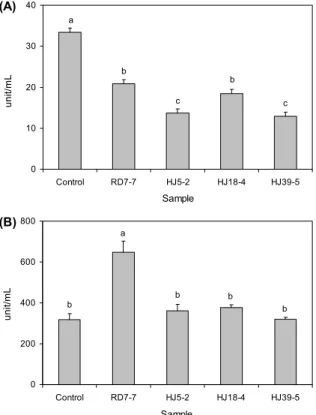
Fig. 2. Enzyme activity of fermented soybean products by Bacillus sp.. (A) amylase activity, (B) protease activity. Error bars represent standard deviations (n=3). Means with different letters (a-c) above the bars are significantly different (P<0.05).
향기 분석
시료 2 g에 추출용매(diethyl ether : pentane=1:1) 10 mL를 가하여 진탕 추출(20°C, 15 hr)한 후, 원심분리(8,000 rpm, 10 min) 하여 상등액에 sodium sulfate 1 g을 첨가하 여 수분을 흡착시켰다. 상등액을 여과(No.2, Whatman)한 후, 여액을 0.2 μm syringe filter(Merck Millipore)를 이용 하여 재 여과하여 분석 시료로 사용하였다. 향기 성분 분석 은 GC/MS(QP2010, Shimadzu, Kyoto, Japan)를 이용하였 고, 칼럼은 HP-innowax(60 m/ID 0.25 μm, Agilent, Santa Clara, CA, USA)를 사용하였다. 오븐온도는 40°C에서 5분 동안 유지한 후 1분당 2°C씩 230°C까지 상승시켰고 30분 동안 유지하였다. Injection 온도는 250°C, carrier gas는 헬륨(He)을 이용하였고, 칼럼 유속은 0.74 mL/min으로 하 였다. 화합물 동정은 GC-MS로 얻은 mass spectrum을 Wiley 275 data base로 검색하여 동정하였다. 정량 분석을 위하여 각 화합물의 함량은 50 ppm 농도의 내부표준물질 (4-methyl-2-pentanol)을 이용하여 정량하였다.
통계 분석
실험결과는 3회 반복으로 측정하였으며, 평균치간의 유 의성 검증은 SPSS system(Statistical Package for Social Sciences, SPSS Inc., Chicago, IL, USA) soft-ware package(version 12)를 이용, P<0.05 수준으로 Duncan's multiple range test에 의하여 검정하였다.
결과 및 고찰
미생물 측정
콩 발효물의 총균수와 유산균수를 측정한 결과는 Fig. 1 과 같다. 총균수는 control이 1.12×10⁸ CFU/mL로 균수가 가장 낮았으며, 발효가 순조롭게 진행된 것을 알 수 있었다.
균주의 종류를 달리하여 측정한 결과, HJ5-2를 접종한 발효 물이 3.00×10⁹ CFU/mL로 가장 높았다. Lee 등(26)은 35
°C에서 8~9 log CFU/g 수준으로 미생물이 생육하였다고 보고하여 본 실험결과와 유사하였다. 균주 종류에 따라 생균
수의 차이가 있으며, 이는 미생물의 생육환경, 영양요구 등 의 영향으로 사료된다(27). 또한 유산균수를 측정한 결과, 균을 접종하지 않은 control이 1.40×10⁸ CFU/mL로 균수 가 가장 높았으며, 균주를 접종한 콩 발효물은 2.50×10²~ 7.30×10⁴ CFU/mL로 control보다 낮은 균수를 나타냈다.
이는 Bacillus sp.를 접종함으로써 우점종이 되어 다른 균들 의 생성을 저해한 것으로 사료된다.
효소 활성 측정
α-Amylase 측정 결과는 Fig. 2와 같다. 균주를 접종하지 않은 control이 33.39 unit/mL로 활성이 가장 높았다. 이는 자연 발효로 인한 다양한 미생물에 의한 영향으로 사료된다.
RD7-7과 HJ18-4를 접종한 콩 발효물 20.82, 18.45 unit/
mL로 활성이 가장 높았다. Amylase 활성은 당분의 감미성 분 등에 관여하여 품질 면에서 중요한 효소라고 할 수 있다 (28). Zheng 등(6)은 B. subtilis-SKm을 스타터로 이용하 여 제조한 청국장의 α-amylase가 12~26 unit/g 범위를 나 타내어 본 실험과 비슷하거나 다소 높게 나타났다. Protease 활성 측정 결과는 RD7-7 균주를 접종한 콩 발효물이 647.92 unit/mL로 활성이 가장 높았으며, 균주를 접종하지 않은 control이 318.13 unit/mL로 가장 낮은 활성을 보였다.
Protease 활성이 높은 균주는 청국장의 이취를 감소시키고 맛을 향상시킨다고 보고된 바 있다(29).
0.0 0.5 1.0 1.5 2.0 2.5 3.0
Control RD7-7 HJ5-2 HJ18-4 HJ39-5
Sample
Reducing sugar (%) . a b
a
c b
Fig. 3. Reducing sugar contents of fermented soybean products by Bacillus sp.. Error bars represent standard deviations (n=3).
Means with different letters (a-c) above the bars are significantly different (P<0.05).
0 50 100 150 200 250
Control RD7-7 HJ5-2 HJ18-4 HJ39-5
Sample
mg% . d
e c
b a
Fig. 4. Amino-type nitrogen contents of fermented soybean products by Bacillus sp.. Error bars represent standard deviations (n=3). Means with different letters (a-e) above the bars are sig- nificantly different (P<0.05).
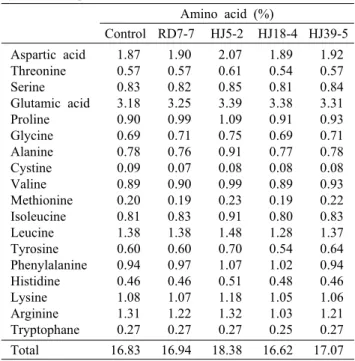
Table 1. Amino acid contents of fermented soybean products by Bacillus sp.
Amino acid (%)
Control RD7-7 HJ5-2 HJ18-4 HJ39-5 Aspartic acid
Threonine Serine Glutamic acid Proline Glycine Alanine Cystine Valine Methionine Isoleucine Leucine Tyrosine Phenylalanine Histidine Lysine Arginine Tryptophane
1.87 0.57 0.83 3.18 0.90 0.69 0.78 0.09 0.89 0.20 0.81 1.38 0.60 0.94 0.46 1.08 1.31 0.27
1.90 0.57 0.82 3.25 0.99 0.71 0.76 0.07 0.90 0.19 0.83 1.38 0.60 0.97 0.46 1.07 1.22 0.27
2.07 0.61 0.85 3.39 1.09 0.75 0.91 0.08 0.99 0.23 0.91 1.48 0.70 1.07 0.51 1.18 1.32 0.27
1.89 0.54 0.81 3.38 0.91 0.69 0.77 0.08 0.89 0.19 0.80 1.28 0.54 1.02 0.48 1.05 1.03 0.25
1.92 0.57 0.84 3.31 0.93 0.71 0.78 0.08 0.93 0.22 0.83 1.37 0.64 0.94 0.46 1.06 1.21 0.27 Total 16.83 16.94 18.38 16.62 17.07 환원당 측정
환원당의 양을 측정한 결과 1.31~2.35%의 함량을 나타 내었으며, HJ18-4를 접종한 콩 발효물이 높은 함량(2.35%) 으로 나타났다(Fig. 3). Baek 등(30)은 발효 균주에 따른 청국장의 환원당을 측정한 결과 발효 24시간째 1.09~
1.32%이었고, 48시간 이후부터는 급격한 감소 현상을 보였 다. 이는 콩의 다당류가 24시간까지는 저분자의 환원당으로 많이 생성되었다가 24시간 이후부터는 발효 미생물의 증식 에 필요한 영양원과 화학적 갈변화 반응 등에 이용되었기 때문인 것으로 사료된다.
아미노태 질소 측정
아미노태 질소 측정 결과는 Fig. 4와 같으며, 112.85~
227.69 mg% 함량을 나타내었고 protease 활성이 높았던 RD7-7이 227.96 mg%로 함량이 가장 높았다. 아미노태 질 소는 콩 발효식품의 발효 정도의 척도로써 발효숙성 중 미생 물이 생산하는 protease에 의해 생성된 아미노산에 기인한 다. Lee 등(26)은 황태 청국장의 경우, 36시간 발효 시 온도
에 따른 아미노태 질소 측정 결과, 130~170 mg%로 본 연구 보다 낮았다. Zheng 등(6)은 균주에 따라 112~224 mg%
함량으로 본 연구와 유사하였다.
아미노산과 유기산 측정
아미노산 18종 측정 결과는 Table 1과 같다. Glutamic acid(3.18~3.39%)가 함량이 가장 많이 검출되었고, as- partic acid(1.87~2.07%), leucine(1.28~1.48%), lysine (1.05~1.18%), arginine(1.03~1.32%) 순으로 검출되었 다. 총 아미노산 함량은 HJ5-2와 HJ39-5를 접종한 콩 발효 물이 18.38, 17.07%로 가장 높았다. Son 등(9)은 Bacillus sp. CS-17로 제조하여 콩을 발효한 결과, glutamic acid (76.6 mg%), phenylalanine(52.4 mg%), alanine(43.2 mg%), proline(41.6 mg%)으로 검출된 바 있다. 콩 발효과 정 중 Bacillus sp. 유래 다양한 효소에 의해 단백질이 분해 되어 구수한 맛을 내는 glutamic acid, aspartic acid, 쓴맛 을 지닌 valine, isoleucine, leucine, methionine, phenyl- alanine, 단맛을 내는 alanine, glycine, lysine 등의 유리아 미노산이 생성되고 어우러져 콩 발효물의 특유의 맛과 향미 를 갖게 해준다(31).
유기산 측정 결과는 Table 2와 같으며, oxalic acid가 모 든 실험구에서 36.51~63.57 mg/100 g이 검출되었고 suc- cinic acid는 control과 RD7-7 접종 콩 발효물에서 600.15
~429.49 mg/100 g이 검출되었다. Control의 경우 균주를 접종한 콩 발효물보다 높은 유기산 함량이 검출되었는데, 이는 유산발효에 의한 유기산 생성에 의한 것이며, 이는 control의 유산균 수가 Bacillus sp. 균 접종 발효물보다 높 은 것과 연관된 것으로 판단된다.
Table 2. Organic acid contents of fermented soybean products by Bacillus sp.
Organic acid (mg/100 g)
Control RD7-7 HJ5-2 HJ18-4 HJ39-5 Citric acid
Succinic acid Lactic acid Oxalic acid Fumaric acid Malic acid
nd1) 600.15
nd 63.57
nd nd
nd 429.49
nd 57.05
nd nd
nd nd nd 40.3
nd nd
nd nd nd 65.28
nd nd
nd nd nd 36.51
nd nd
1)nd: Not detected.
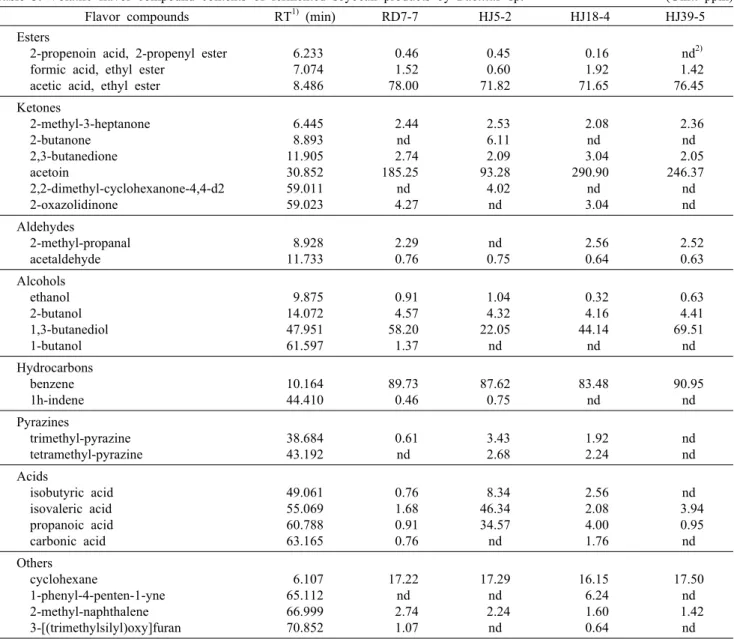
Table 3. Volatile flavor compound contents of fermented soybean products by Bacillus sp. (Unit: ppm) Flavor compounds RT1) (min) RD7-7 HJ5-2 HJ18-4 HJ39-5 Esters
2-propenoin acid, 2-propenyl ester formic acid, ethyl ester
acetic acid, ethyl ester
6.233 7.074 8.486
0.46 1.52 78.00
0.45 0.60 71.82
0.16 1.92 71.65
nd2) 1.42 76.45 Ketones
2-methyl-3-heptanone 2-butanone
2,3-butanedione acetoin
2,2-dimethyl-cyclohexanone-4,4-d2 2-oxazolidinone
6.445 8.893 11.905 30.852 59.011 59.023
2.44 nd 2.74 185.25 nd 4.27
2.53 6.11 2.09 93.28 4.02 nd
2.08 nd 3.04 290.90 nd 3.04
2.36 nd 2.05 246.37 nd nd Aldehydes
2-methyl-propanal acetaldehyde
8.928 11.733
2.29 0.76
nd 0.75
2.56 0.64
2.52 0.63 Alcohols
ethanol 2-butanol 1,3-butanediol 1-butanol
9.875 14.072 47.951 61.597
0.91 4.57 58.20 1.37
1.04 4.32 22.05 nd
0.32 4.16 44.14 nd
0.63 4.41 69.51 nd Hydrocarbons
benzene 1h-indene
10.164 44.410
89.73 0.46
87.62 0.75
83.48 nd
90.95 nd Pyrazines
trimethyl-pyrazine tetramethyl-pyrazine
38.684 43.192
0.61 nd
3.43 2.68
1.92 2.24
nd nd Acids
isobutyric acid isovaleric acid propanoic acid carbonic acid
49.061 55.069 60.788 63.165
0.76 1.68 0.91 0.76
8.34 46.34 34.57 nd
2.56 2.08 4.00 1.76
nd 3.94 0.95 nd Others
cyclohexane
1-phenyl-4-penten-1-yne 2-methyl-naphthalene 3-[(trimethylsilyl)oxy]furan
6.107 65.112 66.999 70.852
17.22 nd 2.74 1.07
17.29 nd 2.24
nd
16.15 6.24 1.60 0.64
17.50 nd 1.42
nd
1)RT: Retention time. 2)nd: Not detected.
향기 분석 측정
장류유래 Bacillus sp.에 따른 콩 발효물의 향기 성분을 분석한 결과 Table 3과 같이 총 28종(esters 3종, ketones 6종, aldehydes 2종, alcohols 4종, hydrocarbons 2종,
pyrazines 2종, acids 4종, 기타 4종)이 검출되었으며, RD7- 7과 HJ18-4를 접종한 콩 발효물에서 23종의 향기 성분이 검출되었고 HJ39-5를 접종한 콩 발효물에서 15종의 향기 성분이 검출되었다. 청국장에서 휘발성 향기 성분으로 알려 진 pyrazine류는 trimethyl-pyrazine, tetramethyl-pyr- azine이 검출되었으며, pyrazine류 중 청국장의 자극취로 보고(32)된 tetramethyl-pyrazine은 RD7-7과 HJ39-5 균 주 발효물에서는 검출되지 않았다. 청국장의 불쾌취로서 알 려진 acid류 중 butyric acid와 valeric acid는 RD7-7과 HJ18-4가 다른 균주보다 다소 낮게 나타났다.
요 약
전통 장류 유래 효소 활성 및 항균 활성 우수 Bacillus sp.를 스타터로 한 콩 발효물의 품질 특성을 분석하였다. 총균수는
HJ5-2를 접종한 시료가 3.00×10⁹ CFU/mL로 가장 높았으 며, 유산균은 스타터 첨가 콩 발효물에서 2.50×10²~ 7.30×10⁴ CFU/mL를 나타나는 것으로 보아 접종된 균주가 우점종이 된 것을 확인하였다. α-Amylase 활성은 RD7-7 (20.82 unit/mL)과 HJ18-4(18.45 unit/mL), protease 활 성은 RD7-7(647.92 unit/mL)을 접종한 콩 발효물이 높은 활성을 나타내었다. 환원당 함량은 HJ18-4(2.35%), 아미노 태 질소 함량은 RD7-7(227.96 mg%) 접종 콩 발효물에서 높은 함량을 나타내었다. 아미노산 함량은 glutamic acid, aspartic acid, leucine, lysine, arginine 순으로 검출되었 다. 유기산은 oxalic acid(36.51~63.57 mg/100 g)가 모든 실험군에서 검출되었으며, succinic acid(600.15~429.49 mg/100 g)는 control과 RD7-7 접종 콩 발효물에서 검출되 었다. 향기 성분을 분석한 결과 총 28종(esters 3종, ke- tones 6종, aldehydes 2종, alcohols 4종, hydrocarbons 2종, pyrazines 2종, acids 4종, 기타 4종)이 검출되었으며, RD7-7과 HJ18-4를 접종한 콩 발효물에서 23종의 향기 성 분이 검출되었다. 본 연구는 고품질 장류용 스타터 개발을 위한 단일균 접종 콩 적용 시험으로 향후 혼합배양 스타터 개발 및 기능성 콩 발효소재 개발을 위한 기초자료로 제시하 고자 한다.
감사의 글
본 연구는 농촌진흥청 연구개발사업(PJ008626 및 PJ907153) 지원을 받아 수행되었으며, 이에 감사드립니다.
REFERENCES
1. Kim JS. 1996. Current research trends on bioactive function of soybean. Korean Soybean Digest 13(2): 17-24.
2. Eom SM, Jung BY, OH HI. 2009. Changes in chemical com- ponents of cheonggukjang prepared with germinated soy- beans during fermentation. J Appl Biol Chem 52: 133-141.
3. Lee JO, Ha SD, Kim AJ, Yuh CS, Bang IS, Park SH. 2005.
Industrial application and physiological functions of cheonggukjang. Food Sci Ind 38: 69-78.
4. Cho YJ, Cha WS, Chun SS, Choi UK, Bok SK, Kim MU.
2000. Production and separation of anti-hypertensive pep- tide during chunggugjang fermentation with Bacillus sub- tilis CH-1023. J Korean Soc Agric Chem Biotechnol 43:
247-252.
5. Kim IJ, Kim HK, Chung JH, Jeong YK, Ryu CH. 2002.
Study of functional chungkukjang contain fibrinolytic en- zyme. Korean J Life Sci 12: 357-362.
6. Zheng YF, Jeong JK, Choi HS, Park KY. 2011. Increased quality characteristics and physiological effects of chung- gukjang fermented with Bacillus subtilis-SKm. J Korean Soc Food Sci Nutr 40: 1694-1699.
7. Lee JJ, Cho CH, Kim JY, Lee DS, Kim HB. 2001.
Antioxidant activity of substances extracted by alcohol from Chungkookjang powder. Kor J Microbiol 37: 177-181.
8. Hwang HA, Lee NK, Cho IJ, Hahm YT, Kwon KO, Kim BY. 2008. Selection of microorganisms and optimization of manufacture process for cheonggukjang. Korean J Food
Sci Technol 40: 406-411.
9. Son DH, Kwon OJ, Ji WD, Choi UK, Kwon OJ, Lee EJ, Cho YJ, Cha WS, Chung YG. 2000. The quality changes of cheonggukjang prepared with Bacillus sp. CS-17 during fermentation time. J Korean Soc Agric Chem Biotechnol 43: 1-6.
10. Allagheny N, Obanu ZA, Campbell-Platt G, Owens JD. 1996.
Control of ammonia formation during Bacillus subtilis fer- mentation of legumes. Int J Food Microbiol 29: 321-333.
11. Kim YS, Jung HJ, Park YS, Yu TS. 2003. Characteristics of flavor and functionality of Bacillus subtilis K-20 chung- gukjang. Korean J Food Sci Technol 35: 475-478.
12. Youn KC, Kim DH, Kim JO, Park BJ, Yook HS, Cho JM, Byun MW. 2002. Quality characteristics of the chungkook- jang fermented by the mixed culture of Bacillus natto and B. lichniformis. J Korean Soc Food Sci Nutr 31: 204-210.
13. Ashiuchi M, Kamei T, Baek DH, Shin SY, Sung MH, Soda K, Yagi T, Misono H. 2001. Isolation of Bacillus subtilis (chungkookjang), a poly-gamma-glutamate producer with high genetic competence. Appl Microbiol Biotechnol 57:
764-769.
14. Yoon KH. 2012. Properties of β-galactosidase from Bacillus licheniformis isolated from Cheongkookjang. Korean J Microbiol Biotechnol 40: 17-22.
15. Yoon KH, Shin HY. 2010. Medium optimization for the protease production by Bacillus licheniformis isolated from Cheongkookjang. Kor J Mocrobiol Biotechnol 38: 385-390.
16. Kim SS, Lee JH, Ahn YS, Kim JH, Kang DK. 2003. A fibrinolytic enzyme from Bacillus amyloliquefaciens D4-7 isolated from Chungkook-Jang: its characterization and in- fluence of additives on thermostability. Kor J Microbiol Biotechnol 31: 271-276.
17. Lee DG, Kim NY, Jang MK, Yoo BH, Kim KY, Kim SG, Jeong YK, Lee SH. 2006. Isolation of a fibrinolytic bacte- rium from Cheongkukjang and characterization of its bio- activity. Kor J Microbiol Biotechnol 34: 299-305.
18. Kwon HY, Kim YS, Kwon GS, Kwon CS, Sohn HY. 2004.
Isolation of immuno-stimulating strain Bacillus pumilus JB-1 from Chungkook-jang and fermentational character- istics of JB-1. Kor J Microbiol Biotechnol 32: 291-296.
19. Woo SM, Kwon SH, Jeong YJ. 2006. Selection and fermen- tation characteristics of cheongkukjang stains. Korean J Food Preserv 13: 77-82.
20. Choi UK, Son DH, Ji WD, Im MH, Choi JD, Chung YG.
1998. Changes of taste components and palatability during chungkukjang fermentation by Bacilllus subtillis DC-2. J Koream Soc Food Sci Nutr 27: 840-845.
21. Kim HJ, Lee JJ, Cheigh MJ, Choi SY. 1998. Amylase, pro- tease, peroxidase and ascorbic acid oxidase activity of kim- chi ingredients. Korean J Food Sci Technol 30: 1333-1338.
22. Yoon KS. 1988. Changes of enzymatic activities during the fermentation of soybean-soy paste by Aspergillus spp. MS Thesis. Kunkuk University, Seoul, Korea.
23. Choi HS, Joo SJ, Song IG, Min KB, Kim KS, Yoon HS.
2007. Quality characteristic of hwangki (Astragalus mem- branaceus) chungkukjang during fermentation. Korean J Food Preserv 14: 356-363.
24. Miller GL, Blum R, Glennon WE, Burton AL. 1960. Mea- surement of carboxymethylcellulase activity. Anal Biochem 2: 127-132.
25. Lee SY, Park NY, Kim JY, Choi HS. 2012. Quality charac- teristics of rice-doenjang during fermentation by differently shaped meju and adding starter. Korean J Food & Nutr 25:
505-512.
26. Lee NR, Go TH, Lee SM, Hong CO, Park KM, Park GT, Hwang DY, Son HJ. 2013. Characteristics of chungkook- jang prepared by Bacillus amyloliquefaciens with different soybeans and fermentation temperatures. Kor J Microbiol 49: 71-77.
27. Suk AR. 2006. Quality of chungkookjang with wild micro- organisms. MS Thesis. Kyungpook National University, Daegu, Korea.
28. Park JS, Lee MY, Lee TS. 1995. Compositions of sugars and fatty acids in soybean paste (doenjang) prepared with different microbial sources. J Korean Soc Food Nutr 24:
917-924.
29. Hong SW, Kim JY, Lee BK, Chung KS. 2006. The bacterial
biological response modifier enriched cheongkukjang fer- mentation. Korean J Food Sci Technol 38: 548-553.
30. Baek LM, Park LY, Park KS, Lee SH. 2008. Effect of starter cultures on the fermentative characteristics of cheonggukjang.
Korean J Food Sci Technol 40: 400-405.
31. Rozan P, Kuo YH, Lambein F. 2000. Free amino acids pre- sentin commercially available seedlings sold for human consumption. A potential hazard for consumers. J Agric Food Chem 48: 716-723.
32. Park JH, Han CK, Choi SH, Lee BH, Lee HJ, Kim SS.
2011. Development of odor-reduced Korean traditional cheonggukjang added with job's tears. J Korean Soc Food Sci Nutr 40: 259-266.